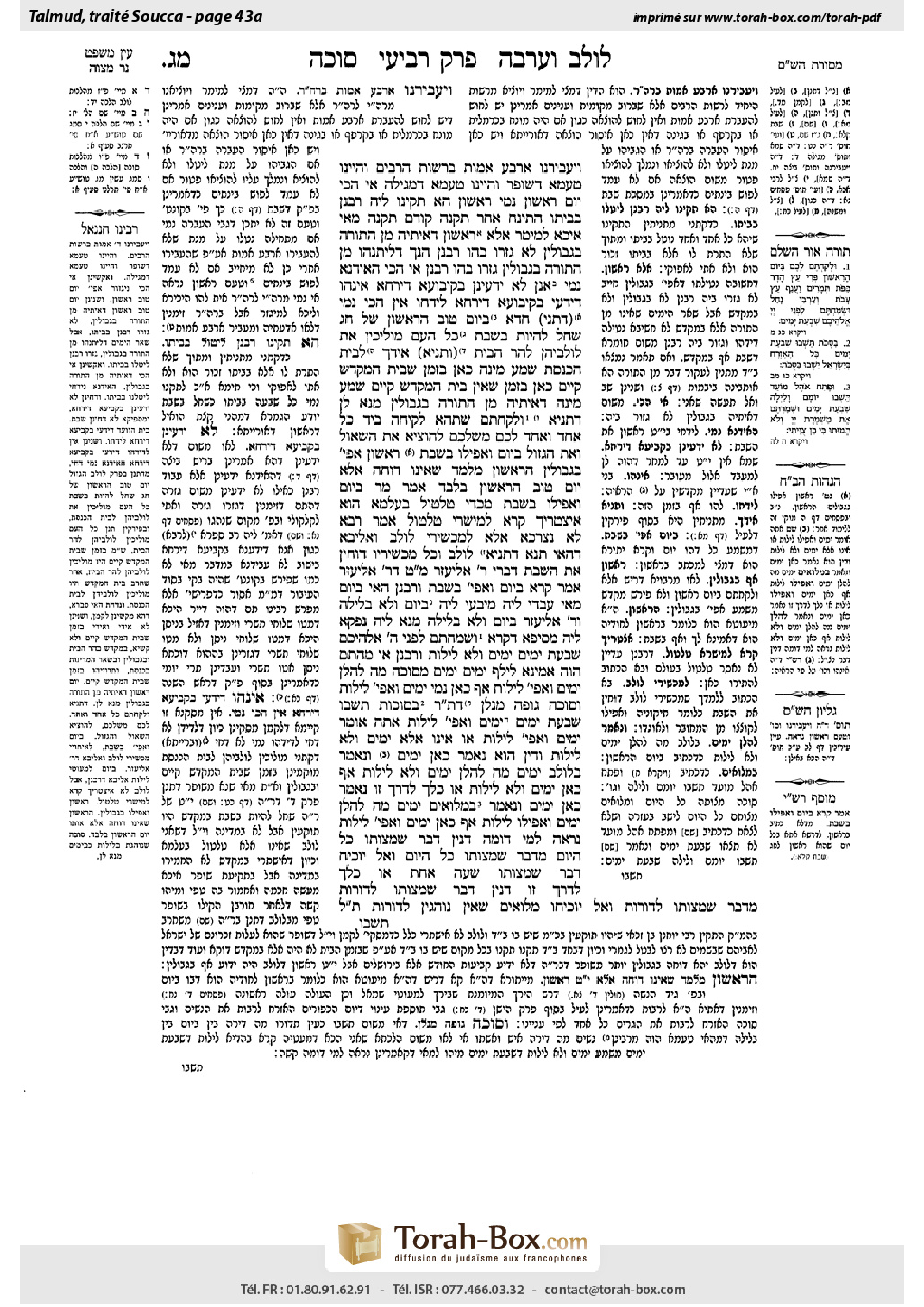
Sukkah 43a: Talmud study for Daf Yomi
Daf Yomi is the daily study of one Talmud folio. Explore 37 tractates with scans, Hebrew text, Sefaria English and AI-generated French translations where annotated.
Passage selection and English or AI-generated French translation are available where the scan has annotations. Daf Study is independent of Torah-Box and Sefaria.
Browse Sukkah · סוכה · All tractatesSukkah 43a text and translations
This page of Sukkah includes the Aramaic text, an English translation and an AI-generated French translation, alongside the scan above.
סוכה מ״ג א · Aramaic and Hebrew text
וְיַעֲבִירֶנּוּ אַרְבַּע אַמּוֹת בִּרְשׁוּת הָרַבִּים. וְהַיְינוּ טַעְמָא דְשׁוֹפָר, וְהַיְינוּ טַעְמָא דִמְגִילָּה.
אִי הָכִי יוֹם רִאשׁוֹן נָמֵי! רִאשׁוֹן, הָא תַּקִּינוּ לֵיה רַבָּנַן בְּבֵיתוֹ. הָתִינַח אַחַר תַּקָּנָה, קוֹדֶם תַּקָּנָה מַאי אִיכָּא לְמֵימַר!
אֶלָּא, רִאשׁוֹן דְּאִיתֵיהּ מִן הַתּוֹרָה בִּגְבוּלִין — לָא גְּזַרוּ בְּהוּ רַבָּנַן. הָנָךְ דְּלֵיתַנְהוּ מִן הַתּוֹרָה בִּגְבוּלִין — גְּזַרוּ בְּהוּ רַבָּנַן.
אִי הָכִי, הָאִידָּנָא נָמֵי! אֲנַן לָא יָדְעִינַן בְּקִיבּוּעָא דְיַרְחָא. אִינְהוּ, דְּיָדְעִי בְּקִיבּוּעָא דְיַרְחָא, לִידְחוֹ!
אִין הָכִי נָמֵי. (דְּתָנֵי) חֲדָא: בְּיוֹם טוֹב הָרִאשׁוֹן שֶׁל חַג שֶׁחָל לִהְיוֹת בְּשַׁבָּת כׇּל הָעָם מוֹלִיכִין אֶת לוּלְבֵיהֶן לְהַר הַבַּיִת, (וְתַנְיָא) אִידַּךְ: לְבֵית הַכְּנֶסֶת. שְׁמַע מִינַּהּ: כָּאן — בִּזְמַן שֶׁבֵּית הַמִּקְדָּשׁ קַיָּים, כָּאן — בִּזְמַן שֶׁאֵין בֵּית הַמִּקְדָּשׁ קַיָּים. שְׁמַע מִינַּהּ.
דְּאִיתֵיהּ מִן הַתּוֹרָה בִּגְבוּלִין מְנָא לַן? דְּתַנְיָא: ״וּלְקַחְתֶּם״. שֶׁתְּהֵא לְקִיחָה בְּיַד כׇּל אֶחָד וְאֶחָד.
״לָכֶם״ — מִשֶּׁלָּכֶם, לְהוֹצִיא אֶת הַשָּׁאוּל וְאֶת הַגָּזוּל. ״בַּיּוֹם״ — וַאֲפִילּוּ בַּשַּׁבָּת. ״רִאשׁוֹן״ — אֲפִילּוּ בִּגְבוּלִין. ״הָרִאשׁוֹן״ — מְלַמֵּד שֶׁאֵינוֹ דּוֹחֶה אֶלָּא יוֹם טוֹב הָרִאשׁוֹן בִּלְבַד.
אָמַר מָר: ״בַּיּוֹם״ — וַאֲפִילּוּ בַּשַּׁבָּת. מִכְּדֵי טִלְטוּל בְּעָלְמָא הוּא, אִיצְטְרִיךְ קְרָא לְמִישְׁרֵי טִלְטוּל? אָמַר רָבָא: לֹא נִצְרְכָא אֶלָּא לְמַכְשִׁירֵי לוּלָב, וְאַלִּיבָּא דְּהַאי תַּנָּא, דְּתַנְיָא: לוּלָב וְכׇל מַכְשִׁירָיו דּוֹחִין אֶת הַשַּׁבָּת, דִּבְרֵי רַבִּי אֱלִיעֶזֶר.
מַאי טַעְמָא דְּרַבִּי אֱלִיעֶזֶר? אָמַר קְרָא: ״בַּיּוֹם״, וַאֲפִילּוּ בַּשַּׁבָּת. וְרַבָּנַן —הַאי בַּיּוֹם מַאי עָבְדִי לֵיהּ? מִיבְּעֵי לֵיהּ: ״בַּיּוֹם״, וְלֹא בַּלַּיְלָה. וְרַבִּי אֱלִיעֶזֶר ״בַּיּוֹם״ וְלֹא בַּלַּיְלָה מְנָא לֵיהּ? נָפְקָא לֵיהּ מִסֵּיפָא דִקְרָא: ״וּשְׂמַחְתֶּם לִפְנֵי ה׳ אֱלֹהֵיכֶם שִׁבְעַת יָמִים״ — יָמִים וְלֹא לֵילוֹת. וְרַבָּנַן — אִי מֵהָתָם הֲוָה אָמֵינָא: לֵילַף ״יָמִים״ ״יָמִים״ מִסּוּכָּה. מָה לְהַלָּן — יָמִים וַאֲפִילּוּ לֵילוֹת, אַף כָּאן נָמֵי יָמִים — וַאֲפִילּוּ לֵילוֹת.
וְסוּכָּה גּוּפַהּ מְנָלַן? דְּתָנוּ רַבָּנַן: ״בַּסּוּכּוֹת תֵּשְׁבוּ שִׁבְעַת יָמִים״, ״יָמִים״ — וַאֲפִילּוּ לֵילוֹת. אַתָּה אוֹמֵר ״יָמִים״ — וַאֲפִילּוּ לֵילוֹת, אוֹ אֵינוֹ אֶלָּא ״יָמִים״ וְלֹא לֵילוֹת? וְדִין הוּא: נֶאֱמַר כָּאן ״יָמִים״, וְנֶאֱמַר בְּלוּלָב ״יָמִים״, מָה לְהַלָּן — ״יָמִים״ וְלֹא לֵילוֹת, אַף כָּאן — ״יָמִים״ וְלֹא לֵילוֹת.
אוֹ כְּלָךְ לַדֶּרֶךְ זוֹ: נֶאֱמַר כָּאן ״יָמִים״ וְנֶאֱמַר בְּמִלּוּאִים ״יָמִים״. מָה לְהַלָּן — ״יָמִים״ וַאֲפִילּוּ לֵילוֹת, אַף כָּאן — ״יָמִים״ וַאֲפִילּוּ לֵילוֹת.
נִרְאֶה לְמִי דּוֹמֶה: דָּנִין דָּבָר שֶׁמִּצְוָתוֹ כׇּל הַיּוֹם מִדָּבָר שֶׁמִּצְוָתוֹ כׇּל הַיּוֹם, וְאַל יוֹכִיחַ דָּבָר שֶׁמִּצְוָתוֹ שָׁעָה אַחַת. אוֹ כְּלָךְ לְדֶרֶךְ זוֹ: דָּנִין דָּבָר שֶׁמִּצְוָתוֹ לְדוֹרוֹת מִדָּבָר שֶׁמִּצְוָתוֹ לְדוֹרוֹת, וְאַל יוֹכִיחוּ מִלּוּאִים שֶׁאֵין נוֹהֲגִין לְדוֹרוֹת.
תַּלְמוּד לוֹמַר:
Sukkah 43a · English translation
and in doing so carry it four cubits in the public domain, thereby violating a severe Torah prohibition. And that is the reason for the prohibition against sounding the shofar on Shabbat, and that is the reason for the prohibition against reading the Scroll of Esther when Purim coincides with Shabbat.
The Gemara asks: If so, on the first day of Sukkot that coincides with Shabbat too one should not take the lulav due to this concern. The Gemara answers: With regard to the first day, the Sages instituted that one should take the four species in his house. Since the Sages already prohibited one from taking the lulav out of the house, he will remember that it is prohibited and will not come to take it elsewhere to learn to wave it or to recite the blessing. The Gemara asks: This works out well after the ordinance that one takes the lulav in his house was instituted. However, prior to introducing the ordinance, what is there to say in explaining why it is permitted to take the lulav on the first day?
Rather, the Gemara rejects the previous explanation and explains the distinction differently. On the first day, when the mitzva of taking the lulav even in the outlying areas and not just in the Temple is in effect by Torah law, the Sages did not issue a decree to prohibit taking the lulav on the first day and permitted the mitzva to be performed even in the outlying areas. However, with regard to these other days of Sukkot, when the mitzva of taking the lulav is not in effect by Torah law in the outlying areas and the lulav is taken there only to commemorate the practice in the Temple, the Sages issued a decree to prohibit taking the lulav on the other days.
The Gemara asks: If it is so that the mitzva on the first day is a mitzva by Torah law even in the outlying areas, today too one should take the lulav on the first day of Sukkot that coincides with Shabbat. The Gemara answers: We do not know when precisely the establishment of the month was determined by the court. Therefore, it is possible that the day observed as the first day of Sukkot is not Sukkot at all. Certainly, one does not violate the rabbinic decree to fulfill a mitzva that is not definitely a mitzva by Torah law. The Gemara asks: If so, with regard to the people of Eretz Yisrael, who sanctify the month based on eyewitness testimony and who know when precisely the establishment of the month was determined by the court, let them override Shabbat for the mitzva of lulav on the first day of Sukkot even today.
The Gemara answers: Yes, it is indeed so, and that is their practice, as it was taught in one mishna: On the first day of the Festival that occurs on Shabbat, all the people bring their lulavim to the Temple Mount on Friday. And we learned in another mishna: They bring their lulavim to the synagogue. Learn from the change in formulation that here, where the mishna says that they bring their lulavim to the Temple Mount, it is referring to when the Temple is in existence, and there, where the mishna says that they bring their lulavim to the synagogue, it is referring to when the Temple is not in existence. The Gemara concludes: Indeed, learn from it that this is so.
§ The Gemara asks: From where do we derive that by Torah law the mitzva of lulav on the first day is in effect even in the outlying areas? The Gemara answers: As it was taught in a baraita: “And you shall take for yourselves on the first day the fruit of a beautiful tree, branches of a date palm, and boughs of a dense-leaved tree, and willows of the brook, and you shall rejoice before the Lord your God seven days” (Leviticus 23:40). The Sages parse the phrases and terms in the verse. In the phrase “And you shall take,” the plural form of you is used, indicating that there should be taking in the hand of each and every one, and no one can fulfill the obligation on another’s behalf.
They continue to expound the verse. Yourselves indicates from your own, to exclude a borrowed or stolen lulav. On the day comes to emphasize that there is a mitzva by Torah law to take the lulav on each day of the Festival, even on Shabbat. The word first, used with no qualification as to where the lulav is to be taken, indicates that this obligation is in effect everywhere on the first day, even in the outlying areas. The first, with the definite article for emphasis, is restrictive and teaches that the mitzva of taking the lulav overrides Shabbat only on the first day of the Festival.
The Gemara analyzes the baraita. The Master said: On the day, indicates even on Shabbat. The Gemara asks: Now, since taking the four species entails merely moving the object and is prohibited due to the rabbinic prohibition of set-aside, is a verse needed to permit moving the lulav? Obviously, the Torah does not address prohibitions that are not by Torah law. Rava said: Indeed, the verse is necessary only for actions that are facilitators of the performance of the mitzva of lulav, i.e., to permit actions necessary to prepare a lulav for the mitzva, such as severing it from the tree, which may be performed on Shabbat. And that is in accordance with the opinion of this tanna who permits doing so on Shabbat, as it was taught in a baraita: Lulav and all the actions that are its facilitators override Shabbat; this is the statement of Rabbi Eliezer.
The Gemara explains: What is the rationale for the statement of Rabbi Eliezer? It is as the verse states: On the day, indicating that the obligation exists every day of the Festival, and even on Shabbat.
The Gemara asks: And the Rabbis, what do they do with the verse: On the day? The Gemara answers: They require it to teach that the mitzva of taking the lulav is specifically during the day and not at night.
The Gemara asks: And from where does Rabbi Eliezer derive that the lulav is taken during the day and not at night? The Gemara answers: He derives it from the end of the verse: “And you shall rejoice before the Lord your God seven days” (Leviticus 23:40), indicating that the obligation to take the lulav is during the days and not during the nights.
The Gemara asks: And the Rabbis, why don’t they derive it from that verse? The Gemara answers: If it was derived from there, I would have said: Derive days written with regard to lulav from days written with regard to sukka by means of a verbal analogy; just as there, with regard to sukka, it means days and even nights, here too, with regard to lulav, it means days and even nights.
The Gemara asks: And with regard to sukka itself, from where do we derive that the mitzva is observed at night as well? As the Sages taught in a baraita that it is written: “You shall reside in sukkot for seven days” (Leviticus 23:42), from which they derived: Days and even nights. The tanna continues the discussion: Do you say days and even nights; or perhaps the meaning is only days and not nights? And it may be inferred logically that the latter is correct. It is stated here, with regard to sukka: “Days.” And it is stated with regard to lulav: “Days.” Just as there, with regard to lulav, the meaning is days and not nights, so too here, with regard to sukka, the meaning is days and not nights. That is one possibility.
Or, perhaps, go this way and say the opposite. It is stated here, with regard to sukka: Days, and it is stated with regard to the inauguration of the Tabernacle: “And at the door of the Tent of Meeting you shall reside day and night seven days” (Leviticus 8:35). Just as there, with regard to the inauguration of the Tabernacle, the meaning is days and even nights, so too here, with regard to sukka, the meaning is days and even nights. A source exists for either possibility.
The baraita continues: Let us see to which of the paradigms the mitzva of sukka is comparable. Perhaps one derives a matter whose mitzva is in effect the entire day, sukka, from another matter whose mitzva is in effect the entire day, the inauguration of the Tabernacle, and do not let a matter whose mitzva is in effect for a brief moment, lulav, prove otherwise. Or perhaps go this way and say the opposite: One derives a matter whose mitzva is in effect throughout the generations, sukka, from another matter whose mitzva is in effect throughout the generations, lulav, and do not let the inauguration that is not in practice throughout the generations, as it was in effect only at the establishment of the Tabernacle, prove otherwise.
Since it is impossible to determine the more appropriate source based on logical inference, derive the matter as the verse states:
Sukkah 43a · Traduction française (IA)
et, ce faisant, le transporter sur une distance de quatre coudées dans le domaine public, transgressant ainsi une grave interdiction de la Torah. Voilà pourquoi il est interdit de sonner du chofar le Chabbat, et voilà pourquoi il est interdit de lire le Rouleau d’Esther lorsque Pourim tombe un Chabbat.
La Guemara demande : Si tel est le cas, le premier jour de Soukkot qui tombe un Chabbat, on ne devrait pas non plus prendre le loulav, par crainte de cela. La Guemara répond : Pour le premier jour, les Sages ont institué que l’on prenne les quatre espèces chez soi. Puisque les Sages ont déjà interdit de sortir le loulav de la maison, on se souviendra que cela est interdit et on ne l’emportera pas ailleurs pour apprendre à l’agiter ou pour réciter la bénédiction. La Guemara demande : Cela s’explique bien après l’instauration de la règle selon laquelle on prend le loulav chez soi. Mais, avant l’instauration de cette règle, comment expliquer qu’il soit permis de prendre le loulav le premier jour ?
La Guemara rejette plutôt l’explication précédente et explique autrement cette distinction. Le premier jour, puisque la mitsva de prendre le loulav s’applique selon la Torah même dans les régions périphériques, et pas seulement dans le Temple, les Sages n’ont pas décrété d’interdire de prendre le loulav ce jour-là et ont permis d’accomplir la mitsva même dans les régions périphériques. En revanche, les autres jours de Soukkot, puisque la mitsva de prendre le loulav ne s’applique pas selon la Torah dans les régions périphériques et qu’on y prend le loulav uniquement en souvenir de la pratique au Temple, les Sages ont décrété d’interdire de prendre le loulav ces autres jours.
La Guemara demande : S’il en est ainsi, et que la mitsva du premier jour est une mitsva prescrite par la Torah même dans les régions périphériques, aujourd’hui aussi, on devrait prendre le loulav le premier jour de Soukkot lorsqu’il tombe un Chabbat. La Guemara répond : Nous ne savons pas exactement quand le tribunal a fixé le début du mois. Il est donc possible que le jour observé comme le premier jour de Soukkot ne soit pas Soukkot du tout. On ne transgresse certainement pas un décret rabbinique pour accomplir une mitsva qui n’est pas assurément prescrite par la Torah. La Guemara demande : Si tel est le cas, les habitants de la terre d’Israël, qui sanctifient le mois sur la foi du témoignage de témoins oculaires et qui savent exactement quand le tribunal a fixé le début du mois, devraient faire prévaloir la mitsva du loulav sur le Chabbat le premier jour de Soukkot, aujourd’hui encore.
La Guemara répond : Oui, c’est bien ainsi, et telle est leur pratique, comme cela a été enseigné dans une Michna : Le premier jour de la fête, lorsqu’il tombe un Chabbat, tous apportent leurs loulavim au mont du Temple le vendredi. Et nous avons appris dans une autre Michna : Ils apportent leurs loulavim à la synagogue. Déduisez de cette différence de formulation que, là où la Michna dit qu’ils apportent leurs loulavim au mont du Temple, elle parle de l’époque où le Temple existe, et que là où elle dit qu’ils les apportent à la synagogue, elle parle de l’époque où le Temple n’existe plus. La Guemara conclut : En effet, déduisez-en que c’est bien ainsi.
§ La Guemara demande : D’où savons-nous que, selon la Torah, la mitsva du loulav le premier jour s’applique même dans les régions périphériques ? La Guemara répond : Comme cela a été enseigné dans une baraïta : « Vous prendrez pour vous, le premier jour, le fruit d’un bel arbre, des branches de palmier, des rameaux d’un arbre touffu et des saules de rivière, et vous vous réjouirez devant le Seigneur votre Dieu pendant sept jours » (Lévitique 23:40). Les Sages analysent les expressions et les termes du verset. Dans l’expression « Vous prendrez », le pluriel est employé, ce qui indique que chacun doit prendre dans sa main et que nul ne peut s’acquitter de l’obligation à la place d’un autre.
Ils poursuivent l’interprétation du verset. « Pour vous » indique que cela doit provenir de ce qui vous appartient, excluant un loulav emprunté ou volé. « Le jour » souligne qu’il existe, selon la Torah, une mitsva de prendre le loulav chaque jour de la fête, même le Chabbat. Le mot « premier », employé sans précision quant au lieu où le loulav doit être pris, indique que cette obligation s’applique partout le premier jour, même dans les régions périphériques. « Le premier », avec l’article défini qui le met en relief, a une portée restrictive et enseigne que la mitsva de prendre le loulav ne l’emporte sur le Chabbat que le premier jour de la fête.
La Guemara analyse la baraïta. Le Maître a dit : « Le jour » indique que cela s’applique même le Chabbat. La Guemara demande : Puisque prendre les quatre espèces consiste simplement à déplacer l’objet, ce qui est interdit en raison de l’interdiction rabbinique de mouqtsé, faut-il un verset pour permettre de déplacer le loulav ? De toute évidence, la Torah ne traite pas d’interdictions qui ne relèvent pas de la Torah. Rava a dit : En effet, le verset est nécessaire uniquement pour les actes qui facilitent l’accomplissement de la mitsva du loulav, c’est-à-dire pour permettre les actes nécessaires à la préparation d’un loulav en vue de la mitsva, comme le détacher de l’arbre, ce qui peut être fait le Chabbat. Cela correspond à l’opinion de ce tanna, qui permet de le faire le Chabbat, comme cela a été enseigné dans une baraïta : Le loulav et tous les actes qui en facilitent l’accomplissement l’emportent sur le Chabbat ; telle est l’opinion de Rabbi Eliezer.
La Guemara explique : Quelle est la raison de l’opinion de Rabbi Eliezer ? Le verset dit : « Le jour », ce qui indique que l’obligation s’applique chaque jour de la fête, même le Chabbat. La Guemara demande : Et que font les Sages de l’expression « le jour » ? La Guemara répond : Ils en ont besoin pour enseigner que la mitsva de prendre le loulav s’accomplit précisément le jour, et non la nuit. La Guemara demande : Et d’où Rabbi Eliezer déduit-il que le loulav se prend le jour et non la nuit ? La Guemara répond : Il le déduit de la fin du verset : « Et vous vous réjouirez devant le Seigneur votre Dieu pendant sept jours » (Lévitique 23:40), ce qui indique que l’obligation de prendre le loulav concerne les jours et non les nuits. La Guemara demande : Et pourquoi les Sages ne le déduisent-ils pas de ce verset ? La Guemara répond : Si on le déduisait de là, je dirais : Déduisons les « jours » mentionnés à propos du loulav des « jours » mentionnés à propos de la soukka, au moyen d’une analogie verbale ; de même que là, à propos de la soukka, cela signifie les jours et aussi les nuits, ici aussi, à propos du loulav, cela signifie les jours et aussi les nuits.
La Guemara demande : Et concernant la soukka elle-même, d’où déduisons-nous que la mitsva s’applique aussi la nuit ? Les Sages ont enseigné dans une baraïta qu’il est écrit : « Vous résiderez dans des soukkot pendant sept jours » (Lévitique 23:42), et ils en ont déduit : Les jours, et aussi les nuits. Le tanna poursuit la discussion : Dis-tu que cela signifie les jours et aussi les nuits ? Ou peut-être cela signifie-t-il seulement les jours et non les nuits ? On peut en déduire logiquement que cette dernière interprétation est correcte. Ici, à propos de la soukka, il est dit : « Jours ». Et à propos du loulav, il est dit : « Jours ». De même que là, à propos du loulav, cela signifie les jours et non les nuits, ici aussi, à propos de la soukka, cela signifie les jours et non les nuits. Voilà une possibilité.
Ou peut-être faut-il raisonner ainsi et dire le contraire. Ici, à propos de la soukka, il est dit : « Jours », et à propos de l’inauguration du Tabernacle, il est dit : « Vous demeurerez à l’entrée de la Tente d’assignation, jour et nuit, pendant sept jours » (Lévitique 8:35). De même que là, à propos de l’inauguration du Tabernacle, cela signifie les jours et aussi les nuits, ici aussi, à propos de la soukka, cela signifie les jours et aussi les nuits. Il existe une source à l’appui de chacune des possibilités.
La baraïta poursuit : Voyons à quel modèle la mitsva de la soukka est comparable. Peut-être déduira-t-on une chose dont la mitsva s’applique toute la journée, la soukka, d’une autre chose dont la mitsva s’applique toute la journée, l’inauguration du Tabernacle, et que le loulav, dont la mitsva ne s’applique que pendant un bref instant, ne constitue pas une preuve contraire. Ou peut-être faut-il raisonner ainsi et dire le contraire : On déduit une chose dont la mitsva s’applique à travers toutes les générations, la soukka, d’une autre chose dont la mitsva s’applique à travers toutes les générations, le loulav, et que l’inauguration du Tabernacle, qui n’est pas pratiquée à travers toutes les générations puisqu’elle n’a eu lieu qu’à l’établissement du Tabernacle, ne constitue pas une preuve contraire.
Puisqu’il est impossible de déterminer par un raisonnement logique quelle est la source la plus appropriée, déduisons la chose conformément à ce que dit le verset :
Traduction française générée par IA à partir de l’édition anglaise de Sefaria. Vérifie toujours un passage avec le texte source.
Text from Sefaria: William Davidson Edition - Vocalized Aramaic (CC BY NC); William Davidson Edition - English (CC BY NC).