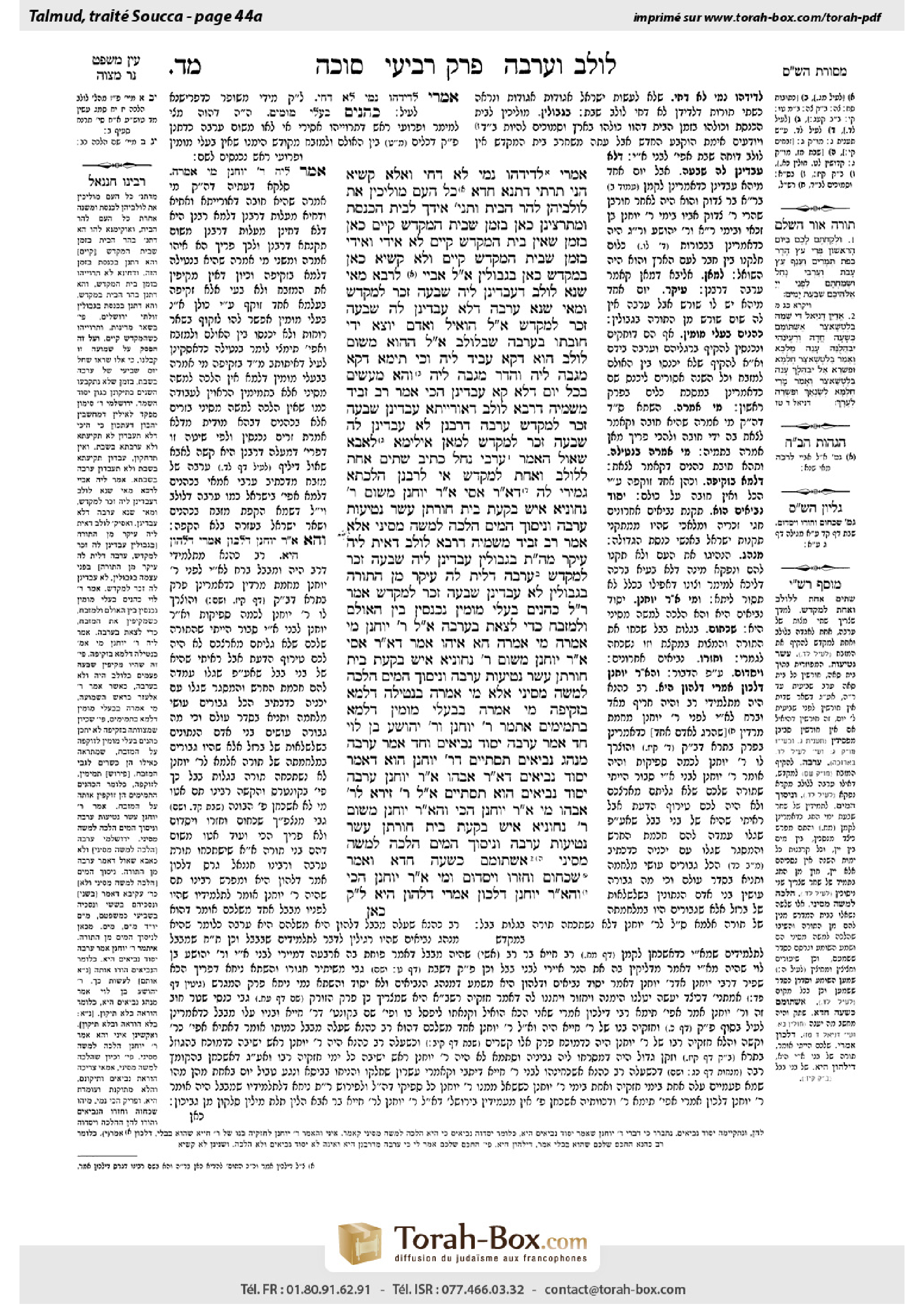
Sukkah 44a: Talmud study for Daf Yomi
Daf Yomi is the daily study of one Talmud folio. Explore 37 tractates with scans, Hebrew text, Sefaria English and AI-generated French translations where annotated.
Passage selection and English or AI-generated French translation are available where the scan has annotations. Daf Study is independent of Torah-Box and Sefaria.
Browse Sukkah · סוכה · All tractatesSukkah 44a text and translations
This page of Sukkah includes the Aramaic text, an English translation and an AI-generated French translation, alongside the scan above.
סוכה מ״ד א · Aramaic and Hebrew text
אָמְרִי: לְדִידְהוּ נָמֵי לָא דָּחֵי. וְאֶלָּא קַשְׁיָא הָנֵי תַּרְתֵּי; דְּתָנָא חֲדָא: כׇּל הָעָם מוֹלִיכִין אֶת לוּלְבֵיהֶן לְהַר הַבַּיִת, וְתַנְיָא אִידַּךְ: לְבֵית הַכְּנֶסֶת, וּמְתָרְצִינַן: כָּאן — בִּזְמַן שֶׁבֵּית הַמִּקְדָּשׁ קַיָּים, כָּאן — בִּזְמַן שֶׁאֵין בֵּית הַמִּקְדָּשׁ קַיָּים.
לָא, אִידִי וְאִידִי בִּזְמַן שֶׁבֵּית הַמִּקְדָּשׁ קַיָּים, וְלָא קַשְׁיָא: כָּאן — בַּמִּקְדָּשׁ, כָּאן — בַּגְּבוּלִין.
אֲמַר לֵיהּ אַבָּיֵי לְרָבָא: מַאי שְׁנָא לוּלָב דְּעָבְדִינַן לֵיהּ שִׁבְעָה זֵכֶר לַמִּקְדָּשׁ, וּמַאי שְׁנָא עֲרָבָה דְּלָא עָבְדִינַן לַהּ שִׁבְעָה זֵכֶר לַמִּקְדָּשׁ? אֲמַר לֵיהּ: הוֹאִיל וְאָדָם יוֹצֵא יְדֵי חוֹבָתוֹ בָּעֲרָבָה שֶׁבַּלּוּלָב. אֲמַר לֵיהּ: הָהוּא מִשּׁוּם לוּלָב הוּא דְּקָא עָבֵיד לַיהּ. וְכִי תֵּימָא דְּקָא מַגְבַּהּ לַיהּ וַהֲדַר מַגְבַּהּ לַיהּ, וְהָא מַעֲשִׂים בְּכׇל יוֹם דְּלָא קָא עָבְדִינַן הָכִי!
אָמַר רַב זְבִיד מִשְּׁמֵיהּ דְּרָבָא: לוּלָב דְּאוֹרָיְיתָא — עָבְדִינַן שִׁבְעָה זֵכֶר לַמִּקְדָּשׁ, עֲרָבָה דְּרַבָּנַן — לָא עָבְדִינַן לַהּ שִׁבְעָה זֵכֶר לַמִּקְדָּשׁ.
לְמַאן? אִילֵימָא אַבָּא שָׁאוּל, הָאָמַר ״עַרְבֵי נַחַל״ כְּתִיב — שְׁתַּיִם, אַחַת לַלּוּלָב וְאַחַת לַמִּקְדָּשׁ. אִי לְרַבָּנַן, הִלְכְתָא גְּמִירִי לַהּ, דְּאָמַר רַבִּי אַסִּי אָמַר רַבִּי יוֹחָנָן מִשּׁוּם רַבִּי נְחוּנְיָא אִישׁ בִּקְעַת בֵּית חוֹרְתָן: עֶשֶׂר נְטִיעוֹת, עֲרָבָה, וְנִיסּוּךְ הַמַּיִם — הֲלָכָה לְמֹשֶׁה מִסִּינַי.
אֶלָּא, אָמַר רַב זְבִיד מִשְּׁמֵיהּ דְּרָבָא: לוּלָב דְּאִית לֵיהּ עִיקָּר מִן הַתּוֹרָה, — בַּגְּבוּלִין עָבְדִינַן לֵיהּ שִׁבְעָה זֵכֶר לַמִּקְדָּשׁ, עֲרָבָה דְּלֵית לַהּ עִיקָּר מִן הַתּוֹרָה — בַּגְּבוּלִין לָא עָבְדִינַן שִׁבְעָה זֵכֶר לַמִּקְדָּשׁ.
אָמַר רֵישׁ לָקִישׁ: כֹּהֲנִים בַּעֲלֵי מוּמִין נִכְנָסִין בֵּין הָאוּלָם וְלַמִּזְבֵּחַ, כְּדֵי לָצֵאת בַּעֲרָבָה. אֲמַר לֵיהּ רַבִּי יוֹחָנָן: מִי אֲמָרָהּ? מִי אֲמָרָהּ?! הָא אִיהוּ אֲמַר! דְּאָמַר רַבִּי אַסִּי אָמַר רַבִּי יוֹחָנָן מִשּׁוּם רַבִּי נְחוּנְיָא אִישׁ בִּקְעַת בֵּית חוֹרְתָן: עֶשֶׂר נְטִיעוֹת, עֲרָבָה, וְנִיסּוּךְ הַמַּיִם — הֲלָכָה לְמֹשֶׁה מִסִּינַי.
אֶלָּא: מִי אֲמָרָהּ בִּנְטִילָה, דִּלְמָא בִּזְקִיפָה! מִי אֲמָרָהּ בְּבַעֲלֵי מוּמִין, דִּלְמָא בִּתְמִימִים!
אִתְּמַר: רַבִּי יוֹחָנָן וְרַבִּי יְהוֹשֻׁעַ בֶּן לֵוִי, חַד אָמַר: עֲרָבָה יְסוֹד נְבִיאִים, וְחַד אָמַר: עֲרָבָה מִנְהַג נְבִיאִים. תִּסְתַּיַּים דְּרַבִּי יוֹחָנָן הוּא דְּאָמַר יְסוֹד נְבִיאִים, דְּאָמַר רַבִּי אֲבָהוּ אָמַר רַבִּי יוֹחָנָן: עֲרָבָה יְסוֹד נְבִיאִים הוּא. תִּסְתַּיַּים.
אֲמַר לֵיהּ רַבִּי זֵירָא לְרַבִּי אֲבָהוּ: מִי אָמַר רַבִּי יוֹחָנָן הָכִי? וְהָאָמַר רַבִּי יוֹחָנָן מִשּׁוּם רַבִּי נְחוּנְיָא אִישׁ בִּקְעַת בֵּית חוֹרְתָן: עֶשֶׂר נְטִיעוֹת, עֲרָבָה, וְנִיסּוּךְ הַמַּיִם — הֲלָכָה לְמֹשֶׁה מִסִּינַי? אֶשְׁתּוֹמַם כְּשָׁעָה חֲדָא וַאֲמַר, שְׁכֵחוּם וְחָזְרוּ וְיִסְּדוּם.
וּמִי אָמַר רַבִּי יוֹחָנָן הָכִי? וְהָאָמַר רַבִּי יוֹחָנָן: דִּלְכוֹן אֲמַרִי: דִּלְהוֹן הִיא! לָא קַשְׁיָא:
Sukkah 44a · English translation
The Sages say: For them in Eretz Yisrael it also does not override Shabbat. The Gemara asks: But if that is the case, the contradiction between these two sources is difficult, as it was taught in one mishna: All the people bring their lulavim to the Temple Mount on Friday, and it was taught in another mishna that they bring their lulavim to the synagogue. And we resolved this contradiction as follows: Here, where the mishna says that they bring their lulavim to the Temple Mount, it is referring to when the Temple is standing, and there, where the mishna says that they bring their lulavim to the synagogue, it is referring to when the Temple is not standing. Based on the above, when the Temple is not in existence the mitzva of lulav does not override Shabbat.
The Gemara resolves the contradiction: No, both this mishna and that mishna are referring to Eretz Yisrael when the Temple is in existence; and nevertheless, it is not difficult. Here, where the mishna says that they bring their lulavim to the Temple Mount, it is referring to the procedure in the Temple. And there, where the mishna says that they bring their lulavim to the synagogue, it is referring to the procedure in the outlying areas in the rest of Eretz Yisrael, where they knew when the new month was established. However, today, neither in the Diaspora nor in Eretz Yisrael does the mitzva of lulav override Shabbat.
Abaye said to Rava: What is different about lulav such that we perform the mitzva seven days in commemoration of the Temple, and what is different about the willow branch that we do not perform the mitzva seven days in commemoration of the Temple? Rava said to him: Since a person fulfills his obligation with the willow branch in the lulav, no additional commemoration is necessary. Abaye said to him: That is not a satisfactory answer, as he is performing that action due to the mitzva of taking the lulav and the other species. And if you say that he lifts the willow branch bound with the lulav to fulfill the mitzva of the four species and then lifts it again in commemoration of the willow branch in the Temple, aren’t actions performed daily proof that we do not do so, as no one lifts the lulav twice?
Rav Zevid said in the name of Rava: Since the mitzva of lulav is a mitzva by Torah law, we perform it seven days in commemoration of the Temple even today. Since the mitzva of the willow branch is a mitzva by rabbinic law, we do not perform it seven days in commemoration of the Temple.
The Gemara asks: In accordance with whose opinion did Rava say this? If we say that Rava said this in accordance with the opinion of Abba Shaul, didn’t he say that it is written: Willows of the river, i.e., in the plural, indicating two willow branches, one for the lulav and one for the Temple? In his opinion, the mitzva of the willow branch in the Temple is also a mitzva by Torah law. If Rava said this in accordance with the opinion of the Rabbis, they learned this as a halakha transmitted to Moses from Sinai, as Rabbi Asi said that Rabbi Yoḥanan said in the name of Rabbi Neḥunya of the valley of Beit Ḥortan: The halakha of the ten saplings, the mitzva of the willow branch in the Temple, and the mitzva of the water libation on the altar during the festival of Sukkot are each a halakha transmitted to Moses from Sinai.
Rather, Rav Zevid said in the name of Rava: With regard to the mitzva of lulav, which has its basis written explicitly in the Torah, in the outlying areas we perform it seven days in commemoration of the Temple. With regard to the mitzva of the willow branch, which does not have its basis written explicitly in the Torah, in the outlying areas we do not perform it seven days in commemoration of the Temple.
Apropos the willow branch in the Temple, Reish Lakish said: Priests with physical defects enter between the Entrance Hall and the altar in order to fulfill the obligation of the mitzva of the willow branch. Although due to their blemishes it is prohibited for them to pass there, as they circle the altar with the willow branches they inevitably pass between the Entrance Hall and the altar. Rabbi Yoḥanan said to him: Who stated this halakha? The Gemara wonders about Rabbi Yoḥanan’s question: Who stated it? Didn’t Rabbi Yoḥanan himself state it? As Rabbi Asi said that Rabbi Yoḥanan said in the name of Rabbi Neḥunya of the valley of Beit Ḥortan: The halakha of the ten saplings, the mitzva of the willow branch in the Temple, and the mitzva of the water libation on the altar during the festival of Sukkot are each a halakha transmitted to Moses from Sinai.
Rather, Rabbi Yoḥanan’s question was: Who said that the mitzva is fulfilled by taking the willow branch and circling the altar? Perhaps the mitzva is only fulfilled by standing the willow branches upright surrounding the altar. Who said that the mitzva may be fulfilled even by those with physical defects? Perhaps it may be fulfilled only by unblemished priests.
It was stated that there is a dispute between Rabbi Yoḥanan and Rabbi Yehoshua ben Levi. One said that the mitzva of the willow branch is an ordinance of the prophets, as Haggai, Zechariah, and Malachi instituted it in the Temple as obligatory. And one said that the mitzva of the willow branch is an ancient custom practiced by the prophets and adopted by others as well. It was not instituted as a binding ordinance. The Gemara suggests: Conclude that it was Rabbi Yoḥanan who said that it is an ordinance of the prophets, as Rabbi Abbahu said that Rabbi Yoḥanan said: The mitzva of the willow branch is an ordinance of the prophets. The Gemara concurs: Indeed, conclude that it is so.
Rabbi Zeira said to Rabbi Abbahu: Did Rabbi Yoḥanan actually say that? Didn’t Rabbi Yoḥanan say in the name of Rabbi Neḥunya of the valley of Beit Ḥortan: The halakha of the ten saplings, the mitzva of the willow branch in the Temple, and the mitzva of the water libation on the altar during the festival of Sukkot are each a halakha transmitted to Moses from Sinai? How then could he attribute the origin of the mitzva of the willow branch to the prophets? “He was astonished for a while” (Daniel 4:16), and after considering the apparent contradiction he said that indeed Rabbi Yoḥanan maintains that the mitzva of the willow branch is a halakha transmitted to Moses from Sinai. However, over the course of time during the Babylonian exile they forgot some halakhot, including the mitzva of the willow branch, and then the prophets reinstituted them.
The Gemara asks: And did Rabbi Yoḥanan actually say that it is a halakha transmitted to Moses from Sinai? And didn’t Rabbi Yoḥanan say: Yours, i.e., the Babylonian Sages, say that this ordinance is theirs, instituted by the Sages, and it is neither a halakha transmitted to Moses from Sinai nor an ordinance instituted by the prophets. The Gemara answers: This is not difficult;
Sukkah 44a · Traduction française (IA)
Les Sages disent : Pour eux, en Eretz Israël également, cela ne repousse pas le Chabbat. La Guemara demande : Mais dans ce cas, la contradiction entre ces deux sources est difficile, car il a été enseigné dans une Michna : « Tous les gens apportent leurs loulavim au mont du Temple le vendredi », tandis qu’une autre Michna enseigne qu’ils apportent leurs loulavim à la synagogue. Nous avons résolu cette contradiction ainsi : ici, lorsque la Michna dit qu’ils apportent leurs loulavim au mont du Temple, il s’agit de l’époque où le Temple est debout ; là, lorsque la Michna dit qu’ils apportent leurs loulavim à la synagogue, il s’agit de l’époque où le Temple n’est pas debout. D’après ce qui précède, lorsque le Temple n’existe pas, la mitsva du loulav ne repousse pas le Chabbat.
La Guemara résout la contradiction : Non, cette Michna comme celle-là parlent d’Eretz Israël à l’époque où le Temple existe ; pourtant, il n’y a pas de difficulté. Ici, lorsque la Michna dit qu’ils apportent leurs loulavim au mont du Temple, il s’agit de la pratique dans le Temple. Là, lorsque la Michna dit qu’ils apportent leurs loulavim à la synagogue, il s’agit de la pratique dans les régions périphériques du reste d’Eretz Israël, où l’on savait quand le nouveau mois avait été fixé. Cependant, aujourd’hui, ni dans la Diaspora ni en Eretz Israël, la mitsva du loulav ne repousse le Chabbat.
Abayé dit à Rava : En quoi le loulav diffère-t-il pour que nous accomplissions la mitsva pendant sept jours en souvenir du Temple, et en quoi le rameau de saule diffère-t-il pour que nous n’accomplissions pas la mitsva pendant sept jours en souvenir du Temple ? Rava lui dit : Puisqu’une personne s’acquitte de son obligation avec le rameau de saule qui se trouve dans le loulav, aucun souvenir supplémentaire n’est nécessaire. Abayé lui dit : Ce n’est pas une réponse satisfaisante, car cette action est accomplie au titre de la mitsva de prendre le loulav et les autres espèces. Et si tu dis qu’il soulève le rameau de saule lié au loulav pour accomplir la mitsva des quatre espèces, puis le soulève une nouvelle fois en souvenir du rameau de saule dans le Temple, les actes accomplis chaque jour ne prouvent-ils pas que nous n’agissons pas ainsi, puisque personne ne soulève le loulav deux fois ?
Rav Zevid dit au nom de Rava : Puisque la mitsva du loulav est une mitsva prescrite par la Torah, nous l’accomplissons pendant sept jours en souvenir du Temple, même aujourd’hui. Puisque la mitsva du rameau de saule est une mitsva rabbinique, nous ne l’accomplissons pas pendant sept jours en souvenir du Temple.
La Guemara demande : Selon l’opinion de qui Rava a-t-il dit cela ? Si l’on dit que Rava l’a dit conformément à l’opinion d’Abba Shaoul, n’a-t-il pas dit qu’il est écrit : « Les saules du torrent », au pluriel, ce qui indique deux rameaux de saule, l’un pour le loulav et l’autre pour le Temple ? Selon son opinion, la mitsva du rameau de saule dans le Temple est elle aussi une mitsva prescrite par la Torah. Si Rava l’a dit conformément à l’opinion des Rabbins, ceux-ci ont appris cette règle comme une halakha transmise à Moïse du Sinaï, ainsi que Rabbi Assi a dit que Rabbi Yoḥanan a dit au nom de Rabbi Neḥounya de la vallée de Beit Ḥortan : La halakha des dix jeunes pousses, la mitsva du rameau de saule dans le Temple et la mitsva de la libation d’eau sur l’autel pendant la fête de Souccot sont chacune une halakha transmise à Moïse du Sinaï.
Rav Zevid dit plutôt au nom de Rava : En ce qui concerne la mitsva du loulav, dont le fondement est explicitement écrit dans la Torah, dans les régions périphériques, nous l’accomplissons pendant sept jours en souvenir du Temple. En ce qui concerne la mitsva du rameau de saule, dont le fondement n’est pas explicitement écrit dans la Torah, dans les régions périphériques, nous ne l’accomplissons pas pendant sept jours en souvenir du Temple.
À propos du rameau de saule dans le Temple, Reish Lakish dit : Les prêtres atteints d’un défaut physique pénètrent dans l’espace entre le Vestibule et l’autel afin de s’acquitter de l’obligation de la mitsva du rameau de saule. Bien qu’en raison de leurs défauts il leur soit interdit de passer par là, lorsqu’ils font le tour de l’autel avec les rameaux de saule, ils passent nécessairement entre le Vestibule et l’autel. Rabbi Yoḥanan lui dit : Qui a énoncé cette halakha ? La Guemara s’interroge sur la question de Rabbi Yoḥanan : Qui l’a énoncée ? Rabbi Yoḥanan lui-même ne l’a-t-il pas énoncée ? Car Rabbi Assi a dit que Rabbi Yoḥanan a dit au nom de Rabbi Neḥounya de la vallée de Beit Ḥortan : La halakha des dix jeunes pousses, la mitsva du rameau de saule dans le Temple et la mitsva de la libation d’eau sur l’autel pendant la fête de Souccot sont chacune une halakha transmise à Moïse du Sinaï.
La question de Rabbi Yoḥanan était plutôt : Qui a dit que l’on accomplit la mitsva en prenant le rameau de saule et en faisant le tour de l’autel ? Peut-être la mitsva ne s’accomplit-elle qu’en dressant les rameaux de saule tout autour de l’autel. Qui a dit que la mitsva peut aussi être accomplie par des prêtres atteints d’un défaut physique ? Peut-être ne peut-elle être accomplie que par des prêtres sans défaut.
Il a été enseigné qu’il existe une controverse entre Rabbi Yoḥanan et Rabbi Yehoshua ben Levi. Selon l’un, la mitsva du rameau de saule est une ordonnance des prophètes, car Aggée, Zacharie et Malachie l’ont instituée comme obligatoire dans le Temple. Selon l’autre, la mitsva du rameau de saule est une ancienne coutume pratiquée par les prophètes et adoptée également par d’autres. Elle n’a pas été instituée comme une ordonnance contraignante. La Guemara propose : Concluons que c’est Rabbi Yoḥanan qui a dit qu’il s’agit d’une ordonnance des prophètes, puisque Rabbi Abbahou a dit que Rabbi Yoḥanan a dit : La mitsva du rameau de saule est une ordonnance des prophètes. La Guemara confirme : En effet, concluons ainsi.
Rabbi Zeira dit à Rabbi Abbahou : Rabbi Yoḥanan a-t-il vraiment dit cela ? Rabbi Yoḥanan n’a-t-il pas dit que Rabbi Neḥounya de la vallée de Beit Ḥortan avait enseigné : La halakha des dix jeunes pousses, la mitsva du rameau de saule dans le Temple et la mitsva de la libation d’eau sur l’autel pendant la fête de Souccot sont chacune une halakha transmise à Moïse du Sinaï ? Comment a-t-il donc pu attribuer l’origine de la mitsva du rameau de saule aux prophètes ? « Il fut stupéfait un moment » (Daniel 4, 16), puis, après avoir réfléchi à la contradiction apparente, il dit qu’en effet Rabbi Yoḥanan maintient que la mitsva du rameau de saule est une halakha transmise à Moïse du Sinaï. Cependant, au fil du temps, durant l’exil à Babylone, certaines halakhot furent oubliées, notamment la mitsva du rameau de saule, puis les prophètes les réinstituèrent.
La Guemara demande : Rabbi Yoḥanan a-t-il vraiment dit qu’il s’agit d’une halakha transmise à Moïse du Sinaï ? Rabbi Yoḥanan n’a-t-il pas dit : « Vous, les Sages de Babylonie, dites que cette ordonnance est la vôtre, qu’elle a été instituée par les Sages, et qu’elle n’est ni une halakha transmise à Moïse du Sinaï ni une ordonnance instituée par les prophètes. » La Guemara répond : Il n’y a pas de difficulté ;
Traduction française générée par IA à partir de l’édition anglaise de Sefaria. Vérifie toujours un passage avec le texte source.
Text from Sefaria: William Davidson Edition - Vocalized Aramaic (CC BY NC); William Davidson Edition - English (CC BY NC).