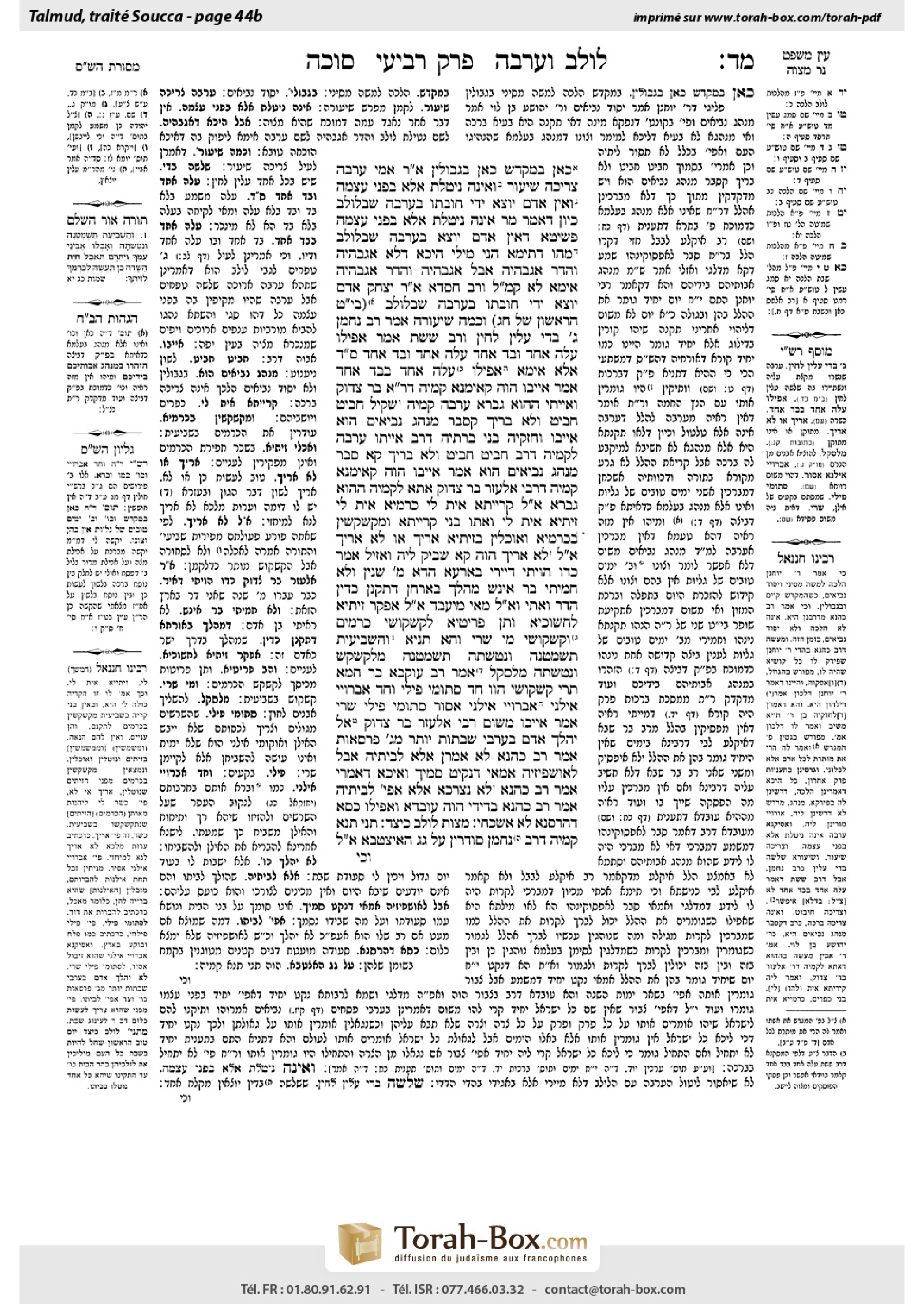
Sukkah 44b: Talmud study for Daf Yomi
Daf Yomi is the daily study of one Talmud folio. Explore 37 tractates with scans, Hebrew text, Sefaria English and AI-generated French translations where annotated.
Passage selection and English or AI-generated French translation are available where the scan has annotations. Daf Study is independent of Torah-Box and Sefaria.
Browse Sukkah · סוכה · All tractatesSukkah 44b text and translations
This page of Sukkah includes the Aramaic text, an English translation and an AI-generated French translation, alongside the scan above.
סוכה מ״ד ב · Aramaic and Hebrew text
כָּאן בַּמִּקְדָּשׁ — כָּאן בַּגְּבוּלִין.
אָמַר רַבִּי אַמֵּי: עֲרָבָה צְרִיכָה שִׁיעוּר, וְאֵינָהּ נִיטֶּלֶת אֶלָּא בִּפְנֵי עַצְמָהּ, וְאֵין אָדָם יוֹצֵא יְדֵי חוֹבָתוֹ בָּעֲרָבָה שֶׁבַּלּוּלָב. כֵּיוָן דְּאָמַר מָר אֵינָהּ נִיטֶּלֶת אֶלָּא בִּפְנֵי עַצְמָהּ, פְּשִׁיטָא דְּאֵין אָדָם יוֹצֵא בָּעֲרָבָה שֶׁבַּלּוּלָב!
מַהוּ דְּתֵימָא: הָנֵי מִילֵּי הֵיכָא דְּלָא אַגְבְּהַיהּ וַהֲדַר אַגְבְּהַיהּ, אֲבָל אַגְבְּהַיהּ וַהֲדַר אַגְבְּהַיהּ — אֵימָא לָא, קָא מַשְׁמַע לַן. וְרַב חִסְדָּא אָמַר רַבִּי יִצְחָק: אָדָם יוֹצֵא יְדֵי חוֹבָתוֹ בָּעֲרָבָה שֶׁבַּלּוּלָב (בְּיוֹם טוֹב הָרִאשׁוֹן שֶׁל חַג).
וְכַמָּה שִׁיעוּרָהּ? אָמַר רַב נַחְמָן: שְׁלֹשָׁה בַּדֵּי עָלִין לַחִין. וְרַב שֵׁשֶׁת אָמַר: אֲפִילּוּ עָלֶה אֶחָד וּבַד אֶחָד. עָלֶה אֶחָד וּבַד אֶחָד סָלְקָא דַּעְתָּךְ?! אֶלָּא אֵימָא: אֲפִילּוּ עָלֶה אֶחָד בְּבַד אֶחָד.
אָמַר אַיְיבוּ: הֲוָה קָאֵימְנָא קַמֵּיהּ דְּרַבִּי אֶלְעָזָר בַּר צָדוֹק וְאַיְיתִי הָהוּא גַּבְרָא עֲרָבָה קַמֵּיהּ. שָׁקֵיל, חַבֵּיט חַבֵּיט, וְלָא בָּרֵיךְ. קָסָבַר מִנְהַג נְבִיאִים הוּא. אַיְיבוּ וְחִזְקִיָּה בְּנֵי בְרַתֵּיה דְּרַב אַיְיתוֹ עֲרָבָה לְקַמֵּיהּ דְּרַב, חַבֵּיט חַבֵּיט, וְלָא בָּרֵיךְ. קָא סָבַר מִנְהַג נְבִיאִים הוּא.
אָמַר אַיְיבוּ: הֲוָה קָאֵימְנָא קַמֵּיהּ דְּרַבִּי אֶלְעָזָר בַּר צָדוֹק, אֲתָא לְקַמֵּיהּ הָהוּא גַּבְרָא, אֲמַר לֵיהּ: קִרְיָיתָא אִית לִי, כַּרְמַיָּא אִית לִי, זֵיתַיָּא אִית לִי, וְאָתוּ בְּנֵי קִרְיָיתָא וּמְקַשְׁקְשִׁין בְּכַרְמַיָּא וְאוֹכְלִין בְּזֵיתַיָּא — אֲרִיךְ אוֹ לָא אֲרִיךְ? אֲמַר לֵיהּ: לָא אֲרִיךְ. הֲוָה קָא שָׁבֵיק לֵיהּ וְאָזֵיל. אֲמַר: כְּדוּ הֲוֵיתִי דָּיַיר בְּאַרְעָא הָדָא אַרְבְּעִין שְׁנִין, וְלָא חֲמֵיתִי בַּר אִינָשׁ מְהַלֵּךְ בְּאָרְחָן דְּתָקְנָן כְּדֵין. הָדַר וְאָתֵי וְאָמַר לֵיהּ: מַאי מֶיעְבַּד? אֲמַר לֵיהּ: אַפְקַר זֵיתַיָּא לְחָשׁוֹכַיָּא, וְתֵן פְּרִיטַיָּא לְקַשְׁקוֹשֵׁי כְּרָמִים.
וְקַשְׁקוֹשֵׁי מִי שְׁרֵי? וְהָא תַּנְיָא: ״וְהַשְּׁבִיעִית תִּשְׁמְטֶנָּה וּנְטַשְׁתָּהּ״. ״תִּשְׁמְטֶנָּה״ — מִלְּקַשְׁקֵשׁ, ״וּנְטַשְׁתָּהּ״ — מִלְּסַקֵּל! אָמַר רַב עוּקְבָא בַּר חָמָא: תְּרֵי קִשְׁקוּשֵׁי הָווּ. חַד — סַתּוֹמֵי פִּילֵי, וְחַד — אַבְרוֹיֵי אִילָנֵי. אַבְרוֹיֵי אִילָנֵי — אָסוּר, סַתּוֹמֵי פִּילֵי — שְׁרֵי.
אָמַר אַיְיבוּ מִשּׁוּם רַבִּי אֶלְעָזָר בַּר צָדוֹק: אַל יְהַלֵּךְ אָדָם בְּעַרְבֵי שַׁבָּתוֹת יוֹתֵר מִשָּׁלֹשׁ פַּרְסָאוֹת. אָמַר רַב כָּהֲנָא: לָא אֲמַרַן אֶלָּא לְבֵיתֵיהּ, אֲבָל לְאוּשְׁפִּיזֵיהּ — אַמַּאי דְּנָקֵיט סְמִיךְ.
וְאִיכָּא דְּאָמְרִי, אָמַר רַב כָּהֲנָא: לֹא נִצְרְכָא אֶלָּא אֲפִילּוּ לְבֵיתֵיהּ. אָמַר רַב כָּהֲנָא: בְּדִידִי הֲוָה עוֹבָדָא, וַאֲפִילּוּ כָּסָא דְהַרְסָנָא לָא אַשְׁכַּחִי.
מִצְוַת לוּלָב כֵּיצַד? תָּנֵי תַּנָּא קַמֵּיהּ דְּרַב נַחְמָן: סוּדָרִין עַל גַּג הָאִיצְטְבָא. אֲמַר לֵיהּ:
Sukkah 44b · English translation
Here, where Rabbi Yoḥanan said that it is a halakha transmitted to Moses from Sinai, he is referring to the mitzva of the willow branch in the Temple; there, where he said that it was established by the prophets, he was referring to the taking of the willow branch in the outlying areas.
§ Rabbi Ami said: The willow branch taken to fulfill the mitzva requires a certain measure, and it is taken only in and of itself and not with the lulav, and a person does not fulfill his obligation with the willow branch that is bound with the lulav. The Gemara asks: Since the Master said: It is taken only in and of itself, it is obvious that a person does not fulfill his obligation with the willow branch that is bound with the lulav. Why are both statements necessary?
The Gemara answers: It is necessary lest you say that this applies only to a case where he did not lift the willow branch bound with the lulav and then lift it again to fulfill the mitzva of the willow branch; however, in a case where he lifted the lulav and then lifted it again, say no, he fulfills his obligation with the willow branch in the lulav. Therefore, he teaches us that even if one takes the four species a second time with the express intent of fulfilling the mitzva of the willow branch, he did not fulfill his obligation, as he must take the willow branch by itself. And Rav Ḥisda said that Rabbi Yitzḥak said: A person fulfills his obligation with the willow branch that is bound with the lulav on the first day of the festival of Sukkot.
Rabbi Ami said that the willow branch requires a certain measure. The Gemara asks: And what is its requisite measure? Rav Naḥman said: It is three branches of moist leaves. And Rav Sheshet said: It is even one leaf and one branch. The Gemara wonders about the statement of Rav Sheshet: Does it enter your mind that one takes a single leaf and a single branch separately? Rather, emend Rav Sheshet’s statement and say: One fulfills his obligation even with one leaf on one branch.
§ The Gemara relates that Aivu, father of the amora Rav, said: I was standing before Rabbi Elazar bar Tzadok, and a certain man brought a willow branch before him to fulfill the mitzva. He took it and waved it; he waved it and did not recite a blessing. This indicates that he holds that the mitzva of the willow branch is a custom of the prophets and is therefore performed without a blessing. Similarly, the Gemara relates that Aivu and Ḥizkiya, sons of the daughter of Rav, brought a willow branch before Rav to fulfill the mitzva. He waved it; he waved it and did not recite a blessing. This indicates that he, too, holds that it is a custom of the prophets.
Apropos the exchange between Aivu and Rabbi Elazar bar Tzadok, the Gemara cites another halakha that was transmitted in the same manner. Aivu said: I was standing before Rabbi Elazar bar Tzadok, and a certain man came before him and said to him: I have villages, I have olive groves, and I have olives, and the villagers come and hoe the olive groves during the Sabbatical Year and eat from the olive trees. Is it appropriate or inappropriate to allow this to continue? He said to him: It is inappropriate. As the man was leaving him and going on his way, Rabbi Elazar bar Tzadok said: I have already resided in this land for forty years and I have not seen a person walk in a path as straight as this man does. The man came back to Rabbi Elazar bar Tzadok and said to him: What should I do to ameliorate the situation? He said to him: Declare the olives ownerless for the poor, and give perutot coins to hired laborers as payment to hoe the olive groves.
The Gemara asks: Is hoeing olive groves permitted during the Sabbatical Year? But wasn’t it taught in a baraita that it is written: “But the seventh year you shall let it rest and lie fallow” (Exodus 23:11); meaning you shall let it rest from hoeing, and lie fallow from clearing the field of rocks? Apparently, hoeing is prohibited during the Sabbatical Year. Rav Ukva bar Ḥama said: There are two types of hoeing, one whose objective is to seal cracks in the ground and one to enhance the trees’ health. Enhancing the trees’ health is prohibited; sealing cracks is permitted, as it is merely to prevent the trees from dying and not to accelerate their growth.
An additional halakha was transmitted in the same manner. Aivu said in the name of Rabbi Elazar bar Tzadok: A person should not walk on Shabbat eves more than a distance of three parasangs [parsaot]. Rather, he should reach the place where he will stay on Shabbat early enough to ensure that he will have meals prepared for Shabbat. Rav Kahana said: We said that restriction only with regard to a case where he is returning to his house. However, if he is going to an inn, he relies on the food that he took with him. As he cannot assume that he will find lodgings with food, he brings food sufficient for his needs. Therefore, it is permitted for him to travel a greater distance.
Some say that Rav Kahana said: This restriction that one may not walk a distance of more than three parasangs on Shabbat eves was required even with regard to one traveling to his house, and all the more so with regard to one traveling to an inn, as he cannot assume that he will find food there. Rav Kahana said: There was an incident that happened with me where I traveled a distance to reach my home on Friday and I did not find even small fried fish [deharsena] to eat in the house. One must prepare for Shabbat well in advance of the onset of Shabbat.
§ The mishna continues: How is the mitzva of lulav fulfilled in the Temple when the first day of the Festival occurs on Shabbat? The mishna then explains how the attendants arrange their lulavim on the bench in the Temple. The tanna who recited mishnayot in the study hall taught a version of the mishna before Rav Naḥman: The attendant arranges them on the roof over the bench in the Temple. Rav Naḥman said to him:
Sukkah 44b · Traduction française (IA)
Ici, lorsque Rabbi Yoḥanan a dit qu’il s’agit d’une halakha transmise à Moïse au Sinaï, il parlait de la mitsva du saule dans le Temple ; là, lorsqu’il a dit qu’elle avait été instituée par les prophètes, il parlait de la prise du rameau de saule dans les régions périphériques.
§ Rabbi Ami a dit : Le rameau de saule pris pour accomplir la mitsva doit avoir une certaine mesure ; il se prend seul, et non avec le loulav, et on ne s’acquitte pas de son obligation avec le rameau de saule lié au loulav. La Guemara demande : Puisque le maître a dit qu’il se prend seul, il est évident qu’on ne s’acquitte pas de son obligation avec le rameau de saule lié au loulav. Pourquoi ces deux affirmations sont-elles nécessaires ?
La Guemara répond : Cette précision est nécessaire, de peur que tu dises que cela ne s’applique qu’au cas où il n’a pas soulevé le rameau de saule lié au loulav, puis l’a soulevé de nouveau pour accomplir la mitsva du saule ; mais que, dans le cas où il a soulevé le loulav puis l’a soulevé de nouveau, il s’acquitte de son obligation avec le rameau de saule lié au loulav. Il nous enseigne donc que même si l’on prend une seconde fois les quatre espèces avec l’intention explicite d’accomplir la mitsva du saule, on ne s’acquitte pas de son obligation, car il faut prendre le rameau de saule seul. Et Rav Ḥisda a dit au nom de Rabbi Yitzḥak : On s’acquitte de son obligation avec le rameau de saule lié au loulav le premier jour de la fête de Soukkot.
Rabbi Ami a dit que le rameau de saule doit avoir une certaine mesure. La Guemara demande : Et quelle est la mesure requise ? Rav Naḥman a dit : trois rameaux portant des feuilles humides. Et Rav Sheshet a dit : même une feuille et un rameau suffisent. La Guemara s’étonne de la déclaration de Rav Sheshet : Peut-on vraiment penser qu’on prend séparément une seule feuille et un seul rameau ? Il faut plutôt corriger la déclaration de Rav Sheshet et dire : On s’acquitte de son obligation même avec une seule feuille sur un seul rameau.
§ La Guemara rapporte qu’Aivu, père de l’amora Rav, a dit : Je me tenais devant Rabbi Elazar bar Tzadok, et un certain homme lui apporta un rameau de saule pour accomplir la mitsva. Il le prit et l’agita ; il l’agita sans réciter de bénédiction. Cela indique qu’il considère la mitsva du saule comme une coutume des prophètes et qu’on l’accomplit donc sans bénédiction. De même, la Guemara rapporte qu’Aivu et Ḥizkiya, fils de la fille de Rav, apportèrent un rameau de saule à Rav pour accomplir la mitsva. Il l’agita sans réciter de bénédiction. Cela indique que lui aussi considère qu’il s’agit d’une coutume des prophètes.
À propos de l’échange entre Aivu et Rabbi Elazar bar Tzadok, la Guemara cite une autre halakha transmise de la même manière. Aivu a dit : Je me tenais devant Rabbi Elazar bar Tzadok, et un certain homme se présenta devant lui et lui dit : « J’ai des villages, des oliveraies et des olives, et les villageois viennent biner les oliveraies pendant l’année sabbatique et mangent des olives. Convient-il de laisser faire ou non ? » Il lui répondit : « Cela ne convient pas. » Alors que l’homme s’éloignait et reprenait sa route, Rabbi Elazar bar Tzadok dit : « Cela fait déjà quarante ans que je réside dans ce pays et je n’ai pas vu d’homme suivre une voie aussi droite que lui. » L’homme revint auprès de Rabbi Elazar bar Tzadok et lui dit : « Que dois-je faire pour remédier à la situation ? » Il lui répondit : « Déclare les olives sans propriétaire au profit des pauvres et donne des pièces de perouta aux ouvriers engagés pour biner les oliveraies. »
La Guemara demande : Est-il permis de biner les oliveraies pendant l’année sabbatique ? N’a-t-on pas enseigné dans une baraïta qu’il est écrit : « Mais la septième année, tu la laisseras se reposer et demeurer en jachère » (Exode 23, 11), c’est-à-dire : tu la laisseras se reposer du binage et demeurer en jachère sans débarrasser le champ des pierres ? Il apparaît donc que le binage est interdit pendant l’année sabbatique. Rav Ukva bar Ḥama a dit : Il existe deux sortes de binage : l’un vise à reboucher les fissures du sol, l’autre à améliorer la santé des arbres. Améliorer la santé des arbres est interdit ; reboucher les fissures est permis, car il s’agit seulement d’empêcher les arbres de mourir, et non d’accélérer leur croissance.
Une autre halakha a été transmise de la même manière. Aivu a dit au nom de Rabbi Elazar bar Tzadok : La veille du Chabbat, on ne doit pas parcourir plus de trois parasanges [parsaot]. On doit plutôt arriver assez tôt à l’endroit où l’on passera le Chabbat pour s’assurer que les repas du Chabbat seront préparés. Rav Kahana a dit : Cette restriction, avons-nous dit, ne s’applique qu’à celui qui retourne chez lui. En revanche, s’il se rend dans une auberge, il compte sur la nourriture qu’il a emportée. Comme il ne peut pas présumer qu’il trouvera un hébergement avec de la nourriture, il emporte assez de provisions pour ses besoins. Il lui est donc permis de parcourir une plus grande distance.
Certains disent que Rav Kahana a dit : Cette restriction interdisant de parcourir plus de trois parasanges la veille du Chabbat s’applique même à celui qui rentre chez lui, et à plus forte raison à celui qui se rend dans une auberge, puisqu’il ne peut pas présumer qu’il y trouvera de la nourriture. Rav Kahana a dit : Il m’est arrivé de parcourir une certaine distance pour rentrer chez moi le vendredi, et de ne même pas trouver à la maison de petits poissons frits [deharsena] à manger. Il faut préparer le Chabbat bien avant son entrée.
§ La Michna poursuit : Comment accomplit-on la mitsva du loulav dans le Temple lorsque le premier jour de la fête tombe un Chabbat ? La Michna explique ensuite comment les préposés disposaient leurs loulavim sur le banc dans le Temple. Le tanna qui récitait les Michnayot à la maison d’étude enseigna à Rav Naḥman une version de la Michna : « Le préposé les dispose sur le toit, au-dessus du banc dans le Temple. » Rav Naḥman lui dit :
Traduction française générée par IA à partir de l’édition anglaise de Sefaria. Vérifie toujours un passage avec le texte source.
Text from Sefaria: William Davidson Edition - Vocalized Aramaic (CC BY NC); William Davidson Edition - English (CC BY NC).