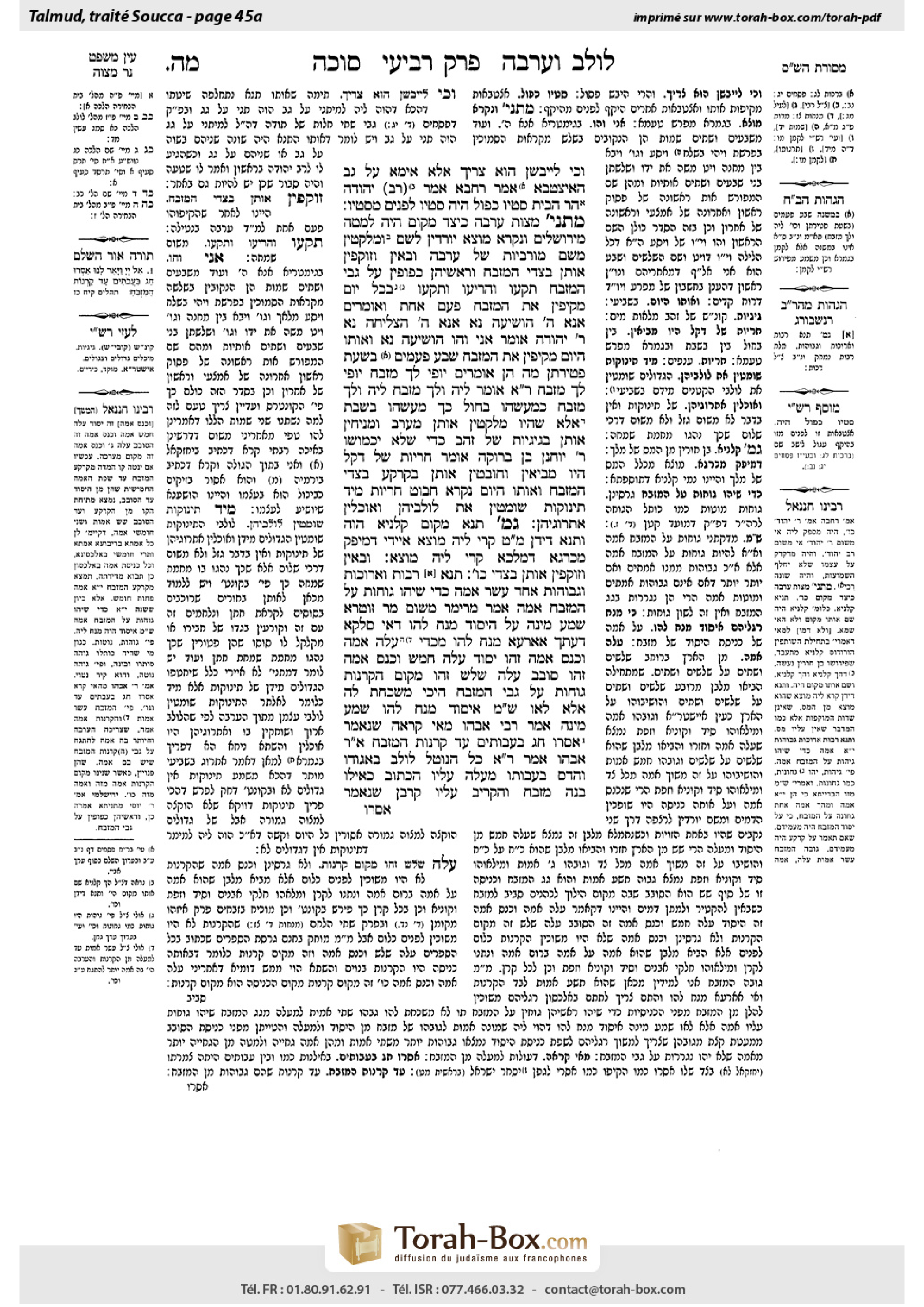
Sukkah 45a: Talmud study for Daf Yomi
Daf Yomi is the daily study of one Talmud folio. Explore 37 tractates with scans, Hebrew text, Sefaria English and AI-generated French translations where annotated.
Passage selection and English or AI-generated French translation are available where the scan has annotations. Daf Study is independent of Torah-Box and Sefaria.
Browse Sukkah · סוכה · All tractatesSukkah 45a text and translations
This page of Sukkah includes the Aramaic text, an English translation and an AI-generated French translation, alongside the scan above.
סוכה מ״ה א · Aramaic and Hebrew text
וְכִי לְיַיבְּשָׁן הוּא צָרִיךְ? אֶלָּא אֵימָא: עַל גַּב הָאִיצְטְבָא. אָמַר רַחֲבָא אָמַר (רַב) יְהוּדָה: הַר הַבַּיִת סְטָיו כָּפוּל הָיָה, סְטָיו לְפָנִים מִסְּטָיו.
מַתְנִי׳ מִצְוַת עֲרָבָה כֵּיצַד? מָקוֹם הָיָה לְמַטָּה מִירוּשָׁלַיִם וְנִקְרָא ״מוֹצָא״, יוֹרְדִין לְשָׁם וּמְלַקְּטִין מִשָּׁם מוּרְבִּיּוֹת שֶׁל עֲרָבָה, וּבָאִין וְזוֹקְפִין אוֹתָן בְּצִדֵּי הַמִּזְבֵּחַ, וְרָאשֵׁיהֶן כְּפוּפִין עַל גַּבֵּי הַמִּזְבֵּחַ. תָּקְעוּ וְהֵרִיעוּ וְתָקְעוּ. בְּכׇל יוֹם מַקִּיפִין אֶת הַמִּזְבֵּחַ פַּעַם אַחַת וְאוֹמְרִים: ״אָנָּא ה׳ הוֹשִׁיעָה נָּא, אָנָּא ה׳ הַצְלִיחָה נָּא״. רַבִּי יְהוּדָה אוֹמֵר: ״אֲנִי וָהוּ הוֹשִׁיעָה נָא״. וְאוֹתוֹ הַיּוֹם מַקִּיפִין אֶת הַמִּזְבֵּחַ שֶׁבַע פְּעָמִים. בִּשְׁעַת פְּטִירָתָן מָה הֵן אוֹמְרִים: ״יוֹפִי לְךָ מִזְבֵּחַ, יוֹפִי לְךָ מִזְבֵּחַ!״ רַבִּי אֶלְעָזָר אוֹמֵר: ״לְיָהּ וּלְךָ מִזְבֵּחַ, לְיָהּ וּלְךָ מִזְבֵּחַ״.
כְּמַעֲשֵׂהוּ בַּחוֹל כָּךְ מַעֲשֵׂהוּ בַּשַּׁבָּת, אֶלָּא שֶׁהָיוּ מְלַקְּטִין אוֹתָן מֵעֶרֶב וּמַנִּיחִין אוֹתָן בְּגִיגִיּוֹת שֶׁל זָהָב, כְּדֵי שֶׁלֹּא יִכְמוֹשׁוּ. רַבִּי יוֹחָנָן בֶּן בְּרוֹקָה אוֹמֵר: חֲרִיּוֹת שֶׁל דֶּקֶל הָיוּ מְבִיאִין, וְחוֹבְטִין אוֹתָן בְּקַרְקַע בְּצִדֵּי הַמִּזְבֵּחַ, וְאוֹתוֹ הַיּוֹם נִקְרָא חִבּוּט חֲרִיּוֹת. מִיַּד תִּינוֹקוֹת שׁוֹמְטִין אֶת לוּלְבֵיהֶן וְאוֹכְלִין אֶתְרוֹגֵיהֶן.
גְּמָ׳ תָּנָא: מְקוֹם קָלָנְיָא הֲוָה. וְתַנָּא דִּידַן מַאי טַעְמָא קָרֵי לֵיהּ ״מוֹצָא״? אַיְּידֵי דְּמִיפָּק מִכְּרָגָא דְמַלְכָּא — קָרֵי לֵיהּ ״מוֹצָא״.
וּבָאִין וְזוֹקְפִין אוֹתָן בְּצִדֵּי כּוּ׳. תָּנָא: רַבּוֹת, וַאֲרוּכוֹת, וּגְבוֹהוֹת אַחַת עֶשְׂרֵה אַמָּה, כְּדֵי שֶׁיְּהוּ גּוֹחוֹת עַל הַמִּזְבֵּחַ אַמָּה.
אָמַר מָרִימָר מִשּׁוּם מָר זוּטְרָא: שְׁמַע מִינַּהּ עַל הַיְּסוֹד מַנַּח לְהוּ, דְּאִי סָלְקָא דַּעְתָּךְ אַאַרְעָא מַנַּח לְהוּ, מִכְּדֵי: עָלָה אַמָּה וְכָנַס אַמָּה — זֶהוּ יְסוֹד. עָלָה חָמֵשׁ וְכָנַס אַמָּה — זֶהוּ סוֹבֵב. עָלָה שָׁלֹשׁ — זֶהוּ מְקוֹם הַקְּרָנוֹת. גּוֹחוֹת עַל גַּבֵּי הַמִּזְבֵּחַ הֵיכִי מַשְׁכַּחַתְּ לַהּ! אֶלָּא לָאו, שְׁמַע מִינַּהּ אַיְּסוֹד מַנַּח לְהוּ. שְׁמַע מִינַּהּ.
אָמַר רַבִּי אֲבָהוּ: מַאי קְרָאָה, שֶׁנֶּאֱמַר: ״אִסְרוּ חַג בַּעֲבוֹתִים עַד קַרְנוֹת הַמִּזְבֵּחַ״. אָמַר רַבִּי אֲבָהוּ אָמַר רַבִּי אֶלְעָזָר: כׇּל הַנּוֹטֵל לוּלָב בְּאִגּוּדוֹ וַהֲדַס בַּעֲבוֹתוֹ, מַעֲלֶה עָלָיו הַכָּתוּב כְּאִילּוּ בָּנָה מִזְבֵּחַ וְהִקְרִיב עָלָיו קׇרְבָּן, שֶׁנֶּאֱמַר:
Sukkah 45a · English translation
And does he need to dry them? Clearly, that is not his intention. Why, then, would he place the lulavim on the roof? Rather, emend your version and say: On the bench beneath the roof, in a place designated for that purpose. Raḥava said that Rav Yehuda said: The Temple Mount was a double colonnade [setav], a colonnade within a colonnade, and there was room there to place the lulavim.
MISHNA: How is the mitzva of the willow branch fulfilled? There was a place below Jerusalem, and it was called Motza. They would descend there and gather willow branches [murbiyyot] from there. And they would then come and stand them upright at the sides of the altar, and the tops of the branches would be inclined over the top of the altar. They then sounded a tekia, a simple uninterrupted blast, sounded a terua, a broken sound and/or a series of short staccato blasts, and sounded another tekia. Each day they would circle the altar one time and say: “Lord, please save us. Lord, please grant us success” (Psalms 118:25). Rabbi Yehuda says that they would say: Ani vaho, please save us. And on that day, the seventh day of Sukkot, they would circle the altar seven times. At the time of their departure at the end of the Festival, what would they say? It is beautiful for you, altar; it is beautiful for you, altar. Rabbi Elazar said that they would say: To the Lord and to you, altar; to the Lord and to you, altar.
The mishna notes: As its performance during the week, so is its performance on Shabbat; except for the fact that they would gather the branches from Shabbat eve and place them in basins of gold so that they would not dry. Rabbi Yoḥanan ben Beroka says: There was a unique custom on the seventh day. They would bring palm branches to the Temple and place them on the ground at the sides of the altar, and that seventh day of Sukkot was called: The day of the placing of palm branches. Immediately after fulfilling the mitzva of taking the four species on the seventh day of the festival of Sukkot, children remove their lulavim from the binding and eat their etrogim as an expression of extreme joy.
GEMARA: It was taught: Motza, which was mentioned in the mishna, was a Roman military colony [kelanya]. The Gemara asks: And the tanna of our mishna, what is the reason that he called it Motza? The reason is that since it is exempted from the king’s tax [karga], they call it Motza, meaning removed.
§ The mishna continues: And after gathering the willow branches, they would then come and stand them upright at the sides of the altar. It was taught: The willow branches were numerous and long, and eleven cubits high, so that they would lean over the altar one cubit.
Mareimar said in the name of Mar Zutra: Learn from it that one places them on the base of the altar and not on the ground, as, if it enters your mind that one places them on the ground, it would pose a difficulty in understanding the mishna. Now, since the following is stated with regard to the structure of the altar: The altar ascended one cubit high and indented one cubit and that is the base, and it ascended five additional cubits and indented one cubit and that is the surrounding ledge, and it ascended three additional cubits and that is the location of the horns of the altar, as the height of the altar totaled nine cubits; consequently, where can you find a case where the willow branches lean over the altar one cubit? Due to the indentations, the branches would need to stand inclined. Eleven cubits would not be sufficiently high to lean one cubit over the altar. Rather, is it not that one must conclude from this that the branches were placed on the base, adding a cubit to their height? The Gemara concludes: Indeed, conclude from it that it is so.
Rabbi Abbahu said: What is the verse that alludes to the fact that the branches must lean one cubit over the top of the altar? It is as it is stated: “Encircle [isru] with branches on the Festival until the horns of the altar” (Psalms 118:27), indicating that willow branches should surround the horns of the altar. That is facilitated by standing the branches on the base. The Gemara cites derivations based on different interpretations of the terms in that verse. Rabbi Abbahu said that Rabbi Elazar said: With regard to anyone who takes a lulav in its binding and a myrtle branch in its dense-leaved form, the verse ascribes him credit as though he built an altar and sacrificed an offering upon it, as it is stated:
Sukkah 45a · Traduction française (IA)
Doit-il donc les faire sécher ? Il est évident que ce n’est pas son intention. Pourquoi, alors, placerait-il les lulavim sur le toit ? Il faut plutôt corriger la version et dire : sur le banc situé sous le toit, à l’endroit prévu à cet effet. Raḥava a dit au nom de Rav Yehuda : Le mont du Temple était une double colonnade [setav], une colonnade à l’intérieur d’une autre, et il y avait là de la place pour déposer les lulavim.
MICHNA : Comment accomplit-on la mitsva de la branche de saule ? Il y avait un endroit en contrebas de Jérusalem, appelé Motza. On y descendait et on y cueillait des branches de saule [murbiyyot]. Puis on venait les dresser verticalement sur les côtés de l’autel, de sorte que leur sommet penche au-dessus de l’autel. On sonnait alors une tekia, un son simple et continu, une teroua, un son brisé et/ou une série de sons courts et saccadés, puis une autre tekia. Chaque jour, on faisait une fois le tour de l’autel et l’on disait : « De grâce, Seigneur, sauve-nous ! De grâce, Seigneur, accorde-nous la réussite ! » (Psaumes 118, 25). Rabbi Yehuda dit qu’on disait : « Ani vaho, de grâce, sauve-nous ! » Et ce jour-là, le septième jour de Soukkot, on faisait sept fois le tour de l’autel. Que disait-on au moment de quitter le Temple à la fin de la fête ? « Tu es beau, autel ; tu es beau, autel. » Rabbi Elazar dit qu’on disait : « Pour le Seigneur et pour toi, autel ; pour le Seigneur et pour toi, autel. »
La Michna précise : Son accomplissement pendant la semaine est identique à son accomplissement le Chabbat, à ceci près qu’on cueillait les branches la veille de Chabbat et qu’on les plaçait dans des bassins d’or afin qu’elles ne sèchent pas. Rabbi Yoḥanan ben Beroka dit : Le septième jour faisait l’objet d’une coutume particulière. On apportait des branches de palmier au Temple et on les plaçait au sol, sur les côtés de l’autel ; ce septième jour de Soukkot était appelé « le jour du dépôt des branches de palmier ». Immédiatement après avoir accompli la mitsva de prendre les quatre espèces le septième jour de la fête de Soukkot, les enfants détachaient leurs lulavim de leur assemblage et mangeaient leurs etrogim, en signe d’une joie extrême.
GUEMARA : Il a été enseigné : Motza, mentionné dans la Michna, était une colonie militaire romaine [kelanya]. La Guemara demande : Pourquoi le tanna de notre Michna l’a-t-il appelée Motza ? Parce qu’elle était exemptée de l’impôt du roi [karga], on l’appelait Motza, c’est-à-dire « exonérée ».
§ La Michna poursuit : Après avoir cueilli les branches de saule, on venait les dresser verticalement sur les côtés de l’autel. Il a été enseigné que les branches de saule étaient nombreuses et longues, et mesuraient onze coudées de haut, de sorte qu’elles dépassaient d’une coudée au-dessus de l’autel.
Mareimar a dit au nom de Mar Zutra : On peut en déduire qu’on les plaçait sur le socle de l’autel et non au sol. En effet, si l’on pouvait penser qu’on les plaçait au sol, il serait difficile de comprendre la Michna. Or, il est dit à propos de la structure de l’autel : l’autel s’élevait d’une coudée, puis se rétrécissait d’une coudée — c’est le socle ; il s’élevait ensuite de cinq coudées supplémentaires, puis se rétrécissait d’une coudée — c’est le pourtour ; enfin, il s’élevait de trois coudées supplémentaires — c’est l’emplacement des cornes de l’autel, car la hauteur totale de l’autel était de neuf coudées. Dans ces conditions, comment les branches de saule pouvaient-elles dépasser d’une coudée au-dessus de l’autel ? En raison des retraits successifs, les branches auraient dû être inclinées. Onze coudées n’auraient pas suffi pour dépasser d’une coudée au-dessus de l’autel. Ne faut-il donc pas conclure que les branches étaient placées sur le socle, ce qui ajoutait une coudée à leur hauteur ? La Guemara conclut : Il faut effectivement en déduire qu’il en est ainsi.
Rabbi Abbahu a dit : Quel verset fait allusion au fait que les branches doivent dépasser d’une coudée au-dessus de l’autel ? C’est ce qui est écrit : « Enlacez [isru] avec des branches pour la fête jusqu’aux cornes de l’autel » (Psaumes 118, 27), ce qui indique que les branches de saule doivent entourer les cornes de l’autel. Cela est rendu possible en plaçant les branches sur le socle. La Guemara cite des déductions fondées sur différentes interprétations des termes de ce verset. Rabbi Abbahu a dit au nom de Rabbi Elazar : À quiconque prend un lulav lié en bouquet et une branche de myrte aux feuilles denses, le verset attribue le mérite comme s’il avait construit un autel et y avait offert un sacrifice, comme il est écrit :
Traduction française générée par IA à partir de l’édition anglaise de Sefaria. Vérifie toujours un passage avec le texte source.
Text from Sefaria: William Davidson Edition - Vocalized Aramaic (CC BY NC); William Davidson Edition - English (CC BY NC).