Sukkah 45b: Talmud study for Daf Yomi
Daf Yomi is the daily study of one Talmud folio. Explore 37 tractates with scans, Hebrew text, Sefaria English and AI-generated French translations where annotated.
Passage selection and English or AI-generated French translation are available where the scan has annotations. Daf Study is independent of Torah-Box and Sefaria.
Browse Sukkah · סוכה · All tractatesSukkah 45b text and translations
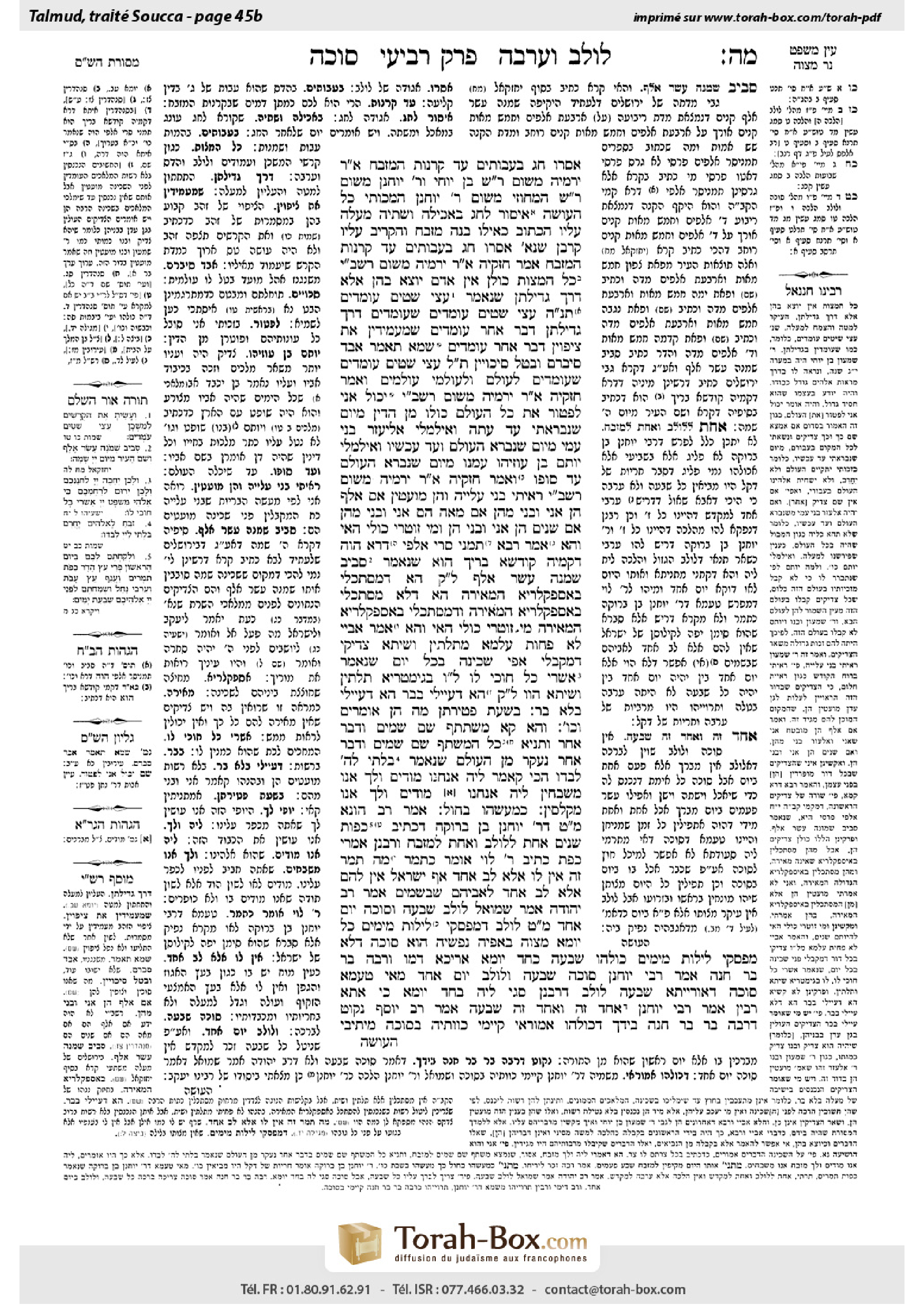
This page of Sukkah includes the Aramaic text, an English translation and an AI-generated French translation, alongside the scan above.
סוכה מ״ה ב · Aramaic and Hebrew text
״אִסְרוּ חַג בַּעֲבוֹתִים עַד קַרְנוֹת הַמִּזְבֵּחַ״. אָמַר רַבִּי יִרְמְיָה מִשּׁוּם רַבִּי שִׁמְעוֹן בֶּן יוֹחַי, וְרַבִּי יוֹחָנָן מִשּׁוּם רַבִּי שִׁמְעוֹן הַמָּחוֹזִי מִשּׁוּם רַבִּי יוֹחָנָן הַמָּכוֹתִי: כׇּל הָעוֹשֶׂה אִיסּוּר לֶחָג בַּאֲכִילָה וּשְׁתִיָּה, מַעֲלֶה עָלָיו הַכָּתוּב כְּאִילּוּ בָּנָה מִזְבֵּחַ וְהִקְרִיב עָלָיו קׇרְבָּן, שֶׁנֶּאֱמַר: ״אִסְרוּ חַג בַּעֲבוֹתִים עַד קַרְנוֹת הַמִּזְבֵּחַ״.
אָמַר חִזְקִיָּה אָמַר רַבִּי יִרְמְיָה מִשּׁוּם רַבִּי שִׁמְעוֹן בֶּן יוֹחַי: כׇּל הַמִּצְוֹת כּוּלָּן אֵין אָדָם יוֹצֵא בָּהֶן אֶלָּא דֶּרֶךְ גְּדִילָתָן, שֶׁנֶּאֱמַר: ״עֲצֵי שִׁטִּים עוֹמְדִים״.
תַּנְיָא נָמֵי הָכִי: ״עֲצֵי שִׁטִּים עוֹמְדִים״ — שֶׁעוֹמְדִים דֶּרֶךְ גְּדִילָתָן. דָּבָר אַחֵר: ״עוֹמְדִים״ — שֶׁמַּעֲמִידִין אֶת צִיפּוּיָן. דָּבָר אַחֵר: ״עוֹמְדִים״ — שֶׁמָּא תֹּאמַר אָבַד סִיבְרָם וּבָטַל סִיכּוּיָין, תַּלְמוּד לוֹמַר: ״עֲצֵי שִׁטִּים עוֹמְדִים״ — שֶׁעוֹמְדִים לְעוֹלָם וּלְעוֹלְמֵי עוֹלָמִים.
וְאָמַר חִזְקִיָּה אָמַר רַבִּי יִרְמְיָה מִשּׁוּם רַבִּי שִׁמְעוֹן בֶּן יוֹחַי: יָכוֹל אֲנִי לִפְטוֹר אֶת כׇּל הָעוֹלָם כּוּלּוֹ מִן הַדִּין — מִיּוֹם שֶׁנִּבְרֵאתִי עַד עַתָּה, וְאִילְמָלֵי אֱלִיעֶזֶר בְּנִי עִמִּי — מִיּוֹם שֶׁנִּבְרָא הָעוֹלָם וְעַד עַכְשָׁיו, וְאִילְמָלֵי יוֹתָם בֶּן עוּזִּיָּהוּ עִמָּנוּ — מִיּוֹם שֶׁנִּבְרָא הָעוֹלָם עַד סוֹפוֹ.
וְאָמַר חִזְקִיָּה אָמַר רַבִּי יִרְמְיָה מִשּׁוּם רַבִּי שִׁמְעוֹן בֶּן יוֹחַי: רָאִיתִי בְּנֵי עֲלִיָּיה וְהֵן מוּעָטִין. אִם אֶלֶף הֵן — אֲנִי וּבְנִי מֵהֶן, אִם מֵאָה הֵם — אֲנִי וּבְנִי מֵהֶן, אִם שְׁנַיִם הֵן — אֲנִי וּבְנִי הֵן. וּמִי זוּטְרֵי כּוּלֵּי הַאי? וְהָא אָמַר רָבָא: תַּמְנֵי סְרֵי אַלְפֵי הָוֵה דָּרָא דְּקַמֵּיהּ קוּדְשָׁא בְּרִיךְ הוּא, שֶׁנֶּאֱמַר: ״סָבִיב שְׁמֹנָה עָשָׂר אָלֶף״! לָא קַשְׁיָא: הָא דְּמִסְתַּכְּלִי בְּאַסְפַּקְלַרְיָא הַמְּאִירָה, הָא דְּלָא מִסְתַּכְּלִי בְּאַסְפַּקְלַרְיָא הַמְּאִירָה.
וּדְמִסְתַּכְּלִי בְּאַסְפַּקְלַרְיָא הַמְּאִירָה, מִי זוּטְרֵי כּוּלֵּי הַאי? וְהָא אָמַר אַבָּיֵי: לָא פָּחֵית עָלְמָא מִתְּלָתִין וְשִׁיתָּא צַדִּיקֵי דִּמְקַבְּלִי אַפֵּי שְׁכִינָה בְּכׇל יוֹם, שֶׁנֶּאֱמַר: ״אַשְׁרֵי כׇּל חוֹכֵי לוֹ״, ״לוֹ״ בְּגִימַטְרִיָּא תְּלָתִין וְשִׁיתָּא הָווּ! לָא קַשְׁיָא: הָא דְּעָיְילִי בְּבַר, הָא דְּעָיְילִי בְּלָא בַּר.
בִּשְׁעַת פְּטִירָתָן מָה הֵן אוֹמְרִים וְכוּ׳. וְהָא קָא מִשְׁתַּתַּף שֵׁם שָׁמַיִם וְדָבָר אַחֵר, וְתַנְיָא: כׇּל הַמְשַׁתֵּף שֵׁם שָׁמַיִם וְדָבָר אַחֵר נֶעֱקָר מִן הָעוֹלָם, שֶׁנֶּאֱמַר: ״בִּלְתִּי לַה׳ לְבַדּוֹ״! הָכִי קָאָמַר: לְיָהּ אֲנַחְנוּ מוֹדִים, וְלָךְ אָנוּ מְשַׁבְּחִין. לְיָהּ אֲנַחְנוּ מוֹדִים, וְלָךְ אָנוּ מְקַלְּסִין.
כְּמַעֲשֵׂהוּ בַּחוֹל. אָמַר רַב הוּנָא: מַאי טַעְמָא דְּרַבִּי יוֹחָנָן בֶּן בְּרוֹקָה, דִּכְתִיב: ״כַּפּוֹת״, שְׁנַיִם: אַחַת לַלּוּלָב וְאַחַת לְמִזְבֵּחַ. וְרַבָּנַן אָמְרִי: ״כַּפַּת״ כְּתִיב.
רַבִּי לֵוִי אוֹמֵר, כְּתָמָר: מָה תָּמָר זֶה אֵין לוֹ אֶלָּא לֵב אֶחָד, אַף יִשְׂרָאֵל אֵין לָהֶם אֶלָּא לֵב אֶחָד לַאֲבִיהֶם שֶׁבַּשָּׁמַיִם.
אָמַר רַב יְהוּדָה אָמַר שְׁמוּאֵל: לוּלָב שִׁבְעָה, וְסוּכָּה יוֹם אֶחָד. מַאי טַעְמָא? לוּלָב דְּמַפְסְקִי לֵילוֹת מִיָּמִים, כׇּל יוֹמָא מִצְוָה בְּאַפֵּיהּ נַפְשֵׁיהּ הוּא. סוּכָּה דְּלָא מַפְסְקִי לֵילוֹת מִיָּמִים, כּוּלְּהוּ שִׁבְעָה כְּחַד יוֹמָא אֲרִיכָא דָּמוּ.
וְרַבָּה בַּר בַּר חָנָה אָמַר רַבִּי יוֹחָנָן: סוּכָּה שִׁבְעָה, וְלוּלָב יוֹם אֶחָד. מַאי טַעְמָא? סוּכָּה דְּאוֹרָיְיתָא — שִׁבְעָה, לוּלָב דְּרַבָּנַן — סַגִּי לֵיהּ בְּחַד יוֹמָא.
כִּי אֲתָא רָבִין אָמַר רַבִּי יוֹחָנָן: אֶחָד זֶה וְאֶחָד זֶה שִׁבְעָה. אָמַר רַב יוֹסֵף: נְקוֹט דְּרַבָּה בַּר בַּר חָנָה בִּידָךְ, דְּכוּלְּהוּ אָמוֹרָאֵי קָיְימִי כְּווֹתֵיהּ בְּסוּכָּה.
מֵיתִיבִי:
Sukkah 45b · English translation
“Bind [isru] with dense-leaved branches [ba’avotim] on the Festival until the horns of the altar” (Psalms 118:27), which alludes both to the binding of the lulav and to the myrtle branch, referred to in the Torah as the branch of a dense-leaved tree [anaf etz avot]. Rabbi Yirmeya said in the name of Rabbi Shimon ben Yoḥai, and Rabbi Yoḥanan said in the name of Rabbi Shimon HaMeḥozi, who said in the name of Rabbi Yoḥanan HaMakkoti: With regard to anyone who establishes an addition [issur] to the Festival on the day after the Festival by eating and drinking, the verse ascribes him credit as though he built an altar and sacrificed an offering upon it, as it is stated: “Add [isru] to the Festival with fattened animals [ba’avotim] until the horns of the altar.”
§ Apropos the halakha cited by Rabbi Yirmeya in the name of Rabbi Shimon ben Yoḥai, the Gemara cites additional halakhot. Ḥizkiya said that Rabbi Yirmeya said in the name of Rabbi Shimon ben Yoḥai: With regard to all objects used in performance of each and every one of the mitzvot, a person fulfills his obligation only when the objects are positioned in the manner of their growth. One must take the lulav with the bottom of the branch facing down, as it is stated with regard to the beams of the Tabernacle: “Acacia wood, standing” (Exodus 26:15), indicating that the beams stood in the manner of their growth.
That was also taught in a baraita: “Acacia wood, standing,” indicating that they stand in the Tabernacle in the manner of their growth in nature. Alternatively, standing means that the beams support their gold plating that is affixed to the beams with nails. Alternatively, standing teaches: Lest you say that after the destruction of the Tabernacle their hope is lost and their prospect is abolished, and they will never serve a sacred purpose again, therefore the verse states: “Acacia wood, standing,” meaning that they stand forever and for all time and will yet be revealed and utilized again.
And Ḥizkiya said that Rabbi Yirmeya said in the name of Rabbi Shimon ben Yoḥai: I am able to absolve the entire world from judgment for sins committed from the day I was created until now. The merit that he accrued through his righteousness and the suffering that he endured atone for the sins of the entire world. And were the merit accrued by Eliezer, my son, calculated along with my own, we would absolve the world from judgment for sins committed from the day that the world was created until now. And were the merit accrued by the righteous king, Jotham ben Uzziah, calculated with our own, we would absolve the world from judgment for sins committed from the day that the world was created until its end. The righteousness of these three serves as a counterbalance to all the evil deeds committed throughout the generations, and it validates the ongoing existence of the world.
And Ḥizkiya said that Rabbi Yirmeya said in the name of Rabbi Shimon ben Yoḥai: I have seen members of the caste of the spiritually prominent, who are truly righteous, and they are few. If they number one thousand, I and my son are among them. If they number one hundred, I and my son are among them; and if they number two, I and my son are they. The Gemara asks: Are they so few? But didn’t Rava say: There are eighteen thousand righteous individuals in a row before the Holy One, Blessed be He, as it is stated: “Surrounding are eighteen thousand” (Ezekiel 48:35)? Apparently, the righteous are numerous. The Gemara answers: This is not difficult. This statement of Rabbi Shimon ben Yoḥai is referring to the very few who view the Divine Presence through a bright, mirror-like partition, while that statement of Rava is referring to those who do not view the Divine Presence through a bright partition.
The Gemara asks further: And are those who view the Divine Presence through a bright partition so few? But didn’t Abaye say: The world has no fewer than thirty-six righteous people in each generation who greet the Divine Presence every day, as it is stated: “Happy are all they that wait for Him [lo]” (Isaiah 30:18)? The numerological value of lo, spelled lamed vav, is thirty-six, alluding to the fact that there are at least thirty-six full-fledged righteous individuals in each generation. The Gemara answers: This is not difficult. This statement of Abaye is referring to those who enter to greet the Divine Presence by requesting and being granted permission, while that statement of Rabbi Shimon ben Yoḥai is referring to those who enter even without requesting permission, for whom the gates of Heaven are open at all times. They are very few indeed.
§ The mishna asks: At the time of their departure at the end of the Festival, what would they say? The mishna answers that they would praise the altar and glorify God. The Gemara challenges this: But in doing so aren’t they joining the name of Heaven and another entity, and it was taught in a baraita: Anyone who joins the name of Heaven and another entity is uprooted from the world, as it is stated: “He that sacrifices unto the gods, save unto the Lord only, shall be utterly destroyed” (Exodus 22:19)? The Gemara answers that this is what the people are saying when they depart the Temple: To the Lord, we acknowledge that He is our God, and to you, the altar, we give praise; to the Lord, we acknowledge that He is our God, and to you, the altar, we give acclaim. The praise to God and the praise to the altar are clearly distinct.
§ The mishna continues: As its performance during the week, so is its performance on Shabbat. And according to Rabbi Yoḥanan ben Beroka, on the seventh day of the Festival they would bring palm branches to the Temple. Rav Huna said: What is the rationale for the opinion of Rabbi Yoḥanan ben Beroka? It is as it is written: “And you shall take for yourselves on the first day the fruit of a beautiful tree, branches of a date palm” (Leviticus 23:40). Branches in the plural indicates that two branches must be taken, one for the lulav and one for placement around the altar. And the Rabbis say: Although the word is vocalized in the plural, based on tradition it is written kappot, without the letter vav. Therefore, it is interpreted as if it were written kappat, indicating that only one palm branch need be taken.
Rabbi Levi says: The rationale for the opinion of Rabbi Yoḥanan ben Beroka is not based on a verse. Rather, it is a custom that developed to express praise for the Jewish people, likening them to a date palm. Just as the date palm has only one heart, as branches do not grow from its trunk but rather the trunk rises and branches emerge only at the top, so too, the Jewish people have only one heart directed toward their Father in Heaven.
§ Rav Yehuda said that Shmuel said: The blessing over the mitzva of lulav is recited seven days and the blessing over the mitzva of sukka is recited one day. What is the rationale for this distinction? It is written explicitly in the Torah that the mitzva to sit in the sukka applies all seven days. The Gemara explains: With regard to the lulav, where the nights are distinct from the days, as the mitzva of lulav is not in effect at night, each day is a mitzva in and of itself. A separate blessing is recited over each mitzva. However, with regard to sukka, where the nights are not distinct from the days, as the mitzva of sukka is in effect at night just as it is during the day, the legal status of all seven days of the Festival is like that of one long day.
But Rabba bar bar Ḥana said that Rabbi Yoḥanan said: The blessing over the mitzva of sukka is recited seven days and the blessing over the mitzva of lulav is recited one day. What is the rationale for this distinction? The Gemara explains: The mitzva of sukka is a mitzva by Torah law all seven days of the Festival. Therefore, a blessing is recited for seven days. However, the mitzva of lulav, other than on the first day, is a mitzva by rabbinic law, as the Sages instituted an ordinance to take the lulav for all seven days to commemorate the practice in the Temple. Therefore, it is enough to recite the blessing one day, on the first day.
When Ravin came from Eretz Yisrael to Babylonia, he said that Rabbi Yoḥanan said: One recites a blessing over both this, the mitzva of sukka, and over that, the mitzva of lulav, all seven days. Rav Yosef said: Take the statement of Rabba bar bar Ḥana in your hand, as all the amora’im who transmitted statements of Rabbi Yoḥanan hold in accordance with his opinion in matters related to sukka.
The Gemara raises an objection based on a baraita:
Sukkah 45b · Traduction française (IA)
« Liez [isru] avec des branches touffues [ba’avotim] pendant la fête, jusqu’aux cornes de l’autel » (Psaumes 118:27), verset qui fait allusion à la fois à la ligature du lulav et à la branche de myrte, désignée dans la Torah comme la branche d’un arbre touffu [anaf etz avot]. Rabbi Yirmeya a dit au nom de Rabbi Shimon ben Yoḥai, et Rabbi Yoḥanan a dit au nom de Rabbi Shimon HaMeḥozi, qui a dit au nom de Rabbi Yoḥanan HaMakkoti : Quiconque ajoute [issur] un jour à la fête, le lendemain de celle-ci, en mangeant et en buvant, le verset lui en attribue le mérite comme s’il avait construit un autel et y avait offert un sacrifice, ainsi qu’il est dit : « Ajoutez [isru] à la fête avec des animaux engraissés [ba’avotim], jusqu’aux cornes de l’autel. »
§ À propos de la halakha citée par Rabbi Yirmeya au nom de Rabbi Shimon ben Yoḥai, la Guemara rapporte d’autres halakhot. Ḥizkiya a dit que Rabbi Yirmeya a dit au nom de Rabbi Shimon ben Yoḥai : Pour tous les objets utilisés dans l’accomplissement de chacune des mitsvot, on ne s’acquitte de son obligation que si ces objets sont orientés dans le sens où ils poussent. Il faut tenir le lulav avec la base de la branche tournée vers le bas, comme il est dit au sujet des poutres du Tabernacle : « Bois d’acacia, debout » (Exode 26:15), ce qui indique que les poutres étaient dressées dans le sens où elles avaient poussé.
Cela a également été enseigné dans une baraïta : « Bois d’acacia, debout » indique que les poutres se dressent dans le Tabernacle dans le sens où elles poussent naturellement. Autre interprétation : « debout » signifie que les poutres soutiennent leur revêtement d’or, fixé aux poutres par des clous. Autre interprétation : « debout » enseigne ceci : de peur que l’on dise qu’après la destruction du Tabernacle, leur espoir est perdu et leur avenir compromis, et qu’elles ne serviront plus jamais à un usage sacré, le verset dit : « Bois d’acacia, debout », c’est-à-dire qu’elles se tiennent pour toujours et à jamais, et qu’elles seront encore révélées et utilisées de nouveau.
Et Ḥizkiya a dit que Rabbi Yirmeya a dit au nom de Rabbi Shimon ben Yoḥai : Je suis capable d’exempter le monde entier du jugement pour les fautes commises depuis le jour où j’ai été créé jusqu’à présent. Le mérite qu’il a acquis par sa droiture et les souffrances qu’il a endurées expient les fautes du monde entier. Si l’on comptait également le mérite acquis par mon fils Eliezer, avec le mien, nous exempterions le monde du jugement pour les fautes commises depuis le jour où le monde a été créé jusqu’à présent. Et si l’on comptait le mérite acquis par le roi juste Yotam, fils d’Ozias, avec le nôtre, nous exempterions le monde du jugement pour les fautes commises depuis le jour où le monde a été créé jusqu’à sa fin. La droiture de ces trois hommes fait contrepoids à toutes les mauvaises actions commises au fil des générations et assure la pérennité du monde.
Et Ḥizkiya a dit que Rabbi Yirmeya a dit au nom de Rabbi Shimon ben Yoḥai : J’ai vu des membres de la catégorie des hommes éminents sur le plan spirituel, qui sont véritablement justes, et ils sont peu nombreux. S’ils sont mille, mon fils et moi en faisons partie. S’ils sont cent, mon fils et moi en faisons partie ; et s’ils sont deux, mon fils et moi sommes ces deux-là. La Guemara demande : Sont-ils si peu nombreux ? Mais Rava n’a-t-il pas dit : Il y a dix-huit mille justes alignés devant le Saint, béni soit-Il, ainsi qu’il est dit : « Tout autour : dix-huit mille » (Ézéchiel 48:35) ? Il semble donc que les justes soient nombreux. La Guemara répond : Il n’y a pas de contradiction. La déclaration de Rabbi Shimon ben Yoḥai concerne les très rares qui contemplent la Présence divine à travers une cloison lumineuse, semblable à un miroir, tandis que la déclaration de Rava concerne ceux qui ne contemplent pas la Présence divine à travers une cloison lumineuse.
La Guemara demande encore : Ceux qui contemplent la Présence divine à travers une cloison lumineuse sont-ils si peu nombreux ? Mais Abaye n’a-t-il pas dit : Le monde compte au moins trente-six justes à chaque génération, qui accueillent chaque jour la Présence divine, ainsi qu’il est dit : « Heureux tous ceux qui l’attendent [lo] » (Isaïe 30:18) ? La valeur numérique de lo, écrit lamed vav, est trente-six, ce qui fait allusion au fait qu’il y a au moins trente-six justes accomplis à chaque génération. La Guemara répond : Il n’y a pas de contradiction. La déclaration d’Abaye concerne ceux qui entrent pour accueillir la Présence divine après en avoir demandé et obtenu la permission, tandis que la déclaration de Rabbi Shimon ben Yoḥai concerne ceux qui entrent même sans demander la permission, car les portes du Ciel leur sont ouvertes en tout temps. Ils sont véritablement très peu nombreux.
§ La Michna demande : Au moment de leur départ, à la fin de la fête, que disaient-ils ? La Michna répond qu’ils louaient l’autel et glorifiaient Dieu. La Guemara objecte : Mais, ce faisant, n’associent-ils pas le nom du Ciel à une autre entité ? Or, il a été enseigné dans une baraïta : Quiconque associe le nom du Ciel à une autre entité est déraciné du monde, comme il est dit : « Celui qui sacrifie aux dieux, hormis au Seigneur seul, sera voué à la destruction » (Exode 22:19). La Guemara répond que voici ce que les gens disaient en quittant le Temple : « Au Seigneur, nous reconnaissons qu’Il est notre Dieu, et à toi, autel, nous adressons nos louanges ; au Seigneur, nous reconnaissons qu’Il est notre Dieu, et à toi, autel, nous rendons hommage. » La louange adressée à Dieu et celle adressée à l’autel sont clairement distinctes.
§ La Michna poursuit : Son accomplissement en semaine est le même que le Chabbat. Et, selon Rabbi Yoḥanan ben Beroka, le septième jour de la fête, on apportait des branches de palmier au Temple. Rav Huna dit : Quel est le fondement de l’opinion de Rabbi Yoḥanan ben Beroka ? Il est écrit : « Vous prendrez pour vous, le premier jour, le fruit d’un bel arbre, des branches de palmier » (Lévitique 23:40). Le pluriel « branches » indique qu’il faut en prendre deux : l’une pour le lulav et l’autre pour la disposer autour de l’autel. Les Sages disent : Bien que le mot se prononce au pluriel, selon la tradition il s’écrit kappot, sans la lettre vav. Il est donc interprété comme s’il était écrit kappat, ce qui indique qu’une seule branche de palmier doit être prise.
Rabbi Levi dit : L’opinion de Rabbi Yoḥanan ben Beroka ne se fonde pas sur un verset. Il s’agit plutôt d’une coutume apparue pour louer le peuple juif en le comparant à un palmier-dattier. De même que le palmier-dattier n’a qu’un seul cœur, car ses branches ne poussent pas sur son tronc, mais que le tronc s’élève et que les branches n’apparaissent qu’à son sommet, de même le peuple juif n’a qu’un seul cœur, tourné vers son Père qui est aux Cieux.
§ Rav Yehuda a dit au nom de Shmuel : On récite la bénédiction sur la mitsva du lulav pendant sept jours et celle sur la mitsva de la soukka pendant un jour. Quel est le fondement de cette distinction ? La Torah écrite dit explicitement que la mitsva de demeurer dans la soukka s’applique pendant les sept jours. La Guemara explique : Pour le lulav, les nuits se distinguent des jours, puisque la mitsva du lulav ne s’applique pas la nuit ; chaque jour constitue donc une mitsva à part entière. On récite une bénédiction distincte pour chaque mitsva. En revanche, pour la soukka, les nuits ne se distinguent pas des jours, puisque la mitsva de la soukka s’applique la nuit comme le jour ; les sept jours de la fête ont donc le statut d’une seule longue journée.
Mais Rabba bar bar Ḥana a dit au nom de Rabbi Yoḥanan : On récite la bénédiction sur la mitsva de la soukka pendant sept jours et celle sur la mitsva du lulav pendant un jour. Quel est le fondement de cette distinction ? La Guemara explique : La mitsva de la soukka est une mitsva prescrite par la Torah pendant les sept jours de la fête. On récite donc une bénédiction pendant sept jours. En revanche, la mitsva du lulav, hormis le premier jour, relève d’une mitsva rabbinique, car les Sages ont institué la prise du lulav pendant les sept jours afin de commémorer la pratique au Temple. Il suffit donc de réciter la bénédiction un seul jour, le premier.
Lorsque Ravin vint d’Eretz Israël en Babylonie, il rapporta que Rabbi Yoḥanan avait dit : On récite une bénédiction sur l’une comme sur l’autre, la mitsva de la soukka et la mitsva du lulav, pendant les sept jours. Rav Yosef dit : Tenez-vous-en à la déclaration de Rabba bar bar Ḥana, car tous les amoraïm qui ont transmis des déclarations de Rabbi Yoḥanan sont d’accord avec lui dans les questions relatives à la soukka.
La Guemara soulève une objection à partir d’une baraïta :
Traduction française générée par IA à partir de l’édition anglaise de Sefaria. Vérifie toujours un passage avec le texte source.
Text from Sefaria: William Davidson Edition - Vocalized Aramaic (CC BY NC); William Davidson Edition - English (CC BY NC).