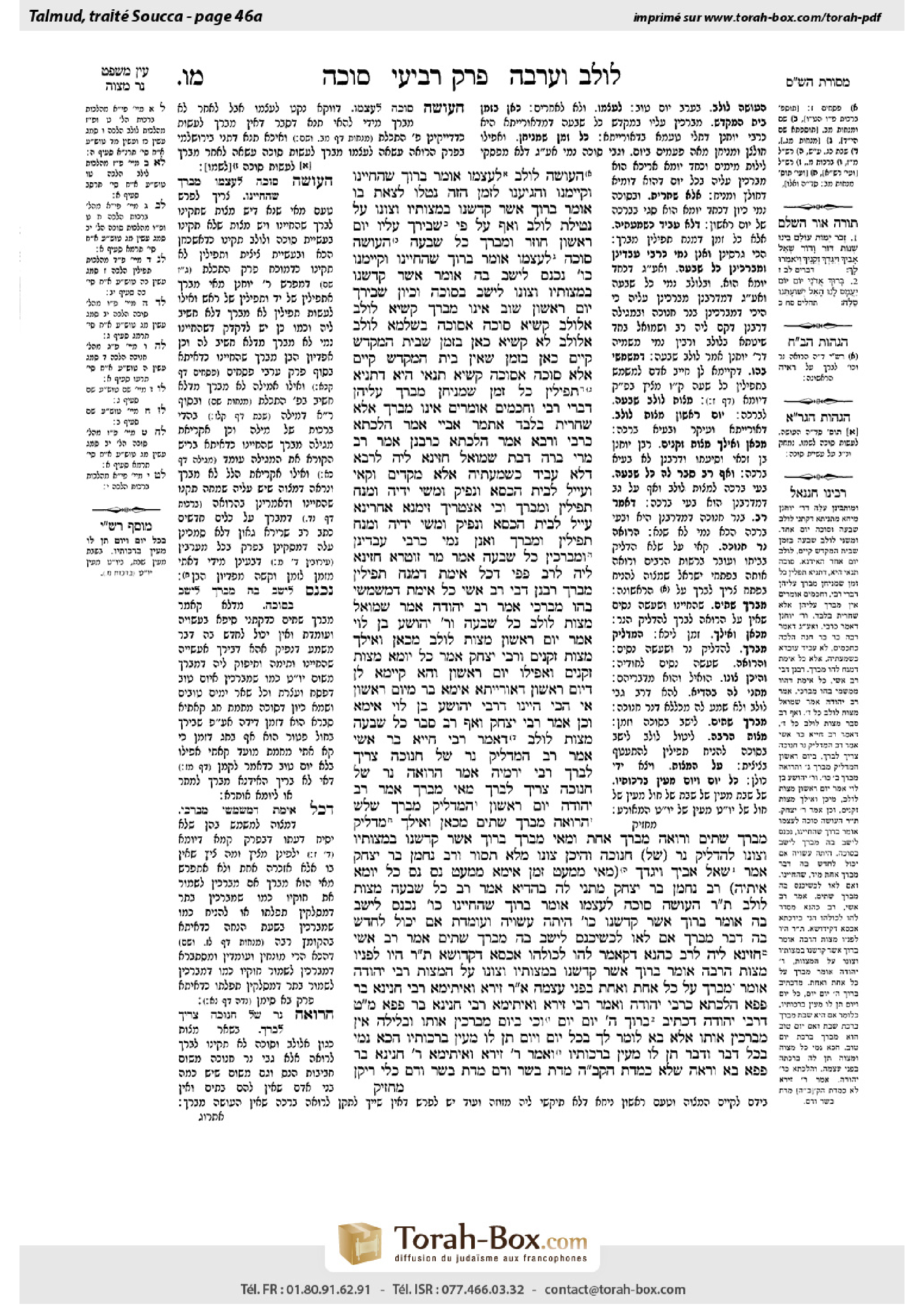
Sukkah 46a: Talmud study for Daf Yomi
Daf Yomi is the daily study of one Talmud folio. Explore 37 tractates with scans, Hebrew text, Sefaria English and AI-generated French translations where annotated.
Passage selection and English or AI-generated French translation are available where the scan has annotations. Daf Study is independent of Torah-Box and Sefaria.
Browse Sukkah · סוכה · All tractatesSukkah 46a text and translations
This page of Sukkah includes the Aramaic text, an English translation and an AI-generated French translation, alongside the scan above.
סוכה מ״ו א · Aramaic and Hebrew text
הָעוֹשֶׂה לוּלָב לְעַצְמוֹ, אוֹמֵר: ״בָּרוּךְ ... שֶׁהֶחֱיָינוּ וְקִיְּימָנוּ וְהִגִּיעָנוּ לִזְמַן הַזֶּה״. נְטָלוֹ לָצֵאת בּוֹ, אוֹמֵר: ״בָּרוּךְ ... אֲשֶׁר קִדְּשָׁנוּ בְּמִצְוֹתָיו וְצִוָּנוּ עַל נְטִילַת לוּלָב״. וְאַף עַל פִּי שֶׁבֵּירַךְ עָלָיו יוֹם רִאשׁוֹן, חוֹזֵר וּמְבָרֵךְ כׇּל שִׁבְעָה. הָעוֹשֶׂה סוּכָּה לְעַצְמוֹ, אוֹמֵר: ״בָּרוּךְ ... שֶׁהֶחֱיָינוּ וְקִיְּימָנוּ כּוּ׳״, נִכְנַס לֵישֵׁב בָּהּ, אוֹמֵר: ״אֲשֶׁר קִדְּשָׁנוּ בְּמִצְוֹתָיו וְצִוָּנוּ לֵישֵׁב בַּסּוּכָּה״, וְכֵיוָן שֶׁבֵּירַךְ יוֹם רִאשׁוֹן — שׁוּב אֵינוֹ מְבָרֵךְ.
קַשְׁיָא לוּלָב אַלּוּלָב, קַשְׁיָא סוּכָּה אַסּוּכָּה!
בִּשְׁלָמָא לוּלָב אַלּוּלָב לָא קַשְׁיָא: כָּאן בִּזְמַן שֶׁבֵּית הַמִּקְדָּשׁ קַיָּים, כָּאן בִּזְמַן שֶׁאֵין בֵּית הַמִּקְדָּשׁ קַיָּים. אֶלָּא סוּכָּה אַסּוּכָּה קַשְׁיָא!
תַּנָּאֵי הִיא. דְּתַנְיָא: תְּפִילִּין, כׇּל זְמַן שֶׁמַּנִּיחָן — מְבָרֵךְ עֲלֵיהֶן, דִּבְרֵי רַבִּי. וַחֲכָמִים אוֹמְרִים: אֵינוֹ מְבָרֵךְ אֶלָּא שַׁחֲרִית בִּלְבַד.
אִתְּמַר, אַבָּיֵי אָמַר: הִלְכְתָא כְּרַבִּי, וְרָבָא אָמַר: הִלְכְתָא כְּרַבָּנַן. אָמַר רַב מָרִי בְּרַהּ דְּבַת שְׁמוּאֵל: חֲזֵינָא לֵיהּ לְרָבָא דְּלָא עָבֵיד כִּשְׁמַעְתֵּיהּ, אֶלָּא מַקְדֵּים וְקָאֵי וְעָיֵיל בֵּית הַכִּסֵּא, וְנָפֵיק וּמָשֵׁי יְדֵיהּ וּמַנַּח תְּפִילִּין וּמְבָרֵךְ. וְכִי אִצְטְרִיךְ זִימְנָא אַחֲרִינָא, עָיֵיל לְבֵית הַכִּסֵּא, וְנָפֵיק וּמָשֵׁי יְדֵיהּ וּמַנַּח תְּפִילִּין וּמְבָרֵךְ, וַאֲנַן נָמֵי כְּרַבִּי עָבְדִינַן, וּמְבָרְכִין כׇּל שִׁבְעָה.
אָמַר מָר זוּטְרָא: חֲזֵינָא לֵיהּ לְרַב פַּפֵּי, דְּכׇל אֵימַת דְּמַנַּח תְּפִילִּין מְבָרֵךְ. רַבָּנַן דְּבֵי רַב אָשֵׁי, כׇּל אֵימַת דִּמְ[מַ]שְׁמְשִׁי בְּהוּ מְבָרְכִי.
אָמַר רַב יְהוּדָה אָמַר שְׁמוּאֵל: מִצְוַת לוּלָב כׇּל שִׁבְעָה. וְרַבִּי יְהוֹשֻׁעַ בֶּן לֵוִי אָמַר: יוֹם רִאשׁוֹן — מִצְוַת לוּלָב, מִכָּאן וְאֵילָךְ מִצְוַת זְקֵנִים. וְרַבִּי יִצְחָק אָמַר: כָּל יוֹמָא מִצְוַת זְקֵנִים. וַאֲפִילּוּ יוֹם רִאשׁוֹן?! וְהָא קַיְימָא לַן דְּיוֹם רִאשׁוֹן דְּאוֹרָיְיתָא! אֵימָא: בַּר מִיּוֹם רִאשׁוֹן. אִי הָכִי — הַיְינוּ דְּרַבִּי יְהוֹשֻׁעַ בֶּן לֵוִי! אֵימָא: וְכֵן אָמַר רַבִּי יִצְחָק.
וְאַף רַב סָבַר: כׇּל שִׁבְעָה מִצְוַת לוּלָב. דְּאָמַר רַבִּי חִיָּיא בַּר אָשֵׁי אָמַר רַב: הַמַּדְלִיק נֵר שֶׁל חֲנוּכָּה — צָרִיךְ לְבָרֵךְ. רַבִּי יִרְמְיָה אָמַר: הָרוֹאֶה נֵר שֶׁל חֲנוּכָּה — צָרִיךְ לְבָרֵךְ. מַאי מְבָרֵךְ? אָמַר רַב יְהוּדָה: יוֹם רִאשׁוֹן, הַמַּדְלִיק מְבָרֵךְ שָׁלֹשׁ, הָרוֹאֶה מְבָרֵךְ שְׁתַּיִם. מִכָּאן וְאֵילָךְ, מַדְלִיק מְבָרֵךְ שְׁתַּיִם, וְרוֹאֶה מְבָרֵךְ אַחַת.
וּמַאי מְבָרֵךְ: ״בָּרוּךְ ... אֲשֶׁר קִדְּשָׁנוּ בְּמִצְוֹתָיו וְצִוָּנוּ לְהַדְלִיק נֵר (שֶׁל) חֲנוּכָּה״. וְהֵיכָן צִוָּנוּ? מִ״לֹּא תָּסוּר״. וְרַב נַחְמָן בַּר יִצְחָק אָמַר: ״שְׁאַל אָבִיךָ וְיַגֵּדְךָ״.
(מַאי מְמַעֵט? — זְמַן. אֵימָא מְמַעֵט נֵס? נֵס כֹּל יוֹמָא אִיתֵיהּ). רַב נַחְמָן בַּר יִצְחָק מַתְנֵי לַהּ בְּהֶדְיָא, אָמַר רַב: כׇּל שִׁבְעָה מִצְוַת לוּלָב.
תָּנוּ רַבָּנַן: הָעוֹשֶׂה סוּכָּה לְעַצְמוֹ, אוֹמֵר: ״בָּרוּךְ ... שֶׁהֶחֱיָינוּ כּוּ׳״. נִכְנַס לֵישֵׁב בָּהּ, אוֹמֵר: ״בָּרוּךְ ... אֲשֶׁר קִדְּשָׁנוּ כּוּ׳״. הָיְתָה עֲשׂוּיָה וְעוֹמֶדֶת, אִם יָכוֹל לְחַדֵּשׁ בָּהּ דָּבָר — מְבָרֵךְ. אִם לָאו, לִכְשֶׁיִּכָּנֵס לֵישֵׁב בָּהּ — מְבָרֵךְ שְׁתַּיִם. אָמַר רַב אָשֵׁי: חֲזֵינָא לֵיהּ לְרַב כָּהֲנָא דְּקָאָמַר לְהוּ לְכוּלְּהוּ אַכָּסָא דְקִדּוּשָׁא.
תָּנוּ רַבָּנַן: הָיוּ לְפָנָיו מִצְוֹת הַרְבֵּה, אוֹמֵר: ״בָּרוּךְ ... אֲשֶׁר קִדְּשָׁנוּ בְּמִצְוֹתָיו וְצִוָּנוּ עַל הַמִּצְוֹת״. רַבִּי יְהוּדָה אוֹמֵר: מְבָרֵךְ עַל כׇּל אַחַת וְאַחַת בִּפְנֵי עַצְמָהּ. אָמַר רַבִּי זֵירָא וְאִיתֵּימָא רַבִּי חֲנִינָא בַּר פָּפָּא: הִלְכְתָא כְּרַבִּי יְהוּדָה. וְאָמַר רַבִּי זֵירָא וְאִיתֵּימָא רַבִּי חֲנִינָא בַּר פָּפָּא: מַאי טַעְמָא דְּרַבִּי יְהוּדָה — דִּכְתִיב: ״בָּרוּךְ ה׳ יוֹם יוֹם״, וְכִי בַּיּוֹם מְבָרְכִין אוֹתוֹ, וּבַלַּיְלָה אֵין מְבָרְכִין אוֹתוֹ? אֶלָּא בָּא לוֹמַר לְךָ: בְּכׇל יוֹם וְיוֹם תֵּן לוֹ מֵעֵין בִּרְכוֹתָיו, הָכָא נָמֵי — בְּכׇל דָּבָר וְדָבָר תֵּן לוֹ מֵעֵין בִּרְכוֹתָיו.
וְאָמַר רַבִּי זֵירָא וְאִיתֵּימָא רַבִּי חֲנִינָא בַּר פָּפָּא: בֹּא וּרְאֵה שֶׁלֹּא כְּמִדַּת הַקָּדוֹשׁ בָּרוּךְ הוּא מִדַּת בָּשָׂר וְדָם. מִדַּת בָּשָׂר וָדָם — כְּלִי רֵיקָן
Sukkah 46a · English translation
One who prepares a lulav for himself, but not one who prepares for others, recites when preparing it on the eve of the Festival: Blessed…Who has given us life, sustained us, and brought us to this time. When he takes it during the Festival in order to fulfill his obligation, he says: Blessed…Who sanctified us with His mitzvot and commanded us concerning the taking of a lulav. And even though he recited the blessing over the lulav on the first day of the Festival, he repeats and recites the blessing over the lulav all seven days when fulfilling the mitzva. One who establishes a sukka for himself recites: Blessed…Who has given us life, sustained us, and brought us to this time. When he enters to sit in the sukka, he recites: “Blessed…Who has sanctified us with His mitzvot and commanded us to reside in the sukka. And once he recited the blessing on the first day, he no longer recites it on the rest of the days, as all seven days are considered a single unit.
Now, the halakha cited in this baraita that the blessing over lulav is recited all seven days is difficult; it contradicts the halakha stated by Rabba bar bar Ḥana in the name of Rabbi Yoḥanan, that the blessing over lulav is recited only on the first day. The halakha cited in this baraita that the blessing over sukka is recited only on the first day is likewise difficult, as it contradicts the halakha that Rabba bar bar Ḥana said that Rabbi Yoḥanan said, that the blessing over sukka is recited all seven days.
The Gemara continues: Granted, the contradiction between the halakha with regard to lulav in the baraita and the halakha with regard to lulav stated in the name of Rabbi Yoḥanan is not difficult. Here, in the baraita, where the halakha is to recite the blessing each day, it is referring to a time when the Temple is in existence, where the mitzva of lulav is performed all seven days. There, in the case of the statement of Rabbi Yoḥanan that the blessing is recited only on the first day, it is referring to a time when the Temple is not in existence. However, the contradiction between one halakha of sukka and the other halakha of sukka remains difficult, as Rabbi Yoḥanan’s statement indicates that the mitzva of sukka during the Festival is considered seven separate mitzvot, while the halakha in the baraita indicates that it is one extended mitzva.
The Gemara answers: This matter is related to a general dispute between tanna’im, as it was taught in a baraita: With regard to phylacteries, every time one dons them he recites the blessing over them; this is the statement of Rabbi Yehuda HaNasi. And the Rabbis say: One recites the blessing only in the morning. Apparently, these tanna’im would dispute the issue of sukka as well: Does one recite the blessing each time he performs the mitzva or only the first time he performs it at the beginning of Sukkot?
Apropos phylacteries, it was stated that Abaye said: The halakha is in accordance with the opinion of Rabbi Yehuda HaNasi, and Rava said: The halakha is in accordance with the opinion of the Rabbis. Rav Mari, son of the daughter of Shmuel, said: I observed Rava, who did not act in accordance with his own halakha and recite the blessing over phylacteries only once. Rather, he rises early, and enters the bathroom, and exits, and washes his hands, and dons phylacteries, and recites the blessing. And when he needs to go another time, he enters the bathroom, and exits, and washes his hands, and then dons phylacteries, and then recites the blessing. And we too, in the case of sukka, act in accordance with the opinion of Rabbi Yehuda HaNasi and recite the blessing all seven days.
Mar Zutra said: I observed Rav Pappi, who recited the blessing whenever he donned phylacteries. The Sages of the school of Rav Ashi recited the blessing whenever they touched the phylacteries that they were donning.
§ Rav Yehuda said that Shmuel said: The blessing over the mitzva of lulav is recited all seven days of the Festival. And Rabbi Yehoshua ben Levi said: On the first day, there is the mitzva of lulav by Torah law, and one recites a blessing. From that point onward it is a mitzva of the Elders, a rabbinic ordinance to commemorate the Temple, and one is not required to recite a blessing. Rabbi Yitzḥak said: On each day of Sukkot it is a mitzva of the Elders. The Gemara wonders: Even on the first day? But don’t we maintain that on the first day the mitzva of lulav is by Torah law? The Gemara emends the citation. Say that Rabbi Yitzḥak said: On each day of Sukkot except for the first day. The Gemara asks: If so, that opinion is the same as that of Rabbi Yehoshua ben Levi; but they appear to disagree. The Gemara answers: Emend the citation and say: And likewise, Rabbi Yitzḥak said, in agreement with Rabbi Yehoshua ben Levi.
The Gemara notes: And Rav also held that the blessing over the mitzva of lulav is recited all seven days, and one recites the blessing even on the six days when the mitzva is by rabbinic law, as Rabbi Ḥiyya bar Ashi said that Rav said: One who lights a Hanukkah light must recite a blessing. Rabbi Yirmeya said: One who sees a burning Hanukkah light must recite a blessing. What blessings does one recite? Rav Yehuda said: On the first day of Hanukkah, the one who lights recites three blessings: To light the Hanukkah light, Who has performed miracles, and the blessing of time. The one who sees burning lights recites two blessings. From this point onward, from the second day of Hanukkah, the one who lights recites two blessings, and the one who sees recites one blessing.
The Gemara asks: And what is the first blessing that one recites? He recites: Blessed…Who has made us holy through His mitzvot and has commanded us to light the Hanukkah light. The Gemara asks: And where did He command us? The mitzva of Hanukkah is not mentioned in the Torah, so how can one say that it was commanded to us by God? The Gemara answers: The obligation to recite this blessing is derived from the verse: “You shall not turn aside from the sentence which they shall declare unto you, to the right, nor to the left” (Deuteronomy 17:11). From this verse, the mitzva incumbent upon all Jews to heed the statements and decrees of the Sages is derived. Therefore, one who fulfills their directives fulfills a mitzva by Torah law. Rav Naḥman bar Yitzḥak said that the mitzva to heed the voice of the Elders is derived from the verse: “Ask your father, and he will declare unto you, your Elders, and they will tell you” (Deuteronomy 32:7).
The Gemara asks: What blessing does he omit on the other days of Hanukkah? The Gemara answers: He omits the blessing of time: Who has given us life, sustained us, and brought us to this time. The Gemara asks: And say that he omits the blessing of the miracle: Who has performed miracles. The Gemara answers: The miracle is relevant on all of the days, whereas the blessing: Who has given us life, is pertinent only to the first time one performs the mitzva each year. In any event, from the statement of Rav it is clear that one recites a blessing over a rabbinic mitzva, and therefore one recites the blessing over the lulav all seven days. Rav Naḥman bar Yitzḥak taught this halakha in the name of Rav explicitly, and it is unnecessary to infer Rav’s opinion from statements in other areas of halakha. Rav said: On all seven days, one recites the blessing over the mitzva of lulav.
§ The Sages taught in a baraita: One who establishes a sukka for himself recites: Blessed…Who has given us life, sustained us, and brought us to this time. When he enters to reside in the sukka, he recites: “Blessed…Who has sanctified us with His mitzvot and commanded us to reside in the sukka. If the sukka was already established and standing and was not constructed for the sake of the mitzva of sukka, then if he is able to introduce a novel element in the sukka for the sake of the mitzva, he recites the blessing: Who has given us life. And if not, then when he enters to reside in the sukka on the Festival he recites two blessings: To reside in the sukka, and: Who has given us life. Rav Ashi said: I observed Rav Kahana, who recites all these blessings over the cup on which he recites kiddush.
The Sages taught: If one had several mitzvot before him to fulfill, he recites: Blessed…Who has sanctified us with His mitzvot, and commanded us concerning the mitzvot. Rabbi Yehuda says: He recites a blessing over each and every one in and of itself. Rabbi Zeira said, and some say that it was Rabbi Ḥanina bar Pappa who said: The halakha is in accordance with the opinion of Rabbi Yehuda. And Rabbi Zeira said, and some say that it was Rabbi Ḥanina bar Pappa who said: What is the rationale for the opinion of Rabbi Yehuda? It is as it is written: “Blessed is the Lord, day by day” (Psalms 68:20). The question arises: Is it so that one blesses Him by day and does not bless Him at night? Rather, the verse comes to tell you: Each and every day, give the Lord the blessings appropriate for that day. Here too, with regard to each and every matter, give Him blessings appropriate to that matter, and do not group the blessings together.
Apropos the halakha transmitted by this pair of amora’im, the Gemara continues: Rabbi Zeira said, and some say that it was Rabbi Ḥanina bar Pappa who said: Come and see that the attribute of flesh and blood is unlike the attribute of the Holy One, Blessed be He. The attribute of flesh and blood is that an empty vessel
Sukkah 46a · Traduction française (IA)
Celui qui prépare un loulav pour lui-même — mais non celui qui en prépare un pour autrui — récite, lorsqu’il le prépare la veille de la fête : « Béni sois-Tu… qui nous as fait vivre, nous as soutenus et nous as fait parvenir à cette époque. » Lorsqu’il le prend pendant la fête afin d’accomplir son obligation, il dit : « Béni sois-Tu… qui nous as sanctifiés par Tes mitsvot et nous as ordonné de prendre un loulav. » Bien qu’il ait récité la bénédiction sur le loulav le premier jour de la fête, il la répète et la récite les sept jours, lorsqu’il accomplit la mitsva. Celui qui construit une soukka pour lui-même récite : « Béni sois-Tu… qui nous as fait vivre, nous as soutenus et nous as fait parvenir à cette époque. » Lorsqu’il y entre pour s’y asseoir, il récite : « Béni sois-Tu… qui nous as sanctifiés par Tes mitsvot et nous as ordonné de résider dans la soukka. » Après avoir récité la bénédiction le premier jour, il ne la récite plus les autres jours, car les sept jours sont considérés comme une seule unité.
Or, la halakha citée dans cette baraïta, selon laquelle on récite la bénédiction sur le loulav pendant les sept jours, pose problème : elle contredit la halakha énoncée par Rabba bar bar Ḥana au nom de Rabbi Yoḥanan, selon laquelle on ne récite cette bénédiction que le premier jour. De même, la halakha citée dans cette baraïta, selon laquelle on ne récite la bénédiction sur la soukka que le premier jour, pose problème, car elle contredit la halakha rapportée par Rabba bar bar Ḥana au nom de Rabbi Yoḥanan, selon laquelle on récite cette bénédiction pendant les sept jours.
La Guemara poursuit : certes, la contradiction entre la halakha concernant le loulav dans la baraïta et celle concernant le loulav énoncée au nom de Rabbi Yoḥanan ne pose pas problème. Ici, dans la baraïta, où la halakha veut que l’on récite la bénédiction chaque jour, il s’agit d’une époque où le Temple existe et où la mitsva du loulav s’accomplit pendant les sept jours. Là, dans le cas de la déclaration de Rabbi Yoḥanan selon laquelle on ne récite la bénédiction que le premier jour, il s’agit d’une époque où le Temple n’existe pas. Cependant, la contradiction entre les deux halakhot concernant la soukka demeure difficile : la déclaration de Rabbi Yoḥanan indique que la mitsva de la soukka pendant la fête est considérée comme sept mitsvot distinctes, tandis que la halakha de la baraïta indique qu’il s’agit d’une seule mitsva prolongée.
La Guemara répond : cette question relève d’un désaccord général entre les tannaïm, comme il a été enseigné dans une baraïta : concernant les téfilines, chaque fois qu’on les met, on récite la bénédiction correspondante ; telle est l’opinion de Rabbi Yehuda HaNasi. Les Sages disent : on ne récite la bénédiction que le matin. Il apparaît que ces tannaïm seraient également en désaccord au sujet de la soukka : récite-t-on la bénédiction chaque fois que l’on accomplit la mitsva, ou seulement la première fois, au début de Soukkot ?
À propos des téfilines, il a été rapporté qu’Abayé a dit : la halakha suit l’opinion de Rabbi Yehuda HaNasi, tandis que Rava a dit : la halakha suit l’opinion des Sages. Rav Mari, fils de la fille de Shmuel, a dit : « J’ai observé Rava, qui n’agissait pas conformément à sa propre halakha, puisqu’il ne récitait la bénédiction sur les téfilines qu’une seule fois. Au contraire, il se levait tôt, entrait aux toilettes, en sortait, se lavait les mains, mettait les téfilines et récitait la bénédiction. Lorsqu’il devait y retourner, il entrait aux toilettes, en sortait, se lavait les mains, mettait de nouveau les téfilines, puis récitait la bénédiction. » Nous aussi, pour la soukka, nous suivons l’opinion de Rabbi Yehuda HaNasi et récitons la bénédiction pendant les sept jours.
Mar Zutra a dit : « J’ai observé Rav Pappi, qui récitait la bénédiction chaque fois qu’il mettait les téfilines. » Les Sages de l’école de Rav Ashi récitaient la bénédiction chaque fois qu’ils touchaient les téfilines qu’ils mettaient.
§ Rav Yehuda a dit au nom de Shmuel : on récite la bénédiction sur la mitsva du loulav pendant les sept jours de la fête. Rabbi Yehoshua ben Levi a dit : le premier jour, la mitsva du loulav relève de la Torah écrite, et l’on récite une bénédiction. À partir de là, c’est une mitsva des Anciens, un décret rabbinique institué en souvenir du Temple, et il n’est pas nécessaire de réciter une bénédiction. Rabbi Yitzḥak a dit : chaque jour de Soukkot, c’est une mitsva des Anciens. La Guemara s’étonne : même le premier jour ? Mais ne tenons-nous pas que, le premier jour, la mitsva du loulav relève de la Torah écrite ? La Guemara rectifie la citation : disons que Rabbi Yitzḥak a dit : chaque jour de Soukkot, sauf le premier. La Guemara demande : dans ce cas, cette opinion est identique à celle de Rabbi Yehoshua ben Levi, alors qu’ils semblent être en désaccord. La Guemara répond : rectifie la citation et dis : de même, Rabbi Yitzḥak a dit, conformément à l’opinion de Rabbi Yehoshua ben Levi.
La Guemara relève que Rav aussi tenait que l’on récite la bénédiction sur la mitsva du loulav pendant les sept jours, et que l’on récite une bénédiction même pendant les six jours où la mitsva relève de la loi rabbinique. En effet, Rabbi Ḥiyya bar Ashi a dit au nom de Rav : celui qui allume une lumière de Ḥanoucca doit réciter une bénédiction. Rabbi Yirmeya a dit : celui qui voit une lumière de Ḥanoucca allumée doit réciter une bénédiction. Quelles bénédictions récite-t-on ? Rav Yehuda a dit : le premier jour de Ḥanoucca, celui qui allume récite trois bénédictions : « Béni sois-Tu… qui nous as ordonné d’allumer la lumière de Ḥanoucca », « Béni sois-Tu… qui as accompli des miracles » et la bénédiction du temps. Celui qui voit les lumières allumées récite deux bénédictions. À partir du deuxième jour de Ḥanoucca, celui qui allume en récite deux, et celui qui voit en récite une.
La Guemara demande : quelle est la première bénédiction que l’on récite ? On dit : « Béni sois-Tu… qui nous as sanctifiés par Tes mitsvot et nous as ordonné d’allumer la lumière de Ḥanoucca. » La Guemara demande : où nous l’a-t-Il ordonné ? La mitsva de Ḥanoucca ne figure pas dans la Torah écrite ; comment peut-on donc dire que Dieu nous l’a ordonnée ? La Guemara répond : l’obligation de réciter cette bénédiction se déduit du verset : « Tu ne t’écarteras pas de la sentence qu’ils t’énonceront, ni à droite ni à gauche » (Deutéronome 17,11). Ce verset permet de déduire qu’il incombe à tous les Juifs de tenir compte des paroles et des décrets des Sages. Par conséquent, celui qui suit leurs directives accomplit une mitsva de la Torah écrite. Rav Naḥman bar Yitzḥak a dit que la mitsva d’écouter la voix des Anciens se déduit du verset : « Interroge ton père, et il te l’apprendra, tes Anciens, et ils te le diront » (Deutéronome 32,7).
La Guemara demande : quelle bénédiction omet-on les autres jours de Ḥanoucca ? Elle répond : on omet la bénédiction du temps : « qui nous as fait vivre, nous as soutenus et nous as fait parvenir à cette époque ». La Guemara demande : pourquoi ne pas dire qu’on omet la bénédiction du miracle, « qui as accompli des miracles » ? Elle répond : le miracle concerne tous les jours, tandis que la bénédiction « qui nous as fait vivre » ne s’applique qu’à la première fois de l’année où l’on accomplit la mitsva. Quoi qu’il en soit, il ressort de la déclaration de Rav que l’on récite une bénédiction sur une mitsva rabbinique ; par conséquent, on récite la bénédiction sur le loulav pendant les sept jours. Rav Naḥman bar Yitzḥak a enseigné explicitement cette halakha au nom de Rav ; il n’est donc pas nécessaire de déduire l’opinion de Rav de déclarations concernant d’autres domaines de la halakha. Rav a dit : pendant les sept jours, on récite la bénédiction sur la mitsva du loulav.
§ Les Sages ont enseigné dans une baraïta : celui qui construit une soukka pour lui-même récite : « Béni sois-Tu… qui nous as fait vivre, nous as soutenus et nous as fait parvenir à cette époque. » Lorsqu’il y entre pour y résider, il récite : « Béni sois-Tu… qui nous as sanctifiés par Tes mitsvot et nous as ordonné de résider dans la soukka. » Si la soukka était déjà construite et se trouvait là, sans avoir été construite en vue de la mitsva de la soukka, alors, s’il peut y ajouter un élément nouveau en vue de cette mitsva, il récite la bénédiction « qui nous as fait vivre ». Sinon, lorsqu’il y entre pour y résider pendant la fête, il récite deux bénédictions : « résider dans la soukka » et « qui nous as fait vivre ». Rav Ashi a dit : « J’ai observé Rav Kahana, qui récite toutes ces bénédictions sur la coupe de kiddouch. »
Les Sages ont enseigné : si plusieurs mitsvot se présentent à quelqu’un et qu’il doit les accomplir, il récite : « Béni sois-Tu… qui nous as sanctifiés par Tes mitsvot et nous as ordonné d’accomplir les mitsvot. » Rabbi Yehuda dit : il récite une bénédiction pour chacune d’entre elles, séparément. Rabbi Zeira a dit — et certains disent que c’est Rabbi Ḥanina bar Pappa qui l’a dit : la halakha suit l’opinion de Rabbi Yehuda. Rabbi Zeira a également dit — et certains disent que c’est Rabbi Ḥanina bar Pappa qui l’a dit : quel est le fondement de l’opinion de Rabbi Yehuda ? C’est ce qui est écrit : « Béni soit le Seigneur, jour après jour » (Psaumes 68,20). Faut-il comprendre qu’on Le bénit le jour et qu’on ne Le bénit pas la nuit ? Le verset vient plutôt t’enseigner : chaque jour, adresse au Seigneur les bénédictions qui conviennent à ce jour. De même ici, pour chaque chose, adresse-Lui les bénédictions qui conviennent à cette chose, et ne regroupe pas les bénédictions.
À propos de la halakha transmise par cette paire d’amoraïm, la Guemara poursuit : Rabbi Zeira a dit — et certains disent que c’est Rabbi Ḥanina bar Pappa qui l’a dit : « Viens voir combien la nature des êtres de chair et de sang diffère de celle du Saint, béni soit-Il. » La nature des êtres de chair et de sang est qu’un récipient vide
Traduction française générée par IA à partir de l’édition anglaise de Sefaria. Vérifie toujours un passage avec le texte source.
Text from Sefaria: William Davidson Edition - Vocalized Aramaic (CC BY NC); William Davidson Edition - English (CC BY NC).