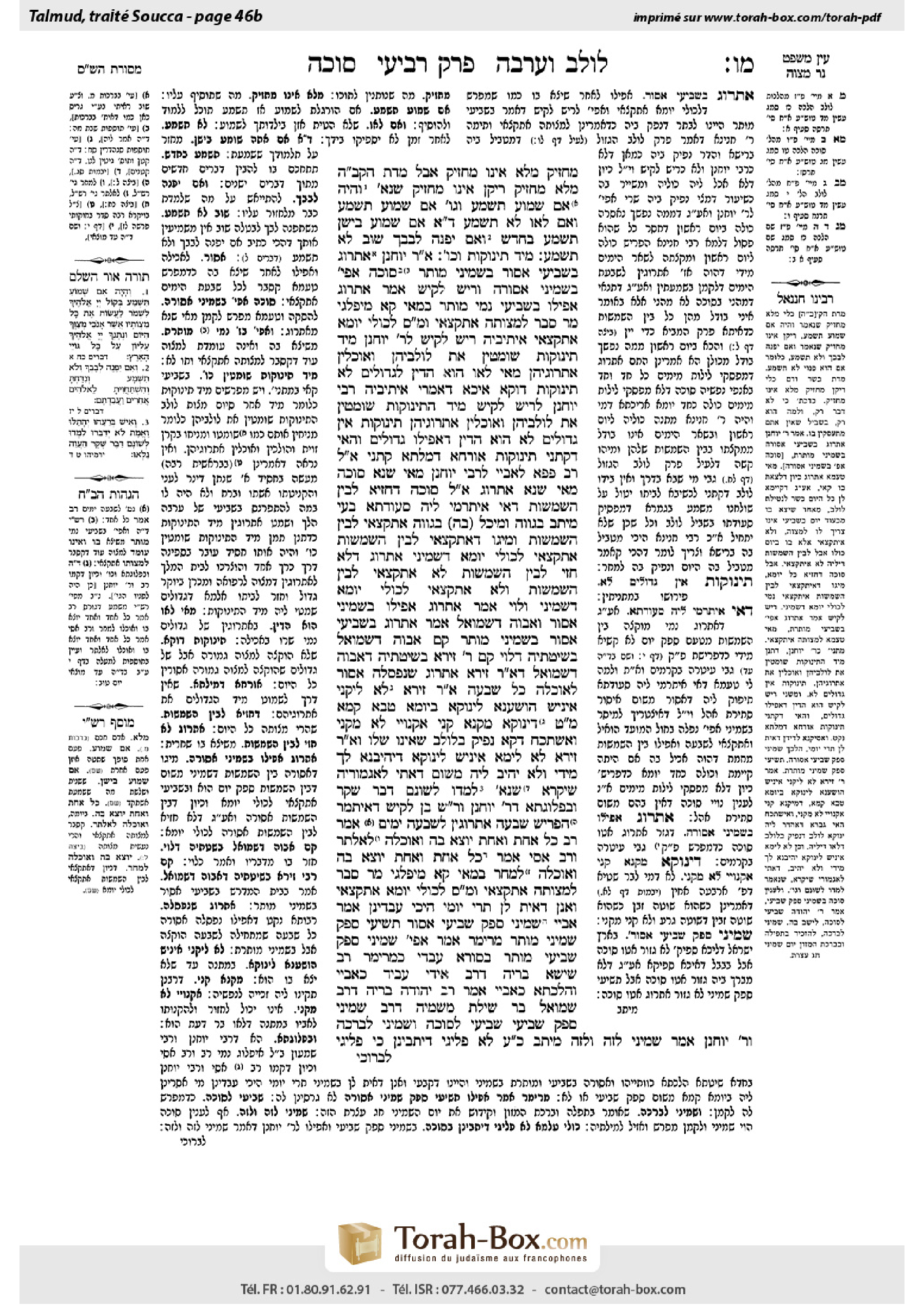
Sukkah 46b: Talmud study for Daf Yomi
Daf Yomi is the daily study of one Talmud folio. Explore 37 tractates with scans, Hebrew text, Sefaria English and AI-generated French translations where annotated.
Passage selection and English or AI-generated French translation are available where the scan has annotations. Daf Study is independent of Torah-Box and Sefaria.
Browse Sukkah · סוכה · All tractatesSukkah 46b text and translations
This page of Sukkah includes the Aramaic text, an English translation and an AI-generated French translation, alongside the scan above.
סוכה מ״ו ב · Aramaic and Hebrew text
מַחֲזִיק, מָלֵא — אֵינוֹ מַחֲזִיק. אֲבָל מִדַּת הַקָּדוֹשׁ בָּרוּךְ הוּא: מָלֵא — מַחֲזִיק, רֵיקָן — אֵינוֹ מַחֲזִיק, שֶׁנֶּאֱמַר: ״וְהָיָה אִם שָׁמוֹעַ תִּשְׁמַע וְגוֹ׳״. ״אִם שָׁמוֹעַ״ — ״תִּשְׁמַע״. וְאִם לָאו — לֹא תִּשְׁמַע. דָּבָר אַחֵר: ״אִם שָׁמוֹעַ״ — בְּיָשָׁן, ״תִּשְׁמַע״ — בְּחָדָשׁ. ״וְאִם יִפְנֶה לְבָבְךָ״ — שׁוּב לֹא תִשְׁמָע.
מִיָּד תִּינוֹקוֹת וְכוּ׳. אָמַר רַבִּי יוֹחָנָן: אֶתְרוֹג בַּשְּׁבִיעִי — אָסוּר, בַּשְּׁמִינִי — מוּתָּר. סוּכָּה — אֲפִילּוּ בַּשְּׁמִינִי, אֲסוּרָה. וְרֵישׁ לָקִישׁ אָמַר: אֶתְרוֹג — אֲפִילּוּ בַּשְּׁבִיעִי נָמֵי מוּתָּר.
בְּמַאי קָא מִיפַּלְגִי? מָר סָבַר: לְמִצְוָתַהּ אִתַּקְצַאי, וּמַר סָבַר: כּוּלֵּי יוֹמָא אִתַּקְצַאי.
אֵיתִיבֵיהּ רֵישׁ לָקִישׁ לְרַבִּי יוֹחָנָן: מִיָּד תִּינוֹקוֹת שׁוֹמְטִין אֶת לוּלְבֵיהֶן וְאוֹכְלִין אֶתְרוֹגֵיהֶן. מַאי לָאו, הוּא הַדִּין לִגְדוֹלִים! לָא, תִּינוֹקוֹת דַּוְקָא.
אִיכָּא דְּאָמְרִי, אֵיתִיבֵיהּ רַבִּי יוֹחָנָן לְרֵישׁ לָקִישׁ: מִיָּד הַתִּינוֹקוֹת שׁוֹמְטִין אֶת לוּלְבֵיהֶן וְאוֹכְלִין אֶתְרוֹגֵיהֶן. תִּינוֹקוֹת — אִין, גְּדוֹלִים לָא! הוּא הַדִּין דַּאֲפִילּוּ גְּדוֹלִים, וְהַאי דְּקָתָנֵי תִּינוֹקוֹת — אוֹרְחָא דְּמִלְּתָא קָתָנֵי.
אֲמַר לֵיהּ רַב פָּפָּא לְאַבָּיֵי: לְרַבִּי יוֹחָנָן, מַאי שְׁנָא סוּכָּה, מַאי שְׁנָא אֶתְרוֹג?
אֲמַר לֵיהּ: סוּכָּה דְּחַזְיָא לְבֵין הַשְּׁמָשׁוֹת, דְּאִי אִיתְרְמִי לֵיהּ סְעוֹדְתָּא בָּעֵי מֵיתַב בְּגַוַּוהּ וּמֵיכַל (בַּהּ) בְּגַוַּוהּ, אִתַּקְצַאי לְבֵין הַשְּׁמָשׁוֹת, וּמִיגּוֹ דְּאִתַּקְצַאי לְבֵין הַשְּׁמָשׁוֹת — אִתַּקְצַאי לְכוּלֵּי יוֹמָא דִּשְׁמִינִי. אֶתְרוֹג, דְּלָא חֲזֵי לְבֵין הַשְּׁמָשׁוֹת — לָא אִתַּקְצַאי לְבֵין הַשְּׁמָשׁוֹת, וְלָא אִתַּקְצַאי לְכוּלֵּי יוֹמָא דִּשְׁמִינִי.
וְלֵוִי אָמַר: אֶתְרוֹג אֲפִילּוּ בַּשְּׁמִינִי אָסוּר, וַאֲבוּהּ דִּשְׁמוּאֵל אָמַר: אֶתְרוֹג בַּשְּׁבִיעִי אָסוּר, בַּשְּׁמִינִי מוּתָּר. קָם אֲבוּהּ דִּשְׁמוּאֵל בְּשִׁיטְתֵיהּ דְּלֵוִי, קָם רַבִּי זֵירָא בְּשִׁיטְתֵיהּ דַּאֲבוּהּ דִּשְׁמוּאֵל. דְּאָמַר רַבִּי זֵירָא: אֶתְרוֹג שֶׁנִּפְסְלָה — אָסוּר לְאוֹכְלָהּ כׇּל שִׁבְעָה.
אָמַר רַבִּי זֵירָא: לָא לִיקְנֵי אִינִישׁ הוֹשַׁעְנָא לְיָנוֹקָא בְּיוֹמָא טָבָא קַמָּא. מַאי טַעְמָא? דְּיָנוֹקָא מִקְנֵא קָנֵי, אַקְנוֹיֵי לָא מַקְנֵי. וְאִשְׁתְּכַח דְּקָא נָפֵיק בְּלוּלָב שֶׁאֵינוֹ שֶׁלּוֹ.
וְאָמַר רַבִּי זֵירָא: לָא לֵימָא אִינִישׁ לְיָנוֹקָא ״דְּיָהֵיבְנָא לָךְ מִידֵּי״ וְלָא יָהֵיב לֵיהּ, מִשּׁוּם דְּאָתֵי לְאַגְמוֹרֵיהּ שִׁיקְרָא, שֶׁנֶּאֱמַר: ״לִמְּדוּ לְשׁוֹנָם דַּבֶּר שֶׁקֶר״.
וּבִפְלוּגְתָּא דְּרַבִּי יוֹחָנָן וְרַבִּי שִׁמְעוֹן בֶּן לָקִישׁ. דְּאִיתְּמַר: הִפְרִישׁ שִׁבְעָה אֶתְרוֹגִין לְשִׁבְעָה יָמִים, אָמַר רַב: כׇּל אַחַת וְאַחַת יוֹצֵא בָּהּ וְאוֹכְלָהּ לְאַלְתַּר, וְרַב אַסִּי אָמַר: כׇּל אַחַת וְאַחַת יוֹצֵא בָּהּ וְאוֹכְלָהּ לְמָחָר. בְּמַאי קָא מִיפַּלְגִי? מָר סָבַר: לְמִצְוָתַהּ אִתַּקְצַאי. וּמַר סָבַר: לְכוּלֵּי יוֹמָא אִתַּקְצַאי.
וַאֲנַן דְּאִית לַן תְּרֵי יוֹמֵי, הֵיכִי עָבְדִינַן? אָמַר אַבָּיֵי: שְׁמִינִי סְפֵק שְׁבִיעִי — אָסוּר, תְּשִׁיעִי סְפֵק שְׁמִינִי — מוּתָּר. מָרִימָר אָמַר: אֲפִילּוּ שְׁמִינִי סְפֵק שְׁבִיעִי — מוּתָּר.
בְּסוּרָא עָבְדִי כְּמָרִימָר, רַב שִׁישָׁא בְּרֵיהּ דְּרַב אִידִי עָבֵיד כְּאַבַּיֵּי. וְהִלְכְתָא כְּאַבַּיֵּי.
אָמַר רַב יְהוּדָה בְּרֵיהּ דְּרַב שְׁמוּאֵל בַּר שִׁילַת מִשְּׁמֵיהּ דְּרַב: שְׁמִינִי סְפֵק שְׁבִיעִי, שְׁבִיעִי לְסוּכָּה וּשְׁמִינִי לִבְרָכָה. וְרַבִּי יוֹחָנָן אָמַר: שְׁמִינִי לָזֶה וְלָזֶה. מֵיתַב כּוּלֵּי עָלְמָא לָא פְּלִיגִי דְּיָתְבִינַן, כִּי פְּלִיגִי
Sukkah 46b · English translation
holds that which is placed within it, while a full vessel does not hold it. However, the attribute of the Holy One, Blessed be He, is: If God adds to someone who is a full vessel in terms of knowledge or good attributes, he holds it; a person who is an empty vessel will not hold it. This is alluded to by the verse where it is stated: “And it shall come to pass, if you will hearken diligently [shamoa tishma] unto the voice of the Lord your God, to observe to do all his commandments” (Deuteronomy 28:1). This verse is interpreted homiletically: If you hearken [shamoa] in the present, you will hearken [tishma] in the future as well; and if not, you will not hearken. Alternatively: If you hearkened to the old, i.e., if you review what you already learned, you will hearken to the new as well. “But if your heart turns away” (Deuteronomy 30:17), you will no longer be able to hearken.
§ The mishna continues: Immediately after fulfilling the mitzva of taking the four species on the seventh day of Sukkot, children remove their lulavim from the binding and eat their etrogim in an expression of extreme joy. Rabbi Yoḥanan said: It is prohibited to derive benefit from the etrog on the seventh day of the festival of Sukkot; however, on the eighth day it is permitted. It is prohibited to derive benefit from the sukka even on the eighth day. And Reish Lakish said: It is permitted to derive benefit from the etrog even on the seventh day, once the mitzva has been fulfilled.
The Gemara asks: With regard to what do they disagree? One Sage, Reish Lakish, holds that the etrog was set aside for its mitzva; once the mitzva has been fulfilled there is no legal barrier to eating the etrog on the seventh day. And one Sage, Rabbi Yoḥanan, holds that the etrog was set aside for the entire day. Therefore, one may not derive benefit from it even after he fulfills the mitzva.
Reish Lakish raised an objection to the opinion of Rabbi Yoḥanan from the mishna: Immediately after fulfilling the mitzva, children remove their lulavim from the binding and eat their etrogim. What, is it not that the same is true for etrogim belonging to adults, and it would be permitted to eat those as well? Apparently, it is permitted to derive benefit from the etrog immediately after the mitzva is performed. Rabbi Yoḥanan rejected this: No, the mishna is referring to children specifically, who are not obligated by Torah law to fulfill the mitzva. However, etrogim belonging to adults were set aside for the entire day.
Some say another version of the exchange between Rabbi Yoḥanan and Reish Lakish. Rabbi Yoḥanan raised an objection to the opinion of Reish Lakish from mishna: Immediately after fulfilling the mitzva, children remove their lulavim from the binding and eat their etrogim. One can conclude by inference: Etrogim belonging to children, yes, they may be eaten; etrogim belonging to adults, no, they may not be eaten until the conclusion of the Festival. Reish Lakish responded: The same is true for etrogim belonging to adults, i.e., it would be permitted to eat those as well, and the reason that the mishna is teaching specifically about etrogim belonging to children is that it is teaching the manner in which the matter typically occurs, because children are entertained by eating the etrogim.
Rav Pappa said to Abaye: According to Rabbi Yoḥanan, who holds that an object set aside for a mitzva is set aside for the entire day, what is different with regard to a sukka such that it is prohibited even on the eighth day, and what is different with regard to an etrog?
Abaye said to him: With regard to a sukka, it is suitable for use even during twilight at the end of the seventh day, as, if a meal happens to present itself to him at that time, he is required to sit in the sukka and eat in the sukka. Therefore, the sukka is set aside for the mitzva for the twilight period, and since it is set aside for the twilight period, it is set aside for the entire eighth day. Since the status of the twilight period is uncertain, it may be the evening of the eighth day, and once it is set aside for the potential start of the eighth day, it is set aside for the entire eighth day. However, with regard to an etrog, which, once the mitzva has been fulfilled, is not suitable for use during the twilight period, it is not set aside during the twilight period. Since it was not set aside then, it is not set aside for the entire eighth day.
And Levi said: It is prohibited to use the etrog even on the eighth day. The father of Shmuel said: It is prohibited to use the etrog on the seventh day, and it is permitted on the eighth day. The Gemara notes that ultimately, the father of Shmuel reconsidered his opinion and assumed the opinion of Levi. Rabbi Zeira, however, assumed the opinion of the father of Shmuel, as Rabbi Zeira said: With regard to an etrog that was rendered unfit for any reason, it is prohibited to eat it all seven days, as it was set aside for the mitzva until the end of the Festival.
Rabbi Zeira said: A person should not transfer ownership of the four species to a child by means of a gift on the first day of the Festival. What is the rationale for this halakha? It is due to the fact with regard to acquisition, a child is able to acquire objects; however, with regard to transferring ownership, he is not able to transfer ownership to others. In other words, a child is legally able to acquire an item given to him, but he does not have the legal cognizance to transfer ownership of an item to another. In this case, if an adult gives the child the four species as a gift before having fulfilled the mitzva himself, the child will be unable to effect the transfer of ownership back to the adult. And in that case, a situation will result where the adult is seeking to fulfill his obligation with a lulav that is not his.
And Rabbi Zeira said: A person should not say to a child: I will give you something, and then not give it to him, because he thereby comes to teach him about lying, as it is stated: “They have taught their tongues to speak lies” (Jeremiah 9:4). One must not accustom a child to fail to honor commitments.
The Gemara notes: And other amora’im disagree with regard to the matter of the dispute of Rabbi Yoḥanan and Rabbi Shimon ben Lakish, as it was stated: If one designated seven etrogim for the seven days of the Festival. Rav said: With each and every one, he fulfills his obligation with it and he may then eat it immediately. And Rav Asi said: With each and every one, he fulfills his obligation with it and he may then eat it the following day. With regard to what principle do they disagree? One Sage, Rav, holds: The etrog was set aside for the mitzva; once the mitzva has been fulfilled it is no longer prohibited to derive benefit from the item. The other Sage, Rav Asi, holds: It was set aside for the entire day. Deriving benefit from the etrog remains prohibited until the end of the day, even after one has fulfilled the mitzva.
The Gemara asks: And we, who live outside of Eretz Yisrael, who have two days of the Festival due to uncertainty whether the eighth day is actually the seventh day of Sukkot, how do we act with regard to deriving benefit from the four species? Abaye said: On the eighth day, with regard to which there is uncertainty that it might be the seventh day, it is prohibited, as due to that uncertainty, the day retains the sanctity of Sukkot. However, on the ninth day, with regard to which there is uncertainty as it might be the eighth day, it is certainly permitted. Mareimar said: Even on the eighth day, with regard to which there is uncertainty that it might be the seventh day, it is permitted. Since that is also the first day of the Eighth Day of Assembly, no vestige of the sanctity of the festival of Sukkot is attached to it.
The Gemara notes: In Sura they acted in accordance with the opinion of Mareimar and derived benefit from the etrog on the eighth day. Rav Sheisha, son of Rav Idi, acted in accordance with the opinion of Abaye. The Gemara notes: The halakha is in accordance with the opinion of Abaye.
§ Apropos the matter of the Eighth Day of Assembly in the Diaspora, the Gemara notes: Rav Yehuda, son of Rav Shmuel bar Sheilat, said in the name of Rav: Outside of Eretz Yisrael, on the eighth day, with regard to which there is uncertainty that it might be the seventh day of Sukkot, its status is like that of the seventh day with regard to the mitzva of sukka and like that of the eighth day with regard to the blessing, i.e., in Grace after Meals, in kiddush, and in the Amida prayer, the Eighth Day of Assembly is mentioned. Rabbi Yoḥanan said: Its status is like that of the eighth day both with regard to this, the mitzva of sukka, and to that, the blessing. The Gemara explains: Everyone, even Rabbi Yoḥanan, agrees that we reside in the sukka on the eighth day, with regard to which there is uncertainty that it might be the seventh day. When they disagree is
Sukkah 46b · Traduction française (IA)
retient ce qui y est placé, tandis qu’un récipient plein ne le retient pas. Cependant, le Saint, béni soit-Il, agit ainsi : s’Il ajoute à quelqu’un qui est un récipient plein de connaissances ou de bonnes qualités, celui-ci le retient ; une personne qui est un récipient vide ne le retient pas. Cela est suggéré par le verset : « Et il arrivera, si tu écoutes attentivement [shamoa tishma] la voix de l’Éternel, ton Dieu, en veillant à observer tous ses commandements » (Deutéronome 28:1). Ce verset est interprété de manière homilétique : si tu écoutes [shamoa] maintenant, tu écouteras [tishma] également à l’avenir ; sinon, tu n’écouteras pas. Autre interprétation : si tu as écouté ce qui est ancien, c’est-à-dire si tu révises ce que tu as déjà appris, tu écouteras également ce qui est nouveau. « Mais si ton cœur se détourne » (Deutéronome 30:17), tu ne seras plus en mesure d’écouter.
§ La Michna poursuit : Aussitôt après avoir accompli la mitsva de prendre les quatre espèces le septième jour de Souccot, les enfants détachent leurs loulavim de leur ligature et mangent leurs étrogim, dans une manifestation de joie extrême. Rabbi Yoḥanan a dit : Il est interdit de tirer profit de l’étrog le septième jour de la fête de Souccot ; toutefois, le huitième jour, cela est permis. Il est interdit de tirer profit de la soucca, même le huitième jour. Reish Lakish a dit : Il est permis de tirer profit de l’étrog même le septième jour, une fois la mitsva accomplie.
La Guemara demande : Sur quoi porte leur désaccord ? Un Sage, Reish Lakish, estime que l’étrog a été mis à part pour la mitsva ; une fois celle-ci accomplie, aucun obstacle juridique n’empêche de manger l’étrog le septième jour. L’autre Sage, Rabbi Yoḥanan, estime que l’étrog a été mis à part pour toute la journée. Par conséquent, il est interdit d’en tirer profit, même après avoir accompli la mitsva.
Reish Lakish soulève une objection à l’opinion de Rabbi Yoḥanan à partir de la Michna : Aussitôt après avoir accompli la mitsva, les enfants détachent leurs loulavim de leur ligature et mangent leurs étrogim. N’est-il pas vrai qu’il en va de même pour les étrogim des adultes, et qu’il serait également permis de les manger ? Apparemment, il est permis de tirer profit de l’étrog aussitôt après l’accomplissement de la mitsva. Rabbi Yoḥanan rejette cette objection : Non, la Michna parle spécifiquement des enfants, qui ne sont pas tenus par la Torah d’accomplir la mitsva. En revanche, les étrogim des adultes ont été mis à part pour toute la journée.
Certains rapportent une autre version de l’échange entre Rabbi Yoḥanan et Reish Lakish. Rabbi Yoḥanan soulève une objection à l’opinion de Reish Lakish à partir de la Michna : Aussitôt après avoir accompli la mitsva, les enfants détachent leurs loulavim de leur ligature et mangent leurs étrogim. On peut en déduire que les étrogim des enfants, oui, peuvent être mangés ; ceux des adultes, non, ne peuvent pas l’être avant la fin de la fête. Reish Lakish répond : Il en va de même pour les étrogim des adultes, c’est-à-dire qu’il serait également permis de les manger. Si la Michna enseigne spécifiquement le cas des étrogim des enfants, c’est parce qu’elle décrit la situation habituelle : les enfants prennent plaisir à manger les étrogim.
Rav Pappa dit à Abaye : Selon Rabbi Yoḥanan, qui estime qu’un objet mis à part pour une mitsva l’est pour toute la journée, en quoi la soucca diffère-t-elle, de sorte qu’il est interdit d’en tirer profit même le huitième jour, et en quoi l’étrog est-il différent ?
Abaye lui dit : La soucca peut encore être utilisée pendant le crépuscule à la fin du septième jour ; en effet, si l’occasion se présente alors de prendre un repas, on est tenu de s’asseoir dans la soucca et d’y manger. La soucca est donc mise à part pour la mitsva pendant le crépuscule et, puisqu’elle l’est à ce moment-là, elle l’est pour toute la journée du huitième jour. Le statut du crépuscule étant incertain, celui-ci peut correspondre au début du huitième jour ; et dès lors qu’elle est mise à part en prévision du début éventuel du huitième jour, elle l’est pour toute cette journée. En revanche, l’étrog, qui, une fois la mitsva accomplie, ne peut plus être utilisé pendant le crépuscule, n’est pas mis à part durant cette période. Puisqu’il ne l’était pas alors, il n’est pas mis à part pour toute la journée du huitième jour.
Levi a dit : Il est interdit d’utiliser l’étrog, même le huitième jour. Le père de Shmuel a dit : Il est interdit d’utiliser l’étrog le septième jour, mais cela est permis le huitième jour. La Guemara note que, finalement, le père de Shmuel est revenu sur son opinion et a adopté celle de Levi. Rabbi Zeira, cependant, a adopté l’opinion du père de Shmuel, car Rabbi Zeira a dit : Il est interdit de manger un étrog qui, pour quelque raison que ce soit, est devenu impropre pendant les sept jours, puisqu’il a été mis à part pour la mitsva jusqu’à la fin de la fête.
Rabbi Zeira a dit : Une personne ne doit pas transférer la propriété des quatre espèces à un enfant au moyen d’un don le premier jour de la fête. Quelle est la raison de cette halakha ? C’est que, s’agissant d’acquérir, un enfant est capable d’acquérir des objets ; en revanche, s’agissant d’en transférer la propriété, il n’est pas capable de la transférer à autrui. Autrement dit, un enfant est juridiquement capable d’acquérir un objet qui lui est donné, mais il n’a pas la capacité juridique de transférer la propriété d’un objet à quelqu’un d’autre. Ainsi, si un adulte donne les quatre espèces à l’enfant avant d’avoir lui-même accompli la mitsva, l’enfant ne pourra pas lui en retransférer la propriété. Il en résultera que l’adulte cherchera à s’acquitter de son obligation avec un loulav qui ne lui appartient pas.
Rabbi Zeira a également dit : Une personne ne doit pas dire à un enfant : « Je te donnerai quelque chose », puis ne pas le lui donner, car elle lui apprend ainsi à mentir, comme il est dit : « Ils ont enseigné à leur langue à dire des mensonges » (Jérémie 9:4). Il ne faut pas habituer un enfant à ne pas tenir ses engagements.
La Guemara note que d’autres amoraïm sont en désaccord sur la question qui oppose Rabbi Yoḥanan et Rabbi Shimon ben Lakish, comme il a été rapporté : Si quelqu’un a désigné sept étrogim pour les sept jours de la fête, Rav a dit : Avec chacun d’eux, il accomplit son obligation, puis peut le manger immédiatement. Rav Asi a dit : Avec chacun d’eux, il accomplit son obligation, puis peut le manger le lendemain. Sur quel principe porte leur désaccord ? Un Sage, Rav, estime que l’étrog a été mis à part pour la mitsva ; une fois celle-ci accomplie, il n’est plus interdit de tirer profit de l’objet. L’autre Sage, Rav Asi, estime qu’il a été mis à part pour toute la journée. Il demeure donc interdit de tirer profit de l’étrog jusqu’à la fin de la journée, même après avoir accompli la mitsva.
La Guemara demande : Et nous, qui vivons hors d’Eretz Yisrael et célébrons deux jours de fête, en raison de l’incertitude quant au fait que le huitième jour soit en réalité le septième jour de Souccot, comment devons-nous agir concernant l’usage des quatre espèces ? Abaye a dit : Le huitième jour, dont on ne sait pas avec certitude s’il pourrait être le septième jour, il est interdit d’en tirer profit, car, en raison de cette incertitude, ce jour conserve la sainteté de Souccot. En revanche, le neuvième jour, dont on ne sait pas avec certitude s’il pourrait être le huitième jour, il est certainement permis d’en tirer profit. Mareimar a dit : Même le huitième jour, dont on ne sait pas avec certitude s’il pourrait être le septième jour, il est permis d’en tirer profit. Puisqu’il s’agit également du premier jour de Chemini Atseret, aucune trace de la sainteté de la fête de Souccot ne s’y attache.
La Guemara note qu’à Soura, on suivait l’opinion de Mareimar et on tirait profit de l’étrog le huitième jour. Rav Sheisha, fils de Rav Idi, suivait l’opinion d’Abaye. La Guemara note que la halakha est conforme à l’opinion d’Abaye.
§ À propos de Chemini Atseret en Diaspora, la Guemara note : Rav Yehuda, fils de Rav Shmuel bar Sheilat, a dit au nom de Rav : Hors d’Eretz Yisrael, le huitième jour, dont on ne sait pas avec certitude s’il pourrait être le septième jour de Souccot, a le statut du septième jour concernant la mitsva de soucca et celui du huitième jour concernant la bénédiction, c’est-à-dire que, dans le Birkat Hamazon, le kiddouch et la prière de la Amida, on mentionne Chemini Atseret. Rabbi Yoḥanan a dit : Il a le statut du huitième jour aussi bien pour ceci, la mitsva de soucca, que pour cela, la bénédiction. La Guemara explique : Tous conviennent, même Rabbi Yoḥanan, que l’on réside dans la soucca le huitième jour, dont on ne sait pas avec certitude s’il pourrait être le septième jour. Le désaccord porte sur
Traduction française générée par IA à partir de l’édition anglaise de Sefaria. Vérifie toujours un passage avec le texte source.
Text from Sefaria: William Davidson Edition - Vocalized Aramaic (CC BY NC); William Davidson Edition - English (CC BY NC).