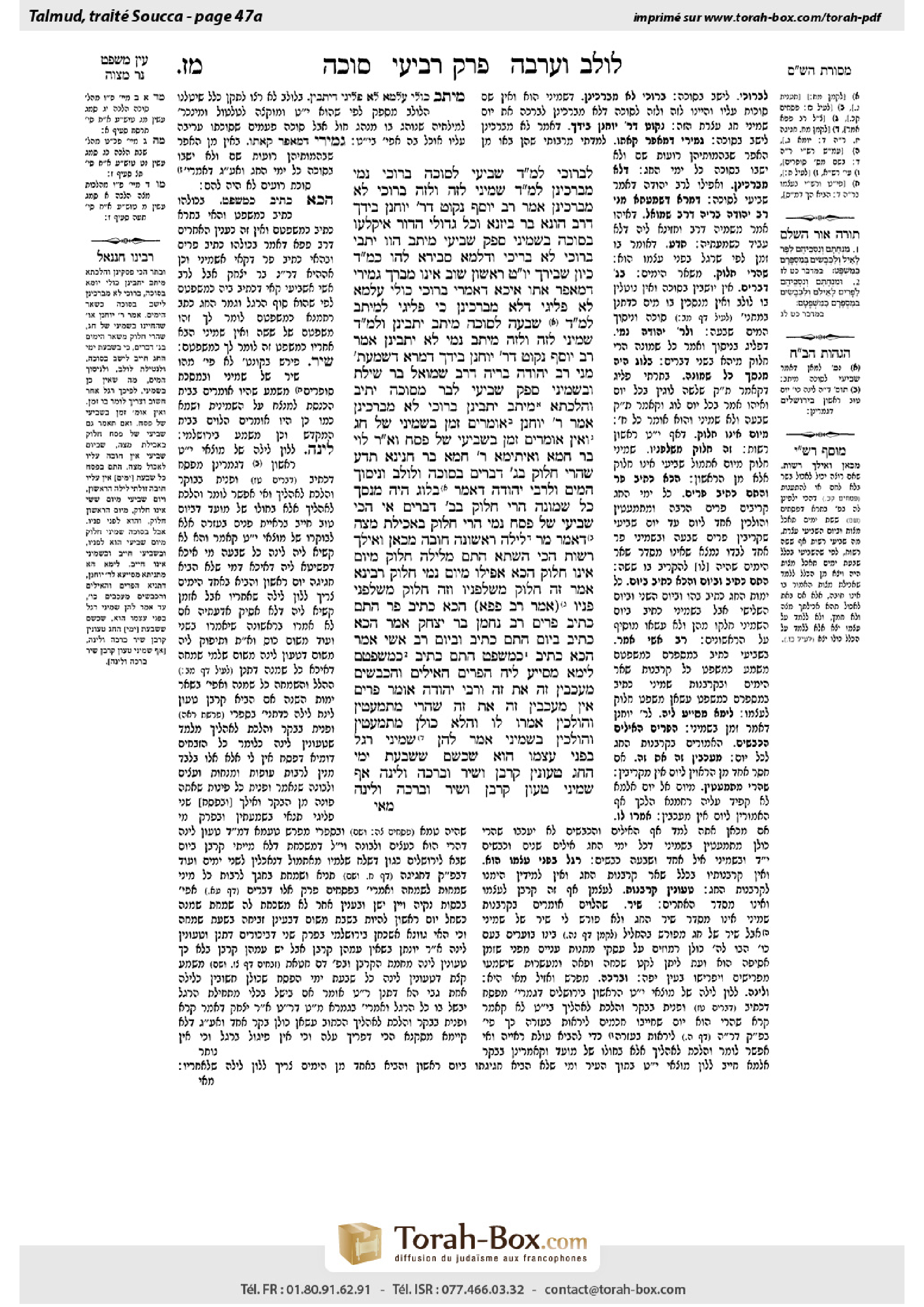
Sukkah 47a: Talmud study for Daf Yomi
Daf Yomi is the daily study of one Talmud folio. Explore 37 tractates with scans, Hebrew text, Sefaria English and AI-generated French translations where annotated.
Passage selection and English or AI-generated French translation are available where the scan has annotations. Daf Study is independent of Torah-Box and Sefaria.
Browse Sukkah · סוכה · All tractatesSukkah 47a text and translations
This page of Sukkah includes the Aramaic text, an English translation and an AI-generated French translation, alongside the scan above.
סוכה מ״ז א · Aramaic and Hebrew text
לְבָרוֹכֵי. לְמַאן דְּאָמַר שְׁבִיעִי לְסוּכָּה — בָּרוֹכֵי נָמֵי מְבָרְכִינַן, לְמַאן דְּאָמַר שְׁמִינִי לָזֶה וְלָזֶה — בָּרוֹכֵי לָא מְבָרְכִינַן. אָמַר רַב יוֹסֵף: נְקוֹט דְּרַבִּי יוֹחָנָן בְּיָדְךָ, דְּרַב הוּנָא בַּר בִּיזְנָא וְכׇל גְּדוֹלֵי הַדּוֹר אִיקְּלַעוּ בְּסוּכָּה בִּשְׁמִינִי סְפֵק שְׁבִיעִי. מֵיתַב הֲווֹ יָתְבִי, בָּרוֹכֵי לָא בָּרִיכוּ.
וְדִלְמָא סְבִירָא לְהוּ כְּמַאן דְּאָמַר: כֵּיוָן שֶׁבֵּירַךְ יוֹם טוֹב רִאשׁוֹן שׁוּב אֵינוֹ מְבָרֵךְ? גְּמִירִי דְּמֵאֲפָר אֲתוֹ.
אִיכָּא דְּאָמְרִי: בָּרוֹכֵי — כּוּלֵּי עָלְמָא לָא פְּלִיגִי דְּלָא מְבָרְכִינַן. כִּי פְּלִיגִי, לְמֵיתַב. לְמַאן דְּאָמַר שִׁבְעָה לְסוּכָּה — מֵיתַב יָתְבִינַן, וּלְמַאן דְּאָמַר שְׁמִינִי לָזֶה וְלָזֶה — מֵיתַב נָמֵי לָא יָתְבִינַן. אָמַר רַב יוֹסֵף: נְקוֹט דְּרַבִּי יוֹחָנָן בִּידָךְ, דְּמָרָא דִשְׁמַעְתָּא מַנִּי — רַב יְהוּדָה בְּרֵיהּ דְּרַב שְׁמוּאֵל בַּר שִׁילַת, וּבִשְׁמִינִי סְפֵק שְׁבִיעִי לְבַר מִסּוּכָּה יָתֵיב. וְהִלְכְתָא: מֵיתַב יָתְבִינַן, בָּרוֹכֵי לָא מְבָרְכִינַן.
אָמַר רַבִּי יוֹחָנָן: אוֹמְרִים זְמַן בִּשְׁמִינִי שֶׁל חַג, וְאֵין אוֹמְרִים זְמַן בִּשְׁבִיעִי שֶׁל פֶּסַח.
וְאָמַר רַבִּי לֵוִי בַּר חָמָא וְאִיתֵּימָא רַבִּי חָמָא בַּר חֲנִינָא: תֵּדַע, שֶׁהֲרֵי חָלוּק בִּשְׁלֹשָׁה דְּבָרִים: בְּסוּכָּה, וְלוּלָב, וְנִיסּוּךְ הַמַּיִם. וּלְרַבִּי יְהוּדָה דְּאָמַר: בַּלּוֹג הָיָה מְנַסֵּךְ כׇּל שְׁמוֹנָה, הֲרֵי חָלוּק בִּשְׁנֵי דְּבָרִים.
אִי הָכִי, שְׁבִיעִי שֶׁל פֶּסַח נָמֵי: הֲרֵי חָלוּק בַּאֲכִילַת מַצָּה! דְּאָמַר מָר: לַיְלָה רִאשׁוֹנָה — חוֹבָה, מִכָּאן וְאֵילָךְ רְשׁוּת. הָכִי הַשְׁתָּא?! הָתָם — מִלַּיְלָה חָלוּק, מִיּוֹם אֵינוֹ חָלוּק. הָכָא — אֲפִילּוּ מִיּוֹם נָמֵי חָלוּק.
רָבִינָא אָמַר: זֶה חָלוּק מִשֶּׁלְּפָנָיו, וְזֶה חָלוּק מִשֶּׁלִּפְנֵי פָנָיו.
(אָמַר רַב פָּפָּא): הָכָא כְּתִיב ״פַּר״, הָתָם כְּתִיב ״פָּרִים״.
רַב נַחְמָן בַּר יִצְחָק אָמַר, הָכָא כְּתִיב: ״בַּיּוֹם״, הָתָם כְּתִיב: ״וּבַיּוֹם״.
רַב אָשֵׁי אָמַר, הָכָא כְּתִיב: ״כַּמִּשְׁפָּט״, הָתָם כְּתִיב: ״כְּמִשְׁפָּטָם״.
לֵימָא מְסַיַּיע לֵיהּ: הַפָּרִים הָאֵילִים וְהַכְּבָשִׂים, מְעַכְּבִין זֶה אֶת זֶה. וְרַבִּי יְהוּדָה אוֹמֵר: פָּרִים אֵין מְעַכְּבִין זֶה אֶת זֶה, שֶׁהֲרֵי מִתְמַעֲטִין וְהוֹלְכִין.
אָמְרוּ לוֹ: וַהֲלֹא כּוּלָּן מִתְמַעֲטִין וְהוֹלְכִין בַּשְּׁמִינִי! אָמַר לָהֶן: שְׁמִינִי רֶגֶל בִּפְנֵי עַצְמוֹ הוּא. שֶׁכְּשֵׁם שֶׁשִּׁבְעַת יְמֵי הַחַג טְעוּנִין קׇרְבָּן וְשִׁיר וּבְרָכָה וְלִינָה, אַף שְׁמִינִי טָעוּן קׇרְבָּן וְשִׁיר וּבְרָכָה וְלִינָה.
Sukkah 47a · English translation
with regard to whether or not to recite the blessing over residing in the sukka. According to the one who says that the status of the eighth day is like that of the seventh day with regard to the mitzva of sukka, we also recite the blessing: To reside in the sukka. However, according to the one who says that its status is like that of the eighth day both with regard to this and to that, we do not recite the blessing. Rav Yosef said: Take the statement of Rabbi Yoḥanan that on the eighth day outside Eretz Yisrael one does not recite the blessing: To reside in the sukka, in your hand, i.e., adopt it as your practice. As Rav Huna bar Bizna and all the prominent scholars of the generation happened to visit a sukka on the eighth day, with regard to which there was uncertainty that it might be the seventh day, and they were sitting in the sukka, but they did not recite the blessing.
The Gemara suggests: And perhaps the reason they did not recite a blessing is that they hold in accordance with the opinion of the one who said: Once he recited the blessing on the first Festival day he does not recite it again on the subsequent days, and not because it was the eighth day. The Gemara answers: That is not the reason that they did not recite the blessing, as the Sages learned through tradition that these Sages were coming from the fields, where they had been herding their flocks, and that was the first time during the Festival that they sat in a sukka.
Some say a different version of the dispute: Everyone agrees that we do not recite the blessing; when they disagree it is with regard to whether to reside in the sukka. According to the one who says that the status of the eighth day is like that of the seventh day with regard to the mitzva of sukka, we reside in the sukka. However, according to the one who says that its status is like that of the eighth day both with regard to this and to that, neither do we reside in the sukka. Rav Yosef said: Take the statement of Rabbi Yoḥanan in your hand, as who is the Master responsible for dissemination of the halakha? It is Rav Yehuda, son of Rav Shmuel bar Sheilat, and on the eighth day, with regard to which there is uncertainty that it might be the seventh day, he himself resides outside of the sukka. The Gemara concludes: And the halakha is that we reside in the sukka on the eighth day, with regard to which there is uncertainty that it might be the seventh day, but we do not recite the blessing.
§ Rabbi Yoḥanan said that one recites the blessing: Who has given us life, sustained us, and brought us to this time, on the eighth day of the Festival, as the eighth day is a Festival distinct from Sukkot, and one does not recite the blessing of time on the seventh day of Passover because it is not a Festival distinct from Passover.
And Rabbi Levi bar Ḥama said, and some say it was Rabbi Ḥama bar Ḥanina who said: Know that the eighth day of Sukkot is a Festival in and of itself and therefore requires its own blessing, as it is distinct from the seven days of Sukkot with regard to three matters: With regard to sukka, as one is not obligated to sit in the sukka on the eighth day; and with regard to lulav, as one is not obligated to take the four species on the eighth day; and with regard to the water libation, as one does not pour the water libation on the altar on the eighth day. The Gemara notes: And according to Rabbi Yehuda, who said: With a vessel measuring one log the priest pours the water libation all eight days, including the eighth day, the eighth day is nevertheless distinct from the rest of the Festival with regard to the other two matters.
The Gemara asks: If so, the seventh day of Passover should be considered distinct as well, as it is distinct from the first day in terms of the obligation of eating matza, as the Master said: On the first night of Passover, it is an obligation to eat matza. From that point onward, it is optional; if one chooses, he eats matza, and if he chooses not to eat matza, he need not, provided that he does not eat leavened foods. The Gemara retorts: How can these cases be compared? There, in the case of Passover, the halakha of the seventh day is distinct from the first night; however, it is not distinct from the first day, as on the first day there is no obligation to eat matza. Here, in the case of Sukkot, the eighth day of the Festival is distinct even from the first day.
Ravina said a different reason for the distinction between the two Festivals: This, the eighth day of Sukkot, is distinct in terms of its halakhot, even from the day just before it, the seventh day. However, that, the seventh day of Passover, is distinct in terms of its halakhot, only from a day previous to the day before, i.e., the first day alone. There is no distinction between the sixth and seventh days.
Rav Pappa said another reason why the eighth day of Sukkot is considered a distinct Festival. Here, with regard to the additional offering sacrificed on the Eighth Day of Assembly, it is written: “And you shall present a burnt-offering, an offering made by fire, of a sweet savor unto the Lord: One bull” (Numbers 29:36). There, with regard to the additional offering sacrificed on the first day of Sukkot, it is written: “And you shall present a burnt-offering, an offering made by fire, of a sweet savor unto the Lord: Thirteen bulls” (Numbers 29:13), and on each subsequent day one bull fewer is sacrificed: Twelve on the second day, eleven on the third day, and so on, until seven are sacrificed on the seventh day. Were the eighth day part of the festival of Sukkot, the additional offering on that day should have included six bulls. The fact that it includes only one bull indicates that it is a distinct Festival.
Rav Naḥman bar Yitzḥak said: Here, it is written: “On the eighth day you shall have a solemn assembly; you shall do no manner of servile labor” (Numbers 29:35). This indicates that this day is distinct from the others, as there, with regard to the other days of Sukkot, it is written: And on the day, indicating that each of the days from the second through the seventh are all continuations of the first day.
Rav Ashi said: Here, with regard to the eighth day, it is written: “Their meal-offering and their libations, for the bull, for the ram, and for the lambs, shall be according to their number, as per the regulation” (Numbers 29:37). However, there, with regard to the seventh day, it is written: “And their meal-offering and their libations, for the bulls, and for the rams, and for the lambs, according to their number, as per their regulation” (Numbers 29:33). The Gemara understands the use of the plural pronoun: Their, to indicate that the offerings sacrificed on all seven days are related.
The Gemara asks: Let us say that the following supports the opinion of Rabbi Yoḥanan that one recites the blessing of time on the eighth day. Failure to bring either the bulls, or the rams, or the sheep on the Festival prevents fulfillment of one’s obligation with the other animals, as they are considered one offering. Rabbi Yehuda says: Failure to bring the bulls does not prevent fulfillment of one’s obligation with the other animals, since they decrease progressively each day. The Torah displays flexibility with regard to the bulls. Therefore, apparently, even if they are not brought at all one fulfills his obligation with the others.
The Sages said to Rabbi Yehuda: But don’t the numbers of all the animals eventually decrease on the eighth day, as on the other days two rams and fourteen sheep are sacrificed and on the eighth day it is one ram and seven sheep? Rabbi Yehuda said to them: The Eighth Day of Assembly is a Festival in and of itself. As just as the seven days of the festival of Sukkot require an offering, and a song sung by the Levites, and a blessing unique to the festival of Sukkot, and there is a mitzva of staying overnight in Jerusalem after the first Festival day, so too, the eighth day requires an offering, and a song sung by the Levites, and a blessing unique to the Eighth Day of Assembly, and there is a mitzva of staying overnight in Jerusalem at its conclusion.
Sukkah 47a · Traduction française (IA)
sur la question de savoir s’il faut réciter ou non la bénédiction pour résider dans la soukka. Selon celui qui dit que le statut du huitième jour est semblable à celui du septième en ce qui concerne la mitsva de la soukka, on récite également la bénédiction « Résider dans la soukka ». En revanche, selon celui qui dit que son statut est semblable à celui du huitième jour à ces deux égards, on ne récite pas la bénédiction. Rav Yosef dit : « Gardez en mémoire la déclaration de Rabbi Yoḥanan selon laquelle, le huitième jour en dehors d’Eretz Israël, on ne récite pas la bénédiction “Résider dans la soukka” ; adoptez-la comme pratique. » En effet, Rav Huna bar Bizna et tous les éminents sages de la génération se trouvèrent dans une soukka le huitième jour, alors qu’il y avait un doute quant au fait qu’il puisse s’agir du septième jour, et ils y étaient assis, mais ne récitèrent pas la bénédiction.
La Guemara suggère : Peut-être ne récitèrent-ils pas la bénédiction parce qu’ils suivent l’opinion de celui qui dit : Après avoir récité la bénédiction le premier jour de fête, on ne la récite pas de nouveau les jours suivants, et non parce que c’était le huitième jour. La Guemara répond : Ce n’est pas la raison pour laquelle ils ne récitèrent pas la bénédiction, car les Sages avaient appris par tradition que ces sages revenaient des champs, où ils avaient fait paître leurs troupeaux, et que c’était la première fois de la fête qu’ils s’asseyaient dans une soukka.
Certains rapportent une autre version de la controverse : tous conviennent qu’on ne récite pas la bénédiction ; leur désaccord porte sur la question de savoir s’il faut résider dans la soukka. Selon celui qui dit que le statut du huitième jour est semblable à celui du septième en ce qui concerne la mitsva de la soukka, on réside dans la soukka. En revanche, selon celui qui dit que son statut est semblable à celui du huitième jour à ces deux égards, on n’y réside pas non plus. Rav Yosef dit : « Gardez en mémoire la déclaration de Rabbi Yoḥanan. » Car qui est le maître chargé de transmettre la halakha ? C’est Rav Yehuda, fils de Rav Shmuel bar Sheilat, et, le huitième jour où l’on doute qu’il puisse s’agir du septième, lui-même réside en dehors de la soukka. La Guemara conclut : La halakha est que l’on réside dans la soukka le huitième jour où l’on doute qu’il puisse s’agir du septième, mais qu’on ne récite pas la bénédiction.
§ Rabbi Yoḥanan dit qu’on récite la bénédiction « qui nous a fait vivre, nous a soutenus et nous a fait parvenir à cette époque » le huitième jour de la fête, car ce jour est une fête distincte de Soukkot ; on ne récite pas la bénédiction du temps le septième jour de Pessaḥ, car celui-ci n’est pas une fête distincte de Pessaḥ.
Et Rabbi Levi bar Ḥama dit — certains attribuent cette déclaration à Rabbi Ḥama bar Ḥanina : Sache que le huitième jour de Soukkot est une fête à part entière et requiert donc sa propre bénédiction, car il se distingue des sept jours de Soukkot à trois égards : en ce qui concerne la soukka, car on n’est pas tenu de s’y asseoir le huitième jour ; en ce qui concerne le loulav, car on n’est pas tenu de prendre les quatre espèces ce jour-là ; et en ce qui concerne la libation d’eau, car on ne verse pas d’eau en libation sur l’autel le huitième jour. La Guemara note : Même selon Rabbi Yehuda, qui dit que le prêtre verse la libation d’eau au moyen d’un récipient d’un log pendant les huit jours, y compris le huitième, ce dernier se distingue néanmoins du reste de la fête à deux autres égards.
La Guemara demande : Si tel est le cas, le septième jour de Pessaḥ devrait lui aussi être considéré comme distinct, puisqu’il se distingue du premier jour par l’obligation de manger de la matsa ; en effet, le Maître a dit : La première nuit de Pessaḥ, il est obligatoire de manger de la matsa. À partir de là, c’est facultatif : si l’on choisit d’en manger, on en mange, et si l’on choisit de ne pas en manger, on n’y est pas tenu, à condition de ne pas manger de produits levés. La Guemara rétorque : Comment comparer ces cas ? Là-bas, dans le cas de Pessaḥ, la halakha du septième jour se distingue de celle de la première nuit ; toutefois, elle ne se distingue pas de celle du premier jour, car ce premier jour, il n’y a pas d’obligation de manger de la matsa. Ici, dans le cas de Soukkot, le huitième jour de la fête se distingue même du premier jour.
Ravina donne une autre raison à la distinction entre les deux fêtes : ici, le huitième jour de Soukkot se distingue par ses halakhot même du jour qui le précède, le septième. Là-bas, le septième jour de Pessaḥ ne se distingue par ses halakhot que d’un jour antérieur au jour qui le précède, c’est-à-dire du premier jour seulement. Il n’y a pas de distinction entre le sixième et le septième jour.
Rav Pappa donne une autre raison pour laquelle le huitième jour de Soukkot est considéré comme une fête distincte. Ici, au sujet du sacrifice supplémentaire offert le huitième jour de l’Assemblée, il est écrit : « Vous présenterez un holocauste, une offrande consumée par le feu, d’une odeur agréable pour le Seigneur : un taureau » (Nombres 29, 36). Là-bas, au sujet du sacrifice supplémentaire offert le premier jour de Soukkot, il est écrit : « Vous présenterez un holocauste, une offrande consumée par le feu, d’une odeur agréable pour le Seigneur : treize taureaux » (Nombres 29, 13), et chaque jour suivant, on offre un taureau de moins : douze le deuxième jour, onze le troisième, et ainsi de suite, jusqu’à en offrir sept le septième jour. Si le huitième jour faisait partie de la fête de Soukkot, le sacrifice supplémentaire de ce jour aurait dû comprendre six taureaux. Le fait qu’il ne comprenne qu’un seul taureau indique qu’il s’agit d’une fête distincte.
Rav Naḥman bar Yitzḥak dit : Ici, il est écrit : « Le huitième jour, vous aurez une assemblée solennelle ; vous ne ferez aucun travail servile » (Nombres 29, 35). Cela indique que ce jour se distingue des autres, car là-bas, au sujet des autres jours de Soukkot, il est écrit : « Et le jour », ce qui indique que chacun des jours allant du deuxième au septième prolonge le premier jour.
Rav Ashi dit : Ici, au sujet du huitième jour, il est écrit : « Leur oblation et leurs libations, pour le taureau, le bélier et les agneaux, selon leur nombre, conformément à la règle » (Nombres 29, 37). En revanche, là-bas, au sujet du septième jour, il est écrit : « Et leur oblation et leurs libations, pour les taureaux, les béliers et les agneaux, selon leur nombre, conformément à leur règle » (Nombres 29, 33). La Guemara comprend que l’emploi du pronom pluriel « leur » indique que les sacrifices offerts pendant les sept jours sont liés entre eux.
La Guemara demande : Ne peut-on pas citer ce qui suit à l’appui de l’opinion de Rabbi Yoḥanan, selon laquelle on récite la bénédiction du temps le huitième jour ? Si l’on omet d’offrir les taureaux, les béliers ou les moutons pendant la fête, cela empêche de s’acquitter de son obligation au moyen des autres animaux, puisqu’ils sont considérés comme une seule offrande. Rabbi Yehuda dit : L’omission des taureaux n’empêche pas de s’acquitter de son obligation au moyen des autres animaux, car leur nombre diminue progressivement chaque jour. La Torah fait preuve de souplesse en ce qui concerne les taureaux. Par conséquent, apparemment, même si l’on ne les offre pas du tout, on s’acquitte de son obligation au moyen des autres animaux.
Les Sages dirent à Rabbi Yehuda : Mais le nombre de tous les animaux finit par diminuer le huitième jour, puisque les autres jours on offre deux béliers et quatorze moutons, tandis que le huitième jour, on offre un bélier et sept moutons. Rabbi Yehuda leur dit : Le huitième jour de l’Assemblée est une fête à part entière. En effet, de même que les sept jours de la fête de Soukkot requièrent un sacrifice, un chant interprété par les Lévites et une bénédiction propre à la fête de Soukkot, et qu’il y a une mitsva de passer la nuit à Jérusalem après le premier jour de fête, de même le huitième jour requiert un sacrifice, un chant interprété par les Lévites et une bénédiction propre au huitième jour de l’Assemblée, et il y a une mitsva de passer la nuit à Jérusalem à l’issue de ce jour.
Traduction française générée par IA à partir de l’édition anglaise de Sefaria. Vérifie toujours un passage avec le texte source.
Text from Sefaria: William Davidson Edition - Vocalized Aramaic (CC BY NC); William Davidson Edition - English (CC BY NC).