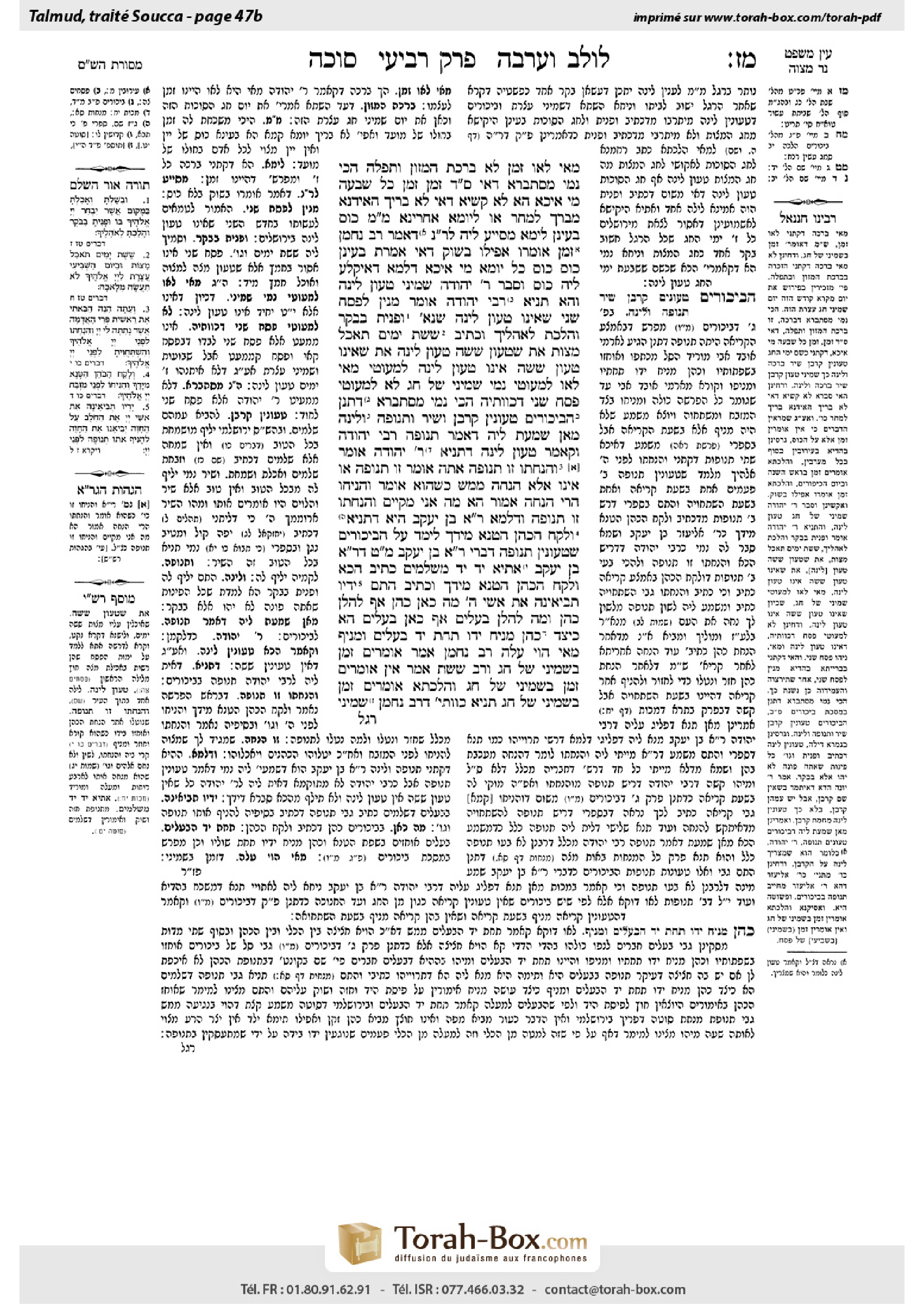
Sukkah 47b: Talmud study for Daf Yomi
Daf Yomi is the daily study of one Talmud folio. Explore 37 tractates with scans, Hebrew text, Sefaria English and AI-generated French translations where annotated.
Passage selection and English or AI-generated French translation are available where the scan has annotations. Daf Study is independent of Torah-Box and Sefaria.
Browse Sukkah · סוכה · All tractatesSukkah 47b text and translations
This page of Sukkah includes the Aramaic text, an English translation and an AI-generated French translation, alongside the scan above.
סוכה מ״ז ב · Aramaic and Hebrew text
מַאי לָאו, זְמַן? לֹא, בִּרְכַּת הַמָּזוֹן וּתְפִלָּה.
הָכִי נָמֵי מִסְתַּבְּרָא, דְּאִי סָלְקָא דַעְתָּךְ זְמַן — זְמַן כׇּל שִׁבְעָה מִי אִיכָּא? הָא לָא קַשְׁיָא: דְּאִי לָא בָּרֵיךְ הָאִידָּנָא — מְבָרֵךְ לִמְחַר, אוֹ לְיוֹמָא אַחֲרִינָא.
מִכׇּל מָקוֹם כּוֹס בָּעֵינַן! לֵימָא מְסַיַּיע לֵיהּ לְרַב נַחְמָן, דְּאָמַר רַב נַחְמָן: זְמַן אוֹמְרוֹ אֲפִילּוּ בַּשּׁוּק. דְּאִי אָמְרַתְּ בָּעֵינַן כּוֹס — כּוֹס כֹּל יוֹמָא מִי אִיכָּא? דִּלְמָא דְּאִיקְּלַע לֵיהּ כּוֹס.
וְסָבַר רַבִּי יְהוּדָה שְׁמִינִי טָעוּן לִינָה? וְהָא תַּנְיָא, רַבִּי יְהוּדָה אוֹמֵר: מִנַּיִן לְפֶסַח שֵׁנִי שֶׁאֵינוֹ טָעוּן לִינָה — שֶׁנֶּאֱמַר: ״וּפָנִיתָ בַבֹּקֶר וְהָלַכְתָּ לְאֹהָלֶיךָ״, וּכְתִיב: ״שֵׁשֶׁת יָמִים תֹּאכַל מַצּוֹת״. אֶת שֶׁטָּעוּן שִׁשָּׁה — טָעוּן לִינָה, אֶת שֶׁאֵינוֹ טָעוּן שִׁשָּׁה — אֵינוֹ טָעוּן לִינָה. לְמַעוֹטֵי מַאי? לָאו לְמַעוֹטֵי נָמֵי שְׁמִינִי שֶׁל חַג?
לָא, לְמַעוֹטֵי פֶּסַח שֵׁנִי דִּכְווֹתֵיהּ. הָכִי נָמֵי מִסְתַּבְּרָא, דִּתְנַן: הַבִּיכּוּרִים טְעוּנִין קׇרְבָּן וְשִׁיר וּתְנוּפָה וְלִינָה. מַאן שָׁמְעַתְּ לֵיהּ דְּאָמַר תְּנוּפָה — רַבִּי יְהוּדָה, וְקָאָמַר: טָעוּן לִינָה.
דְּתַנְיָא, רַבִּי יְהוּדָה אוֹמֵר: ״וְהִנַּחְתּוֹ״ — זוֹ תְּנוּפָה. אַתָּה אוֹמֵר זוֹ תְּנוּפָה, אוֹ אֵינוֹ אֶלָּא הַנָּחָה מַמָּשׁ. כְּשֶׁהוּא אוֹמֵר ״וְהִנִּיחוֹ״, הֲרֵי הַנָּחָה אָמוּר. הָא מָה אֲנִי מְקַיֵּים ״וְהִנַּחְתּוֹ״ — זוֹ תְּנוּפָה.
וְדִלְמָא רַבִּי אֱלִיעֶזֶר בֶּן יַעֲקֹב הִיא, דְּתַנְיָא: ״וְלָקַח הַכֹּהֵן הַטֶּנֶא מִיָּדֶךָ״ — לִימֵּד עַל הַבִּיכּוּרִים שֶׁטְּעוּנִין תְּנוּפָה, דִּבְרֵי רַבִּי אֱלִיעֶזֶר בֶּן יַעֲקֹב.
מַאי טַעְמָא דְּרַבִּי אֱלִיעֶזֶר בֶּן יַעֲקֹב? אָתְיָא ״יָד״ ״יָד״ מִשְּׁלָמִים, כְּתִיב הָכָא: ״וְלָקַח הַכֹּהֵן הַטֶּנֶא מִיָּדֶךָ״, וּכְתִיב הָתָם: ״יָדָיו תְּבִיאֶינָה אֵת אִשֵּׁי ה׳״.
מָה כָּאן — כֹּהֵן, אַף לְהַלָּן — כֹּהֵן. וּמָה לְהַלָּן — בְּעָלִים, אַף כָּאן — בְּעָלִים. הָא כֵּיצַד? כֹּהֵן מַנִּיחַ יָדוֹ תַּחַת יָד בְּעָלִים וּמֵנִיף.
מַאי הָוֵי עֲלַהּ? רַב נַחְמָן אָמַר: אוֹמְרִים זְמַן בִּשְׁמִינִי שֶׁל חַג, וְרַב שֵׁשֶׁת אָמַר: אֵין אוֹמְרִים זְמַן בִּשְׁמִינִי שֶׁל חַג. וְהִלְכְתָא: אוֹמְרִים זְמַן בִּשְׁמִינִי שֶׁל חַג.
תַּנְיָא כְּווֹתֵיהּ דְּרַב נַחְמָן: שְׁמִינִי
Sukkah 47b · English translation
What, is it not that the blessing mentioned is the blessing of time, in support of the opinion of Rabbi Yoḥanan? The Gemara rejects this possibility: No, the blessing here is Grace after Meals and the Amida prayer, where mention is made of the Eighth Day of Assembly and not of Sukkot. Therefore, there is no support for the opinion of Rabbi Yoḥanan that one recites the blessing of time on the Eighth Day of Assembly.
The Gemara says: So too, it is reasonable that this is the proper understanding of the baraita, as should it enter your mind that the baraita is referring to the blessing of time, is there a blessing of time all seven days of Sukkot? One recites the blessing only on the first day. The Gemara responds: This is not difficult, and that is no proof that the baraita is not referring to the blessing of time, as the baraita could mean that if one did not recite the blessing today, on the first day, he recites the blessing on the next day or on another day of the Festival. Under those circumstances the blessing of time may be recited on any of the seven days.
The Gemara asks: How could one recite the blessing of time on each of the days of Sukkot if in any case we require the blessing to be recited over a cup of wine, and not everyone has access to wine during the intermediate days of the Festival? From the fact that the Gemara does not consider this factor, let us say that this baraita supports the opinion of Rav Naḥman, as Rav Naḥman said: One recites the blessing of time even in the marketplace, without wine, as, if you say that we require a cup of wine in order to recite the blessing of time, is there a cup of wine available every day that would enable one to recite the blessing during the intermediate days of the Festival? The Gemara rejects this proof: Perhaps the baraita is referring to a case where a cup of wine happened to become available to him. The baraita is not describing the preferred method of reciting the blessing but merely a possibility.
The Gemara asks: And does Rabbi Yehuda really hold that the Eighth Day of Assembly requires one to stay overnight at its conclusion? But wasn’t it taught in a baraita that Rabbi Yehuda says: From where is it derived that the second Pesaḥ, when the Paschal lamb is brought by those who were impure and unable to sacrifice it on the first Pesaḥ, does not require staying overnight at its conclusion? As it is stated with regard to the first Pesaḥ: “And you shall turn in the morning and go unto your tents” (Deuteronomy 16:7), and immediately thereafter it is written: “Six days you shall eat matzot” (Deuteronomy 16:8). From the juxtaposition of these two verses Rabbi Yehuda derives the following: That which requires observance of the six subsequent days requires staying overnight; that which does not require observance of the six subsequent days does not require staying overnight. What does this juxtaposition come to exclude? Is it not to exclude the eighth day of the Festival, as it is not followed by the observance of six days?
The Gemara rejects this: No, it comes to exclude the second Pesaḥ, which is similar to the first Pesaḥ in terms of its offering, and it teaches that since it is not followed by the observance of six days there is no obligation to stay overnight. The Gemara says: So too, it is reasonable to say that Rabbi Yehuda is excluding the second Pesaḥ, as we learned in a mishna: The first fruits require a peace-offering to be brought with them, a song unique to the occasion, sung by the Levites, waving, and staying overnight. Whom did you hear who said that first fruits require waving? It is Rabbi Yehuda, and the mishna is saying that first fruits require staying overnight. Apparently, Rabbi Yehuda excludes only the second Pesaḥ from the requirement of staying overnight.
Rabbi Yehuda holds that first fruits require waving, as it was taught in a baraita: Rabbi Yehuda says that it is stated with regard to first fruits: “And you shall set it down before the Lord your God,” (Deuteronomy 26:10), and this is referring to waving before the altar the basket containing the first fruits. Do you say that this is referring to waving, or perhaps it is referring only to actually setting it down adjacent to the altar? When the Torah says: “And the priest shall take the basket from your hand and set it down before the altar of the Lord your God” (Deuteronomy 26:4), setting it down is already stated. How, then, do I establish the meaning of the verse: “And you shall set it down”? This is referring to waving.
The Gemara asks: And perhaps the baraita that requires one to stay overnight when bringing first fruits to Jerusalem is not in accordance with Rabbi Yehuda’s opinion. Rather, it is in accordance with the opinion of Rabbi Eliezer ben Ya’akov, who also holds that first fruits require waving. As it was taught in a baraita that it is written: “And the priest shall take the basket from your hand” (Deuteronomy 26:4), which taught concerning first fruits that they require waving. This is the statement of Rabbi Eliezer ben Ya’akov.
The Gemara asks: What is the rationale for the opinion of Rabbi Eliezer ben Ya’akov? How does he derive the waving of the first fruits from this verse? The Gemara answers: This is derived by means of a verbal analogy between the term “hand” written with regard to first fruits and the term “hand” written with regard to a peace-offering. It is written here, with regard to first fruits: “And the priest shall take the basket from your hand,” and it is written there, with regard to a peace-offering: “His own hands shall bring the offerings of the Lord made by fire; the fat with the breast shall he bring, that the breast may be waved before the Lord” (Leviticus 7:30).
In addition, one can derive by means of the verbal analogy that just as here, with regard to first fruits, a priest performs the waving, so too, with regard to a peace-offering, a priest performs the waving. And just as there, with regard to a peace-offering, the owner performs the waving, so too here, with regard to first fruits, the owner performs the waving. How so? How can both the priest and the owner perform the waving? The owner places his hands beneath the peace-offering or under the first fruits, and the priest places his hand under the hand of the owner and waves it together with him. In any event, Rabbi Eliezer ben Ya’akov requires waving of the first fruits. Therefore, it is possible that the baraita is stated in accordance with the opinion of Rabbi Eliezer ben Ya’akov and no conclusive proof can be cited with regard to the opinion of Rabbi Yehuda.
What halakhic conclusion was reached concerning the blessing of time? Rav Naḥman said: One recites the blessing of time on the eighth day of the festival of Sukkot. And Rav Sheshet said: One does not recite the blessing of time on the eighth day of the Festival. The Gemara concludes: And the halakha is that one recites the blessing of time on the eighth day of the Festival.
The Gemara notes: It was taught in a baraita in accordance with the opinion of Rav Naḥman: The eighth day
Sukkah 47b · Traduction française (IA)
N’est-ce pas que la bénédiction mentionnée est la bénédiction du temps, ce qui appuierait l’opinion de Rabbi Yoḥanan ? La Guemara rejette cette possibilité : non, la bénédiction dont il est question est celle récitée après le repas et dans la Amida, où l’on mentionne Chemini Atseret et non Souccot. Il n’y a donc là aucun appui à l’opinion de Rabbi Yoḥanan, selon laquelle on récite la bénédiction du temps à Chemini Atseret.
La Guemara dit : Il est également raisonnable de comprendre ainsi la baraïta. En effet, si l’on envisageait que la baraïta parle de la bénédiction du temps, la réciterait-on chacun des sept jours de Souccot ? On ne la récite que le premier jour. La Guemara répond : Cela ne pose pas de difficulté et ne prouve pas que la baraïta ne parle pas de la bénédiction du temps : elle pourrait vouloir dire que si l’on n’a pas récité la bénédiction aujourd’hui, le premier jour, on la récite le lendemain ou un autre jour de la fête. Dans ces circonstances, on peut réciter la bénédiction du temps n’importe lequel des sept jours.
La Guemara demande : Comment pourrait-on réciter la bénédiction du temps chacun des jours de Souccot, alors qu’il faut en tout état de cause réciter cette bénédiction sur une coupe de vin, et que tout le monde n’a pas accès au vin pendant les jours intermédiaires de la fête ? Puisque la Guemara ne tient pas compte de ce facteur, ne peut-on pas dire que cette baraïta appuie l’opinion de Rav Naḥman ? Car Rav Naḥman a dit : On récite la bénédiction du temps même sur la place du marché, sans vin. En effet, si l’on affirme qu’une coupe de vin est nécessaire pour réciter la bénédiction du temps, trouve-t-on chaque jour une coupe de vin qui permettrait de réciter la bénédiction pendant les jours intermédiaires de la fête ? La Guemara rejette cette preuve : peut-être la baraïta parle-t-elle d’un cas où une coupe de vin s’est trouvée à sa disposition. La baraïta ne décrit pas la manière préférable de réciter la bénédiction, mais simplement une possibilité.
Rabbi Yehuda considère-t-il vraiment qu’à Chemini Atseret, il faut passer la nuit sur place à la fin de la fête ? N’a-t-il pas été enseigné dans une baraïta que Rabbi Yehuda dit : D’où déduit-on que le second Pessaḥ, lorsque l’agneau pascal est offert par ceux qui étaient impurs et n’avaient pas pu l’offrir lors du premier Pessaḥ, n’exige pas que l’on passe la nuit sur place à son terme ? Car il est dit au sujet du premier Pessaḥ : « Puis, le matin, tu retourneras et tu iras à tes tentes » (Deutéronome 16,7), et immédiatement après, il est écrit : « Pendant six jours, tu mangeras des pains azymes » (Deutéronome 16,8). De la juxtaposition de ces deux versets, Rabbi Yehuda déduit ce qui suit : ce qui exige l’observance des six jours suivants exige que l’on passe la nuit sur place ; ce qui n’exige pas l’observance des six jours suivants n’exige pas que l’on passe la nuit sur place. Qu’est-ce que cette juxtaposition vient exclure ? N’est-ce pas le huitième jour de la fête, puisqu’il n’est pas suivi de l’observance de six jours ?
La Guemara rejette cette explication : non, cela vient exclure le second Pessaḥ, qui ressemble au premier Pessaḥ en ce qui concerne son offrande ; elle enseigne que, puisqu’il n’est pas suivi de l’observance de six jours, il n’y a pas d’obligation de passer la nuit sur place. La Guemara dit : Il est également raisonnable de dire que Rabbi Yehuda exclut le second Pessaḥ, car nous avons appris dans une Michna : Les prémices exigent qu’un sacrifice de paix soit apporté avec eux, un chant propre à l’occasion, chanté par les Lévites, le balancement et le fait de passer la nuit sur place. Quel tanna as-tu entendu dire que les prémices exigent le balancement ? C’est Rabbi Yehuda. La Michna dit donc que les prémices exigent que l’on passe la nuit sur place. Il apparaît que Rabbi Yehuda n’exclut que le second Pessaḥ de l’obligation de passer la nuit sur place.
Rabbi Yehuda considère que les prémices exigent le balancement, comme cela a été enseigné dans une baraïta : Rabbi Yehuda dit qu’au sujet des prémices, il est écrit : « Et tu le déposeras devant le Seigneur ton Dieu » (Deutéronome 26,10), ce qui désigne le balancement, devant l’autel, du panier contenant les prémices. Penses-tu que cela désigne le balancement, ou peut-être seulement le fait de le déposer près de l’autel ? Lorsque la Torah dit : « Le prêtre prendra le panier de ta main et le déposera devant l’autel du Seigneur ton Dieu » (Deutéronome 26,4), le fait de le déposer est déjà mentionné. Comment faut-il donc comprendre les mots « et tu le déposeras » ? Ils désignent le balancement.
La Guemara demande : Et peut-être que la baraïta qui exige que l’on passe la nuit sur place lorsqu’on apporte les prémices à Jérusalem n’est pas conforme à l’opinion de Rabbi Yehuda. Elle serait plutôt conforme à celle de Rabbi Eliezer ben Ya’akov, qui considère lui aussi que les prémices exigent le balancement. En effet, il a été enseigné dans une baraïta qu’il est écrit : « Le prêtre prendra le panier de ta main » (Deutéronome 26,4), ce qui enseigne que les prémices exigent le balancement. Telle est l’opinion de Rabbi Eliezer ben Ya’akov.
La Guemara demande : Quel est le raisonnement de Rabbi Eliezer ben Ya’akov ? Comment déduit-il de ce verset le balancement des prémices ? La Guemara répond : On le déduit au moyen d’une analogie verbale entre le terme « main », écrit à propos des prémices, et le terme « main », écrit à propos d’un sacrifice de paix. Il est écrit ici, à propos des prémices : « Le prêtre prendra le panier de ta main », et il est écrit là, à propos d’un sacrifice de paix : « De ses propres mains, il apportera les offrandes du Seigneur faites par le feu ; il apportera la graisse avec la poitrine, afin que la poitrine soit balancée devant le Seigneur » (Lévitique 7,30).
En outre, on peut déduire au moyen de cette analogie verbale que, de même qu’ici, à propos des prémices, le prêtre effectue le balancement, de même, à propos d’un sacrifice de paix, c’est le prêtre qui l’effectue. Et de même que là, à propos d’un sacrifice de paix, le propriétaire effectue le balancement, de même ici, à propos des prémices, c’est le propriétaire qui l’effectue. Comment cela ? Comment le prêtre et le propriétaire peuvent-ils tous deux effectuer le balancement ? Le propriétaire place ses mains sous le sacrifice de paix ou sous les prémices, et le prêtre place sa main sous les mains du propriétaire, puis effectue le balancement avec lui. Quoi qu’il en soit, Rabbi Eliezer ben Ya’akov exige le balancement des prémices. Il est donc possible que la baraïta soit conforme à son opinion, et l’on ne peut apporter aucune preuve concluante quant à l’opinion de Rabbi Yehuda.
Quelle conclusion halakhique a-t-on tirée au sujet de la bénédiction du temps ? Rav Naḥman a dit : On récite la bénédiction du temps le huitième jour de la fête de Souccot. Rav Sheshet a dit : On ne récite pas la bénédiction du temps le huitième jour de la fête. La Guemara conclut : La halakha est que l’on récite la bénédiction du temps le huitième jour de la fête.
La Guemara note : Une baraïta a été enseignée conformément à l’opinion de Rav Naḥman : Le huitième jour
Traduction française générée par IA à partir de l’édition anglaise de Sefaria. Vérifie toujours un passage avec le texte source.
Text from Sefaria: William Davidson Edition - Vocalized Aramaic (CC BY NC); William Davidson Edition - English (CC BY NC).