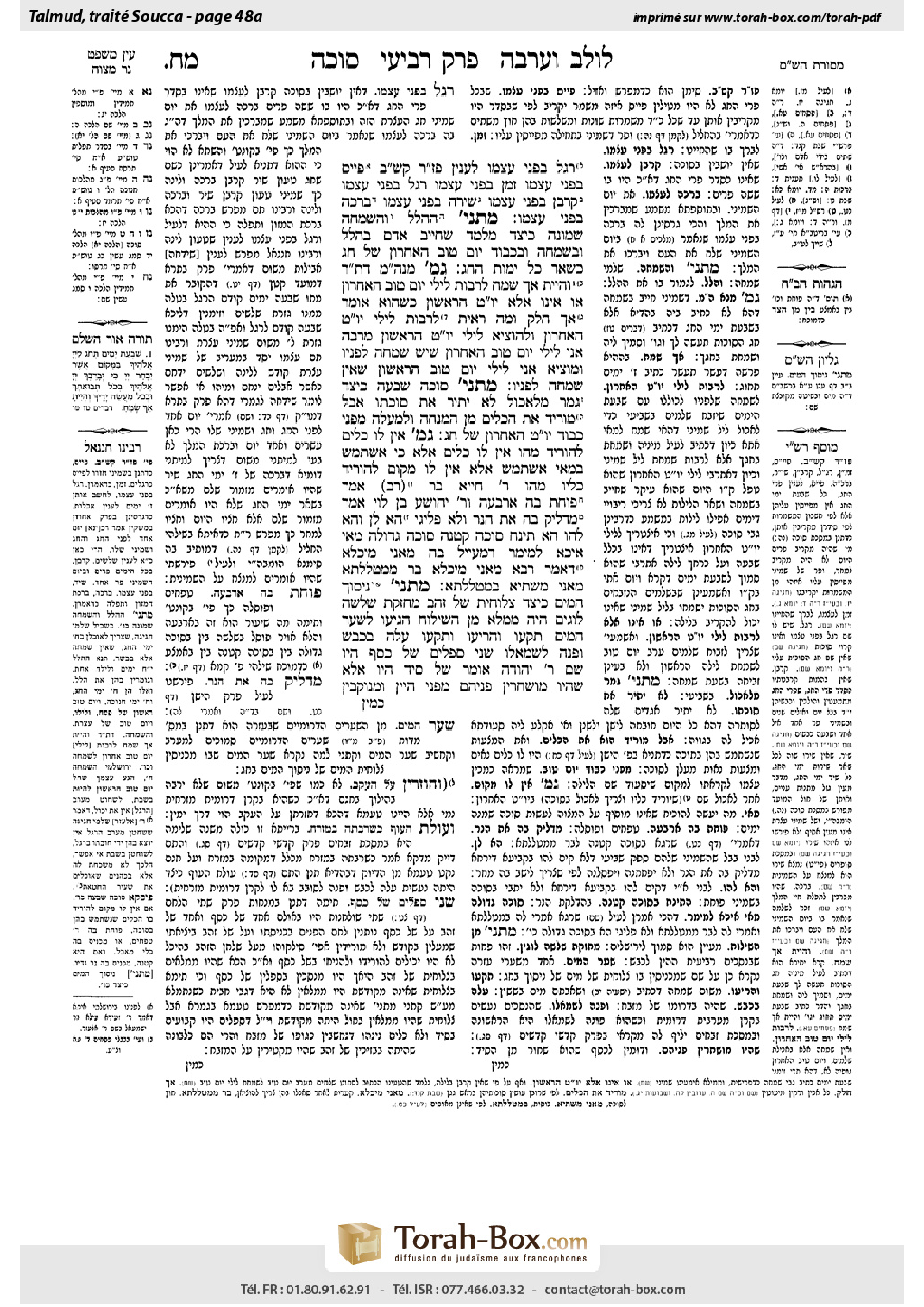
Sukkah 48a: Talmud study for Daf Yomi
Daf Yomi is the daily study of one Talmud folio. Explore 37 tractates with scans, Hebrew text, Sefaria English and AI-generated French translations where annotated.
Passage selection and English or AI-generated French translation are available where the scan has annotations. Daf Study is independent of Torah-Box and Sefaria.
Browse Sukkah · סוכה · All tractatesSukkah 48a text and translations
This page of Sukkah includes the Aramaic text, an English translation and an AI-generated French translation, alongside the scan above.
סוכה מ״ח א · Aramaic and Hebrew text
רֶגֶל בִּפְנֵי עַצְמוֹ לְעִנְיַן פָּזֵ״ר קֶשֶׁ״ב. פַּיִיס בִּפְנֵי עַצְמוֹ. זְמַן בִּפְנֵי עַצְמוֹ. רֶגֶל בִּפְנֵי עַצְמוֹ. קׇרְבָּן בִּפְנֵי עַצְמוֹ. שִׁירָה בִּפְנֵי עַצְמוֹ. בְּרָכָה בִּפְנֵי עַצְמוֹ.
מַתְנִי׳ הַהַלֵּל וְהַשִּׂמְחָה — שְׁמוֹנָה. כֵּיצַד? מְלַמֵּד שֶׁחַיָּיב אָדָם בְּהַלֵּל וּבְשִׂמְחָה וּבִכְבוֹד יוֹם טוֹב הָאַחֲרוֹן שֶׁל חַג כִּשְׁאָר כׇּל יְמוֹת הַחַג.
גְּמָ׳ מְנָא הָנֵי מִילֵּי — דְּתָנוּ רַבָּנַן: ״וְהָיִיתָ אַךְ שָׂמֵחַ״ — לְרַבּוֹת לֵילֵי יוֹם טוֹב הָאַחֲרוֹן. אוֹ אֵינוֹ אֶלָּא יוֹם טוֹב הָרִאשׁוֹן? כְּשֶׁהוּא אוֹמֵר ״אַךְ״ — חִלֵּק.
וּמָה רָאִיתָ לְרַבּוֹת לֵילֵי יוֹם טוֹב הָאַחֲרוֹן וּלְהוֹצִיא לֵילֵי יוֹם טוֹב הָרִאשׁוֹן? מְרַבֶּה אֲנִי לֵילֵי יוֹם טוֹב הָאַחֲרוֹן — שֶׁיֵּשׁ שִׂמְחָה לְפָנָיו, וּמוֹצִיא אֲנִי לֵילֵי יוֹם טוֹב הָרִאשׁוֹן — שֶׁאֵין שִׂמְחָה לְפָנָיו.
מַתְנִי׳ סוּכָּה — שִׁבְעָה. כֵּיצַד? גָּמַר מִלֶּאֱכוֹל — לֹא יַתִּיר אֶת סוּכָּתוֹ. אֲבָל מוֹרִיד אֶת הַכֵּלִים מִן הַמִּנְחָה וּלְמַעְלָה, מִפְּנֵי כְּבוֹד יוֹם טוֹב הָאַחֲרוֹן שֶׁל חַג.
גְּמָ׳ אֵין לוֹ כֵּלִים לְהוֹרִיד, מַהוּ? אֵין לוֹ כֵּלִים?! אֶלָּא כִּי אִשְׁתַּמַּשׁ בְּמַאי אִשְׁתַּמַּשׁ? אֶלָּא: אֵין לוֹ מָקוֹם לְהוֹרִיד כֵּלָיו, מַהוּ? רַבִּי חִיָּיא בַּר (רַב) אָמַר: פּוֹחֵת בָּהּ אַרְבָּעָה. וְרַבִּי יְהוֹשֻׁעַ בֶּן לֵוִי אָמַר: מַדְלִיק בָּהּ אֶת הַנֵּר.
וְלָא פְּלִיגִי: הָא לַן וְהָא לְהוּ.
הָא תִּינַח סוּכָּה קְטַנָּה, סוּכָּה גְּדוֹלָה מַאי אִיכָּא לְמֵימַר? דִּמְעַיֵּיל בַּהּ מָאנֵי מֵיכְלָא. דְּאָמַר רָבָא: מָאנֵי מֵיכְלָא — בַּר מִמְּטַלַּלְתָּא. מָאנֵי מִשְׁתְּיָא — בִּמְטַלַּלְתָּא.
מַתְנִי׳ נִיסּוּךְ הַמַּיִם כֵּיצַד? צְלוֹחִית שֶׁל זָהָב מַחְזֶקֶת שְׁלֹשָׁה לוּגִּים הָיָה מְמַלֵּא מִן הַשִּׁילוֹחַ. הִגִּיעוּ לְשַׁעַר הַמַּיִם, תָּקְעוּ וְהֵרִיעוּ וְתָקְעוּ. עָלָה בַּכֶּבֶשׁ וּפָנָה לִשְׂמֹאלוֹ, שְׁנֵי סְפָלִים שֶׁל כֶּסֶף הָיוּ שָׁם. רַבִּי יְהוּדָה אוֹמֵר: שֶׁל סִיד הָיוּ, אֶלָּא שֶׁהָיוּ מוּשְׁחָרִין פְּנֵיהֶם מִפְּנֵי הַיַּיִן. וּמְנוּקָּבִין
Sukkah 48a · English translation
is a Festival in and of itself with regard to the matter of: Peh, zayin, reish; kuf, shin, beit. This is an acronym for: A lottery [payis] in and of itself, i.e., a new lottery is performed on that day to determine which priests will sacrifice the offerings that day, and the order established on Sukkot does not continue; the blessing of time [zeman], i.e., Who has given us life, sustained us, and brought us to this time, in and of itself, as it is recited just as it is recited at the start of each Festival; a Festival [regel ] in and of itself, and there is no mitzva to sit in the sukka (see Tosafot); an offering [korban] in and of itself, as the number of offerings sacrificed on the Eighth Day is not a continuation of the number sacrificed on Sukkot but is part of a new calculation; a song [shira] in and of itself, since the psalms recited by the Levites as the offerings are sacrificed on the Eighth Day are not a continuation of those recited on Sukkot; a blessing [berakha] in and of itself, as the addition to the third blessing of Grace after Meals and to the Amida prayer (see Tosafot) is phrased in a manner different from that of the addition recited on Sukkot.
MISHNA: This mishna elaborates upon the first mishna in this chapter. The obligation to recite hallel and the mitzva of rejoicing on the Festival by sacrificing and eating the meat of peace-offerings are always for eight days. The mishna explains: How so? This teaches that a person is obligated in hallel, and in the mitzva of rejoicing, and in reverence for the last day of the Festival like he is for all the other days of the Festival.
GEMARA: The Gemara asks: From where are these matters, that on the eighth day of the Festival one is obligated to rejoice, derived? It is as the Sages taught that the verse states with regard to Sukkot: “And you shall be altogether joyful” (Deuteronomy 16:15). The verse comes to include the evenings of the last day of the Festival, i.e., then too, one is obligated to rejoice by partaking of the meat of the peace-offerings sacrificed the previous day. The Gemara asks: Does the verse come to include the evening of the eighth day? Or perhaps it comes to include only the evening of the first day of the Festival. The Gemara answers: When the verse says: Altogether, it is exclusionary, and it has distinguished this night from the other nights of the Festival.
The Gemara asks: What did you see that led you to include the evenings of the last day of the Festival in the mitzva of rejoicing and to exclude the evenings of the first day of the Festival? Why not require one to sacrifice peace-offerings on the afternoon preceding the Festival to be eaten on the first night? The Gemara answers: I include the evenings of the last day of the Festival, before which there is a day of rejoicing, as it is reasonable that the rejoicing should continue, and I exclude the evenings of the first day of the Festival, before which there is not a day of rejoicing, as there is no obligation to sacrifice offerings on the afternoon preceding the Festival.
MISHNA: The mitzva of sukka is seven days. How does one fulfill this obligation for seven full days? When one finished eating on the seventh day, he should not dismantle his sukka immediately, because the obligation continues until the end of the day. However, he takes the vessels down from the sukka into the house from minḥa time and onward in deference to the last day of the Festival, when he will require the vessels in the house.
GEMARA: The Gemara asks: If one does not have vessels to take down from the sukka, what should he do? The Gemara asks: One does not have vessels? But when he utilized his sukka during the Festival, with what vessels did he eat when he utilized the sukka? Rather, this is the question: If he has no place into which he can take down his vessels and he must continue eating in the sukka, what is the halakha? What can he do to underscore the fact that he is eating there not to fulfill a mitzva, thereby violating the prohibition against adding to the mitzvot of the Torah, but only due to the lack of an alternative? Rabbi Ḥiyya bar Rav said: He reduces the roofing of the sukka by four handbreadths, thereby rendering the sukka unfit. And Rabbi Yehoshua ben Levi said: He lights a lamp inside the sukka, which is prohibited during the festival of Sukkot.
The Gemara notes: And they do not disagree with regard to the halakha. Instead, they are providing different solutions for different locations. This is for us, who live outside Eretz Yisrael, and this is for them, who live in Eretz Yisrael. Those who live in Eretz Yisrael reduce the roofing, since the obligation to sit in the sukka no longer applies. However, those who live outside of Eretz Yisrael, who are obligated to sit in the sukka on the eighth day with regard to which there is uncertainty that it might be the seventh day, must find another way to distinguish the eighth day from the days of the Festival of Sukkot.
The Gemara asks: This works out well with regard to a small sukka, since it is prohibited to light a lamp due to the danger of a conflagration, and lighting a lamp will underscore the distinction. However, with regard to a large sukka, in which there is no prohibition and therefore no distinction, what can be said? The Gemara answers: One underscores the distinction in that he brings eating vessels, e.g., pots in which food was cooked, into the sukka, as Rava said: Eating vessels are taken out of the sukka; drinking vessels remain in the sukka. By leaving the pots and pans in the sukka, he indicates that the sukka is no longer involved in fulfillment of the mitzva.
MISHNA: With regard to the rite of water libation performed in the Temple during the Festival, how was it performed? One would fill a golden jug with a capacity of three log with water from the Siloam pool. When those who went to bring the water reached the Gate of the Water, so called because the water for the libation was brought through this gate leading to the Temple courtyard, they sounded a tekia, sounded a terua, and sounded another tekia as an expression of joy. The priest ascended the ramp of the altar and turned to his left. There were two silver basins there into which he poured the water. Rabbi Yehuda said: They were limestone basins, but they would blacken due to the wine and therefore looked like silver. The two basins were perforated at the bottom
Sukkah 48a · Traduction française (IA)
est une fête à part entière en ce qui concerne le sujet désigné par les lettres pé, zaïn, rech ; qof, chine, beit. Il s’agit d’un acronyme signifiant : un tirage au sort [payis] à part entière, c’est-à-dire qu’un nouveau tirage au sort est effectué ce jour-là pour déterminer quels prêtres offriront les sacrifices du jour, et que l’ordre établi à Soukkot ne se poursuit pas ; la bénédiction du temps [zeman], c’est-à-dire « Qui nous a fait vivre, nous a soutenus et nous a fait parvenir à cette époque », à part entière, puisqu’elle est récitée comme au début de chaque fête ; une fête [regel] à part entière, sans mitsva de résider dans la soukka (voir Tossefot) ; une offrande [korban] à part entière, car le nombre d’offrandes sacrifiées le huitième jour ne prolonge pas celui des offrandes sacrifiées à Soukkot, mais relève d’un nouveau décompte ; un chant [shira] à part entière, puisque les psaumes récités par les Lévites pendant que les offrandes sont sacrifiées le huitième jour ne prolongent pas ceux récités à Soukkot ; une bénédiction [berakha] à part entière, car l’ajout à la troisième bénédiction du Birkat Hamazon et à la prière de la Amida (voir Tossefot) est formulé différemment de l’ajout récité à Soukkot.
MICHNA : Cette Michna développe la première Michna de ce chapitre. L’obligation de réciter le hallel et la mitsva de se réjouir pendant la fête en sacrifiant et en mangeant la viande des sacrifices de paix durent toujours huit jours. Comment cela ? Cela enseigne qu’on est tenu de réciter le hallel, d’accomplir la mitsva de se réjouir et de manifester de la révérence le dernier jour de la fête, comme pendant tous les autres jours de la fête.
GUEMARA : La Guemara demande : De quel verset déduit-on que l’on est tenu de se réjouir le huitième jour de la fête ? C’est ce que les Sages ont enseigné : le verset dit au sujet de Soukkot : « Et tu te réjouiras pleinement » (Deutéronome 16,15). Le verset vient inclure les soirées du dernier jour de la fête : on est alors aussi tenu de se réjouir en prenant part à la viande des sacrifices de paix offerts la veille. La Guemara demande : Le verset vient-il inclure la soirée du huitième jour ? Ou peut-être n’inclut-il que la soirée du premier jour de la fête ? La Guemara répond : Lorsque le verset dit « pleinement », cette précision est restrictive et distingue cette soirée des autres soirées de la fête.
La Guemara demande : Qu’as-tu vu qui t’a conduit à inclure les soirées du dernier jour de la fête dans la mitsva de se réjouir et à exclure les soirées du premier jour de la fête ? Pourquoi ne pas exiger que l’on offre des sacrifices de paix l’après-midi précédant la fête, afin de les manger le premier soir ? La Guemara répond : J’inclus les soirées du dernier jour de la fête, précédées d’une journée de réjouissance, car il est raisonnable que la réjouissance se poursuive ; et j’exclus les soirées du premier jour de la fête, qui ne sont pas précédées d’une journée de réjouissance, puisqu’il n’est pas obligatoire d’offrir des sacrifices l’après-midi précédant la fête.
MICHNA : La mitsva de la soukka dure sept jours. Comment s’acquitte-t-on de cette obligation pendant sept jours complets ? Après avoir terminé de manger le septième jour, on ne doit pas démonter immédiatement sa soukka, car l’obligation se poursuit jusqu’à la fin de la journée. Toutefois, à partir de l’heure de Min’ha, on rentre les ustensiles de la soukka dans la maison, par respect pour le dernier jour de la fête, où l’on aura besoin de ces ustensiles dans la maison.
GUEMARA : La Guemara demande : Si l’on n’a pas d’ustensiles à retirer de la soukka, que doit-on faire ? La Guemara demande : On n’a pas d’ustensiles ? Mais, lorsqu’on a utilisé sa soukka pendant la fête, avec quels ustensiles y a-t-on mangé ? Il faut plutôt comprendre la question ainsi : si l’on n’a pas d’endroit où ranger ses ustensiles et que l’on doit continuer à manger dans la soukka, quelle est la halakha ? Que peut-on faire pour montrer que l’on y mange non pas afin d’accomplir une mitsva — ce qui enfreindrait l’interdiction d’ajouter aux mitsvot de la Torah — mais uniquement faute d’autre solution ? Rabbi Ḥiyya bar Rav a dit : On réduit de quatre palmes la surface du toit de la soukka, la rendant ainsi impropre. Et Rabbi Yehoshua ben Levi a dit : On allume une lampe dans la soukka, ce qui est interdit pendant la fête de Soukkot.
La Guemara relève : Ils ne sont pas en désaccord sur la halakha ; ils proposent plutôt des solutions différentes selon les lieux. L’une vaut pour nous, qui vivons hors d’Eretz Israël, et l’autre pour eux, qui vivent en Eretz Israël. Ceux qui vivent en Eretz Israël réduisent la surface du toit, puisque l’obligation de résider dans la soukka ne s’applique plus. En revanche, ceux qui vivent hors d’Eretz Israël, tenus de résider dans la soukka le huitième jour parce qu’il subsiste un doute quant à savoir s’il s’agit du septième jour, doivent trouver un autre moyen de distinguer le huitième jour des jours de la fête de Soukkot.
La Guemara demande : Cela convient pour une petite soukka, puisqu’il est interdit d’y allumer une lampe en raison du danger d’incendie, et que l’allumage d’une lampe marquera la distinction. Mais que peut-on dire pour une grande soukka, où cet allumage n’est pas interdit et ne permet donc pas de marquer de distinction ? La Guemara répond : On marque la distinction en apportant dans la soukka des ustensiles servant aux repas, par exemple des marmites dans lesquelles on a fait cuire des aliments, car Rava a dit : On retire de la soukka les ustensiles servant aux repas ; les récipients à boire y restent. En laissant les marmites et les casseroles dans la soukka, on indique que l’on n’y accomplit plus la mitsva.
MICHNA : Comment accomplissait-on le rite de la libation d’eau effectué au Temple pendant la fête ? On remplissait d’eau du bassin de Siloé une cruche d’or d’une capacité de trois log. Lorsque ceux qui étaient allés chercher l’eau arrivaient à la Porte de l’Eau, ainsi appelée parce que l’eau destinée à la libation passait par cette porte donnant sur la cour du Temple, on sonnait une téqia, une teroua, puis une autre téqia, en signe de joie. Le prêtre montait la rampe de l’autel et tournait à sa gauche. Là se trouvaient deux bassins d’argent dans lesquels il versait l’eau. Rabbi Yehouda a dit : C’étaient des bassins de calcaire, mais ils noircissaient à cause du vin et semblaient ainsi être en argent. Les deux bassins étaient percés dans leur fond
Traduction française générée par IA à partir de l’édition anglaise de Sefaria. Vérifie toujours un passage avec le texte source.
Text from Sefaria: William Davidson Edition - Vocalized Aramaic (CC BY NC); William Davidson Edition - English (CC BY NC).