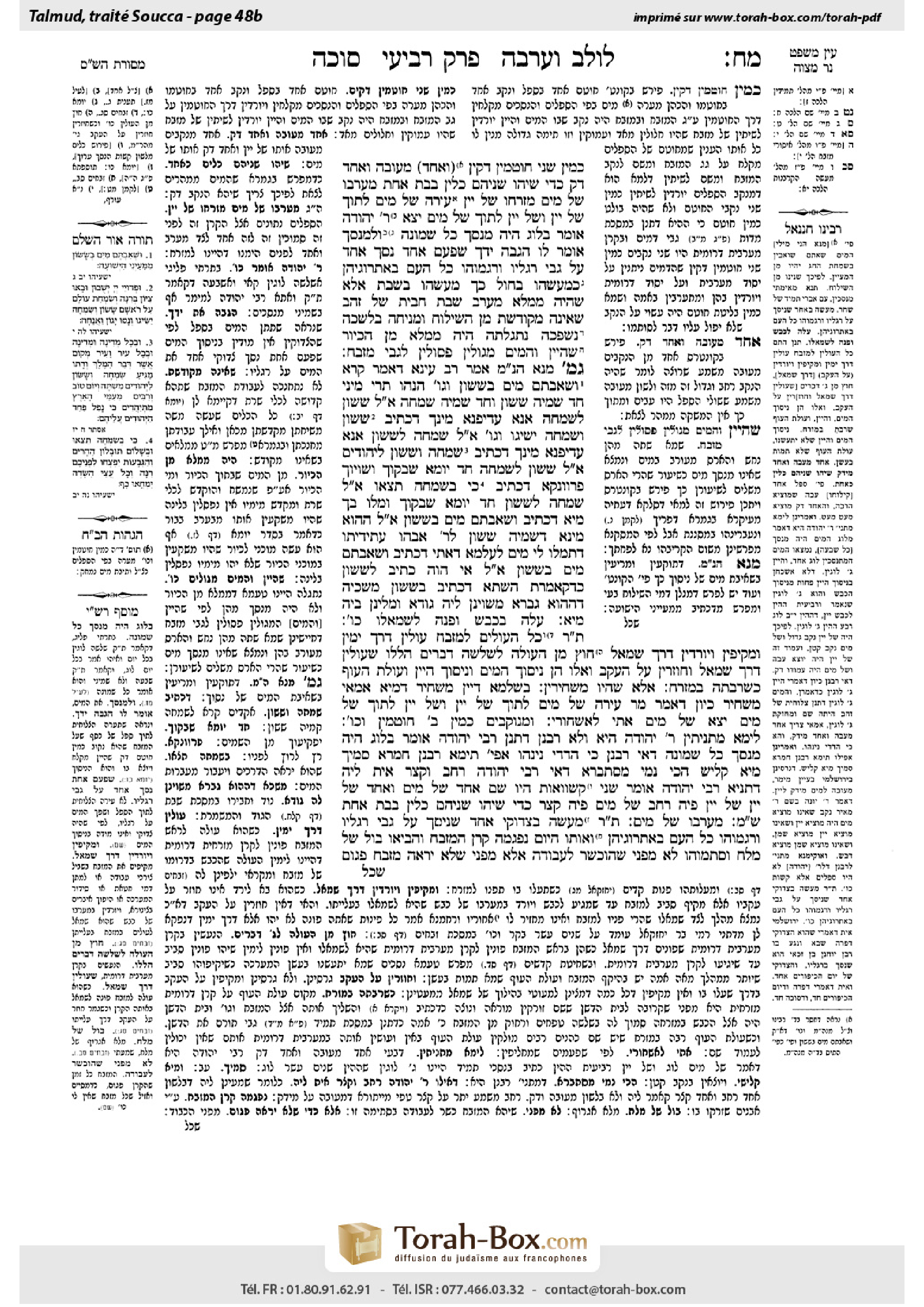
Sukkah 48b: Talmud study for Daf Yomi
Daf Yomi is the daily study of one Talmud folio. Explore 37 tractates with scans, Hebrew text, Sefaria English and AI-generated French translations where annotated.
Passage selection and English or AI-generated French translation are available where the scan has annotations. Daf Study is independent of Torah-Box and Sefaria.
Browse Sukkah · סוכה · All tractatesSukkah 48b text and translations
This page of Sukkah includes the Aramaic text, an English translation and an AI-generated French translation, alongside the scan above.
סוכה מ״ח ב · Aramaic and Hebrew text
כְּמִין שְׁנֵי חוֹטָמִין דַּקִּין, (וְאֶחָד) מְעוּבֶּה וְאֶחָד דַּק, כְּדֵי שֶׁיְּהוּ שְׁנֵיהֶם כָּלִין בְּבַת אַחַת. מַעֲרָבוֹ — שֶׁל מַיִם, מִזְרָחוֹ — שֶׁל יַיִן. עֵירָה שֶׁל מַיִם לְתוֹךְ שֶׁל יַיִן, וְשֶׁל יַיִן לְתוֹךְ שֶׁל מַיִם — יָצָא.
רַבִּי יְהוּדָה אוֹמֵר: בַּלּוֹג הָיָה מְנַסֵּךְ כׇּל שְׁמוֹנָה. וְלַמְנַסֵּךְ אוֹמֵר לוֹ: הַגְבַּהּ יָדֶךָ. שֶׁפַּעַם אֶחָד נִסֵּךְ אֶחָד עַל גַּבֵּי רַגְלָיו, וּרְגָמוּהוּ כׇּל הָעָם בְּאֶתְרוֹגֵיהֶן.
כְּמַעֲשֵׂהוּ בַּחוֹל כָּךְ מַעֲשֵׂהוּ בַּשַּׁבָּת, אֶלָּא שֶׁהָיָה מְמַלֵּא מֵעֶרֶב שַׁבָּת חָבִית שֶׁל זָהָב שֶׁאֵינָהּ מְקוּדֶּשֶׁת מִן הַשִּׁילוֹחַ וּמַנִּיחָהּ בַּלִּשְׁכָּה. נִשְׁפְּכָה, נִתְגַּלְּתָה, הָיָה מְמַלֵּא מִן הַכִּיּוֹר. שֶׁהַיַּיִן וְהַמַּיִם מְגוּלִּין — פְּסוּלִין לְגַבֵּי מִזְבֵּחַ.
גְּמָ׳ מְנָא הָנֵי מִילֵּי? אָמַר רַב עֵינָא, דְּאָמַר קְרָא: ״וּשְׁאַבְתֶּם מַיִם בְּשָׂשׂוֹן וְגוֹ׳״.
הָנְהוּ תְּרֵי מִינֵי, חַד שְׁמֵיהּ שָׂשׂוֹן וְחַד שְׁמֵיהּ שִׂמְחָה. אֲמַר לֵיהּ שָׂשׂוֹן לְשִׂמְחָה: אֲנָא עֲדִיפְנָא מִינָּךְ, דִּכְתִיב: ״שָׂשׂוֹן וְשִׂמְחָה יַשִּׂיגוּ וְגוֹ׳״. אֲמַר לֵיהּ שִׂמְחָה לְשָׂשׂוֹן: אֲנָא עֲדִיפְנָא מִינָּךְ, דִּכְתִיב: ״שִׂמְחָה וְשָׂשׂוֹן לַיְּהוּדִים״. אֲמַר לֵיהּ שָׂשׂוֹן לְשִׂמְחָה: חַד יוֹמָא שָׁבְקוּךְ וְשַׁוְּיוּךְ פַּרְוַונְקָא, דִּכְתִיב: ״כִּי בְשִׂמְחָה תֵצֵאוּ״. אֲמַר לֵיהּ שִׂמְחָה לְשָׂשׂוֹן: חַד יוֹמָא שָׁבְקוּךְ וּמָלוּ בָּךְ מַיָּא, דִּכְתִיב: ״וּשְׁאַבְתֶּם מַיִם בְּשָׂשׂוֹן״.
אֲמַר לֵיהּ הָהוּא מִינָא דִּשְׁמֵיהּ שָׂשׂוֹן לְרַבִּי אֲבָהוּ: עֲתִידִיתוּ דִּתְמַלּוֹ לִי מַיִם לְעָלְמָא דְּאָתֵי, דִּכְתִיב: ״וּשְׁאַבְתֶּם מַיִם בְּשָׂשׂוֹן״, אֲמַר לֵיהּ: אִי הֲוָה כְּתִיב ״לְשָׂשׂוֹן״ — כִּדְקָאָמְרַתְּ, הַשְׁתָּא דִּכְתִיב ״בְּשָׂשׂוֹן״ — מַשְׁכֵּיהּ דְּהָהוּא גַּבְרָא מְשַׁוֵּינַן לֵיהּ גּוֹדָא וּמָלֵינַן בֵּיהּ מַיָּא.
עָלָה בַּכֶּבֶשׁ וּפָנָה לִשְׂמֹאלוֹ כּוּ׳. תָּנוּ רַבָּנַן: כׇּל הָעוֹלִים לְמִזְבֵּחַ — עוֹלִין דֶּרֶךְ יָמִין וּמַקִּיפִין וְיוֹרְדִין דֶּרֶךְ שְׂמֹאל. חוּץ מִן הָעוֹלֶה לִשְׁלֹשָׁה דְּבָרִים הַלָּלוּ, שֶׁעוֹלִין דֶּרֶךְ שְׂמֹאל וְחוֹזְרִין עַל הֶעָקֵב. וְאֵלּוּ הֵן: נִיסּוּךְ הַמַּיִם, וְנִיסּוּךְ הַיַּיִן, וְעוֹלַת הָעוֹף כְּשֶׁרָבְתָה בַּמִּזְרָח.
אֶלָּא, שֶׁהָיוּ מַשְׁחִירִין. בִּשְׁלָמָא דְּיַיִן מַשְׁחִיר, דְּמַיָּא אַמַּאי מַשְׁחִיר? כֵּיוָן דְּאָמַר מָר: עֵירָה שֶׁל מַיִם לְתוֹךְ שֶׁל יַיִן, וְשֶׁל יַיִן לְתוֹךְ שֶׁל מַיִם יָצָא — שֶׁל מַיִם אָתֵי לְאַשְׁחוֹרֵי.
וּמְנוּקָּבִים כְּמִין שְׁנֵי חוֹטָמִין וְכוּ׳. לֵימָא מַתְנִיתִין רַבִּי יְהוּדָה הִיא וְלָא רַבָּנַן, דִּתְנַן: רַבִּי יְהוּדָה אוֹמֵר: בַּלּוֹג הָיָה מְנַסֵּךְ כׇּל שְׁמוֹנָה. דְּאִי רַבָּנַן, — כִּי הֲדָדֵי נִינְהוּ!
אֲפִילּוּ תֵּימָא רַבָּנַן: חַמְרָא סְמִיךְ, מַיָּא קְלִישׁ.
הָכִי נָמֵי מִסְתַּבְּרָא, דְּאִי רַבִּי יְהוּדָה — ״רָחָב״ וְ״קָצָר״ אִית לֵיהּ. דְּתַנְיָא, רַבִּי יְהוּדָה אוֹמֵר: שְׁנֵי קַשְׂווֹאוֹת הָיוּ שָׁם, אֶחָד שֶׁל מַיִם וְאֶחָד שֶׁל יַיִן. שֶׁל יַיִן — פִּיהָ רָחָב, שֶׁל מַיִם — פִּיהָ קָצָר, כְּדֵי שֶׁיְּהוּ שְׁנֵיהֶם כָּלִין בְּבַת אַחַת, שְׁמַע מִינַּהּ.
מַעֲרָבוֹ שֶׁל מַיִם. תָּנוּ רַבָּנַן: מַעֲשֶׂה בְּצַדּוּקִי אֶחָד שֶׁנִּיסֵּךְ עַל גַּבֵּי רַגְלָיו, וּרְגָמוּהוּ כׇּל הָעָם בְּאֶתְרוֹגֵיהֶן. וְאוֹתוֹ הַיּוֹם נִפְגְּמָה קֶרֶן הַמִּזְבֵּחַ, וְהֵבִיאוּ בּוּל שֶׁל מֶלַח וּסְתָמוּהוּ. לֹא מִפְּנֵי שֶׁהוּכְשַׁר לַעֲבוֹדָה, אֶלָּא מִפְּנֵי שֶׁלֹּא יֵרָאֶה מִזְבֵּחַ פָּגוּם.
Sukkah 48b · English translation
with two thin perforated nose-like protrusions. One of the basins, used for the wine libation, had a perforation that was broad, and one, used for the water libation, had a perforation that was thin, so that the flow of both the water and the wine, which do not have the same viscosity, would conclude simultaneously. The basin to the west of the altar was for water, and the basin to the east of the altar was for wine. However, if one poured the contents of the basin of water into the basin of wine, or the contents of the basin of wine into the basin of water, he fulfilled his obligation, as failure to pour the libation from the prescribed location does not disqualify the libation after the fact.
Rabbi Yehuda says: The basin for the water libation was not that large; rather, one would pour the water with a vessel that had a capacity of one log on all eight days of the Festival and not only seven. And the appointee says to the one pouring the water into the silver basin: Raise your hand, so that his actions would be visible, as one time a Sadducee priest intentionally poured the water on his feet, as the Sadducees did not accept the oral tradition requiring water libation, and in their rage all the people pelted him with their etrogim.
Rabbi Yehuda continues: As its performance during the week, so is its performance on Shabbat, except that on Shabbat one would not draw water. Instead, on Shabbat eve, one would fill a golden barrel that was not consecrated for exclusive use in the Temple from the Siloam pool, and he would place it in the Temple chamber and draw water from there on Shabbat. If the water in the barrel spilled, or if it was exposed overnight, leading to concern that a snake may have deposited poison in the water, one would fill the jug with water from the basin in the Temple courtyard, as exposed wine or water is unfit for the altar. Just as it is prohibited for people to drink them due to the potential danger, so too, they may not be poured on the altar.
GEMARA: With regard to the customs accompanying the drawing of the water, the Gemara asks: From where are these matters derived? Rav Eina said that it is as the verse states: “With joy [sason] you shall draw water out of the springs of salvation” (Isaiah 12:3), indicating that the water was to be drawn from the spring and the rite performed in extreme joy.
Apropos this verse, the Gemara relates: There were these two heretics, one named Sason and one named Simḥa. Sason said to Simḥa: I am superior to you, as it is written: “They shall obtain joy [sason] and happiness [simḥa], and sorrow and sighing shall flee” (Isaiah 35:10). The verse mentions joy first. Simḥa said to Sason, On the contrary, I am superior to you, as it is written: “There was happiness [simḥa] and joy [sason] for the Jews” (Esther 8:17). Sason said to Simḥa: One day they will dismiss you and render you a messenger [parvanka], as it is written: “For you shall go out with happiness [simḥa]” (Isaiah 55:12). Simḥa said to Sason: One day they will dismiss you and draw water with you, as it is written: “With joy [sason] you shall draw water.”
The Gemara relates a similar incident: A certain heretic named Sason said to Rabbi Abbahu: You are all destined to draw water for me in the World-to-Come, as it is written: “With sason you shall draw water.” Rabbi Abbahu said to him: If it had been written: For sason, it would have been as you say; now that it is written: With sason, it means that the skin of that man, you, will be rendered a wineskin, and we will draw water with it.
§ The mishna continues: The priest ascended the ramp of the altar and turned to his left. The Sages taught: All who ascend the altar ascend and turn via the right, and circle the altar, and descend via the left. This is the case except for one ascending to perform one of these three tasks, as the ones who perform these tasks ascend via the left, and then turn on their heel and return in the direction that they came. And these tasks are: The water libation, and the wine libation, and the bird sacrificed as a burnt-offering when there were too many priests engaged in the sacrifice of these burnt-offerings in the preferred location east of the altar. When that was the case, additional priests engaged in sacrificing the same offering would pinch the neck of the bird west of the altar.
The mishna continues: Rabbi Yehuda said that they were limestone, not silver, basins, but they would blacken due to the wine. The Gemara asks: Granted, the basin for wine blackened due to the wine; however, why did the basin for water blacken? The Gemara answers: Since the Master said in the mishna: However, if one inadvertently poured the contents of the basin of water into the basin of wine or the contents of the basin of wine into the basin of water, he fulfilled his obligation. Then even the basin for water would come to blacken over the course of time as well.
§ The mishna continues: And the two basins were perforated at the bottom with two thin, perforated, nose-like protrusions, one broad and one thin. The Gemara asks: Let us say that the mishna is in accordance with the opinion of Rabbi Yehuda and not with that of the Rabbis, as we learned in the mishna that Rabbi Yehuda says: One would pour the water with a vessel that had a capacity of one log on all eight days of the Festival, unlike the wine libation, for which a three-log basin was used. According to his opinion, there is a difference between the capacity of the wine vessel and that of the water vessel; therefore, it is clear why the opening in the wine vessel was broader. As, if the mishna is in accordance with the opinion of the Rabbis, they are the same as the capacity of the water basin, three log. Why, then, were there different sized openings?
The Gemara answers: Even if you say that the mishna is in accordance with the opinion of the Rabbis, the reason for the different-sized openings is that wine is thick and water is thin, and therefore wine flows more slowly than water. In order to ensure that the emptying of both basins would conclude simultaneously, the wine basin required a wider opening.
So too, it is reasonable to establish that the mishna is in accordance with the opinion of the Rabbis, as, if it is in accordance with the opinion of Rabbi Yehuda, unlike the description of the two openings in the mishna as broad and thin, elsewhere he is of the opinion that the openings as wide and narrow, as it was taught in a baraita that Rabbi Yehuda says: There were two small pipes there, one for water and one for wine. The mouth of the pipe for wine was wide and the mouth of the pipe for water was narrow, so that the emptying of both basins would conclude simultaneously. The disparity between wide and narrow is greater than the disparity between broad and thin, thereby facilitating the simultaneous emptying of the three-log and one-log basins according to Rabbi Yehuda. The Gemara concludes: Indeed, learn from it that the mishna is not in accordance with the opinion of Rabbi Yehuda.
§ The mishna continues: The basin to the west of the altar was for water, and the basin to the east of the altar was for wine, and they would tell the one pouring the water to raise his hand. The Sages taught: There was an incident involving one Sadducee priest who poured the water on his feet, and in anger all the people pelted him with their etrogim. And that day, the horn of the altar was damaged as a result of the pelting and the ensuing chaos. They brought a fistful of salt and sealed the damaged section, not because it rendered the altar fit for the Temple service, but in deference to the altar, so that the altar would not be seen in its damaged state.
Sukkah 48b · Traduction française (IA)
avec deux minces saillies perforées semblables à des nez. L’un des bassins, destiné à la libation de vin, avait un orifice large, et l’autre, destiné à la libation d’eau, un orifice étroit, afin que l’écoulement de l’eau et du vin, dont la viscosité diffère, s’achève simultanément. Le bassin situé à l’ouest de l’autel était destiné à l’eau, et celui situé à l’est de l’autel, au vin. Toutefois, si l’on versait le contenu du bassin d’eau dans le bassin de vin, ou celui du bassin de vin dans le bassin d’eau, on s’était acquitté de son obligation, car le fait de ne pas verser la libation à l’endroit prescrit ne l’invalide pas a posteriori.
Rabbi Yehuda dit : Le bassin destiné à la libation d’eau n’était pas aussi grand ; on versait plutôt l’eau à l’aide d’un récipient d’une capacité d’un log pendant les huit jours de la fête, et non seulement pendant sept. Le préposé disait à celui qui versait l’eau dans le bassin d’argent : « Lève la main », afin que ses gestes soient visibles. En effet, un jour, un prêtre sadducéen versa délibérément l’eau sur ses pieds, car les Sadducéens n’acceptaient pas la tradition orale exigeant la libation d’eau ; dans leur colère, tout le peuple le lapida avec ses étrog.
Rabbi Yehuda poursuit : Le rite se déroulait le Chabbat comme les autres jours de la semaine, à ceci près que, le Chabbat, on ne puisait pas l’eau. À la place, la veille du Chabbat, on remplissait au bassin de Siloé un tonneau d’or qui n’était pas consacré exclusivement à l’usage du Temple ; on le plaçait dans une chambre du Temple et on y puisait l’eau le Chabbat. Si l’eau du tonneau se répandait, ou si elle avait été exposée pendant la nuit, au risque qu’un serpent y ait déposé du venin, on remplissait la cruche avec de l’eau provenant du bassin de la cour du Temple, car le vin ou l’eau exposés ne conviennent pas à l’autel. De même qu’il est interdit aux gens de les boire en raison du danger potentiel, de même il est interdit de les verser sur l’autel.
GUEMARA : À propos des coutumes qui accompagnaient le puisage de l’eau, la Guemara demande : D’où tire-t-on ces usages ? Rav Eina dit que cela ressort du verset : « Vous puiserez de l’eau avec joie [sason] aux sources du salut » (Isaïe 12, 3), ce qui indique que l’eau devait être puisée à la source et que le rite devait être accompli dans une grande joie.
À propos de ce verset, la Guemara rapporte : Il y avait deux hérétiques, l’un nommé Sason et l’autre Simḥa. Sason dit à Simḥa : « Je te suis supérieur, car il est écrit : “Ils obtiendront joie [sason] et allégresse [simḥa], et la tristesse et les gémissements s’enfuiront” » (Isaïe 35, 10). Le verset mentionne la joie en premier. Simḥa lui dit : « Au contraire, je te suis supérieur, car il est écrit : “Il y eut allégresse [simḥa] et joie [sason] pour les Juifs” » (Esther 8, 17). Sason dit à Simḥa : « Un jour, on te congédiera et on fera de toi un messager [parvanka], comme il est écrit : “Car vous sortirez dans l’allégresse [simḥa]” » (Isaïe 55, 12). Simḥa dit à Sason : « Un jour, on te congédiera et on puisera de l’eau avec toi, comme il est écrit : “Vous puiserez de l’eau avec joie [sason].” »
La Guemara rapporte un épisode similaire : Un hérétique nommé Sason dit à Rabbi Abbahu : « Dans le monde à venir, vous serez tous destinés à puiser de l’eau pour moi, comme il est écrit : “Vous puiserez de l’eau avec sason.” » Rabbi Abbahu lui répondit : « S’il était écrit : “Pour sason”, ce serait comme tu le dis ; mais puisqu’il est écrit : “Avec sason”, cela signifie que la peau de cet homme, toi, sera transformée en outre, et nous puiserons de l’eau avec elle. »
§ La Michna poursuit : Le prêtre montait la rampe de l’autel et tournait à sa gauche. Les Sages enseignent : Tous ceux qui montent à l’autel montent en tournant à droite, font le tour de l’autel, puis en descendent par la gauche. Cela vaut pour tous, sauf pour celui qui monte afin d’accomplir l’une de ces trois tâches : ceux qui les accomplissent montent par la gauche, puis pivotent sur leur talon et repartent dans la direction d’où ils sont venus. Ces tâches sont la libation d’eau, la libation de vin et le sacrifice de l’oiseau en holocauste, lorsqu’un trop grand nombre de prêtres s’occupe du sacrifice de ces holocaustes à l’emplacement privilégié, à l’est de l’autel. Dans ce cas, les prêtres supplémentaires qui accomplissaient le même sacrifice pinçaient le cou de l’oiseau à l’ouest de l’autel.
§ La Michna poursuit : Rabbi Yehuda dit que les bassins étaient en calcaire, et non en argent, mais qu’ils noircissaient à cause du vin. La Guemara demande : Il est compréhensible que le bassin destiné au vin ait noirci à cause du vin ; mais pourquoi le bassin destiné à l’eau noircissait-il ? La Guemara répond : Puisque le Maître a dit dans la Michna : « Toutefois, si l’on versait par inadvertance le contenu du bassin d’eau dans le bassin de vin, ou celui du bassin de vin dans le bassin d’eau, on s’était acquitté de son obligation », alors le bassin destiné à l’eau finissait lui aussi par noircir avec le temps.
§ La Michna poursuit : Les deux bassins étaient perforés au fond de deux minces saillies perforées semblables à des nez, l’une large et l’autre étroite. La Guemara demande : Ne faut-il pas dire que la Michna suit l’opinion de Rabbi Yehuda, et non celle des Rabbins ? En effet, nous avons appris dans la Michna que Rabbi Yehuda dit : « On versait l’eau à l’aide d’un récipient d’une capacité d’un log pendant les huit jours de la fête », contrairement à la libation de vin, pour laquelle on utilisait un bassin de trois log. Selon son opinion, les capacités du récipient à vin et du récipient à eau diffèrent ; on comprend donc pourquoi l’ouverture du récipient à vin était plus large. En effet, si la Michna suivait l’opinion des Rabbins, les deux bassins auraient la même capacité, trois log. Pourquoi, alors, leurs ouvertures étaient-elles de tailles différentes ?
La Guemara répond : Même si tu dis que la Michna suit l’opinion des Rabbins, la raison des ouvertures de tailles différentes est que le vin est épais et l’eau fluide ; le vin s’écoule donc plus lentement que l’eau. Pour que la vidange des deux bassins s’achève simultanément, le bassin à vin devait avoir une ouverture plus large.
De même, il est raisonnable d’établir que la Michna suit l’opinion des Rabbins. En effet, si elle suivait celle de Rabbi Yehuda, celui-ci aurait, ailleurs, décrit les ouvertures comme larges et étroites, plutôt que comme larges et fines dans la Michna. Ainsi, une baraïta enseigne que Rabbi Yehuda dit : « Il y avait là deux petits conduits, l’un pour l’eau et l’autre pour le vin. L’embouchure du conduit à vin était large et celle du conduit à eau était étroite, afin que la vidange des deux bassins s’achève simultanément. » L’écart entre une ouverture large et une ouverture étroite est plus grand que celui entre une ouverture large et une ouverture fine ; cela permettait donc de vider simultanément les bassins de trois log et d’un log selon Rabbi Yehuda. La Guemara conclut : En effet, apprends de là que la Michna ne suit pas l’opinion de Rabbi Yehuda.
§ La Michna poursuit : Le bassin situé à l’ouest de l’autel était destiné à l’eau, celui situé à l’est de l’autel, au vin, et on disait à celui qui versait l’eau de lever la main. Les Sages enseignent : Un jour, un prêtre sadducéen versa l’eau sur ses pieds ; dans leur colère, tout le peuple le lapida avec ses étrog. Ce jour-là, la corne de l’autel fut endommagée par les projectiles et le désordre qui s’ensuivit. On apporta une poignée de sel et on colmata la partie endommagée, non pas parce que cela rendait l’autel apte au service du Temple, mais par respect pour l’autel, afin qu’il ne soit pas vu dans son état endommagé.
Traduction française générée par IA à partir de l’édition anglaise de Sefaria. Vérifie toujours un passage avec le texte source.
Text from Sefaria: William Davidson Edition - Vocalized Aramaic (CC BY NC); William Davidson Edition - English (CC BY NC).