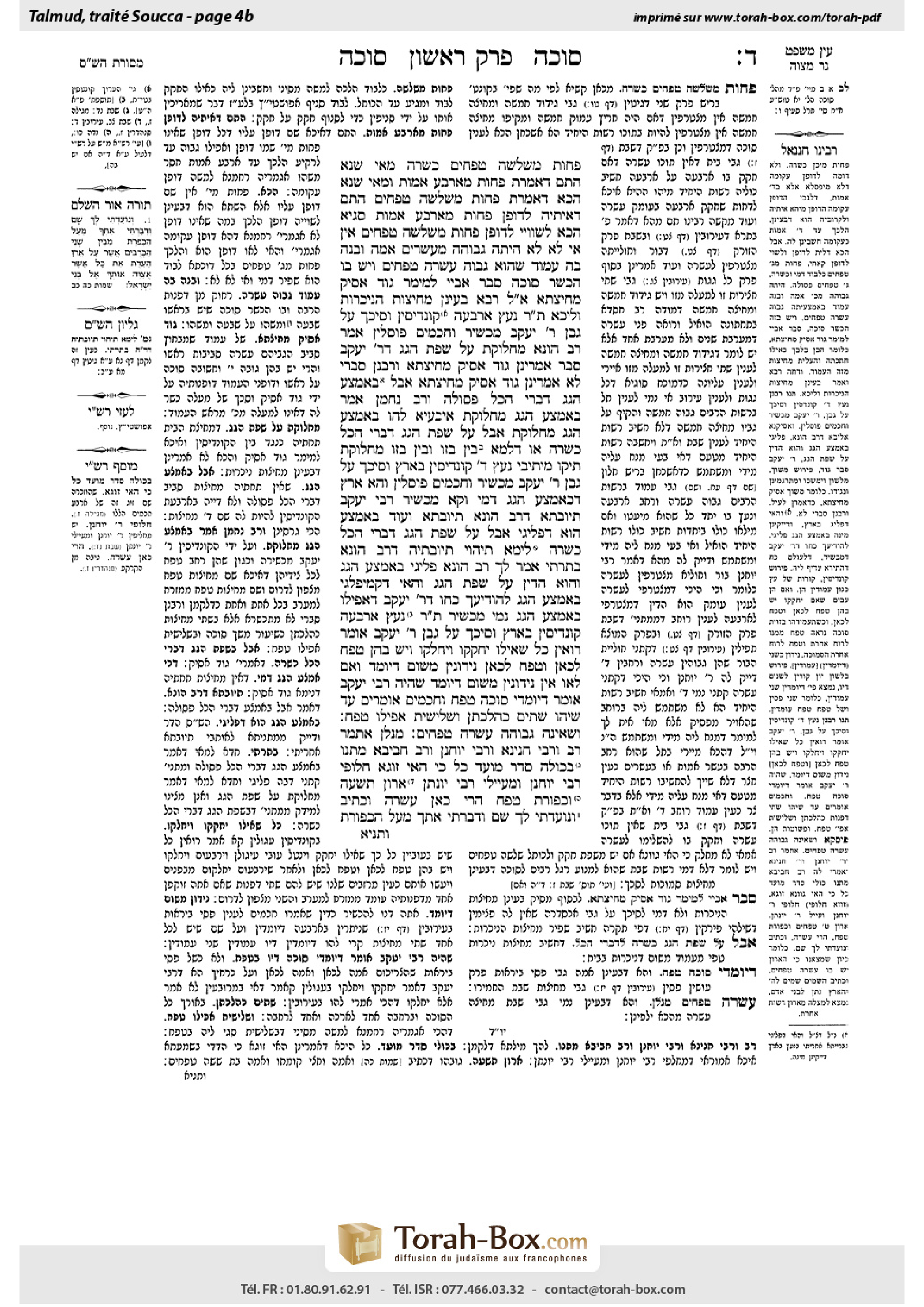
Sukkah 4b: Talmud study for Daf Yomi
Daf Yomi is the daily study of one Talmud folio. Explore 37 tractates with scans, Hebrew text, Sefaria English and AI-generated French translations where annotated.
Passage selection and English or AI-generated French translation are available where the scan has annotations. Daf Study is independent of Torah-Box and Sefaria.
Browse Sukkah · סוכה · All tractatesSukkah 4b text and translations
This page of Sukkah includes the Aramaic text, an English translation and an AI-generated French translation, alongside the scan above.
סוכה ד׳ ב · Aramaic and Hebrew text
פָּחוֹת מִשְּׁלֹשָׁה טְפָחִים — כְּשֵׁרָה.
מַאי שְׁנָא הָתָם, דְּאָמְרַתְּ פָּחוֹת מֵאַרְבַּע אַמּוֹת, וּמַאי שְׁנָא הָכָא, דְּאָמְרַתְּ פָּחוֹת מִשְּׁלֹשָׁה טְפָחִים?
הָתָם, דְּאִיתֵיהּ לְדוֹפֶן, פָּחוֹת מֵאַרְבַּע אַמּוֹת — סַגִּיא, הָכָא, לְשַׁוּוֹיֵי לְדוֹפֶן, פָּחוֹת מִשְּׁלֹשָׁה טְפָחִים — אִין, אִי לָא — לָא.
הָיְתָה גְּבוֹהָה מֵעֶשְׂרִים אַמָּה, וּבָנָה בָּהּ עַמּוּד שֶׁהוּא גָּבוֹהַּ עֲשָׂרָה טְפָחִים, וְיֵשׁ בּוֹ הֶכְשֵׁר סוּכָּה — סָבַר אַבָּיֵי לְמֵימַר, גּוּד אַסֵּיק מְחִיצָתָא.
אֲמַר לֵיהּ רָבָא: בָּעֵינַן מְחִיצוֹת הַנִּיכָּרוֹת, וְלֵיכָּא.
תָּנוּ רַבָּנַן: נָעַץ אַרְבָּעָה קוּנְדֵּיסִין וְסִיכֵּךְ עַל גַּבָּן, רַבִּי יַעֲקֹב מַכְשִׁיר וַחֲכָמִים פּוֹסְלִין.
אָמַר רַב הוּנָא: מַחְלוֹקֶת עַל שְׂפַת הַגָּג, דְּרַבִּי יַעֲקֹב סָבַר: אָמְרִינַן גּוּד אַסֵּיק מְחִיצָתָא, וְרַבָּנַן סָבְרִי: לָא אָמְרִינַן גּוּד אַסֵּיק מְחִיצָתָא, אֲבָל בָּאֶמְצַע הַגָּג — דִּבְרֵי הַכֹּל פְּסוּלָה. וְרַב נַחְמָן אָמַר: בְּאֶמְצַע הַגָּג מַחְלוֹקֶת.
אִיבַּעְיָא לְהוּ: בְּאֶמְצַע הַגָּג מַחְלוֹקֶת, אֲבָל עַל שְׂפַת הַגָּג דִּבְרֵי הַכֹּל כְּשֵׁרָה, אוֹ דִלְמָא, בֵּין בָּזוֹ וּבֵין בָּזוֹ מַחְלוֹקֶת? תֵּיקוּ.
מֵיתִיבִי: נָעַץ אַרְבָּעָה קוּנְדֵּיסִין בָּאָרֶץ וְסִיכֵּךְ עַל גַּבָּן, רַבִּי יַעֲקֹב מַכְשִׁיר וַחֲכָמִים פּוֹסְלִין.
וְהָא אֶרֶץ, דִּכְאֶמְצַע הַגָּג דָּמֵי, וְקָא מַכְשִׁיר רַבִּי יַעֲקֹב! תְּיוּבְתָּא דְרַב הוּנָא, תְּיוּבְתָּא.
וְעוֹד: בָּאֶמְצַע הוּא דִּפְלִיגִי, אֲבָל עַל שְׂפַת הַגָּג דִּבְרֵי הַכֹּל כְּשֵׁרָה! לֵימָא תֶּיהְוֵי תְּיוּבְתֵּיהּ דְּרַב הוּנָא בְּתַרְתֵּי.
אָמַר לְךָ רַב הוּנָא: פְּלִיגִי בְּאֶמְצַע הַגָּג, וְהוּא הַדִּין עַל שְׂפַת הַגָּג. וְהַאי דְּקָמִיפַּלְגִי בְּאֶמְצַע הַגָּג, לְהוֹדִיעֲךָ כֹּחוֹ דְּרַבִּי יַעֲקֹב, דַּאֲפִילּוּ בְּאֶמְצַע הַגָּג נָמֵי מַכְשִׁיר.
תָּנוּ רַבָּנַן: נָעַץ אַרְבָּעָה קוּנְדֵּיסִין בָּאָרֶץ וְסִיכֵּךְ עַל גַּבָּן, רַבִּי יַעֲקֹב אוֹמֵר: רוֹאִין כׇּל שֶׁאִילּוּ יֵחָקְקוּ וְיֵחָלְקוּ, וְיֵשׁ בָּהֶן טֶפַח לְכָאן וְטֶפַח לְכָאן — נִידּוֹנִין מִשּׁוּם דְּיוֹמָד, וְאִם לָאו — אֵין נִידּוֹנִין מִשּׁוּם דְּיוֹמָד. שֶׁהָיָה רַבִּי יַעֲקֹב אוֹמֵר: דְּיוֹמְדֵי סוּכָּה טֶפַח, וַחֲכָמִים אוֹמְרִים: עַד שֶׁיְּהוּ שְׁתַּיִם כְּהִלְכָתָן, וּשְׁלִישִׁית אֲפִילּוּ טֶפַח.
וְשֶׁאֵינָהּ גְּבוֹהָה עֲשָׂרָה טְפָחִים. מְנָלַן?
אִתְּמַר, רַב וְרַבִּי חֲנִינָא וְרַבִּי יוֹחָנָן וְרַב חֲבִיבָא מַתְנוּ.
בְּכוּלֵּהּ סֵדֶר מוֹעֵד, כָּל כִּי הַאי זוּגָא — חַלּוֹפֵי רַבִּי יוֹחָנָן וּמְעַיְּילִי רַבִּי יוֹנָתָן.
אָרוֹן תִּשְׁעָה, וְכַפּוֹרֶת טֶפַח — הֲרֵי כָּאן עֲשָׂרָה, וּכְתִיב: ״וְנוֹעַדְתִּי לְךָ שָׁם וְדִבַּרְתִּי אִתְּךָ מֵעַל הַכַּפּוֹרֶת״,
Sukkah 4b · English translation
If the distance from the edge of the dug-out area to the wall was less than three handbreadths then it is fit, as the edge of the dug-out area is joined to the wall of the sukka based on the principle of lavud.
The Gemara asks: What is different there, in the case of a sukka with a platform in its center, that you said that it is a fit sukka if the wall is at a distance of less than four cubits from the edge of the platform, and what is different here that you said the wall must be at a distance of less than three handbreadths for the sukka to be fit?
The Gemara answers: There, in the case of the sukka more than twenty cubits high, where there already is a wall, but it is removed from the platform, as long as the wall is at a distance of less than four cubits, it is sufficient to render the sukka fit. Here, where the sukka is less than ten handbreadths high, its wall is not a fit wall. In order to render it a wall by adding the height of the dug-out area, if the distance between them is less than three handbreadths, yes, the dug-out area is considered joined to the wall, as based on the principle of lavud two objects are considered joined if the gap between them is less than three handbreadths; and if not, no, they are not considered joined.
If a sukka was more than twenty cubits high, and one built a pillar in the sukka, far from the walls, that is ten handbreadths high, and the distance from the top of the column to the roofing was less than twenty cubits, and on the horizontal surface of the column there is a bit more than seven by seven handbreadths, the minimum area required for fitness of a sukka, Abaye thought to say that this is a fit sukka because of the principle: Extend and raise the partitions of this pillar. Given that the column is at least ten handbreadths high, its four sides are therefore considered partitions, and the halakha is that the legal status of a partition is as if it extends and continues upwards indefinitely. Based on that perspective, the surface of the column is supported by four partitions at least ten handbreadths high that extend upward indefinitely, and from the top of the pillar to the roof is less than twenty cubits; therefore, this squared column forms a fit sukka.
Rava said to Abaye: That is not so, since in order to have a fit sukka we require conspicuous partitions, and there are none, as the sides of the column do not actually project above the surface.
§ The Sages taught: If one inserted four posts [kundeisin] into the floor and placed roofing over them but no walls, Rabbi Ya’akov deems it a fit sukka and the Rabbis deem it unfit.
Rav Huna said: The dispute between the Rabbis and Rabbi Ya’akov is in a case where the four posts are aligned on the edge of the roof, directly above the exterior walls of a house, as Rabbi Ya’akov holds that we say the principle: Extend and raise the partitions. Since the exterior walls of the house are full-fledged partitions, they are considered as extending upward indefinitely, constituting the walls of the sukka. And the Rabbis hold that we do not say the principle: Extend and raise the partitions. However, if the posts are placed in the center of the roof, then the walls of the house are irrelevant and everyone agrees that it is an unfit sukka. And Rav Naḥman said: The dispute is in the case of a sukka in the center of the roof, as according to Rabbi Ya’akov, if the posts themselves are one handbreadth wide, they serve as the partitions, while the Rabbis hold that it is not a fit sukka until it has two complete walls and a partial third wall.
A dilemma was raised before the Sages: Is Rav Naḥman saying that only if the sukka is in the center of the roof there is a dispute between Rabbi Ya’akov and the Rabbis, but if it is at the edge of the roof everyone agrees that it is fit? Or perhaps he is saying that there is a dispute both in this case and in that case? No resolution was found, so the dilemma shall stand unresolved.
The Gemara raises an objection from another baraita: If one drove four posts into the ground and placed roofing over them, Rabbi Ya’akov deems it fit and the Rabbis deem it unfit.
But isn’t the legal status of the ground like that of the center of the roof, as it is not surrounded by partitions that extend upward, and nevertheless Rabbi Ya’akov deems it fit? This is a conclusive refutation of the opinion of Rav Huna, who said that everyone agrees that a sukka in the center of the roof is unfit. The Gemara concludes: Indeed, it is a conclusive refutation of Rav Huna’s opinion.
And furthermore, there is an additional refutation of the opinion of Rav Huna. It is apparent from this baraita that they disagree with regard to the case of posts inserted in the center of the roof; however, in the case of the posts inserted on the edge of the roof everyone agrees that it is fit. Let us say, then, that this is a conclusive refutation of the opinion of Rav Huna on two counts. First, with regard to his statement that everyone agrees in the case of a sukka in the center of the roof that it is unfit, while the baraita cites a dispute on the matter; second, with regard to his statement that there is a dispute in the case of a sukka on the edge of the roof, while the baraita indicates that everyone agrees that it is fit.
The Gemara rejects this: Rav Huna could have said to you that there is no proof from the baraita with regard to the second matter, as it is possible that they disagree in the case of a sukka in the center of the roof and that the same is true in the case of a sukka on the edge of the roof. And the fact that they specifically dispute the case of a sukka in the center of the roof is to convey to you the far-reaching nature of the opinion of Rabbi Ya’akov, who deems the sukka fit even in the center of the roof.
The Sages taught: If one inserted four posts into the ground and placed a roof over them, Rabbi Ya’akov says: One considers whether the posts are wide enough that if they were grooved and split, forming a piece of wood with two segments at a right angle, and they have a handbreadth to here, in this direction, and a handbreadth to there, in that direction, then they are considered a double post [deyumad]. With regard to certain halakhot, the status of a double post positioned at a corner is that of two full-fledged partitions. And if not, if after splitting them they are narrower than that, they are not considered a double post, as Rabbi Ya’akov would say: The minimum measure of double posts of a sukka to be considered full-fledged partitions is one handbreadth. And the Rabbis say: The sukka is fit only if it has two full-fledged partitions in the standard sense, completely closing each of those two sides, and a third wall, which, based on a halakha transmitted to Moses from Sinai, measures even a handbreadth.
§ The mishna continues: A sukka that is not even ten handbreadths high is unfit. The Gemara asks: From where do we derive this halakha?
It was stated that Rav, and Rabbi Ḥanina, and Rabbi Yoḥanan, and Rav Ḥaviva taught the matter below.
As an aside, the Gemara notes: Throughout the entire order of Mo’ed, wherever this second pair of Sages is mentioned, there are some amora’im who replace Rabbi Yoḥanan and do so by inserting Rabbi Yonatan in his place.
And this is what they taught: The Ark of the Covenant was itself nine handbreadths high, as it is stated explicitly in the Torah that it was one and a half cubits high and the cubit used to measure Temple vessels consisted of six handbreadths. And the Ark cover was one handbreadth thick. There is a total height of ten handbreadths here. And it is written: “I will meet with you there and I will speak with you from above the Ark cover” (Exodus 25:22),
Sukkah 4b · Traduction française (IA)
Si la distance entre le bord de la zone excavée et le mur est inférieure à trois palmes, la soukka est valide, car le bord de la zone excavée est considéré comme joint au mur de la soukka selon le principe de lavoud.
La Guemara demande : En quoi ce cas diffère-t-il de celui d’une soukka avec une estrade en son centre, où tu as dit qu’elle est valide si le mur se trouve à moins de quatre coudées du bord de l’estrade ? Et en quoi diffère-t-il du cas présent, où tu as dit que le mur doit se trouver à moins de trois palmes pour que la soukka soit valide ?
La Guemara répond : Là, dans le cas de la soukka de plus de vingt coudées de haut, il y a déjà un mur, mais il est éloigné de l’estrade ; il suffit que le mur se trouve à moins de quatre coudées pour que la soukka soit valide. Ici, dans le cas où la soukka fait moins de dix palmes de haut, son mur n’est pas un mur valide. Pour qu’il le devienne grâce à l’ajout de la hauteur de la zone excavée, si la distance entre les deux est inférieure à trois palmes, alors oui, la zone excavée est considérée comme jointe au mur, car, selon le principe de lavoud, deux éléments sont considérés comme joints lorsque l’espace qui les sépare est inférieur à trois palmes ; sinon, non, ils ne sont pas considérés comme joints.
Si une soukka faisait plus de vingt coudées de haut et que l’on avait construit en son centre, loin des murs, un pilier de dix palmes de haut, que la distance entre le sommet du pilier et la couverture était inférieure à vingt coudées, et que la surface horizontale du pilier faisait un peu plus de sept palmes sur sept — soit la superficie minimale requise pour qu’une soukka soit valide —, Abayé pensait dire que cette soukka était valide en vertu du principe : « Prolonge et élève les parois de ce pilier. » Puisque le pilier a au moins dix palmes de haut, ses quatre côtés sont donc considérés comme des parois, et la halakha veut qu’une paroi soit considérée comme se prolongeant vers le haut à l’infini. Selon cette approche, la surface du pilier est soutenue par quatre parois d’au moins dix palmes de haut, qui se prolongent vers le haut à l’infini ; comme il y a moins de vingt coudées entre le sommet du pilier et la couverture, ce pilier carré forme une soukka valide.
Rava dit à Abayé : Ce n’est pas le cas, car pour qu’une soukka soit valide, nous exigeons des parois visibles, or il n’y en a pas, puisque les côtés du pilier ne dépassent pas réellement sa surface.
§ Les Sages ont enseigné : Si quelqu’un enfonce quatre poteaux [kundeisin] dans le sol et pose une couverture au-dessus d’eux, mais sans murs, Rabbi Ya’akov la déclare valide et les Rabbins la déclarent invalide.
Rav Houna dit : Le désaccord entre les Rabbins et Rabbi Ya’akov porte sur le cas où les quatre poteaux sont alignés au bord du toit, juste au-dessus des murs extérieurs d’une maison, car Rabbi Ya’akov estime que l’on applique le principe : « Prolonge et élève les parois. » Puisque les murs extérieurs de la maison sont de véritables parois, ils sont considérés comme se prolongeant vers le haut à l’infini et constituent ainsi les murs de la soukka. Les Rabbins estiment, eux, que l’on n’applique pas ce principe. En revanche, si les poteaux sont placés au centre du toit, les murs de la maison ne sont pas pertinents et tous reconnaissent que la soukka est invalide. Rav Naḥman dit : Le désaccord porte sur le cas d’une soukka au centre du toit. Selon Rabbi Ya’akov, si les poteaux eux-mêmes ont une largeur d’une palme, ils font office de parois, tandis que les Rabbins estiment que la soukka n’est valide que si elle comporte deux murs complets et un troisième mur partiel.
Une question fut soulevée devant les Sages : Rav Naḥman veut-il dire que Rabbi Ya’akov et les Rabbins ne sont en désaccord que lorsque la soukka se trouve au centre du toit, mais que si elle est au bord du toit, tous reconnaissent qu’elle est valide ? Ou bien veut-il dire qu’il y a un désaccord dans les deux cas ? Aucune réponse ne fut trouvée ; la question reste donc sans réponse.
La Guemara soulève une objection à partir d’une autre baraïta : Si quelqu’un enfonce quatre poteaux dans le sol et pose une couverture au-dessus d’eux, Rabbi Ya’akov la déclare valide et les Rabbins la déclarent invalide.
Mais le sol n’a-t-il pas le même statut que le centre du toit, puisqu’il n’est pas entouré de parois qui se prolongent vers le haut ? Pourtant, Rabbi Ya’akov la déclare valide. C’est une réfutation concluante de l’opinion de Rav Houna, qui disait que tous reconnaissent qu’une soukka au centre du toit est invalide. La Guemara conclut : En effet, c’est une réfutation concluante de l’opinion de Rav Houna.
De plus, un autre élément réfute l’opinion de Rav Houna. Il ressort de cette baraïta qu’ils sont en désaccord au sujet du cas où les poteaux sont enfoncés au centre du toit ; en revanche, lorsque les poteaux sont enfoncés au bord du toit, tous reconnaissent que la soukka est valide. Peut-on donc dire que cela réfute de manière concluante l’opinion de Rav Houna sur deux points ? Premièrement, il affirme que tous reconnaissent qu’une soukka au centre du toit est invalide, alors que la baraïta rapporte un désaccord à ce sujet ; deuxièmement, il affirme qu’il existe un désaccord lorsque la soukka se trouve au bord du toit, alors que la baraïta indique que tous reconnaissent qu’elle est valide.
La Guemara rejette cette conclusion : Rav Houna aurait pu te répondre qu’il n’y a pas de preuve tirée de la baraïta concernant le second point, car il est possible qu’ils soient en désaccord dans le cas d’une soukka au centre du toit et qu’il en aille de même pour une soukka au bord du toit. S’ils mentionnent précisément leur désaccord au sujet d’une soukka au centre du toit, c’est pour te faire comprendre jusqu’où va l’opinion de Rabbi Ya’akov, qui déclare la soukka valide même au centre du toit.
Les Sages ont enseigné : Si quelqu’un enfonce quatre poteaux dans le sol et place une couverture au-dessus d’eux, Rabbi Ya’akov dit : On examine si les poteaux sont assez larges pour que, si on les entaillait et les fendait de manière à former une pièce de bois composée de deux segments à angle droit, ils aient une palme de ce côté, dans cette direction, et une palme de l’autre côté, dans cette direction. Dans ce cas, ils sont considérés comme un poteau double [deyumad]. Pour certaines halakhot, un poteau double placé dans un angle a le statut de deux véritables parois. Sinon, si, une fois fendus, ils sont moins larges que cela, ils ne sont pas considérés comme des poteaux doubles, car Rabbi Ya’akov dirait : La mesure minimale des poteaux doubles d’une soukka pour qu’ils soient considérés comme de véritables parois est d’une palme. Les Rabbins disent : La soukka n’est valide que si elle comporte deux véritables parois au sens habituel, fermant complètement chacun de ces deux côtés, et un troisième mur qui, selon une halakha transmise à Moïse au Sinaï, mesure même une palme.
§ La Michna poursuit : Une soukka qui ne mesure même pas dix palmes de haut est invalide. La Guemara demande : D’où déduisons-nous cette halakha ?
Il a été rapporté que Rav, Rabbi Ḥanina, Rabbi Yoḥanan et Rav Ḥaviva enseignèrent cette question plus loin.
Incidemment, la Guemara note : Dans tout l’ordre de Mo’ed, chaque fois que cette seconde paire de Sages est mentionnée, certains amoraïm remplacent Rabbi Yoḥanan par Rabbi Yonatan.
Et voici ce qu’ils enseignèrent : L’Arche de l’Alliance mesurait elle-même neuf palmes de haut, comme la Torah l’indique explicitement : elle mesurait une coudée et demie de haut, et la coudée utilisée pour mesurer les ustensiles du Temple comptait six palmes. Le couvercle de l’Arche avait une épaisseur d’une palme. La hauteur totale atteint donc ici dix palmes. Et il est écrit : « Je te rencontrerai là et je te parlerai d’au-dessus du couvercle de l’Arche » (Exode 25, 22),
Traduction française générée par IA à partir de l’édition anglaise de Sefaria. Vérifie toujours un passage avec le texte source.
Text from Sefaria: William Davidson Edition - Vocalized Aramaic (CC BY NC); William Davidson Edition - English (CC BY NC).