Sukkah 51a: Talmud study for Daf Yomi
Daf Yomi is the daily study of one Talmud folio. Explore 37 tractates with scans, Hebrew text, Sefaria English and AI-generated French translations where annotated.
Passage selection and English or AI-generated French translation are available where the scan has annotations. Daf Study is independent of Torah-Box and Sefaria.
Browse Sukkah · סוכה · All tractatesSukkah 51a text and translations
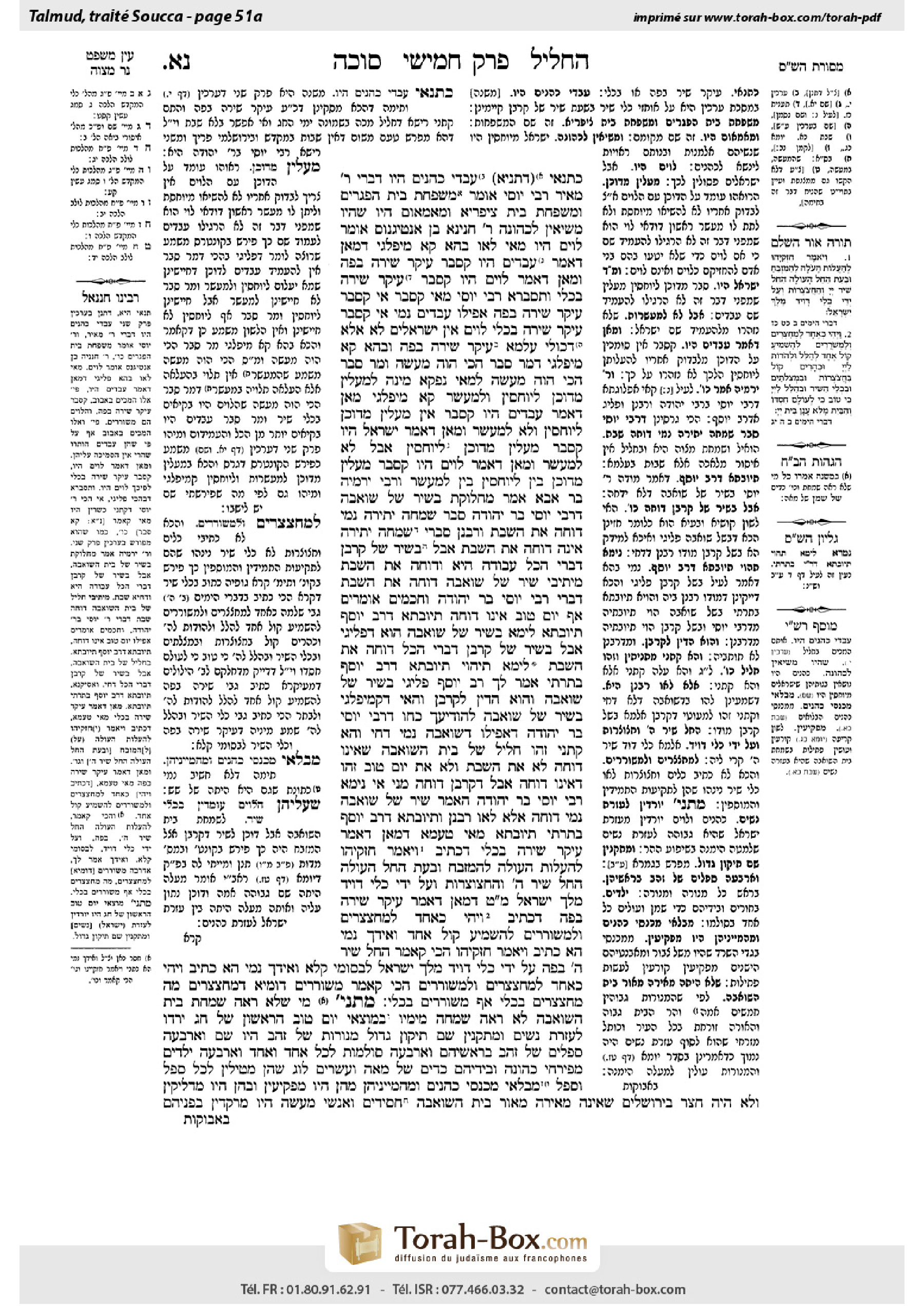
This page of Sukkah includes the Aramaic text, an English translation and an AI-generated French translation, alongside the scan above.
סוכה נ״א א · Aramaic and Hebrew text
כְּתַנָּאֵי, (דְּתַנְיָא): עַבְדֵי כֹהֲנִים הָיוּ, דִּבְרֵי רַבִּי מֵאִיר. רַבִּי יוֹסֵי אוֹמֵר: מִשְׁפַּחַת בֵּית הַפְּגָרִים וּמִשְׁפַּחַת בֵּית צִיפְּרַיָּא, וּמֵאֱמָאוּם הָיוּ, שֶׁהָיוּ מַשִּׂיאִין לַכְּהוּנָּה.
רַבִּי חֲנִינָא בֶּן אַנְטִיגְנוֹס אוֹמֵר: לְוִיִּם הָיוּ. מַאי לָאו בְּהָא קָא מִיפַּלְגִי, דְּמַאן דְּאָמַר עֲבָדִים הָיוּ, קָסָבַר: עִיקַּר שִׁירָה בַּפֶּה. וּמַאן דְּאָמַר לְוִיִּם הָיוּ, קָסָבַר: עִיקַּר שִׁירָה בִּכְלִי.
וְתִסְבְּרָא?! רַבִּי יוֹסֵי מַאי קָסָבַר? אִי קָסָבַר עִיקַּר שִׁירָה בַּפֶּה — אֲפִילּוּ עֲבָדִים נָמֵי, אִי קָסָבַר עִיקַּר שִׁירָה בִּכְלִי — לְוִיִּם אִין, יִשְׂרְאֵלִים לָא!
אֶלָּא: דְּכוּלֵּי עָלְמָא עִיקַּר שִׁירָה בַּפֶּה. וּבְהָא קָא מִיפַּלְגִי, דְּמָר סָבַר: הָכִי הֲוָה מַעֲשֶׂה, וּמָר סָבַר: הָכִי הֲוָה מַעֲשֶׂה.
לְמַאי נָפְקָא מִינַּהּ? לְמַעֲלִין מִדּוּכָן לְיוּחֲסִין וּלְמַעֲשֵׂר קָא מִיפַּלְגִי.
מַאן דְּאָמַר עֲבָדִים הָיוּ, קָסָבַר: אֵין מַעֲלִין מִדּוּכָן לְיוּחֲסִין, וְלֹא לְמַעֲשֵׂר. וּמַאן דְּאָמַר יִשְׂרָאֵל הָיוּ, קָסָבַר: מַעֲלִין מִדּוּכָן יוּחֲסִין, אֲבָל לֹא לְמַעֲשֵׂר. וּמַאן דְּאָמַר לְוִיִּם הָיוּ, קָסָבַר: מַעֲלִין מִדּוּכָן, בֵּין לְיוּחֲסִין בֵּין לְמַעֲשֵׂר.
וְרַבִּי יִרְמְיָה בַּר אַבָּא אָמַר: מַחְלוֹקֶת בְּשִׁיר שֶׁל שׁוֹאֵבָה, דְּרַבִּי יוֹסֵי בַּר יְהוּדָה סָבַר: שִׂמְחָה יְתֵירָה נָמֵי דּוֹחָה אֶת הַשַּׁבָּת, וְרַבָּנַן סָבְרִי: שִׂמְחָה יְתֵירָה אֵינָהּ דּוֹחָה אֶת הַשַּׁבָּת. אֲבָל בְּשִׁיר שֶׁל קׇרְבָּן, דִּבְרֵי הַכֹּל עֲבוֹדָה הִיא, וְדוֹחָה אֶת הַשַּׁבָּת.
מֵיתִיבִי: שִׁיר שֶׁל שׁוֹאֵבָה דּוֹחֶה אֶת הַשַּׁבָּת, דִּבְרֵי רַבִּי יוֹסֵי בַּר יְהוּדָה. וַחֲכָמִים אוֹמְרִים: אַף יוֹם טוֹב אֵינוֹ דּוֹחֶה. תְּיוּבְתָּא דְּרַב יוֹסֵף! תְּיוּבְתָּא.
לֵימָא בְּשִׁיר שֶׁל שׁוֹאֵבָה הוּא דִּפְלִיגִי, אֲבָל בְּשִׁיר שֶׁל קׇרְבָּן דִּבְרֵי הַכֹּל דּוֹחֶה אֶת הַשַּׁבָּת. לֵימָא תֶּיהְוֵי תְּיוּבְתָּא דְּרַב יוֹסֵף בְּתַרְתֵּי!
אָמַר לְךָ רַב יוֹסֵף: פְּלִיגִי בְּשִׁיר שֶׁל שׁוֹאֵבָה, וְהוּא הַדִּין לְקׇרְבָּן. וְהַאי דְּקָמִיפַּלְגִי בְּשִׁיר שֶׁל שׁוֹאֵבָה — לְהוֹדִיעֲךָ כֹּחוֹ דְּרַבִּי יוֹסֵי בַּר יְהוּדָה, דַּאֲפִילּוּ דְּשׁוֹאֵבָה נָמֵי דָּחֵי.
וְהָא קָתָנֵי: זֶהוּ חָלִיל שֶׁל בֵּית הַשּׁוֹאֵבָה שֶׁאֵינוֹ דּוֹחֶה לֹא אֶת הַשַּׁבָּת וְלֹא אֶת יוֹם טוֹב: זֶהוּ דְּאֵינוֹ דּוֹחֶה, אֲבָל דְּקָרְבָּן דּוֹחֶה מַנִּי? אִי נֵימָא רַבִּי יוֹסֵי בַּר יְהוּדָה, הָאָמַר שִׁיר שֶׁל שׁוֹאֵבָה נָמֵי דּוֹחֶה! אֶלָּא לָאו, רַבָּנַן — וּתְיוּבְתָּא דְּרַב יוֹסֵף בְּתַרְתֵּי! תְּיוּבְתָּא.
מַאי טַעְמָא דְּמַאן דְּאָמַר עִיקַּר שִׁירָה בִּכְלִי? דִּכְתִיב: ״וַיֹּאמֶר חִזְקִיָּהוּ לְהַעֲלוֹת הָעוֹלָה לְהַמִּזְבֵּחַ וּבְעֵת הֵחֵל הָעוֹלָה הֵחֵל שִׁיר ה׳ וְהַחֲצוֹצְרוֹת וְעַל יְדֵי כְּלֵי דָּוִיד מֶלֶךְ יִשְׂרָאֵל״.
מַאי טַעְמָא דְּמַאן דְּאָמַר עִיקַּר שִׁירָה בַּפֶּה? דִּכְתִיב: ״וַיְהִי כְאֶחָד לַמְחַצְּצרִים וְלַמְשׁוֹרְרִים לְהַשְׁמִיעַ קוֹל אֶחָד״.
וְאִידַּךְ נָמֵי, הָא כְּתִיב: ״וַיֹּאמֶר חִזְקִיָּהוּ״! הָכִי קָאָמַר: ״הֵחֵל שִׁיר ה׳״ — בַּפֶּה, ״עַל יְדֵי כְּלֵי דָּוִיד מֶלֶךְ יִשְׂרָאֵל״ — לְבַסּוֹמֵי קָלָא.
וְאִידַּךְ נָמֵי, הָא כְּתִיב: ״וַיְהִי כְּאֶחָד לַמְחַצְּצרִים וְלַמְשׁוֹרְרִים״! הָכִי קָאָמַר: מְשׁוֹרְרִים דֻּומְיָא דִּמְחַצְּצרִים, מָה מְחַצְּצרִים — בִּכְלִי, אַף מְשׁוֹרְרִים — בִּכְלִי.
מַתְנִי׳ מִי שֶׁלֹּא רָאָה שִׂמְחַת בֵּית הַשּׁוֹאֵבָה, לֹא רָאָה שִׂמְחָה מִיָּמָיו. בְּמוֹצָאֵי יוֹם טוֹב הָרִאשׁוֹן שֶׁל חַג יָרְדוּ לְעֶזְרַת נָשִׁים, וּמְתַקְּנִין שָׁם תִּיקּוּן גָּדוֹל. מְנוֹרוֹת שֶׁל זָהָב הָיוּ שָׁם, וְאַרְבָּעָה סְפָלִים שֶׁל זָהָב בְּרָאשֵׁיהֶם, וְאַרְבָּעָה סוּלָּמוֹת לְכׇל אֶחָד וְאֶחָד, וְאַרְבָּעָה יְלָדִים מִפִּירְחֵי כְהוּנָּה וּבִידֵיהֶם כַּדִּים שֶׁל מֵאָה וְעֶשְׂרִים לוֹג שֶׁהֵן מְטִילִין לְכׇל סֵפֶל וָסֵפֶל. מִבְּלָאֵי מִכְנְסֵי כֹהֲנִים וּמֵהֶמְיָינֵיהֶן, מֵהֶן הָיוּ מַפְקִיעִין, וּבָהֶן הָיוּ מַדְלִיקִין. וְלֹא הָיָה חָצֵר בִּירוּשָׁלַיִם שֶׁאֵינָהּ מְאִירָה מְאוֹר בֵּית הַשּׁוֹאֵבָה.
חֲסִידִים וְאַנְשֵׁי מַעֲשֶׂה הָיוּ מְרַקְּדִין בִּפְנֵיהֶם
Sukkah 51a · English translation
This dispute is parallel to another dispute between tanna’im, as it is taught in a mishna in tractate Arakhin: The Temple musicians were slaves of priests; this is the statement of Rabbi Meir. Rabbi Yosei says: The musicians were not slaves; they were Israelites from the family of the House of Happegarim and the family of the House of Tzipperaya. And they were from the city of Emma’um, and their lineage was sufficiently distinguished that they would marry their daughters to members of the priesthood.
Rabbi Ḥanina ben Antigonus says: They were Levites. What, is it not that they disagree with regard to this; that the one who said that the musicians were slaves holds that the primary essence of song is singing with the mouth. Since the instrumental music is mere accompaniment, it could be performed by slaves. And the one who said that the musicians were Levites holds that the primary essence of song is accompaniment by musical instruments. Therefore, the musicians were Levites, who were tasked with the song that was part of the Temple service.
The Gemara asks: And how can you understand the mishna that way? According to that explanation, what does Rabbi Yosei hold? If he holds that the primary essence of song is singing with the mouth, then even slaves can also play the instruments. Why then does he require that the musicians be from Israelite families of distinguished lineage? If he holds that the primary essence of song is accompaniment by musical instruments, he should have said: Levites, yes, they may play the instruments, but Israelites, no, they may not.
Rather, the explanation of the dispute is that everyone agrees that the primary essence of song is singing with the mouth and the musical instruments are merely for accompaniment. And it is with regard to this that they disagree: It is that one Sage holds that the event took place in this manner, i.e., slaves played the instruments, and one Sage holds that the event took place in this manner, i.e., Israelite families of distinguished lineage played the instruments.
The Gemara asks: What practical halakhic difference is there whether one group or another played the instruments? The Gemara answers: It is with regard to whether one elevates a Levite from the platform to the presumptive status of distinguished lineage and eligibility to receive tithes that they disagree. Is it possible to draw the conclusion that a family is of distinguished lineage or eligible to receive tithes based on the fact that a member or ancestor of that family played a musical instrument on the Temple platform?
The one who said that the musicians were slaves holds that one does not elevate from the platform to the presumptive status of distinguished lineage and eligibility to receive tithes. And the one who said that the musicians were Israelites holds that one elevates a Levite from the platform to the presumptive status of distinguished lineage but not eligibility to receive tithes. And the one who said that the musicians were Levites holds that one elevates a Levite from the platform to the presumptive status of distinguished lineage and eligibility to receive tithes.
§ The Gemara cites an opinion that disagrees with that of Rav Yosef. And Rabbi Yirmeya bar Abba said: The dispute between Rabbi Yosei bar Yehuda and the Rabbis is with regard to the song of the Drawing of the Water. Rabbi Yosei bar Yehuda holds that extra rejoicing also overrides Shabbat, and the Rabbis hold that extra rejoicing does not override Shabbat. However, with regard to the song that the Levites sang accompanying an offering, everyone agrees that it is part of the Temple service, and overrides Shabbat.
The Gemara raises an objection to the opinion of Rav Yosef that the dispute is with regard to the song that the Levites sang accompanying the daily offering: The song of the Drawing of the Water overrides Shabbat; this is the statement of Rabbi Yosei bar Yehuda. And the Rabbis say: It does not override even the Festival. Apparently, their dispute is with regard to the song of the Drawing of the Water. Say that this is a conclusive refutation of the opinion of Rav Yosef. The Gemara concludes: Indeed, it is a conclusive refutation.
The Gemara suggests: Let us say, based on this baraita, that it is with regard to the song of the Drawing of the Water alone that they disagree; however, with regard to the song that the Levites sang accompanying the daily offering, everyone says that it overrides Shabbat. If so, let us say that this will be a conclusive refutation of the opinion of Rav Yosef on two counts. According to Rav Yosef, the dispute is with regard to the song of the Drawing of the Water, and not with regard to the song the Levites sang accompanying the daily offering. The above suggestion refutes both aspects of his opinion.
Rav Yosef could have said to you: They disagree with regard to the song of the Drawing of the Water and the same is true for the song that the Levites sang accompanying an offering. And the fact that they disagree specifically with regard to the song of the Drawing of the Water and do not specifically mention the song that the Levites sang accompanying the daily offering is to convey to you the far-reaching nature of the opinion of Rabbi Yosei bar Yehuda, that even the song of the Drawing of the Water also overrides Shabbat.
The Gemara asks: But isn’t it taught in the mishna: This is the flute of the Place of the Drawing of the Water, which overrides neither Shabbat nor the Festival. By inference, this is the flute that does not override Shabbat; however, the flute that accompanies the daily offering overrides Shabbat. The Gemara asks: Who is the tanna of the mishna? If we say it is Rabbi Yosei bar Yehuda, didn’t he say that the song of the Drawing of the Water also overrides Shabbat? Rather, is it not the Rabbis, and say that this is a conclusive refutation of Rav Yosef on two counts. The Gemara concludes: Indeed, it is a conclusive refutation.
The Gemara asks: What is the rationale for the opinion of the one who said: The primary essence of song is singing accompanied by musical instruments? The Gemara answers: It is as it is written: “And Hezekiah commanded to sacrifice the burnt-offering upon the altar. And when the burnt-offering began, the song of the Lord began also, and the trumpets, together with the instruments of David, king of Israel” (II Chronicles 29:27), indicating that the song of God that accompanies the offering is played by trumpets and other instruments.
The Gemara asks: What is the rationale for the opinion of the one who said: The primary essence of song is singing with the mouth? The Gemara answers: It is as it is written: “And it came to pass, when the trumpeters and the singers were as one to make one sound” (II Chronicles 5:13). Since the verse does not mention any musical instrument played with the singing other than the trumpets, and the trumpets were not sounded as accompaniment for the singers, apparently the primary essence of song is singing with the mouth. The trumpets were sounded in order to accompany the sacrifice of the daily and additional offerings with the requisite sounds of tekia and terua.
The Gemara asks: And according to the other tanna too, who holds that the primary essence of song is singing with the mouth, isn’t it written: “And Hezekiah commanded…the song of the Lord began also, and the trumpets, together with the instruments,” indicating that the instruments are the primary essence? The Gemara answers: This is what the verse is saying: “The song of the Lord began,” indicates that the primary essence is with the mouth; “with the instruments of David, King of Israel,” is to sweeten the sound, as the instruments are merely to accompany and enhance the singing.
The Gemara asks: And according to the other tanna too, who holds that the primary essence of song is singing accompanied by musical instruments, isn’t it written: “And it came to pass, when the trumpeters and the singers were as one,” indicating that the primary essence is with the mouth? The Gemara answers: This is what the verse is saying: Through their juxtaposition, one derives that the singers are similar to the trumpeters; just as trumpeters produce their sound with an instrument, so too the singers produce their song with an instrument.
MISHNA: One who did not see the Celebration of the Place of the Drawing of the Water never saw celebration in his days. This was the sequence of events: At the conclusion of the first Festival day the priests and the Levites descended from the Israelites’ courtyard to the Women’s Courtyard, where they would introduce a significant repair, as the Gemara will explain. There were golden candelabra atop poles there in the courtyard. And there were four basins made of gold at the top of each candelabrum. And there were four ladders for each and every pole and there were four children from the priesthood trainees, and in their hands were pitchers with a capacity of 120 log of oil that they would pour into each and every basin. From the worn trousers of the priests and their belts they would loosen and tear strips to use as wicks, and with them they would light the candelabra. And the light from the candelabra was so bright that there was not a courtyard in Jerusalem that was not illuminated from the light of the Place of the Drawing of the Water.
The pious and the men of action would dance before the people who attended the celebration,
Sukkah 51a · Traduction française (IA)
Cette controverse est parallèle à un autre désaccord entre des tannaim, comme on l’enseigne dans une Michna du traité Arakhin : les musiciens du Temple étaient des esclaves des prêtres ; telle est l’opinion de Rabbi Meïr. Rabbi Yossi dit : les musiciens n’étaient pas des esclaves, mais des Israélites issus de la famille de la Maison de Happegarim et de la famille de la Maison de Tzipperaya. Ils étaient originaires de la ville d’Emma’um, et leur lignée était suffisamment distinguée pour qu’ils marient leurs filles à des membres de la famille sacerdotale.
Rabbi Ḥanina ben Antigonus dit : c’étaient des Lévites. Ne sont-ils pas en désaccord sur ce point : celui qui dit que les musiciens étaient des esclaves estime que l’essentiel du chant réside dans la voix. Puisque la musique instrumentale n’est qu’un accompagnement, des esclaves pouvaient l’assurer. Celui qui dit que les musiciens étaient des Lévites estime, lui, que l’essentiel du chant réside dans l’accompagnement par des instruments de musique. Les musiciens étaient donc des Lévites, chargés du chant qui faisait partie du service du Temple.
La Guemara demande : comment peut-on comprendre la Michna ainsi ? Selon cette explication, quelle est la position de Rabbi Yossi ? S’il estime que l’essentiel du chant réside dans la voix, des esclaves peuvent eux aussi jouer des instruments. Pourquoi exige-t-il alors que les musiciens soient issus de familles israélites à la lignée distinguée ? S’il estime que l’essentiel du chant réside dans l’accompagnement par des instruments de musique, il aurait dû dire : les Lévites, oui, peuvent jouer des instruments, mais les Israélites, non.
L’explication du désaccord est plutôt la suivante : tous conviennent que l’essentiel du chant réside dans la voix et que les instruments de musique ne servent qu’à l’accompagner. Leur désaccord porte sur la façon dont les choses se sont passées : un Sage estime que des esclaves jouaient des instruments, tandis qu’un autre estime que des familles israélites à la lignée distinguée les jouaient.
La Guemara demande : quelle différence pratique halakhique y a-t-il selon que tel ou tel groupe jouait des instruments ? La Guemara répond : leur désaccord porte sur la question de savoir si l’on peut, du fait de son service sur l’estrade, conférer à un Lévite une présomption de lignée distinguée et d’aptitude à recevoir les dîmes. Peut-on conclure qu’une famille possède une lignée distinguée ou est apte à recevoir les dîmes parce qu’un membre ou un ancêtre de cette famille a joué d’un instrument sur l’estrade du Temple ?
Celui qui dit que les musiciens étaient des esclaves estime que le service sur l’estrade ne confère ni présomption de lignée distinguée ni aptitude à recevoir les dîmes. Celui qui dit que les musiciens étaient des Israélites estime que le service d’un Lévite sur l’estrade confère une présomption de lignée distinguée, mais non d’aptitude à recevoir les dîmes. Celui qui dit que les musiciens étaient des Lévites estime que le service d’un Lévite sur l’estrade confère une présomption de lignée distinguée et d’aptitude à recevoir les dîmes.
§ La Guemara cite une opinion divergente de celle de Rav Yossef. Rabbi Yirmeya bar Abba dit : le désaccord entre Rabbi Yossi bar Yehouda et les Sages porte sur le chant de la cérémonie du puisage de l’eau. Rabbi Yossi bar Yehouda estime que la réjouissance supplémentaire l’emporte également sur le Chabbat, tandis que les Sages estiment qu’elle ne l’emporte pas sur le Chabbat. En revanche, tous conviennent que le chant des Lévites qui accompagnait une offrande fait partie du service du Temple et l’emporte sur le Chabbat.
La Guemara soulève une objection à l’opinion de Rav Yossef, selon laquelle le désaccord porte sur le chant des Lévites qui accompagnait l’offrande quotidienne : « Le chant de la cérémonie du puisage de l’eau l’emporte sur le Chabbat » ; telle est l’opinion de Rabbi Yossi bar Yehouda. Les Sages disent : « Il ne l’emporte même pas sur la fête. » Il semble donc que leur désaccord porte sur le chant de la cérémonie du puisage de l’eau. Disons que cela constitue une réfutation décisive de l’opinion de Rav Yossef. La Guemara conclut : en effet, c’est une réfutation décisive.
La Guemara propose : disons, sur la base de cette baraïta, que leur désaccord porte uniquement sur le chant de la cérémonie du puisage de l’eau ; en revanche, tous conviennent que le chant des Lévites qui accompagnait l’offrande quotidienne l’emporte sur le Chabbat. Si tel est le cas, disons que cela réfute définitivement l’opinion de Rav Yossef à deux titres. Selon Rav Yossef, le désaccord porte sur le chant de la cérémonie du puisage de l’eau, et non sur le chant des Lévites qui accompagnait l’offrande quotidienne. La proposition ci-dessus réfute ces deux aspects de son opinion.
Rav Yossef aurait pu te répondre : leur désaccord porte sur le chant de la cérémonie du puisage de l’eau, et il en va de même pour le chant des Lévites qui accompagnait une offrande. S’ils parlent précisément du chant de la cérémonie du puisage de l’eau, sans mentionner expressément celui qui accompagnait l’offrande quotidienne, c’est pour te faire comprendre toute l’ampleur de l’opinion de Rabbi Yossi bar Yehouda : même le chant de la cérémonie du puisage de l’eau l’emporte également sur le Chabbat.
La Guemara demande : mais n’est-il pas enseigné dans la Michna : « Voici la flûte du lieu du puisage de l’eau, qui ne l’emporte ni sur le Chabbat ni sur la fête » ? On en déduit que cette flûte-là ne l’emporte pas sur le Chabbat, tandis que la flûte qui accompagne l’offrande quotidienne l’emporte sur le Chabbat. La Guemara demande : qui est le tanna de la Michna ? Si nous disons qu’il s’agit de Rabbi Yossi bar Yehouda, n’a-t-il pas dit que le chant de la cérémonie du puisage de l’eau l’emporte lui aussi sur le Chabbat ? Il s’agit donc des Sages, n’est-ce pas ? Disons alors que cela réfute définitivement l’opinion de Rav Yossef à deux titres. La Guemara conclut : en effet, c’est une réfutation décisive.
La Guemara demande : quel est le raisonnement de celui qui dit que l’essentiel du chant réside dans le chant accompagné d’instruments de musique ? La Guemara répond : comme il est écrit : « Hizqiya ordonna d’offrir l’holocauste sur l’autel. Au moment où commença l’holocauste, le chant de l’Éternel commença aussi, avec les trompettes et les instruments de David, roi d’Israël » (II Chroniques 29,27). Cela indique que le chant de Dieu qui accompagne l’offrande est exécuté au moyen de trompettes et d’autres instruments.
La Guemara demande : quel est le raisonnement de celui qui dit que l’essentiel du chant réside dans la voix ? La Guemara répond : comme il est écrit : « Il arriva que les trompettistes et les chanteurs ne firent qu’un pour produire un seul son » (II Chroniques 5,13). Puisque le verset ne mentionne, avec le chant, aucun instrument de musique autre que les trompettes, et que celles-ci n’accompagnaient pas les chanteurs, il apparaît que l’essentiel du chant réside dans la voix. Les trompettes sonnaient afin d’accompagner l’offrande quotidienne et les offrandes supplémentaires par les sonneries requises de tekia et de teroua.
La Guemara demande : et selon l’autre tanna, qui estime lui aussi que l’essentiel du chant réside dans la voix, n’est-il pas écrit : « Hizqiya ordonna… le chant de l’Éternel commença aussi, avec les trompettes et les instruments », ce qui indique que l’essentiel réside dans les instruments ? La Guemara répond : voici ce que signifie le verset : « Le chant de l’Éternel commença » indique que l’essentiel réside dans la voix ; « avec les instruments de David, roi d’Israël » signifie que ceux-ci adoucissent le son, car les instruments ne servent qu’à accompagner et à embellir le chant.
La Guemara demande : et selon l’autre tanna, qui estime que l’essentiel du chant réside dans le chant accompagné d’instruments de musique, n’est-il pas écrit : « Il arriva que les trompettistes et les chanteurs ne firent qu’un », ce qui indique que l’essentiel réside dans la voix ? La Guemara répond : voici ce que signifie le verset : de leur juxtaposition, on déduit que les chanteurs sont semblables aux trompettistes ; de même que les trompettistes produisent leur son au moyen d’un instrument, de même les chanteurs exécutent leur chant au moyen d’un instrument.
MICHNA : Celui qui n’a pas vu la célébration du lieu du puisage de l’eau n’a jamais vu de célébration de sa vie. Voici comment se déroulaient les événements : à la fin du premier jour de fête, les prêtres et les Lévites descendaient de la cour des Israélites vers la cour des Femmes, où ils procédaient à une importante modification, comme la Guemara l’expliquera. Dans la cour se trouvaient des candélabres d’or montés sur des mâts. Au sommet de chaque candélabre se trouvaient quatre bassins d’or. Chaque mât était pourvu de quatre échelles, et quatre jeunes gens parmi les apprentis prêtres tenaient des cruches d’une capacité de 120 log d’huile, qu’ils versaient dans chacun des bassins. Ils détachaient et déchiraient des bandes dans les pantalons usés des prêtres et dans leurs ceintures, pour s’en servir comme mèches ; c’est avec elles qu’ils allumaient les candélabres. Leur lumière était si éclatante qu’il n’y avait pas une cour à Jérusalem qui ne fût illuminée par la lumière du lieu du puisage de l’eau.
Les hommes pieux et les hommes d’action dansaient devant les personnes venues assister à la célébration,
Traduction française générée par IA à partir de l’édition anglaise de Sefaria. Vérifie toujours un passage avec le texte source.
Text from Sefaria: William Davidson Edition - Vocalized Aramaic (CC BY NC); William Davidson Edition - English (CC BY NC).