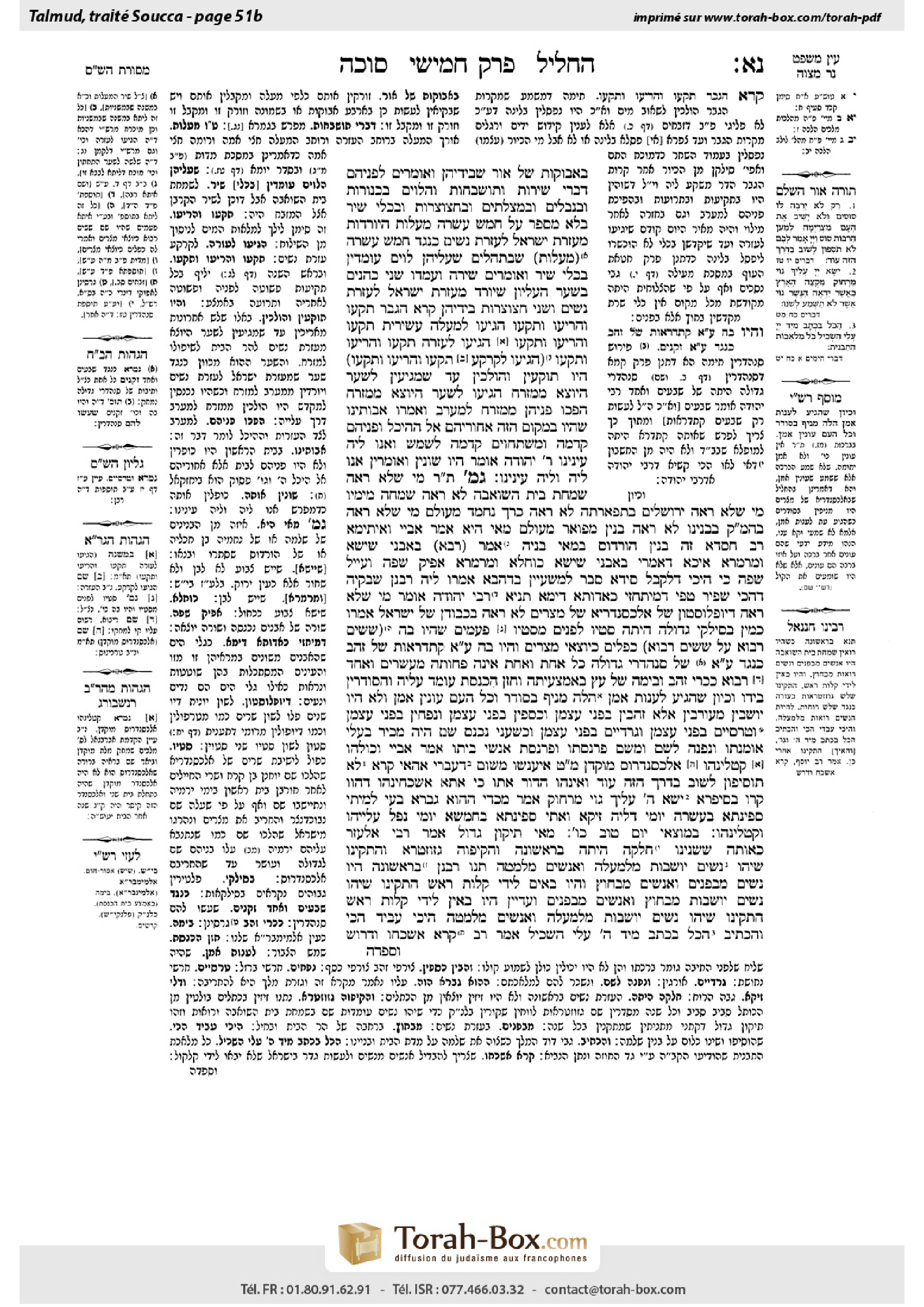
Sukkah 51b: Talmud study for Daf Yomi
Daf Yomi is the daily study of one Talmud folio. Explore 37 tractates with scans, Hebrew text, Sefaria English and AI-generated French translations where annotated.
Passage selection and English or AI-generated French translation are available where the scan has annotations. Daf Study is independent of Torah-Box and Sefaria.
Browse Sukkah · סוכה · All tractatesSukkah 51b text and translations
This page of Sukkah includes the Aramaic text, an English translation and an AI-generated French translation, alongside the scan above.
סוכה נ״א ב · Aramaic and Hebrew text
בַּאֲבוּקוֹת שֶׁל אוֹר שֶׁבִּידֵיהֶן, וְאוֹמְרִים לִפְנֵיהֶם דִּבְרֵי שִׁירוֹת וְתוּשְׁבָּחוֹת. וְהַלְוִיִּם בְּכִנּוֹרוֹת וּבִנְבָלִים וּבִמְצִלְתַּיִם וּבַחֲצוֹצְרוֹת וּבִכְלֵי שִׁיר בְּלֹא מִסְפָּר, עַל חֲמֵשׁ עֶשְׂרֵה מַעֲלוֹת הַיּוֹרְדוֹת מֵעֶזְרַת יִשְׂרָאֵל לְעֶזְרַת נָשִׁים, כְּנֶגֶד חֲמֵשׁ עֶשְׂרֵה (מַעֲלוֹת) שֶׁבַּתְּהִלִּים, שֶׁעֲלֵיהֶן לְוִיִּם עוֹמְדִין בִּכְלֵי שִׁיר וְאוֹמְרִים שִׁירָה.
וְעָמְדוּ שְׁנֵי כֹהֲנִים בְּשַׁעַר הָעֶלְיוֹן שֶׁיּוֹרֵד מֵעֶזְרַת יִשְׂרָאֵל לְעֶזְרַת נָשִׁים, וּשְׁתֵּי חֲצוֹצְרוֹת בִּידֵיהֶן, קָרָא הַגֶּבֶר — תָּקְעוּ וְהֵרִיעוּ וְתָקְעוּ. הִגִּיעוּ לְמַעֲלָה עֲשִׂירִית — תָּקְעוּ וְהֵרִיעוּ וְתָקְעוּ. הִגִּיעוּ לָעֲזָרָה — תָּקְעוּ וְהֵרִיעוּ וְתָקְעוּ.
(הִגִּיעוּ לַקַּרְקַע — תָּקְעוּ וְהֵרִיעוּ וְתָקְעוּ.) הָיוּ תּוֹקְעִין וְהוֹלְכִין עַד שֶׁמַּגִּיעִין לְשַׁעַר הַיּוֹצֵא מִמִּזְרָח. הִגִּיעוּ לְשַׁעַר הַיּוֹצֵא מִמִּזְרָח — הָפְכוּ פְּנֵיהֶן מִמִּזְרָח לְמַעֲרָב וְאָמְרוּ: אֲבוֹתֵינוּ שֶׁהָיוּ בַּמָּקוֹם הַזֶּה — ״אֲחוֹרֵיהֶם אֶל הַהֵיכָל וּפְנֵיהֶם קֵדְמָה וּמִשְׁתַּחֲוִים קֵדְמָה לַשֶּׁמֶשׁ״, וְאָנוּ לְיָהּ עֵינֵינוּ. רַבִּי יְהוּדָה אוֹמֵר, הָיוּ שׁוֹנִין וְאוֹמְרִין: אָנוּ לְיָהּ, וּלְיָהּ עֵינֵינוּ.
גְּמָ׳ תָּנוּ רַבָּנַן: מִי שֶׁלֹּא רָאָה שִׂמְחַת בֵּית הַשּׁוֹאֵבָה — לֹא רָאָה שִׂמְחָה מִיָּמָיו. מִי שֶׁלֹּא רָאָה יְרוּשָׁלַיִם בְּתִפְאַרְתָּהּ — לֹא רָאָה כְּרַךְ נֶחְמָד מֵעוֹלָם. מִי שֶׁלֹּא רָאָה בֵּית הַמִּקְדָּשׁ בְּבִנְיָנוֹ — לֹא רָאָה בִּנְיָן מְפוֹאָר מֵעוֹלָם. מַאי הִיא? אָמַר אַבָּיֵי וְאִיתֵּימָא רַב חִסְדָּא: זֶה בִּנְיַן הוֹרְדוֹס.
בְּמַאי בַּנְיֵהּ? אָמַר (רָבָא): בְּאַבְנֵי שֵׁישָׁא וּמַרְמְרָא. אִיכָּא דְּאָמְרִי: בְּאַבְנֵי שֵׁישָׁא כּוּחְלָא וּמַרְמְרָא. אַפֵּיק שָׂפָה וְעַיֵּיל שָׂפָה, כִּי הֵיכִי דִּלְקַבֵּל סִידָא. סְבַר לְמִשְׁעֲיֵיהּ בְּדַהֲבָא, אֲמַרוּ לֵיהּ רַבָּנַן: שִׁבְקֵיהּ, דְּהָכִי שַׁפִּיר טְפֵי, דְּמִיתְחֲזֵי כְּאִדְוָתָא דְיַמָּא.
תַּנְיָא, רַבִּי יְהוּדָה אוֹמֵר: מִי שֶׁלֹּא רָאָה דְּיוֹפְּלוּסְטוֹן שֶׁל אֲלֶכְּסַנְדְּרִיָּא שֶׁל מִצְרַיִם, לֹא רָאָה בִּכְבוֹדָן שֶׁל יִשְׂרָאֵל. אָמְרוּ: כְּמִין בָּסִילְקֵי גְּדוֹלָה הָיְתָה, סְטָיו לְפָנִים מִסְּטָיו. פְּעָמִים שֶׁהָיוּ בָּהּ (שִׁשִּׁים רִבּוֹא עַל שִׁשִּׁים רִבּוֹא), כִּפְלַיִם כְּיוֹצְאֵי מִצְרַיִם. וְהָיוּ בָּהּ שִׁבְעִים וְאַחַת קָתֶדְרָאוֹת שֶׁל זָהָב, כְּנֶגֶד שִׁבְעִים וְאַחַת שֶׁל סַנְהֶדְרִי גְּדוֹלָה, כׇּל אַחַת וְאַחַת אֵינָהּ פְּחוּתָה מֵעֶשְׂרִים וְאֶחָד רִבּוֹא כִּכְּרֵי זָהָב. וּבִימָה שֶׁל עֵץ בְּאֶמְצָעִיתָהּ, וְחַזַּן הַכְּנֶסֶת עוֹמֵד עָלֶיהָ וְהַסּוּדָרִין בְּיָדוֹ. וְכֵיוָן שֶׁהִגִּיעַ לַעֲנוֹת אָמֵן, הַלָּה מֵנִיף בַּסּוּדָר וְכׇל הָעָם עוֹנִין אָמֵן.
וְלֹא הָיוּ יוֹשְׁבִין מְעוֹרָבִין, אֶלָּא זֶהָבִין בִּפְנֵי עַצְמָן וְכַסָּפִין בִּפְנֵי עַצְמָן וְנַפָּחִין בִּפְנֵי עַצְמָן וְטַרְסִיִּים בִּפְנֵי עַצְמָן וְגַרְדִיִּים בִּפְנֵי עַצְמָן. וּכְשֶׁעָנִי נִכְנָס שָׁם, הָיָה מַכִּיר בַּעֲלֵי אוּמָּנֻתוֹ וְנִפְנֶה שָׁם. וּמִשָּׁם פַּרְנָסָתוֹ וּפַרְנָסַת אַנְשֵׁי בֵיתוֹ.
אָמַר אַבָּיֵי: וְכוּלְּהוּ קַטְלִינְהוּ אָלֶכְּסַנְדְּרוֹס מוֹקְדֹּן. מַאי טַעְמָא אִיעֲנוּשׁ? מִשּׁוּם דְּעָבְרִי אַהַאי קְרָא: ״לָא תוֹסִיפוּן לָשׁוּב בַּדֶּרֶךְ הַזֶּה עוֹד״, וְאִינְהוּ הֲדוּר אֲתוֹ.
כִּי אֲתָא, אַשְׁכְּחִינְהוּ דַּהֲווֹ קָרוּ בְּסִיפְרָא: ״יִשָּׂא ה׳ עָלֶיךָ גּוֹי מֵרָחוֹק״, אֲמַר: מִכְּדֵי הָהוּא גַּבְרָא בָּעֵי לְמֵיתֵי סְפִינְתָּא בְּעַשְׂרָה יוֹמֵי, דַּלְיַהּ זִיקָא וְאָתֵי סְפִינְתָּא בְּחַמְשָׁא יוֹמֵי — נְפַל עֲלַיְיהוּ וְקַטְלִינְהוּ.
בְּמוֹצָאֵי יוֹם טוֹב כּוּ׳. מַאי תִּיקּוּן גָּדוֹל? אָמַר רַבִּי אֶלְעָזָר: כְּאוֹתָהּ שֶׁשָּׁנִינוּ: חֲלָקָה הָיְתָה בָּרִאשׁוֹנָה. וְהִקִּיפוּהָ גְּזוּזְטְרָא, וְהִתְקִינוּ שֶׁיְּהוּ נָשִׁים יוֹשְׁבוֹת מִלְמַעְלָה וַאֲנָשִׁים מִלְּמַטָּה.
תָּנוּ רַבָּנַן: בָּרִאשׁוֹנָה הָיוּ נָשִׁים מִבִּפְנִים וַאֲנָשִׁים מִבַּחוּץ, וְהָיוּ בָּאִים לִידֵי קַלּוּת רֹאשׁ. הִתְקִינוּ שֶׁיְּהוּ נָשִׁים יוֹשְׁבוֹת מִבַּחוּץ וַאֲנָשִׁים מִבִּפְנִים, וַעֲדַיִין הָיוּ בָּאִין לִידֵי קַלּוּת רֹאשׁ. הִתְקִינוּ שֶׁיְּהוּ נָשִׁים יוֹשְׁבוֹת מִלְּמַעְלָה וַאֲנָשִׁים מִלְּמַטָּה.
הֵיכִי עֲבִיד הָכִי? וְהָכְתִיב: ״הַכֹּל בִּכְתָב מִיַּד ה׳ עָלַי הִשְׂכִּיל״.
אָמַר רַב: קְרָא אַשְׁכַּחוּ וּדְרוּשׁ —
Sukkah 51b · English translation
with flaming torches that they would juggle in their hands, and they would say before them passages of song and praise to God. And the Levites would play on lyres, harps, cymbals, and trumpets, and countless other musical instruments. The musicians would stand on the fifteen stairs that descend from the Israelites’ courtyard to the Women’s Courtyard, corresponding to the fifteen Songs of the Ascents in Psalms, i.e., chapters 120–134, and upon which the Levites stand with musical instruments and recite their song.
And this was the ceremony of the Water Libation: Two priests stood at the Upper Gate that descends from the Israelites’ courtyard to the Women’s Courtyard, with two trumpets in their hands. When the rooster crowed at dawn, they sounded a tekia, and sounded a terua, and sounded a tekia. When they who would draw the water reached the tenth stair the trumpeters sounded a tekia, and sounded a terua, and sounded a tekia, to indicate that the time to draw water from the Siloam pool had arrived. When they reached the Women’s Courtyard with the basins of water in their hands, the trumpeters sounded a tekia, and sounded a terua, and sounded a tekia.
When they reached the ground of the Women’s Courtyard, the trumpeters sounded a tekia, and sounded a terua, and sounded a tekia. They continued sounding the trumpets until they reached the gate through which one exits to the east, from the Women’s Courtyard to the eastern slope of the Temple Mount. When they reached the gate through which one exits to the east, they turned from facing east to facing west, toward the Holy of Holies, and said: Our ancestors who were in this place during the First Temple period who did not conduct themselves appropriately, stood “with their backs toward the Sanctuary of the Lord, and their faces toward the east; and they worshipped the sun toward the east” (Ezekiel 8:16), and we, our eyes are to God. Rabbi Yehuda says that they would repeat and say: We are to God, and our eyes are to God.
GEMARA: The Sages taught: One who did not see the Celebration of the Place of the Drawing of the Water, never saw celebration in his life. One who did not see Jerusalem in its glory, never saw a beautiful city. One who did not see the Temple in its constructed state, never saw a magnificent structure. The Gemara asks: What is the Temple building to which the Sages refer? Abaye said, and some say that it was Rav Ḥisda who said: This is referring to the magnificent building of Herod, who renovated the Second Temple.
The Gemara asks: With what materials did he construct it? Rava said: It was with stones of green-gray marble and white marble [marmara]. Some say: It was with stones of blue marble and white marble. The rows of stones were set with one row slightly protruded and one row slightly indented, so that the plaster would take better. He thought to plate the Temple with gold, but the Sages said to him: Leave it as is, and do not plate it, as it is better this way, as with the different colors and the staggered arrangement of the rows of stones, it has the appearance of waves of the sea.
It is taught in a baraita that Rabbi Yehuda says: One who did not see the great synagogue [deyofloston] of Alexandria of Egypt never saw the glory of Israel. They said that its structure was like a large basilica [basileki], with a colonnade within a colonnade. At times there were six hundred thousand men and another six hundred thousand men in it, twice the number of those who left Egypt. In it there were seventy-one golden chairs [katedraot], corresponding to the seventy-one members of the Great Sanhedrin, each of which consisted of no less than twenty-one thousand talents of gold. And there was a wooden platform at the center. The sexton of the synagogue would stand on it, with the scarves in his hand. And because the synagogue was so large and the people could not hear the communal prayer, when the prayer leader reached the conclusion of a blessing requiring the people to answer amen, the sexton waved the scarf and all the people would answer amen.
And the members of the various crafts would not sit mingled. Rather, the goldsmiths would sit among themselves, and the silversmiths among themselves, and the blacksmiths among themselves, and the coppersmiths among themselves, and the weavers among themselves. And when a poor stranger entered there, he would recognize people who plied his craft, and he would turn to join them there. And from there he would secure his livelihood as well as the livelihood of the members of his household, as his colleagues would find him work in that craft.
After depicting the glory of the synagogue, the Gemara relates that Abaye said: All of the people who congregated in that synagogue were killed by Alexander the Great of Macedonia. The Gemara asks: What is the reason that they were punished and killed? It is due to the fact that they violated the prohibition with regard to Egypt in this verse: “You shall henceforth return no more that way” (Deuteronomy 17:16), and they returned. Since they established their permanent place of residence in Egypt, they were punished.
When Alexander arrived, he found them, and saw that they were reading the verse in the Torah scroll: “The Lord will bring a nation against you from far, from the end of the earth, as the vulture swoops down; a nation whose tongue you shall not understand” (Deuteronomy 28:49). He said, referring to himself: Now, since that man sought to come by ship in ten days, and a wind carried it and the ship arrived in only five days, apparently the verse referring a vulture swooping down is referring to me and heavenly forces are assisting me. Immediately, he set upon them and slaughtered them.
§ The mishna continues: At the conclusion of the first Festival day, etc., the priests and the Levites descended from the Israelites’ courtyard to the Women’s Courtyard, where they would introduce a significant repair. The Gemara asks: What is this significant repair? Rabbi Elazar said that it is like that which we learned: The walls of the Women’s Courtyard were smooth, without protrusions, initially. Subsequently, they affixed protrusions to the wall surrounding the Women’s Courtyard. Each year thereafter, for the Celebration of the Place of the Drawing of the Water, they placed wooden planks on these projections and surrounded the courtyard with a balcony [gezuztra]. And they instituted that the women should sit above and the men below.
The Sages taught in the Tosefta: Initially, women would stand on the inside of the Women’s Courtyard, closer to the Sanctuary to the west, and the men were on the outside in the courtyard and on the rampart. And they would come to conduct themselves with inappropriate levity in each other’s company, as the men needed to enter closer to the altar when the offerings were being sacrificed and as a result they would mingle with the women. Therefore, the Sages instituted that the women should sit on the outside and the men on the inside, and still they would come to conduct themselves with inappropriate levity. Therefore, they instituted in the interest of complete separation that the women would sit above and the men below.
The Gemara asks: How could one do so, i.e., alter the structure of the Temple? But isn’t it written with regard to the Temple: “All this I give you in writing, as the Lord has made me wise by His hand upon me, even all the works of this pattern” (I Chronicles 28:19), meaning that all the structural plans of the Temple were divinely inspired; how could the Sages institute changes?
Rav said: They found a verse, and interpreted it homiletically and acted accordingly:
Sukkah 51b · Traduction française (IA)
avec des torches enflammées qu’ils faisaient jongler dans leurs mains, et ils récitaient devant eux des passages de chants et de louanges à Dieu. Les Lévites jouaient de lyres, de harpes, de cymbales, de trompettes et d’innombrables autres instruments de musique. Les musiciens se tenaient sur les quinze marches qui descendent de la cour des Israélites à la cour des Femmes, correspondant aux quinze Chants des montées dans les Psaumes, c’est-à-dire les chapitres 120 à 134, et sur lesquelles les Lévites se tiennent avec leurs instruments de musique pour réciter leur chant.
Et voici comment se déroulait la cérémonie de la libation de l’eau : deux prêtres se tenaient à la Porte supérieure qui descend de la cour des Israélites à la cour des Femmes, avec deux trompettes à la main. Lorsque le coq chantait à l’aube, ils sonnaient une tekia, puis une teroua, puis une tekia. Lorsque ceux qui allaient puiser l’eau atteignaient la dixième marche, les trompettistes sonnaient une tekia, puis une teroua, puis une tekia, pour signaler que le moment était venu de puiser l’eau dans le bassin de Siloé. Lorsqu’ils arrivaient dans la cour des Femmes, les bassins d’eau à la main, les trompettistes sonnaient une tekia, puis une teroua, puis une tekia.
Lorsqu’ils atteignaient le sol de la cour des Femmes, les trompettistes sonnaient une tekia, puis une teroua, puis une tekia. Ils continuaient à sonner des trompettes jusqu’à ce qu’ils arrivent à la porte par laquelle on sort vers l’est, de la cour des Femmes vers le versant oriental du mont du Temple. Lorsqu’ils arrivaient à cette porte, ils se tournaient de l’est vers l’ouest, en direction du Saint des Saints, et disaient : « Nos ancêtres qui se trouvaient en ce lieu à l’époque du Premier Temple et qui ne se conduisaient pas comme il convenait se tenaient “le dos tourné vers le sanctuaire de l’Éternel et le visage tourné vers l’orient ; ils se prosternaient devant le soleil, vers l’orient” » (Ézéchiel 8,16), tandis que nous, nous tournons nos yeux vers Dieu. Rabbi Yehouda dit qu’ils répétaient : « Nous sommes tournés vers Dieu, et nos yeux sont tournés vers Dieu. »
GUEMARA : Les Sages ont enseigné : Celui qui n’a pas vu la Célébration du lieu du puisage de l’eau n’a jamais vu de célébration de sa vie. Celui qui n’a pas vu Jérusalem dans sa splendeur n’a jamais vu de belle ville. Celui qui n’a pas vu le Temple dans son état construit n’a jamais vu de construction magnifique. La Guemara demande : À quel édifice du Temple les Sages font-ils référence ? Abayé a dit, et certains disent que c’est Rav Ḥisda qui l’a dit : il s’agit du magnifique édifice d’Hérode, qui rénova le Second Temple.
La Guemara demande : Avec quels matériaux l’a-t-il construit ? Rava a dit : avec des pierres de marbre gris-vert et de marbre blanc [marmara]. Certains disent : avec des pierres de marbre bleu et de marbre blanc. Les rangées de pierres étaient disposées de telle sorte qu’une rangée avançait légèrement et que la suivante était légèrement en retrait, afin que le mortier adhère mieux. Hérode avait l’intention de recouvrir le Temple d’or, mais les Sages lui dirent : « Laisse-le tel quel, ne le recouvre pas, car il est préférable ainsi ; avec ses différentes couleurs et la disposition décalée des rangées de pierres, il ressemble aux vagues de la mer. »
Il est enseigné dans une baraïta que Rabbi Yehouda dit : Celui qui n’a pas vu la grande synagogue [deyofloston] d’Alexandrie, en Égypte, n’a jamais vu la gloire d’Israël. On disait que son édifice ressemblait à une grande basilique [basileki], avec une colonnade à l’intérieur d’une autre colonnade. Il s’y trouvait parfois six cent mille hommes, auxquels s’ajoutaient six cent mille autres hommes, soit deux fois le nombre de ceux qui sortirent d’Égypte. Elle comptait soixante et onze sièges d’or [katedraot], correspondant aux soixante et onze membres du Grand Sanhédrin, chacun étant fait d’au moins vingt et un mille talents d’or. Au centre se trouvait une estrade en bois. Le bedeau de la synagogue s’y tenait, un foulard à la main. Comme la synagogue était si grande que les gens ne pouvaient pas entendre la prière communautaire, lorsque l’officiant arrivait à la fin d’une bénédiction à laquelle les fidèles devaient répondre amen, le bedeau agitait le foulard et tous les fidèles répondaient amen.
Les membres des différents corps de métier ne s’asseyaient pas mêlés les uns aux autres. Les orfèvres s’asseyaient entre eux, les argentiers entre eux, les forgerons entre eux, les chaudronniers entre eux et les tisserands entre eux. Lorsqu’un étranger pauvre y entrait, il reconnaissait les gens qui exerçaient son métier et allait les rejoindre. De là, il assurait sa subsistance ainsi que celle des membres de son foyer, car ses collègues lui trouvaient du travail dans ce métier.
Après avoir décrit la splendeur de la synagogue, la Guemara rapporte qu’Abayé a dit : Tous les gens qui se rassemblaient dans cette synagogue furent tués par Alexandre le Grand de Macédoine. La Guemara demande : Pourquoi furent-ils punis et tués ? Parce qu’ils avaient enfreint l’interdiction concernant l’Égypte énoncée dans ce verset : « Désormais, vous ne reprendrez plus ce chemin-là » (Deutéronome 17,16), et qu’ils y étaient retournés. Comme ils avaient établi leur résidence permanente en Égypte, ils furent punis.
Quand Alexandre arriva, il les trouva en train de lire dans le rouleau de la Torah le verset : « L’Éternel fera venir contre toi, de loin, de l’extrémité de la terre, une nation qui fondra sur toi comme un vautour, une nation dont tu ne comprendras pas la langue » (Deutéronome 28,49). En parlant de lui-même, il dit : « Cet homme a voulu venir par bateau en dix jours, mais un vent l’a poussé et le bateau est arrivé en cinq jours seulement ; il semble donc que le verset qui parle d’un vautour fondant sur sa proie me désigne, et que les forces célestes m’assistent. » Aussitôt, il se rua sur eux et les massacra.
§ La Michna poursuit : À la fin du premier jour de fête, etc., les prêtres et les Lévites descendaient de la cour des Israélites à la cour des Femmes, où ils procédaient à une importante réparation. La Guemara demande : En quoi consistait cette importante réparation ? Rabbi Elazar dit qu’il s’agit de ce que nous avons appris : Au début, les murs de la cour des Femmes étaient lisses, sans saillies. Par la suite, on fixa des saillies au mur qui entourait la cour des Femmes. Chaque année ensuite, à l’occasion de la Célébration du lieu du puisage de l’eau, on plaçait des planches de bois sur ces saillies et on entourait la cour d’une galerie [gezuztra]. On institua que les femmes s’assiéraient en haut et les hommes en bas.
Les Sages ont enseigné dans la Tosefta : Au début, les femmes se tenaient à l’intérieur de la cour des Femmes, plus près du Sanctuaire, à l’ouest, tandis que les hommes se trouvaient à l’extérieur, dans la cour et sur le rempart. Il arrivait alors qu’ils se conduisent avec une légèreté déplacée les uns en compagnie des autres, car les hommes devaient s’approcher davantage de l’autel lorsque les offrandes étaient sacrifiées et, de ce fait, se mêlaient aux femmes. Les Sages instituèrent donc que les femmes s’installeraient à l’extérieur et les hommes à l’intérieur ; pourtant, ils continuaient à se conduire avec une légèreté déplacée. Ils instituèrent donc, afin d’assurer une séparation complète, que les femmes s’assiéraient en haut et les hommes en bas.
La Guemara demande : Comment pouvait-on faire cela, c’est-à-dire modifier la structure du Temple ? N’est-il pas écrit au sujet du Temple : « Tout cela m’a été donné par écrit, l’Éternel m’ayant éclairé de sa main, pour tous les ouvrages de ce modèle » (I Chroniques 28,19), ce qui signifie que tous les plans architecturaux du Temple étaient d’inspiration divine ? Comment les Sages pouvaient-ils instituer des modifications ?
Rav a dit : Ils ont trouvé un verset, l’ont interprété de manière homilétique et ont agi en conséquence :
Traduction française générée par IA à partir de l’édition anglaise de Sefaria. Vérifie toujours un passage avec le texte source.
Text from Sefaria: William Davidson Edition - Vocalized Aramaic (CC BY NC); William Davidson Edition - English (CC BY NC).