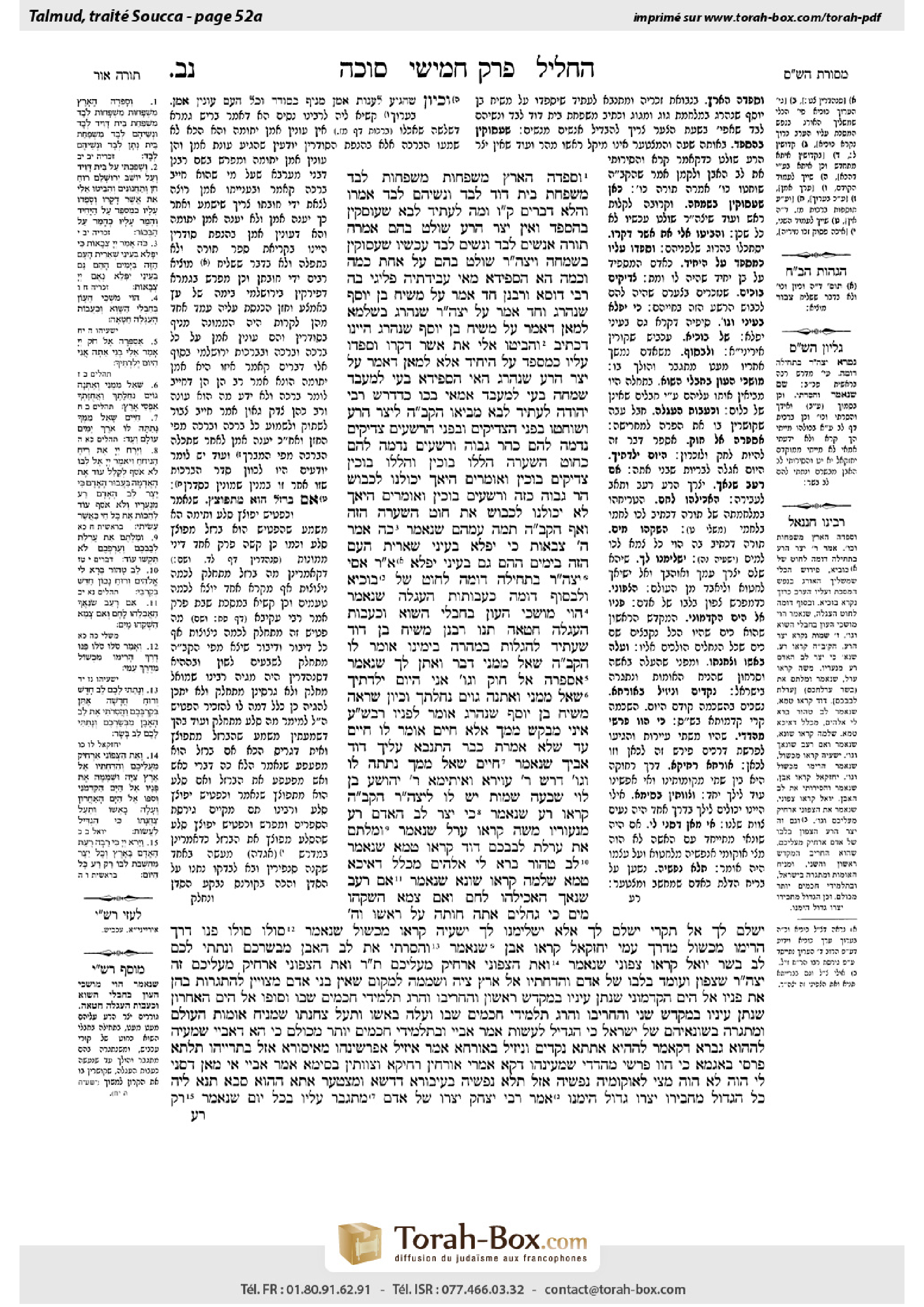
Sukkah 52a: Talmud study for Daf Yomi
Daf Yomi is the daily study of one Talmud folio. Explore 37 tractates with scans, Hebrew text, Sefaria English and AI-generated French translations where annotated.
Passage selection and English or AI-generated French translation are available where the scan has annotations. Daf Study is independent of Torah-Box and Sefaria.
Browse Sukkah · סוכה · All tractatesSukkah 52a text and translations
This page of Sukkah includes the Aramaic text, an English translation and an AI-generated French translation, alongside the scan above.
סוכה נ״ב א · Aramaic and Hebrew text
״וְסָפְדָה הָאָרֶץ מִשְׁפָּחוֹת מִשְׁפָּחוֹת לְבָד מִשְׁפַּחַת בֵּית דָּוִד לְבָד וּנְשֵׁיהֶם לְבָד״. אָמְרוּ: וַהֲלֹא דְּבָרִים קַל וָחוֹמֶר: וּמָה לֶעָתִיד לָבֹא, שֶׁעוֹסְקִין בְּהֶסְפֵּד וְאֵין יֵצֶר הָרָע שׁוֹלֵט בָּהֶם — אָמְרָה תּוֹרָה אֲנָשִׁים לְבַד וְנָשִׁים לְבַד. עַכְשָׁיו, שֶׁעֲסוּקִין בְּשִׂמְחָה וְיֵצֶר הָרָע שׁוֹלֵט בָּהֶם — עַל אַחַת כַּמָּה וְכַמָּה.
הָא הֶסְפֵּידָא מַאי עֲבִידְתֵּיהּ? פְּלִיגִי בַּהּ רַבִּי דּוֹסָא וְרַבָּנַן. חַד אָמַר: עַל מָשִׁיחַ בֶּן יוֹסֵף שֶׁנֶּהֱרַג, וְחַד אָמַר: עַל יֵצֶר הָרַע שֶׁנֶּהֱרַג.
בִּשְׁלָמָא לְמַאן דְּאָמַר עַל מָשִׁיחַ בֶּן יוֹסֵף שֶׁנֶּהֱרַג, הַיְינוּ דִּכְתִיב: ״וְהִבִּיטוּ אֵלַי אֵת אֲשֶׁר דָּקָרוּ וְסָפְדוּ עָלָיו כְּמִסְפֵּד עַל הַיָּחִיד״. אֶלָּא לְמַאן דְּאָמַר עַל יֵצֶר הָרַע שֶׁנֶּהֱרַג — הַאי הֶסְפֵּידָא בָּעֵי לְמֶעְבַּד? שִׂמְחָה בָּעֵי לְמֶעְבַּד! אַמַּאי בָּכוּ?
כִּדְדָרֵשׁ רַבִּי יְהוּדָה: לֶעָתִיד לָבֹא, מְבִיאוֹ הַקָּדוֹשׁ בָּרוּךְ הוּא לְיֵצֶר הָרָע, וְשׁוֹחֲטוֹ בִּפְנֵי הַצַּדִּיקִים וּבִפְנֵי הָרְשָׁעִים. צַדִּיקִים נִדְמֶה לָהֶם כְּהַר גָּבוֹהַּ, וּרְשָׁעִים נִדְמֶה לָהֶם כְּחוּט הַשַּׂעֲרָה. הַלָּלוּ בּוֹכִין וְהַלָּלוּ בּוֹכִין. צַדִּיקִים בּוֹכִין וְאוֹמְרִים: הֵיאַךְ יָכוֹלְנוּ לִכְבּוֹשׁ הַר גָּבוֹהַּ כָּזֶה! וּרְשָׁעִים בּוֹכִין וְאוֹמְרִים: הֵיאַךְ לֹא יָכוֹלְנוּ לִכְבּוֹשׁ אֶת חוּט הַשַּׂעֲרָה הַזֶּה! וְאַף הַקָּדוֹשׁ בָּרוּךְ הוּא תָּמֵהַּ עִמָּהֶם, שֶׁנֶּאֱמַר: ״כֹּה אָמַר ה׳ צְבָאוֹת כִּי יִפָּלֵא בְּעֵינֵי שְׁאֵרִית הָעָם הַזֶּה בַּיָּמִים הָהֵם גַּם בְּעֵינַי יִפָּלֵא״.
אָמַר רַב אַסִּי: יֵצֶר הָרָע בַּתְּחִילָּה דּוֹמֶה לְחוּט שֶׁל בּוּכְיָא, וּלְבַסּוֹף דּוֹמֶה כַּעֲבוֹתוֹת הָעֲגָלָה, שֶׁנֶּאֱמַר: ״הוֹי מוֹשְׁכֵי הֶעָוֹן בְּחַבְלֵי הַשָּׁוְא וְכַעֲבוֹת הָעֲגָלָה חַטָּאָה״.
תָּנוּ רַבָּנַן: מָשִׁיחַ בֶּן דָּוִד שֶׁעָתִיד לְהִגָּלוֹת בִּמְהֵרָה בְּיָמֵינוּ, אוֹמֵר לוֹ הַקָּדוֹשׁ בָּרוּךְ הוּא: שְׁאַל מִמֶּנִּי דָּבָר וְאֶתֵּן לָךְ, שֶׁנֶּאֱמַר: ״אֲסַפְּרָה אֶל חוֹק וְגוֹ׳ אֲנִי הַיּוֹם יְלִדְתִּיךָ. שְׁאַל מִמֶּנִּי וְאֶתְּנָה גוֹיִם נַחֲלָתֶךָ״. וְכֵיוָן שֶׁרָאָה מָשִׁיחַ בֶּן יוֹסֵף שֶׁנֶּהֱרַג, אוֹמֵר לְפָנָיו: רִבּוֹנוֹ שֶׁל עוֹלָם! אֵינִי מְבַקֵּשׁ מִמְּךָ אֶלָּא חַיִּים. אוֹמֵר לוֹ: חַיִּים, עַד שֶׁלֹּא אָמַרְתָּ כְּבָר הִתְנַבֵּא עָלֶיךָ דָּוִד אָבִיךָ, שֶׁנֶּאֱמַר: ״חַיִּים שָׁאַל מִמְּךָ נָתַתָּה לוֹ וְגוֹ׳״.
דָּרֵשׁ רַבִּי עַוִּירָא וְאִיתֵּימָא רַבִּי יְהוֹשֻׁעַ בֶּן לֵוִי: שִׁבְעָה שֵׁמוֹת יֵשׁ לוֹ לְיֵצֶר הָרָע. הַקָּדוֹשׁ בָּרוּךְ הוּא קְרָאוֹ ״רַע״, שֶׁנֶּאֱמַר: ״כִּי יֵצֶר לֵב הָאָדָם רַע מִנְּעוּרָיו״. מֹשֶׁה קְרָאוֹ ״עָרֵל״, שֶׁנֶּאֱמַר: ״וּמַלְתֶּם אֵת עׇרְלַת לְבַבְכֶם״. דָּוִד קְרָאוֹ ״טָמֵא״, שֶׁנֶּאֱמַר: ״לֵב טָהוֹר בְּרָא לִי אֱלֹהִים״, מִכְּלָל דְּאִיכָּא טָמֵא.
שְׁלֹמֹה קְרָאוֹ ״שׂוֹנֵא״, שֶׁנֶּאֱמַר: ״אִם רָעֵב שֹׂנַאֲךָ הַאֲכִילֵהוּ לָחֶם וְאִם צָמֵא הַשְׁקֵהוּ מָיִם כִּי גֶחָלִים אַתָּה חוֹתֶה עַל רֹאשׁוֹ וַה׳ יְשַׁלֶּם לָךְ״. אַל תִּקְרֵי ״יְשַׁלֶּם לָךְ״, אֶלָּא ״יַשְׁלִימֶנּוּ לָךְ״.
יְשַׁעְיָה קְרָאוֹ ״מִכְשׁוֹל״, שֶׁנֶּאֱמַר: ״סוֹלּוּ סוֹלּוּ פַּנּוּ דָרֶךְ הָרִימוּ מִכְשׁוֹל מִדֶּרֶךְ עַמִּי״. יְחֶזְקֵאל קְרָאוֹ ״אֶבֶן״, שֶׁנֶּאֱמַר: ״וַהֲסִרֹתִי אֶת לֵב הָאֶבֶן מִבְּשַׂרְכֶם וְנָתַתִּי לָכֶם לֵב בָּשָׂר״. יוֹאֵל קְרָאוֹ ״צְפוֹנִי״, שֶׁנֶּאֱמַר: ״וְאֶת הַצְּפוֹנִי אַרְחִיק מֵעֲלֵיכֶם״. תָּנוּ רַבָּנַן: ״וְאֶת הַצְּפוֹנִי אַרְחִיק מֵעֲלֵיכֶם״ — זֶה יֵצֶר הָרָע, שֶׁצָּפוּן וְעוֹמֵד בְּלִבּוֹ שֶׁל אָדָם.
״וְהִדַּחְתִּיו אֶל אֶרֶץ צִיָּה וּשְׁמָמָה״ — לִמְקוֹם שֶׁאֵין בְּנֵי אָדָם מְצוּיִין לְהִתְגָּרוֹת בָּהֶן. ״אֶת פָּנָיו אֶל הַיָּם הַקַּדְמוֹנִי״ — שֶׁנָּתַן עֵינָיו בְּמִקְדָּשׁ רִאשׁוֹן וְהֶחְרִיבוֹ, וְהָרַג תַּלְמִידֵי חֲכָמִים שֶׁבּוֹ. ״וְסוֹפוֹ אֶל הַיָּם הָאַחֲרוֹן״ — שֶׁנָּתַן עֵינָיו בְּמִקְדָּשׁ שֵׁנִי וְהֶחְרִיבוֹ, וְהָרַג תַּלְמִידֵי חֲכָמִים שֶׁבּוֹ. ״וְעָלָה בׇאְשׁוֹ וְתַעַל צַחֲנָתוֹ״ — שֶׁמַּנִּיחַ אוּמּוֹת הָעוֹלָם, וּמִתְגָּרֶה בְּשׂוֹנְאֵיהֶם שֶׁל יִשְׂרָאֵל. ״כִּי הִגְדִּיל לַעֲשׂוֹת״ — אָמַר אַבָּיֵי: וּבְתַלְמִידֵי חֲכָמִים יוֹתֵר מִכּוּלָּם.
כִּי הָא דְּאַבָּיֵי שַׁמְעֵיהּ לְהָהוּא גַּבְרָא דְּקָאָמַר לְהַהִיא אִתְּתָא: נַקְדֵּים וְנֵיזִיל בְּאוֹרְחָא. אֲמַר: אֵיזִיל אַפְרְשִׁינְהוּ מֵאִיסּוּרָא. אֲזַל בָּתְרַיְיהוּ תְּלָתָא פַּרְסֵי בְּאַגְמָא. כִּי הֲווֹ פָּרְשִׁי מֵהֲדָדֵי, שַׁמְעִינְהוּ דְּקָא אָמְרִי: אוֹרְחִין רַחִיקָא, וְצַוְותִּין בְּסִימָא.
אֲמַר אַבָּיֵי: אִי מַאן דְּסָנֵי לִי הֲוָה, לָא הֲוָה מָצֵי לְאוֹקוֹמֵי נַפְשֵׁיהּ. אֲזַל תְּלָא נַפְשֵׁיהּ בְּעִיבּוּרָא דְּדָשָׁא וּמִצְטַעֵר. אֲתָא הָהוּא סָבָא, תְּנָא לֵיהּ: כׇּל הַגָּדוֹל מֵחֲבֵירוֹ — יִצְרוֹ גָּדוֹל הֵימֶנּוּ.
אָמַר רַבִּי יִצְחָק: יִצְרוֹ שֶׁל אָדָם מִתְגַּבֵּר עָלָיו בְּכׇל יוֹם, שֶׁנֶּאֱמַר: ״רַק
Sukkah 52a · English translation
It is stated: “The land will eulogize, each family separately; the family of the house of David separately, and their women separately, the family of the house of Nathan separately, and their women separately” (Zechariah 12:12). This indicates that at the end of days a great eulogy will be organized during which men and women will be separate. They said: And are these matters not inferred a fortiori? If in the future, at the end of days referred to in this prophecy, when people are involved in a great eulogy and consequently the evil inclination does not dominate them, as typically during mourning inappropriate thoughts and conduct are less likely, and nevertheless the Torah says: Men separately and women separately; then now that they are involved in the Celebration of the Drawing of the Water, and as such the evil inclination dominates them, since celebration lends itself to levity, all the more so should men and women be separate.
Apropos the eulogy at the end of days, the Gemara asks: For what is the nature of this eulogy? The Gemara answers: Rabbi Dosa and the Rabbis disagree concerning this matter. One said that this eulogy is for Messiah ben Yosef who was killed in the war of Gog from the land of Magog prior to the ultimate redemption with the coming of Messiah ben David. And one said that this eulogy is for the evil inclination that was killed.
The Gemara asks: Granted, according to the one who said that the lament is for Messiah ben Yosef who was killed, this would be the meaning of that which is written in that context: “And they shall look unto Me because they have thrust him through; and they shall mourn for him, as one mourns for his only son” (Zechariah 12:10). However, according to the one who said that the eulogy is for the evil inclination that was killed, does one need to conduct a eulogy for this? On the contrary, one should conduct a celebration. Why, then, did they cry?
The Gemara answers: This can be understood as Rabbi Yehuda taught: In the future, at the end of days, God will bring the evil inclination and slaughter it in the presence of the righteous and in the presence of the wicked. For the righteous the evil inclination appears to them as a high mountain, and for the wicked it appears to them as a mere strand of hair. These weep and those weep. The righteous weep and say: How were we able to overcome so high a mountain? And the wicked weep and say: How were we unable to overcome this strand of hair? And even the Holy One, Blessed be He, will wonder with them, as it is stated with regard to the eulogy: “So says the Lord of hosts: If it be wondrous in the eyes of the remnant of this people in those days, it should also be wondrous in My eyes” (Zechariah 8:6).
Apropos the evil inclination and the battle against it, the Gemara cites that which Rav Asi said: Initially, when it begins to entice someone, the evil inclination is like a strand of a spider’s web [bukhya]; and ultimately it is like the thick ropes of a wagon, as it is stated: “Woe unto them that draw iniquity with cords of vanity, and sin as if it were with a wagon rope” (Isaiah 5:18). Initially, the enticement is almost imperceptible, like a thin strand; however, after one sins, it is like wagon ropes tied tightly around him.
The Sages taught: To Messiah ben David, who is destined to be revealed swiftly in our time, the Holy One, Blessed be He, says: Ask of Me anything and I will give you whatever you wish, as it is stated: “I will tell of the decree; the Lord said unto me: You are My son, this day have I begotten you, ask of Me, and I will give the nations for your inheritance, and the ends of the earth for your possession” (Psalms 2:7–8). Once the Messiah ben David saw Messiah ben Yosef, who was killed, he says to the Holy One, Blessed be He: Master of the Universe, I ask of you only life; that I will not suffer the same fate. The Holy One, Blessed be He, says to him: Life? Even before you stated this request, your father, David, already prophesied about you with regard to this matter precisely, as it is stated: “He asked life of You, You gave it to him; even length of days for ever and ever” (Psalms 21:5).
§ Rabbi Avira, and some say Rabbi Yehoshua ben Levi, taught: The evil inclination has seven names. The Holy One, Blessed be He, called it evil, as it is stated: “For the inclination of a man’s heart is evil from his youth” (Genesis 8:21). Moses called it uncircumcised, as it is stated: “And circumcise the foreskin of your hearts” (Deuteronomy 10:16). David called it impure, as it is stated: “Create for me a pure heart, O God” (Psalms 51:12); by inference, there is an impure heart that is the evil inclination.
Solomon called it enemy, as it is stated: “If your enemy is hungry, give him bread to eat, and if he is thirsty, give him water to drink; for you will heap coals of fire upon his head, and the Lord will reward you” (Proverbs 25:21–22). Do not read it as: And the Lord will reward you [yeshalem lakh]; rather read it as: And the Lord will reconcile it to you [yashlimenu lakh]. God will cause the evil inclination to love you and no longer seek to entice you to sin.
Isaiah called it a stumbling block, as it is stated: “And He will say: Cast you up, cast you up, clear the way, take up the stumbling block out of the way of My people” (Isaiah 57:14). Ezekiel called it stone, as it is stated: “And I will take away the stony heart out of your flesh, and I will give you a heart of flesh” (Ezekiel 36:26). Joel called it hidden one, as it says: “But I will remove the northern one [hatzefoni] far off from you” (Joel 2:20). The Sages taught concerning the verse: “But I will remove the northern one [hatzefoni] far off from you,” that this is referring to the evil inclination. And why is the evil inclination referred to as tzefoni? It is due to the fact that it is always hidden [tzafun] in the heart of man.
The baraita continues interpreting the verse in the book of Joel. “And will drive it to a land barren and desolate” (Joel 2:20), where there are no people for the evil inclination to incite. And what damage does the evil inclination cause? “With its face toward the eastern [hakadmoni] sea” (Joel 2:20), as it set its eyes on the First [mukdam] Temple and destroyed it, and killed the Torah scholars that were in it; “and its end toward the western [ha’aḥaron] sea” (Joel 2:20), as it set its eyes on the Second [aḥaron] Temple and destroyed it, and killed the Torah scholars that were in it; “its foulness may come up, and its ill odor may come up” (Joel 2:20), as it forsakes the nations of the world and incites the enemies of the Jewish people: In this context, the term the nations is a euphemism for the Jewish people. The evil inclination seeks to corrupt the Jews more than it does the members of any other nation. “Because it has done greatly” (Joel 2:20): Abaye said: And it provokes Torah scholars more than it provokes everyone else.
The Gemara illustrates that point. It is like this incident, as Abaye once heard a certain man say to a certain woman: Let us rise early and go on the road. Upon hearing this, Abaye said to himself: I will go and accompany them and prevent them from violating the prohibition that they certainly intend to violate. He went after them for a distance of three parasangs in a marsh among the reeds, while they walked on the road, and they did not engage in any wrongful activity. When they were taking leave of each other, he heard that they were saying: We traveled a long distance together, and the company was pleasant company.
Abaye said: In that situation, if instead of that man it had been one whom I hate, a euphemism for himself, he would not have been able to restrain himself from sinning. After becoming aware of so great a shortcoming he went and leaned against the doorpost, thinking and feeling regret. A certain Elder came and taught him: Anyone who is greater than another, his evil inclination is greater than his. Therefore, Abaye should not feel regret, as his realization is a consequence of his greatness.
Rabbi Yitzḥak said: A person’s inclination overcomes him each day, as it is stated: “Only
Sukkah 52a · Traduction française (IA)
Il est dit : « Le pays mènera le deuil, chaque famille à part ; la famille de la maison de David à part, et leurs femmes à part ; la famille de la maison de Nathan à part, et leurs femmes à part » (Zacharie 12:12). Cela indique qu’à la fin des temps, un grand deuil sera organisé, au cours duquel les hommes et les femmes seront séparés. Ils dirent : Ces choses ne se déduisent-elles pas a fortiori ? Si, à l’avenir, à la fin des temps évoquée dans cette prophétie, les gens prennent part à un grand deuil et que, par conséquent, le mauvais penchant ne les domine pas — car, en général, pendant le deuil, les pensées et les comportements inconvenants sont moins susceptibles de se manifester —, la Torah dit néanmoins : « Les hommes à part et les femmes à part » ; alors, à plus forte raison, maintenant qu’ils prennent part à la célébration du puisage de l’eau et que le mauvais penchant les domine, puisque les réjouissances favorisent la légèreté, les hommes et les femmes doivent être séparés.
À propos du deuil à la fin des temps, la Guemara demande : En quoi consiste ce deuil ? La Guemara répond : Rabbi Dosa et les Rabbins sont en désaccord à ce sujet. Selon l’un, ce deuil concerne le Messie fils de Joseph, qui a été tué pendant la guerre de Gog du pays de Magog, avant la rédemption ultime qui viendra avec l’avènement du Messie fils de David. Selon l’autre, ce deuil concerne le mauvais penchant qui a été tué.
La Guemara demande : Il est compréhensible, selon celui qui dit que le deuil concerne le Messie fils de Joseph qui a été tué, que telle soit la signification de ce qui est écrit dans ce contexte : « Ils tourneront les regards vers Moi à cause de celui qu’ils ont transpercé ; ils mèneront le deuil pour lui comme on mène le deuil pour un fils unique » (Zacharie 12:10). Mais, selon celui qui dit que le deuil concerne le mauvais penchant qui a été tué, faut-il donc mener le deuil pour lui ? Au contraire, on devrait célébrer cela. Pourquoi ont-ils donc pleuré ?
La Guemara répond : Cela s’éclaire par ce que Rabbi Yehouda enseigna : À l’avenir, à la fin des temps, Dieu fera venir le mauvais penchant et l’égorgera en présence des justes et des méchants. Aux yeux des justes, le mauvais penchant apparaît comme une haute montagne ; aux yeux des méchants, il apparaît comme un simple cheveu. Les uns pleurent et les autres pleurent. Les justes pleurent et disent : Comment avons-nous pu vaincre une montagne si haute ? Et les méchants pleurent et disent : Comment n’avons-nous pas pu vaincre ce simple cheveu ? Même le Saint, béni soit-Il, s’étonnera avec eux, comme il est dit au sujet du deuil : « Ainsi parle le Seigneur des armées : Si cela paraît merveilleux aux yeux du reste de ce peuple en ces jours-là, cela paraîtra-t-il aussi merveilleux à Mes yeux ? » (Zacharie 8:6).
À propos du mauvais penchant et de la lutte contre lui, la Guemara rapporte ce que Rav Assi a dit : Au début, lorsqu’il commence à tenter quelqu’un, le mauvais penchant est comme un fil de toile d’araignée [bukhya] ; mais, à la fin, il est comme les grosses cordes d’un chariot, ainsi qu’il est dit : « Malheur à ceux qui tirent l’iniquité avec des cordes de vanité, et le péché comme avec une corde de chariot » (Isaïe 5:18). Au début, la tentation est presque imperceptible, comme un fil ténu ; mais, après que l’on a péché, elle est comme des cordes de chariot étroitement nouées autour de soi.
Les Sages enseignèrent : Au Messie fils de David, qui doit se révéler bientôt, de nos jours, le Saint, béni soit-Il, dit : « Demande-Moi ce que tu veux et Je te donnerai tout ce que tu souhaites », ainsi qu’il est dit : « Je proclamerai le décret : le Seigneur m’a dit : Tu es Mon fils ; aujourd’hui, Je t’ai engendré. Demande-Moi, et Je te donnerai les nations en héritage, et les confins de la terre en possession » (Psaumes 2:7–8). Lorsque le Messie fils de David vit le Messie fils de Joseph, qui avait été tué, il dit au Saint, béni soit-Il : « Maître de l’Univers, je ne Te demande que la vie, afin de ne pas subir le même sort. » Le Saint, béni soit-Il, lui dit : « La vie ? Même avant que tu formules cette demande, ton père David a déjà prophétisé précisément à ton sujet, à propos de cette question », ainsi qu’il est dit : « Il t’a demandé la vie, tu la lui as accordée ; tu lui as donné une longue vie, pour toujours et à jamais » (Psaumes 21:5).
§ Rabbi Avira — et certains disent Rabbi Yehoshoua ben Lévi — enseigna : Le mauvais penchant a sept noms. Le Saint, béni soit-Il, l’appela « mauvais », ainsi qu’il est dit : « Car les penchants du cœur de l’homme sont mauvais dès sa jeunesse » (Genèse 8:21). Moïse l’appela « incirconcis », ainsi qu’il est dit : « Circoncisez le prépuce de votre cœur » (Deutéronome 10:16). David l’appela « impur », ainsi qu’il est dit : « Crée en moi un cœur pur, ô Dieu » (Psaumes 51:12) ; on en déduit qu’il existe un cœur impur, qui est le mauvais penchant.
Salomon l’appela « ennemi », ainsi qu’il est dit : « Si ton ennemi a faim, donne-lui du pain à manger ; s’il a soif, donne-lui de l’eau à boire ; car tu amasseras des charbons ardents sur sa tête, et le Seigneur te le rendra » (Proverbes 25:21–22). Ne lis pas : « Et le Seigneur te le rendra » [yeshalem lakh] ; lis plutôt : « Et Il le réconciliera avec toi » [yashlimenu lakh]. Dieu fera en sorte que le mauvais penchant t’aime et ne cherche plus à t’inciter à pécher.
Isaïe l’appela « obstacle », ainsi qu’il est dit : « Il dira : Frayez, frayez la route, dégagez-la, ôtez l’obstacle du chemin de Mon peuple » (Isaïe 57:14). Ézéchiel l’appela « pierre », ainsi qu’il est dit : « J’ôterai de votre chair le cœur de pierre et je vous donnerai un cœur de chair » (Ézéchiel 36:26). Joël l’appela « celui qui est caché », comme il est dit : « Mais Je vous éloignerai celui du nord [hatzefoni] » (Joël 2:20). Les Sages enseignèrent, à propos du verset « Mais Je vous éloignerai celui du nord [hatzefoni] », qu’il fait référence au mauvais penchant. Et pourquoi le mauvais penchant est-il appelé tzefoni ? Parce qu’il est toujours caché [tzafun] dans le cœur de l’homme.
La baraïta poursuit l’interprétation du verset du livre de Joël. « Et Je le pousserai vers une terre aride et désolée » (Joël 2:20), où il n’y a personne que le mauvais penchant puisse inciter. Et quels dégâts le mauvais penchant cause-t-il ? « Son visage tourné vers la mer orientale [hakadmoni] » (Joël 2:20), car il a jeté son dévolu sur le Premier Temple [mukdam], l’a détruit et a tué les sages de la Torah qui s’y trouvaient ; « et son extrémité vers la mer occidentale [ha’aḥaron] » (Joël 2:20), car il a jeté son dévolu sur le Second Temple [aḥaron], l’a détruit et a tué les sages de la Torah qui s’y trouvaient ; « sa puanteur montera, son odeur infecte montera » (Joël 2:20), car il délaisse les nations du monde et incite les ennemis du peuple juif : dans ce contexte, le terme « les nations » est un euphémisme désignant le peuple juif. Le mauvais penchant cherche à corrompre les Juifs davantage que les membres de toute autre nation. « Parce qu’il a fait de grandes choses » (Joël 2:20) : Abayé dit : Il provoque les sages de la Torah davantage que tous les autres.
La Guemara illustre cette idée par l’épisode suivant : Abayé entendit un jour un homme dire à une femme : « Levons-nous tôt et prenons la route. » En entendant cela, Abayé se dit : « Je vais les accompagner pour les empêcher d’enfreindre l’interdit qu’ils ont certainement l’intention d’enfreindre. » Il les suivit à distance pendant trois parasanges, dans un marais parmi les roseaux, tandis qu’eux marchaient sur la route ; ils ne se livrèrent à aucun acte répréhensible. Au moment de se séparer, il les entendit dire : « Nous avons parcouru ensemble une longue distance, et la compagnie était agréable. »
Abayé dit : « Dans cette situation, si, au lieu de cet homme, cela avait été quelqu’un que je déteste — euphémisme pour parler de moi-même —, je n’aurais pas pu me retenir de pécher. » Après avoir pris conscience d’une si grande faiblesse, il alla s’adosser au montant de la porte, réfléchissant et regrettant. Un certain ancien vint alors lui enseigner : « Le mauvais penchant de celui qui est plus grand qu’un autre est plus grand que celui de l’autre. » Abayé ne devait donc pas regretter, car cette prise de conscience était une conséquence de sa grandeur.
Rabbi Yitzḥak dit : Le penchant d’une personne la domine chaque jour, ainsi qu’il est dit : « Seulement
Traduction française générée par IA à partir de l’édition anglaise de Sefaria. Vérifie toujours un passage avec le texte source.
Text from Sefaria: William Davidson Edition - Vocalized Aramaic (CC BY NC); William Davidson Edition - English (CC BY NC).