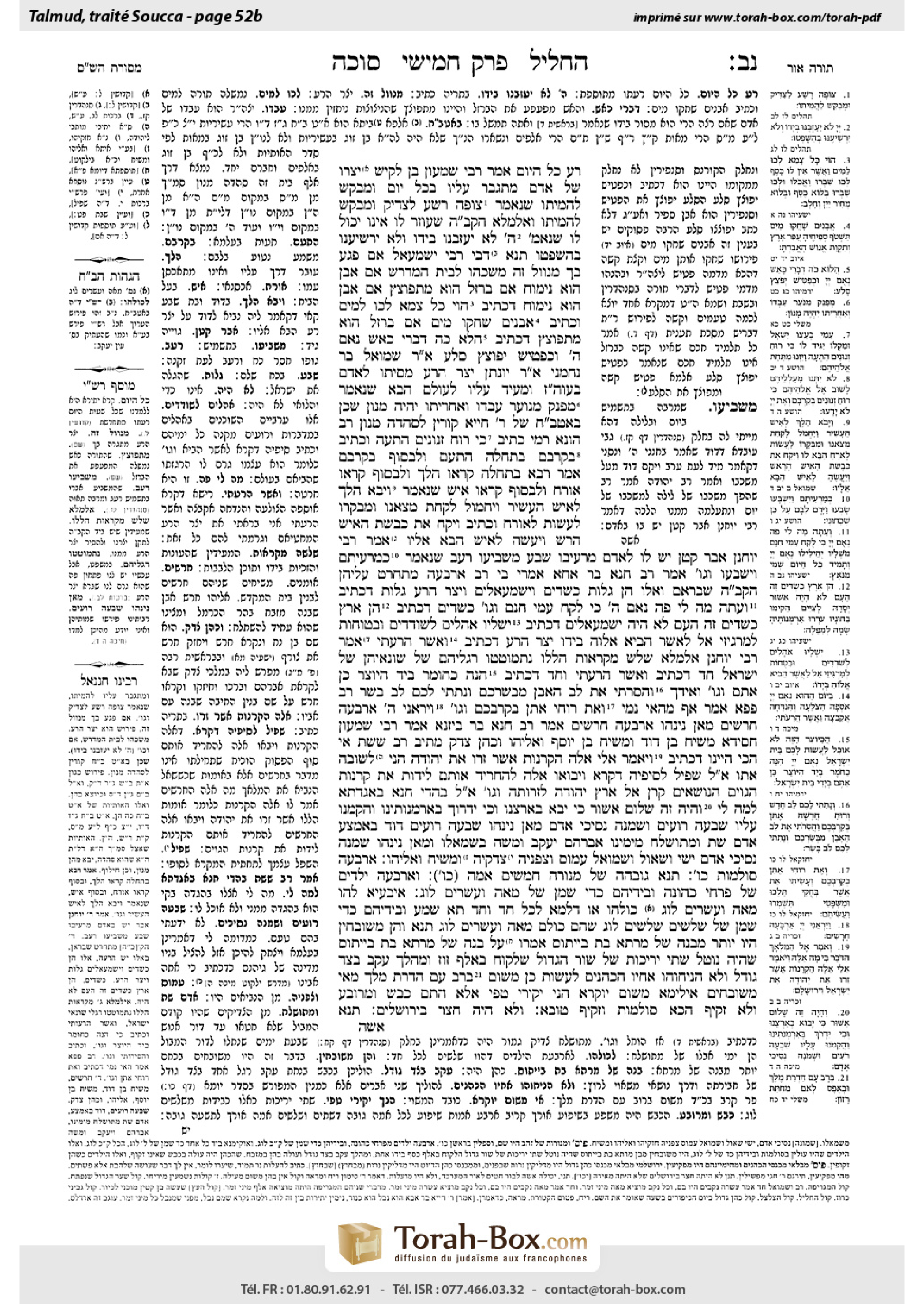
Sukkah 52b: Talmud study for Daf Yomi
Daf Yomi is the daily study of one Talmud folio. Explore 37 tractates with scans, Hebrew text, Sefaria English and AI-generated French translations where annotated.
Passage selection and English or AI-generated French translation are available where the scan has annotations. Daf Study is independent of Torah-Box and Sefaria.
Browse Sukkah · סוכה · All tractatesSukkah 52b text and translations
This page of Sukkah includes the Aramaic text, an English translation and an AI-generated French translation, alongside the scan above.
סוכה נ״ב ב · Aramaic and Hebrew text
רַע כׇּל הַיּוֹם״. אָמַר רַבִּי שִׁמְעוֹן בֶּן לָקִישׁ: יִצְרוֹ שֶׁל אָדָם מִתְגַּבֵּר עָלָיו בְּכׇל יוֹם וּמְבַקֵּשׁ לַהֲמִיתוֹ, שֶׁנֶּאֱמַר: ״צוֹפֶה רָשָׁע לַצַּדִּיק וּמְבַקֵּשׁ לַהֲמִיתוֹ״, וְאִלְמָלֵא הַקָּדוֹשׁ בָּרוּךְ הוּא שֶׁעוֹזֵר לוֹ — אֵינוֹ יָכוֹל לוֹ, שֶׁנֶּאֱמַר: ״ה׳ לֹא יַעַזְבֶנּוּ בְיָדוֹ וְלֹא יַרְשִׁיעֶנּוּ בְּהִשָּׁפְטוֹ״.
תָּנָא דְּבֵי רַבִּי יִשְׁמָעֵאל: אִם פָּגַע בְּךָ מְנֻוּוֹל זֶה — מׇשְׁכֵהוּ לְבֵית הַמִּדְרָשׁ. אִם אֶבֶן הוּא — נִימּוֹחַ, אִם בַּרְזֶל הוּא מִתְפּוֹצֵץ. אִם אֶבֶן הוּא נִימּוֹחַ, דִּכְתִיב: ״הוֹי כׇּל צָמֵא לְכוּ לַמַּיִם״, וּכְתִיב: ״אֲבָנִים שָׁחֲקוּ מַיִם״. אִם בַּרְזֶל הוּא מִתְפּוֹצֵץ, דִּכְתִיב: ״הֲלׂא כֹה דְבָרִי כָּאֵשׁ נְאֻם ה׳ וּכְפַטִּישׁ יְפוֹצֵץ סָלַע״.
אָמַר רַבִּי שְׁמוּאֵל בַּר נַחְמָנִי אָמַר רַבִּי יוֹנָתָן: יֵצֶר הָרָע מְסִיתוֹ לָאָדָם בָּעוֹלָם הַזֶּה, וּמֵעִיד עָלָיו לָעוֹלָם הַבָּא, שֶׁנֶּאֱמַר: ״מְפַנֵּק מִנּוֹעַר עַבְדּוֹ וְאַחֲרִיתוֹ יִהְיֶה מָנוֹן״ — שֶׁכֵּן בְּאַטְבַּ״ח שֶׁל רַבִּי חִיָּיא, קוֹרִין לְסָהֲדָה מָנוֹן.
רַב הוּנָא רָמֵי כְּתִיב: ״כִּי רוּחַ זְנוּנִים הִתְעָה״. וּכְתִיב: ״בְּקִרְבָּם״! בַּתְּחִלָּה הִתְעָם, וּלְבַסּוֹף בְּקִרְבָּם.
אָמַר רָבָא: בַּתְּחִלָּה קְרָאוֹ ״הֵלֶךְ״, וּלְבַסּוֹף קְרָאוֹ ״אוֹרֵחַ״, וּלְבַסּוֹף קְרָאוֹ ״אִישׁ״, שֶׁנֶּאֱמַר: ״וַיָּבֹא הֵלֶךְ לְאִישׁ הֶעָשִׁיר וַיַּחְמוֹל לָקַחַת מִצֹּאנוֹ וּמִבְּקָרוֹ לַעֲשׂוֹת לָאוֹרֵחַ״, וּכְתִיב: ״וַיִּקַּח אֶת כִּבְשַׂת הָאִישׁ הָרָשׁ וַיַּעֲשֶׂהָ לָאִישׁ הַבָּא אֵלָיו״.
אָמַר רַבִּי יוֹחָנָן: אֵבֶר קָטָן יֵשׁ לוֹ לָאָדָם, מַרְעִיבוֹ — שָׂבֵעַ, מַשְׂבִּיעוֹ — רָעֵב, שֶׁנֶּאֱמַר: ״כְּמַרְעִיתָם וַיִּשְׂבָּעוּ וְגוֹ׳״.
אָמַר רַב חָנָא בַּר אַחָא, אָמְרִי בֵּי רַב: אַרְבָּעָה מִתְחָרֵט עֲלֵיהֶן הַקָּדוֹשׁ בָּרוּךְ הוּא שֶׁבְּרָאָם, וְאֵלּוּ הֵן: גָּלוּת, כַּשְׂדִּים, וְיִשְׁמְעֵאלִים, וְיֵצֶר הָרָע. גָּלוּת, דִּכְתִיב: ״וְעַתָּה מַה לִּי פֹה נְאֻם ה׳ כִּי לֻקַּח עַמִּי חִנָּם וְגוֹ׳״. כַּשְׂדִּים, דִּכְתִיב: ״הֵן אֶרֶץ כַּשְׂדִּים זֶה הָעָם לֹא הָיָה״.
יִשְׁמְעֵאלִים, דִּכְתִיב: ״יִשְׁלָיוּ אֹהָלִים לְשׁוֹדְדִים וּבַטּוּחוֹת לְמַרְגִּיזֵי אֵל לַאֲשֶׁר הֵבִיא אֱלוֹהַּ בְּיָדוֹ״. יֵצֶר הָרָע, דִּכְתִיב: ״וַאֲשֶׁר הֲרֵעֹתִי״.
אָמַר רַבִּי יוֹחָנָן: אִלְמָלֵא שָׁלֹשׁ מִקְרָאוֹת הַלָּלוּ, נִתְמוֹטְטוּ רַגְלֵיהֶם שֶׁל שׂוֹנְאֵיהֶן שֶׁל יִשְׂרָאֵל. חַד, דִּכְתִיב: ״וַאֲשֶׁר הֲרֵעֹתִי״. וְחַד, דִּכְתִיב: ״הִנֵּה כַחוֹמֶר בְּיַד הַיּוֹצֵר כֵּן אַתֶּם וְגוֹ׳״. וְאִידַּךְ: ״וַהֲסִרֹתִי אֶת לֵב הָאֶבֶן מִבְּשַׂרְכֶם וְנָתַתִּי לָכֶם לֵב בָּשָׂר״.
רַב פָּפָּא אָמַר, אַף מֵהַאי נָמֵי: ״וְאֶת רוּחִי אֶתֵּן בְּקִרְבְּכֶם וְגוֹ׳״.
״וַיַּרְאֵנִי ה׳ אַרְבָּעָה חָרָשִׁים״, מַאן נִינְהוּ אַרְבָּעָה חָרָשִׁים? אָמַר רַב חָנָא בַּר בִּיזְנָא אָמַר רַבִּי שִׁמְעוֹן חֲסִידָא: מָשִׁיחַ בֶּן דָּוִד, וּמָשִׁיחַ בֶּן יוֹסֵף, וְאֵלִיָּהוּ, וְכֹהֵן צֶדֶק. מֵתִיב רַב שֵׁשֶׁת: אִי הָכִי, הַיְינוּ דִּכְתִיב: ״וַיֹּאמֶר אֵלַי אֵלֶּה הַקְּרָנוֹת אֲשֶׁר זֵרוּ אֶת יְהוּדָה״, הָנֵי לְשׁוּבָה אָתוּ!
אֲמַר לֵיהּ, שְׁפֵיל לְסֵיפֵיהּ דִּקְרָא: ״וְיָבוֹאוּ אֵלֶּה לְהַחֲרִיד אוֹתָם לְיַדּוֹת אֶת קַרְנוֹת הַגּוֹיִם הַנּוֹשְׂאִים קֶרֶן אֶל אֶרֶץ יְהוּדָה לְזָרוֹתָהּ וְגוֹ׳״. אֲמַר לֵיהּ: בַּהֲדֵי חָנָא בְּאַגָּדְתָּא לְמָה לִי.
״וְהָיָה זֶה שָׁלוֹם אַשּׁוּר כִּי יָבֹא בְאַרְצֵנוּ וְכִי יִדְרוֹךְ בְּאַרְמְנוֹתֵינוּ וַהֲקֵמֹנוּ עָלָיו שִׁבְעָה רוֹעִים וּשְׁמֹנָה נְסִיכֵי אָדָם״. מַאן נִינְהוּ ״שִׁבְעָה רוֹעִים״? דָּוִד בָּאֶמְצַע, אָדָם שֵׁת וּמְתוּשֶׁלַח מִימִינוֹ, אַבְרָהָם יַעֲקֹב וּמֹשֶׁה בִּשְׂמֹאלוֹ. וּמַאן נִינְהוּ ״שְׁמֹנָה נְסִיכֵי אָדָם״? יִשַׁי, וְשָׁאוּל, וּשְׁמוּאֵל, עָמוֹס, וּצְפַנְיָה, צִדְקִיָּה, וּמָשִׁיחַ, וְאֵלִיָּהוּ.
אַרְבָּעָה סוּלָּמוֹת כּוּ׳. תָּנָא: גּוֹבְהָהּ שֶׁל מְנוֹרָה חֲמִשִּׁים אַמָּה, וְאַרְבָּעָה יְלָדִים שֶׁל פִּרְחֵי כְּהוּנָּה, וּבִידֵיהֶם כַּדֵּי שֶׁמֶן שֶׁל מֵאָה וְעֶשְׂרִים לוֹג. אִיבַּעְיָא לְהוּ: מֵאָה וְעֶשְׂרִים לוֹג כּוּלְּהוּ, אוֹ דִּלְמָא לְכׇל חַד וְחַד? תָּא שְׁמַע: וּבִידֵיהֶם כַּדֵּי שֶׁמֶן שֶׁל שְׁלֹשִׁים שְׁלֹשִׁים לוֹג, שֶׁהֵם כּוּלָּם מֵאָה וְעֶשְׂרִים לוֹג.
תָּנָא: וְהֵן מְשׁוּבָּחִין הָיוּ יוֹתֵר מִבְּנָהּ שֶׁל מָרְתָּא בַּת בַּיְיתּוֹס. אָמְרוּ עַל בְּנָהּ שֶׁל מָרְתָּא בַּת בַּיְיתּוֹס שֶׁהָיָה נוֹטֵל שְׁתֵּי יְרֵיכוֹת שֶׁל שׁוֹר הַגָּדוֹל שֶׁלָּקוּחַ בְּאֶלֶף זוּז, וּמְהַלֵּךְ עָקֵב בְּצַד גּוּדָל. וְלֹא הֱנִיחוּהוּ אֶחָיו הַכֹּהֲנִים לַעֲשׂוֹת כֵּן, מִשּׁוּם: ״בְּרׇב עָם הַדְרַת מֶלֶךְ״.
מַאי מְשׁוּבָּחִים? אִילֵּימָא מִשּׁוּם יוּקְרָא — הָנֵי יַקִּירִי טְפֵי! אֶלָּא: הָתָם כֶּבֶשׁ, וּמְרוּבָּע, וְלָא זְקִיף. הָכָא סוּלָּמוֹת, וּזְקִיף טוּבָא.
וְלֹא הָיָה חָצֵר בִּירוּשָׁלַיִם. תָּנָא:
Sukkah 52b · English translation
evil all day” (Genesis 6:5). All day long his thoughts and desires are for evil. Rabbi Shimon ben Lakish said: A person’s evil inclination overcomes him each day and seeks to kill him, as it stated: “The wicked watches the righteous and seeks to kill him” (Psalms 37:32); the wicked here is referring to the wickedness inside one’s heart. And if not for the Holy One, Blessed be He, Who assists him with the good inclination, he would not overcome it, as it is stated: “The Lord will not leave him in his hand, nor suffer him to be condemned when he is judged” (Psalms 37:33).
The school of Rabbi Yishmael taught: If this scoundrel, the evil inclination, accosted you, seeking to tempt you to sin, drag it to the study hall and study Torah. If it is like a stone, it will be dissolved by the Torah. If it is like iron, it will be shattered. The Gemara elaborates: If it is like stone, it will be dissolved, as it is written: “Ho, everyone who is thirsty, come you for the water” (Isaiah 55:1), water in this context meaning Torah; and it is written: “Stones were worn by water” (Job 14:19). If it is like iron, it will be shattered, as it is written: “Is not My word like fire, says the Lord; and like a hammer that shatters rock” (Jeremiah 23:29).
Rabbi Shmuel bar Naḥmani said that Rabbi Yoḥanan said: The evil inclination incites a person to sin in this world, and then testifies against him in the next world, as it is stated: “He that delicately brings up his servant from a child shall have him become a master [manon] at the last” (Proverbs 29:21). Initially, in one’s youth, the evil inclination, which should have been enslaved to him, takes control of him and causes him to sin. Then, ultimately, that same evil inclination becomes his manon. Manon means witness, as in Rabbi Ḥiyya’s coded alphabet in which alef and tet and beit and ḥet, etc., are interchanged. Witness [sahada] is called manon. The letters mem and samekh, nun and heh, and vav and dalet are interchanged with other letters.
Rav Huna raised a contradiction between two verses. It is written: “For the spirit of harlotry caused them to err” (Hosea 4:12), indicating that this spirit was a temporary phenomenon and not an integral part of their persona. And it is also written: “For the spirit of harlotry is within them” (Hosea 5:4), indicating that it is an integral part of their persona. The Gemara explains: Initially, it causes them to err from without, and ultimately, it is from within them.
Rava said: Initially, the verse called the evil inclination a traveler coming from afar. Subsequently, the verse calls it a guest, as one welcomes it. Ultimately, the verse calls it man, indicating significance, as it became the homeowner. As it is stated in the parable of the poor man’s lamb that Nathan the prophet said to David: “And there came a traveler to the rich man, and he was reluctant to take of his own flock and of his own herd, to prepare for the guest” (II Samuel 12:4). And it is written in the same verse: “And he took the poor man’s lamb, and prepared it for the man that was come to him.” In other words, the evil inclination that began as a traveler gradually rose in prominence.
Rabbi Yoḥanan said: A man has a small organ used in sexual relations. If he starves the organ, and does not overindulge, it is satiated; however, if he satiates the organ and overindulges in sexual relations, it is starving, and desires more, as it is stated: “When they were fed, they became full, they were filled, and their heart was exalted; therefore have they forgotten Me” (Hosea 13:6).
Rav Ḥana bar Aḥa said that the Sages in the school of Rav say: There are four creations that the Holy One, Blessed be He, created, yet He, as it were, regrets that He created them, as they do more harm than good. And these are they: Exile, Chaldeans, and Ishmaelites, and the evil inclination. Exile, as it is written: “Now therefore, for what am I here, says the Lord, seeing that My people is taken away for naught” (Isaiah 52:5). God Himself is asking: For what am I here? Chaldeans, as it is written: “Behold the land of the Chaldeans, this is the people that was not” (Isaiah 23:13), meaning, if only they never were.
Ishmaelites, as it is written: “The tents of robbers prosper, and they that provoke God are secure, in whatsoever God brings with His hand” (Job 12:6). God brought upon Himself these Arabs that dwell in the deserts in tents. The evil inclination, as it is written: “On that day, says the Lord, will I assemble her that is lame, and I will gather her that is driven away, and her that I corrupted” (Micah 4:6). God is saying that He created the evil inclination that led the people to sin and to be cast into exile.
Rabbi Yoḥanan said: Were it not for these three verses that follow that indicate that God controls people’s hearts, the legs of the enemies of the Jewish people, a euphemism for the Jewish people themselves, would have collapsed, unable to withstand the repercussions of their sins. One, as it is written: “And her that I corrupted,” indicating God’s regret for doing so. And one, as it is written: “Behold, as the clay in the potter’s hand, so are you in My hand, O house of Israel” (Jeremiah 18:6). And the other verse: “And I will take away the heart of stone out of your flesh, and I will give you a heart of flesh” (Ezekiel 36:26), indicating that the matter is not solely in human hands, but in the hands of God as well.
Rav Pappa said: It is derived from this verse as well: “And I will put My spirit within you, and cause you to walk in My statutes, and you shall keep My ordinances, and do them” (Ezekiel 36:27).
§ Apropos the end of days, the Gemara cites another verse and interprets it homiletically. It is stated: “The Lord then showed me four craftsmen” (Zechariah 2:3). Who are these four craftsmen? Rav Ḥana bar Bizna said that Rabbi Shimon Ḥasida said: They are Messiah ben David, Messiah ben Yosef, Elijah, and the righteous High Priest, who will serve in the Messianic era. Rav Sheshet raised an objection: If so, if that is the identity of the four craftsmen, then that which is written in the previous verse: “And he said to me: These are the horns that scattered Judea” (Zechariah 2:4), is difficult; these four in the first verse are coming for their enemies, and are not redeemers.
Rav Ḥana said to Rav Sheshet: Go to the end of the verse: “These then are come to frighten them, to cast down the horns of the nations, which lifted up their horn against the land of Judah to scatter it.” This indicates that the horns refer to the nations that exiled the Jewish people and that the four craftsmen will hurl those horns aside. Rav Sheshet said to him: Why should I disagree with Rav Ḥana in matters of aggada, where he is more expert than I, and I cannot prevail?
The Gemara continues homiletically interpreting verses that relate to the end of days. It is stated: “And this shall be peace: When the Assyrian shall come into our land, and when he shall tread in our palaces, then shall we raise against him seven shepherds, and eight princes among men” (Micah 5:4). The Gemara asks: Who are these seven shepherds? The Gemara explains: David is in the middle; Adam, Seth, and Methuselah are to his right; Abraham, Jacob, and Moses are to his left. And who are the eight princes among men? They are Yishai, Saul, Samuel, Amos, Zephania, Zedekiah, Messiah, and Elijah.
§ The mishna continues: And there were four ladders for each pole. One of the Sages taught: The height of the candelabrum upon the pole is fifty cubits. And there were four children from the priesthood trainees holding and in their hands jugs of oil with a capacity of 120 log of oil. A dilemma was raised: Was it 120 log altogether, or perhaps each and every child carried that amount? Come and hear proof from this baraita: And in their hands were jugs of oil, each with a capacity of thirty log, that were all together 120 log.
One of the Sages taught: And these young priests who held the pitchers were superior in strength to the son of Marta, daughter of Baitos, who was a priest renowned for his might. They said about the son of Marta, daughter of Baitos, that he would take two thighs of a large bull that was so large that it would be purchased for one thousand zuz, and walk up the ramp in small steps, heel to toe, without hurrying, due to his strength. However, his brethren the priests would not allow him do so, due to the principle: “In the multitude of people is the King’s glory” (Proverbs 14:28). The more priests engaged in the Temple service, the greater glory for God. Therefore, it is preferable for the thighs to be carried to the altar by multiple priests.
The Gemara asks: In what sense were these young priests superior? If we say it is due to the weight of the pitchers that they carried, these two thighs are heavier than the thirty log of oil. The Gemara answers: Rather, the difference is that there, in the case of the son of Marta, he walked on a ramp that was wide, and with a moderate gradient of only one cubit every four cubits of length, and it is not steep; here they climbed ladders, and those are very steep.
§ The mishna continues: And there was not a courtyard in Jerusalem that was not illuminated from the light of the Place of the Drawing of the Water. One of the Sages taught:
Sukkah 52b · Traduction française (IA)
« mauvais tout au long du jour » (Genèse 6:5). Tout au long de la journée, ses pensées et ses désirs sont tournés vers le mal. Rabbi Shimon ben Lakish a dit : Le mauvais penchant de l’homme prend chaque jour le dessus sur lui et cherche à le tuer, comme il est écrit : « Le méchant épie le juste et cherche à le tuer » (Psaumes 37:32) ; le « méchant » désigne ici la méchanceté qui se trouve dans le cœur de l’homme. Et si le Saint, béni soit-Il, ne l’aidait pas par le bon penchant, il ne parviendrait pas à le vaincre, comme il est écrit : « L’Éternel ne le laissera pas entre ses mains et ne le condamnera pas lorsqu’il sera jugé » (Psaumes 37:33).
L’école de Rabbi Yishmael enseignait : Si ce vaurien, le mauvais penchant, t’aborde pour te tenter de pécher, traîne-le à la maison d’étude et étudie la Torah. S’il est comme une pierre, la Torah le dissoudra ; s’il est comme du fer, elle le brisera. La Guemara développe : S’il est comme une pierre, il sera dissous, comme il est écrit : « Vous tous qui avez soif, venez vers l’eau » (Isaïe 55:1), l’eau désignant ici la Torah ; et il est écrit : « Les pierres sont usées par l’eau » (Job 14:19). S’il est comme du fer, il sera brisé, comme il est écrit : « Ma parole n’est-elle pas comme un feu, dit l’Éternel, et comme un marteau qui fracasse le roc ? » (Jérémie 23:29).
Rabbi Shmuel bar Naḥmani a dit au nom de Rabbi Yoḥanan : Le mauvais penchant incite l’homme à pécher dans ce monde, puis témoigne contre lui dans le monde à venir, comme il est écrit : « Celui qui gâte son serviteur dès l’enfance finira par en faire un maître [manon] » (Proverbes 29:21). Au début, dans sa jeunesse, le mauvais penchant, qui aurait dû lui être assujetti, prend le dessus sur lui et le pousse à pécher. Puis, en fin de compte, ce même mauvais penchant devient son manon. Manon signifie « témoin », comme dans l’alphabet codé de Rabbi Ḥiyya, où alef et tet, beit et ḥet, etc., sont intervertis. Le témoin [sahada] est appelé manon. Les lettres mem et samekh, nun et heh, ainsi que vav et dalet, sont interverties avec d’autres lettres.
Rav Huna a soulevé une contradiction entre deux versets. Il est écrit : « Car un esprit de prostitution les a égarés » (Osée 4:12), ce qui indique que cet esprit n’était qu’un phénomène temporaire et ne faisait pas partie intégrante de leur personnalité. Mais il est aussi écrit : « Car l’esprit de prostitution est en eux » (Osée 5:4), ce qui indique qu’il fait partie intégrante de leur personnalité. La Guemara explique : Au début, il les égare de l’extérieur ; finalement, il est en eux.
Rava a dit : Au début, le verset appelle le mauvais penchant un voyageur venu de loin. Ensuite, le verset l’appelle un invité, puisqu’on l’accueille. Finalement, le verset l’appelle un homme, ce qui indique son importance, car il est devenu le maître de maison. Comme il est écrit dans la parabole de l’agneau du pauvre que le prophète Nathan raconta à David : « Un voyageur arriva chez le riche, et celui-ci répugna à prendre de son troupeau ou de son bétail pour préparer un repas à l’hôte » (II Samuel 12:4). Et il est écrit dans le même verset : « Il prit l’agneau du pauvre et le prépara pour l’homme qui était venu chez lui. » Autrement dit, le mauvais penchant, qui avait commencé comme un voyageur, prit progressivement de plus en plus d’importance.
Rabbi Yoḥanan a dit : L’homme possède un petit organe servant aux relations sexuelles. S’il le prive de nourriture et ne se livre pas aux excès, il est rassasié ; mais s’il le rassasie et se livre à des excès sexuels, il est affamé et en désire davantage, comme il est écrit : « Lorsqu’ils furent nourris, ils furent rassasiés ; ils se rassasièrent, et leur cœur s’enorgueillit ; c’est pourquoi ils m’ont oublié » (Osée 13:6).
Rav Ḥana bar Aḥa a dit au nom des Sages de l’école de Rav : Le Saint, béni soit-Il, a créé quatre choses qu’Il regrette pourtant, pour ainsi dire, d’avoir créées, car elles causent plus de tort que de bien. Les voici : l’exil, les Chaldéens, les Ismaélites et le mauvais penchant. L’exil, comme il est écrit : « Et maintenant, que fais-je ici, dit l’Éternel, puisque mon peuple a été enlevé pour rien ? » (Isaïe 52:5). Dieu Lui-même demande : « Que fais-je ici ? » Les Chaldéens, comme il est écrit : « Voici le pays des Chaldéens ; ce peuple n’était pas » (Isaïe 23:13), c’est-à-dire : si seulement ils n’avaient jamais existé.
Les Ismaélites, comme il est écrit : « Les tentes des brigands prospèrent ; ceux qui provoquent Dieu sont en sécurité, quoi que Dieu fasse venir par Sa main » (Job 12:6). Dieu a fait venir contre Lui-même ces Arabes qui vivent dans des tentes au désert. Le mauvais penchant, comme il est écrit : « En ce jour, dit l’Éternel, je rassemblerai celle qui boite ; je réunirai celle qui est chassée et celle que j’ai corrompue » (Michée 4:6). Dieu dit qu’Il a créé le mauvais penchant, qui a conduit le peuple à pécher et à être envoyé en exil.
Rabbi Yoḥanan a dit : Sans ces trois versets qui suivent et indiquent que Dieu maîtrise le cœur des hommes, les jambes des ennemis du peuple juif — euphémisme désignant le peuple juif lui-même — se seraient dérobées, incapables de supporter les conséquences de leurs péchés. Le premier, comme il est écrit : « Celle que j’ai corrompue », ce qui indique que Dieu regrette de l’avoir fait. Le deuxième, comme il est écrit : « Voici, comme l’argile dans la main du potier, ainsi êtes-vous dans ma main, maison d’Israël » (Jérémie 18:6). Et l’autre verset : « J’ôterai de votre chair le cœur de pierre et je vous donnerai un cœur de chair » (Ézéchiel 36:26), ce qui indique que la chose ne dépend pas uniquement des hommes, mais aussi de Dieu.
Rav Pappa a dit : Cela se déduit également de ce verset : « Je mettrai mon esprit en vous, je ferai en sorte que vous suiviez mes lois, que vous observiez mes ordonnances et les accomplissiez » (Ézéchiel 36:27).
§ À propos de la fin des temps, la Guemara cite un autre verset et l’interprète de manière homilétique. Il est écrit : « L’Éternel me montra alors quatre artisans » (Zacharie 2:3). Qui sont ces quatre artisans ? Rav Ḥana bar Bizna a dit au nom de Rabbi Shimon Ḥasida : Ce sont le Messie fils de David, le Messie fils de Yosef, Élie et le grand prêtre juste, qui officiera à l’époque messianique. Rav Sheshet souleva une objection : Si tel est le cas, si telle est l’identité des quatre artisans, alors le verset précédent pose problème : « Il me dit : Ceux-ci sont les cornes qui ont dispersé Juda » (Zacharie 2:4). Ces quatre artisans du premier verset seraient alors venus pour leurs ennemis et ne seraient pas des libérateurs.
Rav Ḥana dit à Rav Sheshet : Lis la fin du verset : « Ceux-ci sont venus pour les effrayer, pour abattre les cornes des nations qui ont levé leur corne contre le pays de Juda afin de le disperser. » Cela indique que les cornes désignent les nations qui ont exilé le peuple juif et que les quatre artisans feront voler ces cornes. Rav Sheshet lui dit : Pourquoi contesterais-je Rav Ḥana sur des questions d’aggada, domaine dans lequel il est plus expert que moi et où je ne saurais l’emporter ?
La Guemara poursuit son interprétation homilétique des versets relatifs à la fin des temps. Il est écrit : « Et telle sera la paix : lorsque l’Assyrien entrera dans notre pays et qu’il foulera nos palais, nous dresserons contre lui sept bergers et huit princes parmi les hommes » (Michée 5:4). La Guemara demande : Qui sont ces sept bergers ? Elle explique : David est au milieu ; Adam, Seth et Methuselah sont à sa droite ; Abraham, Jacob et Moïse sont à sa gauche. Et qui sont les huit princes parmi les hommes ? Ce sont Yishai, Saül, Samuel, Amos, Zephania, Sédécias, le Messie et Élie.
§ La Michna poursuit : Il y avait quatre échelles pour chaque mât. Un des Sages enseigna : Le candélabre placé au sommet du mât mesurait cinquante coudées de haut. Quatre jeunes prêtres parmi les apprentis tenaient dans leurs mains des cruches contenant chacune 120 log d’huile. Une question fut soulevée : S’agissait-il de 120 log en tout, ou chacun des jeunes prêtres en portait-il cette quantité ? Écoutons la preuve tirée de cette baraïta : Ils avaient dans leurs mains des cruches contenant chacune trente log, soit 120 log au total.
Un des Sages enseigna : Ces jeunes prêtres qui tenaient les cruches étaient plus forts que le fils de Marta, fille de Baitos, un prêtre réputé pour sa force. On disait du fils de Marta, fille de Baitos, qu’il prenait deux cuisses d’un grand taureau, si énorme qu’il avait été acheté mille zouz, et montait la rampe à petits pas, talon contre pointe, sans se presser, grâce à sa force. Cependant, ses frères prêtres ne le laissaient pas faire, en vertu du principe : « La gloire du roi est dans la multitude du peuple » (Proverbes 14:28). Plus nombreux sont les prêtres qui prennent part au service du Temple, plus grande est la gloire rendue à Dieu. Il est donc préférable que plusieurs prêtres portent les cuisses jusqu’à l’autel.
La Guemara demande : En quel sens ces jeunes prêtres étaient-ils plus forts ? Si l’on dit que c’était en raison du poids des cruches qu’ils portaient, les deux cuisses sont plus lourdes que les trente log d’huile. La Guemara répond : La différence tient plutôt au fait que, dans le cas du fils de Marta, il montait une rampe large, dont la pente était modérée — une coudée pour quatre coudées de longueur — et qui n’était pas raide ; tandis qu’ici, les jeunes prêtres gravissaient des échelles, qui sont très raides.
§ La Michna poursuit : Il n’y avait pas une cour à Jérusalem qui ne fût éclairée par la lumière du lieu du puisage de l’eau. Un des Sages enseigna :
Traduction française générée par IA à partir de l’édition anglaise de Sefaria. Vérifie toujours un passage avec le texte source.
Text from Sefaria: William Davidson Edition - Vocalized Aramaic (CC BY NC); William Davidson Edition - English (CC BY NC).