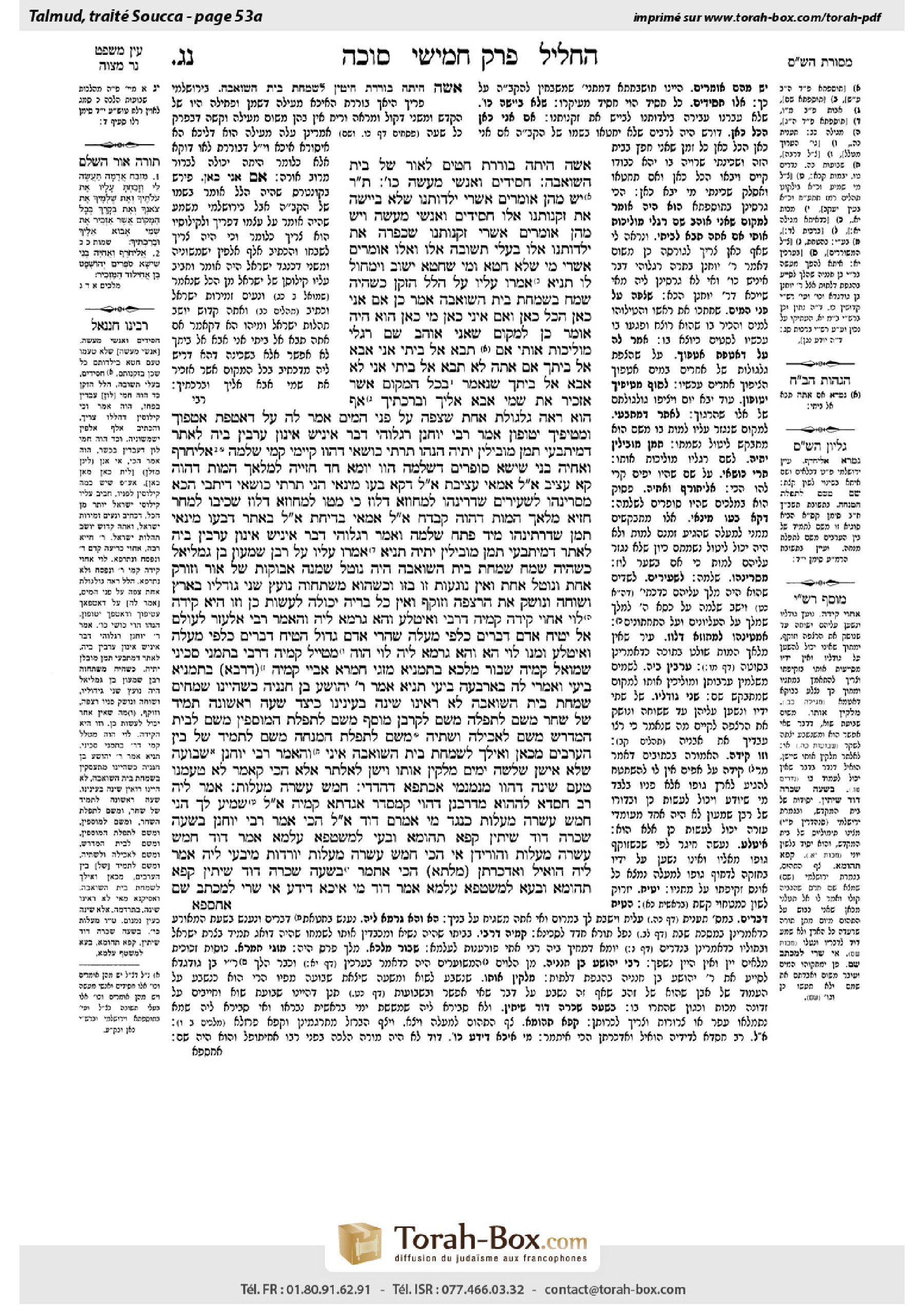
Sukkah 53a: Talmud study for Daf Yomi
Daf Yomi is the daily study of one Talmud folio. Explore 37 tractates with scans, Hebrew text, Sefaria English and AI-generated French translations where annotated.
Passage selection and English or AI-generated French translation are available where the scan has annotations. Daf Study is independent of Torah-Box and Sefaria.
Browse Sukkah · סוכה · All tractatesSukkah 53a text and translations
This page of Sukkah includes the Aramaic text, an English translation and an AI-generated French translation, alongside the scan above.
סוכה נ״ג א · Aramaic and Hebrew text
אִשָּׁה הָיְתָה בּוֹרֶרֶת חִטִּים לָאוֹר שֶׁל בֵּית הַשּׁוֹאֵבָה.
חֲסִידִים וְאַנְשֵׁי מַעֲשֶׂה כּוּ׳. תָּנוּ רַבָּנַן, יֵשׁ מֵהֶן אוֹמְרִים: אַשְׁרֵי יַלְדוּתֵנוּ שֶׁלֹּא בִּיְּישָׁה אֶת זִקְנוּתֵנוּ — אֵלּוּ חֲסִידִים וְאַנְשֵׁי מַעֲשֶׂה. וְיֵשׁ מֵהֶן אוֹמְרִים: אַשְׁרֵי זִקְנוּתֵנוּ שֶׁכִּפְּרָה אֶת יַלְדוּתֵנוּ — אֵלּוּ בַּעֲלֵי תְשׁוּבָה. אֵלּוּ וָאֵלּוּ אוֹמְרִים: אַשְׁרֵי מִי שֶׁלֹּא חָטָא, וּמִי שֶׁחָטָא — יָשׁוּב וְיִמְחוֹל לוֹ.
תַּנְיָא: אָמְרוּ עָלָיו עַל הִלֵּל הַזָּקֵן, כְּשֶׁהָיָה שָׂמֵחַ בְּשִׂמְחַת בֵּית הַשּׁוֹאֵבָה, אָמַר כֵּן: אִם אֲנִי כָּאן — הַכֹּל כָּאן, וְאִם אֵינִי כָּאן — מִי כָּאן. הוּא הָיָה אוֹמֵר כֵּן: מָקוֹם שֶׁאֲנִי אוֹהֵב — שָׁם רַגְלַי מוֹלִיכוֹת אוֹתִי. אִם תָּבֹא אֶל בֵּיתִי — אֲנִי אָבֹא אֶל בֵּיתֶךָ, אִם אַתָּה לֹא תָּבֹא אֶל בֵּיתִי — אֲנִי לֹא אָבֹא אֶל בֵּיתֶךָ, שֶׁנֶּאֱמַר: ״בְּכׇל הַמָּקוֹם אֲשֶׁר אַזְכִּיר אֶת שְׁמִי אָבֹא אֵלֶיךָ וּבֵרַכְתִּיךָ״.
אַף הוּא רָאָה גֻּלְגּוֹלֶת אַחַת שֶׁצָּפָה עַל פְּנֵי הַמַּיִם, אֲמַר לַהּ: עַל דְּאַטֵּפְתְּ אַטְפוּךְ וּמְטִיפַיִךְ יְטוּפוּן. אָמַר רַבִּי יוֹחָנָן: רַגְלוֹהִי דְּבַר אִינִישׁ אִינּוּן עָרְבִין בֵּיהּ, לַאֲתַר דְּמִיתְבְּעֵי — תַּמָּן מוֹבִילִין יָתֵיהּ.
הָנְהוּ תַּרְתֵּי כּוּשָׁאֵי דַּהֲווֹ קָיְימִי קַמֵּי שְׁלֹמֹה, אֱלִיחֹרֶף וַאֲחִיָּה בְּנֵי שִׁישָׁא, סוֹפְרִים דִּשְׁלֹמֹה הֲווֹ. יוֹמָא חַד חַזְיֵיהּ מַלְאַךְ הַמָּוֶת דַּהֲוָה קָא עֲצִיב, אֲמַר לֵיהּ: אַמַּאי עֲצִיבַתְּ? אֲמַר לֵיהּ: דְּקָא בָעוּ מִינַּאי הָנֵי תַּרְתֵּי כּוּשָׁאֵי דְּיָתְבִי הָכָא. מַסְרִינְהוּ לִשְׂעִירִים, שַׁדְּרִינְהוּ לְמָחוֹזָא דְלוּז. כִּי מְטוֹ לְמָחוֹזָא דְלוּז — שְׁכִיבוּ.
לִמְחַר, חַזְיֵהּ מַלְאַךְ הַמָּוֶת דַּהֲוָה קָבָדַח! אֲמַר לֵיהּ: אַמַּאי בְּדִיחַתְּ? אֲמַר לֵיהּ: בַּאֲתַר דִּבְעוֹ מִינַּאי, תַּמָּן שַׁדַּרְתִּינְהוּ. מִיָּד פָּתַח שְׁלֹמֹה וְאָמַר: רַגְלוֹהִי דְּבַר אִינִישׁ אִינּוּן עָרְבִין בֵּיהּ, לַאֲתַר דְּמִיתְבְּעֵי — תַּמָּן מוֹבִילִין יָתֵיהּ.
תַּנְיָא: אָמְרוּ עָלָיו עַל רַבָּן שִׁמְעוֹן בֶּן גַּמְלִיאֵל, כְּשֶׁהָיָה שָׂמֵחַ שִׂמְחַת בֵּית הַשּׁוֹאֵבָה, הָיָה נוֹטֵל שְׁמֹנֶה אֲבוּקוֹת שֶׁל אוֹר, וְזוֹרֵק אַחַת וְנוֹטֵל אַחַת וְאֵין נוֹגְעוֹת זוֹ בָּזוֹ. וּכְשֶׁהוּא מִשְׁתַּחֲוֶה, נוֹעֵץ שְׁנֵי גּוּדָלָיו בָּאָרֶץ וְשׁוֹחֶה וְנוֹשֵׁק אֶת הָרִצְפָּה וְזוֹקֵף, וְאֵין כׇּל בְּרִיָּה יְכוֹלָה לַעֲשׂוֹת כֵּן, וְזוֹ הִיא קִידָּה.
לֵוִי אַחְוִי קִידָּה קַמֵּיהּ דְּרַבִּי וְאִיטְּלַע. וְהָא גְּרַמָא לֵיהּ? וְהָאָמַר רַבִּי אֶלְעָזָר: לְעוֹלָם אַל יָטִיחַ אָדָם דְּבָרִים כְּלַפֵּי מַעְלָה, שֶׁהֲרֵי אָדָם גָּדוֹל הֵטִיחַ דְּבָרִים כְּלַפֵּי מַעְלָה וְאִיטְּלַע, וּמַנּוּ — לֵוִי. הָא וְהָא גְּרַמָא לֵיהּ.
לֵוִי הֲוָה מְטַיֵּיל קַמֵּיהּ דְּרַבִּי בְּתַמְנֵי סַכִּינֵי. שְׁמוּאֵל קַמֵּיהּ שַׁבּוּר מַלְכָּא בִּתְמָנְיָא מְזָגֵי חַמְרָא. אַבָּיֵי קַמֵּיהּ (דְּרָבָא) בִּתְמָנְיָא בֵּיעֵי, וְאָמְרִי לַהּ בְּאַרְבְּעָה בֵּיעֵי.
תַּנְיָא, אָמַר רַבִּי יְהוֹשֻׁעַ בֶּן חֲנַנְיָה: כְּשֶׁהָיִינוּ שְׂמֵחִים שִׂמְחַת בֵּית הַשּׁוֹאֵבָה, לֹא רָאִינוּ שֵׁינָה בְּעֵינֵינוּ. כֵּיצַד? שָׁעָה רִאשׁוֹנָה תָּמִיד שֶׁל שַׁחַר, מִשָּׁם לִתְפִלָּה, מִשָּׁם לְקׇרְבַּן מוּסַף, מִשָּׁם לִתְפִלַּת הַמּוּסָפִין, מִשָּׁם לְבֵית הַמִּדְרָשׁ, מִשָּׁם לַאֲכִילָה וּשְׁתִיָּה, מִשָּׁם לִתְפִלַּת הַמִּנְחָה, מִשָּׁם לְתָמִיד שֶׁל בֵּין הָעַרְבַּיִם, מִכָּאן וְאֵילָךְ לְשִׂמְחַת בֵּית הַשּׁוֹאֵבָה.
אִינִי? וְהָאָמַר רַבִּי יוֹחָנָן: ״שְׁבוּעָה שֶׁלֹּא אִישַׁן שְׁלֹשָׁה יָמִים״ — מַלְקִין אוֹתוֹ וְיָשֵׁן לְאַלְתַּר! אֶלָּא הָכִי קָאָמַר: לֹא טָעַמְנוּ טַעַם שֵׁינָה, דַּהֲווֹ מְנַמְנְמִי אַכַּתְפָּא דַהֲדָדֵי.
חֲמֵשׁ עֶשְׂרֵה מַעֲלוֹת. אֲמַר לֵיהּ רַב חִסְדָּא לְהָהוּא מִדְּרַבָּנַן דַּהֲוָה קָמְסַדַּר אַגָּדָתָא קַמֵּיהּ, אֲמַר לֵיהּ: שְׁמִיעַ לְךָ, הָנֵי חֲמֵשׁ עֶשְׂרֵה מַעֲלוֹת, כְּנֶגֶד מִי אֲמָרָם דָּוִד? אֲמַר לֵיהּ: הָכִי אָמַר רַבִּי יוֹחָנָן: בְּשָׁעָה שֶׁכָּרָה דָּוִד שִׁיתִין, קְפָא תְּהוֹמָא וּבָעֵי לְמִשְׁטְפֵיהּ לְעָלְמָא. אָמַר דָּוִד חֲמֵשׁ עֶשְׂרֵה מַעֲלוֹת וְהוֹרִידָן. אִי הָכִי, חֲמֵשׁ עֶשְׂרֵה ״מַעֲלוֹת״ — ״יוֹרְדוֹת״ מִיבְּעֵי לֵיהּ!
אֲמַר לֵיהּ: הוֹאִיל וְאַדְכַּרְתַּן (מִלְּתָא), הָכִי אִתְּמַר: בְּשָׁעָה שֶׁכָּרָה דָּוִד שִׁיתִין, קְפָא תְּהוֹמָא וּבְעָא לְמִשְׁטְפֵיהּ לְעָלְמָא. אָמַר דָּוִד: מִי אִיכָּא דְּיָדַע אִי שְׁרֵי לְמִכְתַּב שֵׁם
Sukkah 53a · English translation
It was so bright that a woman would be able to sort wheat by the light of the Celebration of the Place of the Drawing of the Water.
§ The mishna continues: The pious and the men of action would dance before the people who attended the celebration. The Sages taught in the Tosefta that some of them would say in their song praising God: Happy is our youth, as we did not sin then, that did not embarrass our old age. These are the pious and the men of action, who spent all their lives engaged in Torah and mitzvot. And some would say: Happy is our old age, that atoned for our youth when we sinned. These are the penitents. Both these and those say: Happy is he who did not sin; and he who sinned should repent and God will absolve him.
It is taught in the Tosefta: They said about Hillel the Elder that when he was rejoicing at the Celebration of the Place of the Drawing of the Water he said this: If I am here, everyone is here; and if I am not here, who is here? In other words, one must consider himself as the one upon whom it is incumbent to fulfill obligations, and he must not rely on others to do so. He would also say this: To the place that I love, there my feet take me, and therefore, I come to the Temple. And the Holy One, Blessed be He, says: If you come to My house, I will come to your house; if you do not come to My house, I will not come to your house, as it is stated: “In every place that I cause My name to be mentioned, I will come to you and bless you” (Exodus 20:21).
The Gemara cites another statement of Hillel the Elder. Additionally, he saw one skull that was floating on the water and he said to it: Because you drowned others, they drowned you, and those that drowned you will be drowned. That is the way of the world; everyone is punished measure for measure. Apropos following one’s feet, Rabbi Yoḥanan said: The feet of a person are responsible for him; to the place where he is in demand, there they lead him.
The Gemara relates with regard to these two Cushites who would stand before Solomon: “Elihoreph and Ahijah, the sons of Shisha” (I Kings 4:3), and they were scribes of Solomon. One day Solomon saw that the Angel of Death was sad. He said to him: Why are you sad? He said to him: They are asking me to take the lives of these two Cushites who are sitting here. Solomon handed them to the demons in his service, and sent them to the district of Luz, where the Angel of Death has no dominion. When they arrived at the district of Luz, they died.
The following day, Solomon saw that the Angel of Death was happy. He said to him: Why are you happy? He replied: In the place that they asked me to take them, there you sent them. The Angel of Death was instructed to take their lives in the district of Luz. Since they resided in Solomon’s palace and never went to Luz, he was unable to complete his mission. That saddened him. Ultimately, Solomon dispatched them to Luz, enabling the angel to accomplish his mission. That pleased him. Immediately, Solomon began to speak and said: The feet of a person are responsible for him; to the place where he is in demand, there they lead him.
§ It is taught in a baraita: They said about Rabban Shimon ben Gamliel that when he would rejoice at the Celebration of the Place of the Drawing of the Water, he would take eight flaming torches and toss one and catch another, juggling them, and, though all were in the air at the same time, they would not touch each other. And when he would prostrate himself, he would insert his two thumbs into the ground, and bow, and kiss the floor of the courtyard and straighten, and there was not any other creature that could do that due to the extreme difficulty involved. And this was the form of bowing called kidda performed by the High Priest.
The Gemara relates: Levi demonstrated a kidda before Rabbi Yehuda HaNasi and strained his thigh and came up lame. The Gemara asks: And is that what caused him to be lame? But didn’t Rabbi Elazar say: One should never speak impertinently toward God above; as a great person once spoke impertinently toward God above, and even though his prayers were answered, he was still punished and came up lame. And who was this great person? It was Levi. Apparently his condition was not caused by his bow. The Gemara answers: There is no contradiction. Both this and that caused him to come up lame; because he spoke impertinently toward God, he therefore was injured when exerting himself in demonstrating kidda.
Apropos the rejoicing of Rabban Shimon ben Gamliel at the Celebration of the Place of the Drawing of the Water, the Gemara recounts: Levi would walk before Rabbi Yehuda HaNasi juggling with eight knives. Shmuel would juggle before King Shapur with eight glasses of wine without spilling. Abaye would juggle before Rabba with eight eggs. Some say he did so with four eggs. All these were cited.
It is taught in a baraita that Rabbi Yehoshua ben Ḥananya said: When we would rejoice in the Celebration of the Place of the Drawing of the Water, we did not see sleep in our eyes the entire Festival. How so? In the first hour of the day, the daily morning offering was sacrificed and everyone came to watch. From there they proceeded to engage in prayer in the synagogue; from there, to watch the sacrifice of the additional offerings; from there, to the synagogue to recite the additional prayer. From there they would proceed to the study hall to study Torah; from there to the eating and drinking in the sukka; from there to the afternoon prayer. From there they would proceed to the daily afternoon offering in the Temple. From this point forward, they proceeded to the Celebration of the Place of the Drawing of the Water.
The Gemara wonders: Is that so? But didn’t Rabbi Yoḥanan say: One who took an oath that I will not sleep three days, one flogs him immediately for taking an oath in vain, and he may sleep immediately because it is impossible to stay awake for three days uninterrupted. Rather, this is what Rabbi Yehoshua is saying: We did not experience the sense of actual sleep, because they would merely doze on each other’s shoulders. In any case, they were not actually awake for the entire week.
§ The mishna continues: The musicians would stand on the fifteen stairs that descend from the Israelites’ courtyard to the Women’s Courtyard, corresponding to the fifteen Songs of the Ascents in Psalms. Rav Ḥisda said to one of the Sages who was organizing aggada before him: Did you hear with regard to these fifteen Songs of Ascents in Psalms, corresponding to what did David say them? He said to him that this is what Rabbi Yoḥanan said: At the time that David dug the drainpipes in the foundation of the Temple, the waters of the depths rose and sought to inundate the world. Immediately, David recited the fifteen Songs of the Ascents and caused them to subside. Rav Ḥisda asked: If so, should they be called fifteen Songs of the Ascents? They should have been called Songs of the Descents.
Rav Ḥisda continued and said to him: Since you reminded me of this matter, this is what was originally stated: At the time that David dug the drainpipes, the waters of the depths rose and sought to inundate the world. David said: Is there anyone who knows whether it is permitted to write the sacred name
Sukkah 53a · Traduction française (IA)
La lumière était si vive qu’une femme aurait pu trier du blé à sa lueur, celle de la célébration du lieu du puisage de l’eau.
§ La Michna poursuit : Les pieux et les hommes d’action dansaient devant les personnes qui assistaient à la célébration. Les Sages enseignent dans la Tosefta que certains d’entre eux chantaient en louant Dieu : « Heureuse notre jeunesse, car nous n’avons pas péché alors et n’avons pas fait honte à notre vieillesse. » Il s’agit des pieux et des hommes d’action, qui ont consacré toute leur vie à la Torah et aux mitsvot. D’autres disaient : « Heureuse notre vieillesse, qui a expié notre jeunesse, lorsque nous avons péché. » Il s’agit des pénitents. Les uns comme les autres disent : « Heureux celui qui n’a pas péché ; quant à celui qui a péché, qu’il se repente, et Dieu lui pardonnera. »
Il est enseigné dans la Tosefta : On disait de Hillel l’Ancien que, lorsqu’il se réjouissait lors de la célébration du lieu du puisage de l’eau, il disait ceci : « Si je suis ici, tout le monde est ici ; et si je ne suis pas ici, qui est ici ? » Autrement dit, chacun doit se considérer comme celui à qui incombe l’accomplissement des obligations, et ne pas compter sur les autres pour s’en acquitter. Il disait également : « C’est vers le lieu que j’aime que mes pieds me portent » ; c’est pourquoi il venait au Temple. Et le Saint, béni soit-Il, dit : « Si tu viens dans Ma maison, Je viendrai dans ta maison ; si tu ne viens pas dans Ma maison, Je ne viendrai pas dans ta maison », comme il est dit : « En tout lieu où Je ferai mentionner Mon nom, Je viendrai à toi et te bénirai » (Exode 20, 21).
La Guemara rapporte une autre parole de Hillel l’Ancien. De plus, il vit un crâne qui flottait sur l’eau et lui dit : « Parce que tu as noyé d’autres personnes, on t’a noyé ; et ceux qui t’ont noyé seront noyés. » Telle est la marche du monde : chacun est puni mesure pour mesure. À propos du fait que les pieds conduisent une personne, Rabbi Yoḥanan dit : Les pieds d’une personne sont responsables de son sort ; ils la conduisent là où l’on a besoin d’elle.
La Guemara raconte au sujet de ces deux Koushites qui se tenaient devant Salomon — « Elihoreph et Ahijah, fils de Shisha » (I Rois 4, 3) — qu’ils étaient les scribes de Salomon. Un jour, Salomon vit que l’Ange de la mort était triste. Il lui demanda : « Pourquoi es-tu triste ? » Celui-ci lui répondit : « On me demande de prendre la vie de ces deux Koushites qui sont assis ici. » Salomon les remit aux démons à son service et les envoya dans la région de Luz, où l’Ange de la mort n’a pas de pouvoir. Lorsqu’ils arrivèrent dans la région de Luz, ils moururent.
Le lendemain, Salomon vit que l’Ange de la mort était heureux. Il lui demanda : « Pourquoi es-tu heureux ? » Il répondit : « C’est au lieu où l’on m’avait demandé de les prendre que tu les as envoyés. » L’Ange de la mort avait reçu l’ordre de prendre leur vie dans la région de Luz. Comme ils résidaient dans le palais de Salomon et n’étaient jamais allés à Luz, il ne pouvait pas accomplir sa mission. Cela l’attristait. Finalement, Salomon les envoya à Luz, permettant à l’ange d’accomplir sa mission. Cela le réjouit. Aussitôt, Salomon se mit à parler et dit : « Les pieds d’une personne sont responsables de son sort ; ils la conduisent là où l’on a besoin d’elle. »
§ Il est enseigné dans une baraïta : On disait de Rabban Shimon ben Gamliel que, lorsqu’il se réjouissait lors de la célébration du lieu du puisage de l’eau, il prenait huit torches enflammées, en lançait une et en rattrapait une autre, jonglant ainsi ; bien qu’elles fussent toutes en l’air en même temps, elles ne se touchaient pas. Lorsqu’il se prosternait, il enfonçait ses deux pouces dans le sol, s’inclinait, embrassait le sol de la cour, puis se redressait. Aucune autre créature ne pouvait faire de même, tant cela était difficile. C’était la forme de prosternation appelée kidda, accomplie par le Grand Prêtre.
La Guemara raconte : Levi fit une démonstration de kidda devant Rabbi Yehuda HaNasi, se froissa la cuisse et se mit à boiter. La Guemara demande : Est-ce bien cela qui le fit boiter ? Rabbi Elazar n’a-t-il pas dit : « Qu’on ne parle jamais avec insolence à Dieu, là-haut » ? Un grand personnage avait parlé avec insolence à Dieu, là-haut, et, bien que ses prières aient été exaucées, il fut tout de même puni et se mit à boiter. Qui était ce grand personnage ? C’était Levi. Il semble donc que son état n’ait pas été causé par sa prosternation. La Guemara répond : Il n’y a pas de contradiction. Les deux choses l’ont fait boiter : parce qu’il avait parlé avec insolence à Dieu, il fut blessé en faisant l’effort de démontrer la kidda.
À propos des réjouissances de Rabban Shimon ben Gamliel lors de la célébration du lieu du puisage de l’eau, la Guemara raconte : Levi marchait devant Rabbi Yehuda HaNasi en jonglant avec huit couteaux. Shmuel jonglait devant le roi Shapur avec huit coupes de vin sans en renverser. Abaye jonglait devant Rabba avec huit œufs. Certains disent qu’il le faisait avec quatre œufs. Toutes ces démonstrations sont rapportées.
Il est enseigné dans une baraïta que Rabbi Yehoshua ben Ḥananya disait : « Lorsque nous nous réjouissions lors de la célébration du lieu du puisage de l’eau, nous n’avons pas eu sommeil de toute la fête. » Comment cela se faisait-il ? À la première heure du jour, on offrait l’holocauste quotidien du matin, et tous venaient y assister. De là, ils allaient prier à la synagogue ; ensuite, ils assistaient à l’offrande des sacrifices supplémentaires, puis retournaient à la synagogue pour réciter la prière supplémentaire. Ils se rendaient ensuite à la maison d’étude pour étudier la Torah, puis allaient manger et boire dans la soukka, avant de réciter la prière de l’après-midi. Ils se rendaient ensuite au Temple pour l’holocauste quotidien de l’après-midi. À partir de là, ils se rendaient à la célébration du lieu du puisage de l’eau.
La Guemara s’étonne : Est-ce bien possible ? Rabbi Yoḥanan n’a-t-il pas dit : « Celui qui fait le serment de ne pas dormir pendant trois jours, on le fouette immédiatement pour avoir fait un serment vain, et il peut dormir aussitôt », car il est impossible de rester éveillé sans interruption pendant trois jours ? Il faut plutôt comprendre que voici ce que Rabbi Yehoshua disait : « Nous n’avons pas connu le sommeil véritable », car ils ne faisaient que somnoler les uns sur les épaules des autres. En tout cas, ils n’étaient pas réellement éveillés toute la semaine.
§ La Michna poursuit : Les musiciens se tenaient sur les quinze marches qui descendent de la cour des Israélites à la cour des femmes, correspondant aux quinze Cantiques des montées dans les Psaumes. Rav Ḥisda demanda à l’un des Sages qui exposait devant lui des aggadot : « As-tu entendu à propos de ces quinze Cantiques des montées dans les Psaumes : en référence à quoi David les a-t-il dits ? » Il lui répondit que Rabbi Yoḥanan avait dit ceci : Au moment où David creusa les conduits d’évacuation dans les fondations du Temple, les eaux des profondeurs montèrent et menacèrent d’inonder le monde. Aussitôt, David récita les quinze Cantiques des montées et les fit redescendre. Rav Ḥisda demanda : « Si c’est ainsi, devrait-on les appeler les quinze Cantiques des montées ? On aurait dû les appeler les Cantiques des descentes. »
Rav Ḥisda poursuivit et lui dit : « Puisque tu m’as rappelé cette affaire, voici ce qui fut dit à l’origine : Au moment où David creusa les conduits d’évacuation, les eaux des profondeurs montèrent et menacèrent d’inonder le monde. David dit : “Y a-t-il quelqu’un qui sache s’il est permis d’écrire le Nom sacré” »
Traduction française générée par IA à partir de l’édition anglaise de Sefaria. Vérifie toujours un passage avec le texte source.
Text from Sefaria: William Davidson Edition - Vocalized Aramaic (CC BY NC); William Davidson Edition - English (CC BY NC).