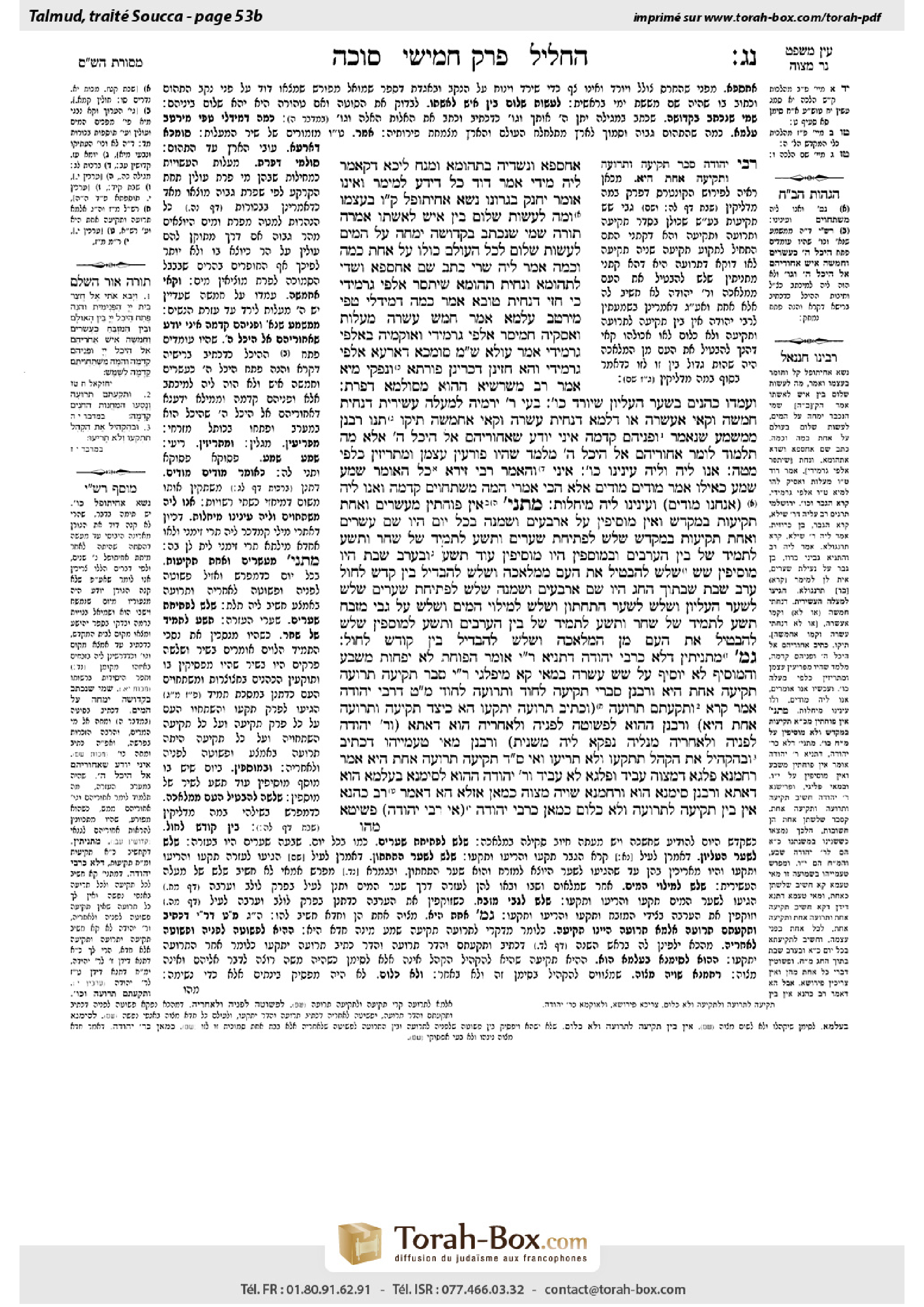
Sukkah 53b: Talmud study for Daf Yomi
Daf Yomi is the daily study of one Talmud folio. Explore 37 tractates with scans, Hebrew text, Sefaria English and AI-generated French translations where annotated.
Passage selection and English or AI-generated French translation are available where the scan has annotations. Daf Study is independent of Torah-Box and Sefaria.
Browse Sukkah · סוכה · All tractatesSukkah 53b text and translations
This page of Sukkah includes the Aramaic text, an English translation and an AI-generated French translation, alongside the scan above.
סוכה נ״ג ב · Aramaic and Hebrew text
אַחַסְפָּא, וְנִשְׁדְּיֵהּ בִּתְהוֹמָא וּמַנַּח! לֵיכָּא דְּקָאָמַר לֵיהּ מִידֵּי. אֲמַר דָּוִד: כׇּל דְּיָדַע לְמֵימַר וְאֵינוֹ אוֹמֵר, יֵחָנֵק בִּגְרוֹנוֹ. נָשָׂא אֲחִיתוֹפֶל קַל וָחוֹמֶר בְּעַצְמוֹ: וּמָה לַעֲשׂוֹת שָׁלוֹם בֵּין אִישׁ לְאִשְׁתּוֹ, אָמְרָה תּוֹרָה: שְׁמִי שֶׁנִּכְתַּב בִּקְדוּשָּׁה יִמָּחֶה עַל הַמַּיִם, לַעֲשׂוֹת שָׁלוֹם לְכׇל הָעוֹלָם כּוּלּוֹ — עַל אַחַת כַּמָּה וְכַמָּה. אֲמַר לֵיהּ: שְׁרֵי.
כָּתֵב שֵׁם אַחַסְפָּא וְשָׁדֵי לִתְהוֹמָא, וּנְחֵית תְּהוֹמָא שִׁיתְּסַר אַלְפֵי גַּרְמִידֵי. כִּי חָזֵי דְּנָחֵית טוּבָא, אֲמַר: כַּמָּה דְּמִידְּלֵי — טְפֵי מִירְטַב עָלְמָא. אֲמַר חֲמֵשׁ עֶשְׂרֵה מַעֲלוֹת, וְאַסְּקֵיהּ חֲמֵיסַר אַלְפֵי גַּרְמִידֵי, וְאוֹקְמֵיהּ בְּאַלְפָּא גַּרְמִידֵי. אָמַר עוּלָּא: שְׁמַע מִינַּהּ סוּמְכָא דְאַרְעָא אַלְפָּא גַּרְמִידֵי. וְהָא חָזֵינַן דְּכָרֵינַן פּוּרְתָּא וְנָפְקִי מַיָּא! אָמַר רַב מְשַׁרְשְׁיָא: הָהוּא מִסּוּלָּמָא דִפְרָת.
וְעָמְדוּ כֹּהֲנִים בְּשַׁעַר הָעֶלְיוֹן שֶׁיּוֹרֵד כּוּ׳. בָּעֵי רַבִּי יִרְמְיָה: לְמַעֲלָה עֲשִׂירִית — דְּנָחֵית חַמְשָׁה וְקָאֵי אַעַשְׂרָה, אוֹ דִלְמָא דְּנָחֵית עַשְׂרָה וְקָאֵי אַחַמְשָׁה? תֵּיקוּ.
תָּנוּ רַבָּנַן, מִמַּשְׁמַע שֶׁנֶּאֱמַר: ״וּפְנֵיהֶם קֵדְמָה״, אֵינִי יוֹדֵעַ שֶׁ״אֲחוֹרֵיהֶם אֶל הֵיכַל ה׳״?
אֶלָּא מָה תַּלְמוּד לוֹמַר: ״אֲחוֹרֵיהֶם אֶל הֵיכַל ה׳״ — מְלַמֵּד שֶׁהָיוּ פּוֹרְעִין עַצְמָן, וּמַתְרִיזִין כְּלַפֵּי מַטָּה.
אָנוּ לְיָהּ וּלְיָהּ עֵינֵינוּ כּוּ׳. אִינִי?! וְהָאָמַר רַבִּי זֵירָא: כׇּל הָאוֹמֵר ״שְׁמַע״ ״שְׁמַע״, כְּאִילּוּ אָמַר ״מוֹדִים״ ״מוֹדִים״! אֶלָּא הָכִי אָמְרִי: הֵמָּה מִשְׁתַּחֲוִים קֵדְמָה, וְאָנוּ לְיָהּ (אֲנַחְנוּ מוֹדִים), וְעֵינֵינוּ לְיָהּ מְיַחֲלוֹת.
מַתְנִי׳ אֵין פּוֹחֲתִין מֵעֶשְׂרִים וְאַחַת תְּקִיעוֹת בַּמִּקְדָּשׁ, וְאֵין מוֹסִיפִין עַל אַרְבָּעִים וּשְׁמֹנֶה. בְּכׇל יוֹם הָיוּ שָׁם עֶשְׂרִים וְאַחַת תְּקִיעוֹת בַּמִּקְדָּשׁ: שָׁלֹשׁ לִפְתִיחַת שְׁעָרִים, וְתֵשַׁע לְתָמִיד שֶׁל שַׁחַר, וְתֵשַׁע לְתָמִיד שֶׁל בֵּין הָעַרְבַּיִם. וּבַמּוּסָפִין הָיוּ מוֹסִיפִין עוֹד תֵּשַׁע.
וּבְעֶרֶב שַׁבָּת הָיוּ מוֹסִיפִין שֵׁשׁ: שָׁלֹשׁ לְהַבְטִיל אֶת הָעָם מִמְּלָאכָה, וְשָׁלֹשׁ לְהַבְדִּיל בֵּין קֹדֶשׁ לְחוֹל.
עֶרֶב שַׁבָּת שֶׁבְּתוֹךְ הַחַג הָיוּ שָׁם אַרְבָּעִים וּשְׁמֹנֶה: שָׁלֹשׁ לִפְתִיחַת שְׁעָרִים, שָׁלֹשׁ לְשַׁעַר הָעֶלְיוֹן, וְשָׁלֹשׁ לְשַׁעַר הַתַּחְתּוֹן, וְשָׁלֹשׁ לְמִילּוּי הַמַּיִם, וְשָׁלֹשׁ עַל גַּבֵּי מִזְבֵּחַ, תֵּשַׁע לְתָמִיד שֶׁל שַׁחַר, וְתֵשַׁע לְתָמִיד שֶׁל בֵּין הָעַרְבַּיִם, וְתֵשַׁע לְמוּסָפִין, שָׁלֹשׁ לְהַבְטִיל אֶת הָעָם מִן הַמְּלָאכָה, וְשָׁלֹשׁ לְהַבְדִּיל בֵּין קוֹדֶשׁ לְחוֹל.
גְּמָ׳ מַתְנִיתִין דְּלָא כְּרַבִּי יְהוּדָה. דְּתַנְיָא, רַבִּי יְהוּדָה אוֹמֵר: הַפּוֹחֵת לֹא יִפְחוֹת מִשֶּׁבַע, וְהַמּוֹסִיף לֹא יוֹסִיף עַל שֵׁשׁ עֶשְׂרֵה. בְּמַאי קָא מִיפַּלְגִי? רַבִּי יְהוּדָה סָבַר: תְּקִיעָה תְּרוּעָה תְּקִיעָה — אַחַת הִיא, וְרַבָּנַן סָבְרִי: תְּקִיעָה לְחוּד וּתְרוּעָה לְחוּד.
מַאי טַעְמָא דְּרַבִּי יְהוּדָה? אָמַר קְרָא: ״וּתְקַעְתֶּם תְּרוּעָה״ (וּכְתִיב: ״תְּרוּעָה יִתְקְעוּ״, הָא כֵּיצַד? תְּקִיעָה וּתְרוּעָה — אַחַת הִיא). וְרַבָּנַן: הַהוּא לִפְשׁוּטָה לְפָנֶיהָ וּלְאַחֲרֶיהָ הוּא דַּאֲתָא (וְרַבִּי יְהוּדָה, לְפָנֶיהָ וּלְאַחֲרֶיהָ מְנָלֵיהּ? נָפְקָא לֵיהּ מִ״שֵּׁנִית״).
וְרַבָּנַן, מַאי טַעְמַיְיהוּ? דִּכְתִיב: ״וּבְהַקְהִיל אֶת הַקָּהָל תִּתְקְעוּ וְלֹא תָרִיעוּ״, וְאִי סָלְקָא דַעְתָּךְ: תְּקִיעָה תְּרוּעָה — אַחַת הִיא, אָמַר רַחֲמָנָא פַּלְגָא דְּמִצְוָה עֲבֵיד וּפַלְגָא לָא עֲבֵיד?! וְרַבִּי יְהוּדָה: הָהוּא לְסִימָנָא בְּעָלְמָא הוּא דַּאֲתָא.
וְרַבָּנַן: סִימָנָא הוּא, וְרַחֲמָנָא שַׁוְּיֵהּ מִצְוָה. כְּמַאן אָזְלָא הָא דְּאָמַר רַב כָּהֲנָא: אֵין בֵּין תְּקִיעָה לִתְרוּעָה וְלֹא כְּלוּם, כְּמַאן? כְּרַבִּי יְהוּדָה. (אִי רַבִּי יְהוּדָה) פְּשִׁיטָא!
Sukkah 53b · English translation
on an earthenware shard? If it is permitted, we will write it and throw it into the depths, and they will subside. There was no one who said anything to him. David said: Anyone who knows what to say and does not say anything may he be strangled in his throat. Then Ahithophel raised an a fortiori argument on his own and said: And just as in order to make peace between a man and his wife in the case of sota, when the husband suspects his wife of having committed adultery, the Torah said: My Name that was written in sanctity will be erased on the water to establish peace for the whole world in its entirety, all the more so it is permitted. He said to David: It is permitted.
He wrote the sacred name on an earthenware shard and cast it into the depths, and the waters in the depths subsided sixteen thousand cubits. When he saw that they subsided excessively, he said: The higher the waters in the aquifers, the moister and more fertile the soil of the world. He recited the fifteen Songs of the Ascents and elevated them fifteen thousand cubits, and established them at a depth of one thousand cubits. Ulla said: Learn from here that the thickness of the earth above the waters of the depths is one thousand cubits. The Gemara asks: But don’t we see that when we dig a little, significantly less than one thousand cubits, water emerges? Rav Mesharshiyya said: That is from the ascent of the Euphrates River, which flows at a higher altitude than do other rivers. The water flows up through underground passages to reach the river. That is why water emerges when one digs in the hills of Babylonia.
§ The mishna continues: And two priests stood with two trumpets at the Upper Gate that descends from the Israelites’ courtyard to the Women’s Courtyard, and when those drawing the water reached the tenth stair they sounded the trumpets. Rabbi Yirmeya raised a dilemma: Does the phrase reached the tenth stair mean that he would descend five stairs and stand on the tenth from the bottom? Or perhaps it means that he would descend ten stairs and stand on the fifth from the bottom? The Gemara notes: The dilemma shall stand unresolved.
The mishna describes: When they reached the gate through which one exits to the east, they turned from facing east to facing west toward the Holy of Holies, and said: Our ancestors who were in this place during the First Temple period did not conduct themselves appropriately and stood “with their backs toward the Sanctuary of the Lord, and their faces toward the east; and they worshipped the sun toward the east” (Ezekiel 8:16), and we, our eyes are to God. The Sages taught: By inference, from the fact that it is stated: “And their faces toward the east,” don’t I know that “their backs were toward the Sanctuary of the Lord”? The Sanctuary was to the west.
Rather, to what purpose does the verse state: “Their backs toward the Sanctuary of the Lord”? It is an allusion to the fact that in addition to turning their backs on the Sanctuary of the Lord, they performed an additional evil. It teaches that they would expose themselves and defecate downward, a euphemism for the direction of the Divine Presence.
The mishna continues: In the Second Temple period they would say: We are to God, and to God are our eyes. The Gemara asks: Is that so? May one pray in that manner? Didn’t Rabbi Zeira say: One who repeats himself while reciting Shema and says: Listen, listen, is like one who says: We give thanks, we give thanks, and he is silenced, as it appears that he is worshipping two authorities. How then did they recite God’s name twice, consecutively? Rather, this is what they said: They bow toward the east, while we give thanks to God, and our eyes turn in hope to God, so that they would not recite God’s name consecutively.
MISHNA: One sounds no fewer than twenty-one trumpet blasts in the Temple, and one sounds no more than forty-eight. The mishna elaborates: Each day there were twenty-one trumpet blasts in the Temple: Three blasts were sounded for the opening of the gates in the morning, nine for the daily morning offering, and nine for the daily afternoon offering, totaling twenty-one. And on a day when the additional offerings were sacrificed, e.g., the New Moon, with the additional offerings they would add nine additional blasts.
And on Shabbat eve they would add six blasts sounded adjacent to the onset of Shabbat: Three to stop the people from their labor, as the blasts inform the people that Shabbat is approaching and they stop working, and three at the onset of Shabbat to demarcate between sacred and profane.
On Shabbat eve during the festival of Sukkot, there were forty-eight blasts. How so? Three in the morning for the opening of the gates; three for the upper gate; and three for the lower gate; and three for the filling of the vessel with water, as described in the sequence of the ritual of drawing the water for the water libation (48b); and three when pouring the water libation upon the altar; nine for the daily morning offering; and nine for the daily afternoon offering; and nine for the additional offerings; three to stop the people from work; and three more to demarcate between sacred and profane, totaling forty-eight blasts.
GEMARA: The Gemara notes: The mishna is not in accordance with the opinion of Rabbi Yehuda, as it is taught in a baraita that Rabbi Yehuda says: The one who seeks to minimize the number of blasts shall not minimize their number to fewer than seven blasts. And one who seeks to add to the number of blasts shall not add beyond sixteen. The Gemara asks: With regard to what do they disagree? The Gemara explains that Rabbi Yehuda holds: A series of blasts consisting of tekia, terua, tekia is counted as one blast. And the Rabbis hold: A tekia is counted separately and a terua is counted separately. They agree with regard to the sequence and the number of the blasts, and disagree only with regard to how the blasts are tallied.
The Gemara asks: What is the rationale for the opinion of Rabbi Yehuda? It is as the verse states: “And you shall sound [utkatem] a terua” (Numbers 10:5), and it is written: “A terua they will sound [yitke’u]” (Numbers 10:6). How is it that the Torah uses a verb from the root of tekia to describe the sounding of a terua? Apparently, a tekia and a terua together compose one blast. And how do the Rabbis interpret these verses? This comes to teach that each terua blast is accompanied by a plain unembellished blast, a tekia, preceding it and following it. The Gemara asks: And from where does Rabbi Yehuda derive that each terua must be accompanied by a tekia preceding it and following it? The Gemara explains: He derives it from the verse when it says: “And you shall sound [utkatem] a terua a second time” (Numbers 10:6), indicating an additional tekia.
The Gemara asks: And what is the rationale for the opinion of the Rabbis? It is as it is written: “And when congregating the people you shall sound a tekia and shall not sound a terua” (Numbers 10:7). And if it enters your mind that a tekia and a terua are considered one blast, would the Merciful One say to perform half a mitzva and not to perform the other half of the mitzva? Apparently, each is a separate mitzva. The Gemara asks: And how does Rabbi Yehuda interpret the verse? The Gemara answers: That single tekia mentioned in the context of congregating the people came merely as a signal to the camps and was not for the purpose of fulfilling the mitzva, which, in Rabbi Yehuda’s opinion, always comes in groups of three.
And how do the Rabbis counter that assertion? They say: Indeed, it is a signal to assemble the people; however, the Merciful One rendered it a mitzva. Therefore, one can derive that a single tekia blast is a distinct mitzva. The Gemara asks: In accordance with whose opinion is this statement of Rav Kahana: There is no pause between a tekia and a terua at all and they are sounded in one continuous blast? In accordance with whose opinion is it? It is in accordance with the opinion of Rabbi Yehuda. The Gemara asks: If Rav Kahana’s statement is in accordance with the opinion of Rabbi Yehuda; that is obvious. Why was it necessary for the Gemara to raise the matter at all?
Sukkah 53b · Traduction française (IA)
sur un tesson de terre cuite ? Si cela est permis, nous l’écrirons et le jetterons dans les profondeurs, et les eaux s’abaisseront. Personne ne lui répondit. David dit : « Que celui qui sait quoi dire et ne dit rien soit étranglé dans sa gorge ! » Alors Ahitophel formula de lui-même un raisonnement a fortiori et dit : « De même que, pour rétablir la paix entre un homme et sa femme dans le cas d’une sota, lorsque le mari soupçonne sa femme d’avoir commis un adultère, la Torah a ordonné que Mon Nom, écrit dans la sainteté, soit effacé dans l’eau afin d’établir la paix dans le monde entier, à plus forte raison cela est-il permis. » Il dit à David : « C’est permis. »
Il écrivit le Nom sacré sur un tesson de terre cuite et le jeta dans les profondeurs ; les eaux des profondeurs s’abaissèrent de seize mille coudées. Voyant qu’elles s’étaient trop abaissées, il dit : « Plus les eaux des nappes souterraines sont hautes, plus le sol du monde est humide et fertile. » Il récita les quinze Cantiques des montées et les fit remonter de quinze mille coudées, puis les fixa à une profondeur de mille coudées. Oula dit : « Il faut en déduire que l’épaisseur de la terre au-dessus des eaux des profondeurs est de mille coudées. » La Guemara demande : Mais ne voit-on pas que, lorsqu’on creuse un peu — bien moins de mille coudées —, de l’eau jaillit ? Rav Mesharshiyya dit : Cette eau provient de la remontée de l’Euphrate, qui coule à une altitude supérieure à celle des autres fleuves. L’eau remonte par des passages souterrains pour atteindre le fleuve. Voilà pourquoi de l’eau jaillit lorsqu’on creuse dans les collines de Babylonie.
§ La Michna poursuit : Deux prêtres se tenaient avec deux trompettes à la Porte supérieure, qui descend de la cour des Israélites vers la cour des femmes ; lorsque ceux qui puisaient l’eau atteignaient la dixième marche, ils sonnaient des trompettes. Rabbi Yirmeya souleva une question : L’expression « atteignaient la dixième marche » signifie-t-elle qu’ils descendaient cinq marches et se tenaient sur la dixième en partant du bas ? Ou peut-être descendaient-ils dix marches et se tenaient sur la cinquième en partant du bas ? La Guemara indique que la question reste sans réponse.
La Michna décrit la scène : Lorsqu’ils atteignaient la porte par laquelle on sort vers l’est, ils se détournaient de l’est pour faire face à l’ouest, en direction du Saint des Saints, et disaient : « Nos ancêtres qui se trouvaient en ce lieu à l’époque du Premier Temple ne se comportaient pas comme il convenait : ils se tenaient “le dos tourné vers le Sanctuaire du Seigneur et le visage vers l’orient ; ils se prosternaient devant le soleil, vers l’orient” (Ézéchiel 8,16), tandis que nous, nous tournons les yeux vers Dieu. » Les Sages ont enseigné : À en juger par l’indication « le visage vers l’orient », ne sais-je pas que « leur dos était tourné vers le Sanctuaire du Seigneur » ? Le Sanctuaire se trouvait à l’ouest.
Alors, dans quel but le verset précise-t-il : « Le dos tourné vers le Sanctuaire du Seigneur » ? C’est une allusion au fait qu’en plus de tourner le dos au Sanctuaire du Seigneur, ils commettaient un autre méfait. Cela enseigne qu’ils se dénudaient et déféquaient vers le bas, euphémisme désignant la direction de la Présence divine.
La Michna poursuit : À l’époque du Second Temple, ils disaient : « Nous sommes tournés vers Dieu, et nos yeux sont tournés vers Dieu. » La Guemara demande : Est-ce vraiment ainsi ? Est-il permis de prier de cette manière ? Rabbi Zeira n’a-t-il pas dit : Celui qui se répète en récitant le Chéma et dit : « Écoute, écoute », est comme celui qui dit : « Nous rendons grâce, nous rendons grâce », et on le fait taire, car il semble adorer deux autorités. Comment donc pouvaient-ils prononcer deux fois de suite le nom de Dieu ? Il faut plutôt comprendre qu’ils disaient : « Eux se prosternent vers l’est, tandis que nous rendons grâce à Dieu et que nos yeux se tournent vers Dieu dans l’espoir », afin de ne pas prononcer deux fois de suite le nom de Dieu.
MICHNA : Dans le Temple, on ne sonne pas moins de vingt et un coups de trompette, ni plus de quarante-huit. La Michna détaille : Chaque jour, on sonnait vingt et un coups de trompette dans le Temple : trois pour l’ouverture des portes le matin, neuf pour l’holocauste quotidien du matin et neuf pour l’holocauste quotidien de l’après-midi, soit vingt et un au total. Un jour où l’on offrait les sacrifices supplémentaires, par exemple à la nouvelle lune, on ajoutait neuf coups pour les sacrifices supplémentaires.
La veille de Chabbat, on ajoutait six coups à l’approche de l’entrée de Chabbat : trois pour faire cesser le travail des gens, car ces coups leur annonçaient que Chabbat approchait et qu’ils devaient arrêter de travailler, et trois au début de Chabbat, pour marquer la séparation entre le sacré et le profane.
La veille de Chabbat pendant la fête de Soukkot, on sonnait quarante-huit coups. Comment cela ? Trois le matin pour l’ouverture des portes ; trois pour la porte supérieure ; trois pour la porte inférieure ; trois lorsque l’on remplissait le récipient d’eau, comme le décrit la succession des étapes du rituel du puisage de l’eau destinée à la libation d’eau (48b) ; trois lors de la libation d’eau sur l’autel ; neuf pour l’holocauste quotidien du matin ; neuf pour l’holocauste quotidien de l’après-midi ; neuf pour les sacrifices supplémentaires ; trois pour faire cesser le travail des gens ; et trois autres pour marquer la séparation entre le sacré et le profane, soit quarante-huit coups au total.
GUEMARA : La Guemara relève que la Michna ne suit pas l’opinion de Rabbi Yehouda, car il est enseigné dans une baraïta que Rabbi Yehouda dit : « Celui qui veut réduire le nombre de coups ne doit pas le réduire à moins de sept. Et celui qui veut l’augmenter ne doit pas dépasser seize. » La Guemara demande : Sur quoi porte leur désaccord ? La Guemara explique que Rabbi Yehouda considère qu’une série de coups composée d’une tekia, d’une teroua et d’une tekia compte comme un seul coup. Les Sages, eux, considèrent qu’une tekia compte séparément et qu’une teroua compte séparément. Ils s’accordent sur la séquence et le nombre des coups ; leur désaccord porte seulement sur la manière de les compter.
La Guemara demande : Quelle est la raison de l’opinion de Rabbi Yehouda ? C’est ce qui est dit dans le verset : « Vous sonnerez [utkatem] une teroua » (Nombres 10,5), et il est écrit : « Ils sonneront [yitke’u] une teroua » (Nombres 10,6). Pourquoi la Torah emploie-t-elle un verbe de la racine de tekia pour désigner le son d’une teroua ? Apparemment, une tekia et une teroua forment ensemble un seul coup. Et comment les Sages interprètent-ils ces versets ? Cela vient enseigner que chaque teroua est accompagnée d’un son simple, non modulé — une tekia — qui la précède et la suit. La Guemara demande : Et d’où Rabbi Yehouda déduit-il que chaque teroua doit être accompagnée d’une tekia avant et après elle ? La Guemara explique : Il le déduit du verset qui dit : « Vous sonnerez [utkatem] une teroua une seconde fois » (Nombres 10,6), ce qui indique une tekia supplémentaire.
La Guemara demande : Et quelle est la raison de l’opinion des Sages ? C’est ce qui est écrit : « Lorsque vous rassemblerez le peuple, vous sonnerez une tekia et vous ne sonnerez pas de teroua » (Nombres 10,7). Si l’on devait penser qu’une tekia et une teroua sont considérées comme un seul coup, le Miséricordieux aurait-il ordonné d’accomplir la moitié d’une mitsva et de ne pas en accomplir l’autre moitié ? Il semble donc que chacune constitue une mitsva distincte. La Guemara demande : Et comment Rabbi Yehouda interprète-t-il le verset ? La Guemara répond : Cette tekia unique mentionnée à propos du rassemblement du peuple ne servait que de signal aux camps et n’avait pas pour but d’accomplir la mitsva, qui, selon Rabbi Yehouda, se présente toujours par séries de trois.
Et comment les Sages réfutent-ils cette affirmation ? Ils disent : « Certes, c’est un signal pour rassembler le peuple ; cependant, le Miséricordieux en a fait une mitsva. » On peut donc en déduire qu’un seul coup de tekia constitue une mitsva distincte. La Guemara demande : Selon l’opinion de qui faut-il comprendre cette déclaration de Rav Kahana : « Il n’y a absolument aucune interruption entre une tekia et une teroua, et elles sont sonnées en un seul souffle continu » ? Selon l’opinion de qui ? Selon celle de Rabbi Yehouda. La Guemara demande : Si la déclaration de Rav Kahana suit l’opinion de Rabbi Yehouda, cela va de soi. Pourquoi la Guemara a-t-elle donc eu besoin de soulever cette question ?
Traduction française générée par IA à partir de l’édition anglaise de Sefaria. Vérifie toujours un passage avec le texte source.
Text from Sefaria: William Davidson Edition - Vocalized Aramaic (CC BY NC); William Davidson Edition - English (CC BY NC).