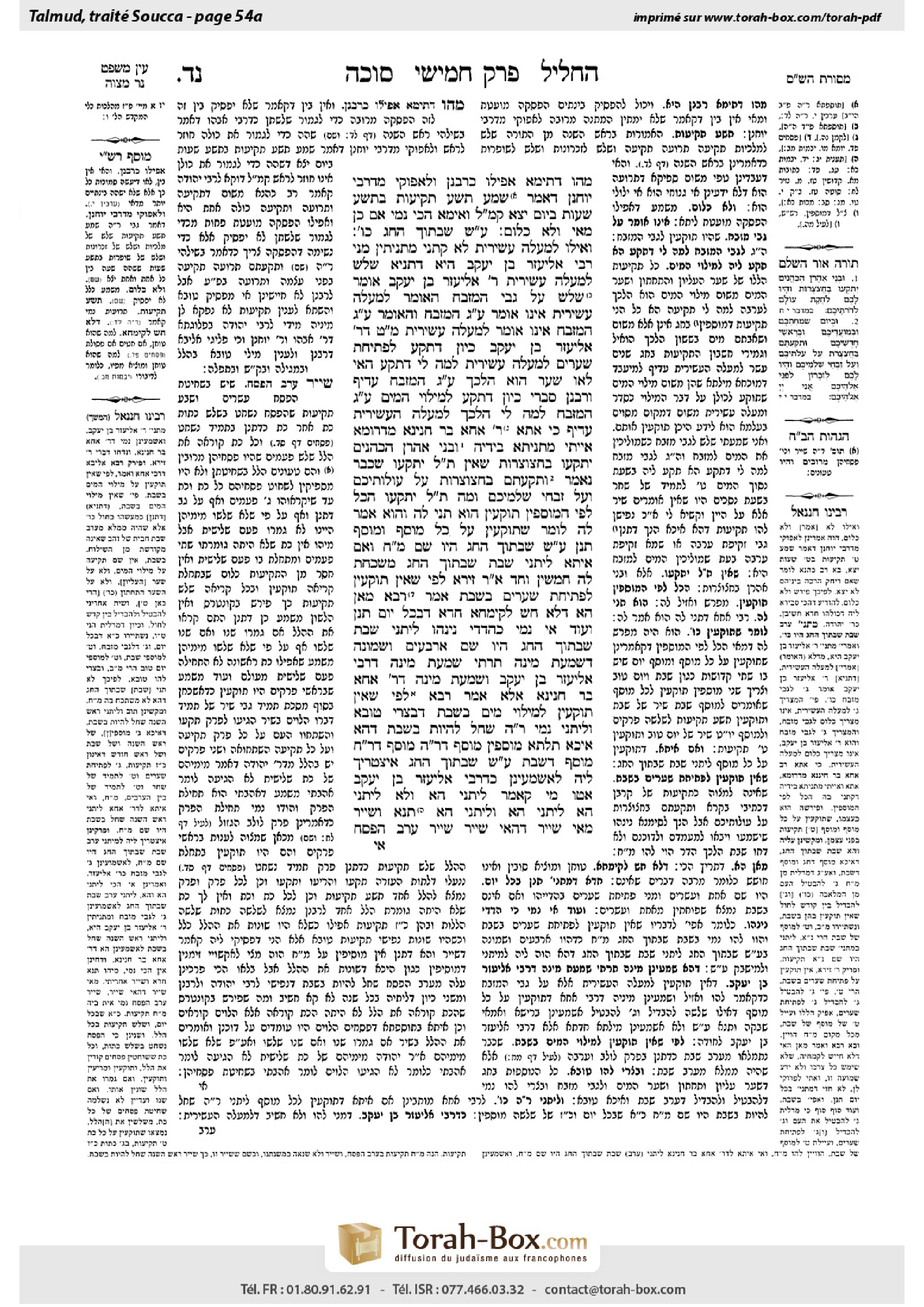
Sukkah 54a: Talmud study for Daf Yomi
Daf Yomi is the daily study of one Talmud folio. Explore 37 tractates with scans, Hebrew text, Sefaria English and AI-generated French translations where annotated.
Passage selection and English or AI-generated French translation are available where the scan has annotations. Daf Study is independent of Torah-Box and Sefaria.
Browse Sukkah · סוכה · All tractatesSukkah 54a text and translations
This page of Sukkah includes the Aramaic text, an English translation and an AI-generated French translation, alongside the scan above.
סוכה נ״ד א · Aramaic and Hebrew text
מַהוּ דְּתֵימָא: אֲפִילּוּ כְּרַבָּנַן, וּלְאַפּוֹקֵי מִדְּרַבִּי יוֹחָנָן דְּאָמַר: שָׁמַע תֵּשַׁע תְּקִיעוֹת בְּתֵשַׁע שָׁעוֹת בַּיּוֹם — יָצָא, קָא מַשְׁמַע לַן.
וְאֵימָא הָכִי נָמֵי! אִם כֵּן, מַאי ״וְלֹא כְּלוּם״?
עֶרֶב שַׁבָּת שֶׁבְּתוֹךְ הַחַג כּוּ׳. וְאִילּוּ לְמַעֲלָה עֲשִׂירִית לָא קָתָנֵי. מַתְנִיתִין מַנִּי? רַבִּי אֱלִיעֶזֶר בֶּן יַעֲקֹב הִיא. דְּתַנְיָא: שָׁלֹשׁ לְמַעֲלָה עֲשִׂירִית, רַבִּי אֱלִיעֶזֶר בֶּן יַעֲקֹב אוֹמֵר: שָׁלֹשׁ עַל גַּבֵּי הַמִּזְבֵּחַ.
הָאוֹמֵר לְמַעֲלָה עֲשִׂירִית — אֵינוֹ אוֹמֵר עַל גַּבֵּי הַמִּזְבֵּחַ, וְהָאוֹמֵר עַל גַּבֵּי הַמִּזְבֵּחַ — אֵינוֹ אוֹמֵר לְמַעֲלָה עֲשִׂירִית.
מַאי טַעְמָא דְּרַבִּי אֱלִיעֶזֶר בֶּן יַעֲקֹב? כֵּיוָן דְּתָקַע לִפְתִיחַת שְׁעָרִים, לְמַעֲלָה עֲשִׂירִית לְמָה לִי דְּתָקַע? הַאי לָאו שַׁעַר הוּא! הִלְכָּךְ, עַל גַּבֵּי הַמִּזְבֵּחַ עֲדִיף. וְרַבָּנַן סָבְרִי: כֵּיוָן דְּתָקַע לְמִילּוּי הַמַּיִם, עַל גַּבֵּי הַמִּזְבֵּחַ לְמָה לִי? הִלְכָּךְ, לְמַעֲלָה הָעֲשִׂירִית עֲדִיף.
כִּי אֲתָא רַבִּי אַחָא בַּר חֲנִינָא מִדָּרוֹמָא, אַיְיתִי מַתְנִיתָא בִּידֵיהּ: ״וּבְנֵי אַהֲרֹן הַכֹּהֲנִים יִתְקְעוּ בַּחֲצוֹצְרוֹת״, שֶׁאֵין תַּלְמוּד לוֹמַר ״יִתְקְעוּ״, שֶׁכְּבָר נֶאֱמַר ״וּתְקַעְתֶּם בַּחֲצוֹצְרוֹת עַל עוֹלוֹתֵיכֶם וְעַל זִבְחֵי שַׁלְמֵיכֶם״. וּמָה תַּלְמוּד לוֹמַר ״יִתְקְעוּ״ — הַכֹּל לְפִי הַמּוּסָפִין תּוֹקְעִין. הוּא תָּנֵי לַהּ, וְהוּא אָמַר לַהּ: לוֹמַר שֶׁתּוֹקְעִין עַל כׇּל מוּסָף וּמוּסָף.
תְּנַן: עֶרֶב שַׁבָּת שֶׁבְּתוֹךְ הַחַג הָיוּ שָׁם אַרְבָּעִים וּשְׁמֹנֶה. וְאִם אִיתָא, לִיתְנֵי: שַׁבָּת שֶׁבְּתוֹךְ הַחַג מַשְׁכַּחַתְּ לַהּ חַמְשִׁין וְחַד! אָמַר רַבִּי זֵירָא: לְפִי שֶׁאֵין תּוֹקְעִין לִפְתִיחַת שְׁעָרִים בְּשַׁבָּת.
אָמַר רָבָא: מַאן הַאי דְּלָא חָשׁ לְקִימְחֵיהּ! חֲדָא: דִּ״בְכׇל יוֹם״ תְּנַן, וְעוֹד: אִי נָמֵי כַּהֲדָדֵי נִינְהוּ, לִיתְנֵי שַׁבָּת שֶׁבְּתוֹךְ הַחַג הָיוּ שָׁם אַרְבָּעִים וּשְׁמֹנֶה, דְּשָׁמְעַתְּ מִינַּהּ תַּרְתֵּי: שָׁמְעַתְּ מִינַּהּ דְּרַבִּי אֱלִיעֶזֶר בֶּן יַעֲקֹב, וְשָׁמְעַתְּ מִינַּהּ דְּרַבִּי אַחָא בַּר חֲנִינָא.
אֶלָּא אָמַר רָבָא: לְפִי שֶׁאֵין תּוֹקְעִין לְמִילּוּי מַיִם בְּשַׁבָּת, דְּבָצְרִי טוּבָא. וְלִיתְנֵי נָמֵי רֹאשׁ הַשָּׁנָה שֶׁחָל לִהְיוֹת בְּשַׁבָּת, דְּהָא אִיכָּא תְּלָתָא מוּסָפִין: מוּסָף דְּרֹאשׁ הַשָּׁנָה, מוּסָף דְּרֹאשׁ חוֹדֶשׁ, מוּסַף דְּשַׁבָּת.
עֶרֶב שַׁבָּת שֶׁבְּתוֹךְ הַחַג אִיצְטְרִיךְ לֵיהּ, לְאַשְׁמֹעִינַן כִּדְרַבִּי אֱלִיעֶזֶר בֶּן יַעֲקֹב. אַטּוּ מִי קָאָמַר — לִיתְנֵי הָא וְלָא לִיתְנֵי הָא? לִיתְנֵי הָא וְלִיתְנֵי הָא! תְּנָא וְשַׁיַּיר. מַאי שַׁיֵּיר דְּהַאי שַׁיַּיר?
שַׁיַּיר עֶרֶב הַפֶּסַח.
Sukkah 54a · English translation
The Gemara answers: It is not obvious that Rav Kahana’s statement was stated in accordance with the opinion of Rabbi Yehuda. Lest you say that Rav Kahana’s statement is even in accordance with the opinion of the Rabbis, and that he is coming to exclude the opinion of Rabbi Yoḥanan who said: If one heard nine blasts in nine different hours on the day of Rosh HaShana, despite the considerable gap between them, he fulfilled his obligation. Therefore, the Gemara teaches us that Rav Kahana holds in accordance with the opinion of Rabbi Yehuda alone and he does not allow even a brief pause between the sounds of the shofar.
The Gemara asks: And say it is indeed so that Rav Kahana holds in accordance with the opinion of the Rabbis and he merely comes to exclude the view of Rabbi Yoḥanan. The Gemara answers: If so, what is the meaning of the phrase: At all, in Rav Kahana’s statement: There is no pause between a tekia and a terua at all? This indicates that Rav Kahana does not allow even a slight pause between blasts, and that could be only in accordance with Rabbi Yehuda.
§ The mishna enumerates the number of blasts sounded on Shabbat eve during the festival of Sukkot. Among those blasts were three sounded when pouring the water libation upon the altar. The Gemara infers: However, the mishna is not teaching that the trumpet blasts were sounded when the person carrying the water reached the tenth stair. According to whose opinion is the mishna? It is according to the opinion of Rabbi Eliezer ben Ya’akov, as it is taught in a baraita: Three blasts were sounded when arriving at the tenth stair. Rabbi Eliezer ben Ya’akov says: Three blasts were sounded when pouring the water libation upon the altar.
The Gemara explains: The one who says that the trumpets were sounded upon arriving at the tenth stair does not say that they sounded the trumpets when pouring the water libation upon the altar; and the one who says that they sounded the trumpets when pouring the water libation upon the altar does not say that the trumpets were sounded upon arriving at the tenth stair.
The Gemara asks: What is the rationale for the opinion of Rabbi Eliezer ben Ya’akov? The Gemara answers: Since he sounded the trumpet for the opening of the gates, for what do I need to sound it again when arriving at the tenth stair? That is not a gate. Therefore, it is preferable to sound the trumpets when pouring the water libation upon the altar. And the Rabbis hold that since he sounded the trumpets for the filling of the vessel with the water, why do I need an additional trumpet blast when pouring the water libation upon the altar? Therefore, it is preferable to sound the trumpets when arriving at the tenth stair.
§ When Rabbi Aḥa bar Ḥanina came from the south of Eretz Yisrael, from Judea, he brought a baraita with him that he received from the Sages there. It is written: “And the children of Aaron, the priests, will sound the trumpets” (Numbers 10:8). There is no need for the verse to state: “Shall sound,” as it is already stated: “And you shall sound the trumpets for your burnt-offerings and your peace-offerings” (Numbers 10:10). And what then is the meaning when the verse states: “Shall sound”? It appears to be teaching a new halakha; it is all according to the additional offerings that one sounds trumpet blasts. The Gemara notes: Rabbi Aḥa bar Ḥanina teaches the baraita, and he said its explanation: The verse comes to say that one sounds trumpet blasts for each and every additional offering in and of itself.
The Gemara asks: We learned in the mishna: On Shabbat eve during the festival of Sukkot there were forty-eight blasts, and that was the highest number of blasts sounded on any day in the Temple. And if it is so, Rabbi Aḥa bar Ḥanina says: Let the mishna teach the case of Shabbat during the Festival, when you find that there are fifty-one blasts, including additional blasts for the additional offerings of Shabbat. Rabbi Zeira said: Although based on the baraita taught by Rabbi Aḥa bar Ḥanina there would indeed be additional blasts for the additional offerings of Shabbat, they would total forty-eight blasts, because one does not sound the three blasts for the opening of the gates on Shabbat; those blasts were merely a signal.
Rava said: Who is this who is not concerned about the flour that his mill is producing, i.e., who is making unconsidered statements? First, the mishna contradicts the explanation of Rabbi Zeira, as, with regard to the order of the blasts, including those for the opening of the gates, we learned that this was the practice each day, including Shabbat. And furthermore, even if they are equal to each other, i.e., the same number of blasts were sounded on Shabbat during the Festival and on Friday during the Festival, let the mishna teach: On Shabbat during the Festival there are forty-eight blasts. You would learn two matters from that case: You would learn from it that the mishna is in accordance with the opinion of Rabbi Eliezer ben Ya’akov that the trumpets are not sounded at the tenth step but when pouring the water libation upon the altar. And you would learn from it that halakha of Rabbi Aḥa bar Ḥanina, that the trumpet is sounded for each and every additional offering.
Rather, Rava said: The reason that the number of offerings on Shabbat during the Festival does not exceed forty-eight is because one does not sound the trumpet for filling the vessels with water on Shabbat, as the mishna stated that they did not draw water from the Siloam pool on Shabbat. Therefore, the blasts sounded on Shabbat during the Festival were considerably fewer than those sounded on Friday. The Gemara asks: And let the mishna also teach the case of Rosh HaShana that occurs on Shabbat, as in that case there are three additional offerings: The additional offering of Rosh HaShana, the additional offering of the New Moon, and the additional offering of Shabbat. The total would be forty-eight blasts. The fact that the mishna did not cite this case indicates that it is contrary to the opinion of Rabbi Aḥa bar Ḥanina.
The Gemara rejects that conclusion. The reason that the mishna did not cite the case of Rosh HaShana is that the tanna held that the case of Shabbat eve during the Festival is necessary in order to teach that the halakha is in accordance with the opinion of Rabbi Eliezer ben Ya’akov that one does not sound the trumpet at the tenth stair. The Gemara asks: Is anyone saying: Let the tanna teach this case and let him not teach that case? Let him teach this case and let him teach that case, as there is a novel element in each. The Gemara answers: The tanna did not list all the possible cases; he taught one case and omitted others. The Gemara asks: What other case did he omit, that he omitted this case of Rosh HaShana as well? While the tanna does not typically list all relevant cases, if there are only two that are relevant, he typically cites them in the mishna.
The Gemara answers: He omitted the case of Passover eve. The Paschal lamb was sacrificed in three shifts. When the Paschal lamb was sacrificed they would recite hallel, and the recitation of hallel was accompanied by three blasts. Due to the great number of Paschal lambs sacrificed, they would often recite hallel three times during each shift. Consequently, there could be as many as twenty-seven additional blasts sounded on that day. Added to the twenty-one blasts sounded each day, the total is forty-eight blasts.
Sukkah 54a · Traduction française (IA)
La Guemara répond : Il n’est pas évident que la déclaration de Rav Kahana ait été formulée conformément à l’opinion de Rabbi Yehuda. Peut-être dirais-tu que la déclaration de Rav Kahana est également conforme à l’opinion des Sages et qu’il vient exclure l’opinion de Rabbi Yoḥanan, qui a dit : Si quelqu’un a entendu neuf sonneries à neuf heures différentes le jour de Roch Hachana, malgré l’intervalle considérable qui les sépare, il s’est acquitté de son obligation. La Guemara nous enseigne donc que Rav Kahana suit uniquement l’opinion de Rabbi Yehuda et ne tolère même pas une brève pause entre les sons du chofar.
La Guemara demande : Et si Rav Kahana était effectivement de l’avis des Sages et venait seulement exclure celui de Rabbi Yoḥanan ? La Guemara répond : Si tel était le cas, que signifie l’expression « pas du tout » dans la déclaration de Rav Kahana : « Il n’y a pas du tout de pause entre une tekia et une teroua » ? Cela indique que Rav Kahana ne tolère même pas la moindre pause entre les sonneries, ce qui ne peut correspondre qu’à l’opinion de Rabbi Yehuda.
§ La Michna énumère le nombre de sonneries effectuées la veille de Chabbat pendant la fête de Souccot. Parmi ces sonneries, trois étaient effectuées lors de la libation d’eau sur l’autel. La Guemara en déduit : Cependant, la Michna n’enseigne pas que les trompettes étaient sonnées lorsque celui qui portait l’eau arrivait à la dixième marche. Selon l’opinion de qui la Michna est-elle ? Selon celle de Rabbi Eliezer ben Ya’akov, comme il est enseigné dans une baraïta : Trois sonneries étaient effectuées à l’arrivée à la dixième marche. Rabbi Eliezer ben Ya’akov dit : Trois sonneries étaient effectuées lors de la libation d’eau sur l’autel.
La Guemara explique : Celui qui dit que les trompettes étaient sonnées à l’arrivée à la dixième marche ne dit pas qu’elles l’étaient lors de la libation d’eau sur l’autel ; et celui qui dit qu’elles étaient sonnées lors de la libation d’eau sur l’autel ne dit pas qu’elles l’étaient à l’arrivée à la dixième marche.
La Guemara demande : Quel est le raisonnement de Rabbi Eliezer ben Ya’akov ? La Guemara répond : Puisqu’on sonnait de la trompette pour l’ouverture des portes, pourquoi la faire sonner de nouveau à l’arrivée à la dixième marche ? Ce n’est pas une porte. Il est donc préférable de sonner des trompettes lors de la libation d’eau sur l’autel. Les Sages, eux, soutiennent que, puisqu’on sonnait des trompettes pour remplir le récipient d’eau, pourquoi faudrait-il une sonnerie supplémentaire lors de la libation d’eau sur l’autel ? Il est donc préférable de sonner des trompettes à l’arrivée à la dixième marche.
§ Lorsque Rabbi Aḥa bar Ḥanina arriva du sud de la terre d’Israël, de Judée, il apporta une baraïta qu’il avait reçue des Sages de là-bas. Il est écrit : « Les fils d’Aaron, les prêtres, sonneront des trompettes » (Nombres 10:8). Le verset n’a pas besoin de dire « sonneront », puisqu’il est déjà dit : « Vous sonnerez des trompettes pour vos holocaustes et vos sacrifices de paix » (Nombres 10:10). Que signifie donc le mot « sonneront » dans le verset ? Il semble enseigner une nouvelle halakha : on sonne des trompettes pour les offrandes supplémentaires. La Guemara note : Rabbi Aḥa bar Ḥanina enseigne la baraïta et en donne l’explication suivante : le verset vient enseigner qu’on sonne des trompettes pour chacune des offrandes supplémentaires, séparément.
La Guemara demande : Nous avons appris dans la Michna : La veille de Chabbat pendant la fête de Souccot, il y avait quarante-huit sonneries, soit le plus grand nombre de sonneries effectuées un jour quelconque dans le Temple. Or, si tel est le cas, selon Rabbi Aḥa bar Ḥanina, que la Michna enseigne le cas du Chabbat pendant la fête, où l’on compterait cinquante et une sonneries, y compris les sonneries supplémentaires pour les offrandes supplémentaires de Chabbat. Rabbi Zeira dit : Bien que, selon la baraïta enseignée par Rabbi Aḥa bar Ḥanina, il y ait effectivement eu des sonneries supplémentaires pour les offrandes supplémentaires de Chabbat, le total aurait été de quarante-huit sonneries, car on ne sonnait pas les trois sonneries pour l’ouverture des portes le Chabbat ; ces sonneries n’étaient qu’un signal.
Rava dit : Qui donc ne se soucie pas de la farine que produit son moulin, c’est-à-dire qui avance des propos irréfléchis ? Tout d’abord, la Michna contredit l’explication de Rabbi Zeira, car, au sujet de l’ordre des sonneries, y compris celles de l’ouverture des portes, nous avons appris que cet ordre était observé chaque jour, y compris le Chabbat. De plus, même si le nombre de sonneries était identique le Chabbat pendant la fête et le vendredi pendant la fête, que la Michna enseigne : « Le Chabbat pendant la fête, il y a quarante-huit sonneries. » On tirerait deux enseignements de ce cas : on apprendrait que la Michna suit l’opinion de Rabbi Eliezer ben Ya’akov, selon laquelle les trompettes ne sont pas sonnées à la dixième marche, mais lors de la libation d’eau sur l’autel ; et on apprendrait la halakha de Rabbi Aḥa bar Ḥanina, selon laquelle on sonne de la trompette pour chacune des offrandes supplémentaires.
Rava dit plutôt : Si le nombre de sonneries le Chabbat pendant la fête ne dépasse pas quarante-huit, c’est parce qu’on ne sonnait pas de trompette pour remplir les récipients d’eau le Chabbat, comme l’indique la Michna : on ne puisait pas d’eau au bassin de Siloé le Chabbat. Les sonneries effectuées le Chabbat pendant la fête étaient donc nettement moins nombreuses que celles du vendredi. La Guemara demande : Et que la Michna enseigne également le cas de Roch Hachana tombant un Chabbat, où il y a trois offrandes supplémentaires : l’offrande supplémentaire de Roch Hachana, celle de la nouvelle lune et celle de Chabbat. Le total serait de quarante-huit sonneries. Le fait que la Michna ne cite pas ce cas indique qu’elle n’est pas conforme à l’opinion de Rabbi Aḥa bar Ḥanina.
La Guemara rejette cette conclusion. Si la Michna ne cite pas le cas de Roch Hachana, c’est parce que le tanna jugeait nécessaire de mentionner le cas de la veille de Chabbat pendant la fête afin d’enseigner que la halakha suit l’opinion de Rabbi Eliezer ben Ya’akov, selon laquelle on ne sonne pas de trompette à la dixième marche. La Guemara demande : Quelqu’un dirait-il : « Que le tanna enseigne ce cas et n’enseigne pas celui-là » ? Qu’il enseigne les deux cas, puisqu’il y a dans chacun un élément nouveau. La Guemara répond : Le tanna n’a pas énuméré tous les cas possibles ; il en a enseigné un et en a omis d’autres. La Guemara demande : Quel autre cas a-t-il omis, pour avoir également omis celui de Roch Hachana ? Même si le tanna n’énumère généralement pas tous les cas pertinents, lorsqu’il n’y en a que deux, il les cite en général dans la Michna.
La Guemara répond : Il a omis le cas de la veille de Pessaḥ. L’agneau pascal était sacrifié en trois groupes. Lorsqu’on sacrifiait l’agneau pascal, on récitait le Hallel, et cette récitation était accompagnée de trois sonneries. En raison du grand nombre d’agneaux pascals sacrifiés, il arrivait souvent qu’on récite le Hallel trois fois dans chaque groupe. Il pouvait donc y avoir jusqu’à vingt-sept sonneries supplémentaires ce jour-là. Ajoutées aux vingt et une sonneries effectuées chaque jour, elles portaient le total à quarante-huit.
Traduction française générée par IA à partir de l’édition anglaise de Sefaria. Vérifie toujours un passage avec le texte source.
Text from Sefaria: William Davidson Edition - Vocalized Aramaic (CC BY NC); William Davidson Edition - English (CC BY NC).