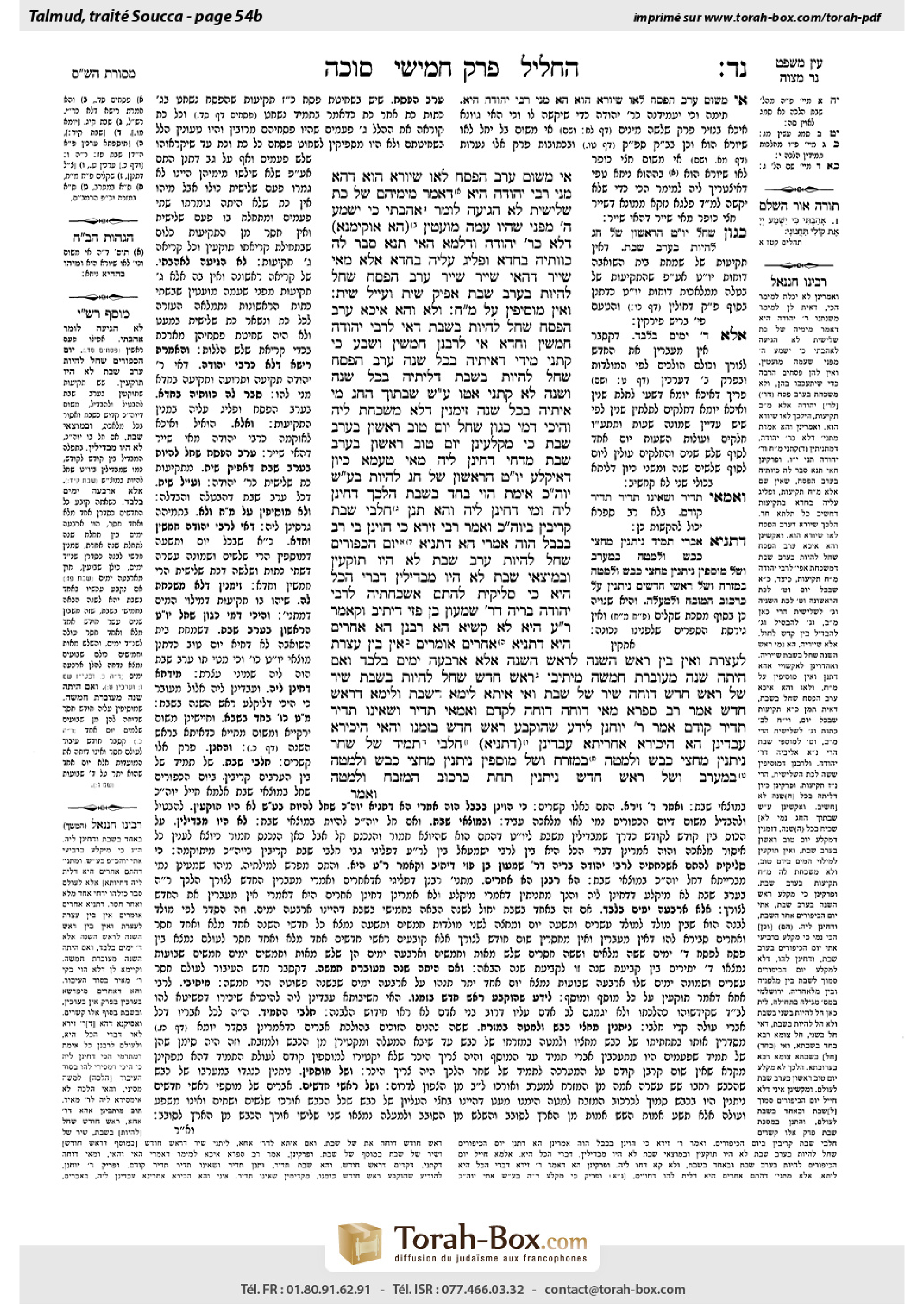
Sukkah 54b: Talmud study for Daf Yomi
Daf Yomi is the daily study of one Talmud folio. Explore 37 tractates with scans, Hebrew text, Sefaria English and AI-generated French translations where annotated.
Passage selection and English or AI-generated French translation are available where the scan has annotations. Daf Study is independent of Torah-Box and Sefaria.
Browse Sukkah · סוכה · All tractatesSukkah 54b text and translations
This page of Sukkah includes the Aramaic text, an English translation and an AI-generated French translation, alongside the scan above.
סוכה נ״ד ב · Aramaic and Hebrew text
אִי מִשּׁוּם עֶרֶב הַפֶּסַח — לָאו שִׁיּוּרָא הוּא, דְּהָא מַנִּי רַבִּי יְהוּדָה הִיא, דְּאָמַר: מִימֵיהֶם שֶׁל כַּת שְׁלִישִׁית לֹא הִגִּיעָה לוֹמַר ״אָהַבְתִּי כִּי יִשְׁמַע ה׳״, מִפְּנֵי שֶׁהָיוּ עַמָּהּ מוּעָטִין.
(הָא אוֹקֵימְנָא) דְּלָא כְּרַבִּי יְהוּדָה! וְדִלְמָא הַאי תַּנָּא סָבַר לַהּ כְּווֹתֵיהּ בַּחֲדָא, וּפְלִיג עֲלֵיהּ בַּחֲדָא.
אֶלָּא: מַאי שַׁיַּיר דְּהַאי שַׁיַּיר? שַׁיַּיר עֶרֶב הַפֶּסַח שֶׁחָל לִהְיוֹת בְּעֶרֶב שַׁבָּת, אַפֵּיק שֵׁית וְעַיֵּיל שֵׁית.
וְאֵין מוֹסִיפִין עַל אַרְבָּעִים וּשְׁמֹנֶה. וְלָא? וְהָא אִיכָּא עֶרֶב הַפֶּסַח שֶׁחָל לִהְיוֹת בְּשַׁבָּת, דְּאִי לְרַבִּי יְהוּדָה — חַמְשִׁין וַחֲדָא, אִי לְרַבָּנַן — חַמְשִׁין וּשְׁבַע!
כִּי קָתָנֵי, מִידֵּי דְּאִיתֵיהּ בְּכׇל שָׁנָה. עֶרֶב הַפֶּסַח שֶׁחָל לִהְיוֹת בְּשַׁבָּת, דְּלֵיתֵיהּ בְּכׇל שָׁנָה וְשָׁנָה, לָא קָתָנֵי. אַטּוּ עֶרֶב שַׁבָּת שֶׁבְּתוֹךְ הַחַג מִי אִיתֵיהּ בְּכׇל שָׁנָה? זִימְנִין דְּלָא מַשְׁכַּחַתְּ לֵיהּ. וְהֵיכִי דָּמֵי, כְּגוֹן שֶׁחָל יוֹם טוֹב רִאשׁוֹן בְּעֶרֶב שַׁבָּת.
כִּי מִקְּלַע יוֹם טוֹב רִאשׁוֹן בְּעֶרֶב שַׁבָּת — מִדְחֵי דָּחֵינַן לֵיהּ. מַאי טַעְמָא, כֵּיוָן דְּאִיקְּלַע יוֹם טוֹב הָרִאשׁוֹן שֶׁל חַג לִהְיוֹת בְּעֶרֶב שַׁבָּת, יוֹם הַכִּפּוּרִים אֵימַת הָוֵי — בְּחַד בְּשַׁבָּת, הִלְכָּךְ דָּחֵינַן לֵיהּ.
וּמִי דָּחֵינַן לֵיהּ? וְהָא תְּנַן: חֶלְבֵי שַׁבָּת קְרֵיבִין בְּיוֹם הַכִּפּוּרִים,
וְאָמַר רַבִּי זֵירָא: כִּי הֲוֵינַן בֵּי רַב בְּבָבֶל, הֲוָה אָמְרִי הָא דְּתַנְיָא: יוֹם הַכִּפּוּרִים שֶׁחָל לִהְיוֹת עֶרֶב שַׁבָּת לֹא הָיוּ תּוֹקְעִין, וּבְמוֹצָאֵי שַׁבָּת לֹא הָיוּ מַבְדִּילִין — דִּבְרֵי הַכֹּל הִיא. כִּי סְלֵיקִית לְהָתָם, אַשְׁכַּחְתֵּיהּ לְרַבִּי יְהוּדָה בְּרֵיהּ דְּרַבִּי שִׁמְעוֹן בֶּן פַּזִּי, דְּיָתֵיב וְקָאָמַר: רַבִּי עֲקִיבָא הִיא!
לָא קַשְׁיָא: הָא רַבָּנַן, הָא אֲחֵרִים הִיא.
דְּתַנְיָא, אֲחֵרִים אוֹמְרִים: אֵין בֵּין עֲצֶרֶת לַעֲצֶרֶת וְאֵין בֵּין רֹאשׁ הַשָּׁנָה לְרֹאשׁ הַשָּׁנָה אֶלָּא אַרְבָּעָה יָמִים בִּלְבַד, וְאִם הָיְתָה שָׁנָה מְעוּבֶּרֶת — חֲמִשָּׁה.
מֵיתִיבִי: רֹאשׁ חֹדֶשׁ שֶׁחָל לִהְיוֹת בְּשַׁבָּת — שִׁיר שֶׁל רֹאשׁ חֹדֶשׁ דּוֹחֶה שִׁיר שֶׁל שַׁבָּת. וְאִי אִיתָא, לֵימָא דְּשַׁבָּת וְלֵימָא דְּרֹאשׁ חֹדֶשׁ!
אָמַר רַב סָפְרָא: מַאי דּוֹחֶה — דּוֹחֶה לִקָּדֵם. וְאַמַּאי? תָּדִיר וְשֶׁאֵינוֹ תָּדִיר — תָּדִיר קוֹדֵם!
אָמַר רַבִּי יוֹחָנָן: לֵידַע שֶׁהוּקְבַּע רֹאשׁ חֹדֶשׁ בִּזְמַנּוֹ. וְהַאי הֶיכֵּירָא עָבְדִינַן? הָא הֶיכֵּירָא אַחֲרִינָא עָבְדִינַן! (דְּתַנְיָא) חֶלְבֵי תָּמִיד שֶׁל שַׁחַר נִיתָּנִין מֵחֲצִי כֶּבֶשׁ וּלְמַטָּה בַּמִּזְרָח, וְשֶׁל מוּסָפִין נִיתָּנִין מֵחֲצִי כֶּבֶשׁ וּלְמַטָּה בַּמַּעֲרָב, וְשֶׁל רֹאשׁ חֹדֶשׁ נִיתָּנִין תַּחַת כַּרְכּוֹב הַמִּזְבֵּחַ וּלְמַטָּה.
Sukkah 54b · English translation
The Gemara rejects this answer. If it is due to the case of Passover eve, that is not an omission, as who is the tanna of this mishna? It is Rabbi Yehuda, who said: Although there were three shifts in the sacrifice of the Paschal lamb, never in the all the days of the third shift did it reach the point in hallel to recite: “I love that the Lord hears my voice” (Psalms 116:1), which is the second paragraph of hallel, because the people participating in the third shift were few. Therefore, when they reached that section of hallel they had already completed the slaughter of all the offerings, and consequently only one set of blasts was sounded during this shift, for a total of forty-two.
The Gemara wonders: But didn’t we establish that the mishna is not in accordance with the opinion of Rabbi Yehuda? The Gemara answers: And perhaps this tanna of the mishna holds in accordance with his opinion in one case, with regard to the third shift on Passover eve, and disagrees with him in one case, with regard to tallying the number of blasts.
But the question remains: What other case did he omit, that he omitted this case of Rosh HaShana as well? The Gemara answers: He omitted the case of Passover eve that occurs on Shabbat eve, in which case you eliminate six blasts of the third shift and incorporate six blasts sounded each Friday. The total is forty-eight blasts.
§ The mishna continues: And one sounds no more than forty-eight trumpet blasts on any given day. The Gemara wonders: And are there no more than forty-eight on any day? But isn’t there Passover eve that occurs on Shabbat, where if it is according to Rabbi Yehuda, there would be fifty-one blasts, i.e., twenty-one daily blasts, nine for the additional offering of Shabbat, nine for the hallel of each of the first two shifts sacrificing the Paschal lamb, and three for the third shift; and if it is according to the Rabbis, who hold that nine blasts were sounded for the third shift as well, there would be fifty-seven blasts? According to both opinions, there are more than forty-eight.
The Gemara answers: When the tanna teaches the mishna, he is teaching matters that occur every year; the case of Passover eve that occurs on Shabbat, which is a matter that does not occur each and every year, he does not teach. The Gemara asks: Is that to say that Shabbat eve during the Festival occurs every year? There are times when you do not find a Friday during the intermediate days of Sukkot. And what are the circumstances? It is a case where the first Festival day occurs on Shabbat eve, and therefore the following Friday is the Eighth Day of Assembly.
The Gemara answers: That cannot be, as when the first Festival day of Sukkot would happen to occur on Shabbat eve, we postpone it by adding a day to the month of Elul and observing both Rosh HaShana and the first day of Sukkot on Shabbat. What is the reason for doing so? The reason is: Since if the first Festival day occurs on Shabbat eve, when is Yom Kippur that year? It is on Sunday. Therefore, in order to avoid two consecutive days, Shabbat and Yom Kippur, when there is a severe prohibition against performing labor, we postpone Rosh HaShana. The first Festival day never coincides with Friday.
The Gemara asks: And do we postpone it to prevent Yom Kippur from occurring on Sunday? But didn’t we learn in a mishna: The fats of the offerings slaughtered and sacrificed on Shabbat that were not yet burned on the altar may be sacrificed on Yom Kippur that begins at the conclusion of Shabbat?
And Rabbi Zeira said: When we were studying in the school of Rav in Babylonia, they said with regard to that which was taught in the baraita: On Yom Kippur that occurs on Shabbat eve they did not sound the trumpets to stop the people from their labor and signify the onset of Shabbat, and if it occurred at the conclusion of Shabbat they would not recite havdala after Shabbat, that it is undisputed, as everyone agrees to that halakha. However, when I ascended to there, to Eretz Yisrael, I found Rabbi Yehuda, son of Rabbi Shimon ben Pazi, who was sitting and saying that this is the opinion of Rabbi Akiva, and the other Sages disagree. From both of these sources, it is apparent that Yom Kippur can occur both before and after Shabbat. The question remains: Why did the tanna cite a case that does not occur every year?
The Gemara answers: This is not difficult. This, the mishna, from which it is understood that there will always be a Friday during the Festival, is in accordance with the opinion of the Rabbis, who maintain that Rosh HaShana is postponed to ensure that Yom Kippur will not occur adjacent to Shabbat. However, this mishna, which teaches that the fats of Shabbat may be sacrificed at the conclusion of Shabbat on Yom Kippur, and Rosh HaShana is not postponed, is in accordance with the opinion of Aḥerim, who maintain that there are a fixed number of days in a year and a fixed number of days in a month.
As it is taught in a baraita: Aḥerim say: Between the festival of Shavuot one year and the festival of Shavuot the following year, and similarly, between Rosh HaShana one year and Rosh HaShana the following year, there is a difference of only four days of the week. And if it was a leap year there is a difference of five days between them. The 354 days in the year are divided among twelve months; six months are thirty days long and six months are twenty-nine days long. Since according to Aḥerim the number of days is constant, Rosh HaShana could occur on any day of the week.
§ The Gemara returns to analyze the opinion of Rabbi Aḥa bar Ḥanina, who holds that the trumpet was sounded for each additional offering sacrificed on a given day. The Gemara raises an objection: In the case of the New Moon that occurs on Shabbat, the song of the New Moon supersedes the song of Shabbat. And if it is so, as Rabbi Aḥa asserts, let us recite the song of Shabbat and let us recite the song of the New Moon. Since only one song is recited, apparently only one set of blasts is sounded.
Rav Safra said: What is the meaning of supersedes? Supersedes means to precede, and the song for the New Moon would precede the song of Shabbat. The Gemara asks: And why does the song of the New Moon precede that of Shabbat? Doesn’t the principle: When a frequent practice and an infrequent practice clash, the frequent practice takes precedence over the infrequent practice, dictate that the song of Shabbat should be recited first?
Rabbi Yoḥanan said, the New Moon takes precedence here, contrary to the general principle, in order to inform the people that the New Moon was established at its proper time by the court. The Gemara asks: And is that the indicator that we implement to indicate that the month was established at its proper time? Don’t we implement a different indicator, as it is taught in a mishna: In order to avoid confusion between the fats of earlier offerings and the fats of later offerings, prior to being placed on the altar the fats of the daily morning offering were placed from the midpoint of the ramp and below on the east side of the ramp, and those of the additional offerings were placed from the midpoint of the ramp and below on the west side of the ramp. And the fats of the offerings of the New Moon offering were placed under the surrounding ledge of the altar and slightly beneath it.
Sukkah 54b · Traduction française (IA)
La Guemara rejette cette réponse. Si l’on invoque le cas de la veille de Pessa’h, il ne s’agit pas d’une omission : qui est le tanna de cette Michna ? C’est Rabbi Yehouda, qui a dit : bien qu’il y eût trois équipes pour le sacrifice de l’agneau pascal, jamais, pendant toute la durée de la troisième équipe, on n’en arriva dans le Hallel au verset « J’aime que le Seigneur entende ma voix » (Psaumes 116, 1), qui est le deuxième paragraphe du Hallel, car les participants de la troisième équipe étaient peu nombreux. Par conséquent, lorsqu’ils parvenaient à ce passage du Hallel, ils avaient déjà achevé l’abattage de tous les sacrifices. Ainsi, durant cette équipe, une seule série de sonneries retentissait, soit un total de quarante-deux.
La Guemara s’étonne : Mais n’avons-nous pas établi que la Michna n’est pas conforme à l’opinion de Rabbi Yehouda ? La Guemara répond : Peut-être ce tanna de la Michna est-il d’accord avec lui dans un cas, celui de la troisième équipe la veille de Pessa’h, mais en désaccord avec lui dans un autre cas, celui du décompte du nombre de sonneries.
Mais la question demeure : quel autre cas a-t-il omis pour omettre également ce cas de Roch Hachana ? La Guemara répond : Il a omis le cas de la veille de Pessa’h qui tombe la veille de Chabbat. Dans ce cas, on retranche six sonneries de la troisième équipe et on ajoute les six sonneries qui retentissent chaque vendredi. Le total est de quarante-huit sonneries.
§ La Michna poursuit : On ne sonne pas plus de quarante-huit fois de la trompette un jour donné. La Guemara s’étonne : N’y a-t-il donc pas plus de quarante-huit sonneries certains jours ? Pourtant, lorsque la veille de Pessa’h tombe Chabbat, si l’on suit Rabbi Yehouda, il y aurait cinquante et une sonneries, à savoir les vingt et une sonneries quotidiennes, les neuf pour le sacrifice supplémentaire de Chabbat, les neuf pour le Hallel de chacune des deux premières équipes qui sacrifient l’agneau pascal, et les trois de la troisième équipe. Et si l’on suit les Rabbins, qui soutiennent qu’on sonnait également neuf fois pour la troisième équipe, il y aurait cinquante-sept sonneries. Selon les deux opinions, il y en a donc plus de quarante-huit.
La Guemara répond : Lorsque le tanna enseigne la Michna, il enseigne les situations qui se présentent chaque année ; il n’enseigne pas le cas de la veille de Pessa’h qui tombe Chabbat, situation qui ne se présente pas chaque année. La Guemara demande : Cela signifie-t-il que la veille de Chabbat pendant la fête se présente chaque année ? Il arrive qu’il n’y ait pas de vendredi pendant les jours intermédiaires de Souccot. Dans quelles circonstances ? Lorsque le premier jour de fête tombe la veille de Chabbat, le vendredi suivant est donc le huitième jour de l’Assemblée solennelle.
La Guemara répond : Cela ne peut pas être le cas, car lorsque le premier jour de la fête de Souccot tomberait la veille de Chabbat, on le repousserait en ajoutant un jour au mois d’Eloul, et l’on célébrerait Roch Hachana ainsi que le premier jour de Souccot le Chabbat. Pourquoi ? Parce que si le premier jour de fête tombe la veille de Chabbat, quand tombe Yom Kippour cette année-là ? Un dimanche. Par conséquent, afin d’éviter deux jours consécutifs, Chabbat et Yom Kippour, pendant lesquels l’interdiction du travail est particulièrement sévère, on repousse Roch Hachana. Le premier jour de fête ne tombe jamais un vendredi.
La Guemara demande : Repousse-t-on donc la date pour empêcher Yom Kippour de tomber un dimanche ? N’avons-nous pas appris dans une Michna : Les graisses des sacrifices abattus et offerts le Chabbat, qui n’ont pas encore été brûlées sur l’autel, peuvent être offertes à Yom Kippour qui commence à l’issue de Chabbat ?
Et Rabbi Zeïra a dit : Lorsque nous étudiions dans l’école de Rav, en Babylonie, ils disaient au sujet de ce qui a été enseigné dans la baraïta — à Yom Kippour qui tombe la veille de Chabbat, on ne sonnait pas des trompettes pour faire cesser le travail du peuple et annoncer l’entrée de Chabbat, et s’il tombait à l’issue de Chabbat, on ne récitait pas la havdala après Chabbat — que cette halakha ne faisait l’objet d’aucun désaccord, car tous s’y accordaient. Mais lorsque je suis monté là-bas, en terre d’Israël, j’ai trouvé Rabbi Yehouda, fils de Rabbi Chimon ben Pazi, assis et disant que c’était l’opinion de Rabbi Akiva, tandis que les autres Sages n’étaient pas d’accord. Ces deux sources montrent que Yom Kippour peut tomber aussi bien avant qu’après Chabbat. La question demeure : pourquoi le tanna a-t-il cité un cas qui ne se présente pas chaque année ?
La Guemara répond : Il n’y a pas de difficulté. Cette Michna, dont on comprend qu’il y aura toujours un vendredi pendant la fête, est conforme à l’opinion des Rabbins, qui soutiennent que l’on repousse Roch Hachana afin que Yom Kippour ne tombe pas juste avant ou après Chabbat. En revanche, cette Michna, qui enseigne que les graisses des sacrifices de Chabbat peuvent être offertes à Yom Kippour à l’issue de Chabbat, et que Roch Hachana n’est pas repoussé, est conforme à l’opinion des Aḥerim, qui soutiennent que le nombre de jours dans une année et celui des jours dans un mois sont fixes.
Comme il est enseigné dans une baraïta : Les Aḥerim disent : entre la fête de Chavouot d’une année et celle de l’année suivante, et de même entre Roch Hachana d’une année et celui de l’année suivante, il n’y a qu’une différence de quatre jours de la semaine. Et s’il s’agit d’une année embolismique, la différence entre les deux est de cinq jours. Les 354 jours de l’année sont répartis entre douze mois : six mois comptent trente jours et six mois en comptent vingt-neuf. Puisque, selon les Aḥerim, le nombre de jours est constant, Roch Hachana peut tomber n’importe quel jour de la semaine.
§ La Guemara revient à l’analyse de l’opinion de Rabbi Aḥa bar Ḥanina, selon laquelle on sonnait de la trompette pour chaque sacrifice supplémentaire offert un jour donné. La Guemara soulève une objection : lorsque la nouvelle lune tombe Chabbat, le chant de la nouvelle lune supplante celui de Chabbat. Or, si l’affirmation de Rabbi Aḥa est exacte, récitons le chant de Chabbat et celui de la nouvelle lune. Puisqu’un seul chant est récité, il semble qu’une seule série de sonneries retentisse.
Rav Safra a dit : Que signifie « supplante » ? Cela signifie qu’il passe avant : le chant de la nouvelle lune passerait avant celui de Chabbat. La Guemara demande : Et pourquoi le chant de la nouvelle lune passe-t-il avant celui de Chabbat ? Le principe selon lequel, lorsqu’une pratique fréquente et une pratique peu fréquente entrent en concurrence, la pratique fréquente prime la pratique peu fréquente, ne dicte-t-il pas de réciter d’abord le chant de Chabbat ?
Rabbi Yoḥanan a dit : ici, le chant de la nouvelle lune prime, contrairement au principe général, afin d’informer le peuple que le tribunal a fixé la nouvelle lune à sa date appropriée. La Guemara demande : Est-ce là le signe utilisé pour indiquer que le mois a été fixé à sa date appropriée ? N’utilisons-nous pas un autre signe ? Car il est enseigné dans une Michna : afin d’éviter toute confusion entre les graisses des sacrifices antérieurs et celles des sacrifices ultérieurs, les graisses de l’offrande quotidienne du matin étaient déposées, avant d’être placées sur l’autel, à partir du milieu de la rampe et vers le bas, du côté est de la rampe ; celles des sacrifices supplémentaires étaient déposées à partir du milieu de la rampe et vers le bas, du côté ouest de la rampe. Quant aux graisses des sacrifices de la nouvelle lune, elles étaient déposées sous le rebord qui entoure l’autel et légèrement en dessous.
Traduction française générée par IA à partir de l’édition anglaise de Sefaria. Vérifie toujours un passage avec le texte source.
Text from Sefaria: William Davidson Edition - Vocalized Aramaic (CC BY NC); William Davidson Edition - English (CC BY NC).