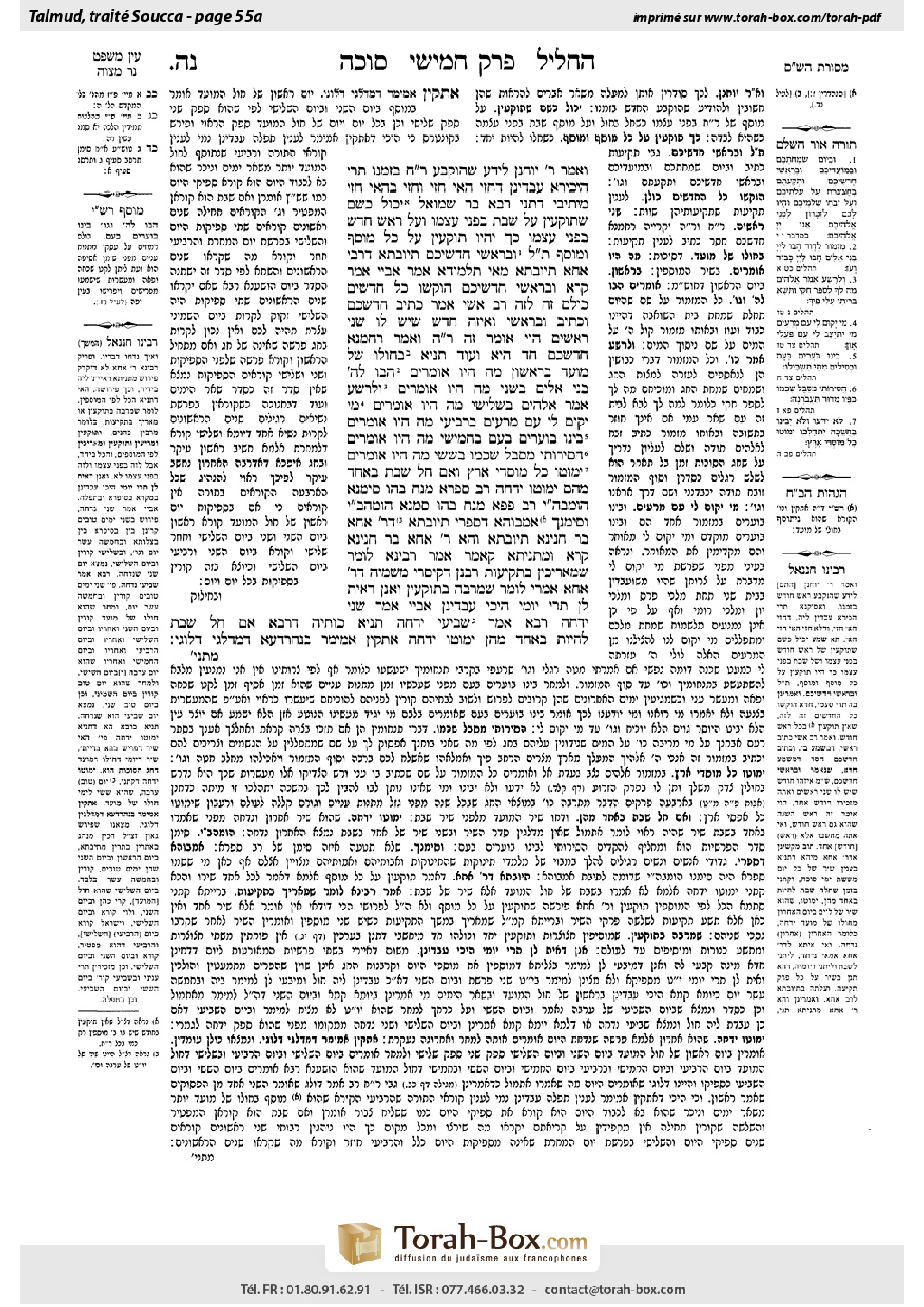
Sukkah 55a: Talmud study for Daf Yomi
Daf Yomi is the daily study of one Talmud folio. Explore 37 tractates with scans, Hebrew text, Sefaria English and AI-generated French translations where annotated.
Passage selection and English or AI-generated French translation are available where the scan has annotations. Daf Study is independent of Torah-Box and Sefaria.
Browse Sukkah · סוכה · All tractatesSukkah 55a text and translations
This page of Sukkah includes the Aramaic text, an English translation and an AI-generated French translation, alongside the scan above.
סוכה נ״ה א · Aramaic and Hebrew text
וְאָמַר רַבִּי יוֹחָנָן: לֵידַע שֶׁהוּקְבַּע רֹאשׁ חוֹדֶשׁ בִּזְמַנּוֹ. תְּרֵי הֶיכֵּירָא עָבְדִינַן. דְּחָזֵי הַאי — חָזֵי, וְחָזֵי בְּהַאי — חָזֵי.
מֵיתִיבִי, דְּתָנֵי רָבָא בַּר שְׁמוּאֵל: יָכוֹל כְּשֵׁם שֶׁתּוֹקְעִין עַל שַׁבָּת בִּפְנֵי עַצְמוֹ וְעַל רֹאשׁ חֹדֶשׁ בִּפְנֵי עַצְמוֹ, כָּךְ יִהְיוּ תּוֹקְעִין עַל כׇּל מוּסָף וּמוּסָף — תַּלְמוּד לוֹמַר: ״וּבְרָאשֵׁי חׇדְשֵׁיכֶם״, תְּיוּבְתָּא דְּרַבִּי אַחָא! תְּיוּבְתָּא.
מַאי תַּלְמוּדָא? אָמַר אַבָּיֵי, אָמַר קְרָא: ״וּבְרָאשֵׁי חׇדְשֵׁיכֶם״ — הוּקְּשׁוּ כׇּל חֳדָשִׁים כּוּלָּם זֶה לָזֶה. רַב אָשֵׁי אָמַר: כְּתִיב ״חׇדְשְׁכֶם״, וּכְתִיב ״וּבְרָאשֵׁי״ — וְאֵיזֶה חֹדֶשׁ שֶׁיֵּשׁ לוֹ שְׁנֵי רָאשִׁים, הֱוֵי אוֹמֵר: זֶה רֹאשׁ הַשָּׁנָה, וְאָמַר רַחֲמָנָא ״חׇדְשְׁכֶם״, חַד הִיא.
וְעוֹד, תַּנְיָא: בְּחוּלּוֹ שֶׁל מוֹעֵד, בָּרִאשׁוֹן מֶה הָיוּ אוֹמְרִים: ״הָבוּ לַה׳ בְּנֵי אֵלִים״. בַּשֵּׁנִי מֶה הָיוּ אוֹמְרִים: ״וְלָרָשָׁע אָמַר אֱלֹהִים״. בַּשְּׁלִישִׁי מֶה הָיוּ אוֹמְרִים: ״מִי יָקוּם לִי עִם מְרֵעִים״.
בָּרְבִיעִי מֶה הָיוּ אוֹמְרִים: ״בִּינוּ בּוֹעֲרִים בָּעָם״. בַּחֲמִישִׁי מֶה הָיוּ אוֹמְרִים: ״הֲסִירוֹתִי מִסֵּבֶל שִׁכְמוֹ״. בַּשִּׁשִּׁי מֶה הָיוּ אוֹמְרִים: ״יִמּוֹטוּ כׇּל מוֹסְדֵי אָרֶץ״. וְאִם חָל שַׁבָּת בְּאֶחָד מֵהֶם, ״יִמּוֹטוּ״ יִדָּחֶה.
רַב סָפְרָא מַנַּח בְּהוּ סִימָנָא: ״הוּמְבָּהֵ״י״. רַב פָּפָּא מַנַּח בְּהוּ סִימָנָא: ״הוּמְהָבֵּ״י״. וְסִימָנָךְ, ״אַמְבּוּהָא דְסָפְרֵי״.
תְּיוּבְתָּא דְּרַבִּי אַחָא בַּר חֲנִינָא! תְּיוּבְתָּא. וְהָא רַבִּי אַחָא בַּר חֲנִינָא קְרָא וּמַתְנִיתָא קָאָמַר?
אָמַר רָבִינָא: לוֹמַר שֶׁמַּאֲרִיכִין בִּתְקִיעוֹת. רַבָּנַן דְּקֵיסָרִי מִשְּׁמֵיהּ דְּרַבִּי אַחָא אָמְרִי: לוֹמַר שֶׁמַּרְבֶּה בְּתוֹקְעִין.
וַאֲנַן, דְּאִית לַן תְּרֵי יוֹמֵי, הֵיכִי עָבְדִינַן? אַבָּיֵי אָמַר: שֵׁנִי יִדָּחֶה.
רָבָא אָמַר: שְׁבִיעִי יִדָּחֶה. תַּנְיָא כְּוָתֵיהּ דְּרָבָא: אִם חָל שַׁבָּת לִהְיוֹת בְּאֶחָד מֵהֶן, ״יִמּוֹטוּ״ יִדָּחֶה.
אַתְקִין אַמֵּימָר בִּנְהַרְדְּעָא, דִּמְדַלְּגִי דַּלּוֹגֵי.
Sukkah 55a · English translation
And Rabbi Yoḥanan said: Why was it placed in this manner? It was as an indicator for the people to know that the New Moon was established at its proper time, after the twenty-ninth day of the previous month. The Gemara answers: This is not difficult, as they implemented two indicators: One who saw this one, i.e., the sequence of the songs, saw it; and one who saw that one, i.e., where the fats were placed, saw it, and there is no contradiction.
The Gemara raises another objection to the opinion of Rabbi Aḥa, as Rava bar Shmuel taught this baraita: I might have thought that just as when Shabbat and the New Moon do not coincide they sound the trumpets for the additional Shabbat offering in and of itself, and for the additional New Moon offering in and of itself, so too would they sound the trumpets for each and every additional offering when the days coincide. Therefore, the verse states: “And on the day of your rejoicing, and at your appointed times, and on your New Moons, and you shall sound the trumpets for your burnt-offerings and your peace-offerings, and they will be a memorial for you before your God. I am the Lord your God” (Numbers 10:10), indicating that one blast is sounded for all. The Gemara suggests: This is a conclusive refutation of the opinion of Rabbi Aḥa. The Gemara concludes: Indeed, it is a conclusive refutation.
Since the baraita was cited, the Gemara asks: What is the derivation cited in this baraita? How does the phrase: And on your New Moons, prove that the trumpets are sounded once for all the additional offerings? Abaye said: The verse states: “And on your New Moons,” in plural, indicating that all the months are equated to each other, and just as on a typical New Moon the trumpets are sounded once for the additional offering, so too when Shabbat and the New Moon coincide the trumpets are sounded once and no more. Rav Ashi said that in this verse it is written: Your moon [ḥodshekhem], without a yod, in the singular, and in the same verse it is written: “And on your new [uverashei],” in the plural. And which is the month that has two new beginnings? You must say it is Rosh HaShana, which is the beginning of both the new year and the new month. And yet the Merciful One says: Your moon, in the singular, indicating it is one and the trumpets are sounded once.
And furthermore, contrary to the statement of Rabbi Aḥa, it was taught in a baraita: On the intermediate days of the Festival, on the first day, what would they say as the song accompanying the offering on that day? “Ascribe [havu] unto the Lord, O you sons of might” (Psalms 29:1). On the second day, what would they say? The psalm that contains the verse: “But unto the wicked [velarasha] God says: What have you to do to declare My statutes?” (Psalms 50:16). On the third day, what would they say? The psalm containing the verse: “Who [mi] will rise up for me against the evildoers?” (Psalms 94:16).
On the fourth day, what would they say? “Consider [binu], you brutish among the people” (Psalms 94:8). On the fifth day, what would they say? “I removed [hasiroti] his shoulder from the burden” (Psalms 81:7). On the sixth day, what would they say? “All the foundations of the earth are moved [yimotu]” (Psalms 82:5). And if Shabbat occurred on any of the intermediate days of the Festival, since Shabbat has its own song (Psalms 92), the last of the songs of the intermediate days, i.e., “All the foundations of the earth are moved,” is superseded, and all the other songs are recited in their proper sequence.
Rav Safra established a mnemonic for the sequence of the psalms recited during the intermediate days of the Festival: Heh, vav, mem, beit, heh, yod, the first letters of the transliterated word in the verses cited. Rav Pappa established a different mnemonic for a different sequence of the Psalms: Heh, vav, mem, heh, beit, yod, as in his opinion, the psalm containing: “I removed” is recited before the psalm containing: “Consider.” The Gemara notes: A mnemonic to identify which amora established which mnemonic is the expression: Convoy [ambuha] of scribes [desafrei], as the spelling of ambuha is like the mnemonic of Rav Safra.
The Gemara concludes: This baraita is a conclusive refutation of the opinion of Rabbi Aḥa bar Ḥanina, as on Shabbat the song for Shabbat was recited alone without the song for the Festival, and similarly, separate trumpet blasts are not sounded for the various additional offerings. Rabbi Aḥa’s opinion was rejected based on several sources. The Gemara asks: But didn’t Rabbi Aḥa say a verse and a baraita in support of his opinion? How can those citations be rejected?
Ravina said: The verse and the baraita that he cited do not teach that trumpet blasts were sounded for each additional offering. Rather, they come to say that one extends the duration of the blasts to honor the added additional offerings, but does not sound even one additional blast. The Sages of Caesarea, in the name of Rabbi Aḥa, said: The verse and the baraita cited by Rabbi Aḥa come to say that one increases the number of trumpeters to honor the added additional offerings, but not the number of blasts sounded.
Apropos the psalms recited during the Festival, the Gemara asks: And we, outside Eretz Yisrael, who have two days of Festival due to the uncertainty, as well as uncertainty with regard to each of the intermediate days, how do we conduct ourselves with regard to the mention of the additional offerings in the additional prayer of the Festival during the intermediate days, and with regard to Torah reading on those days? Abaye said: Mention of the second day will be superseded. Since the first of the intermediate days outside Eretz Yisrael is the third day of the Festival in Eretz Yisrael, the additional offering for the third day alone is mentioned, and the offerings for the fourth day on the fourth day, etc. No mention is made of the second day outside Eretz Yisrael.
Rava said: Mention of the seventh day will be superseded. On the first of the intermediate days outside Eretz Yisrael, the third day of the Festival, the passage beginning “And on the second day” (Numbers 29:17) is mentioned in the additional Amida prayer and read in the Torah, and on each succeeding day the succeeding passage is mentioned and read. There is no mention of the seventh day on the eighth day, as that is no longer Sukkot but rather the Eighth Day of Assembly. The Gemara notes: A baraita was taught in accordance with the opinion of Rava: And if Shabbat occurs on any of the intermediate days of the Festival, the song of the seventh day of Sukkot: “All the foundations of the earth are moved,” is superseded.
The Gemara cites a third opinion: Ameimar instituted in his city of Neharde’a that during the intermediate days, one repeats the second of the additional offerings that he mentioned the day before and adds the additional offerings of the subsequent day. On the first of the intermediate days in the Diaspora, one mentions the additional offerings of both the second and third days of Sukkot. On the second of the intermediate days, one repeats the verses of the third day of Sukkot and adds the verses of the fourth day.
Sukkah 55a · Traduction française (IA)
Et Rabbi Yoḥanan dit : Pourquoi cela a-t-il été disposé de cette manière ? C’était un signe destiné à permettre au peuple de savoir que la nouvelle lune avait été fixée à la date prévue, après le vingt-neuvième jour du mois précédent. La Guemara répond : Il n’y a pas de difficulté, car ils utilisaient deux signes : celui qui voyait l’un — c’est-à-dire l’ordre des chants — le voyait, et celui qui voyait l’autre — c’est-à-dire l’endroit où étaient déposées les graisses — le voyait ; il n’y a donc pas de contradiction.
La Guemara soulève une autre objection à l’opinion de Rabbi Aḥa, car Rava bar Shmuel a enseigné cette baraïta : J’aurais pu penser que, de même que, lorsque Chabbat et la nouvelle lune ne coïncident pas, on sonne des trompettes pour l’offrande supplémentaire de Chabbat séparément, et pour l’offrande supplémentaire de la nouvelle lune séparément, de même, lorsque ces jours coïncident, on sonne des trompettes pour chacune des offrandes supplémentaires. Le verset enseigne donc : « Le jour de vos réjouissances, à vos fêtes et à vos nouvelles lunes, vous sonnerez des trompettes pour vos holocaustes et vos sacrifices de paix, et elles seront pour vous un mémorial devant votre Dieu. Je suis le Seigneur votre Dieu » (Nombres 10,10), indiquant qu’une seule sonnerie suffit pour toutes. La Guemara suggère : Cela constitue une réfutation décisive de l’opinion de Rabbi Aḥa. La Guemara conclut : En effet, c’est une réfutation décisive.
Puisque la baraïta a été citée, la Guemara demande : Quelle est la dérivation mentionnée dans cette baraïta ? Comment l’expression « et à vos nouvelles lunes » prouve-t-elle qu’on sonne des trompettes une seule fois pour toutes les offrandes supplémentaires ? Abaye dit : Le verset dit « et à vos nouvelles lunes », au pluriel, ce qui indique que tous les mois sont assimilés les uns aux autres. De même qu’à une nouvelle lune ordinaire, on sonne des trompettes une seule fois pour l’offrande supplémentaire, de même, lorsque Chabbat et la nouvelle lune coïncident, on sonne une seule fois, et pas davantage. Rav Ashi dit que, dans ce verset, il est écrit « votre lune » [ḥodshekhem], sans yod, au singulier, tandis que, dans le même verset, il est écrit « et à vos débuts de mois » [uverashei], au pluriel. Et quel est le mois qui a deux débuts ? Il faut dire que c’est Roch Hachana, qui marque à la fois le début de la nouvelle année et celui du nouveau mois. Pourtant, le Miséricordieux dit « votre lune », au singulier, indiquant qu’il n’y en a qu’une et qu’on sonne les trompettes une seule fois.
De plus, contrairement à l’opinion de Rabbi Aḥa, il a été enseigné dans une baraïta : Pendant les jours intermédiaires de la fête, que disait-on comme chant accompagnant l’offrande du premier jour ? « Rendez [havu] au Seigneur, fils des puissants » (Psaumes 29,1). Que disait-on le deuxième jour ? Le psaume qui contient le verset : « Mais au méchant [velarasha], Dieu dit : Qu’as-tu à proclamer mes lois ? » (Psaumes 50,16). Que disait-on le troisième jour ? Le psaume qui contient le verset : « Qui [mi] se lèvera pour moi contre les malfaiteurs ? » (Psaumes 94,16).
Que disait-on le quatrième jour ? « Comprenez [binu], vous qui êtes insensés parmi le peuple » (Psaumes 94,8). Que disait-on le cinquième jour ? « J’ai retiré [hasiroti] son épaule de sous le fardeau » (Psaumes 81,7). Que disait-on le sixième jour ? « Tous les fondements de la terre chancellent [yimotu] » (Psaumes 82,5). Et si Chabbat tombait pendant l’un des jours intermédiaires de la fête, puisque Chabbat a son propre chant (Psaumes 92), le dernier des chants des jours intermédiaires, c’est-à-dire « Tous les fondements de la terre chancellent », était omis, et tous les autres chants étaient récités dans leur ordre habituel.
Rav Safra a établi un moyen mnémotechnique pour l’ordre des psaumes récités pendant les jours intermédiaires de la fête : heh, vav, mem, beit, heh, yod, les premières lettres des mots translittérés dans les versets cités. Rav Pappa a établi un autre moyen mnémotechnique, correspondant à un ordre différent des psaumes : heh, vav, mem, heh, beit, yod, car selon lui, le psaume contenant « J’ai retiré » est récité avant celui qui contient « Comprenez ». La Guemara note : Pour se rappeler quel amora a établi quel moyen mnémotechnique, on peut utiliser l’expression « convoi [ambuha] de scribes [desafrei] », car l’orthographe d’ambuha correspond au moyen mnémotechnique de Rav Safra.
La Guemara conclut : Cette baraïta réfute de manière décisive l’opinion de Rabbi Aḥa bar Ḥanina, car, le jour de Chabbat, le chant de Chabbat était récité seul, sans le chant de la fête ; de même, on ne sonne pas de coups de trompette distincts pour les différentes offrandes supplémentaires. L’opinion de Rabbi Aḥa a été rejetée sur la base de plusieurs sources. La Guemara demande : Mais Rabbi Aḥa n’a-t-il pas cité un verset et une baraïta à l’appui de son opinion ? Comment peut-on écarter ces citations ?
Ravina dit : Le verset et la baraïta qu’il a cités n’enseignent pas qu’on sonnait des trompettes pour chaque offrande supplémentaire. Ils viennent plutôt enseigner qu’on prolonge la durée des sonneries pour honorer les offrandes supplémentaires qui s’ajoutent, mais qu’on n’ajoute pas même une seule sonnerie. Les Sages de Césarée, au nom de Rabbi Aḥa, ont dit : Le verset et la baraïta cités par Rabbi Aḥa viennent enseigner qu’on augmente le nombre de trompettistes pour honorer les offrandes supplémentaires qui s’ajoutent, mais pas le nombre de sonneries.
À propos des psaumes récités pendant la fête, la Guemara demande : Et nous, en dehors d’Eretz Israël, où nous célébrons deux jours de fête en raison de l’incertitude, et où règne également une incertitude concernant chacun des jours intermédiaires, comment procédons-nous pour mentionner les offrandes supplémentaires dans la prière supplémentaire de la fête pendant les jours intermédiaires, et pour la lecture de la Torah ces jours-là ? Abaye dit : La mention du deuxième jour sera omise. Puisque le premier jour intermédiaire en dehors d’Eretz Israël correspond au troisième jour de la fête en Eretz Israël, on mentionne uniquement l’offrande supplémentaire du troisième jour, puis, le quatrième jour, celles du quatrième jour, et ainsi de suite. On ne mentionne pas le deuxième jour en dehors d’Eretz Israël.
Rava dit : La mention du septième jour sera omise. Le premier jour intermédiaire en dehors d’Eretz Israël, qui correspond au troisième jour de la fête, on mentionne dans la prière supplémentaire de la Amida et on lit dans la Torah le passage qui commence par « Le deuxième jour » (Nombres 29,17) ; chaque jour suivant, on mentionne et on lit le passage du jour suivant. On ne mentionne pas le septième jour le huitième jour, car ce n’est plus Soukkot, mais le Huitième Jour d’Assemblée. La Guemara note : Une baraïta a été enseignée conformément à l’opinion de Rava : Si Chabbat tombe pendant l’un des jours intermédiaires de la fête, le chant du septième jour de Soukkot — « Tous les fondements de la terre chancellent » — est omis.
La Guemara cite une troisième opinion : Ameimar a institué dans sa ville de Neharde’a que, pendant les jours intermédiaires, on répète le deuxième ensemble d’offrandes supplémentaires mentionné la veille et on y ajoute les offrandes supplémentaires du jour suivant. Le premier jour intermédiaire en diaspora, on mentionne les offrandes supplémentaires des deuxième et troisième jours de Soukkot. Le deuxième jour intermédiaire, on répète les versets du troisième jour de Soukkot et on y ajoute ceux du quatrième jour.
Traduction française générée par IA à partir de l’édition anglaise de Sefaria. Vérifie toujours un passage avec le texte source.
Text from Sefaria: William Davidson Edition - Vocalized Aramaic (CC BY NC); William Davidson Edition - English (CC BY NC).