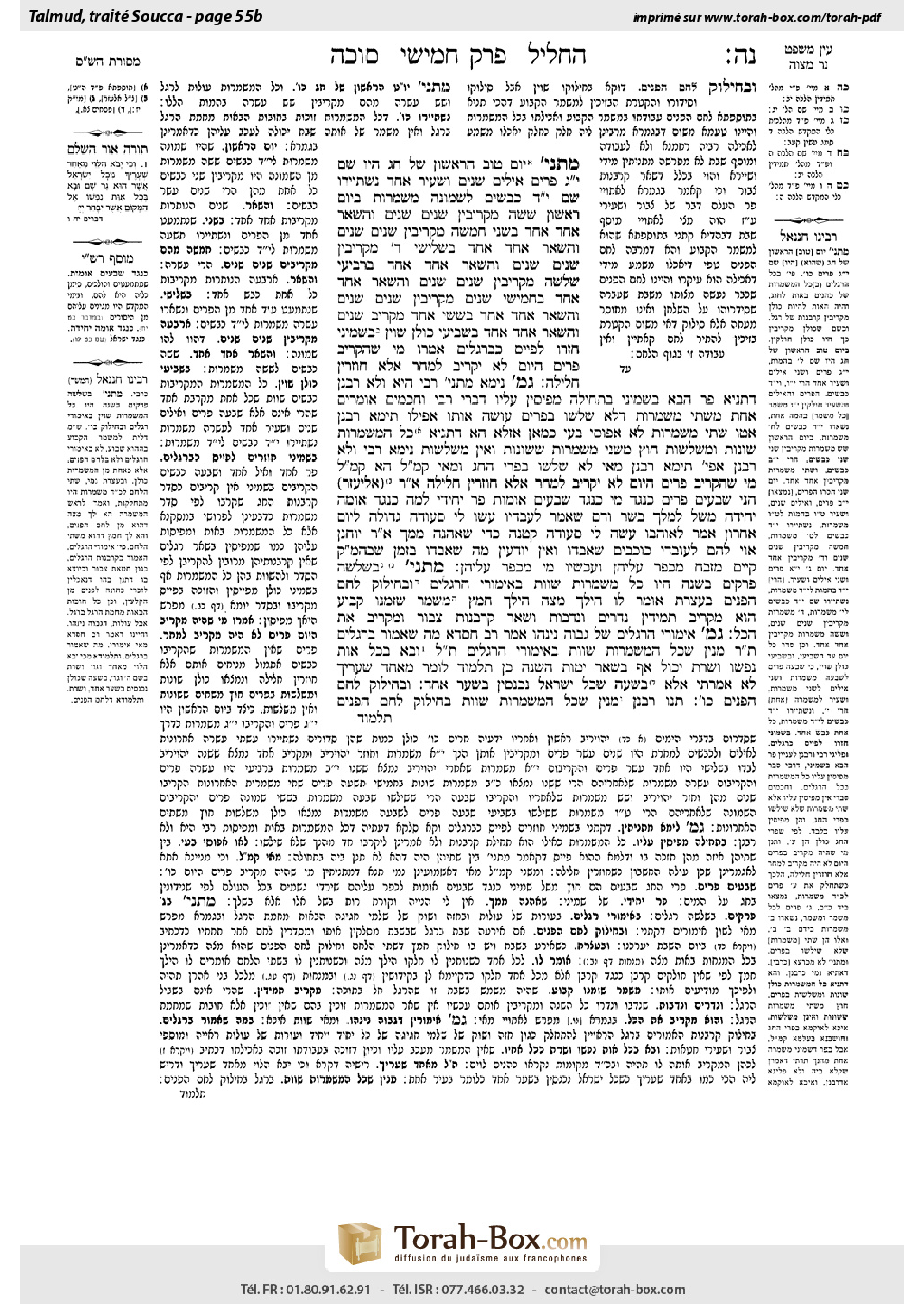
Sukkah 55b: Talmud study for Daf Yomi
Daf Yomi is the daily study of one Talmud folio. Explore 37 tractates with scans, Hebrew text, Sefaria English and AI-generated French translations where annotated.
Passage selection and English or AI-generated French translation are available where the scan has annotations. Daf Study is independent of Torah-Box and Sefaria.
Browse Sukkah · סוכה · All tractatesSukkah 55b text and translations
This page of Sukkah includes the Aramaic text, an English translation and an AI-generated French translation, alongside the scan above.
סוכה נ״ה ב · Aramaic and Hebrew text
מַתְנִי׳ יוֹם טוֹב הָרִאשׁוֹן שֶׁל חַג הָיוּ שָׁם שְׁלֹשָׁה עָשָׂר פָּרִים, אֵילִים שְׁנַיִם וְשָׂעִיר אֶחָד. נִשְׁתַּיְּירוּ שָׁם אַרְבָּעָה עָשָׂר כְּבָשִׂים לִשְׁמוֹנֶה מִשְׁמָרוֹת. בְּיוֹם רִאשׁוֹן, שִׁשָּׁה מַקְרִיבִין שְׁנַיִם שְׁנַיִם. וְהַשְּׁאָר, אֶחָד אֶחָד.
בַּשֵּׁנִי, חֲמִשָּׁה מַקְרִיבִין שְׁנַיִם שְׁנַיִם. וְהַשְּׁאָר, אֶחָד אֶחָד. בַּשְּׁלִישִׁי, אַרְבָּעָה מַקְרִיבִין שְׁנַיִם שְׁנַיִם. וְהַשְּׁאָר, אֶחָד אֶחָד.
בָּרְבִיעִי, שְׁלֹשָׁה מַקְרִיבִין שְׁנַיִם שְׁנַיִם. וְהַשְּׁאָר, אֶחָד אֶחָד. בַּחֲמִישִׁי, שְׁנַיִם מַקְרִיבִין שְׁנַיִם שְׁנַיִם. וְהַשְּׁאָר, אֶחָד אֶחָד. בַּשִּׁשִּׁי, אֶחָד מַקְרִיב שְׁנַיִם. וְהַשְּׁאָר, אֶחָד אֶחָד.
בַּשְּׁבִיעִי, כּוּלָּן שָׁוִין. בַּשְּׁמִינִי, חָזְרוּ לַפַּיִיס כְּבָרְגָלִים. אָמְרוּ: מִי שֶׁהִקְרִיב פָּרִים הַיּוֹם — לֹא יַקְרִיב לְמָחָר, אֶלָּא חוֹזְרִין חֲלִילָה.
גְּמָ׳ נֵימָא מַתְנִיתִין רַבִּי הִיא וְלָא רַבָּנַן? דְּתַנְיָא: פַּר הַבָּא בַּשְּׁמִינִי — בַּתְּחִילָּה מְפַיְּסִין עָלָיו, דִּבְרֵי רַבִּי. וַחֲכָמִים אוֹמְרִים: אַחַת מִשְׁתֵּי מִשְׁמָרוֹת דְּלֹא שִׁלְּשׁוּ בְּפָרִים, עוֹשָׂה אוֹתוֹ.
אֲפִילּוּ תֵּימָא רַבָּנַן, אַטּוּ שְׁתֵּי מִשְׁמָרוֹת לָא אַפּוֹסֵי בָּעֵי?
כְּמַאן אָזְלָא הָא דְּתַנְיָא: כׇּל הַמִּשְׁמָרוֹת שׁוֹנוֹת וּמְשַׁלְּשׁוֹת, חוּץ מִשְּׁנֵי מִשְׁמָרוֹת שֶׁשּׁוֹנוֹת וְאֵין מְשַׁלְּשׁוֹת? נֵימָא רַבִּי וְלָא רַבָּנַן! אֲפִילּוּ תֵּימָא רַבָּנַן: מַאי לֹא שִׁלְּשׁוּ — בְּפָרֵי הַחַג.
וּמַאי קָא מַשְׁמַע לַן! הָא קָא מַשְׁמַע לַן: מִי שֶׁהִקְרִיב פָּרִים הַיּוֹם — לֹא יַקְרִיב לְמָחָר, אֶלָּא חוֹזְרִין חֲלִילָה.
אָמַר רַבִּי (אֶלְעָזָר): הָנֵי שִׁבְעִים פָּרִים כְּנֶגֶד מִי — כְּנֶגֶד שִׁבְעִים אוּמּוֹת. פַּר יְחִידִי לָמָּה — כְּנֶגֶד אוּמָּה יְחִידָה.
מָשָׁל לְמֶלֶךְ בָּשָׂר וָדָם שֶׁאָמַר לַעֲבָדָיו: עֲשׂוּ לִי סְעוּדָה גְּדוֹלָה. לְיוֹם אַחֲרוֹן אָמַר לְאוֹהֲבוֹ: עֲשֵׂה לִי סְעוּדָה קְטַנָּה כְּדֵי שֶׁאֵהָנֶה מִמְּךָ.
אָמַר רַבִּי יוֹחָנָן: אוֹי לָהֶם לַגּוֹיִים, שֶׁאִבְּדוּ — וְאֵין יוֹדְעִין מַה שֶּׁאִבְּדוּ. בִּזְמַן שֶׁבֵּית הַמִּקְדָּשׁ קַיָּים, מִזְבֵּחַ מְכַפֵּר עֲלֵיהֶן. וְעַכְשָׁיו, מִי מְכַפֵּר עֲלֵיהֶן?!
מַתְנִי׳ בִּשְׁלֹשָׁה פְּרָקִים בַּשָּׁנָה הָיוּ כׇּל מִשְׁמָרוֹת שָׁווֹת: בְּאֵימוּרֵי הָרְגָלִים, וּבְחִילּוּק לֶחֶם הַפָּנִים.
בָּעֲצֶרֶת, אוֹמֵר לוֹ: הֵילָךְ מַצָּה, הֵילָךְ חָמֵץ. מִשְׁמָר שֶׁזְּמַנּוֹ קָבוּעַ, הוּא מַקְרִיב תְּמִידִין, נְדָרִים וּנְדָבוֹת, וּשְׁאָר קׇרְבְּנוֹת צִבּוּר — וּמַקְרִיב אֶת הַכֹּל.
גְּמָ׳ אֵימוּרֵי הָרְגָלִים שֶׁל גָּבוֹהַּ נִינְהוּ! אָמַר רַב חִסְדָּא: מַה שֶּׁאָמוּר בָּרְגָלִים.
תָּנוּ רַבָּנַן: מִנַּיִן שֶׁכׇּל הַמִּשְׁמָרוֹת שָׁווֹת בְּאֵימוּרֵי הָרְגָלִים, תַּלְמוּד לוֹמַר: ״וּבָא בְּכׇל אַוַּת נַפְשׁוֹ ... וְשֵׁרֵת״. יָכוֹל אַף בִּשְׁאָר יְמוֹת הַשָּׁנָה כֵּן — תַּלְמוּד לוֹמַר: ״מֵאַחַד שְׁעָרֶיךָ״, לֹא אָמַרְתִּי אֶלָּא בְּשָׁעָה שֶׁכׇּל יִשְׂרָאֵל נִכְנָסִין בְּשַׁעַר אֶחָד.
וּבְחִילּוּק לֶחֶם הַפָּנִים כּוּ׳. תָּנוּ רַבָּנַן: מִנַּיִן שֶׁכׇּל הַמִּשְׁמָרוֹת שָׁווֹת בְּחִילּוּק לֶחֶם הַפָּנִים —
Sukkah 55b · English translation
MISHNA: On the first Festival day of Sukkot there were thirteen bulls, two rams, and one goat there. The mishna proceeds to discuss the division of labor for the Festival offerings among the twenty-four priestly watches, all of which serve in the Temple on the pilgrimage Festivals. The sixteen offerings mentioned above were divided among sixteen priestly watches, one offering per watch. Fourteen sheep remained to be divided among the eight remaining watches. On the first day of the Festival, six of the eight remaining watches sacrifice two sheep each for a total of twelve, and the remaining two watches sacrifice one sheep each.
On the second day of the Festival, i.e., the first day of the intermediate days, when twelve bulls were sacrificed, fifteen of the priestly watches sacrifice the bulls, rams, and goat, five of the remaining watches sacrifice two sheep each, and the remaining four watches sacrifice one sheep each. On the third day of the Festival, when eleven bulls were sacrificed, fourteen of the priestly watches sacrifice the bulls, rams, and goat, four of the remaining watches sacrifice two sheep each, and the remaining six watches sacrifice one sheep each.
On the fourth day of the Festival, when ten bulls were sacrificed, thirteen of the priestly watches sacrifice the bulls, rams, and goat, three of the remaining watches sacrifice two sheep each, and the remaining eight watches sacrifice one sheep each. On the fifth day, when nine bulls were sacrificed, twelve watches sacrifice the bulls, rams, and goat, two of the twelve remaining watches sacrifice two sheep each, and the remaining ten watches sacrifice one sheep each. On the sixth day, when eight bulls were sacrificed, eleven watches sacrifice the bulls, rams, and goat, one of the remaining watches sacrifices two sheep, and the remaining twelve watches sacrifice one sheep each.
On the seventh day they are all equal and bring one offering each. On the eighth day, when there was a completely different configuration of offerings, they returned to the standard lottery system used to determine which of the priestly watches would sacrifice the offerings, as they did on the other pilgrimage Festivals, which do not have as many offerings as does Sukkot. They said about the ordering of the priestly watches: One who sacrificed bulls today will not sacrifice bulls tomorrow; rather, they will sacrifice one of the other types of offerings. They rotate, so that each of the watches will have the opportunity to sacrifice bulls as well as other animals.
GEMARA: The Gemara suggests: Let us say that the mishna that says that on the eighth day they returned to the standard lottery of the other pilgrimage Festivals is according to Rabbi Yehuda HaNasi and not according to the Rabbis. As it is taught in a baraita: To determine the priestly watch that would sacrifice the bull that comes as an additional offering on the Eighth Day of Assembly, they draw lots over it from the beginning; this is the statement of Rabbi Yehuda HaNasi. And the Rabbis say: One of the two watches that did not sacrifice three bulls during Sukkot sacrifices it. Only two of the twenty-four watches sacrifices two bulls over the course of Sukkot. Each of the other watches sacrifices three bulls. Since the mishna mentions that a lottery was held, apparently the mishna is in accordance with the opinion of Rabbi Yehuda HaNasi.
The Gemara rejects this suggestion: Even if you say that it is in accordance with the opinion of the Rabbis, is that to say that the two remaining priestly watches are not required to draw lots to determine which will merit sacrificing the bull?
The Gemara asks: In accordance with whose opinion is that which is taught in a baraita: All of the priestly watches sacrifice a bull twice and three times, except for two watches that sacrifice a bull twice and do not sacrifice a bull three times? Let us say that it is in accordance with the opinion of Rabbi Yehuda HaNasi and not in accordance with the opinion of the Rabbis, as they hold that one of those watches sacrifices a third bull on the Eighth Day of Assembly. The Gemara rejects this suggestion: Even if you say that it is in accordance with the opinion of the Rabbis; what is the meaning of the phrase: They did not sacrifice a bull three times? It means that with regard to the bulls of the festival of Sukkot they did not sacrifice a bull three times.
The Gemara asks: With regard to the bulls sacrificed on Sukkot, what does the baraita teach us? It is a simple calculation that seventy bulls divided by twenty-four watches leaves two watches that sacrificed only two bulls. The Gemara answers: This is what the baraita comes to teach us: One who sacrificed bulls today will not sacrifice bulls tomorrow; rather, they rotate. Therefore, each watch sacrifices at least two bulls, and most of them sacrifice three.
Rabbi Elazar said: These seventy bulls that are sacrificed as additional offerings over the course of the seven days of Sukkot, to what do they correspond? They correspond to the seventy nations of the world, and are brought to atone for their sins and to hasten world peace. Why is a single bull sacrificed on the Eighth Day of Assembly? It corresponds to the singular nation, Israel.
The Gemara cites a parable about a king of flesh and blood who said to his servants: Prepare me a great feast that will last for several days. When the feast concluded, on the last day, he said to his beloved servant: Prepare me a small feast so that I can derive pleasure from you alone.
Rabbi Yoḥanan said: Woe unto the nations of the world that lost something and do not know what they lost. When the Temple is standing, the seventy bulls sacrificed on the altar during the festival of Sukkot atones for them. And now that the Temple is destroyed, who atones for them?
MISHNA: At three times during the year, all twenty-four priestly watches have equal status, in that all receive a share in the Temple service independent of the standard order of the watches and all receive a share in the accompanying gifts of the priesthood: In the portions of the offerings of the Festivals sacrificed on the altar and in the distribution of the shewbread on Shabbat during the Festivals.
On Shavuot that coincides with Shabbat, when the two loaves offered on Shavuot would be distributed together with the distribution of the shewbread, the priest charged with the distribution says to each priest: Here is matza from the shewbread for you, and here is leavened bread from the two loaves for you. The principle is that the priestly watch whose time is fixed during the Festival sacrifices the daily offerings during the Festival, as well as vow-offerings, free-will offerings, and all other communal offerings. And that watch sacrifices all of them even during the Festival, when other aspects of the service are shared by all the watches.
GEMARA: The Gemara wonders: How is it that the priests divide those portions of the Festival offerings? Don’t they belong to God, and must be placed on the altar? How do the priestly watches share these portions? Rav Ḥisda said: The mishna is referring not to portions sacrificed on the altar [eimurim] but to what was stated [amur] with regard to the pilgrimage Festivals, all those portions of the offerings that the Torah commanded to sacrifice at the Temple that are not burnt on the altar and are shared by the priests, e.g., hides of the burnt-offerings of appearance and the breast and thigh of the Festival peace-offerings.
The Sages taught: From where is it derived that all of the priestly watches have equal status in the portions of the Festival offerings? The verse states: “And if a Levite comes from any of your gates out of all Israel, where he sojourns, and comes with all the desire of his soul unto the place that the Lord shall choose; then he shall minister…as all his brethren…They shall have like portions to eat, besides the transactions of their fathers’ houses” (Deuteronomy 18:6–8). Based on these verses, one might have thought that this is the case even on the rest of the days of the year and the priestly watches would have equal status. Therefore, the verse states: From one of your gates. I said that all have equal status only when all of Israel enters through one gate, i.e., on a pilgrimage Festival.
The mishna continues: And in the distribution of the shewbread on the three pilgrimage Festivals, all twenty-four priestly watches have equal status. The Sages taught: From where is it derived that all of the priestly watches have equal status in the distribution of the shewbread?
Sukkah 55b · Traduction française (IA)
MICHNA : Le premier jour de la fête de Souccot, il y avait là treize taureaux, deux béliers et un bouc. La Michna aborde ensuite la répartition du service des sacrifices de la fête entre les vingt-quatre gardes sacerdotales, qui officient toutes au Temple lors des fêtes de pèlerinage. Les seize sacrifices mentionnés ci-dessus étaient répartis entre seize gardes sacerdotales, à raison d’un sacrifice par garde. Il restait quatorze moutons à répartir entre les huit gardes restantes. Le premier jour de la fête, six de ces huit gardes restantes sacrifiaient chacune deux moutons, soit douze au total, et les deux dernières sacrifiaient chacune un mouton.
Le deuxième jour de la fête, c’est-à-dire le premier jour des jours intermédiaires, où douze taureaux étaient sacrifiés, quinze gardes sacerdotales sacrifiaient les taureaux, les béliers et le bouc ; cinq des gardes restantes sacrifiaient chacune deux moutons, et les quatre dernières sacrifiaient chacune un mouton. Le troisième jour de la fête, où onze taureaux étaient sacrifiés, quatorze gardes sacerdotales sacrifiaient les taureaux, les béliers et le bouc ; quatre des gardes restantes sacrifiaient chacune deux moutons, et les six dernières sacrifiaient chacune un mouton.
Le quatrième jour de la fête, où dix taureaux étaient sacrifiés, treize gardes sacerdotales sacrifiaient les taureaux, les béliers et le bouc ; trois des gardes restantes sacrifiaient chacune deux moutons, et les huit dernières sacrifiaient chacune un mouton. Le cinquième jour, où neuf taureaux étaient sacrifiés, douze gardes sacrifiaient les taureaux, les béliers et le bouc ; deux des douze gardes restantes sacrifiaient chacune deux moutons, et les dix dernières sacrifiaient chacune un mouton. Le sixième jour, où huit taureaux étaient sacrifiés, onze gardes sacrifiaient les taureaux, les béliers et le bouc ; l’une des gardes restantes sacrifiait deux moutons, et les douze dernières sacrifiaient chacune un mouton.
Le septième jour, elles sont toutes à égalité et apportent chacune un sacrifice. Le huitième jour, où la configuration des sacrifices était tout à fait différente, on revenait au système habituel du tirage au sort utilisé pour déterminer quelles gardes sacerdotales sacrifieraient les sacrifices, comme lors des autres fêtes de pèlerinage, qui ne comportent pas autant de sacrifices que Souccot. On disait à propos de l’ordre des gardes sacerdotales : Celle qui a sacrifié des taureaux aujourd’hui n’en sacrifiera pas demain ; elle sacrifiera plutôt l’un des autres types de sacrifices. Les gardes se relaient, afin que chacune ait l’occasion de sacrifier des taureaux ainsi que d’autres animaux.
GUEMARA : La Guemara suggère : Disons que la Michna, selon laquelle on revenait le huitième jour au tirage au sort habituel des autres fêtes de pèlerinage, suit l’opinion de Rabbi Yehouda HaNassi et non celle des Rabbins. En effet, il est enseigné dans une baraïta : Pour désigner la garde sacerdotale qui sacrifierait le taureau apporté comme sacrifice supplémentaire le huitième jour de l’Assemblée, on tire au sort dès le départ ; telle est l’opinion de Rabbi Yehouda HaNassi. Les Rabbins disent : L’une des deux gardes qui n’ont pas sacrifié trois taureaux pendant Souccot le sacrifie. Seules deux des vingt-quatre gardes ont sacrifié deux taureaux au cours de Souccot. Chacune des autres gardes en a sacrifié trois. Puisque la Michna mentionne qu’un tirage au sort a eu lieu, elle semble donc suivre l’opinion de Rabbi Yehouda HaNassi.
La Guemara rejette cette suggestion : Même si l’on dit que la Michna suit l’opinion des Rabbins, cela signifie-t-il que les deux gardes sacerdotales restantes n’ont pas à tirer au sort pour déterminer laquelle aura le mérite de sacrifier le taureau ?
La Guemara demande : Selon l’opinion de qui est l’enseignement de la baraïta suivant : Toutes les gardes sacerdotales sacrifient un taureau deux fois et trois fois, à l’exception de deux gardes qui sacrifient un taureau deux fois et ne le sacrifient pas une troisième fois ? Disons qu’il suit l’opinion de Rabbi Yehouda HaNassi et non celle des Rabbins, puisque ceux-ci considèrent que l’une de ces gardes sacrifie un troisième taureau le huitième jour de l’Assemblée. La Guemara rejette cette suggestion : Même si l’on dit que cela suit l’opinion des Rabbins, que signifie l’expression « elles n’ont pas sacrifié un taureau trois fois » ? Cela signifie qu’elles n’ont pas sacrifié un taureau trois fois parmi les taureaux de la fête de Souccot.
La Guemara demande : Que nous apprend la baraïta au sujet des taureaux sacrifiés à Souccot ? C’est un calcul simple : sur soixante-dix taureaux répartis entre vingt-quatre gardes, deux gardes n’en ont sacrifié que deux. La Guemara répond : Voici ce que la baraïta vient nous enseigner : Celle qui a sacrifié des taureaux aujourd’hui n’en sacrifiera pas demain ; les gardes se relaient. Ainsi, chaque garde sacrifie au moins deux taureaux, et la plupart en sacrifient trois.
Rabbi Elazar a dit : À quoi correspondent ces soixante-dix taureaux sacrifiés comme offrandes supplémentaires au cours des sept jours de Souccot ? Ils correspondent aux soixante-dix nations du monde et sont apportés pour expier leurs fautes et hâter la paix dans le monde. Pourquoi sacrifie-t-on un seul taureau le huitième jour de l’Assemblée ? Il correspond à l’unique nation, Israël.
La Guemara rapporte une parabole au sujet d’un roi de chair et de sang qui dit à ses serviteurs : « Préparez-moi un grand festin qui durera plusieurs jours. » À la fin du festin, le dernier jour, il dit à son serviteur bien-aimé : « Prépare-moi un petit festin afin que je puisse prendre plaisir à toi seul. »
Rabbi Yoḥanan a dit : Malheur aux nations du monde, qui ont perdu quelque chose sans savoir ce qu’elles ont perdu ! Lorsque le Temple est debout, les soixante-dix taureaux sacrifiés sur l’autel pendant la fête de Souccot expient pour elles. Et maintenant que le Temple est détruit, qui expie pour elles ?
MICHNA : À trois moments de l’année, les vingt-quatre gardes sacerdotales sont toutes à égalité : chacune reçoit une part du service du Temple, indépendamment de l’ordre habituel des gardes, ainsi qu’une part des dons associés au sacerdoce. Il s’agit des portions des sacrifices des fêtes offerts sur l’autel et de la distribution des pains de proposition le Chabbat pendant les fêtes.
Lorsque Chavouot tombe un Chabbat, les deux pains offerts à Chavouot sont distribués en même temps que les pains de proposition. Le prêtre chargé de la distribution dit à chaque prêtre : « Voici pour toi du pain azyme provenant des pains de proposition, et voici pour toi du pain levé provenant des deux pains. » Le principe est que la garde sacerdotale dont le tour est fixé pendant la fête sacrifie les sacrifices quotidiens pendant la fête, ainsi que les sacrifices votifs, les sacrifices volontaires et tous les autres sacrifices communautaires. Cette garde les sacrifie tous, même pendant la fête, alors que les autres aspects du service sont partagés entre toutes les gardes.
GUEMARA : La Guemara s’interroge : Comment les prêtres se partagent-ils ces portions des sacrifices de la fête ? Ne reviennent-elles pas à Dieu et ne doivent-elles pas être placées sur l’autel ? Comment les gardes sacerdotales peuvent-elles se partager ces portions ? Rav Ḥisda a dit : La Michna ne parle pas des portions sacrifiées sur l’autel [eimurim], mais de ce qui a été mentionné [amur] au sujet des fêtes de pèlerinage, à savoir toutes les portions des sacrifices que la Torah a ordonné d’offrir au Temple, qui ne sont pas brûlées sur l’autel et sont partagées entre les prêtres, par exemple les peaux des holocaustes d’apparition ainsi que la poitrine et la cuisse des sacrifices de paix de la fête.
Les Sages ont enseigné : D’où déduit-on que toutes les gardes sacerdotales sont à égalité pour les portions des sacrifices de la fête ? Le verset dit : « Si un lévite vient de l’une de tes portes, de tout Israël, là où il séjourne, et vient avec tout le désir de son âme au lieu que l’Éternel choisira, alors il officiera… comme tous ses frères… Ils auront des parts égales à manger, outre les transactions des maisons de leurs pères » (Deutéronome 18, 6-8). Sur la base de ces versets, on aurait pu penser que cela vaut également pour le reste de l’année et que les gardes sacerdotales sont à égalité. Le verset dit donc : « De l’une de tes portes ». J’ai dit qu’elles sont toutes à égalité uniquement lorsque tout Israël entre par une seule porte, c’est-à-dire lors d’une fête de pèlerinage.
La Michna poursuit : Lors de la distribution des pains de proposition pendant les trois fêtes de pèlerinage, les vingt-quatre gardes sacerdotales sont toutes à égalité. Les Sages ont enseigné : D’où déduit-on que toutes les gardes sacerdotales sont à égalité pour la distribution des pains de proposition ?
Traduction française générée par IA à partir de l’édition anglaise de Sefaria. Vérifie toujours un passage avec le texte source.
Text from Sefaria: William Davidson Edition - Vocalized Aramaic (CC BY NC); William Davidson Edition - English (CC BY NC).