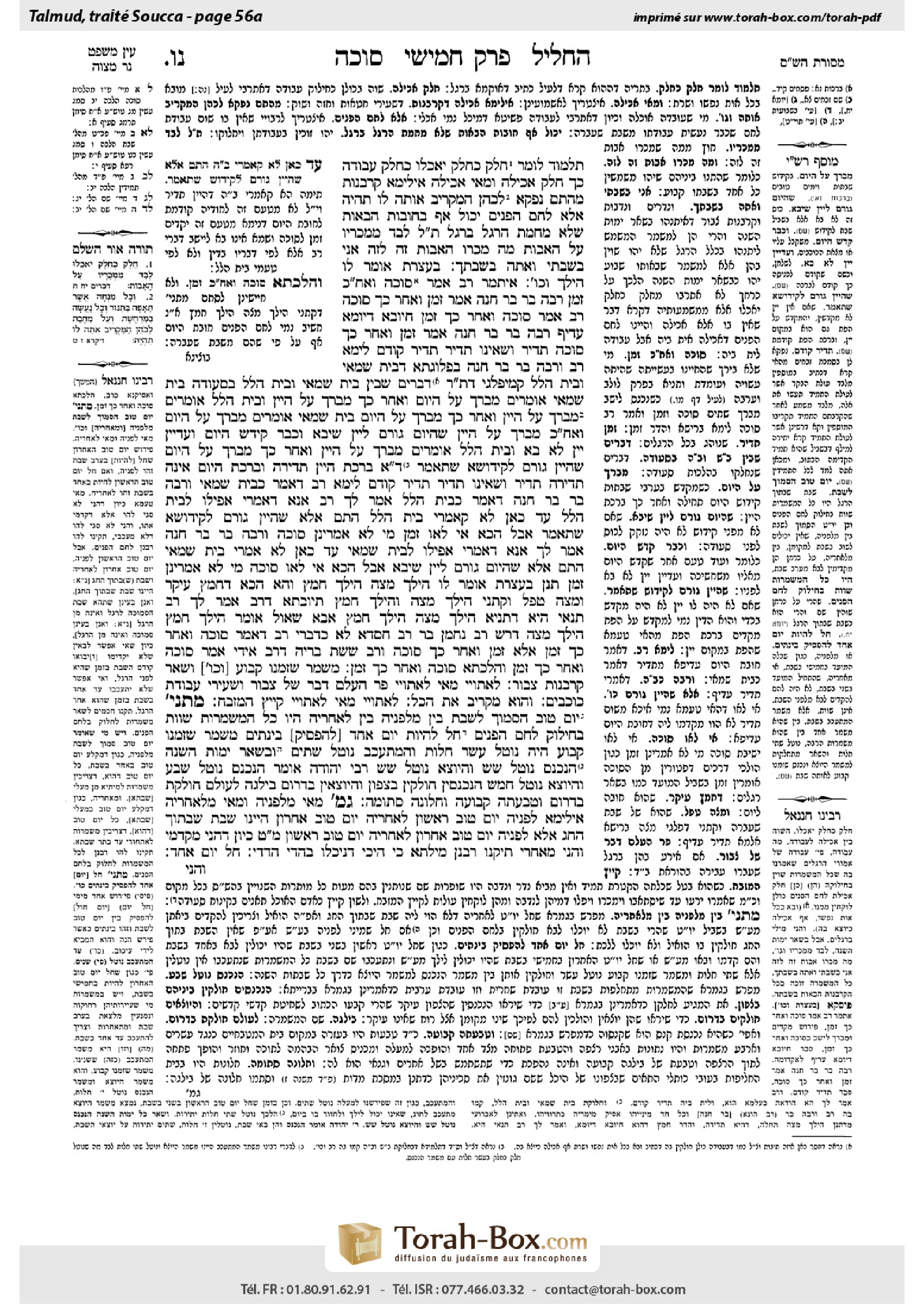
Sukkah 56a: Talmud study for Daf Yomi
Daf Yomi is the daily study of one Talmud folio. Explore 37 tractates with scans, Hebrew text, Sefaria English and AI-generated French translations where annotated.
Passage selection and English or AI-generated French translation are available where the scan has annotations. Daf Study is independent of Torah-Box and Sefaria.
Browse Sukkah · סוכה · All tractatesSukkah 56a text and translations
This page of Sukkah includes the Aramaic text, an English translation and an AI-generated French translation, alongside the scan above.
סוכה נ״ו א · Aramaic and Hebrew text
תַּלְמוּד לוֹמַר: ״חֵלֶק כְּחֵלֶק יֹאכֵלוּ״, כְּחֵלֶק עֲבוֹדָה כָּךְ חֵלֶק אֲכִילָה. וּמַאי אֲכִילָה? אִילֵּימָא קׇרְבָּנוֹת, מֵהָתָם נָפְקָא: ״לַכֹּהֵן הַמַּקְרִיב אוֹתָהּ לוֹ תִהְיֶה״! אֶלָּא: לֶחֶם הַפָּנִים.
יָכוֹל אַף בְּחוֹבוֹת הַבָּאוֹת שֶׁלֹּא מֵחֲמַת הָרֶגֶל בָּרֶגֶל, תַּלְמוּד לוֹמַר: ״לְבַד מִמְכָּרָיו עַל הָאָבוֹת״ — מָה מָכְרוּ הָאָבוֹת זֶה לָזֶה, אֲנִי בְּשַׁבַּתִּי וְאַתָּה בְּשַׁבַּתֶּךָ.
בָּעֲצֶרֶת אוֹמֵר לוֹ הֵילָךְ וְכוּ׳. אִיתְּמַר, רַב אָמַר: סוּכָּה, וְאַחַר כָּךְ זְמַן. רַבָּה בַּר בַּר חָנָה אָמַר: זְמַן, וְאַחַר כָּךְ סוּכָּה.
רַב אָמַר: סוּכָּה וְאַחַר כָּךְ זְמַן — חִיּוּבָא דְיוֹמָא עֲדִיף. רַבָּה בַּר בַּר חָנָה אָמַר: זְמַן וְאַחַר כָּךְ סוּכָּה — תָּדִיר וְשֶׁאֵינוֹ תָּדִיר תָּדִיר קוֹדֵם.
לֵימָא רַב וְרַבָּה בַּר בַּר חָנָה בִּפְלוּגְתָּא דְּבֵית שַׁמַּאי וּבֵית הִלֵּל קָמִיפַּלְגִי, דְּתָנוּ רַבָּנַן: דְּבָרִים שֶׁבֵּין בֵּית שַׁמַּאי וּבֵית הִלֵּל בַּסְּעוּדָה. בֵּית שַׁמַּאי אוֹמְרִים: מְבָרֵךְ עַל הַיּוֹם וְאַחַר כָּךְ מְבָרֵךְ עַל הַיַּיִן, וּבֵית הִלֵּל אוֹמְרִים: מְבָרֵךְ עַל הַיַּיִן וְאַחַר כָּךְ מְבָרֵךְ עַל הַיּוֹם.
בֵּית שַׁמַּאי אוֹמְרִים: מְבָרֵךְ עַל הַיּוֹם וְאַחַר כָּךְ מְבָרֵךְ עַל הַיַּיִן — שֶׁהַיּוֹם גּוֹרֵם לַיַּיִן שֶׁיָּבֹא, וּכְבָר קִידֵּשׁ הַיּוֹם וַעֲדַיִין יַיִן לֹא בָּא. וּבֵית הִלֵּל אוֹמְרִים: מְבָרֵךְ עַל הַיַּיִן וְאַחַר כָּךְ מְבָרֵךְ עַל הַיּוֹם — שֶׁהַיַּיִן גּוֹרֵם לְקִידּוּשָׁא שֶׁתֵּאָמֵר. דָּבָר אַחֵר: בִּרְכַּת הַיַּיִן תְּדִירָה, וּבִרְכַּת הַיּוֹם אֵינָהּ תְּדִירָה. תָּדִיר וְשֶׁאֵינוֹ תָּדִיר — תָּדִיר קוֹדֵם.
לֵימָא רַב דְּאָמַר כְּבֵית שַׁמַּאי, וְרַבָּה בַּר בַּר חָנָה דְּאָמַר כְּבֵית הִלֵּל!
אָמַר לְךָ רַב: אֲנָא דַּאֲמַרִי אֲפִילּוּ לְבֵית הִלֵּל. עַד כָּאן לָא קָאָמְרִי בֵּית הִלֵּל הָתָם, אֶלָּא שֶׁהַיַּיִן גּוֹרֵם לְקִידּוּשָׁא שֶׁתֵּאָמֵר; אֲבָל הָכָא — אִי לָאו זְמַן, מִי לָא אָמְרִינַן סוּכָּה!
וְרַבָּה בַּר בַּר חָנָה אָמַר לָךְ: אֲנָא דַּאֲמַרִי אֲפִילּוּ לְבֵית שַׁמַּאי. עַד כָּאן לָא אָמְרִי בֵּית שַׁמַּאי הָתָם, אֶלָּא שֶׁהַיּוֹם גּוֹרֵם לַיַּיִן שֶׁיָּבֹא; אֲבָל הָכָא — אִי לָאו סוּכָּה, מִי לָא אָמְרִינַן זְמַן!
תְּנַן, בָּעֲצֶרֶת אוֹמֵר לוֹ: הֵילָךְ מַצָּה, הֵילָךְ חָמֵץ. וְהָא הָכָא, דְּחָמֵץ עִיקָּר וּמַצָּה טָפֵל, וְקָתָנֵי: הֵילָךְ מַצָּה וְהֵילָךְ חָמֵץ, תְּיוּבְתָּא דְּרַב!
אָמַר לְךָ רַב: תַּנָּאֵי הִיא. דְּתַנְיָא: הֵילָךְ מַצָּה, הֵילָךְ חָמֵץ. אַבָּא שָׁאוּל אוֹמֵר: הֵילָךְ חָמֵץ, הֵילָךְ מַצָּה.
דָּרַשׁ רַב נַחְמָן בַּר רַב חִסְדָּא: לֹא כְּדִבְרֵי רַב, דְּאָמַר: סוּכָּה, וְאַחַר כָּךְ זְמַן — אֶלָּא: זְמַן, וְאַחַר כָּךְ סוּכָּה. וְרַב שֵׁשֶׁת בְּרֵיהּ דְּרַב אִידִי אָמַר: סוּכָּה, וְאַחַר כָּךְ זְמַן. וְהִלְכְתָא: סוּכָּה, וְאַחַר כָּךְ זְמַן.
מִשְׁמָר שֶׁזְּמַנּוֹ קָבוּעַ [וְכוּ׳], וּשְׁאָר קׇרְבְּנוֹת צִבּוּר. לְאֵתוֹיֵי מַאי? לְאֵתוֹיֵי פַּר הֶעְלֵם דָּבָר שֶׁל צִבּוּר וּשְׂעִירֵי עֲבוֹדָה זָרָה.
וְהוּא מַקְרִיב אֶת הַכֹּל. לְאֵתוֹיֵי מַאי? לְאֵתוֹיֵי קֵייץ הַמִּזְבֵּחַ.
מַתְנִי׳ יוֹם טוֹב הַסָּמוּךְ לַשַּׁבָּת, בֵּין מִלְּפָנֶיהָ בֵּין לְאַחֲרֶיהָ — הָיוּ כׇּל הַמִּשְׁמָרוֹת שָׁווֹת בְּחִילּוּק לֶחֶם הַפָּנִים. חָל לִהְיוֹת יוֹם אֶחָד [לְהַפְסִיק] בֵּינָתַיִם — מִשְׁמָר שֶׁזְּמַנּוֹ קָבוּעַ הָיָה נוֹטֵל עֶשֶׂר חַלּוֹת, וְהַמִּתְעַכֵּב נוֹטֵל שְׁתַּיִם. וּבִשְׁאָר יְמוֹת הַשָּׁנָה — הַנִּכְנָס נוֹטֵל שֵׁשׁ, וְהַיּוֹצֵא נוֹטֵל שֵׁשׁ. רַבִּי יְהוּדָה אוֹמֵר: הַנִּכְנָס נוֹטֵל שֶׁבַע, וְהַיּוֹצֵא נוֹטֵל חָמֵשׁ.
הַנִּכְנָסִין חוֹלְקִין בַּצָּפוֹן, וְהַיּוֹצְאִין בַּדָּרוֹם. בִּילְגָּה לְעוֹלָם חוֹלֶקֶת בַּדָּרוֹם, וְטַבַּעְתָּהּ קְבוּעָה, וְחַלּוֹנָהּ סְתוּמָה.
גְּמָ׳ מַאי מִלְּפָנֶיהָ וּמַאי מִלְּאַחֲרֶיהָ? אִילֵימָא: לְפָנֶיהָ — יוֹם טוֹב רִאשׁוֹן, לְאַחֲרֶיהָ — יוֹם טוֹב אַחֲרוֹן, הַיְינוּ שַׁבָּת שֶׁבְּתוֹךְ הֶחָג.
אֶלָּא: לְפָנֶיהָ — יוֹם טוֹב אַחֲרוֹן. לְאַחֲרֶיהָ — יוֹם טוֹב רִאשׁוֹן. מַאי טַעְמָא — כֵּיוָן דְּהָנֵי מְקַדְּמִי וְהָנֵי מְאַחֲרִי, תַּקִּינוּ רַבָּנַן מִילְּתָא כִּי הֵיכִי דְּנֵיכְלוּ בַּהֲדֵי הֲדָדֵי.
חָל יוֹם אֶחָד.
Sukkah 56a · English translation
The verse states: “They shall have like portions to eat” (Deuteronomy 18:8); just as all the watches receive an equal portion of the service, so too all the watches receive an equal portion in the eating. The Gemara asks: What is the eating mentioned in this verse? If you say it is the eating of offerings, the verse is superfluous, as it is derived from there: “And every meal-offering…shall be the priest’s that offers it” (Leviticus 7:9), which, although it was written with regard to meal-offerings, applies to all offerings. Moreover, it teaches that a priest who participates in the sacrifice of the offering shares in eating the offering. Rather, the verse is referring to the shewbread that was not part of the service this Shabbat, as it was baked the previous Shabbat.
One might have thought that all the watches should be equal even with regard to obligations that come not due to the Festival but are brought on the Festival nevertheless, as there were many vow-offerings and free-will offerings brought to the Temple that were not part of the Festival rite, but simply the result of people taking advantage of their presence in Jerusalem to fulfill their outstanding obligations. Therefore, the verse states: “Besides the transactions of their fathers’ houses” (Deuteronomy 18:8). What did the forefathers of each watch sell each other? They agreed with regard to the service of the watches: I will serve during my week, and you will serve during your week. Each watch has the right to perform the Temple service during its appointed weeks and to receive all priestly gifts offered during those weeks.
§ The mishna continues: On Shavuot that coincides with Shabbat the priest charged with the distribution says to each priest: Here is matza from the shewbread for you, and here is leavened bread from the two loaves for you. It was stated that there is a dispute between the amora’im, and Rav said: When one enters the sukka, he recites the blessing of the sukka: Who has made us holy through His mitzvot and has commanded us to sit in the sukka, and then the blessing of time: Who has given us life, sustained us, and brought us to this time. Rabba bar bar Ḥana said: One recites the blessing of time, and then the blessing of the sukka.
The Gemara elaborates: Rav said that one recites the blessing of sukka and then the blessing of time because the obligation of the day takes precedence. Rabba bar bar Ḥana said that one recites the blessing of time and then the blessing of the sukka because when a frequent practice and an infrequent practice clash, the frequent practice takes precedence over the infrequent practice, and the blessing of time is recited more frequently.
The Gemara suggests: Let us say that Rav and Rabba bar bar Ḥana disagree in the dispute of Beit Shammai and Beit Hillel. As the Sages taught in a baraita: These are the matters of dispute between Beit Shammai and Beit Hillel with regard to the halakhot of a meal. Beit Shammai say: When one recites kiddush over wine, he recites a blessing over the sanctification of the day and then recites a blessing over the wine. And Beit Hillel say: One recites a blessing over the wine and then recites a blessing over the day.
The Gemara elaborates: Beit Shammai say: One recites a blessing over the sanctification of the day and then recites a blessing over the wine, as the day causes the wine to come before the meal. And Beit Shammai offer an additional reason: The day has already been sanctified and the wine has not yet come. Since Shabbat was sanctified first, it should likewise be mentioned first. And Beit Hillel say: One recites a blessing over the wine and then recites a blessing over the day, as the wine causes the kiddush to be recited. Were there no wine, kiddush would not be recited. Alternatively, Beit Hillel say: The blessing over wine is recited frequently, and the blessing over the day is not recited frequently, and when a frequent practice and an infrequent practice clash, the frequent practice takes precedence over the infrequent practice.
The Gemara suggests: Let us say that it was Rav who stated his opinion in accordance with the opinion of Beit Shammai that the blessing over the sanctification of the day takes precedence over the blessing over the wine, and it was Rabba bar bar Ḥana who stated his opinion in accordance with Beit Hillel, i.e., that the frequent blessing takes precedence.
The Gemara rejects this suggestion. Rav could have said to you: It is I who stated my opinion even in accordance with the opinion of Beit Hillel, as Beit Hillel stated their opinion there in the case of kiddush only due to the additional reason that the wine causes the kiddush to be recited. But here there is no similar connection between the two blessings, and if there was no blessing on time, wouldn’t we recite the blessing of the sukka anyway? The fact is that the blessing on the sukka is recited throughout the week of the Festival, when no blessing on time is recited.
And Rabba bar bar Ḥana could have said to you: It is I who stated my opinion even in accordance with the opinion of Beit Shammai, as Beit Shammai only stated their opinion there in the case of kiddush, and only due to the additional reason that the day causes the wine to come before the meal. However, here, if there was no blessing of sukka, wouldn’t we recite the blessing of time even without sitting in the sukka, simply due to the onset of the Festival?
The Gemara cites proof from that which we learned in the mishna: On Shavuot the priest charged with the distribution of the shewbread and the two loaves says to each priest: Here is matza for you, here is leavened bread for you. But here, where the ḥametz is primary and the matza is subordinate to it, as it is the festival of Shavuot when the two loaves of leavened bread are the offering of the day, and yet the mishna teaches: Here is matza for you, and here is leavened bread for you, it accords precedence to the frequent shewbread over the obligation of the day. This is a conclusive refutation of the opinion of Rav.
The Gemara responds that Rav could have said to you: This matter is a dispute between tanna’im, as it is taught in a baraita that the priest charged with distribution says: Here is matza for you, here is leavened bread for you. Abba Shaul says that he would say: Here is leavened bread for you, here is matza for you.
With regard to the final halakhic decision: Rav Naḥman bar Rav Ḥisda taught: The halakha is not in accordance with the statement of Rav, who said: One recites the blessing of sukka and then the blessing of time; rather, one recites the blessing of time and then the blessing of sukka. Rav Sheshet, son of Rav Idi, said: One recites the blessing of sukka and then the blessing of time, in accordance with the opinion of Rav. And the Gemara concludes that the halakha is: One recites the blessing of sukka and then the blessing of time.
§ The mishna continues: The priestly watch whose time is scheduled during the Festival, sacrifices the daily offerings during the Festival, as well as vow-offerings, free-will offerings, and all other communal offerings. The Gemara asks: What additional communal offerings does the mishna come to include? The Gemara answers: It comes to include a bull brought for an unwitting communal sin, which is brought by the community due to a transgression committed by the community as a whole as a result of an erroneous halakhic decision issued by the Great Sanhedrin, although it has no fixed time and need not be brought during the Festival; and it includes goats brought for the unwitting transgression of the prohibition against idol worship. If these offerings are brought during the Festival, they are sacrificed by members of the watch whose shift is scheduled for that week.
The mishna concludes: And that watch sacrifices all of them. The Gemara asks: What does this phrase come to include? The Gemara explains: It comes to include the summer fruits of the altar. Whenever the altar was inactive, special burnt-offerings were sacrificed as communal donations in deference to the Divine Presence so that the altar would not remain empty. These offerings were sacrificed by the scheduled watch.
MISHNA: In the case of a Festival that occurs adjacent to Shabbat, both when it occurs preceding it and when it occurs following it, all the watches that arrived early or remained late to serve in the Temple were of equal status in the distribution of the shewbread on that Shabbat. If one day happened to separate between the Festival and Shabbat, the watch whose time was scheduled would take ten of the twelve loaves of shewbread, and the watch that was detained after the Festival because there was insufficient time to get home before Shabbat takes two loaves. And during the rest of the days of the year, when the changing of the watches takes place on Shabbat, the incoming watch takes six loaves and the outgoing watch takes six loaves. Rabbi Yehuda says: The incoming watch takes seven loaves and the outgoing takes five.
The standard procedure was that the members of the incoming watch divide the shewbread in the north section of the courtyard, and the outgoing watch in the south. However, there was one exception: The watch of Bilga, due to a penalty imposed upon it, always divides the shewbread to its members in the south, even when it is the incoming watch. And its ring used to facilitate slaughter of the animals was fixed in place, rendering it useless, and its niche among the niches in the wall of the Chamber of Knives, where the priests would store their knives and other vessels, was sealed.
GEMARA: The Gemara asks: What is the meaning in the mishna of preceding it and what is the meaning of following it? If we say preceding it is referring to the first Festival day preceding Shabbat and following it is referring to the last day of the Festival following Shabbat, then this is the case of Shabbat that is during the Festival, and that is how the mishna should have presented it.
Rather, preceding it is referring to the last day of the Festival that precedes Shabbat and following it is referring to the first Festival day that follows Shabbat. What is the reason that the watches share equally in these cases? Since these are coming early, as the arriving watch cannot arrive after Shabbat because the Festival begins right away, and these remain late, as the outgoing watch cannot leave at the end of the Festival due to the immediate onset of Shabbat, the Sages instituted this matter so that they would eat the shewbread together.
The mishna continues: If one day happened. During the rest of the days of the year, the incoming watch takes six loaves and the outgoing watch takes six loaves. Rabbi Yehuda says: The incoming watch takes seven loaves and the outgoing takes five.
Sukkah 56a · Traduction française (IA)
Le verset dit : « Ils auront des parts égales à manger » (Deutéronome 18, 8). De même que toutes les gardes reçoivent une part égale du service, de même toutes les gardes reçoivent une part égale de la nourriture. La Guemara demande : À quelle nourriture ce verset fait-il référence ? Si l’on dit qu’il s’agit de la consommation des sacrifices, le verset est superflu, car on déduit déjà de là : « Toute offrande de céréales […] appartiendra au prêtre qui l’offre » (Lévitique 7, 9) que cette règle, bien qu’énoncée à propos des offrandes de céréales, s’applique à tous les sacrifices. De plus, cela enseigne que le prêtre qui participe au sacrifice partage la consommation de celui-ci. Le verset fait donc plutôt référence aux pains de proposition qui ne faisaient pas partie du service de ce Chabbat, puisqu’ils avaient été cuits le Chabbat précédent.
On aurait pu penser que toutes les gardes devaient être à égalité même en ce qui concerne les obligations qui ne sont pas dues à la fête, mais qui sont néanmoins offertes pendant celle-ci : de nombreux sacrifices votifs et offrandes volontaires étaient apportés au Temple sans faire partie du rituel de la fête, simplement parce que les gens profitaient de leur présence à Jérusalem pour s’acquitter des obligations qu’ils n’avaient pas encore remplies. Le verset dit donc : « Outre ce qui provient des transactions de leurs pères » (Deutéronome 18, 8). Qu’est-ce que les ancêtres des différentes gardes se sont vendu entre eux ? Ils ont convenu de la répartition du service entre les gardes : « Je servirai pendant ma semaine, et toi, pendant la tienne. » Chaque garde a le droit d’assurer le service du Temple pendant les semaines qui lui sont attribuées et de recevoir tous les dons sacerdotaux offerts pendant ces semaines.
§ La Michna poursuit : Lorsque Chavouot tombe un Chabbat, le prêtre chargé de la répartition dit à chaque prêtre : « Voici de la matsa des pains de proposition pour toi, et voici du pain levé des deux pains pour toi. » Il a été rapporté qu’il existe un désaccord entre les amoraïm. Rav dit : Lorsqu’on entre dans la soukka, on récite la bénédiction de la soukka — « Qui nous a sanctifiés par Ses mitsvot et nous a ordonné de résider dans la soukka » — puis la bénédiction du temps : « Qui nous a fait vivre, nous a soutenus et nous a fait parvenir à ce moment-ci. » Rabba bar bar Ḥana dit : On récite la bénédiction du temps, puis celle de la soukka.
La Guemara précise : Rav dit qu’on récite la bénédiction de la soukka, puis celle du temps, parce que l’obligation du jour a priorité. Rabba bar bar Ḥana dit qu’on récite la bénédiction du temps, puis celle de la soukka, car lorsqu’une pratique fréquente et une pratique peu fréquente entrent en concurrence, la pratique fréquente a priorité sur la pratique peu fréquente ; or, la bénédiction du temps est récitée plus fréquemment.
La Guemara propose : Disons que Rav et Rabba bar bar Ḥana sont en désaccord sur la même question que Beit Chammaï et Beit Hillel. En effet, les Sages ont enseigné dans une baraïta : Voici les sujets de désaccord entre Beit Chammaï et Beit Hillel concernant les halakhot du repas. Beit Chammaï disent : Lorsqu’on récite le kiddouch sur le vin, on récite la bénédiction de sanctification du jour, puis la bénédiction sur le vin. Beit Hillel disent : On récite la bénédiction sur le vin, puis celle du jour.
La Guemara précise : Beit Chammaï disent de réciter la bénédiction de sanctification du jour, puis celle sur le vin, car le jour fait venir le vin avant le repas. Beit Chammaï donnent une raison supplémentaire : le jour a déjà été sanctifié, tandis que le vin n’est pas encore arrivé. Puisque le Chabbat a été sanctifié en premier, il convient de le mentionner en premier également. Beit Hillel disent de réciter la bénédiction sur le vin, puis celle du jour, car le vin est la cause de la récitation du kiddouch : s’il n’y avait pas de vin, on ne réciterait pas le kiddouch. Autre explication : Beit Hillel disent que la bénédiction sur le vin est récitée fréquemment, contrairement à la bénédiction du jour ; lorsqu’une pratique fréquente et une pratique peu fréquente entrent en concurrence, la pratique fréquente a priorité sur la pratique peu fréquente.
La Guemara propose : Disons que Rav a exprimé son opinion conformément à celle de Beit Chammaï, selon qui la bénédiction de sanctification du jour a priorité sur la bénédiction sur le vin, et que Rabba bar bar Ḥana a exprimé son opinion conformément à celle de Beit Hillel, c’est-à-dire que la bénédiction fréquente a priorité.
La Guemara rejette cette proposition. Rav aurait pu te répondre : C’est moi qui ai exprimé mon opinion même conformément à celle de Beit Hillel, car Beit Hillel n’ont exprimé leur opinion là-bas, dans le cas du kiddouch, qu’en raison de cette raison supplémentaire : le vin est la cause de la récitation du kiddouch. Ici, cependant, il n’existe pas de lien semblable entre les deux bénédictions ; et s’il n’y avait pas de bénédiction du temps, ne réciterait-on pas quand même la bénédiction de la soukka ? De fait, la bénédiction de la soukka est récitée pendant toute la semaine de la fête, alors qu’on ne récite pas la bénédiction du temps.
Rabba bar bar Ḥana aurait pu te répondre : C’est moi qui ai exprimé mon opinion même conformément à celle de Beit Chammaï, car Beit Chammaï n’ont exprimé leur opinion là-bas, dans le cas du kiddouch, qu’en raison de cette raison supplémentaire : le jour fait venir le vin avant le repas. Ici, toutefois, s’il n’y avait pas de bénédiction de la soukka, ne réciterait-on pas la bénédiction du temps même sans s’asseoir dans la soukka, simplement parce que la fête commence ?
La Guemara apporte une preuve de ce que nous avons appris dans la Michna : À Chavouot, le prêtre chargé de la répartition des pains de proposition et des deux pains dit à chaque prêtre : « Voici de la matsa pour toi, voici du pain levé pour toi. » Mais ici, où le ḥamets est l’élément principal et la matsa l’élément secondaire — car c’est la fête de Chavouot, où les deux pains levés constituent l’offrande du jour —, la Michna enseigne pourtant : « Voici de la matsa pour toi, et voici du pain levé pour toi. » Elle donne donc priorité aux pains de proposition, qui sont offerts fréquemment, sur l’obligation du jour. C’est une réfutation concluante de l’opinion de Rav.
La Guemara répond que Rav aurait pu te dire : Cette question fait l’objet d’un désaccord entre des tannaïm, car il est enseigné dans une baraïta que le prêtre chargé de la répartition dit : « Voici de la matsa pour toi, voici du pain levé pour toi. » Abba Chaoul dit qu’il disait : « Voici du pain levé pour toi, voici de la matsa pour toi. »
Quant à la décision halakhique finale, Rav Naḥman bar Rav Ḥisda enseigna : La halakha ne suit pas l’avis de Rav, qui dit de réciter la bénédiction de la soukka, puis celle du temps ; on récite plutôt la bénédiction du temps, puis celle de la soukka. Rav Chéchet, fils de Rav Idi, dit : On récite la bénédiction de la soukka, puis celle du temps, conformément à l’avis de Rav. Et la Guemara conclut que la halakha est la suivante : on récite la bénédiction de la soukka, puis celle du temps.
§ La Michna poursuit : La garde sacerdotale dont le tour est prévu pendant la fête offre les sacrifices quotidiens pendant celle-ci, ainsi que les sacrifices votifs, les offrandes volontaires et tous les autres sacrifices communautaires. La Guemara demande : Quels autres sacrifices communautaires la Michna vient-elle inclure ? La Guemara répond : Elle inclut un taureau offert à la suite d’une transgression involontaire de la communauté, apporté par celle-ci pour une transgression commise par la communauté dans son ensemble à la suite d’une décision halakhique erronée du Grand Sanhédrin, bien qu’il n’ait pas de date fixe et ne doive pas nécessairement être apporté pendant la fête ; elle inclut aussi les boucs offerts à la suite d’une transgression involontaire de l’interdiction de l’idolâtrie. Si ces sacrifices sont apportés pendant la fête, ils sont offerts par les membres de la garde dont le tour est prévu cette semaine-là.
La Michna conclut : Et cette garde les offre tous. La Guemara demande : Qu’est-ce que cette phrase vient inclure ? La Guemara explique : Elle inclut les offrandes estivales de l’autel. Chaque fois que l’autel était inactif, des holocaustes spéciaux étaient offerts à titre de dons communautaires, par égard pour la Présence divine, afin que l’autel ne reste pas vide. Ces offrandes étaient offertes par la garde dont le tour était prévu.
MICHNA : Lorsqu’une fête tombe juste avant ou juste après le Chabbat, toutes les gardes qui sont arrivées plus tôt ou qui sont restées plus longtemps pour servir au Temple ont le même statut dans la répartition des pains de proposition ce Chabbat-là. Si un jour s’intercale entre la fête et le Chabbat, la garde dont le tour est prévu reçoit dix des douze pains de proposition, et la garde retenue après la fête parce qu’il ne lui restait pas assez de temps pour rentrer chez elle avant le Chabbat en reçoit deux. Pendant le reste de l’année, lorsque le changement de garde a lieu le Chabbat, la garde entrante reçoit six pains et la garde sortante en reçoit six. Rabbi Yehouda dit : la garde entrante reçoit sept pains et la garde sortante en reçoit cinq.
La procédure habituelle était que les membres de la garde entrante se répartissaient les pains de proposition dans la partie nord de la cour, et ceux de la garde sortante dans la partie sud. Il y avait toutefois une exception : la garde de Bilga, en raison d’une sanction qui lui avait été infligée, se répartissait toujours les pains de proposition dans la partie sud, même lorsqu’elle était la garde entrante. En outre, son anneau servant à faciliter l’abattage des animaux était fixé en place, ce qui le rendait inutilisable, et sa niche parmi celles du mur de la Chambre des couteaux, où les prêtres rangeaient leurs couteaux et autres ustensiles, était scellée.
GUEMARA : La Guemara demande : Que signifient dans la Michna les expressions « juste avant » et « juste après » ? Si l’on dit que « juste avant » désigne le premier jour de fête qui précède le Chabbat, et que « juste après » désigne le dernier jour de fête qui suit le Chabbat, alors il s’agit du cas d’un Chabbat qui tombe pendant la fête, et c’est ainsi que la Michna aurait dû le présenter.
Il faut plutôt comprendre que « juste avant » désigne le dernier jour de la fête qui précède le Chabbat, et « juste après » le premier jour de fête qui suit le Chabbat. Pourquoi les gardes partagent-elles également les pains dans ces cas ? Parce que les unes arrivent plus tôt — la garde entrante ne peut pas arriver après le Chabbat, puisque la fête commence immédiatement — et que les autres restent plus longtemps — la garde sortante ne peut pas partir à la fin de la fête, en raison du Chabbat qui commence aussitôt. Les Sages ont institué cette règle afin qu’elles mangent ensemble les pains de proposition.
La Michna poursuit : Si un jour s’intercale. Pendant le reste de l’année, la garde entrante reçoit six pains et la garde sortante en reçoit six. Rabbi Yehouda dit : la garde entrante reçoit sept pains et la garde sortante en reçoit cinq.
Traduction française générée par IA à partir de l’édition anglaise de Sefaria. Vérifie toujours un passage avec le texte source.
Text from Sefaria: William Davidson Edition - Vocalized Aramaic (CC BY NC); William Davidson Edition - English (CC BY NC).