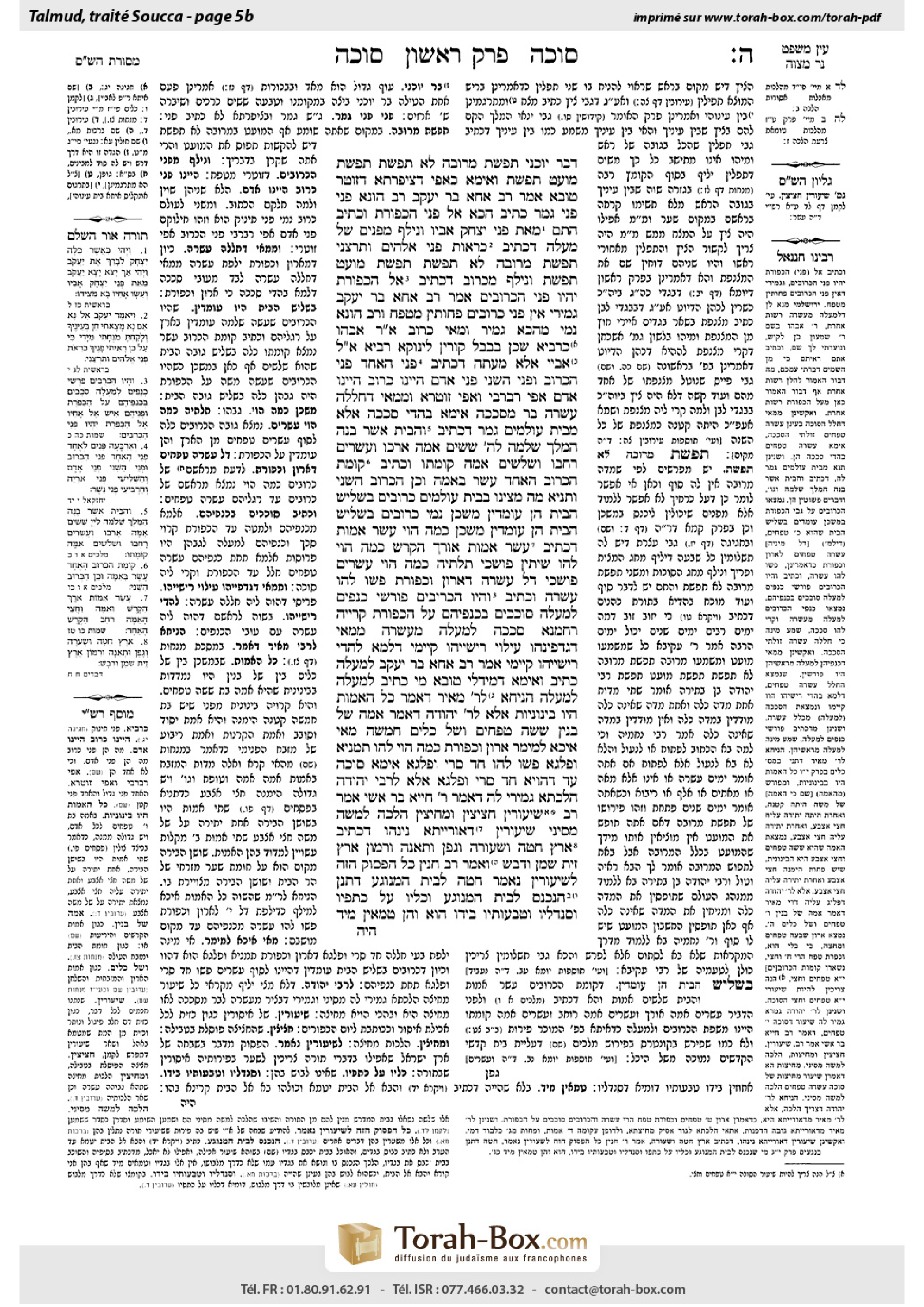
Sukkah 5b: Talmud study for Daf Yomi
Daf Yomi is the daily study of one Talmud folio. Explore 37 tractates with scans, Hebrew text, Sefaria English and AI-generated French translations where annotated.
Passage selection and English or AI-generated French translation are available where the scan has annotations. Daf Study is independent of Torah-Box and Sefaria.
Browse Sukkah · סוכה · All tractatesSukkah 5b text and translations
This page of Sukkah includes the Aramaic text, an English translation and an AI-generated French translation, alongside the scan above.
סוכה ה׳ ב · Aramaic and Hebrew text
דְּבַר יוֹכָנִי! תָּפַשְׂתָּ מְרוּבֶּה לֹא תָּפַשְׂתָּ, תָּפַשְׂתָּ מוּעָט תָּפַשְׂתָּ. וְאֵימָא כְּאַפֵּי דְּצִיפַּרְתָּא דְּזוּטַר טוּבָא! אֲמַר רַב אַחָא בַּר יַעֲקֹב: רַב הוּנָא ״פְּנֵי״ ״פְּנֵי״ גָּמַר. כְּתִיב הָכָא: ״אֶל פְּנֵי הַכַּפּוֹרֶת״, וּכְתִיב הָתָם: ״מֵאֵת פְּנֵי יִצְחָק אָבִיו״.
וְנֵילַף מִפָּנִים שֶׁל מַעְלָה, דִּכְתִיב: ״כִּרְאוֹת פְּנֵי אֱלֹהִים וַתִּרְצֵנִי״! תָּפַשְׂתָּ מְרוּבֶּה לֹא תָּפַשְׂתָּ, תָּפַשְׂתָּ מוּעָט תָּפַשְׂתָּ.
וְנֵילַף מִכְּרוּב, דִּכְתִיב: ״אֶל הַכַּפּוֹרֶת יִהְיוּ פְּנֵי הַכְּרוּבִים״!
אָמַר רַב אַחָא בַּר יַעֲקֹב: גְּמִירִי אֵין פְּנֵי כְרוּבִים פְּחוּתִין מִטֶּפַח, וְרַב הוּנָא נָמֵי מֵהָכָא גְּמִיר.
וּמַאי כְּרוּב? אָמַר רַבִּי אֲבָהוּ: כְּרָבְיָא, שֶׁכֵּן בְּבָבֶל קוֹרִין לְיָנוֹקָא רָבְיָא.
אֲמַר לֵיהּ אַבָּיֵי: אֶלָּא מֵעַתָּה, דִּכְתִיב: ״פְּנֵי הָאֶחָד פְּנֵי הַכְּרוּב וּפְנֵי הַשֵּׁנִי פְּנֵי אָדָם״, הַיְינוּ כְּרוּב הַיְינוּ אָדָם! אַפֵּי רַבְרְבֵי וְאַפֵּי זוּטְרֵי.
וּמִמַּאי דַּחֲלָלַהּ עֲשָׂרָה בַּר מִסְּכָכַהּ? אֵימָא בַּהֲדֵי סְכָכַהּ!
אֶלָּא מִבֵּית עוֹלָמִים גָּמַר, דִּכְתִיב: ״וְהַבַּיִת אֲשֶׁר בָּנָה הַמֶּלֶךְ שְׁלֹמֹה לַה׳ שִׁשִּׁים אַמָּה אׇרְכּוֹ וְעֶשְׂרִים רׇחְבּוֹ וּשְׁלֹשִׁים אַמָּה קוֹמָתוֹ״. וּכְתִיב: ״קוֹמַת הַכְּרוּב הָאֶחָד עֶשֶׂר בָּאַמָּה וְכֵן הַכְּרוּב הַשֵּׁנִי״, וְתַנְיָא: מָה מָצִינוּ בְּבֵית עוֹלָמִים כְּרוּבִים בִּשְׁלִישׁ הַבַּיִת הֵן עוֹמְדִין. מִשְׁכָּן נָמֵי — כְּרוּבִים שְׁלִישׁ הַבַּיִת הֵן עוֹמְדִין.
מִשְׁכָּן כַּמָּה הָוֵי — עֶשֶׂר אַמּוֹת, דִּכְתִיב: ״עֶשֶׂר אַמּוֹת אוֹרֶךְ הַקָּרֶשׁ״, כַּמָּה הָוֵי לְהוּ — שִׁיתִּין פּוּשְׁכֵי, תִּלְתֵּיהּ כַּמָּה הָוֵי — עֶשְׂרִים פּוּשְׁכֵי, דַּל עַשְׂרָה דְּאָרוֹן וְכַפּוֹרֶת, פָּשׁוּ לְהוּ עַשְׂרָה, וּכְתִיב: ״וְהָיוּ הַכְּרוּבִים פּוֹרְשֵׂי כְנָפַיִם לְמַעְלָה סוֹכְכִים בְּכַנְפֵיהֶם עַל הַכַּפּוֹרֶת״, קַרְיֵיהּ רַחֲמָנָא סְכָכָה לְמַעְלָה מֵעֲשָׂרָה.
מִמַּאי דְּגַדְּפִינְהוּ עִילָּוֵי רֵישַׁיְיהוּ קָיְימִי, דִּלְמָא לַהֲדֵי רֵישַׁיְיהוּ קָיְימִי! אָמַר רַב אַחָא בַּר יַעֲקֹב: ״לְמַעְלָה״ כְּתִיב. וְאֵימָא דְּמִידְּלֵי טוּבָא? מִי כְּתִיב ״לְמַעְלָה לְמַעְלָה״?
הָנִיחָא לְרַבִּי מֵאִיר, דְּאָמַר: כׇּל הָאַמּוֹת הָיוּ בֵּינוֹנִיּוֹת. אֶלָּא לְרַבִּי יְהוּדָה דְּאָמַר, אַמָּה שֶׁל בִּנְיָן שִׁשָּׁה טְפָחִים, וְשֶׁל כֵּלִים חֲמִשָּׁה — מַאי אִיכָּא לְמֵימַר?
אָרוֹן וְכַפּוֹרֶת כַּמָּה הָוֵי לְהוּ? תְּמָנְיָא וּפַלְגָא, פָּשׁוּ לְהוּ חַד סְרֵי וּפַלְגָא, אֵימָא סוּכָּה עַד דְּהָוְיָא חַד סְרֵי וּפַלְגָא!
אֶלָּא, לְרַבִּי יְהוּדָה הִלְכְתָא גְּמִירִי לַהּ. דְּאָמַר רַבִּי חִיָּיא בַּר אָשֵׁי אָמַר רַב: שִׁיעוּרִין, חֲצִיצִין, וּמְחִיצִין — הֲלָכָה לְמֹשֶׁה מִסִּינַי.
שִׁיעוּרִין דְּאוֹרָיְיתָא נִינְהוּ! דִּכְתִיב: ״אֶרֶץ חִטָּה וּשְׂעוֹרָה וְגֶפֶן וּתְאֵנָה וְרִמּוֹן אֶרֶץ זֵית שֶׁמֶן וּדְבָשׁ״, וְאָמַר רַב חָנִין: כׇּל הַפָּסוּק הַזֶּה לְשִׁיעוּרִין נֶאֱמַר!
חִטָּה — לְבַיִת הַמְנוּגָּע, דִּתְנַן: הַנִּכְנָס לְבַיִת הַמְּנוּגָּע וְכֵלָיו עַל כְּתֵפָיו, וְסַנְדָּלָיו וְטַבְּעוֹתָיו בְּיָדוֹ — הוּא וָהֵן טְמֵאִין מִיָּד.
Sukkah 5b · English translation
of a bird called bar Yokhani, whose face is significantly larger than a handbreadth? The Gemara rejects this suggestion: If you grasped many, you did not grasp anything; if you grasped few, you grasped something. The Gemara asks: If so, say that it is like the face of a bird, which is extremely small? Rav Aḥa bar Ya’akov said: Rav Huna derives that the thickness of the Ark cover was one handbreadth not through an actual comparison to the real faces of different creatures but rather by means of a verbal analogy between the terms penei and penei written in different places in the Torah. It is written here: “Before [penei] the Ark cover” (Leviticus 16:2), and it is written there: “From the presence of [penei] Isaac his father” (Genesis 27:30). The dimension of the Ark cover is like that of the face of a person, a handbreadth.
The Gemara suggests: And let us derive a verbal analogy from the face of God, as it is written: “For I have seen your face as one sees the face of [penei] God, and you were pleased with me” (Genesis 33:10). The term penei is used with regard to the face of God as well. The Gemara rejects this suggestion: If you grasped many, you did not grasp anything; if you grasped few, you grasped something.
The Gemara suggests: And let us derive a verbal analogy from the face of the cherub in the Tabernacle and the Temple, as it is written: “Toward the Ark cover shall be the faces of [penei] the cherubs” (Exodus 25:20), and their faces were presumably smaller than one handbreadth.
Rav Aḥa bar Ya’akov said: We have learned through tradition that the faces of the cherubs were not smaller than a handbreadth, and indeed Rav Huna derived the thickness of the Ark cover from here as well, i.e., from the verbal analogy between the instances of the word penei in the verses: “Upon the face of [penei] the Ark cover on the east” and: “The faces [penei] of the cherubs,” indicating that both are the same size.
Apropos the cherubs, the Gemara asks: And what is the form of the face of a cherub [keruv]? Rabbi Abbahu said: Like that of a child [keravya], as in Babylonia one calls a child ravya.
Abaye said to him: But if what you say is so, what is the meaning of that which is written about the faces of the celestial beasts drawing the celestial chariot: “The face of the first was the face of the cherub, and the face of the second was the face of a man” (Ezekiel 10:14)? According to your explanation, this face of the cherub is the same as that face of a man. The Gemara answers: Although two of the celestial beasts drawing that chariot had the face of a man, the difference between them is that one was a large face and one was a small face. In other words, the face described as the face of a man was the face of an adult, and the face described as the face of a cherub was that of a child. This is the source that the Ark and the Ark cover were ten handbreadths high.
However, with regard to the application of this measure to the halakhot of sukka, the Gemara asks: And from where is it derived that the interior space of the sukka must be ten handbreadths high without the thickness of the roofing? Say that the ten handbreadths of the sukka are with the thickness of the roofing. Just as the ten handbreadths of the Ark are measured from the bottom of the Ark to the top of the Ark cover, let the sukka be measured to the top of the roofing.
Rather, the dimension of the sukka is not derived from the Ark; one instead derived it from the dimensions of the eternal Temple, as it is written: “And the house which King Solomon built for the Lord, its length was sixty cubits, and its breadth twenty cubits, and its height thirty cubits” (I Kings 6:2). And it is written: “The height of the first cherub was ten cubits, and likewise was the second cherub” (I Kings 6:26). And it is taught in a baraita: Just as we find in the eternal Temple that the cherubs stand reaching one-third the height of the Temple, as each cherub was ten cubits high and the Temple was thirty cubits high, in the Tabernacle as well, the cherubs stand reaching one-third the height of the Tabernacle.
And to calculate: How many cubits high was the Tabernacle? It was ten cubits, as it is written: “Ten cubits shall be the length of a beam” (Exodus 26:16). How many handbreadths do these ten cubits contain? They contain sixty handbreadths. And one third of that total is how many? It is twenty handbreadths. Subtract from this figure ten handbreadths of the Ark and the Ark cover upon which the cherubs stood, and ten handbreadths remain, which was the height of each individual cherub. And it is written: “And the cherubs shall spread out their wings upward, screening [sokhekhim] the Ark cover with their wings” (Exodus 25:20). Here the Merciful One is referring to the wings using the terminology of roofing [sekhakha] specifically when they are ten handbreadths above the Ark cover. This is a source that the roofing of the sukka is placed at least ten handbreadths high.
The Gemara asks: And from where is it known that their wings were spread above their heads, from which it is derived that roofing is ten handbreadths high? Perhaps they were spread level with their heads. In that case, the ten handbreadths derived would include the roofing, leaving the interior space of the sukka less than ten handbreadths high. Rav Aḥa bar Ya’akov said that it is written: “Spread out their wings upward,” indicating that the wings were above their heads. The Gemara asks: If so, say that the wings were extremely high to an unspecified height. The Gemara answers: Does the verse say: Upward, upward? It says upward only once, meaning slightly over their heads. There is proof from the verses that the roofing was at least ten handbreadths off the ground.
The Gemara asks: This calculation works out well according to Rabbi Meir, who said that all the cubits in the Tabernacle and the Temple were intermediate cubits, consisting of six handbreadths; however, according to Rabbi Yehuda, who said that the cubit used in the dimensions of a building in the Temple was a cubit consisting of six handbreadths, but the cubit used in the dimensions of vessels was a cubit consisting of only five handbreadths, what is there to say?
Based on that calculation, how many handbreadths was the height of the Ark and the Ark cover? They totaled eight and a half handbreadths. The height of the Ark was one and a half cubits, which, based on a five-handbreadth cubit, equals seven and a half handbreadths. Including the additional handbreadth of the Ark cover, the total height is eight and a half handbreadths. If the cherubs were one third of the height of the Tabernacle, which is twenty handbreadths, eleven and a half handbreadths remain for the height of the cherubs, over which their wings were spread. Therefore, say that for a sukka to be fit for use its interior space must be eleven and a half handbreadths high. However, there is no recorded opinion that requires a sukka with that dimension.
Rather, according to Rabbi Yehuda, the Sages learned the minimum height of a sukka as a halakha transmitted to Moses from Sinai. As Rabbi Ḥiyya bar Ashi said that Rav said: The measures in various areas of halakha, e.g., olive-bulk, dried fig-bulk, egg-bulk, and the various halakhot of interpositions that serve as a barrier between one’s body and the water in a ritual bath and invalidate immersions, and the dimensions and nature of halakhic partitions are all halakhot transmitted to Moses from Sinai. They were not written in the Torah; rather, they were received in the framework of the Oral Law.
The Gemara questions this assertion: Are measures a halakha transmitted to Moses from Sinai? They are written in the Torah, as it is written: “A land of wheat, and barley, and vines, and figs, and pomegranates, a land of olive oil and honey” (Deuteronomy 8:8), and Rav Ḥanin said: This entire verse is stated for the purpose of teaching measures with regard to different halakhot in the Torah.
Wheat was mentioned as the basis for calculating the time required for one to become ritually impure when entering a house afflicted with leprosy, as we learned in a mishna: With regard to one who enters a house afflicted with leprosy of the house (see Leviticus, chapter 14), and his clothes are draped over his shoulders, and his sandals and his rings are in his hands, both he and they, the clothes, sandals, and rings, immediately become ritually impure.
Sukkah 5b · Traduction française (IA)
d’un oiseau appelé bar Yokhani, dont le visage est nettement plus grand qu’un téfaḥ ? La Guemara rejette cette suggestion : si l’on en saisit trop, on ne saisit rien ; si l’on en saisit peu, on saisit quelque chose. La Guemara demande : dans ce cas, disons que c’est comme le visage d’un oiseau, qui est extrêmement petit. Rav Aḥa bar Ya’akov dit : Rav Houna ne déduit pas que l’épaisseur du couvercle de l’Arche était d’un téfaḥ en comparant réellement les visages de différentes créatures, mais au moyen d’une analogie verbale entre les termes penei et penei employés en différents endroits de la Torah. Il est écrit ici : « Devant [penei] le couvercle de l’Arche » (Lévitique 16, 2), et il est écrit ailleurs : « Dès qu’il eut quitté la présence [penei] d’Isaac, son père » (Genèse 27, 30). La dimension du couvercle de l’Arche est donc celle du visage d’une personne, soit un téfaḥ.
La Guemara suggère : déduisons-le du visage de Dieu, puisqu’il est écrit : « Car j’ai vu ton visage comme on voit le visage [penei] de Dieu, et tu m’as accueilli favorablement » (Genèse 33, 10). Le terme penei est également employé à propos du visage de Dieu. La Guemara rejette cette suggestion : si l’on en saisit trop, on ne saisit rien ; si l’on en saisit peu, on saisit quelque chose.
La Guemara suggère : déduisons-le du visage du chérubin dans le Tabernacle et le Temple, puisqu’il est écrit : « Les faces [penei] des chérubins seront tournées vers le couvercle de l’Arche » (Exode 25, 20), et leurs visages étaient, semble-t-il, plus petits qu’un téfaḥ.
Rav Aḥa bar Ya’akov dit : nous avons appris par tradition que les visages des chérubins ne mesuraient pas moins d’un téfaḥ. De fait, Rav Houna a également déduit l’épaisseur du couvercle de l’Arche de ce passage, c’est-à-dire de l’analogie verbale entre les occurrences du mot penei dans les versets « sur la face [penei] du couvercle de l’Arche, à l’est » et « les faces [penei] des chérubins », ce qui indique que les deux ont la même dimension.
À propos des chérubins, la Guemara demande : quelle était la forme du visage d’un chérubin [keruv] ? Rabbi Abbahou dit : celle d’un enfant [keravya], car en Babylonie, on appelle un enfant ravya.
Abayé lui dit : mais si ce que tu dis est vrai, que signifie ce qui est écrit au sujet des faces des créatures célestes qui tirent le char céleste : « La face de la première était la face du chérubin, et la face de la seconde était la face d’un homme » (Ézéchiel 10, 14) ? Selon ton explication, cette face du chérubin est la même que cette face d’un homme. La Guemara répond : bien que deux des créatures célestes qui tirent ce char aient eu une face humaine, la différence entre elles est que l’une avait un grand visage et l’autre un petit visage. Autrement dit, le visage décrit comme celui d’un homme était celui d’un adulte, et celui décrit comme celui d’un chérubin était celui d’un enfant. C’est de là que l’on apprend que l’Arche et son couvercle avaient une hauteur de dix téfaḥim.
Cependant, quant à l’application de cette mesure aux halakhot de la soukka, la Guemara demande : d’où déduit-on que l’espace intérieur de la soukka doit mesurer dix téfaḥim de hauteur, sans compter l’épaisseur du toit ? Disons que les dix téfaḥim de la soukka incluent l’épaisseur du toit. De même que les dix téfaḥim de l’Arche se mesurent depuis le fond de l’Arche jusqu’au sommet de son couvercle, mesurons la soukka jusqu’au sommet de son toit.
Mais la dimension de la soukka ne se déduit pas de l’Arche ; on la déduit plutôt des dimensions du Temple éternel, comme il est écrit : « La maison que le roi Salomon bâtit pour le Seigneur avait soixante coudées de longueur, vingt coudées de largeur et trente coudées de hauteur » (I Rois 6, 2). Et il est écrit : « Le premier chérubin avait dix coudées de hauteur, et le second également » (I Rois 6, 26). Et une baraïta enseigne : de même que l’on constate dans le Temple éternel que les chérubins atteignent le tiers de la hauteur du Temple, puisque chaque chérubin mesurait dix coudées et que le Temple en mesurait trente, de même, dans le Tabernacle, les chérubins atteignent le tiers de sa hauteur.
Calculons : quelle était la hauteur du Tabernacle en coudées ? Dix coudées, comme il est écrit : « Une poutre aura dix coudées de longueur » (Exode 26, 16). Combien de téfaḥim ces dix coudées comprennent-elles ? Elles en comprennent soixante. Combien en représente le tiers ? Vingt téfaḥim. Retranchons de ce chiffre les dix téfaḥim de l’Arche et de son couvercle, sur lequel se tenaient les chérubins : il reste dix téfaḥim, soit la hauteur de chacun des chérubins. Et il est écrit : « Les chérubins déploieront leurs ailes vers le haut, couvrant [sokhekhim] le couvercle de l’Arche de leurs ailes » (Exode 25, 20). Ici, le Miséricordieux désigne les ailes par le terme évoquant le toit [sekhakha] précisément lorsqu’elles se trouvent à dix téfaḥim au-dessus du couvercle de l’Arche. C’est une source indiquant que le toit de la soukka doit être placé à au moins dix téfaḥim de hauteur.
La Guemara demande : d’où sait-on que leurs ailes étaient déployées au-dessus de leurs têtes, ce qui permet de déduire que le toit se trouve à dix téfaḥim de hauteur ? Peut-être étaient-elles déployées à la hauteur de leur tête. Dans ce cas, les dix téfaḥim déduits incluraient le toit, et l’espace intérieur de la soukka mesurerait moins de dix téfaḥim de hauteur. Rav Aḥa bar Ya’akov dit qu’il est écrit : « Ils déploieront leurs ailes vers le haut », ce qui indique que les ailes étaient au-dessus de leurs têtes. La Guemara demande : dans ce cas, disons que les ailes étaient très haut, à une hauteur indéterminée. La Guemara répond : le verset dit-il « vers le haut, vers le haut » ? Il dit « vers le haut » une seule fois, ce qui signifie légèrement au-dessus de leurs têtes. Les versets prouvent donc que le toit se trouvait à au moins dix téfaḥim du sol.
La Guemara demande : ce calcul est cohérent selon Rabbi Meïr, qui dit que toutes les coudées du Tabernacle et du Temple étaient des coudées intermédiaires, comptant six téfaḥim ; mais, selon Rabbi Yehouda, qui dit que la coudée employée pour les dimensions d’un bâtiment du Temple comptait six téfaḥim, tandis que celle employée pour les dimensions des ustensiles n’en comptait que cinq, que peut-on répondre ?
Selon ce calcul, quelle était la hauteur de l’Arche et de son couvercle en téfaḥim ? Leur hauteur totale était de huit téfaḥim et demi. L’Arche mesurait une coudée et demie de hauteur, ce qui, avec une coudée de cinq téfaḥim, équivaut à sept téfaḥim et demi. En ajoutant le téfaḥ supplémentaire du couvercle de l’Arche, la hauteur totale est de huit téfaḥim et demi. Si les chérubins mesuraient un tiers de la hauteur du Tabernacle, soit vingt téfaḥim, il reste onze téfaḥim et demi pour leur hauteur, au-dessus desquels leurs ailes étaient déployées. Il faut donc dire que, pour qu’une soukka soit apte à l’usage, son espace intérieur doit mesurer onze téfaḥim et demi de hauteur. Or, aucune opinion consignée n’exige une soukka de cette dimension.
Mais, selon Rabbi Yehouda, les Sages ont appris que la hauteur minimale d’une soukka est une halakha transmise à Moïse au Sinaï. Car Rabbi Ḥiyya bar Ashi a dit au nom de Rav : les mesures dans différents domaines de la halakha — par exemple le volume d’une olive, celui d’une figue sèche et celui d’un œuf —, les différentes halakhot relatives aux interpositions qui font écran entre le corps d’une personne et l’eau d’un bain rituel et invalident les immersions, ainsi que les dimensions et la nature des cloisons halakhiques, sont toutes des halakhot transmises à Moïse au Sinaï. Elles ne sont pas écrites dans la Torah ; elles ont été reçues dans le cadre de la Torah orale.
La Guemara met cette affirmation en question : les mesures sont-elles une halakha transmise à Moïse au Sinaï ? Elles sont écrites dans la Torah, comme il est écrit : « Un pays de blé, d’orge, de vigne, de figues et de grenades, un pays d’oliviers à huile et de miel » (Deutéronome 8, 8). Et Rav Ḥanin a dit que ce verset tout entier a été énoncé afin d’enseigner les mesures applicables à différentes halakhot de la Torah.
Le blé a été mentionné comme base du calcul du temps nécessaire pour qu’une personne devienne rituellement impure en entrant dans une maison atteinte de lèpre, comme nous l’avons appris dans une Michna : à propos de celui qui entre dans une maison atteinte de lèpre (voir Lévitique, chapitre 14), avec ses vêtements posés sur les épaules et ses sandales et ses bagues dans les mains, lui-même et ces objets — vêtements, sandales et bagues — deviennent immédiatement rituellement impurs.
Traduction française générée par IA à partir de l’édition anglaise de Sefaria. Vérifie toujours un passage avec le texte source.
Text from Sefaria: William Davidson Edition - Vocalized Aramaic (CC BY NC); William Davidson Edition - English (CC BY NC).