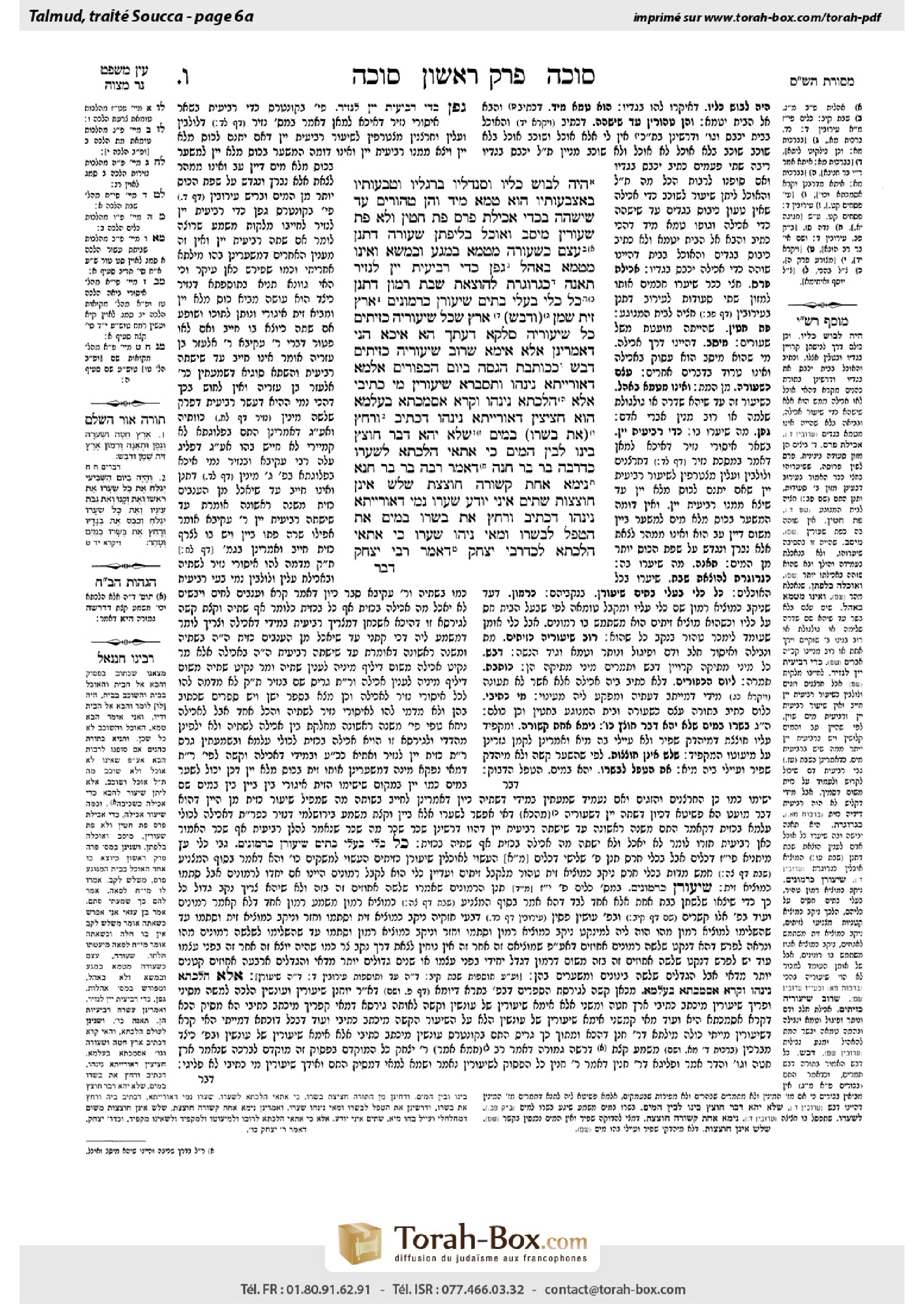
Sukkah 6a: Talmud study for Daf Yomi
Daf Yomi is the daily study of one Talmud folio. Explore 37 tractates with scans, Hebrew text, Sefaria English and AI-generated French translations where annotated.
Passage selection and English or AI-generated French translation are available where the scan has annotations. Daf Study is independent of Torah-Box and Sefaria.
Browse Sukkah · סוכה · All tractatesSukkah 6a text and translations
This page of Sukkah includes the Aramaic text, an English translation and an AI-generated French translation, alongside the scan above.
סוכה ו׳ א · Aramaic and Hebrew text
הָיָה לָבוּשׁ כֵּלָיו וְסַנְדָּלָיו בְּרַגְלָיו וְטַבְּעוֹתָיו בְּאֶצְבְּעוֹתָיו — הוּא טָמֵא מִיָּד, וְהֵן טְהוֹרִים עַד שֶׁיִּשְׁהֶה בִּכְדֵי אֲכִילַת פְּרָס, פַּת חִטִּין וְלֹא פַּת שְׂעוֹרִין, מֵיסֵב וְאוֹכֵל בְּלִיפְתָּן.
שְׂעוֹרָה — דִּתְנַן: עֶצֶם כִּשְׂעוֹרָה — מְטַמֵּא בְּמַגָּע וּבְמַשָּׂא, וְאֵינוֹ מְטַמֵּא בְּאֹהֶל.
גֶּפֶן — כְּדֵי רְבִיעִית יַיִן לְנָזִיר.
תְּאֵנָה — כִּגְרוֹגֶרֶת לְהוֹצָאַת שַׁבָּת.
רִמּוֹן — דִּתְנַן: כָּל כְּלֵי בַּעֲלֵי בָתִּים — שִׁיעוּרָן כְּרִמּוֹנִים.
״אֶרֶץ זֵית שֶׁמֶן (וּדְבָשׁ)״ — אֶרֶץ שֶׁכׇּל שִׁיעוּרֶיהָ כְּזֵיתִים. ״כָּל שִׁיעוּרֶיהָ״ סָלְקָא דַּעְתָּךְ?! הָא אִיכָּא הָנֵי דְּאָמְרִינַן! אֶלָּא אֵימָא: שֶׁרוֹב שִׁיעוּרֶיהָ כְּזֵיתִים.
דְּבָשׁ — כְּכוֹתֶבֶת הַגַּסָּה בְּיוֹם הַכִּפּוּרִים.
אַלְמָא דְּאוֹרָיְיתָא נִינְהוּ! וְתִסְבְּרָא? שִׁיעוּרִין מִי כְּתִיבִי? אֶלָּא הִלְכְתָא נִינְהוּ, וּקְרָא אַסְמַכְתָּא בְּעָלְמָא הוּא.
חֲצִיצִין דְּאוֹרָיְיתָא נִינְהוּ! דִּכְתִיב: ״וְרָחַץ (אֶת בְּשָׂרוֹ) בַּמַּיִם״, שֶׁלֹּא יְהֵא דָּבָר חוֹצֵץ בֵּינוֹ לְבֵין הַמַּיִם!
כִּי אֲתַאי הִלְכְתָא — לִשְׂעָרוֹ, כִּדְרַבָּה בַּר בַּר חָנָה. דְּאָמַר רַבָּה בַּר בַּר חָנָא: נִימָא אַחַת קְשׁוּרָה — חוֹצֶצֶת, שָׁלֹשׁ — אֵינָן חוֹצְצוֹת, שְׁתַּיִם — אֵינִי יוֹדֵעַ.
שְׂעָרוֹ נָמֵי דְּאוֹרָיְיתָא נִינְהוּ, דִּכְתִיב: ״וְרָחַץ אֶת בְּשָׂרוֹ בַּמַּיִם״, אֶת הַטָּפֵל לִבְשָׂרוֹ, וּמַאי נִיהוּ — שְׂעָרוֹ!
כִּי אֲתַאי הִלְכְתָא, לְכִדְרַבִּי יִצְחָק. דְּאָמַר רַבִּי יִצְחָק:
Sukkah 6a · English translation
However, if he was dressed in his clothes, and his sandals were on his feet, and his rings were on his fingers, he immediately becomes ritually impure, but they, the clothes, sandals, and rings, remain pure until he stays in the house long enough to eat half a loaf of bread. This calculation is based on wheat bread, which takes less time to eat, and not on barley bread, and it relates to one who is reclining and eating it together with relish or a condiment, which hastens the eating. This is a Torah measurement connected specifically to wheat.
Barley is also used as a basis for measurements, as we learned in a mishna: A bone from a corpse the size of a grain of barley imparts ritual impurity through contact and by being carried, but it does not impart impurity by means of a tent, i.e., if the bone was inside a house, it does not render all the articles in the house ritually impure.
The halakhic measure determined by a vine is the quantity of a quarter-log of wine for a nazirite. A nazirite, for whom it is prohibited to drink wine, is liable to be flogged if he drinks that measure.
Fig alludes to the measure of a dried fig-bulk with regard to the halakhot of carrying out on Shabbat. One is liable for carrying food fit for human consumption on Shabbat, provided that he carries a dried fig-bulk of that food.
Pomegranate teaches the following measure, as we learned in a mishna: All ritually impure wooden vessels belonging to ordinary homeowners become pure through being broken, as broken vessels cannot contract or maintain ritual impurity. They are considered broken if they have holes the size of pomegranates.
The Sages interpreted: “A land of olive oil and honey,” as: A land, all of whose measures are olive-bulks. The Gemara poses a question: Does it enter your mind that it is a land all of whose measures are olive-bulks? But aren’t there those measures that we just mentioned above, which are not olive-bulks? Rather, say: A land, most of whose measures are olive-bulks, as most measures relating to forbidden foods, e.g., fats, blood, piggul, leftover sacrificial flesh, ritually impure food, and the sciatic nerve, are olive-bulks, as are the measures for a corpse to transmit impurity in a tent and for an animal carcass to transmit impurity through contact.
Honey, i.e., dates from which date honey is extracted, also determines a measure, as with regard to eating on Yom Kippur, one is liable only if he eats a large date-bulk of food.
Apparently, all these halakhic measurements are derived from this verse in the Torah and are not halakhot transmitted to Moses from Sinai. The Gemara refutes this argument: And how can you understand it in that manner that all these measures are explicitly written in the Torah with regard to each of the halakhot mentioned above? Rather, they are halakhot that were transmitted to Moses from Sinai, and the verse cited is mere support for these halakhot, not a source.
Rabbi Ḥiyya bar Ashi said earlier that Rav said that the halakhot governing interpositions that invalidate ritual immersion are halakhot transmitted to Moses from Sinai. The Gemara challenges this assertion: These, too, are written in the Torah, as it is written: “And he shall bathe his flesh in the water” (Leviticus 14:9), and the Sages derived that nothing should interpose between his flesh and the water. Apparently, the halakhot of interposition are derived from a verse in the Torah and not through oral tradition.
The Gemara answers: When the halakha transmitted to Moses comes to teach, it is not with regard to an interposition on one’s skin, which is indeed derived from verses in the Torah. Rather, it comes to teach that an interposition in one’s hair invalidates the immersion, in accordance with the opinion of Rabba bar bar Ḥana, as Rabba bar bar Ḥana said: A single hair [nima] tied in a knot interposes and invalidates the immersion. Three hairs tied together in a knot do not interpose, because three hairs cannot be tied so tightly that water cannot penetrate them. With regard to two hairs tied together in a knot, I do not know the halakha. This halakha with regard to hair is a halakha transmitted to Moses from Sinai.
The Gemara raises a difficulty: The halakha with regard to one’s hair is also written in the Torah, as it is taught in a baraita with regard to that which is written: “And he shall bathe [et besaro] his flesh in the water.” The superfluous word et comes to include that which is subordinate to his flesh, and what is that? That is his hair. The fact that, like the body, there can be no interposition between one’s hair and the water is also derived from a verse.
The Gemara answers: When the halakha transmitted to Moses from Sinai comes to teach, it is not with regard to an interposition in one’s hair, which is indeed derived from a verse in the Torah. Rather, it comes to teach in accordance with the statement of Rabbi Yitzḥak, as Rabbi Yitzḥak said:
Sukkah 6a · Traduction française (IA)
Cependant, s’il était habillé, qu’il avait ses sandales aux pieds et des bagues aux doigts, il devient immédiatement impur, tandis que ses vêtements, ses sandales et ses bagues restent purs jusqu’à ce qu’il séjourne dans la maison assez longtemps pour manger la moitié d’un pain. Ce calcul se fonde sur du pain de blé, qui se mange plus vite que du pain d’orge, et concerne quelqu’un qui est allongé et le mange avec un mets ou un condiment, ce qui accélère le repas. Il s’agit d’une mesure de la Torah spécifiquement liée au blé.
L’orge sert elle aussi de base à des mesures, comme nous l’avons appris dans une Michna : un os provenant d’un cadavre, de la taille d’un grain d’orge, transmet l’impureté rituelle par contact et par portage, mais ne la transmet pas par l’intermédiaire d’une tente ; autrement dit, si l’os se trouve à l’intérieur d’une maison, il ne rend pas rituellement impurs tous les objets qui s’y trouvent.
La mesure halakhique déterminée par la vigne est celle d’un quart de log de vin pour un nazir. Un nazir, à qui il est interdit de boire du vin, est passible de la flagellation s’il boit cette quantité.
La figue renvoie à la mesure du volume d’une figue sèche pour les halakhot relatives au transport pendant Chabbat. On est passible d’une sanction pour avoir transporté pendant Chabbat un aliment propre à la consommation humaine, à condition d’en avoir transporté le volume d’une figue sèche.
La grenade enseigne la mesure suivante, comme nous l’avons appris dans une Michna : tous les récipients en bois rituellement impurs appartenant à des particuliers deviennent purs lorsqu’ils sont brisés, car des récipients brisés ne peuvent ni contracter ni conserver l’impureté rituelle. Ils sont considérés comme brisés s’ils comportent des trous de la taille d’une grenade.
Les Sages ont interprété « un pays d’huile d’olive et de miel » ainsi : un pays dont toutes les mesures sont des volumes d’olive. La Guemara soulève une question : Peut-on vraiment penser qu’il s’agit d’un pays dont toutes les mesures sont des volumes d’olive ? Pourtant, parmi les mesures que nous venons de mentionner, certaines ne sont-elles pas des volumes d’olive ? Il faut plutôt dire : un pays dont la plupart des mesures sont des volumes d’olive, car la plupart des mesures concernant les aliments interdits — par exemple les graisses, le sang, le piggoul, les restes de chair sacrificielle, les aliments rituellement impurs et le nerf sciatique — sont des volumes d’olive, tout comme les mesures requises pour qu’un cadavre transmette l’impureté sous une tente et pour qu’une carcasse d’animal transmette l’impureté par contact.
Le miel, c’est-à-dire les dattes dont on extrait le miel de dattes, détermine lui aussi une mesure : pour la consommation à Yom Kippour, on n’est passible d’une sanction que si l’on mange un volume équivalant à celui d’une grosse datte.
Il semble donc que toutes ces mesures halakhiques soient déduites de ce verset de la Torah et ne soient pas des halakhot transmises à Moïse depuis le Sinaï. La Guemara réfute cet argument : comment peut-on comprendre que toutes ces mesures soient explicitement écrites dans la Torah pour chacune des halakhot mentionnées plus haut ? Il faut plutôt dire qu’il s’agit de halakhot transmises à Moïse depuis le Sinaï et que le verset cité n’est qu’un appui à ces halakhot, non leur source.
Rabbi Ḥiyya bar Ashi a dit plus haut que Rav a enseigné que les halakhot régissant les interpositions qui invalident l’immersion rituelle sont des halakhot transmises à Moïse depuis le Sinaï. La Guemara conteste cette affirmation : celles-ci aussi sont écrites dans la Torah, comme il est écrit : « Il baignera son corps dans l’eau » (Lévitique 14,9), et les Sages en ont déduit que rien ne doit s’interposer entre son corps et l’eau. Il semble donc que les halakhot concernant les interpositions soient déduites d’un verset de la Torah et non transmises par la tradition orale.
La Guemara répond : la halakha transmise à Moïse ne vient pas enseigner qu’une interposition sur la peau invalide l’immersion, car cela est effectivement déduit de versets de la Torah. Elle vient plutôt enseigner qu’une interposition dans les cheveux invalide l’immersion, conformément à l’avis de Rabba bar bar Ḥana. En effet, Rabba bar bar Ḥana a dit : un seul cheveu [nima] noué constitue une interposition et invalide l’immersion. Trois cheveux noués ensemble ne constituent pas une interposition, car il est impossible de les nouer si serrés que l’eau ne puisse pas y pénétrer. Quant à deux cheveux noués ensemble, j’ignore quelle est la halakha. Cette halakha concernant les cheveux est une halakha transmise à Moïse depuis le Sinaï.
La Guemara soulève une difficulté : la halakha concernant les cheveux est elle aussi écrite dans la Torah, comme l’enseigne une baraïta à propos de ce qui est écrit : « Il baignera [et besaro] son corps dans l’eau. » Le mot superflu et vient inclure ce qui est subordonné à son corps ; de quoi s’agit-il ? De ses cheveux. Le fait que, comme pour le corps, rien ne puisse s’interposer entre ses cheveux et l’eau est donc lui aussi déduit d’un verset.
La Guemara répond : la halakha transmise à Moïse depuis le Sinaï ne vient pas enseigner qu’une interposition dans les cheveux invalide l’immersion, car cela est effectivement déduit d’un verset de la Torah. Elle vient plutôt enseigner conformément à la déclaration de Rabbi Yitzḥak, car Rabbi Yitzḥak a dit :
Traduction française générée par IA à partir de l’édition anglaise de Sefaria. Vérifie toujours un passage avec le texte source.
Text from Sefaria: William Davidson Edition - Vocalized Aramaic (CC BY NC); William Davidson Edition - English (CC BY NC).