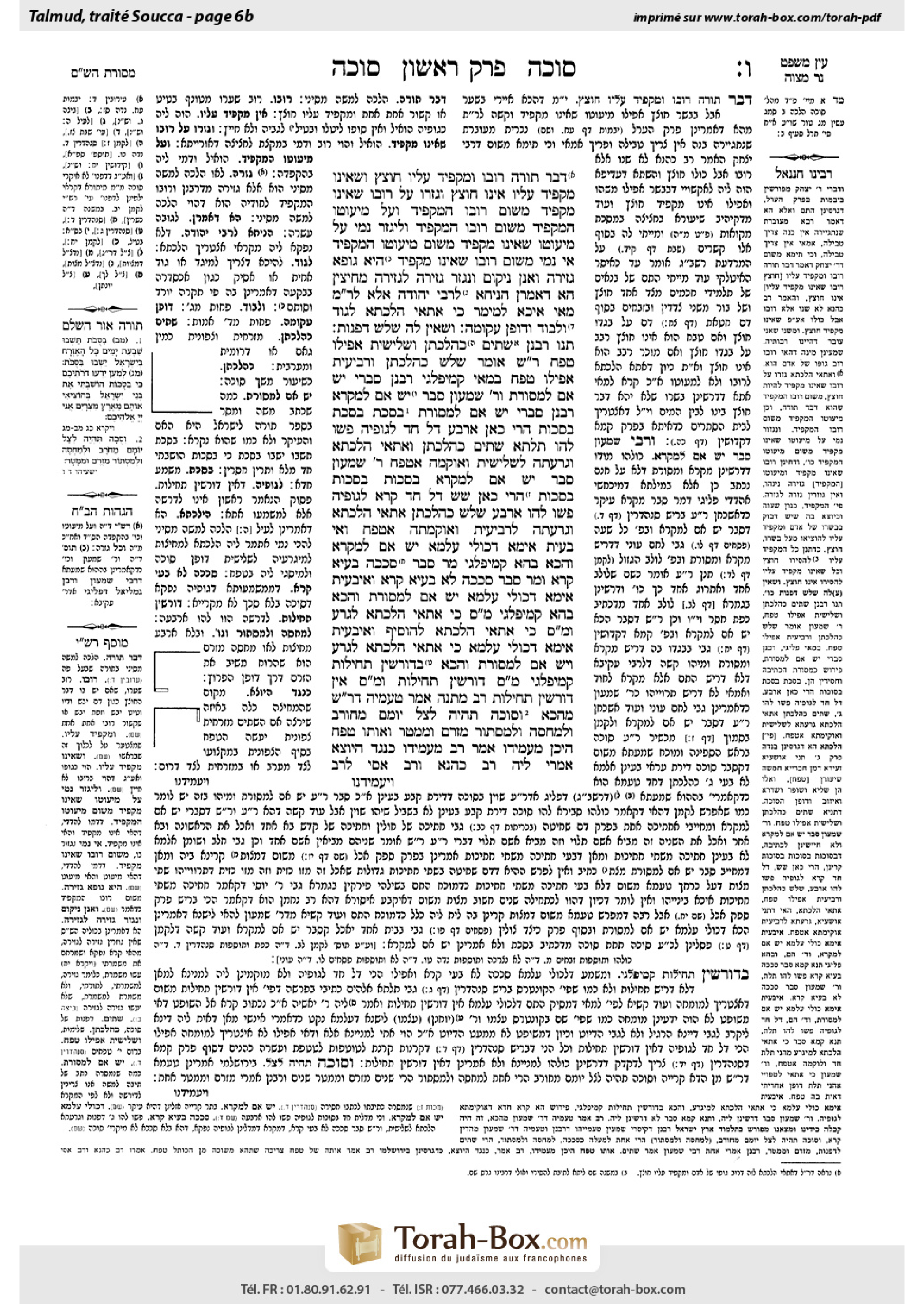
Sukkah 6b: Talmud study for Daf Yomi
Daf Yomi is the daily study of one Talmud folio. Explore 37 tractates with scans, Hebrew text, Sefaria English and AI-generated French translations where annotated.
Passage selection and English or AI-generated French translation are available where the scan has annotations. Daf Study is independent of Torah-Box and Sefaria.
Browse Sukkah · סוכה · All tractatesSukkah 6b text and translations
This page of Sukkah includes the Aramaic text, an English translation and an AI-generated French translation, alongside the scan above.
סוכה ו׳ ב · Aramaic and Hebrew text
דְּבַר תּוֹרָה, רוּבּוֹ וּמַקְפִּיד עָלָיו — חוֹצֵץ, וְשֶׁאֵינוֹ מַקְפִּיד עָלָיו — אֵינוֹ חוֹצֵץ. וְגָזְרוּ עַל רוּבּוֹ שֶׁאֵינוֹ מַקְפִּיד מִשּׁוּם רוּבּוֹ הַמַּקְפִּיד, וְעַל מִיעוּטוֹ הַמַּקְפִּיד מִשּׁוּם רוּבּוֹ הַמַּקְפִּיד.
וְלִיגְזַר נָמֵי עַל מִיעוּטוֹ שֶׁאֵינוֹ מַקְפִּיד מִשּׁוּם מִיעוּטוֹ הַמַּקְפִּיד, אִי נָמֵי מִשּׁוּם רוּבּוֹ שֶׁאֵינוֹ מַקְפִּיד!
הִיא גּוּפָא גְּזֵירָה, וַאֲנַן נֵיקוּם וְנִגְזֹר גְּזֵירָה לִגְזֵירָה?!
מְחִיצִין — הָא דַּאֲמַרַן. הָנִיחָא לְרַבִּי יְהוּדָה, אֶלָּא לְרַבִּי מֵאִיר — מַאי אִיכָּא לְמֵימַר?
כִּי אֲתַאי הִלְכְתָא — לְגוּד, וְלָבוּד, וְדוֹפֶן עֲקוּמָּה.
וְשֶׁאֵין לָהּ שָׁלֹשׁ דְּפָנוֹת.
תָּנוּ רַבָּנַן: שְׁתַּיִם כְּהִלְכָתָן, וּשְׁלִישִׁית אֲפִילּוּ טֶפַח. רַבִּי שִׁמְעוֹן אוֹמֵר: שָׁלֹשׁ כְּהִלְכָתָן, וּרְבִיעִית אֲפִילּוּ טֶפַח.
בְּמַאי קָמִיפַּלְגִי? רַבָּנַן סָבְרִי: יֵשׁ אֵם לַמָּסוֹרֶת, וְרַבִּי שִׁמְעוֹן סָבַר: יֵשׁ אֵם לַמִּקְרָא.
רַבָּנַן סָבְרִי: יֵשׁ אֵם לַמָּסוֹרֶת, ״בְּסֻכַּת״ ״בְּסֻכַּת״ ״בַּסֻּכּוֹת״ — הֲרֵי כָּאן אַרְבַּע.
דַּל חַד לְגוּפֵיהּ, פָּשׁוּ לְהוּ תְּלָתָא. שְׁתַּיִם כְּהִלְכָתָן, וַאֲתַאי הִלְכְתָא וּגְרַעְתַּהּ לִשְׁלִישִׁית וְאוֹקֵמְתַּהּ אַטֶּפַח.
רַבִּי שִׁמְעוֹן סָבַר: יֵשׁ אֵם לַמִּקְרָא, ״בַּסֻּכּוֹת״ ״בַּסֻּכּוֹת״ ״בַּסֻּכּוֹת״ — הֲרֵי כָּאן שֵׁשׁ, דַּל חַד קְרָא לְגוּפֵיהּ, פָּשׁוּ לְהוּ אַרְבַּע. שָׁלֹשׁ כְּהִלְכָתָן, אֲתַאי הִלְכְתָא וּגְרַעְתַּהּ לִרְבִיעִית וְאוֹקֵמְתַּהּ אַטֶּפַח.
וְאִי בָּעֵית אֵימָא: דְּכוּלֵּי עָלְמָא יֵשׁ אֵם לַמִּקְרָא, וְהָכָא בְּהָא קָמִיפַּלְגִי: מָר סָבַר: סְכָכָה בָּעֲיָא קְרָא, וּמָר סָבַר: סְכָכָה לָא בָּעֲיָא קְרָא.
וְאִיבָּעֵית אֵימָא: דְּכוּלֵּי עָלְמָא יֵשׁ אֵם לַמָּסוֹרֶת, וְהָכָא בְּהָא קָמִיפַּלְגִי: מָר סָבַר: כִּי אֲתַאי הִלְכְתָא — לְגָרֵעַ. וּמָר סָבַר: כִּי אֲתַאי הִלְכְתָא — לְהוֹסִיף.
וְאִיבָּעֵית אֵימָא: דְּכוּלֵּי עָלְמָא, כִּי אֲתַאי הִלְכְתָא — לְגָרֵעַ, וְיֵשׁ אֵם לַמָּסוֹרֶת. וְהָכָא בְּדוֹרְשִׁין תְּחִילּוֹת קָמִיפַּלְגִי: מָר סָבַר: דּוֹרְשִׁין תְּחִילּוֹת, וּמַר סָבַר: אֵין דּוֹרְשִׁין תְּחִילּוֹת.
רַב מַתְנָה אָמַר: טַעְמֵיהּ דְּרַבִּי שִׁמְעוֹן מֵהָכָא: ״וְסוּכָּה תִּהְיֶה לְצֵל יוֹמָם מֵחוֹרֶב וּלְמַחְסֶה וּלְמִסְתּוֹר מִזֶּרֶם וּמִמָּטָר״.
וְאוֹתוֹ טֶפַח הֵיכָן מַעֲמִידוֹ? אָמַר רַב: מַעֲמִידוֹ כְּנֶגֶד הַיּוֹצֵא.
אָמְרִי לֵיהּ רַב כָּהֲנָא וְרַב אַסִּי לְרַב:
Sukkah 6b · English translation
By Torah law, if there is an interposition between a person and the water, and it covers the majority of his body, and he is particular about it and wants the interposing substance removed, only then is it considered an interposition that invalidates immersion in a ritual bath. However, if he is not particular about that substance, it is not considered an interposition. The Sages, however, issued a decree that it is prohibited to immerse with a substance covering the majority of one’s body with regard to which he is not particular, due to substances covering the majority of one’s body with regard to which he is particular. And, they issued a decree that it is prohibited to immerse with a substance covering the minority of his body with regard to which one is particular, due to substances covering the majority of his body with regard to which one is particular.
The Gemara raises a question: Then let us also issue a decree deeming substances covering the minority of one’s body with regard to which he is not particular an interposition, due to substances covering the minority of his body with regard to which he is particular, or alternatively, due to substances covering the majority of his body with regard to which he is not particular.
The Gemara answers: We do not issue that decree because the halakha that deems both an interposition covering the minority of his body about which one is particular and an interposition covering the majority of his body about which one is not particular an interposition is itself a decree. Shall we then arise and issue one decree to prevent violation of another decree? In any case, these details with regard to interpositions are neither written nor alluded to in the Torah; rather, they are halakhot transmitted to Moses from Sinai.
The halakha transmitted to Moses from Sinai that the minimum height for partitions is ten handbreadths is as we stated earlier. The Gemara asks: This works out well according to the opinion of Rabbi Yehuda, who holds that there is no verse in the Torah from which this halakha can be derived, as he therefore concludes that it is a halakha transmitted to Moses from Sinai. However, according to Rabbi Meir, who holds that all of the cubits in the Temple consist of six handbreadths and therefore the measure of ten handbreadths can be derived from verses in the Torah, what is there to say? What is the halakha transmitted to Moses from Sinai with regard to partitions?
When the halakha transmitted to Moses comes to teach, it is with regard to other halakhot concerning partitions, e.g., the halakhot of extending [gode], according to which an existing partition is extended upward or downward to complete the requisite measure; and the halakhot of joining [lavud], according to which two solid surfaces are joined if they are separated by a gap of less than three handbreadths; and the halakhot of a curved wall of a sukka. A sukka is fit even if there are up to four cubits of unfit roofing, provided that this roofing is adjacent to one of the walls of the sukka. In that case, the unfit roofing is considered a bent extension of the wall. These concepts are certainly not written in the Torah.
§ Among the factors listed in the mishna that render a sukka unfit is: And one that does not have three walls.
The Sages taught in the Tosefta: In order to construct a fit sukka, two of the walls must be walls in the standard sense, sealing the entire length and height of the sukka, and the third wall may be even one handbreadth long. Rabbi Shimon says: Three of the walls must be walls in the standard sense, and the fourth wall may be even one handbreadth long.
The Gemara asks: With regard to what principle do they disagree? The Rabbis hold: The tradition of the manner in which the verses in the Torah are written is authoritative, and one derives halakhot based on the spelling of the words. And Rabbi Shimon holds: The vocalization of the Torah is authoritative, meaning that one derives halakhot based on the pronunciation of the words, although it diverges from the spelling.
With regard to sukka, the Rabbis hold: The tradition of the verses is authoritative, as the word basukkot is written three times in the context of the mitzva of sukka. It is written twice in the verse: “In sukkot [basukkot] shall you reside seven days; all that are home-born in Israel shall reside in sukkot [basukkot]” (Leviticus 23:42). In both of these instances, the word in Hebrew is spelled without a vav, as are Hebrew words in the singular. And one time it is written with a vav, as are Hebrew words in the plural: “So that your future generations will know that I caused the children of Israel to reside in sukkot [basukkot]” (Leviticus 23:43). There is mention here of sukka four times, two singular plus one plural hinted at here in these verses.
Subtract one to teach the mitzva of sukka itself, and three remain. These three remaining sukkot teach that the sukka requires three walls; two of the three are walls in the standard sense, and the halakha transmitted to Moses from Sinai comes and reduces the dimension of the third and establishes it as one handbreadth. That tradition teaches that one wall need not be any longer than one handbreadth.
On the other hand, Rabbi Shimon holds: The vocalization of the Torah is authoritative. Therefore, although two of the instances are written without a vav, since they are all vocalized in the plural, basukkot, basukkot, basukkot, there is mention here of sukka six times in these two verses. Subtract one verse to teach the mitzva of the sukka itself, and two mentions of basukkot, which equal four sukkot, remain and teach that the sukka requires four walls. Three of the walls are walls in the standard sense, and the halakha transmitted to Moses from Sinai comes and reduces the dimension of the fourth and establishes it as one handbreadth.
And if you wish, say instead that everyone agrees that the vocalization of the Torah is authoritative, and here, it is with regard to this that they disagree: One Sage, the Rabbis, holds that to derive its roofing requires a verse; therefore, only three of the original six sukkot remain from which walls can be derived. The halakha transmitted to Moses from Sinai reduces the dimension of one of the three walls to one handbreadth. And one Sage, Rabbi Shimon, holds that to derive its roofing does not require a verse, as the essence of sukka is its roofing. No additional source beyond the verse from which the mitzva of sukka is derived is required for the roofing. Therefore, walls are derived from four of the six sukkot: Three full-fledged walls and a fourth measuring one handbreadth.
And if you wish, say instead that everyone agrees that the tradition of the verses is authoritative, and here, it is with regard to this that they disagree: One Sage, the Rabbis, holds: When the halakha transmitted to Moses comes to teach, it is to reduce to one handbreadth the dimension of one of the three walls derived from the verses. And one Sage, Rabbi Shimon, holds: When the halakha transmitted to Moses comes to teach, it is to add another wall to the three walls derived from the verses; however, the dimension of that fourth wall may be one handbreadth.
And if you wish, say instead that everyone agrees that when the halakha transmitted to Moses comes to teach, it is to reduce the dimension of one of the three walls. And everyone agrees that the tradition of the verses is authoritative, and there are four mentions of sukka in the verse. And here it is with regard to whether one derives numbers for halakhic matters from the first mention of a term in the Torah that they disagree. When that total is derived from the number of instances a certain word appears in the Torah, there is a dispute whether the first instance is included in the tally, or whether the first instance is necessary to teach the mitzva itself and the number may be counted only from subsequent mentions. One Sage, Rabbi Shimon, holds that one derives numbers from the first mention and therefore four walls derived from the verses. And one Sage, the Rabbis, holds that one does not derive numbers from the first mention, and therefore only three walls are derived from the verses.
Rav Mattana said that the rationale for the opinion of Rabbi Shimon is derived from here: “And there shall be a sukka for shade in the daytime from the heat, and for refuge and cover from storm and from rain” (Isaiah 4:6). A sukka without three full-fledged walls does not provide shelter nor serve as refuge.
§ The Gemara asks: According to the opinion that a sukka can be built with two full-fledged walls and a third that is one handbreadth, where does one position that third wall that measures one handbreadth? Rav said: He positions it at the end of one of the standing walls opposite the wall that emerges from the other end of that wall.
Rav Kahana and Rav Asi said to Rav:
Sukkah 6b · Traduction française (IA)
Selon la Torah, une substance qui s’interpose entre une personne et l’eau n’invalide l’immersion dans un mikvé que si elle couvre la majeure partie de son corps et que la personne y prête attention, c’est-à-dire souhaite que cette substance soit retirée. En revanche, si elle n’y prête pas attention, la substance n’est pas considérée comme une interposition. Les Sages ont toutefois décrété qu’il est interdit de s’immerger avec une substance couvrant la majeure partie du corps à laquelle on ne prête pas attention, en raison des substances couvrant la majeure partie du corps auxquelles on prête attention. Ils ont également décrété qu’il est interdit de s’immerger avec une substance couvrant une partie minoritaire du corps à laquelle on prête attention, en raison des substances couvrant la majeure partie du corps auxquelles on prête attention.
La Guemara soulève une question : pourquoi ne pas décréter également que les substances couvrant une partie minoritaire du corps auxquelles on ne prête pas attention constituent une interposition, en raison des substances couvrant une partie minoritaire du corps auxquelles on prête attention ou, alternativement, en raison des substances couvrant la majeure partie du corps auxquelles on ne prête pas attention ?
La Guemara répond : nous ne décrétons pas cela, car la halakha selon laquelle une substance couvrant une partie minoritaire du corps à laquelle on prête attention et une substance couvrant la majeure partie du corps à laquelle on ne prête pas attention constituent toutes deux une interposition est elle-même un décret. Allons-nous donc instituer un décret pour prévenir la transgression d’un autre décret ? Quoi qu’il en soit, ces détails concernant les interpositions ne sont ni écrits ni suggérés dans la Torah ; ce sont plutôt des halakhot transmises à Moïse au Sinaï.
La halakha transmise à Moïse au Sinaï selon laquelle la hauteur minimale des parois est de dix téfaḥim est celle que nous avons énoncée précédemment. La Guemara demande : cela s’explique bien selon l’opinion de Rabbi Yehouda, qui soutient qu’aucun verset de la Torah ne permet de déduire cette halakha et conclut donc qu’il s’agit d’une halakha transmise à Moïse au Sinaï. Mais, selon Rabbi Meïr, qui soutient que toutes les coudées du Temple mesurent six téfaḥim et que la mesure de dix téfaḥim peut donc être déduite de versets de la Torah, que faut-il dire ? Quelle est la halakha transmise à Moïse au Sinaï concernant les parois ?
La halakha transmise à Moïse vient enseigner d’autres halakhot relatives aux parois, par exemple les règles de prolongement [gode], selon lesquelles une paroi existante est prolongée vers le haut ou vers le bas pour atteindre la mesure requise ; les règles de jonction [lavud], selon lesquelles deux surfaces solides sont considérées comme jointes si elles sont séparées par un espace de moins de trois téfaḥim ; et les règles de la paroi courbe d’une soukka. Une soukka est valide même si elle comporte jusqu’à quatre coudées de couverture invalide, à condition que cette couverture soit contiguë à l’une des parois de la soukka. Dans ce cas, la couverture invalide est considérée comme un prolongement courbé de la paroi. Ces notions ne sont certainement pas écrites dans la Torah.
§ Parmi les éléments énumérés dans la Michna qui rendent une soukka invalide figure le fait qu’elle n’a pas trois parois.
Les Sages ont enseigné dans la Tossefta : pour construire une soukka valide, deux des parois doivent être des parois au sens habituel, fermant toute la longueur et toute la hauteur de la soukka, tandis que la troisième paroi peut ne mesurer qu’un téfaḥ. Rabbi Shimon dit : trois des parois doivent être des parois au sens habituel, et la quatrième peut ne mesurer qu’un téfaḥ.
Sur quel principe sont-ils en désaccord ? Les Rabbins soutiennent que la tradition relative à la manière dont les versets de la Torah sont écrits fait autorité et que l’on déduit les halakhot de l’orthographe des mots. Rabbi Shimon, lui, soutient que la vocalisation de la Torah fait autorité, c’est-à-dire que l’on déduit les halakhot de la prononciation des mots, même lorsqu’elle diffère de leur orthographe.
Concernant la soukka, les Rabbins soutiennent que la tradition des versets fait autorité, car le mot basukkot apparaît trois fois dans le contexte de la mitsva de la soukka. Il apparaît deux fois dans le verset : « Vous demeurerez dans des soukkot [basukkot] pendant sept jours ; tous ceux qui sont nés dans la maison d’Israël demeureront dans des soukkot [basukkot] » (Lévitique 23:42). Dans ces deux occurrences, le mot hébreu s’écrit sans vav, comme les mots hébreux au singulier. Une fois, il s’écrit avec un vav, comme les mots hébreux au pluriel : « Afin que vos générations futures sachent que j’ai fait demeurer les enfants d’Israël dans des soukkot [basukkot] » (Lévitique 23:43). Ces versets mentionnent donc la soukka quatre fois : deux occurrences au singulier et une occurrence au pluriel, comme cela est suggéré ici.
On en soustrait une pour enseigner la mitsva de la soukka elle-même ; il en reste trois. Ces trois occurrences restantes de soukkot enseignent que la soukka requiert trois parois : deux des trois sont des parois au sens habituel, et la halakha transmise à Moïse au Sinaï vient réduire la dimension de la troisième et la fixer à un téfaḥ. Cette tradition enseigne qu’une paroi n’a pas besoin de mesurer plus d’un téfaḥ.
En revanche, Rabbi Shimon soutient que la vocalisation de la Torah fait autorité. Par conséquent, bien que deux occurrences soient écrites sans vav, puisqu’elles sont toutes vocalisées au pluriel — basukkot, basukkot, basukkot — ces deux versets mentionnent la soukka six fois. On soustrait une occurrence pour enseigner la mitsva de la soukka elle-même ; il reste deux occurrences de basukkot, qui équivalent à quatre soukkot et enseignent que la soukka requiert quatre parois. Trois de ces parois sont des parois au sens habituel, et la halakha transmise à Moïse au Sinaï vient réduire la dimension de la quatrième et la fixer à un téfaḥ.
Et si tu veux, dis plutôt que tous sont d’accord pour dire que la vocalisation de la Torah fait autorité, et que leur désaccord porte sur ce point : un Sage, les Rabbins, soutient qu’il faut un verset pour déduire les règles relatives à la couverture de la soukka ; il ne reste donc que trois des six occurrences initiales de soukkot pour déduire les parois. La halakha transmise à Moïse au Sinaï réduit la dimension de l’une des trois parois à un téfaḥ. Un autre Sage, Rabbi Shimon, soutient qu’il n’est pas nécessaire d’avoir un verset pour déduire les règles relatives à la couverture, puisque l’essence de la soukka réside dans sa couverture. Aucun autre enseignement n’est nécessaire pour établir ces règles au-delà du verset dont on déduit la mitsva de la soukka. On déduit donc les parois de quatre des six occurrences de soukkot : trois parois complètes et une quatrième d’un téfaḥ.
Et si tu veux, dis plutôt que tous sont d’accord pour dire que la tradition des versets fait autorité, et que leur désaccord porte sur ce point : un Sage, les Rabbins, soutient que lorsque la halakha transmise à Moïse vient enseigner, c’est pour réduire à un téfaḥ la dimension de l’une des trois parois déduites des versets. Un autre Sage, Rabbi Shimon, soutient que lorsque la halakha transmise à Moïse vient enseigner, c’est pour ajouter une paroi aux trois déduites des versets ; toutefois, cette quatrième paroi peut mesurer un téfaḥ.
Et si tu veux, dis plutôt que tous sont d’accord pour dire que lorsque la halakha transmise à Moïse vient enseigner, c’est pour réduire la dimension de l’une des trois parois. Tous sont également d’accord pour dire que la tradition des versets fait autorité et que le verset mentionne la soukka quatre fois. Leur désaccord porte ici sur la question de savoir si l’on déduit des nombres pour les questions de halakha à partir de la première occurrence d’un terme dans la Torah. Lorsque le total est établi en comptant le nombre d’occurrences d’un mot donné dans la Torah, il y a désaccord sur le point de savoir si la première occurrence est incluse dans le décompte ou si elle est nécessaire pour enseigner la mitsva elle-même, de sorte que le nombre ne peut être établi qu’à partir des occurrences suivantes. Un Sage, Rabbi Shimon, soutient que l’on déduit des nombres à partir de la première occurrence et que l’on déduit donc quatre parois des versets. Un autre Sage, les Rabbins, soutient que l’on ne déduit pas de nombres à partir de la première occurrence et que l’on ne déduit donc que trois parois des versets.
Rav Mattana dit que le fondement de l’opinion de Rabbi Shimon se déduit de ce verset : « Il y aura une soukka pour faire de l’ombre pendant le jour contre la chaleur, et pour servir de refuge et d’abri contre la tempête et la pluie » (Isaïe 4:6). Une soukka dépourvue de trois parois complètes n’offre pas d’abri et ne sert pas de refuge.
§ La Guemara demande : selon l’opinion selon laquelle une soukka peut être construite avec deux parois complètes et une troisième d’un téfaḥ, où place-t-on cette troisième paroi d’un téfaḥ ? Rav dit : on la place à l’extrémité de l’une des parois verticales, en face de la paroi qui part de l’autre extrémité de cette même paroi.
Rav Kahana et Rav Asi dirent à Rav :
Traduction française générée par IA à partir de l’édition anglaise de Sefaria. Vérifie toujours un passage avec le texte source.
Text from Sefaria: William Davidson Edition - Vocalized Aramaic (CC BY NC); William Davidson Edition - English (CC BY NC).