Sukkah 7a: Talmud study for Daf Yomi
Daf Yomi is the daily study of one Talmud folio. Explore 37 tractates with scans, Hebrew text, Sefaria English and AI-generated French translations where annotated.
Passage selection and English or AI-generated French translation are available where the scan has annotations. Daf Study is independent of Torah-Box and Sefaria.
Browse Sukkah · סוכה · All tractatesSukkah 7a text and translations
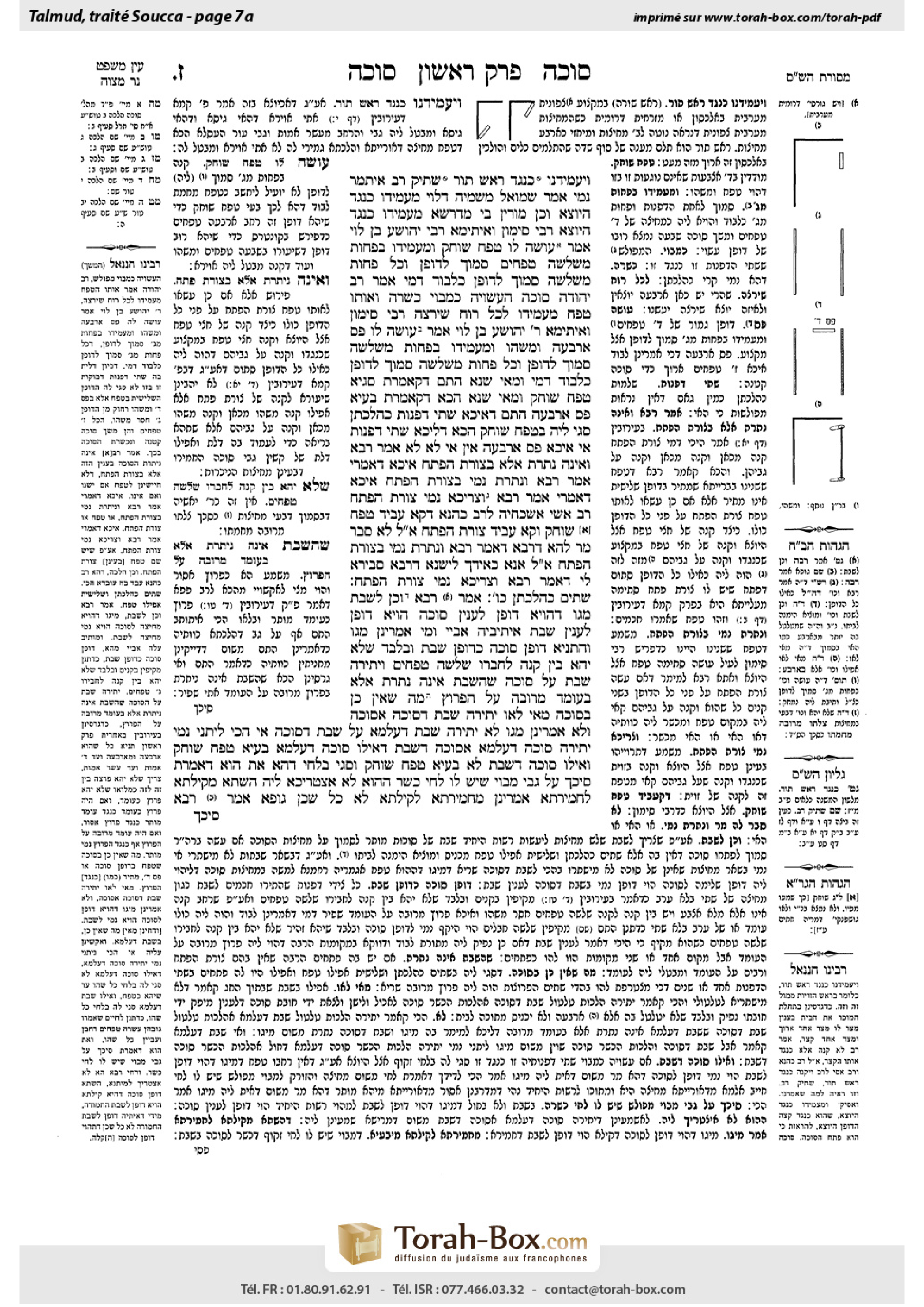
This page of Sukkah includes the Aramaic text, an English translation and an AI-generated French translation, alongside the scan above.
סוכה ז׳ א · Aramaic and Hebrew text
וְיַעֲמִידֶנּוּ כְּנֶגֶד רֹאשׁ תּוֹר?! שְׁתֵיק רַב.
אִיתְּמַר נָמֵי, אָמַר שְׁמוּאֵל מִשְּׁמֵיהּ דְּלֵוִי: מַעֲמִידוֹ כְּנֶגֶד הַיּוֹצֵא. וְכֵן מוֹרִין בֵּי מִדְרְשָׁא: מַעֲמִידוֹ כְּנֶגֶד הַיּוֹצֵא.
רַבִּי סִימוֹן, וְאִיתֵּימָא רַבִּי יְהוֹשֻׁעַ בֶּן לֵוִי אָמַר: עוֹשֶׂה לוֹ טֶפַח שׂוֹחֵק, וּמַעֲמִידוֹ בְּפָחוֹת מִשְּׁלֹשָׁה טְפָחִים סָמוּךְ לַדּוֹפֶן, וְכׇל פָּחוֹת מִשְּׁלֹשָׁה סָמוּךְ לַדּוֹפֶן כְּלָבוּד דָּמֵי.
אָמַר רַב יְהוּדָה: סוּכָּה הָעֲשׂוּיָה כְּמָבוֹי — כְּשֵׁרָה, וְאוֹתוֹ טֶפַח מַעֲמִידוֹ לְכׇל רוּחַ שֶׁיִּרְצֶה.
רַבִּי סִימוֹן, וְאִיתֵּימָא רַבִּי יְהוֹשֻׁעַ בֶּן לֵוִי אָמַר: עוֹשֶׂה לוֹ פַּס אַרְבָּעָה וּמַשֶּׁהוּ, וּמַעֲמִידוֹ בְּפָחוֹת מִשְּׁלֹשָׁה סָמוּךְ לַדּוֹפֶן, וְכׇל פָּחוֹת מִשְּׁלֹשָׁה סָמוּךְ לַדּוֹפֶן כְּלָבוּד דָּמֵי.
וּמַאי שְׁנָא הָתָם דְּקָאָמְרַתְּ סַגִּיא טֶפַח שׂוֹחֵק, וּמַאי שְׁנָא הָכָא דְּקָאָמְרַתְּ בָּעֲיָא פַּס אַרְבָּעָה? הָתָם דְּאִיכָּא שְׁתֵּי דְפָנוֹת כְּהִלְכָתָן — סַגִּי לֵיהּ בְּטֶפַח שׂוֹחֵק, הָכָא דְּלֵיכָּא שְׁתֵּי דְפָנוֹת, אִי אִיכָּא פַּס אַרְבָּעָה — אֵין, אִי לָא — לָא.
אָמַר רָבָא: וְאֵינָהּ נִתֶּרֶת אֶלָּא בְּצוּרַת הַפֶּתַח.
אִיכָּא דְּאָמְרִי, אָמַר רָבָא: וְנִתֶּרֶת נָמֵי בְּצוּרַת הַפֶּתַח.
אִיכָּא דְּאָמְרִי, אָמַר רָבָא: וּצְרִיכָא נָמֵי צוּרַת הַפֶּתַח.
רַב אָשֵׁי אַשְׁכְּחֵיהּ לְרַב כָּהֲנָא דְּקָא עָבֵיד טֶפַח שׂוֹחֵק, וְקָא עָבֵיד צוּרַת הַפֶּתַח. אֲמַר לֵיהּ: לָא סָבַר מָר לְהָא דְּרָבָא, דְּאָמַר רָבָא: וְנִתֶּרֶת נָמֵי בְּצוּרַת הַפֶּתַח? אֲמַר לֵיהּ: אֲנָא כְּאִידַּךְ לִישָּׁנָא דְּרָבָא סְבִירָא לִי. דְּאָמַר רָבָא: וּצְרִיכָא נָמֵי צוּרַת הַפֶּתַח.
שְׁתַּיִם כְּהִלְכָתָן כּוּ׳. אָמַר רָבָא: וְכֵן לְשַׁבָּת, מִגּוֹ דְּהָוְיָא דּוֹפֶן לְעִנְיַן סוּכָּה — הָוְיָא דּוֹפֶן לְעִנְיַן שַׁבָּת.
אֵיתִיבֵיהּ אַבָּיֵי: וּמִי אָמְרִינַן מִגּוֹ? וְהָתַנְיָא: דּוֹפֶן סוּכָּה כְּדוֹפֶן שַׁבָּת, וּבִלְבַד שֶׁלֹּא יְהֵא בֵּין קָנֶה לַחֲבֵרוֹ שְׁלֹשָׁה טְפָחִים.
וִיתֵירָה, שַׁבָּת עַל סוּכָּה, שֶׁהַשַּׁבָּת אֵינָהּ נִתֶּרֶת אֶלָּא בְּעוֹמֵד מְרוּבֶּה עַל הַפָּרוּץ, מַה שֶּׁאֵין כֵּן בְּסוּכָּה.
מַאי לָאו: יְתֵירָה שַׁבָּת דְּסוּכָּה אַסּוּכָּה, וְלָא אָמְרִינַן מִגּוֹ!
לָא: יְתֵירָה שַׁבָּת דְּעָלְמָא עַל שַׁבָּת דְּסוּכָּה.
אִי הָכִי, לִיתְנֵי נָמֵי: יְתֵירָה סוּכָּה דְעָלְמָא אַסּוּכָּה דְשַׁבָּת, דְּאִילּוּ סוּכָּה דְעָלְמָא בָּעֲיָא טֶפַח שׂוֹחֵק, וְאִילּוּ סוּכָּה דְשַׁבָּת לָא בָּעֲיָא טֶפַח שׂוֹחֵק, וְסַגִּי בְּלֶחִי.
דְּהָא אַתְּ הוּא דְּאָמְרַתְּ: סִיכֵּךְ עַל גַּבֵּי מָבוֹי שֶׁיֵּשׁ לוֹ לֶחִי — כָּשֵׁר!
הָהוּא לָא אִצְטְרִיכָא לֵיהּ, הַשְׁתָּא מִקִּילְּתָא לַחֲמִירְתָּא אָמְרִינַן, מֵחֲמִירְתָּא לְקִילְּתָא לֹא כׇּל שֶׁכֵּן.
גּוּפָא. אָמַר רָבָא:
Sukkah 7a · English translation
And let him position the wall measuring one handbreadth opposite the wall that emerges like the diagonal line formed by the end of the furrows as the field gradually narrows. This third partition would represent the third side of a triangle and would make the sukka appear more like a full-fledged structure, as the diagonal would represent closure of both unwalled directions. Rav was silent and did not respond.
It was also stated that Shmuel said in the name of Levi: He positions it at the end of one of the standing walls opposite the wall that emerges from the other end of that wall. And similarly, they rule in the study hall: He positions it at the end of one of the standing walls opposite the wall that emerges from the other end of that wall.
Rabbi Simon said, and some say it was Rabbi Yehoshua ben Levi who said, that the third wall is positioned differently. He establishes for the third side a wall that measures an expansive handbreadth, measured with the fingers spread apart, which is slightly larger than a standard handbreadth. And he then positions it less than three handbreadths from and adjacent to the wall opposite the second wall. And the legal status of any item positioned less than three handbreadths from and adjacent to the wall is like an item joined to that wall. In this way, the handbreadth-wide wall is joined to the adjacent wall, and it is as if it is a wall of four handbreadths, which is the majority of the minimum measure of the wall of a full-fledged sukka, seven handbreadths.
Rav Yehuda said: A sukka constructed like an alleyway, with two parallel full-fledged walls, is fit, and with regard to that third wall that measures one handbreadth, he positions it adjacent to one of the walls in any direction that he chooses, as it is merely a conspicuous marker.
Rabbi Simon said, and some say it was Rabbi Yehoshua ben Levi who said: In the case of a sukka built like an alleyway open on two ends, a third wall measuring a single handbreadth is insufficient. Rather, one establishes for the third side a board with a width of four handbreadths and a bit and positions it less than three handbreadths from and adjacent to either wall, as a wall on either of the open ends. And the legal status of any item positioned less than three handbreadths from and adjacent to the wall is like an item joined to that wall. The result is a full-fledged seven-handbreadth sukka wall.
The Gemara asks: What is different there, in the case of two attached walls, where you say that a wall with the dimension of an expansive handbreadth suffices to complete the third wall, and what is different here where you say that it requires a board that measures four handbreadths and a bit? The Gemara answers: There, where there are two walls in the standard sense, as they are attached forming a type of structure, it is sufficient to have the third wall measure an expansive handbreadth in order to render the sukka fit; however, here, where there are not two walls in the standard sense, as they are not attached, if there is a board that measures four handbreadths as the third wall, yes, it is fit, and if not, no, it is unfit.
Rava said: And the sukka consisting of two adjacent walls with a third wall measuring one handbreadth is permitted and fit only if the third wall is in the form of a doorway. One can render the sukka fit only by splitting the one-handbreadth wall and attaching one half to the standing wall and one half across from the other wall that emerges from the standing wall, and then placing a pole across the two halves. By creating the form of a doorway, that third wall becomes like an open gate, which is considered a halakhic partition.
Some say that Rava said: And a sukka consisting of two adjacent walls is also permitted and fit if the third wall is in the form of a doorway. In other words, Rava does not reject the remedy of the expansive-handbreadth wall suggested by Rabbi Yehoshua ben Levi; rather, he suggests an alternative.
Some say a third version of that which Rava said: And a sukka consisting of two adjacent walls, even with a third that is an expansive handbreadth wide as suggested by Rabbi Yehoshua ben Levi, also requires the form of a doorway to be fit. In other words, in addition to Rabbi Yehoshua ben Levi’s remedy, one must also create the form of a doorway to render the sukka fit.
The Gemara relates: Rav Ashi found Rav Kahana establishing his sukka, which had two adjacent walls, and establishing a third wall that was an expansive handbreadth wide and establishing the form of a doorway as well. Rav Ashi said to him: And does the Master not hold in accordance with that opinion of Rava, as Rava said: And the sukka is also permitted and fit if the third wall is in the form of a doorway? Why are you establishing a wall that is an expansive handbreadth wide as well? Rav Kahana said to him: I hold in accordance with the other version of the opinion of Rava, as Rava said: And the sukka also requires the form of a doorway, in addition to the expansive handbreadth, to be fit.
§ It is taught in the Tosefta that if the sukka has two walls in the standard sense and a third wall that measures one handbreadth, it is fit. Rava said: And likewise with regard to Shabbat that occurs during the festival of Sukkot, since it is considered a wall with regard to the halakhot of sukka it is considered a partition with regard to the halakhot of Shabbat. Were one to construct a sukka in that manner in a public domain adjacent to the entrance to his house, its legal status would be that of a private domain and one would be permitted to move objects from it to his house and vice versa on Shabbat that occurs during the Festival. However, that structure is not considered a private domain on any other Shabbat.
Abaye raised an objection to Rava’s opinion from a baraita: And do we say that this principle: Since it is considered, etc., applies in this area of halakha? But isn’t it taught in a baraita: The specifications of the wall of a sukka are like those of a partition with regard to the halakhot of Shabbat. Just as with regard to the halakhot of Shabbat, one forms a partition by establishing adjacent reeds, so too, one forms the wall of a sukka in the same manner, provided that the gap from one reed to another will not be as much as three handbreadths. If the gap is three handbreadths or greater, the legal status of the reeds is that they are not considered joined.
But the stringency of the halakha with regard to Shabbat goes beyond the stringency of the halakha with regard to sukka, in terms of the criteria for effective partitions, as with regard to Shabbat, carrying is permitted only in a case where the total of the standing segments of the partition, the actual wall, is greater than the total of the breached segments of the partition, the gaps that are less than three handbreadths. That is not so with regard to the sukka, where, even if the breached segments total more than the standing segments, e.g., a sukka consisting of two walls in which there are gaps and a third wall measuring only a single handbreadth, it is still fit.
The Gemara analyzes the baraita. What, isn’t the baraita teaching that the stringency with regard to Shabbat that occurs during the festival of Sukkot goes beyond the stringency with regard to the rest of the festival of Sukkot? And apparently, we do not say the principle: Since it is considered a fit partition for sukka let it also be considered a fit partition for Shabbat. This is difficult according to Rava, in whose opinion that principle is applied in this case.
Rava rejects that interpretation of the baraita. No, the baraita is teaching that the stringency with regard to Shabbat in general goes beyond the stringency with regard to Shabbat that occurs during the festival of Sukkot. On Shabbat during the festival of Sukkot, a partition where the total of the breached segments of the partition is greater than the total of the standing segments is effective, as, since it is effective as a wall in a sukka, it is effective as a partition for Shabbat as well. That is not the case on Shabbat during the rest of the year, when a partition of that sort is ineffective on Shabbat.
Abaye asked: If it is so that the distinction in the baraita is not a fundamental distinction between the halakhot of sukka and the halakhot of Shabbat, but is instead a distinction between the halakhot of Shabbat in general and the specific case of Shabbat during the festival of Sukkot, then let the baraita also teach a novel distinction involving Shabbat that occurs during the festival of Sukkot. The stringency with regard to sukka in general during the rest of Sukkot goes beyond the stringency with regard to sukka on Shabbat that occurs during the festival of Sukkot, as a sukka in general consisting of two parallel walls, like an alleyway, requires that its third wall measure an expansive handbreadth, while a sukka on Shabbat does not require an expansive handbreadth for this purpose, and it is sufficient for the third wall to be established with a side post ten handbreadths high and any width.
Since the side post is effective as a partition with regard to the halakhot of Shabbat, it should also be effective as a wall with regard to the halakhot of sukka although it is less than one handbreadth wide, as you are the one who said: If one placed roofing over an alleyway which has a side post on one of the open ends to permit carrying in that alleyway on Shabbat, it is fit as a sukka for that same Shabbat, although it would not be fit during the rest of the week of the Festival.
Rava replied to him: That is indeed my statement; however, the fact is that the baraita does not cite that distinction, because it is not necessary to state that there are circumstances in which the general halakhot of sukka are stricter than its halakhot on Shabbat, as there is no novelty in the concept that the halakhot of partitions on Shabbat should apply to a sukka. Now that we say that halakhot may be derived from a leniency to a stringency, as a halakha that applies to sukka, which is a positive mitzva, is applied to the halakhot of Shabbat, which is a stringent prohibition punishable by karet; then from a stringency, the halakhot of Shabbat, to a leniency, all the more so may halakhot be derived. Therefore, there is no reason for the baraita to mention that distinction explicitly.
§ Apropos roofing over an alleyway, the Gemara elaborates about the matter itself. Rava said:
Sukkah 7a · Traduction française (IA)
Et qu’il place la paroi d’un téfaḥ face à la paroi qui se prolonge en diagonale, comme la ligne formée par l’extrémité des sillons lorsque le champ se rétrécit progressivement. Cette troisième cloison constituerait le troisième côté d’un triangle et donnerait à la soukka davantage l’apparence d’une structure complète, puisque la diagonale fermerait les deux côtés dépourvus de paroi. Rav resta silencieux et ne répondit pas.
Il a également été enseigné que Chmouel a dit au nom de Lévi : Il la place à l’extrémité de l’une des parois dressées, face à la paroi qui se prolonge depuis l’autre extrémité de cette paroi. De même, on tranche à la maison d’étude : Il la place à l’extrémité de l’une des parois dressées, face à la paroi qui se prolonge depuis l’autre extrémité de cette paroi.
Rabbi Shimon a dit — et certains disent que c’est Rabbi Yehoshoua ben Lévi qui l’a dit — que la troisième paroi est placée autrement. Pour le troisième côté, il établit une paroi d’un téfaḥ ample, mesurée doigts écartés, légèrement plus large qu’un téfaḥ ordinaire. Puis il la place à moins de trois téfaḥim de la paroi opposée à la deuxième, en la jouxtant. Or, tout élément placé à moins de trois téfaḥim d’une paroi et qui la jouxte est considéré comme joint à cette paroi. Ainsi, la paroi d’un téfaḥ de large est jointe à la paroi voisine et est considérée comme une paroi de quatre téfaḥim, ce qui constitue la majorité de la mesure minimale de la paroi d’une soukka complète, soit sept téfaḥim.
Rav Yehouda a dit : Une soukka construite comme une ruelle, avec deux parois complètes parallèles, est valide. Quant à cette troisième paroi d’un téfaḥ, il la place contre l’une des parois, dans la direction de son choix, car elle ne sert que de repère visible.
Rabbi Shimon a dit — et certains disent que c’est Rabbi Yehoshoua ben Lévi qui l’a dit : Dans le cas d’une soukka construite comme une ruelle ouverte à ses deux extrémités, une troisième paroi d’un seul téfaḥ ne suffit pas. Il faut plutôt établir, pour le troisième côté, une planche de quatre téfaḥim et un peu, puis la placer à moins de trois téfaḥim de l’une ou l’autre des parois, en la jouxtant, comme paroi à l’une des extrémités ouvertes. Or, tout élément placé à moins de trois téfaḥim d’une paroi et qui la jouxte est considéré comme joint à cette paroi. On obtient ainsi une paroi complète de soukka de sept téfaḥim.
La Guemara demande : En quoi ce cas diffère-t-il de celui de deux parois jointes, où tu dis qu’une paroi d’un téfaḥ ample suffit à compléter la troisième paroi ? Et en quoi diffère-t-il du cas présent, où tu dis qu’il faut une planche de quatre téfaḥim et un peu ? La Guemara répond : Là-bas, où il y a deux parois au sens ordinaire, puisqu’elles sont jointes et forment une sorte de structure, il suffit que la troisième paroi mesure un téfaḥ ample pour rendre la soukka valide. Mais ici, où il n’y a pas deux parois au sens ordinaire, puisqu’elles ne sont pas jointes, la soukka est valide si une planche de quatre téfaḥim sert de troisième paroi ; sinon, elle ne l’est pas.
Rava a dit : La soukka composée de deux parois adjacentes et d’une troisième paroi d’un téfaḥ n’est permise et valide que si cette troisième paroi a la forme d’une porte. On ne peut rendre la soukka valide qu’en partageant la paroi d’un téfaḥ, en fixant une moitié contre la paroi dressée et l’autre moitié en face de l’autre paroi qui se prolonge depuis la paroi dressée, puis en posant une barre au-dessus des deux moitiés. En lui donnant la forme d’une porte, cette troisième paroi devient comme un portail ouvert, considéré comme une cloison au regard de la halakha.
Certains disent que Rava a dit : Une soukka composée de deux parois adjacentes est également permise et valide si la troisième paroi a la forme d’une porte. Autrement dit, Rava ne rejette pas la solution de la paroi d’un téfaḥ ample proposée par Rabbi Yehoshoua ben Lévi ; il suggère plutôt une autre solution.
Certains rapportent une troisième version de ce qu’a dit Rava : Une soukka composée de deux parois adjacentes doit également avoir la forme d’une porte pour être valide, même si elle comporte en outre une troisième paroi large d’un téfaḥ ample, comme l’a proposé Rabbi Yehoshoua ben Lévi. Autrement dit, en plus de la solution de Rabbi Yehoshoua ben Lévi, il faut aussi créer la forme d’une porte pour rendre la soukka valide.
La Guemara rapporte : Rav Ashi trouva Rav Kahana en train d’établir sa soukka, qui avait deux parois adjacentes, en installant une troisième paroi large d’un téfaḥ ample et en donnant également à l’ensemble la forme d’une porte. Rav Ashi lui dit : Le Maître ne suit-il donc pas l’opinion de Rava, qui a dit : La soukka est également permise et valide si la troisième paroi a la forme d’une porte ? Pourquoi installes-tu aussi une paroi d’un téfaḥ ample ? Rav Kahana lui répondit : Je suis l’autre version de l’opinion de Rava, selon laquelle la soukka doit également avoir la forme d’une porte, en plus du téfaḥ ample, pour être valide.
§ Il est enseigné dans la Tosefta que si la soukka comporte deux parois au sens ordinaire et une troisième paroi d’un téfaḥ, elle est valide. Rava a dit : Il en va de même pour le Chabbat qui tombe pendant la fête de Soukkot : puisqu’elle est considérée comme une paroi pour les halakhot de la soukka, elle est considérée comme une cloison pour les halakhot du Chabbat. Si quelqu’un construisait une soukka de cette manière dans le domaine public, près de l’entrée de sa maison, elle aurait le statut de domaine privé et il serait permis de transporter des objets de celle-ci vers sa maison et inversement, le Chabbat qui tombe pendant la fête. Cependant, cette structure n’est pas considérée comme un domaine privé un autre Chabbat.
Abayé souleva une objection à l’opinion de Rava à partir d’une baraïta : Disons-nous donc que ce principe — puisqu’elle est considérée comme telle, etc. — s’applique dans ce domaine de la halakha ? Pourtant, il est enseigné dans une baraïta : Les règles relatives à la paroi d’une soukka sont comme celles d’une cloison pour les halakhot du Chabbat. De même que, pour les halakhot du Chabbat, on forme une cloison en plaçant des roseaux côte à côte, on forme de la même manière la paroi d’une soukka, à condition que l’intervalle entre deux roseaux soit inférieur à trois téfaḥim. Si l’intervalle est de trois téfaḥim ou davantage, les roseaux ne sont pas considérés comme joints.
Mais, quant aux critères permettant de reconnaître une cloison efficace, la halakha du Chabbat est plus stricte que celle de la soukka : pour le Chabbat, il n’est permis de transporter que lorsque la longueur totale des parties debout de la cloison — la paroi proprement dite — est supérieure à celle des parties interrompues, c’est-à-dire des intervalles inférieurs à trois téfaḥim. Il n’en va pas ainsi pour la soukka : même si les parties interrompues totalisent davantage que les parties debout, par exemple dans une soukka composée de deux parois comportant des intervalles et d’une troisième paroi d’un seul téfaḥ, elle reste valide.
La Guemara analyse la baraïta. N’enseigne-t-elle pas que la halakha est plus stricte concernant le Chabbat qui tombe pendant la fête de Soukkot que pour le reste de la fête de Soukkot ? Apparemment, nous ne disons pas : puisqu’elle est considérée comme une cloison valide pour la soukka, qu’elle soit également considérée comme une cloison valide pour le Chabbat. Cela pose une difficulté à Rava, selon qui ce principe s’applique dans ce cas.
Rava rejette cette interprétation de la baraïta. Non, la baraïta enseigne que la halakha du Chabbat en général est plus stricte que celle du Chabbat qui tombe pendant la fête de Soukkot. Le Chabbat pendant la fête de Soukkot, une cloison dont les parties interrompues totalisent davantage que les parties debout est efficace, car, puisqu’elle constitue une paroi efficace pour une soukka, elle constitue également une cloison efficace pour le Chabbat. Il n’en va pas ainsi le Chabbat pendant le reste de l’année, où une cloison de ce type est inefficace.
Abayé demanda : Si la distinction indiquée dans la baraïta n’est pas une distinction fondamentale entre les halakhot de la soukka et celles du Chabbat, mais une distinction entre les halakhot du Chabbat en général et le cas particulier du Chabbat pendant la fête de Soukkot, alors que la baraïta enseigne aussi une distinction nouvelle concernant le Chabbat qui tombe pendant la fête de Soukkot. La halakha est plus stricte concernant la soukka en général pendant le reste de Soukkot que concernant la soukka le Chabbat qui tombe pendant la fête de Soukkot : en effet, une soukka ordinaire composée de deux parois parallèles, comme une ruelle, exige que sa troisième paroi mesure un téfaḥ ample, tandis que, pour une soukka le Chabbat, un téfaḥ ample n’est pas nécessaire à cet effet ; il suffit d’ériger, pour la troisième paroi, un poteau latéral haut de dix téfaḥim, quelle qu’en soit la largeur.
Puisque le poteau latéral est efficace comme cloison pour les halakhot du Chabbat, il devrait aussi être efficace comme paroi pour les halakhot de la soukka, bien qu’il mesure moins d’un téfaḥ de large. Car c’est toi-même qui as dit : Si quelqu’un pose un toit sur une ruelle dont l’une des extrémités ouvertes comporte un poteau latéral permettant d’y transporter des objets le Chabbat, cette structure est valide comme soukka pour ce même Chabbat, bien qu’elle ne soit pas valide pendant le reste de la semaine de la fête.
Rava lui répondit : C’est bien ce que j’ai dit. Toutefois, la baraïta ne mentionne pas cette distinction, car il n’est pas nécessaire de préciser qu’il existe des circonstances où les règles générales de la soukka sont plus strictes que celles qui s’appliquent le Chabbat : il n’y a rien de nouveau à dire que les règles des cloisons du Chabbat s’appliquent à une soukka. Puisque nous disons que des halakhot peuvent être déduites d’un cas indulgent pour les appliquer à un cas rigoureux — car une halakha qui s’applique à la soukka, qui relève d’une mitsva positive, s’applique aux halakhot du Chabbat, qui relèvent d’une interdiction rigoureuse passible de karet —, à plus forte raison peut-on déduire des halakhot d’un cas rigoureux, les halakhot du Chabbat, pour les appliquer à un cas indulgent. La baraïta n’a donc aucune raison de mentionner explicitement cette distinction.
§ À propos du toit posé sur une ruelle, la Guemara examine le sujet lui-même. Rava a dit :
Traduction française générée par IA à partir de l’édition anglaise de Sefaria. Vérifie toujours un passage avec le texte source.
Text from Sefaria: William Davidson Edition - Vocalized Aramaic (CC BY NC); William Davidson Edition - English (CC BY NC).