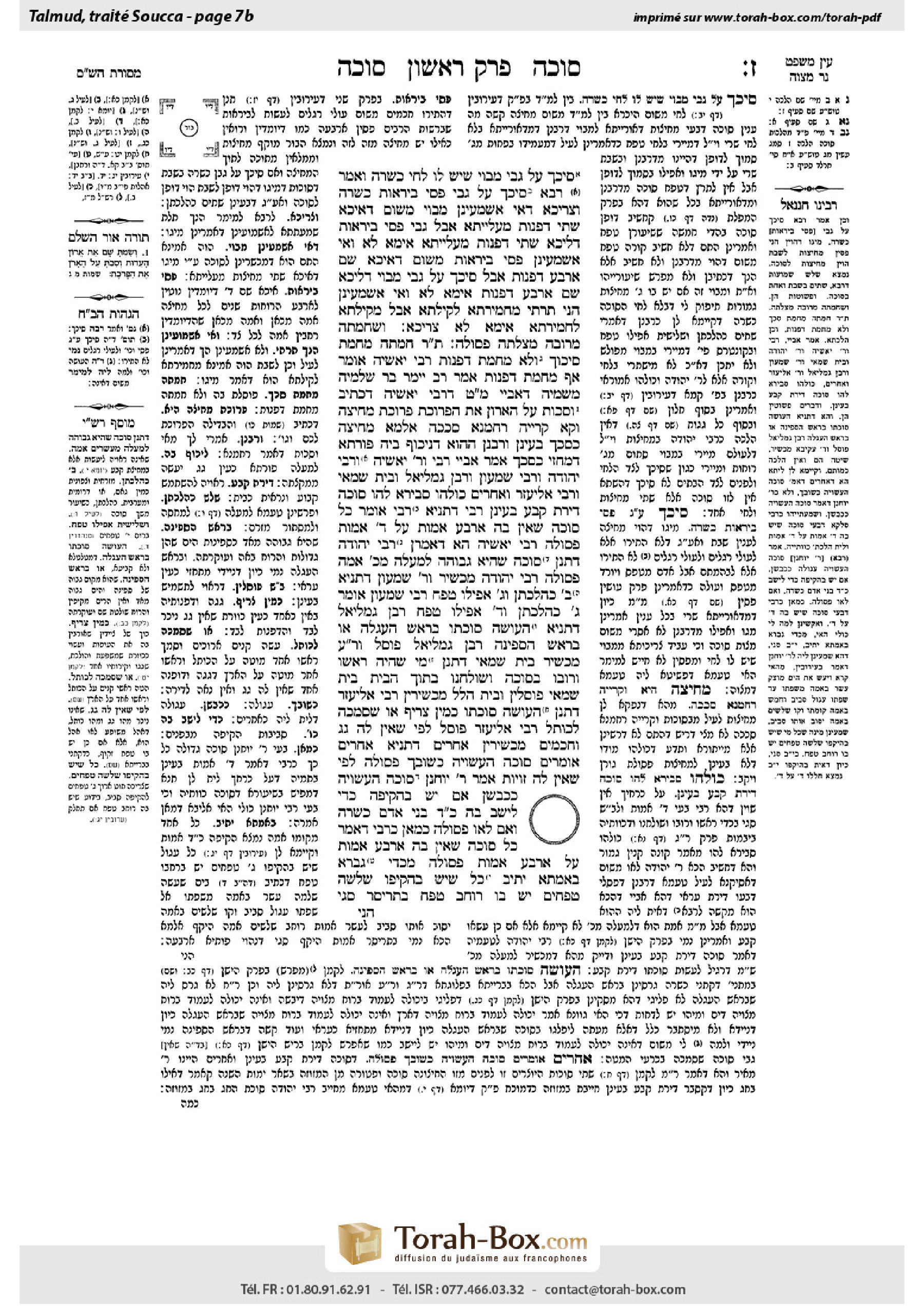
Sukkah 7b: Talmud study for Daf Yomi
Daf Yomi is the daily study of one Talmud folio. Explore 37 tractates with scans, Hebrew text, Sefaria English and AI-generated French translations where annotated.
Passage selection and English or AI-generated French translation are available where the scan has annotations. Daf Study is independent of Torah-Box and Sefaria.
Browse Sukkah · סוכה · All tractatesSukkah 7b text and translations
This page of Sukkah includes the Aramaic text, an English translation and an AI-generated French translation, alongside the scan above.
סוכה ז׳ ב · Aramaic and Hebrew text
סִיכֵּךְ עַל גַּבֵּי מָבוֹי שֶׁיֵּשׁ לוֹ לֶחִי — כְּשֵׁרָה.
וְאָמַר רָבָא: סִיכֵּךְ עַל גַּבֵּי פַּסֵּי בֵירָאוֹת — כְּשֵׁרָה.
וּצְרִיכָא. דְּאִי אַשְׁמְעִינַן מָבוֹי, מִשּׁוּם דְּאִיכָּא שְׁתֵּי דְפָנוֹת מְעַלְּיָיתָא. אֲבָל גַּבֵּי פַּסֵּי בֵירָאוֹת, דְּלֵיכָּא שְׁתֵּי דְפָנוֹת מְעַלְּיָיתָא — אֵימָא לָא.
וְאִי אַשְׁמְעִינַן פַּסֵּי בֵירָאוֹת, מִשּׁוּם דְּאִיכָּא שֵׁם אַרְבַּע דְפָנוֹת, אֲבָל סִיכֵּךְ עַל גַּבֵּי מָבוֹי, דְּלֵיכָּא שֵׁם אַרְבַּע דְפָנוֹת — אֵימָא לָא.
וְאִי אַשְׁמְעִינַן הָנֵי תַּרְתֵּי, מֵחֲמִירְתָּא לְקִילְּתָא, אֲבָל מִקִּילְּתָא לַחֲמִירְתָּא — אֵימָא לָא, צְרִיכָא.
וְשֶׁחֲמָתָהּ מְרוּבָּה מְצִלָּתָהּ — פְּסוּלָה.
תָּנוּ רַבָּנַן: חֲמָתָהּ מֵחֲמַת סִיכּוּךְ, וְלֹא מֵחֲמַת דְּפָנוֹת. רַבִּי יֹאשִׁיָּה אוֹמֵר: אַף מֵחֲמַת דְּפָנוֹת.
אָמַר רַב יֵימַר בַּר שֶׁלֶמְיָה מִשְּׁמֵיהּ דְּאַבָּיֵי: מַאי טַעְמֵיהּ דְּרַבִּי יֹאשִׁיָּה, דִּכְתִיב: ״וְסַכּוֹתָ עַל הָאָרוֹן אֶת הַפָּרוֹכֶת״, פָּרוֹכֶת מְחִיצָה, וְקָא קַרְיֵיהּ רַחֲמָנָא ״סְכָכָה״, אַלְמָא מְחִיצָה כִּסְכָךְ בָּעֵינַן.
וְרַבָּנַן? הַהוּא דְּנִיכּוֹף בַּיהּ פּוּרְתָּא, דְּמִחֲזֵי כִּסְכָךְ.
אָמַר אַבָּיֵי: רַבִּי, וְרַבִּי יֹאשִׁיָּה, וְרַבִּי יְהוּדָה, וְרַבִּי שִׁמְעוֹן, וְרַבָּן גַּמְלִיאֵל, וּבֵית שַׁמַּאי, וְרַבִּי אֱלִיעֶזֶר, וַאֲחֵרִים — כּוּלְּהוּ סְבִירָא לְהוּ: סוּכָּה דִּירַת קֶבַע בָּעֵינַן.
רַבִּי — דְּתַנְיָא, רַבִּי אוֹמֵר: כׇּל סוּכָּה שֶׁאֵין בָּהּ אַרְבַּע אַמּוֹת עַל אַרְבַּע אַמּוֹת — פְּסוּלָה.
רַבִּי יֹאשִׁיָּה — הָא דַּאֲמַרַן.
רַבִּי יְהוּדָה דִּתְנַן סוּכָּה שֶׁהִיא גְּבוֹהָה לְמַעְלָה מֵעֶשְׂרִים אַמָּה פְּסוּלָה רַבִּי יְהוּדָה מַכְשִׁיר
וְרַבִּי שִׁמְעוֹן — דְּתַנְיָא: שְׁתַּיִם כְּהִלְכָתָן וּשְׁלִישִׁית אֲפִילּוּ טֶפַח, רַבִּי שִׁמְעוֹן אוֹמֵר: שָׁלֹשׁ כְּהִלְכָתָן וּרְבִיעִית אֲפִילּוּ טֶפַח.
רַבָּן גַּמְלִיאֵל — דְּתַנְיָא: הָעוֹשֶׂה סוּכָּתוֹ בְּרֹאשׁ הָעֲגָלָה אוֹ בְּרֹאשׁ הַסְּפִינָה, רַבָּן גַּמְלִיאֵל פּוֹסֵל, וְרַבִּי עֲקִיבָא מַכְשִׁיר.
בֵּית שַׁמַּאי — דִּתְנַן: מִי שֶׁהָיָה רֹאשׁוֹ וְרוּבּוֹ בַּסּוּכָּה וְשׁוּלְחָנוֹ בְּתוֹךְ הַבַּיִת, בֵּית שַׁמַּאי פּוֹסְלִין, וּבֵית הִלֵּל מַכְשִׁירִין.
רַבִּי אֱלִיעֶזֶר — דִּתְנַן: הָעוֹשֶׂה סוּכָּתוֹ כְּמִין צְרִיף, אוֹ שֶׁסְּמָכָהּ לְכוֹתֶל, רַבִּי אֱלִיעֶזֶר פּוֹסֵל לְפִי שֶׁאֵין לָהּ גַּג, וַחֲכָמִים מַכְשִׁירִין.
אֲחֵרִים — דְּתַנְיָא, אֲחֵרִים אוֹמְרִים: סוּכָּה הָעֲשׂוּיָה כְּשׁוֹבָךְ — פְּסוּלָה, לְפִי שֶׁאֵין לָהּ זָוִיּוֹת.
אָמַר רַבִּי יוֹחָנָן: סוּכָּה הָעֲשׂוּיָה כְּכִבְשָׁן, אִם יֵשׁ בְּהֶקֵּיפָהּ כְּדֵי לֵישֵׁב בָּהּ עֶשְׂרִים וְאַרְבָּעָה בְּנֵי אָדָם — כְּשֵׁרָה, וְאִם לָאו — פְּסוּלָה.
כְּמַאן — כְּרַבִּי, דְּאָמַר: כׇּל סוּכָּה שֶׁאֵין בָּהּ אַרְבַּע אַמּוֹת עַל אַרְבַּע אַמּוֹת פְּסוּלָה.
מִכְּדִי, גַּבְרָא בְּאַמְּתָא יָתֵיב, כֹּל שֶׁיֵּשׁ בְּהֶקֵּיפוֹ שְׁלֹשָׁה טְפָחִים יֵשׁ בּוֹ רוֹחַב טֶפַח, בִּתְרֵיסַר סַגִּי?
Sukkah 7b · English translation
If one placed roofing over an alleyway that has a side post, it is fit for use as a sukka.
And similarly, Rava said: If one placed roofing over upright boards surrounding wells, it is fit for use as a sukka. A well is usually at least four handbreadths wide and ten handbreadths deep. Therefore, it is considered a private domain, and it is prohibited to draw water from it on Shabbat, as that would constitute a violation of the prohibition to carry from a private domain into a public one. In order to permit drawing water from the well, the surrounding area must be partitioned off and rendered a private domain. For the benefit of Festival pilgrims, the Sages instituted a special leniency that full-fledged partitions need not be constructed around the well for this purpose. Rather, it is sufficient if there are four double posts at the four corners of the area surrounding the well. Since these symbolic barriers are considered partitions for the halakhot of Shabbat, they are considered partitions for the halakhot of sukka on Shabbat as well.
The Gemara notes: And it is necessary for Rava to state the halakha in each of the two similar cases, as if he had taught us only that the sukka is fit in the case of the alleyway, one could say that it is due to the fact that there are two full-fledged walls; however, in the case of upright boards surrounding wells, where there are not two full-fledged walls and most of the area is breached, say no, it is not considered a fit sukka.
And if he had taught us only the case of upright boards surrounding wells, one could say that it is due to the fact that in that case it is in the category of a sukka with four, albeit virtual, walls; however, in the case where one placed roofing over an alleyway, where it is not in the category of a sukka with four walls, say no, it is not considered a fit sukka.
And if he had taught us only these two cases, to teach that a partition with regard to the halakhot of Shabbat is a partition with regard to the halakhot of sukka, one could say that it is due to the fact that one can derive a halakha from a stringency, the halakhot of Shabbat, to a leniency, the halakhot of sukka; however, to derive a halakha from a leniency to a stringency, say no. Therefore, it is necessary to teach the third halakha with regard to a sukka consisting of two walls in the standard sense and a third wall measuring a handbreadth: Since the third wall is considered a wall with regard to the halakhot of sukka, a leniency, it is considered a wall with regard to the halakhot of Shabbat, a stringency.
§ The mishna continues: And a sukka whose sunlight, i.e., the sunlight that passes through the roofing, is greater than its shade, is unfit.
The Sages taught in a baraita that in the statement: Whose sunlight is greater than its shade, the reference is to sunlight that passes through due to sparse roofing, and not to the sunlight entering due to gaps in the walls. It is possible for a sukka to have more sunlight than shade due to sunlight passing through the sides and not the roofing, in which case the sukka is fit. Rabbi Yoshiya says: If the sunlight exceeds the shade the sukka is unfit, even if the sunlight is due to gaps in the walls.
Rav Yeimar bar Shelemya said in the name of Abaye: What is the rationale for the statement of Rabbi Yoshiya? It is as it is written: “And you shall screen [vesakkota] the Ark with the curtain” (Exodus 40:3). The curtain is a partition and not a covering over the Ark, and nevertheless, the Merciful One calls it roofing [sekhakha]. Apparently, we require the purpose of a partition to be similar to the purpose of roofing; just as the roofing must be mostly impermeable by sunlight, so must the partition.
And how do the Rabbis, who disagree with Rabbi Yoshiya, interpret the term: And you shall screen [vesakkota]? That term teaches that we should bend the top of the curtain a bit so that it appears as roofing over the Ark.
Abaye said: Rabbi Yehuda HaNasi, and Rabbi Yoshiya, and Rabbi Yehuda, and Rabbi Shimon, and Rabban Gamliel, and Beit Shammai, and Rabbi Eliezer, and Aḥerim all hold that we require the sukka to be sturdy and fit for dwelling like a permanent residence.
Abaye cites the relevant statements of the tanna’im listed above. Rabbi Yehuda HaNasi states this opinion, as it is taught in a baraita that Rabbi Yehuda HaNasi says: Any sukka that does not have an area of four cubits by four cubits is unfit. These are the dimensions of a permanent residence.
The fact that Rabbi Yoshiya holds that a sukka must be a permanent residence can be seen from that which we stated, that the walls must also be impermeable by sunlight like the walls of a permanent residence.
Rabbi Yehuda also holds that a sukka must be a permanent residence, as we learned in the mishna: A sukka that is more than twenty cubits high is unfit; Rabbi Yehuda deems it fit. As explained above, in constructing a sukka more than twenty cubits high, one cannot render his residence a temporary residence; rather, he must construct a sturdy permanent residence.
Rabbi Shimon agrees, as it is taught in a baraita: The dimensions of a sukka are two walls in the standard sense, and a third wall that measures even a handbreadth; Rabbi Shimon says: Three of the walls must be walls in the standard sense, and a fourth wall is required that measures even a handbreadth. Apparently, a sukka must be surrounded on four sides like a permanent residence.
Rabban Gamliel holds that a sukka must be a permanent residence, as it is taught in a baraita: In the case of one who establishes his sukka atop a wagon or atop a boat, Rabban Gamliel deems it unfit; a mobile structure is not a permanent residence. Rabbi Akiva deems it fit. Apparently, Rabban Gamliel requires that a sukka be a permanent residence.
Beit Shammai agree, as we learned in a mishna: In the case of one whose head and most of his body were in the sukka and his table was in the house, Beit Shammai deem the sukka unfit, since a small sukka is unfit for use and one cannot fulfill the mitzva of sukka with it. And Beit Hillel deem it fit. Apparently, Beit Shammai require that the sukka be similar to a permanent structure.
Rabbi Eliezer holds that a sukka must be a permanent residence, as we learned in a mishna: In the case of one who establishes his sukka like a type of circular hut whose walls slope down from the center and has no roof, or one who rested the sukka against the wall, taking long branches and placing one end on the ground and leaning the other end against the wall, establishing a structure with no roof, Rabbi Eliezer deems it unfit because it does not have a roof, and the Rabbis deem it fit. A permanent residence has a roof.
Aḥerim agree, as it is taught in a baraita that Aḥerim say: A sukka built in a circular shape like a dovecote is unfit, because it does not have corners, and a permanent residence is one with corners.
§ Rabbi Yoḥanan said: With regard to a sukka that is shaped like a furnace and is completely round, if its circumference has sufficient space for twenty-four people to sit in it, it is fit, and if not, it is unfit.
The Gemara asks: In accordance with whose opinion did Rabbi Yoḥanan rule that the sukka must be so expansive? The Gemara answers: It is undoubtedly in accordance with the opinion of Rabbi Yehuda HaNasi, who said: Any sukka that does not have an area of four cubits by four cubits is unfit. Since he requires the sukka with the largest minimum dimensions, Rabbi Yoḥanan must hold in accordance with his opinion.
However, even if he holds in accordance with the opinion of Rabbi Yehuda HaNasi, the question arises: Now, since when a person sits, he occupies one cubit of space, the circumference required by Rabbi Yoḥanan for the sukka is twenty-four cubits. However, mathematically, for every three handbreadths circumference in a circle, there is a diameter of approximately one handbreadth. Consequently, rather than requiring a sukka that holds twenty-four people, a sukka that holds merely twelve people should suffice, since a sukka with a circumference of twelve cubits has a diameter of approximately four. In that case, why does Rabbi Yoḥanan require the sukka to have double the necessary circumference?
Sukkah 7b · Traduction française (IA)
Si l’on a posé un toit de soukka au-dessus d’une ruelle munie d’un poteau latéral, elle est apte à servir de soukka.
De même, Rava a dit : si l’on a posé un toit de soukka au-dessus de poteaux verticaux disposés autour de puits, elle est apte à servir de soukka. Un puits a généralement au moins quatre téfa’him de largeur et dix téfa’him de profondeur. Il est donc considéré comme un domaine privé, et il est interdit d’y puiser de l’eau pendant Chabbat, car cela constituerait une violation de l’interdiction de transporter un objet d’un domaine privé vers un domaine public. Pour permettre de puiser de l’eau dans le puits, il faut délimiter la zone qui l’entoure et en faire un domaine privé. Pour faciliter les choses aux pèlerins qui se rendaient au Temple pour les fêtes, les Sages ont institué une dérogation particulière : il n’est pas nécessaire de construire des clôtures complètes autour du puits à cette fin. Il suffit de placer quatre paires de poteaux aux quatre coins de la zone qui l’entoure. Puisque ces barrières symboliques sont considérées comme des clôtures au regard des halakhot de Chabbat, elles sont également considérées comme des clôtures au regard des halakhot de la soukka pendant Chabbat.
La Guemara note qu’il est nécessaire que Rava énonce la halakha dans chacun des deux cas similaires. En effet, s’il nous avait enseigné uniquement que la soukka est apte dans le cas de la ruelle, on aurait pu dire que c’est parce qu’il y a deux parois complètes. Mais, dans le cas des poteaux verticaux disposés autour des puits, où il n’y a pas deux parois complètes et où la majeure partie de la zone est ouverte, on aurait pu dire qu’elle n’est pas considérée comme une soukka apte.
Et s’il nous avait enseigné uniquement le cas des poteaux verticaux disposés autour des puits, on aurait pu dire que c’est parce qu’il s’agit alors d’une soukka pourvue de quatre parois, même si celles-ci sont virtuelles. Mais, dans le cas où l’on a posé un toit de soukka au-dessus d’une ruelle, qui ne relève pas de la catégorie des soukkot à quatre parois, on aurait pu dire qu’elle n’est pas considérée comme une soukka apte.
Et s’il nous avait enseigné uniquement ces deux cas, pour nous apprendre qu’une clôture au regard des halakhot de Chabbat est aussi une clôture au regard des halakhot de la soukka, on aurait pu dire que c’est parce qu’on peut déduire une halakha d’un domaine de rigueur, celui des halakhot de Chabbat, vers un domaine de souplesse, celui des halakhot de la soukka. Mais on aurait pu dire qu’on ne peut pas déduire une halakha d’un domaine de souplesse vers un domaine de rigueur. Il est donc nécessaire d’enseigner la troisième halakha, concernant une soukka constituée de deux parois au sens habituel et d’une troisième paroi d’un téfa’h : puisque cette troisième paroi est considérée comme une paroi au regard des halakhot de la soukka, qui relèvent de la souplesse, elle est également considérée comme une paroi au regard des halakhot de Chabbat, qui relèvent de la rigueur.
§ La Michna poursuit : une soukka dans laquelle la lumière du soleil, c’est-à-dire celle qui traverse le toit de soukka, est plus abondante que l’ombre est inapte.
Les Sages ont enseigné dans une baraïta que, dans l’expression « dont la lumière du soleil est plus abondante que l’ombre », il s’agit de la lumière qui traverse le toit de soukka parce que celui-ci est clairsemé, et non de la lumière qui entre par les interstices des parois. Une soukka peut recevoir plus de lumière que d’ombre parce que la lumière entre par les côtés et non par le toit ; dans ce cas, la soukka est apte. Rabbi Yoshiya dit : si la lumière du soleil dépasse l’ombre, la soukka est inapte, même si cette lumière entre par les interstices des parois.
Rav Yeimar bar Shelemya a dit au nom d’Abaye : quelle est la raison de l’avis de Rabbi Yoshiya ? C’est ce qui est écrit : « Tu feras écran [vesakkota] à l’Arche avec le rideau » (Exode 40:3). Le rideau est une paroi, et non un toit au-dessus de l’Arche ; pourtant, le Miséricordieux l’appelle un toit de soukka [sekhakha]. Apparemment, la fonction d’une paroi doit être semblable à celle d’un toit de soukka : de même que celui-ci doit être en grande partie imperméable à la lumière du soleil, la paroi doit l’être également.
Et comment les Rabbins, qui sont en désaccord avec Rabbi Yoshiya, interprètent-ils l’expression « Tu feras écran [vesakkota] » ? Cette expression enseigne qu’il faut replier légèrement le haut du rideau afin qu’il ait l’apparence d’un toit au-dessus de l’Arche.
Abaye a dit : Rabbi Yehuda HaNasi, Rabbi Yoshiya, Rabbi Yehuda, Rabbi Shimon, Rabban Gamliel, Beit Shammaï, Rabbi Eliezer et Aḥerim estiment tous que la soukka doit être solide et apte à servir d’habitation, comme une résidence permanente.
Abaye cite les déclarations pertinentes des tannaïm mentionnés ci-dessus. Rabbi Yehuda HaNasi exprime cette opinion, comme on l’enseigne dans une baraïta : Rabbi Yehuda HaNasi dit que toute soukka dont la superficie n’est pas de quatre coudées sur quatre coudées est inapte. Telles sont les dimensions d’une résidence permanente.
On voit que Rabbi Yoshiya estime que la soukka doit être une résidence permanente d’après ce que nous avons dit : les parois aussi doivent être imperméables à la lumière du soleil, comme celles d’une résidence permanente.
Rabbi Yehuda estime lui aussi que la soukka doit être une résidence permanente, comme nous l’avons appris dans la Michna : une soukka de plus de vingt coudées de haut est inapte ; Rabbi Yehuda la juge apte. Comme on l’a expliqué plus haut, lorsqu’on construit une soukka de plus de vingt coudées de haut, on ne peut pas en faire une résidence temporaire ; il faut plutôt construire une résidence permanente et solide.
Rabbi Shimon est également d’accord, comme on l’enseigne dans une baraïta : une soukka doit avoir deux parois au sens habituel et une troisième paroi mesurant ne serait-ce qu’un téfa’h. Rabbi Shimon dit que trois parois doivent être des parois au sens habituel et qu’une quatrième paroi, mesurant ne serait-ce qu’un téfa’h, est nécessaire. Apparemment, une soukka doit être entourée de quatre côtés, comme une résidence permanente.
Rabban Gamliel estime que la soukka doit être une résidence permanente, comme on l’enseigne dans une baraïta : dans le cas de celui qui installe sa soukka sur un chariot ou sur un bateau, Rabban Gamliel la juge inapte ; une structure mobile n’est pas une résidence permanente. Rabbi Akiva la juge apte. Apparemment, Rabban Gamliel exige que la soukka soit une résidence permanente.
Beit Shammaï est également d’accord, comme nous l’avons appris dans une Michna : dans le cas de celui dont la tête et la majeure partie du corps se trouvent dans la soukka, mais dont la table est dans la maison, Beit Shammaï juge la soukka inapte, car une petite soukka est impropre à l’usage et l’on ne peut pas y accomplir la mitsva de la soukka. Beit Hillel la juge apte. Apparemment, Beit Shammaï exige que la soukka ressemble à une construction permanente.
Rabbi Eliezer estime que la soukka doit être une résidence permanente, comme nous l’avons appris dans une Michna : dans le cas de celui qui construit sa soukka à la manière d’une sorte de hutte circulaire, dont les parois descendent en pente depuis le centre et qui n’a pas de toit, ou de celui qui appuie la soukka contre un mur en prenant de longues branches, en posant une extrémité au sol et en appuyant l’autre contre le mur, de façon à créer une structure sans toit, Rabbi Eliezer la juge inapte parce qu’elle n’a pas de toit, tandis que les Rabbins la jugent apte. Une résidence permanente a un toit.
Aḥerim est également d’accord, comme on l’enseigne dans une baraïta : Aḥerim disent qu’une soukka construite en forme de cercle, comme un pigeonnier, est inapte, car elle n’a pas d’angles ; or, une résidence permanente a des angles.
§ Rabbi Yoḥanan a dit : une soukka ayant la forme d’un four et étant entièrement ronde est apte si sa circonférence est assez grande pour que vingt-quatre personnes puissent s’y asseoir ; sinon, elle est inapte.
La Guemara demande : selon l’avis de qui Rabbi Yoḥanan a-t-il statué que la soukka doit être aussi vaste ? La Guemara répond : c’est sans aucun doute selon l’avis de Rabbi Yehuda HaNasi, qui a dit que toute soukka dont la superficie n’est pas de quatre coudées sur quatre coudées est inapte. Puisque celui-ci exige les dimensions minimales les plus grandes pour la soukka, Rabbi Yoḥanan doit partager son avis.
Cependant, même s’il partage l’avis de Rabbi Yehuda HaNasi, une question se pose : puisqu’une personne assise occupe un espace d’une coudée, la circonférence que Rabbi Yoḥanan exige pour la soukka est de vingt-quatre coudées. Or, mathématiquement, le diamètre d’un cercle est d’environ un téfa’h pour trois téfa’him de circonférence. Par conséquent, au lieu d’exiger une soukka pouvant accueillir vingt-quatre personnes, une soukka pouvant en accueillir seulement douze devrait suffire, puisque la circonférence d’une soukka pouvant accueillir douze personnes serait de douze coudées et son diamètre, d’environ quatre coudées. Dans ce cas, pourquoi Rabbi Yoḥanan exige-t-il que la soukka ait une circonférence deux fois supérieure à celle qui est nécessaire ?
Traduction française générée par IA à partir de l’édition anglaise de Sefaria. Vérifie toujours un passage avec le texte source.
Text from Sefaria: William Davidson Edition - Vocalized Aramaic (CC BY NC); William Davidson Edition - English (CC BY NC).