Sukkah 8a: Talmud study for Daf Yomi
Daf Yomi is the daily study of one Talmud folio. Explore 37 tractates with scans, Hebrew text, Sefaria English and AI-generated French translations where annotated.
Passage selection and English or AI-generated French translation are available where the scan has annotations. Daf Study is independent of Torah-Box and Sefaria.
Browse Sukkah · סוכה · All tractatesSukkah 8a text and translations
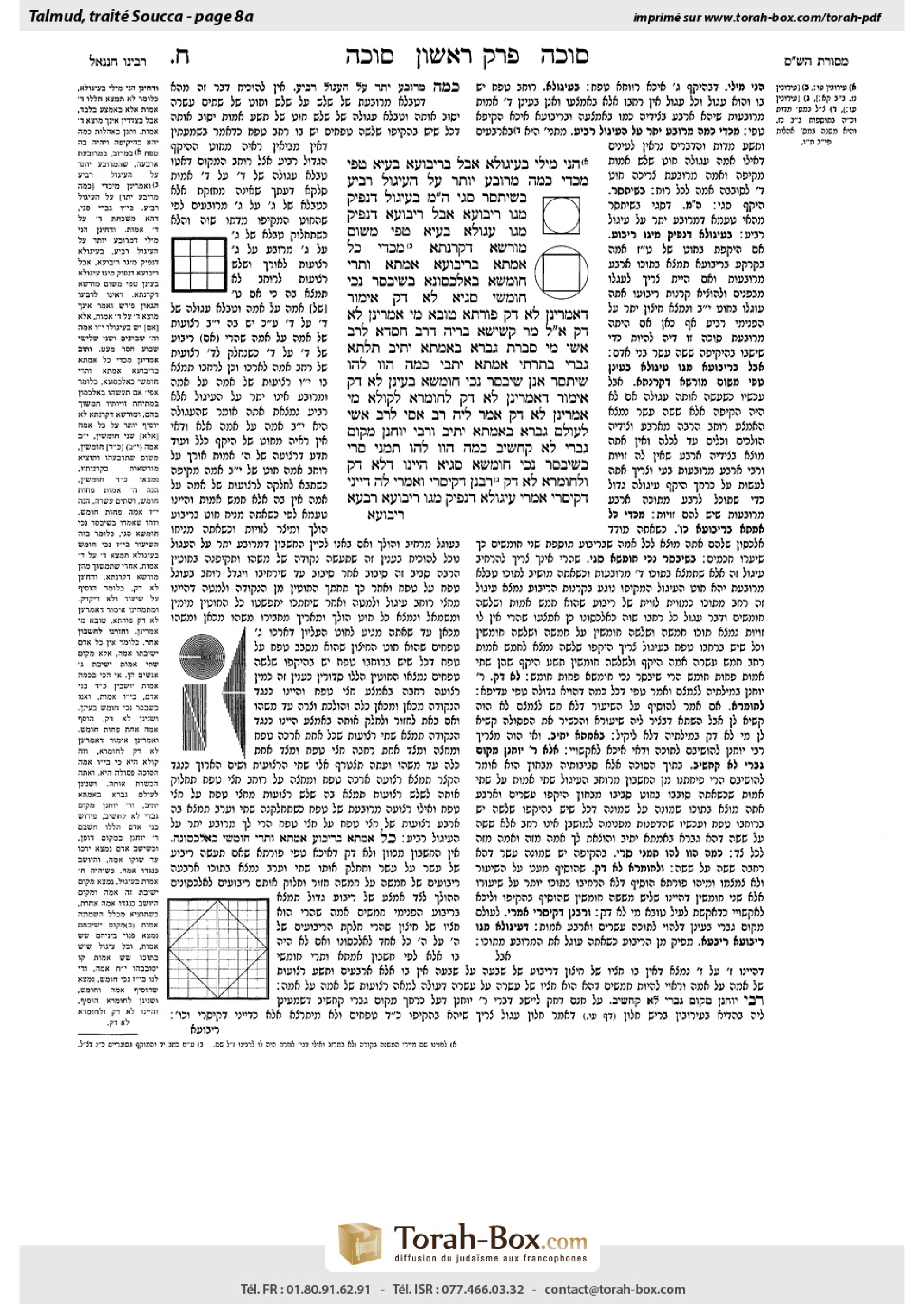
This page of Sukkah includes the Aramaic text, an English translation and an AI-generated French translation, alongside the scan above.
סוכה ח׳ א · Aramaic and Hebrew text
הָנֵי מִילֵּי בְּעִיגּוּלָא, אֲבָל בְּרִיבּוּעָא — בָּעֲיָא טְפֵי.
מִכְּדֵי כַּמָּה מְרוּבָּע יוֹתֵר עַל הָעִיגּוּל — רְבִיעַ, בְּשִׁיתְּסַר סַגִּי?
הָנֵי מִילֵּי בְּעִיגּוּל דְּנָפֵיק מִגּוֹ רִיבּוּעָא, אֲבָל רִיבּוּעָא דְּנָפֵיק מִגּוֹ עִגּוּלָא — בָּעֵינַן טְפֵי, מִשּׁוּם מוּרְשָׁא דְקַרְנָתָא.
מִכְּדֵי כׇּל אַמְּתָא בְּרִיבּוּעָא אַמְּתָא וּתְרֵי חוּמְשֵׁי בַּאֲלַכְסוֹנָא, בְּשִׁיבְסַר נְכֵי חוּמְשָׁא סַגִּיא? לָא דָּק.
אֵימוֹר דְּאָמְרִינַן לָא דָּק פּוּרְתָּא, טוּבָא מִי אָמְרִינַן לָא דָּק?
אֲמַר לֵיהּ מָר קַשִּׁישָׁא בְּרֵיהּ דְּרַב חִסְדָּא לְרַב אָשֵׁי: מִי סָבְרַתְּ גַּבְרָא בְּאַמְּתָא יָתֵיב, תְּלָתָא גַּבְרֵי בְּתַרְתֵּי אַמְּתָא יָתְבִי. כַּמָּה הָווּ לְהוּ — שִׁיתְּסַר, אֲנַן שִׁיבְסַר נְכֵי חוּמְשָׁא בָּעֵינַן! לָא דָּק.
אֵימוֹר דְּאָמְרִינַן לָא דָּק לְחוּמְרָא, לְקוּלָּא מִי אָמְרִינַן לָא דָּק?
אֲמַר לֵיהּ רַב אַסִּי לְרַב אָשֵׁי: לְעוֹלָם גַּבְרָא בְּאַמְּתָא יָתֵיב, וְרַבִּי יוֹחָנָן מְקוֹם גַּבְרֵי לָא קָחָשֵׁיב.
כַּמָּה הָווּ לְהוּ — תַּמְנֵי סְרֵי, בְּשִׁיבְסַר נְכֵי חוּמְשָׁא סַגִּיא! הַיְינוּ דְּלָא דָּק וּלְחוּמְרָא לָא דָּק.
רַבָּנַן דְּקֵיסָרִי, וְאָמְרִי לַהּ דַּיָּינֵי דְקֵיסָרִי אָמְרִי: עִיגּוּלָא דְּנָפֵיק מִגּוֹ רִיבּוּעָא — רִבְעָא,
Sukkah 8a · English translation
The Gemara answers: This applies only in the middle of the circle that has a circumference of twelve cubits, as the diameter of the circle is four cubits; but in order for a square inscribed within a circle to have a perimeter of sixteen cubits, the circle requires a circumference that is more than twelve cubits.
The Gemara asks further: Now, by how much is the perimeter of a square inscribing a circle greater than the circumference of that circle? It is greater by one quarter of the perimeter of the square. If that is the case, a circle with a circumference of sixteen cubits is sufficient. Why, then, does Rabbi Yoḥanan require a circumference of twenty-four cubits?
The Gemara answers: This statement with regard to the ratio of the perimeter of a square to the circumference of a circle applies to a circle inscribed in a square, but in the case of a square circumscribed by a circle, the circle requires a greater circumference due to the projection of the corners of the square. In order to ensure that a square whose sides are four cubits each fits neatly into a circle, the circumference of the circle must be greater than sixteen cubits.
The Gemara calculates precisely how much greater the circumference must be in order to circumscribe the four-by-four-cubit square. Now, in every square whose sides each measure one cubit its diagonal measures one and two-fifths cubits, and in a circle that circumscribes a square, the diagonal of the square is the diameter of the circle. In this case, the circumscribed square measures four by four cubits; therefore, the diagonal of the square, which is the diameter of the circle, measures five and three-fifths cubits. Since the Gemara calculates the circumference of the circle as three times its diameter, a circular sukka with a circumference of seventeen cubits minus one-fifth of a cubit should be sufficient. The Gemara answers: Rabbi Yoḥanan was not precise and rounded the dimensions of the circular sukka to a number higher than the absolute minimum.
The Gemara wonders: Say that we say that the Sage was not precise when the difference between the number cited and the precise number is slight; however, when the difference is great, do we say the Sage was not precise? After all, Rabbi Yoḥanan stated that the minimum measure is twenty-four cubits, a difference of more than seven cubits.
Mar Keshisha, i.e., the elder, son of Rav Ḥisda, said to Rav Ashi: Do you hold that when a man sits, he sits and occupies one cubit, and consequently a sukka that seats twenty-four people must have a circumference of twenty-four cubits? In fact, three people sit and occupy two cubits. The Gemara asks: How many cubits are there in the sukka required by Rabbi Yoḥanan? There are sixteen cubits. But we require a sukka with a circumference of seventeen cubits minus one-fifth, as calculated above. The Gemara answers: He was not precise and rounded the figure down to the lower whole number; actually, the required circumference is four-fifths of a cubit larger.
The Gemara rejects this explanation: Say that we say that the Sage was not precise when the result is a stringency, e.g., he required a sukka whose dimensions are greater than the minimum required dimensions; however, when the result is a leniency, do we say the Sage was not precise? In that case, the lack of precision will lead to establishing a sukka whose dimensions are smaller than the minimum requirement.
Rav Asi said to Rav Ashi: Actually, a man sits and occupies one cubit, and Rabbi Yoḥanan is not factoring the space that the men occupy in his calculation. In other words, to this point, the assumption has been that Rabbi Yoḥanan calculated the circumference of the sukka required to seat twenty-four people. Actually, he merely calculated the circumference of the inner circle formed by the twenty-four people seated.
The Gemara asks: How many cubits are there in the circumference of the inner circle formed by a circle of twenty-four people? There are eighteen cubits. Based on the principle that for every three cubits of circumference there is one cubit of diameter, the diameter of a circle whose outer circumference surrounds twenty-four people is eight cubits. To calculate the circumference of the inner circle, subtract from the diameter the space occupied by two people, each sitting at one end of the diameter. The result is a diameter of six cubits. Based on the above principle, a circle with a diameter of six cubits will have a circumference of eighteen cubits. However, a circumference of seventeen cubits minus one-fifth of a cubit should be sufficient. The Gemara answers: This is the case where he was not precise, and in this case he is not precise when the result is a stringency, as instead of sixteen and four-fifths, Rabbi Yoḥanan required eighteen cubits.
The Sages of Caesarea, and some say that it was the judges of Caesarea, said that Rabbi Yoḥanan’s statement could be explained using a different calculation: The circumference of a circle inscribed in a square is one-quarter less than the perimeter of the square,
Sukkah 8a · Traduction française (IA)
La Guemara répond : cela ne vaut que pour le milieu du cercle dont la circonférence mesure douze coudées, puisque son diamètre est de quatre coudées. Mais, pour qu’un carré inscrit dans un cercle ait un périmètre de seize coudées, la circonférence du cercle doit dépasser douze coudées.
La Guemara demande encore : de combien le périmètre d’un carré circonscrit à un cercle dépasse-t-il la circonférence de ce cercle ? Il la dépasse d’un quart du périmètre du carré. Dans ce cas, une circonférence de seize coudées suffirait. Pourquoi Rabbi Yoḥanan exige-t-il donc une circonférence de vingt-quatre coudées ?
La Guemara répond : cette affirmation concernant le rapport entre le périmètre d’un carré et la circonférence d’un cercle s’applique à un cercle inscrit dans un carré. Mais, lorsqu’un cercle circonscrit un carré, sa circonférence doit être plus grande, en raison des angles saillants du carré. Pour qu’un carré de quatre coudées de côté entre exactement dans un cercle, la circonférence de celui-ci doit dépasser seize coudées.
La Guemara calcule précisément de combien la circonférence doit dépasser cette mesure pour circonscrire le carré de quatre coudées sur quatre. Or, dans tout carré dont chaque côté mesure une coudée, la diagonale mesure une coudée et deux cinquièmes ; et, dans un cercle circonscrit à un carré, la diagonale du carré correspond au diamètre du cercle. Ici, le carré circonscrit mesure quatre coudées sur quatre ; sa diagonale, qui correspond au diamètre du cercle, mesure donc cinq coudées et trois cinquièmes. Puisque la Guemara calcule la circonférence d’un cercle en multipliant son diamètre par trois, une soukka circulaire d’une circonférence de dix-sept coudées moins un cinquième de coudée devrait suffire. La Guemara répond : Rabbi Yoḥanan n’a pas été précis et a arrondi les dimensions de la soukka circulaire à une valeur supérieure au minimum absolu.
La Guemara s’interroge : admettons qu’on dise qu’un Sage n’a pas été précis lorsque l’écart entre le nombre cité et le nombre exact est faible ; mais, lorsque cet écart est important, peut-on dire que le Sage n’a pas été précis ? Après tout, Rabbi Yoḥanan a déclaré que la mesure minimale est de vingt-quatre coudées, soit un écart de plus de sept coudées.
Mar Keshisha, c’est-à-dire l’Ancien, fils de Rav Ḥisda, dit à Rav Ashi : « Penses-tu qu’un homme assis occupe une coudée, de sorte qu’une soukka pouvant accueillir vingt-quatre personnes doit avoir une circonférence de vingt-quatre coudées ? En réalité, trois personnes assises occupent deux coudées. » La Guemara demande : combien de coudées mesure la soukka requise selon Rabbi Yoḥanan ? Seize coudées. Mais il nous faut une soukka dont la circonférence mesure dix-sept coudées moins un cinquième, comme calculé plus haut. La Guemara répond : il n’a pas été précis et a arrondi la valeur à l’entier inférieur ; en réalité, la circonférence requise est supérieure de quatre cinquièmes de coudée.
La Guemara rejette cette explication : admettons qu’on dise qu’un Sage n’a pas été précis lorsque cela aboutit à une rigueur, par exemple lorsqu’il exige une soukka dont les dimensions dépassent le minimum requis ; mais, lorsque cela aboutit à une indulgence, peut-on dire que le Sage n’a pas été précis ? Dans ce cas, le manque de précision conduirait à établir une soukka dont les dimensions seraient inférieures au minimum requis.
Rav Asi dit à Rav Ashi : « En réalité, un homme assis occupe une coudée, et Rabbi Yoḥanan ne tient pas compte, dans son calcul, de l’espace occupé par les hommes. » Autrement dit, jusqu’ici, on supposait que Rabbi Yoḥanan avait calculé la circonférence de la soukka nécessaire pour accueillir vingt-quatre personnes. En réalité, il a simplement calculé la circonférence du cercle intérieur formé par les vingt-quatre personnes assises.
La Guemara demande : combien de coudées mesure la circonférence du cercle intérieur formé par vingt-quatre personnes assises en cercle ? Elle mesure dix-huit coudées. Selon le principe selon lequel trois coudées de circonférence correspondent à une coudée de diamètre, le diamètre d’un cercle dont la circonférence extérieure entoure vingt-quatre personnes est de huit coudées. Pour calculer la circonférence du cercle intérieur, on soustrait du diamètre l’espace occupé par deux personnes assises chacune à une extrémité du diamètre. On obtient ainsi un diamètre de six coudées. Selon le principe énoncé plus haut, un cercle de six coudées de diamètre a une circonférence de dix-huit coudées. Cependant, une circonférence de dix-sept coudées moins un cinquième de coudée devrait suffire. La Guemara répond : voilà un cas où il n’a pas été précis ; ici, il ne l’a pas été dans le sens de la rigueur, puisque Rabbi Yoḥanan a exigé dix-huit coudées au lieu de seize coudées et quatre cinquièmes.
Les Sages de Césarée — et certains disent qu’il s’agissait des juges de Césarée — ont dit que l’affirmation de Rabbi Yoḥanan pouvait s’expliquer par un autre calcul : la circonférence d’un cercle inscrit dans un carré est inférieure d’un quart au périmètre du carré,
Traduction française générée par IA à partir de l’édition anglaise de Sefaria. Vérifie toujours un passage avec le texte source.
Text from Sefaria: William Davidson Edition - Vocalized Aramaic (CC BY NC); William Davidson Edition - English (CC BY NC).