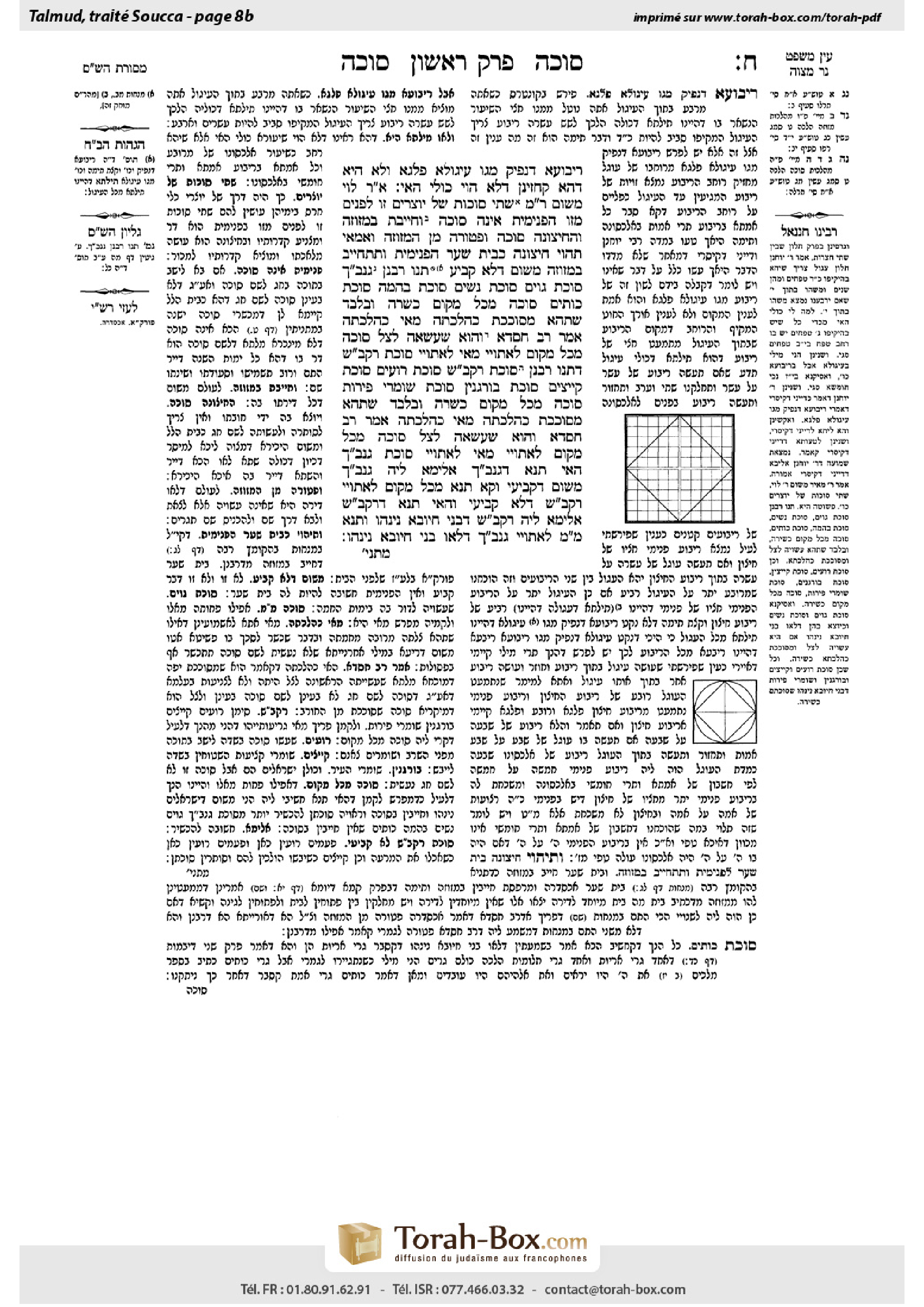
Sukkah 8b: Talmud study for Daf Yomi
Daf Yomi is the daily study of one Talmud folio. Explore 37 tractates with scans, Hebrew text, Sefaria English and AI-generated French translations where annotated.
Passage selection and English or AI-generated French translation are available where the scan has annotations. Daf Study is independent of Torah-Box and Sefaria.
Browse Sukkah · סוכה · All tractatesSukkah 8b text and translations
This page of Sukkah includes the Aramaic text, an English translation and an AI-generated French translation, alongside the scan above.
סוכה ח׳ ב · Aramaic and Hebrew text
רִיבּוּעָא דְּנָפֵיק מִגּוֹ עִיגּוּלָא — פַּלְגָא. וְלָא הִיא, דְּהָא קָחָזֵינַן דְּלָא הָוֵי כּוּלֵּי הַאי.
אָמַר רַבִּי לֵוִי מִשּׁוּם רַבִּי מֵאִיר: שְׁתֵּי סוּכּוֹת שֶׁל יוֹצְרִים זוֹ לִפְנִים מִזּוֹ — הַפְּנִימִית אֵינָהּ סוּכָּה, וְחַיֶּיבֶת בִּמְזוּזָה. וְהַחִיצוֹנָה סוּכָּה, וּפְטוּרָה מִן הַמְּזוּזָה.
וְאַמַּאי? תִּהְוֵי חִיצוֹנָה כְּבֵית שַׁעַר הַפְּנִימִית, וְתִתְחַיֵּיב בִּמְזוּזָה! מִשּׁוּם דְּלָא קְבִיעַ.
תָּנוּ רַבָּנַן: גַּנְבַּ״ךְ: סוּכַּת גּוֹיִם, סוּכַּת נָשִׁים, סוּכַּת בְּהֵמָה, סוּכַּת כּוּתִים סוּכָּה מִכׇּל מָקוֹם — כְּשֵׁרָה, וּבִלְבַד שֶׁתְּהֵא מְסוּכֶּכֶת כְּהִלְכָתָהּ.
מַאי ״כְּהִלְכָתָהּ״? אָמַר רַב חִסְדָּא: וְהוּא שֶׁעֲשָׂאָהּ לְצֵל סוּכָּה.
״מִכׇּל מָקוֹם״ לְאֵתוֹיֵי מַאי? לְאֵתוֹיֵי: סוּכַּת רַקְבַּ״שׁ. דְּתָנוּ רַבָּנַן: סוּכַּת רַקְבַּ״שׁ: סוּכַּת רוֹעִים, סוּכַּת קַיָּיצִים סוּכַּת בּוּרְגָּנִין סוּכַּת שׁוֹמְרֵי פֵירוֹת, סוּכָּה מִכׇּל מָקוֹם — כְּשֵׁרָה, וּבִלְבַד שֶׁתְּהֵא מְסוּכֶּכֶת כְּהִלְכָתָהּ.
מַאי ״כְּהִלְכָתָהּ״? אָמַר רַב חִסְדָּא: וְהוּא שֶׁעֲשָׂאָהּ לְצֵל סוּכָּה.
״מִכׇּל מָקוֹם״ לְאֵתוֹיֵי מַאי? לְאֵתוֹיֵי: סוּכַּת גַּנְבַּ״ךְ.
הַאי תַּנָּא דְּגַנְבַּ״ךְ, אַלִּימָא לֵיהּ גַּנְבַּ״ךְ מִשּׁוּם דִּקְבִיעִי, וְקָא תָּנֵא ״מִכׇּל מָקוֹם״ לְאֵתוֹיֵי רַקְבַּ״שׁ, דְּלָא קְבִיעִי.
וְהַאי תַּנָּא דְּרַקְבַּ״שׁ, אַלִּימָא לֵיהּ רַקְבַּ״שׁ, דִּבְנֵי חִיּוּבָא נִינְהוּ, וְתָנֵא ״מִכׇּל מָקוֹם״ לְאֵתוֹיֵי גַּנְבַּ״ךְ, דְּלָאו בְּנֵי חִיּוּבָא נִינְהוּ.
Sukkah 8b · English translation
while the perimeter of a square circumscribed by a circle is smaller than the circumference of that circle by half, i.e., if one adds half the perimeter of the square to the perimeter of the square, that is equal to the circumference of its circumscribing circle. Therefore, a circle with a circumference of twenty-four cubits would circumscribe a square with a perimeter of sixteen cubits, as prescribed by Rabbi Yoḥanan. The Gemara notes: And that is not the case, as we see that the circumference of the circumscribing circle is not that much. The actual circumference is closer to seventeen cubits.
§ Rabbi Levi said in the name of Rabbi Meir: With regard to two craftsmen’s booths, one within the other, as potters would build two booths, an inner one used as living quarters and an outer one for plying their craft and selling their wares, the inner one is not fit for fulfillment of the mitzva of sukka, since the potter resides there year-round and it is not evident during the Festival that he is residing there for the sake of the mitzva of sukka. And since it a permanent residence, it is also obligated in the mitzva of mezuza. And the outer booth is fit for fulfillment of the mitzva of sukka, since he does not reside there year-round, and when he resides there during the Festival it is evident that he is doing so for the sake of the mitzva. Since it is not designated as a year-round residence, but rather serves as an entrance to his residence and a passage for merchants and merchandise, it is not considered a residence and is not obligated in the mitzva of mezuza.
The Gemara asks: Why is the outer booth exempt from the mitzva of mezuza? Let the outer booth be considered like a gatehouse of the inner booth and therefore be obligated in the mitzva of mezuza. The Gemara answers: It is exempt because even the inner booth is not a permanent residence. It requires a mezuza because the potter resides there year-round; however, that alone does not render it a full-fledged residence that would obligate one to affix a mezuza to the outer booth as its gatehouse.
The Sages taught: The booths represented by the mnemonic: Gimmel, nun, beit, kaf, which stands for a booth of gentiles [goyim], a booth of women [nashim], a booth of domesticated animals [behema], a booth of Samaritans [Kutim], a booth of any sort, each is fit for use as a sukka, provided it is roofed in the standard sense. None of them is disqualified due to the one who constructed it or the purpose for which it was constructed.
The Gemara asks: What is the meaning of the term: In the standard sense? Rav Ḥisda said that it means: And provided that one established the booth to provide shade of a sukka from its roofing, it may be used to fulfill the mitzva of sukka.
The Gemara asks: What does the phrase: A booth of any sort, come to include? What other booths are included in this generalization? The Gemara answers: It comes to include the booths listed in another baraita with the mnemonic: Reish, kuf, beit, shin, as the Sages taught: The booth known by the mnemonic reish, kuf, beit, shin, which stands for the booth of shepherds [ro’im], the booth of fig driers [kayyatzim], the booth of guards of fields [burganin], the booth of the guards of produce [shomerei peirot], a booth of any sort, each is fit, provided it is roofed in the standard sense.
The Gemara asks again: What is the meaning of the term: In the standard sense? Rav Ḥisda said that it means: And provided that one established the booth to provide shade of a sukka, it may be used to fulfill the mitzva of sukka.
The Gemara asks: What does the phrase: A booth of any sort, come to include? The Gemara answers: It comes to include the booths listed in the first baraita cited above with the mnemonic gimmel, nun, beit, kaf.
The Gemara explains: This tanna who taught and detailed the halakhot of booths of gimmel, nun, beit, kaf did so because the fitness of the booths of gimmel, nun, beit, kaf for use in fulfilling the mitzva of sukka is powerful and more obvious to him because they are permanent structures, even though their builders are not obligated in the mitzva. And he taught: Booths of any sort, to include the booths of reish, kuf, beit, shin, which, although they are seasonal and not permanent structures, may still be used to fulfill the mitzva of sukka.
And that other tanna who taught and detailed the halakhot of booths of reish, kuf, beit, shin did so because the fitness of the booths of reish, kuf, beit, shin for use in fulfilling the mitzva of sukka is powerful and more obvious to him because those who constructed the booths are obligated in the mitzva of sukka. And he taught: Booths of any sort, to include the booths of gimmel, nun, beit, kaf, which, although those who constructed them are not obligated in the mitzva, may still be used to fulfill the mitzva of sukka.
Sukkah 8b · Traduction française (IA)
tandis que le périmètre d’un carré circonscrit par un cercle est inférieur de moitié à la circonférence de ce cercle ; autrement dit, si l’on ajoute la moitié du périmètre du carré à son périmètre, on obtient la circonférence du cercle qui le circonscrit. Ainsi, un cercle d’une circonférence de vingt-quatre coudées circonscrirait un carré dont le périmètre serait de seize coudées, comme l’a prescrit Rabbi Yoḥanan. La Guemara fait remarquer : ce n’est pourtant pas le cas, car on constate que la circonférence du cercle circonscrit n’est pas aussi grande. Sa circonférence réelle est plus proche de dix-sept coudées.
§ Rabbi Lévi a dit au nom de Rabbi Meïr : à propos de deux cabanes d’artisans, l’une à l’intérieur de l’autre — comme les potiers avaient coutume de construire deux cabanes, une intérieure, servant d’habitation, et une extérieure, où ils exerçaient leur métier et vendaient leurs marchandises —, la cabane intérieure ne convient pas à l’accomplissement de la mitsva de la soukka, puisque le potier y réside toute l’année et qu’il n’est pas manifeste, pendant la fête, qu’il y réside pour accomplir la mitsva de la soukka. Et, puisqu’il s’agit d’une résidence permanente, elle est également assujettie à la mitsva de mezouza. La cabane extérieure, quant à elle, convient à l’accomplissement de la mitsva de la soukka, puisqu’il n’y réside pas toute l’année et que, lorsqu’il y réside pendant la fête, il est manifeste qu’il le fait pour accomplir la mitsva. Comme elle n’est pas destinée à servir de résidence toute l’année, mais plutôt d’entrée à son habitation et de passage pour les marchands et les marchandises, elle n’est pas considérée comme une résidence et n’est pas assujettie à la mitsva de mezouza.
La Guemara demande : pourquoi la cabane extérieure est-elle exemptée de la mitsva de mezouza ? Ne devrait-on pas la considérer comme un corps de garde de la cabane intérieure et, par conséquent, l’assujettir à la mitsva de mezouza ? La Guemara répond : elle en est exemptée, car même la cabane intérieure n’est pas une résidence permanente. Elle requiert une mezouza parce que le potier y réside toute l’année ; toutefois, cela ne suffit pas à en faire une véritable résidence qui entraînerait l’obligation de fixer une mezouza à la cabane extérieure en tant que corps de garde.
Les Sages ont enseigné : les cabanes désignées par le moyen mnémotechnique guimel, noun, beit, kaf — qui signifie une cabane de non-Juifs [goyim], une cabane de femmes [nashim], une cabane d’animaux domestiques [behema], une cabane de Samaritains [Kutim], et une cabane de n’importe quelle sorte — conviennent chacune pour servir de soukka, à condition d’être couvertes au sens habituel du terme. Aucune d’elles n’est invalidée en raison de la personne qui l’a construite ou de la raison pour laquelle elle a été construite.
La Guemara demande : que signifie l’expression « au sens habituel du terme » ? Rav Ḥisda a dit qu’elle signifie : à condition que l’on ait construit la cabane afin que sa couverture procure l’ombre d’une soukka ; elle peut alors servir à accomplir la mitsva de la soukka.
La Guemara demande : qu’inclut l’expression « une cabane de n’importe quelle sorte » ? Quelles autres cabanes sont comprises dans cette généralisation ? La Guemara répond : elle inclut les cabanes mentionnées dans une autre baraïta, désignées par le moyen mnémotechnique reish, kouf, beit, shin. En effet, les Sages ont enseigné : les cabanes désignées par reish, kouf, beit, shin — qui signifie la cabane des bergers [ro’im], la cabane des dessiccateurs de figues [kayyatzim], la cabane des gardiens des champs [burganin], la cabane des gardiens des produits [shomerei peirot], et une cabane de n’importe quelle sorte — conviennent chacune, à condition d’être couvertes au sens habituel du terme.
La Guemara demande de nouveau : que signifie l’expression « au sens habituel du terme » ? Rav Ḥisda a dit qu’elle signifie : à condition que l’on ait construit la cabane afin qu’elle procure l’ombre d’une soukka ; elle peut alors servir à accomplir la mitsva de la soukka.
La Guemara demande : qu’inclut l’expression « une cabane de n’importe quelle sorte » ? La Guemara répond : elle inclut les cabanes mentionnées dans la première baraïta citée plus haut, désignées par le moyen mnémotechnique guimel, noun, beit, kaf.
Ce tanna qui a enseigné et détaillé les halakhot relatives aux cabanes désignées par guimel, noun, beit, kaf l’a fait parce qu’à ses yeux, leur aptitude à servir à l’accomplissement de la mitsva de la soukka est plus évidente, puisqu’il s’agit de constructions permanentes, bien que leurs constructeurs ne soient pas assujettis à la mitsva. Et il a enseigné l’expression « des cabanes de n’importe quelle sorte » afin d’inclure les cabanes désignées par reish, kouf, beit, shin qui, bien qu’elles soient saisonnières et non permanentes, peuvent néanmoins servir à l’accomplissement de la mitsva de la soukka.
Et cet autre tanna qui a enseigné et détaillé les halakhot relatives aux cabanes désignées par reish, kouf, beit, shin l’a fait parce qu’à ses yeux, leur aptitude à servir à l’accomplissement de la mitsva de la soukka est plus évidente, puisque leurs constructeurs sont assujettis à la mitsva de la soukka. Et il a enseigné l’expression « des cabanes de n’importe quelle sorte » afin d’inclure les cabanes désignées par guimel, noun, beit, kaf qui, bien que leurs constructeurs ne soient pas assujettis à la mitsva, peuvent néanmoins servir à l’accomplissement de la mitsva de la soukka.
Traduction française générée par IA à partir de l’édition anglaise de Sefaria. Vérifie toujours un passage avec le texte source.
Text from Sefaria: William Davidson Edition - Vocalized Aramaic (CC BY NC); William Davidson Edition - English (CC BY NC).