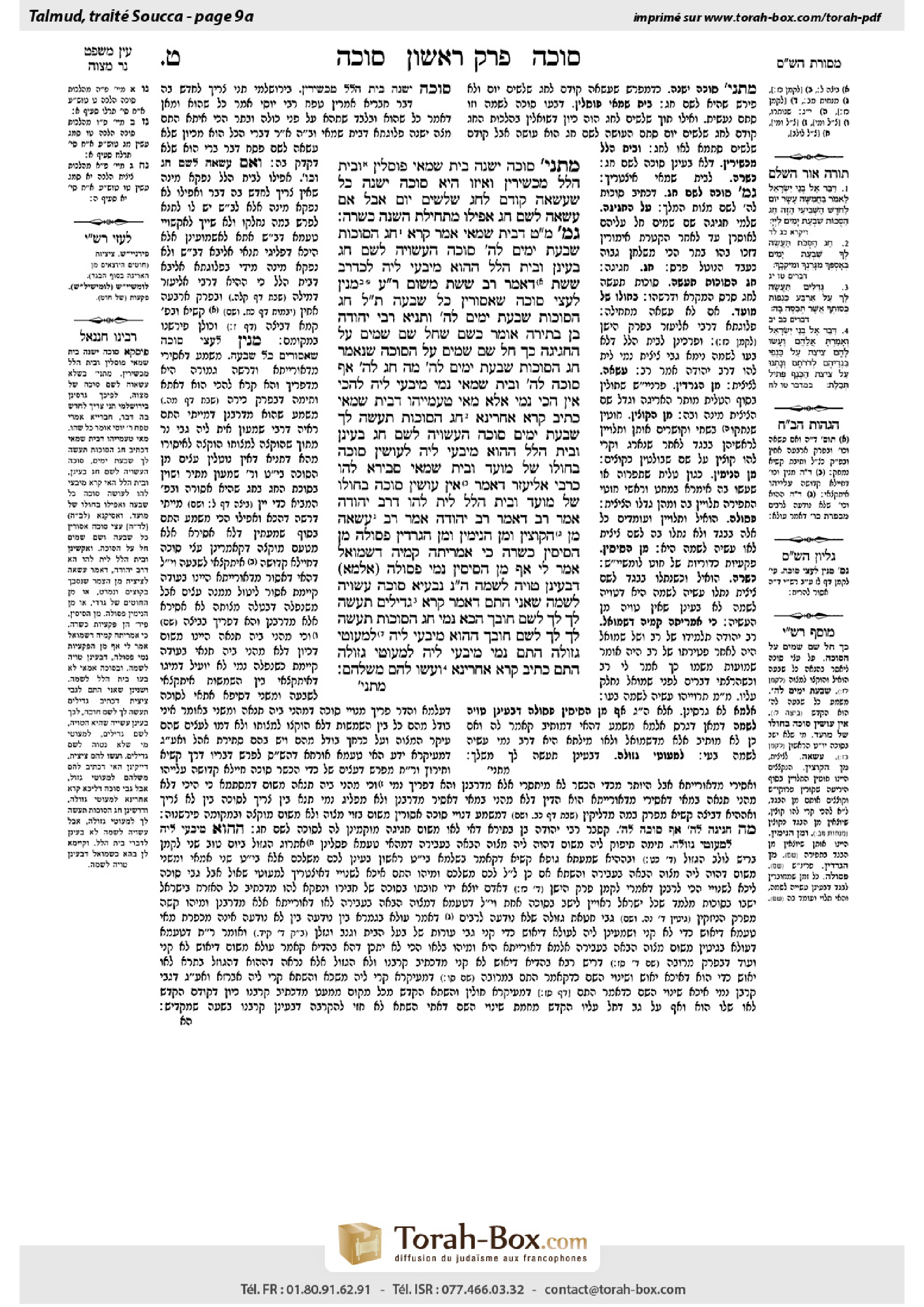
Sukkah 9a: Talmud study for Daf Yomi
Daf Yomi is the daily study of one Talmud folio. Explore 37 tractates with scans, Hebrew text, Sefaria English and AI-generated French translations where annotated.
Passage selection and English or AI-generated French translation are available where the scan has annotations. Daf Study is independent of Torah-Box and Sefaria.
Browse Sukkah · סוכה · All tractatesSukkah 9a text and translations
This page of Sukkah includes the Aramaic text, an English translation and an AI-generated French translation, alongside the scan above.
סוכה ט׳ א · Aramaic and Hebrew text
מַתְנִי׳ סוּכָּה יְשָׁנָה — בֵּית שַׁמַּאי פּוֹסְלִין וּבֵית הִלֵּל מַכְשִׁירִין. וְאֵיזוֹ הִיא סוּכָּה יְשָׁנָה, כׇּל שֶׁעֲשָׂאָהּ קוֹדֶם לֶחָג שְׁלֹשִׁים יוֹם. אֲבָל אִם עֲשָׂאָהּ לְשֵׁם חַג, אֲפִילּוּ מִתְּחִילַּת הַשָּׁנָה — כְּשֵׁרָה.
גְּמָ׳ מַאי טַעְמַיְיהוּ דְּבֵית שַׁמַּאי? אָמַר קְרָא: ״חַג הַסּוּכּוֹת שִׁבְעַת יָמִים לַה׳״, סוּכָּה הָעֲשׂוּיָה לְשֵׁם חַג בָּעֵינַן.
וּבֵית הִלֵּל? הַהוּא מִיבְּעֵי לֵיהּ לְכִדְרַב שֵׁשֶׁת. דְּאָמַר רַב שֵׁשֶׁת מִשּׁוּם רַבִּי עֲקִיבָא: מִנַּיִן לַעֲצֵי סוּכָּה שֶׁאֲסוּרִין כׇּל שִׁבְעָה — תַּלְמוּד לוֹמַר: ״חַג הַסּוּכּוֹת שִׁבְעַת יָמִים לַה׳״,
וְתַנְיָא, רַבִּי יְהוּדָה בֶּן בְּתִירָה אוֹמֵר: כְּשֵׁם שֶׁחָל שֵׁם שָׁמַיִם עַל הַחֲגִיגָה, כָּךְ חָל שֵׁם שָׁמַיִם עַל הַסּוּכָּה, שֶׁנֶּאֱמַר: ״חַג הַסּוּכּוֹת שִׁבְעַת יָמִים לַה׳״, מָה חַג לַה׳ — אַף סוּכָּה לַה׳.
וּבֵית שַׁמַּאי נָמֵי מִיבְּעֵי לֵיהּ לְהָכִי! אִין הָכִי נָמֵי,
אֶלָּא מַאי טַעְמַיְיהוּ דְּבֵית שַׁמַּאי — כְּתִיב קְרָא אַחֲרִינָא: ״חַג הַסּוּכּוֹת תַּעֲשֶׂה לְךָ שִׁבְעַת יָמִים״, סוּכָּה הָעֲשׂוּיָה לְשֵׁם חַג בָּעֵינַן.
וּבֵית הִלֵּל — הַהוּא מִיבְּעֵי לֵיהּ לְעוֹשִׂין סוּכָּה בְּחוּלּוֹ שֶׁל מוֹעֵד.
וּבֵית שַׁמַּאי — סְבִירָא לְהוּ כְּרַבִּי אֱלִיעֶזֶר, דְּאָמַר: אֵין עוֹשִׂין סוּכָּה בְּחוּלּוֹ שֶׁל מוֹעֵד.
וּבֵית הִלֵּל לֵית לְהוּ דְּרַב יְהוּדָה אָמַר רַב? דְּאָמַר רַב יְהוּדָה אָמַר רַב: עֲשָׂאָהּ מִן הַקּוֹצִין וּמִן הַנִּימִין וּמִן הַגְּרָדִין — פְּסוּלָה. מִן הַסִּיסִין — כְּשֵׁרָה,
כִּי אַמְרִיתַהּ קַמֵּיהּ דִּשְׁמוּאֵל, אָמַר לִי: אַף מִן הַסִּיסִין נָמֵי פְּסוּלָה, (אַלְמָא) דְּבָעֵינַן טְוִיָּה לִשְׁמָהּ. הָכָא נָמֵי בָּעֵינַן סוּכָּה עֲשׂוּיָה לִשְׁמָהּ!
שָׁאנֵי הָתָם, דְּאָמַר קְרָא: ״גְּדִילִים תַּעֲשֶׂה לָךְ״, לָךְ — לְשֵׁם חוֹבָךְ. הָכָא נָמֵי: ״חַג הַסּוּכּוֹת תַּעֲשֶׂה לְךָ״, לָךְ — לְשֵׁם חוֹבָךְ!
הַהוּא מִיבְּעֵי לֵיהּ לְמַעוֹטֵי גְּזוּלָה. הָתָם נָמֵי מִיבְּעֵי לֵיהּ לְמַעוֹטֵי גְּזוּלָה!
הָתָם כְּתִיב קְרָא אַחֲרִינָא: ״וְעָשׂוּ לָהֶם״ — מִשֶּׁלָּהֶם.
Sukkah 9a · English translation
MISHNA: With regard to an old sukka, Beit Shammai deem it unfit for the mitzva of sukka and Beit Hillel deem it fit. And which is considered an old sukka? It is any booth that one established thirty days or more prior to the Festival without expressly designating that it was for the mitzva of sukka. In that case, the assumption is that he constructed it for some other purpose. However, if he established it expressly for the sake of the festival of Sukkot, even if he constructed it at the beginning of the previous year, it is fit for use in the fulfillment of the mitzva of sukka, even according to Beit Shammai.
GEMARA: The Gemara asks: What is the rationale for the opinion of Beit Shammai? The Gemara explains that it is as the verse states: “The festival of Sukkot is seven days unto the Lord” (Leviticus 23:34), indicating that we require a sukka established for the sake of the Festival. A sukka not constructed expressly for the Festival is unfit.
The Gemara asks: And how do Beit Hillel interpret this verse? The Gemara answers: In Beit Hillel’s opinion, that verse is necessary to teach in accordance with the statement of Rav Sheshet, as Rav Sheshet said in the name of Rabbi Akiva: From where is it derived that use of the wood of the sukka is prohibited for any purpose other than for the sukka all seven days of the Festival, and it is designated exclusively for the mitzva? It is derived as the verse states: “The festival of Sukkot is seven days unto the Lord.”
And it is taught in a baraita in explanation that Rabbi Yehuda ben Beteira says: Just as the name of Heaven takes effect upon the Festival peace-offering, so too, the name of Heaven takes effect upon the sukka, as it is stated: “The festival of Sukkot is seven days unto the Lord”; just as the Festival offering is consecrated to the Lord, so too, the sukka is consecrated to the Lord.
The Gemara asks: But don’t Beit Shammai require the verse to derive this halakha as well? The Gemara answers: Yes, indeed it is so that Beit Shammai derives the sanctity of the wood of the sukka from this verse. Therefore, the rationale for their opinion with regard to an old sukka must be based on a different verse.
Rather, what is the rationale for the opinion of Beit Shammai with regard to an old sukka? Another verse is written: “You shall prepare for you the festival of Sukkot for seven days” (Deuteronomy 16:13), from which it is derived that we require a sukka established for the sake of the Festival.
The Gemara asks: And how do Beit Hillel interpret this verse? The Gemara answers: That verse is necessary to teach that one may establish a sukka even during the intermediate days of the Festival. If one failed to construct a sukka prior to the onset of the Festival, or if it collapsed during the Festival, he may establish it during the intermediate days, as the mitzva to establish a sukka is in effect for all seven days of the Festival.
The Gemara asks: And from where do Beit Shammai derive this halakha? They hold in accordance with the opinion of Rabbi Eliezer, who said: One may not establish a sukka during the intermediate days of the Festival. Therefore, the requirement to build the sukka for the sake of the mitzva may be derived from this verse.
The Gemara proceeds to clarify Beit Hillel’s opinion: And do Beit Hillel not agree with the statement that Rav Yehuda said that Rav said? As Rav Yehuda said that Rav said: If one fashioned ritual fringes from hanging threads that remain protruding from the fabric like thorns after most of the superfluous threads were torn, and tied them into ritual fringes; or if he tied the fringes from threads that hang down after sewing; or if he tied them from the fringes [geradin] that hang from the bottom of a garment, the ritual fringes are unfit for fulfilling the mitzva. However, if the ritual fringes were tied from balls of thread that were not spun for the sake of the mitzva, they are fit.
And Rav Yehuda related: When I stated this halakha in the name of Rav before Shmuel, he said to me: Even ritual fringes tied from balls of thread are unfit, as we require the spinning of the thread to be for the sake of the mitzva. Just as the threads for the ritual fringes must be spun for the sake of the mitzva, here too, let us require a sukka established for the sake of the mitzva.
The Gemara answers: It is different there, as the verse states: “You shall prepare for you fringes” (Deuteronomy 22:12), from which it is derived: “For you,” for the sake of your obligation. The fringes, from the beginning of their production, must be produced for the sake of the mitzva. The Gemara asks: Here, too, with regard to sukka, the verse says: “You shall prepare for you the festival of Sukkot” (Deuteronomy 16:13). Shouldn’t it be derived: “For you,” for the sake of your obligation?
The Gemara answers that this term “for you” is required to exclude use of a stolen sukka; establish the sukka for you, and do not use a sukka belonging to another. The Gemara asks: There, too, with regard to ritual fringes, isn’t the term “for you” required to exclude use of stolen ritual fringes?
The Gemara answers: There, with regard to ritual fringes, another verse is written: “And they shall make for them ritual fringes” (Numbers 15:38), from which it is derived: “For them,” of their own, to exclude the use of stolen ritual fringes. Therefore from the term “for you,” it may be derived that ritual fringes must be produced for the sake of the mitzva.
Sukkah 9a · Traduction française (IA)
MICHNA : À propos d’une soukka ancienne, Beit Chammaï la déclarent impropre à la mitsva de la soukka, tandis que Beit Hillel la déclarent apte. Qu’appelle-t-on une soukka ancienne ? Toute cabane construite au moins trente jours avant la fête, sans qu’il ait été précisé expressément qu’elle était destinée à la mitsva de la soukka. Dans ce cas, on présume qu’elle a été construite dans un autre but. En revanche, si elle a été construite expressément en vue de la fête de Soukkot, même au début de l’année précédente, elle est apte à l’accomplissement de la mitsva de la soukka, même selon Beit Chammaï.
GUEMARA : La Guemara demande : Quel est le fondement de l’opinion de Beit Chammaï ? La Guemara explique qu’elle s’appuie sur ce verset : « La fête de Soukkot durera sept jours pour le Seigneur » (Lévitique 23, 34), ce qui indique qu’il faut une soukka construite en vue de la fête. Une soukka qui n’a pas été construite expressément en vue de la fête est impropre.
La Guemara demande : Et comment Beit Hillel interprètent-ils ce verset ? La Guemara répond : Selon Beit Hillel, ce verset est nécessaire pour enseigner conformément à ce que Rav Chéchet a dit au nom de Rabbi Akiva : D’où apprend-on qu’il est interdit d’utiliser le bois de la soukka à toute autre fin que celle de la soukka pendant les sept jours de la fête, et qu’il est réservé exclusivement à la mitsva ? On l’apprend de ce verset : « La fête de Soukkot durera sept jours pour le Seigneur. »
Et une baraïta enseigne, pour expliquer ce principe, que Rabbi Yehouda ben Beteira dit : De même que le nom du Ciel s’applique au sacrifice de paix de la fête, le nom du Ciel s’applique aussi à la soukka, comme il est dit : « La fête de Soukkot durera sept jours pour le Seigneur » ; de même que le sacrifice de la fête est consacré au Seigneur, la soukka est elle aussi consacrée au Seigneur.
La Guemara demande : Mais Beit Chammaï n’ont-ils pas besoin de ce verset pour déduire également cette halakha ? La Guemara répond : Si, Beit Chammaï déduisent effectivement de ce verset la sainteté du bois de la soukka. Le fondement de leur opinion concernant une soukka ancienne doit donc s’appuyer sur un autre verset.
Mais alors, quel est le fondement de l’opinion de Beit Chammaï concernant une soukka ancienne ? Un autre verset est écrit : « Tu célébreras pour toi la fête de Soukkot pendant sept jours » (Deutéronome 16, 13), d’où l’on déduit qu’il faut une soukka construite en vue de la fête.
La Guemara demande : Et comment Beit Hillel interprètent-ils ce verset ? La Guemara répond : Ce verset est nécessaire pour enseigner qu’on peut construire une soukka même pendant les jours intermédiaires de la fête. Si quelqu’un n’a pas construit de soukka avant le début de la fête, ou si elle s’est effondrée pendant la fête, il peut en construire une pendant les jours intermédiaires, car la mitsva de construire une soukka s’applique pendant les sept jours de la fête.
La Guemara demande : Et d’où Beit Chammaï déduisent-ils cette halakha ? Ils suivent l’opinion de Rabbi Eliézer, qui a dit : On ne peut pas construire de soukka pendant les jours intermédiaires de la fête. On peut donc déduire de ce verset l’obligation de construire la soukka en vue de la mitsva.
La Guemara poursuit en précisant l’opinion de Beit Hillel : Beit Hillel ne sont-ils pas d’accord avec ce que Rav Yehouda a dit au nom de Rav ? Rav Yehouda a dit au nom de Rav : Si quelqu’un a confectionné des franges rituelles à partir de fils pendants qui dépassent du tissu comme des épines, après qu’on en a arraché la majeure partie des fils superflus, puis les a noués en franges rituelles ; ou s’il a noué les franges à partir de fils qui pendent après la couture ; ou s’il les a nouées à partir des franges [geradin] qui pendent du bas d’un vêtement, ces franges rituelles sont impropres à l’accomplissement de la mitsva. En revanche, si les franges rituelles ont été nouées à partir de pelotes de fil qui n’avaient pas été filées en vue de la mitsva, elles sont aptes.
Rav Yehouda rapporta : Lorsque j’ai énoncé cette halakha au nom de Rav devant Chmouel, celui-ci m’a dit : Même les franges rituelles nouées à partir de pelotes de fil sont impropres, car le fil doit avoir été filé en vue de la mitsva. De même que les fils des franges rituelles doivent être filés en vue de la mitsva, ne faut-il pas également exiger qu’une soukka soit construite en vue de la mitsva ?
La Guemara répond : Le cas est différent, car le verset dit : « Tu te feras des franges » (Deutéronome 22, 12), d’où l’on déduit : « Pour toi », c’est-à-dire en vue de satisfaire à ton obligation. Dès le début de leur fabrication, les franges doivent être produites en vue de la mitsva. La Guemara demande : Ici aussi, à propos de la soukka, le verset dit : « Tu célébreras pour toi la fête de Soukkot » (Deutéronome 16, 13). Ne devrait-on pas en déduire : « Pour toi », c’est-à-dire en vue de satisfaire à ton obligation ?
La Guemara répond que l’expression « pour toi » est nécessaire pour exclure l’utilisation d’une soukka volée : construis la soukka pour toi et n’utilise pas une soukka appartenant à autrui. La Guemara demande : Là aussi, à propos des franges rituelles, l’expression « pour toi » n’est-elle pas nécessaire pour exclure l’utilisation de franges rituelles volées ?
La Guemara répond : Là, à propos des franges rituelles, un autre verset est écrit : « Ils se feront des franges rituelles » (Nombres 15, 38), d’où l’on déduit : « Pour eux », c’est-à-dire des franges qui leur appartiennent, afin d’exclure l’utilisation de franges rituelles volées. On peut donc déduire de l’expression « pour toi » que les franges rituelles doivent être produites en vue de la mitsva.
Traduction française générée par IA à partir de l’édition anglaise de Sefaria. Vérifie toujours un passage avec le texte source.
Text from Sefaria: William Davidson Edition - Vocalized Aramaic (CC BY NC); William Davidson Edition - English (CC BY NC).