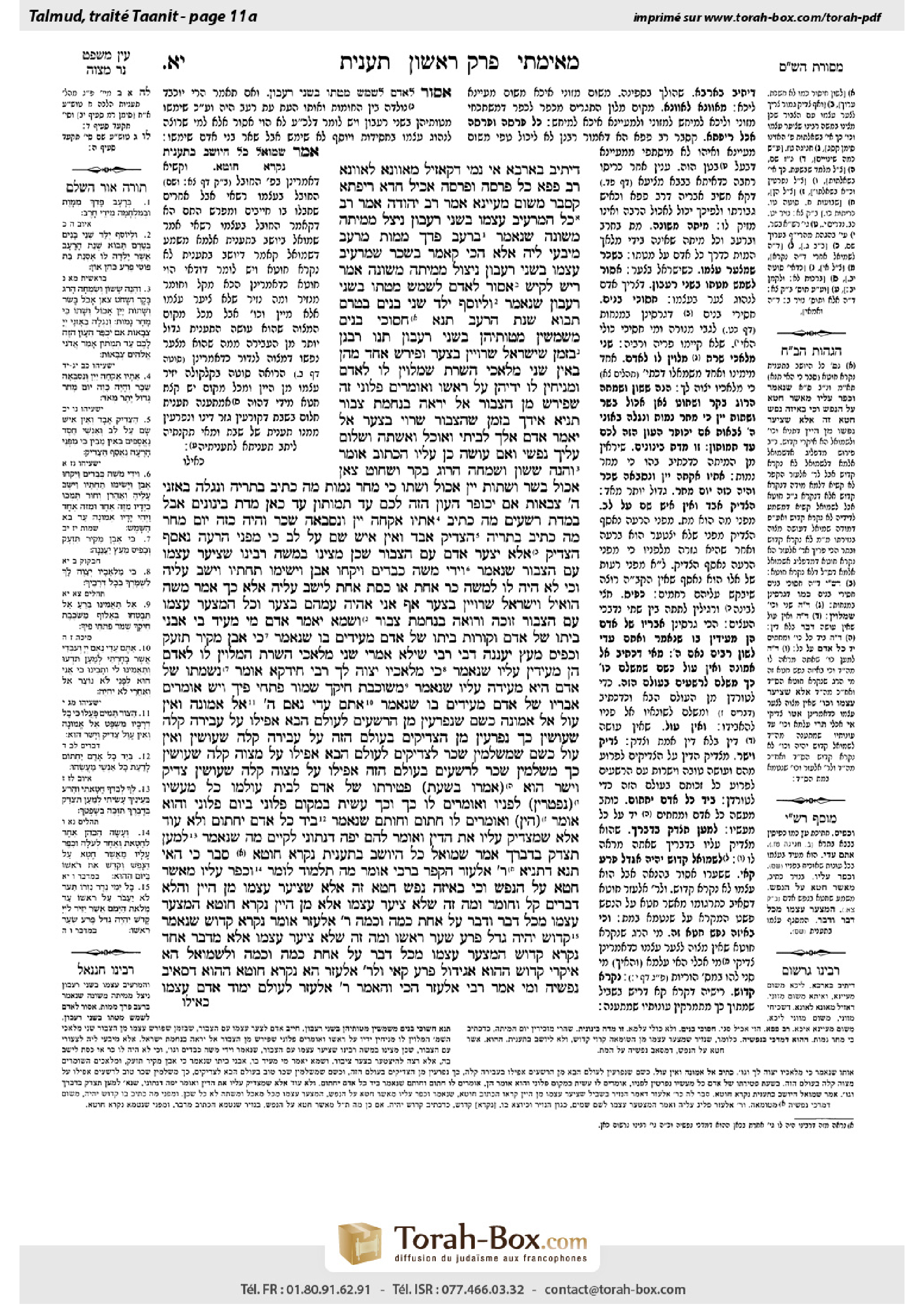
Taanit 11a: Talmud study for Daf Yomi
Daf Yomi is the daily study of one Talmud folio. Explore 37 tractates with scans, Hebrew text, Sefaria English and AI-generated French translations where annotated.
Passage selection and English or AI-generated French translation are available where the scan has annotations. Daf Study is independent of Torah-Box and Sefaria.
Browse Taanit · תענית · All tractatesTaanit 11a text and translations
This page of Taanit includes the Aramaic text, an English translation and an AI-generated French translation, alongside the scan above.
תענית י״א א · Aramaic and Hebrew text
דְּיָתֵיב בְּאַרְבָּא. אִי נָמֵי, דְּקָאָזֵיל מֵאַוּוֹנָא לְאַוּוֹנָא.
רַב פָּפָּא — כׇּל פַּרְסָה וּפַרְסָה אָכֵיל חֲדָא רִיפְתָּא. קָסָבַר, מִשּׁוּם מַעְיָינָא.
אָמַר רַב יְהוּדָה אָמַר רַב: כׇּל הַמַּרְעִיב עַצְמוֹ בִּשְׁנֵי רְעָבוֹן, — נִיצָּל מִמִּיתָה מְשׁוּנָּה, שֶׁנֶּאֱמַר: ״בָּרָעָב פָּדְךָ מִמָּוֶת״. ״מֵרָעָב״ מִיבְּעֵי לֵיהּ, אֶלָּא הָכִי קָאָמַר: בִּשְׂכַר שֶׁמַּרְעִיב עַצְמוֹ בִּשְׁנֵי רְעָבוֹן — נִיצּוֹל מִמִּיתָה מְשׁוּנָּה.
אָמַר רֵישׁ לָקִישׁ: אָסוּר לְאָדָם לְשַׁמֵּשׁ מִטָּתוֹ בִּשְׁנֵי רְעָבוֹן, שֶׁנֶּאֱמַר: ״וּלְיוֹסֵף יֻלַּד שְׁנֵי בָנִים בְּטֶרֶם תָּבוֹא שְׁנַת הָרָעָב״. תָּנָא: חֲסוּכֵי בָּנִים מְשַׁמְּשִׁין מִטּוֹתֵיהֶן בִּשְׁנֵי רְעָבוֹן.
תָּנוּ רַבָּנַן: בִּזְמַן שֶׁיִּשְׂרָאֵל שְׁרוּיִין בְּצַעַר וּפֵירַשׁ אֶחָד מֵהֶן, בָּאִין שְׁנֵי מַלְאֲכֵי הַשָּׁרֵת שֶׁמְּלַוִּין לוֹ לָאָדָם, וּמַנִּיחִין לוֹ יְדֵיהֶן עַל רֹאשׁוֹ, וְאוֹמְרִים: פְּלוֹנִי זֶה שֶׁפֵּירַשׁ מִן הַצִּבּוּר אַל יִרְאֶה בְּנֶחָמַת צִבּוּר.
תַּנְיָא אִידַּךְ: בִּזְמַן שֶׁהַצִּבּוּר שָׁרוּי בְּצַעַר, אַל יֹאמַר אָדָם: אֵלֵךְ לְבֵיתִי, וְאוֹכַל וְאֶשְׁתֶּה, וְשָׁלוֹם עָלַיִךְ נַפְשִׁי. וְאִם עוֹשֶׂה כֵּן — עָלָיו הַכָּתוּב אוֹמֵר: ״וְהִנֵּה שָׂשׂוֹן וְשִׂמְחָה הָרֹג בָּקָר וְשָׁחֹט צֹאן אָכֹל בָּשָׂר וְשָׁתוֹת יָיִן אָכוֹל וְשָׁתוֹ כִּי מָחָר נָמוּת״, מָה כְּתִיב בָּתְרֵיהּ — ״וְנִגְלָה בְאׇזְנָי ה׳ צְבָאוֹת אִם יְכֻפַּר הֶעָוֹן הַזֶּה לָכֶם עַד תְּמֻתוּן״.
עַד כָּאן מִידַּת בֵּינוֹנִים. אֲבָל בְּמִדַּת רְשָׁעִים, מָה כְּתִיב? ״אֵתָיוּ אֶקְחָה יַיִן וְנִסְבְּאָה שֵׁכָר וְהָיָה כָזֶה יוֹם מָחָר״, מָה כְּתִיב בָּתְרֵיהּ: ״הַצַּדִּיק אָבָד וְאֵין אִישׁ שָׂם עַל לֵב כִּי מִפְּנֵי הָרָעָה נֶאֱסַף הַצַּדִּיק״.
אֶלָּא, יְצַעֵר אָדָם עִם הַצִּבּוּר, שֶׁכֵּן מָצִינוּ בְּמֹשֶׁה רַבֵּינוּ שֶׁצִּיעֵר עַצְמוֹ עִם הַצִּבּוּר, שֶׁנֶּאֱמַר: ״וִידֵי מֹשֶׁה כְּבֵדִים וַיִּקְחוּ אֶבֶן וַיָּשִׂימוּ תַחְתָּיו וַיֵּשֶׁב עָלֶיהָ״, וְכִי לֹא הָיָה לוֹ לְמֹשֶׁה כַּר אֶחָד אוֹ כֶּסֶת אַחַת לֵישֵׁב עָלֶיהָ? אֶלָּא כָּךְ אָמַר מֹשֶׁה: הוֹאִיל וְיִשְׂרָאֵל שְׁרוּיִין בְּצַעַר — אַף אֲנִי אֶהְיֶה עִמָּהֶם בְּצַעַר. וְכׇל הַמְצַעֵר עַצְמוֹ עִם הַצִּבּוּר — זוֹכֶה וְרוֹאֶה בְּנֶחָמַת צִבּוּר.
וְשֶׁמָּא יֹאמַר אָדָם: מִי מֵעִיד בִּי? אַבְנֵי בֵיתוֹ שֶׁל אָדָם וְקוֹרוֹת בֵּיתוֹ שֶׁל אָדָם מְעִידִים בּוֹ, שֶׁנֶּאֱמַר: ״כִּי אֶבֶן מִקִּיר תִּזְעָק וְכָפִיס מֵעֵץ יַעֲנֶנָּה״. דְּבֵי רַבִּי שֵׁילָא אָמְרִי: שְׁנֵי מַלְאֲכֵי הַשָּׁרֵת הַמְלַוִּין לוֹ לָאָדָם, הֵן מְעִידִין עָלָיו, שֶׁנֶּאֱמַר: ״כִּי מַלְאָכָיו יְצַוֶּה לָּךְ״.
רַבִּי חִידְקָא אוֹמֵר: נִשְׁמָתוֹ שֶׁל אָדָם הִיא מְעִידָה עָלָיו, שֶׁנֶּאֱמַר: ״מִשֹּׁכֶבֶת חֵיקֶךָ שְׁמֹר פִּתְחֵי פִיךָ״. וְיֵשׁ אוֹמְרִים: אֵבָרָיו שֶׁל אָדָם מְעִידִים בּוֹ, שֶׁנֶּאֱמַר: ״אַתֶּם עֵדַי נְאֻם ה׳״.
״אֵל אֱמוּנָה וְאֵין עָוֶל״. ״אֵל אֱמוּנָה״, כְּשֵׁם שֶׁנִּפְרָעִין מִן הָרְשָׁעִים לָעוֹלָם הַבָּא אֲפִילּוּ עַל עֲבֵירָה קַלָּה שֶׁעוֹשִׂין, כָּךְ נִפְרָעִין מִן הַצַּדִּיקִים בָּעוֹלָם הַזֶּה עַל עֲבֵירָה קַלָּה שֶׁעוֹשִׂין.
״וְאֵין עָוֶל״, כְּשֵׁם שֶׁמְּשַׁלְּמִין שָׂכָר לַצַּדִּיקִים לָעוֹלָם הַבָּא אֲפִילּוּ עַל מִצְוָה קַלָּה שֶׁעוֹשִׂין, כָּךְ מְשַׁלְּמִין שָׂכָר לָרְשָׁעִים בָּעוֹלָם הַזֶּה אֲפִילּוּ עַל מִצְוָה קַלָּה שֶׁעוֹשִׂין.
״צַדִּיק וְיָשָׁר הוּא״, אָמְרוּ: בִּשְׁעַת פְּטִירָתוֹ שֶׁל אָדָם לְבֵית עוֹלָמוֹ כׇּל מַעֲשָׂיו נִפְרָטִין לְפָנָיו, וְאוֹמְרִים לוֹ: כָּךְ וְכָךְ עָשִׂיתָ בְּמָקוֹם פְּלוֹנִי בְּיוֹם פְּלוֹנִי, וְהוּא אוֹמֵר: הֵן, וְאוֹמְרִים לוֹ: חֲתוֹם! וְחוֹתֵם. שֶׁנֶּאֱמַר: ״בְּיַד כׇּל אָדָם יַחְתּוֹם״. וְלֹא עוֹד, אֶלָּא שֶׁמַּצְדִּיק עָלָיו אֶת הַדִּין, וְאוֹמֵר לָהֶם: יָפֶה דַּנְתּוּנִי, לְקַיֵּים מַה שֶּׁנֶּאֱמַר ״לְמַעַן תִּצְדַּק בְּדׇבְרֶךָ״.
אָמַר שְׁמוּאֵל: כׇּל הַיּוֹשֵׁב בְּתַעֲנִית נִקְרָא חוֹטֵא. סָבַר כִּי הַאי תַּנָּא, דְּתַנְיָא: רַבִּי אֶלְעָזָר הַקַּפָּר בְּרַבִּי אוֹמֵר, מָה תַּלְמוּד לוֹמַר: ״וְכִפֶּר עָלָיו מֵאֲשֶׁר חָטָא עַל הַנָּפֶשׁ״, וְכִי בְּאֵיזֶה נֶפֶשׁ חָטָא זֶה? אֶלָּא שֶׁצִּיעֵר עַצְמוֹ מִן הַיַּיִן.
וַהֲלֹא דְּבָרִים קַל וְחוֹמֶר: וּמָה זֶה, שֶׁלֹּא צִיעֵר עַצְמוֹ אֶלָּא מִן הַיַּיִן — נִקְרָא חוֹטֵא, הַמְצַעֵר עַצְמוֹ מִכׇּל דָּבָר וְדָבָר — עַל אַחַת כַּמָּה וְכַמָּה.
רַבִּי אֶלְעָזָר אוֹמֵר: נִקְרָא קָדוֹשׁ, שֶׁנֶּאֱמַר: ״קָדוֹשׁ יִהְיֶה גַּדֵּל פֶּרַע שְׂעַר רֹאשׁוֹ״. וּמָה זֶה, שֶׁלֹּא צִיעֵר עַצְמוֹ אֶלָּא מִדָּבָר אֶחָד — נִקְרָא קָדוֹשׁ, הַמְצַעֵר עַצְמוֹ מִכׇּל דָּבָר — עַל אַחַת כַּמָּה וְכַמָּה.
וְלִשְׁמוּאֵל, הָא אִיקְּרִי קָדוֹשׁ! הָהוּא, אַגִּידּוּל פֶּרַע קָאֵי. וּלְרַבִּי אֶלְעָזָר, הָא נִקְרָא חוֹטֵא! הָהוּא דְּסַאֵיב נַפְשֵׁיהּ.
וּמִי אָמַר רַבִּי אֶלְעָזָר הָכִי? וְהָאָמַר רַבִּי אֶלְעָזָר: לְעוֹלָם יָמוֹד אָדָם עַצְמוֹ
Taanit 11a · English translation
is in a case where he is sitting in a boat. The traveler must be concerned about his food supply, but he need not worry that the jostling of the road might force him to exert himself, which has a tendency to cause digestive problems. Alternatively, the practical difference is in a case where he is traveling from station [avna] to station. Here the exertion of the road might cause digestive problems, but one need not be concerned about running out of food, as he can resupply along the way.
The Gemara relates that when Rav Pappa traveled, along each and every parasang he would eat one loaf of bread. Rav Pappa did so because he maintained that the prohibition was due to the bowels, and as he was healthy he was not concerned that travel by road would irritate his digestion.
Rav Yehuda said that Rav said: Anyone who has food for himself but nevertheless starves himself in years of famine will be saved from an unusual death, as it is stated: “In famine, He will redeem you from death” (Job 5:20). This is derived from the precise wording of the verse. According to its straightforward meaning, instead of “in famine,” it should have said: From famine, as one is delivered from famine. Rather, this is what the verse is saying: As a reward for starving himself in years of famine, Job will be saved from an unusual death.
Similarly, Reish Lakish said: It is prohibited for a person to have conjugal relations in years of famine, so that children not be born during these difficult years. As it is stated: “And to Joseph were born two sons before the year of famine came” (Genesis 41:50). It was taught in a baraita: Nevertheless, those without children may have marital relations in years of famine, as they must strive to fulfill the mitzva to be fruitful and multiply.
Likewise, the Sages taught in a baraita: When the Jewish people is immersed in distress, and one of them separates himself from the community and does not share their suffering, the two ministering angels who accompany a person come and place their hands on his head, as though he was an offering, and say: This man, so-and-so, who has separated himself from the community, let him not see the consolation of the community.
A similar idea is taught in another baraita: When the community is immersed in suffering, a person may not say: I will go to my home and I will eat and drink, and peace be upon you, my soul. And if he does so, the verse says about him: “And behold joy and gladness, slaying oxen and killing sheep, eating flesh and drinking wine; let us eat and drink, for tomorrow we shall die” (Isaiah 22:13). And the prophecy continues with what is written afterward, in the following verse: “And the Lord of hosts revealed Himself in my ears: Surely this iniquity shall not be expiated by you until you die” (Isaiah 22:14).
The baraita comments: Up to this point is the attribute of middling people, who merely exclude themselves from the suffering of the community. However, with regard to the attribute of wicked people, what is written about those who hope for more of these days? “Come, I will fetch wine, and we will fill ourselves with strong drink; and tomorrow shall be as this day, and much more abundant” (Isaiah 56:12). And what is written afterward? “The righteous perishes, and no man lays it to heart, and godly men are taken away, none considering that the righteous is taken away from the evil to come” (Isaiah 57:1). This verse teaches that righteous people suffer early death to prevent them from witnessing the harm that will befall these evil people.
The baraita continues: Rather, a person should be distressed together with the community. As we found with Moses our teacher that he was distressed together with the community, as it is stated during the war with Amalek: “But Moses’ hands were heavy; and they took a stone, and put it under him, and he sat upon it” (Exodus 17:12). But didn’t Moses have one pillow or one cushion to sit upon; why was he forced to sit on a rock? Rather, Moses said as follows: Since the Jewish people are immersed in suffering, I too will be with them in suffering, as much as I am able, although I am not participating in the fighting. The baraita adds: And anyone who is distressed together with the community will merit seeing the consolation of the community.
The baraita further states: And lest a person say, I have acted in secret; who will testify against me on the Day of Judgment? The tanna explains that the stones of a person’s house and the beams of a person’s house will testify against him, as it is stated: “For a stone shall cry out from the wall, and a beam out of the timber shall answer it” (Habakkuk 2:11). In the school of Rabbi Sheila they say: The two ministering angels who accompany a person will testify against him, as it is stated: “For He will give His angels charge over you, to keep you in all your ways” (Psalms 91:11).
Rabbi Ḥidka said: A person’s soul will testify against him, as it is stated: “Keep the doors of your mouth from her who lies in your bosom” (Micah 7:5). And some say: A man’s limbs will testify against him, as it is stated: “You are My witnesses, says the Lord” (Isaiah 43:10).
The baraita cites another verse that deals with judgment. “A God of faithfulness and without iniquity, He is just and righteous” (Deuteronomy 32:4). The baraita interprets “a God of faithfulness” to mean that just as punishment is exacted from the wicked in the World-to-Come even for a light transgression that they commit, so too, punishment is exacted from the righteous in this world for a light transgression that they commit. The righteous suffer their punishment in this world to purify them so they can enjoy the World-to-Come.
The baraita turns to the second section of the verse: “And without iniquity.” This teaches that just as reward is paid to the righteous in the World-to-Come even for a minor mitzva that they fulfill, so too, reward is paid to the wicked in this world for even a minor mitzva that they fulfill, to give the wicked all the reward they deserve for the performance of mitzvot in this world, and deprive them of any share in the World-to-Come.
With regard to the third section of the verse: “He is just and righteous,” the Sages said: At the hour of a person’s departure to his eternal home, all his deeds are enumerated before him and are rendered visible to him once again, and the deeds themselves say to him: You did such and such, in such and such a place, on such and such a day, and he says: Yes, that is exactly what happened. And they say to him: Sign a statement that this is correct, and he signs it, as it is stated: “He makes the hand of every man sign” (Job 37:7). And not only that, but after one has been shown all his deeds, he justifies the judgment upon himself, and says to them: You have judged me well. This response serves to fulfill that which is stated: “That You may be justified when You speak and be right when You judge” (Psalms 51:6).
§ The Gemara returns to the primary topic of the tractate, the issue of fasts. Shmuel said: Whoever sits in observance of a fast is called a sinner, as it is inappropriate to take unnecessary suffering upon oneself. The Gemara comments: Shmuel holds in accordance with the opinion of the following tanna, as it is taught in a baraita: Rabbi Elazar HaKappar the Great says: What is the meaning when the verse states, with regard to a nazirite: “And he will atone for him for that he sinned by the soul [nefesh]” (Numbers 6:11). But with what soul did this nazirite sin? Rather, the nazirite sinned by the distress he caused himself when he abstained from wine, in accordance with the terms of his vow.
And are these matters not inferred a fortiori? And if this nazirite, who distressed himself by abstaining only from wine, is nevertheless called a sinner and requires atonement, then with regard to one who distresses himself by abstaining from each and every matter of food and drink when he fasts, all the more so should he be considered a sinner.
Conversely, Rabbi Elazar says: One who accepts a fast upon himself is called sacred, as it is stated with regard to the nazirite: “He shall be sacred, he shall let the locks of the hair of his head grow long” (Numbers 6:5). Here too, one can apply an a fortiori inference: And if this nazirite, who distressed himself by abstaining from only one matter, wine, is nevertheless called sacred, then with regard to one who distresses himself by abstaining from every matter, all the more so should he be considered sacred.
The Gemara asks: And according to the opinion of Shmuel, the nazirite is indeed called sacred, as stated by Rabbi Elazar. The Gemara answers: That verse is referring to the sanctity of the growth of the locks, as the nazirite’s hair does possess an element of sanctity, but it does not refer to the nazirite himself. The Gemara reverses the question: And according to the opinion of Rabbi Elazar, the nazirite is called a sinner. The Gemara answers: That verse refers specifically to a nazirite who rendered himself ritually impure by coming into contact with a dead body, an act that is prohibited for him. This particular nazirite must bring an offering to atone “for that he sinned by the soul.”
The Gemara asks: And did Rabbi Elazar actually say this, that fasting is a virtuous act? But didn’t Rabbi Elazar say: A person should always consider himself
Taanit 11a · Traduction française (IA)
il se trouve dans un bateau. Le voyageur doit se soucier de ses provisions, mais il n’a pas à craindre que les cahots de la route l’obligent à faire des efforts, ce qui tend à provoquer des troubles digestifs. Autre possibilité : la différence pratique concerne le cas où il voyage d’une étape [avna] à une autre. Dans ce cas, les efforts du voyage peuvent provoquer des troubles digestifs, mais il n’a pas à craindre de manquer de nourriture, puisqu’il peut se réapprovisionner en chemin.
La Guemara rapporte que, lorsque Rav Pappa voyageait, il mangeait un pain à chaque parasange. Rav Pappa agissait ainsi parce qu’il estimait que l’interdiction était due aux intestins ; étant en bonne santé, il ne craignait pas que le voyage par la route perturbe sa digestion.
Rav Yehouda a dit au nom de Rav : quiconque a de la nourriture à sa disposition, mais se prive néanmoins de nourriture pendant les années de famine, sera épargné d’une mort inhabituelle, comme il est dit : « Au temps de la famine, Il te rachètera de la mort » (Job 5:20). Cela se déduit de la formulation précise du verset. Selon son sens littéral, au lieu de « au temps de la famine », il aurait dû dire : « de la famine », puisqu’on est délivré de la famine. Mais voici ce que dit le verset : en récompense de s’être privé de nourriture pendant les années de famine, Job sera épargné d’une mort inhabituelle.
De même, Reish Lakish a dit : il est interdit à une personne d’avoir des relations conjugales pendant les années de famine, afin que des enfants ne naissent pas au cours de ces années difficiles. Comme il est dit : « Deux fils naquirent à Joseph avant que vînt l’année de la famine » (Genèse 41:50). Une baraïta enseigne : néanmoins, ceux qui n’ont pas d’enfants peuvent avoir des relations conjugales pendant les années de famine, car ils doivent s’efforcer d’accomplir la mitsva de procréer.
De même, les Sages ont enseigné dans une baraïta : lorsque le peuple juif est plongé dans la détresse et que l’un de ses membres se sépare de la communauté et ne partage pas sa souffrance, les deux anges du Service qui accompagnent une personne viennent poser leurs mains sur sa tête, comme s’il était une offrande, et disent : « Que cet homme, untel, qui s’est séparé de la communauté, ne voie pas la consolation de la communauté. »
Une idée semblable est enseignée dans une autre baraïta : lorsque la communauté est plongée dans la souffrance, une personne ne peut pas dire : « Je vais rentrer chez moi, manger et boire, et que la paix soit sur toi, mon âme. » Si elle agit ainsi, le verset dit à son sujet : « Et voici la joie et l’allégresse : on abat des bœufs et on égorge des brebis, on mange de la viande et on boit du vin ; mangeons et buvons, car demain nous mourrons » (Isaïe 22:13). La prophétie se poursuit par ce qui est écrit ensuite, au verset suivant : « Le Seigneur des armées s’est révélé à mes oreilles : assurément, cette faute ne vous sera pas expiée jusqu’à votre mort » (Isaïe 22:14).
La baraïta commente : jusqu’à présent, il s’agit de la conduite des gens ordinaires, qui se contentent de se désolidariser de la souffrance de la communauté. Mais concernant la conduite des méchants, que lit-on au sujet de ceux qui souhaitent que ces jours se prolongent ? « Venez, je prendrai du vin, et nous nous enivrerons de boissons fortes ; demain sera comme aujourd’hui, et bien davantage encore » (Isaïe 56:12). Et que lit-on ensuite ? « Le juste périt, et nul ne le prend à cœur ; les hommes pieux sont enlevés, sans que personne comprenne que le juste est enlevé pour échapper au mal à venir » (Isaïe 57:1). Ce verset enseigne que les justes meurent prématurément afin de ne pas assister au malheur qui s’abattra sur ces méchants.
La baraïta poursuit : au contraire, une personne doit souffrir avec la communauté. Nous le voyons chez Moïse notre maître, qui souffrait avec la communauté, comme il est dit, pendant la guerre contre Amalek : « Les mains de Moïse étaient lourdes ; on prit une pierre, on la plaça sous lui, et il s’assit dessus » (Exode 17:12). Mais Moïse n’avait-il pas un oreiller ou un coussin sur lequel s’asseoir ? Pourquoi fut-il contraint de s’asseoir sur un rocher ? Moïse dit plutôt ceci : puisque le peuple juif est plongé dans la souffrance, moi aussi je partagerai autant que possible sa souffrance, bien que je ne participe pas aux combats. La baraïta ajoute : quiconque souffre avec la communauté méritera de voir la consolation de la communauté.
La baraïta poursuit : de peur qu’une personne ne dise : « J’ai agi en secret ; qui témoignera contre moi au Jour du Jugement ? », le tanna explique que les pierres de la maison d’une personne et les poutres de sa maison témoigneront contre elle, comme il est dit : « Car une pierre criera depuis le mur, et une poutre de bois lui répondra » (Habacuc 2:11). À l’école de Rabbi Sheila, on dit : les deux anges du Service qui accompagnent une personne témoigneront contre elle, comme il est dit : « Car Il donnera ordre à Ses anges à ton sujet, afin qu’ils te gardent dans toutes tes voies » (Psaumes 91:11).
Rabbi Ḥidka a dit : l’âme d’une personne témoignera contre elle, comme il est dit : « Garde les portes de ta bouche devant celle qui repose dans ton sein » (Michée 7:5). Certains disent : les membres d’un homme témoigneront contre lui, comme il est dit : « Vous êtes Mes témoins, dit le Seigneur » (Isaïe 43:10).
La baraïta cite un autre verset qui traite du jugement : « Dieu fidèle et sans iniquité, Il est juste et droit » (Deutéronome 32:4). La baraïta interprète « Dieu fidèle » ainsi : de même que les méchants sont punis dans le Monde futur même pour une faute légère qu’ils commettent, de même les justes sont punis dans ce monde pour une faute légère qu’ils commettent. Les justes subissent leur châtiment dans ce monde afin d’être purifiés et de pouvoir jouir du Monde futur.
La baraïta passe à la deuxième partie du verset : « et sans iniquité ». Cela enseigne que, de même que les justes reçoivent dans le Monde futur une récompense même pour une mitsva mineure qu’ils accomplissent, de même les méchants reçoivent dans ce monde une récompense même pour une mitsva mineure qu’ils accomplissent, afin de leur accorder toute la récompense qu’ils méritent pour l’accomplissement des mitsvot dans ce monde et de les priver de toute part dans le Monde futur.
Concernant la troisième partie du verset : « Il est juste et droit », les Sages ont dit : au moment où une personne part vers sa demeure éternelle, toutes ses actions sont énumérées devant elle et lui sont de nouveau rendues visibles. Ces actions elles-mêmes lui disent : « Tu as fait ceci et cela, à tel endroit, tel jour », et elle répond : « Oui, c’est exactement ce qui s’est passé. » Elles lui disent alors : « Signe une déclaration attestant que c’est exact », et elle la signe, comme il est dit : « Il met la main de tout homme sous scellé » (Job 37:7). Et ce n’est pas tout : après qu’on lui a montré toutes ses actions, elle reconnaît la justesse du jugement porté contre elle et leur dit : « Vous m’avez bien jugée. » Cette réponse accomplit ce qui est dit : « Afin que Tu sois reconnu juste dans Tes paroles et irréprochable dans Ton jugement » (Psaumes 51:6).
§ La Guemara revient au sujet principal du traité, celui des jeûnes. Shmuel a dit : quiconque observe un jeûne est appelé pécheur, car il ne convient pas de s’imposer une souffrance inutile. La Guemara fait remarquer que Shmuel suit l’opinion du tanna suivant, comme l’enseigne une baraïta : Rabbi Elazar HaKappar le Grand dit : quel est le sens du verset concernant un nazir : « Il fera expiation pour lui, car il a péché par la personne [nefesh] » (Nombres 6:11) ? Mais en quoi ce nazir a-t-il péché par la personne ? Il a plutôt péché par la détresse qu’il s’est infligée en s’abstenant de vin, conformément aux termes de son vœu.
Ces choses ne se déduisent-elles pas a fortiori ? Si ce nazir, qui s’est infligé une détresse en s’abstenant uniquement de vin, est néanmoins appelé pécheur et doit obtenir l’expiation, alors, à plus forte raison, celui qui s’inflige une détresse en s’abstenant de toute nourriture et de toute boisson lorsqu’il jeûne doit-il être considéré comme un pécheur.
À l’inverse, Rabbi Elazar dit : celui qui s’impose un jeûne est appelé saint, comme il est dit au sujet du nazir : « Il sera saint ; il laissera pousser les cheveux de sa tête » (Nombres 6:5). Ici aussi, on peut appliquer une déduction a fortiori : si ce nazir, qui s’est infligé une détresse en ne s’abstenant que d’une seule chose, le vin, est néanmoins appelé saint, alors, à plus forte raison, celui qui s’inflige une détresse en s’abstenant de toute chose doit-il être considéré comme saint.
La Guemara demande : selon l’opinion de Shmuel, le nazir est bien appelé saint, comme l’affirme Rabbi Elazar. La Guemara répond : ce verset se rapporte à la sainteté des cheveux qui poussent, car les cheveux du nazir comportent effectivement un élément de sainteté ; il ne se rapporte pas au nazir lui-même. La Guemara inverse alors la question : selon l’opinion de Rabbi Elazar, le nazir est appelé pécheur. La Guemara répond : ce verset se rapporte précisément à un nazir qui s’est rendu rituellement impur en entrant en contact avec un cadavre, acte qui lui est interdit. Ce nazir en particulier doit apporter une offrande afin d’expier « car il a péché par la personne ».
La Guemara demande : Rabbi Elazar a-t-il réellement dit cela, que jeûner est un acte méritoire ? Mais Rabbi Elazar n’a-t-il pas dit : une personne doit toujours se considérer
Traduction française générée par IA à partir de l’édition anglaise de Sefaria. Vérifie toujours un passage avec le texte source.
Text from Sefaria: William Davidson Edition - Vocalized Aramaic (CC BY NC); William Davidson Edition - English (CC BY NC).