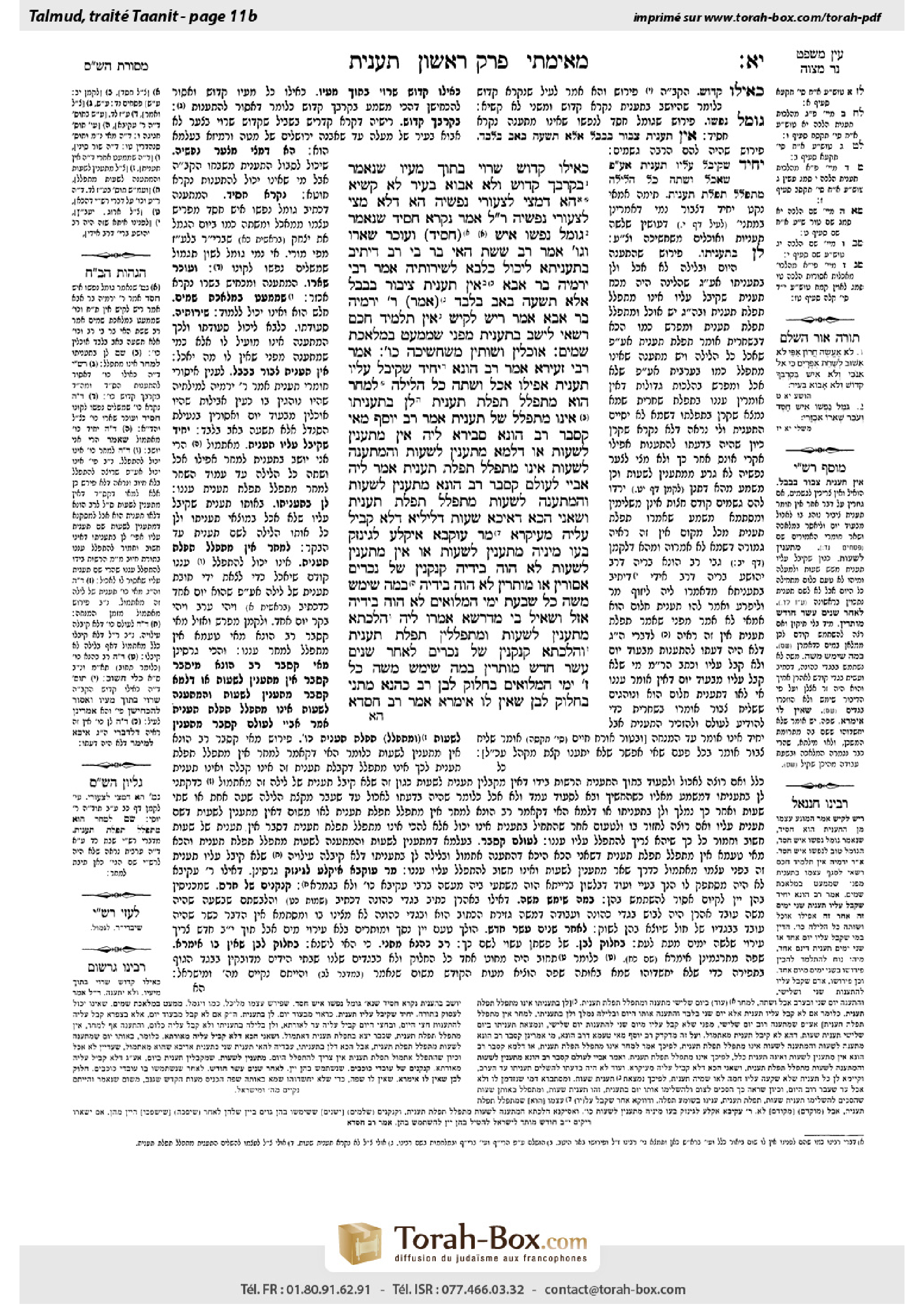
Taanit 11b: Talmud study for Daf Yomi
Daf Yomi is the daily study of one Talmud folio. Explore 37 tractates with scans, Hebrew text, Sefaria English and AI-generated French translations where annotated.
Passage selection and English or AI-generated French translation are available where the scan has annotations. Daf Study is independent of Torah-Box and Sefaria.
Browse Taanit · תענית · All tractatesTaanit 11b text and translations
This page of Taanit includes the Aramaic text, an English translation and an AI-generated French translation, alongside the scan above.
תענית י״א ב · Aramaic and Hebrew text
כְּאִילּוּ קָדוֹשׁ שָׁרוּי בְּתוֹךְ מֵעָיו, שֶׁנֶּאֱמַר: ״בְּקִרְבְּךָ קָדוֹשׁ וְלֹא אָבוֹא בְּעִיר״! לָא קַשְׁיָא: הָא — דְּמָצֵי לְצַעוֹרֵי נַפְשֵׁיהּ, הָא — דְּלָא מָצֵי לְצַעוֹרֵי נַפְשֵׁיהּ.
רֵישׁ לָקִישׁ אָמַר: נִקְרָא חָסִיד, שֶׁנֶּאֱמַר: ״גֹּמֵל נַפְשׁוֹ אִישׁ חָסֶד וְעֹכֵר שְׁאֵרוֹ וְגוֹ׳״. אָמַר רַב שֵׁשֶׁת: הַאי בַּר בֵּי רַב דְּיָתֵיב בְּתַעֲנִיתָא — לֵיכוֹל כַּלְבָּא לְשֵׁירוּתֵיהּ.
אָמַר רַב יִרְמְיָה בַּר אַבָּא: אֵין תַּעֲנִית צִיבּוּר בְּבָבֶל אֶלָּא תִּשְׁעָה בְּאָב בִּלְבַד. אָמַר רַב יִרְמְיָה בַּר אַבָּא אָמַר רֵישׁ לָקִישׁ: אֵין תַּלְמִיד חָכָם רַשַּׁאי לֵישֵׁב בְּתַעֲנִית, מִפְּנֵי שֶׁמְּמַעֵט בִּמְלֶאכֶת שָׁמַיִם.
אוֹכְלִין וְשׁוֹתִין מִשֶּׁחָשֵׁיכָה כּוּ׳. אָמַר רַבִּי זְעֵירָא אָמַר רַב הוּנָא: יָחִיד שֶׁקִּיבֵּל עָלָיו תַּעֲנִית, אֲפִילּוּ אָכַל וְשָׁתָה כׇּל הַלַּיְלָה — לְמָחָר הוּא מִתְפַּלֵּל תְּפִילַּת תַּעֲנִית. לָן בְּתַעֲנִיתוֹ — אֵינוֹ מִתְפַּלֵּל שֶׁל תַּעֲנִית.
אָמַר רַב יוֹסֵף: מַאי קָסָבַר רַב הוּנָא? סְבִירָא לֵיהּ: אֵין מִתְעַנִּין לְשָׁעוֹת, אוֹ דִלְמָא: מִתְעַנִּין לְשָׁעוֹת — וְהַמִּתְעַנֶּה לְשָׁעוֹת אֵינוֹ מִתְפַּלֵּל תְּפִלַּת תַּעֲנִית?
אֲמַר לֵיהּ אַבָּיֵי: לְעוֹלָם קָסָבַר רַב הוּנָא מִתְעַנִּין לְשָׁעוֹת, וְהַמִּתְעַנֶּה לְשָׁעוֹת מִתְפַּלֵּל תְּפִלַּת תַּעֲנִית. וְשָׁאנֵי הָכָא, דְּאִיכָּא שָׁעוֹת דְּלֵילְיָא דְּלָא קַבֵּיל עֲלֵיהּ מֵעִיקָּרָא.
מָר עוּקְבָא אִיקְּלַע לְגִינְזַק, בְּעוֹ מִינֵּיהּ: מִתְעַנִּין לְשָׁעוֹת אוֹ אֵין מִתְעַנִּין לְשָׁעוֹת? לָא הֲוָה בִּידֵיהּ. קַנְקַנִּין שֶׁל נׇכְרִים, אֲסוּרִין אוֹ מוּתָּרִין? לָא הֲוָה בִּידֵיהּ. בַּמֶּה שִׁימֵּשׁ מֹשֶׁה כׇּל שִׁבְעַת יְמֵי הַמִּלּוּאִים? לָא הֲוָה בִּידֵיהּ.
אֲזַל וּשְׁאֵיל בֵּי מִדְרְשָׁא. אֲמַרוּ לֵיהּ, הִלְכְתָא: מִתְעַנִּין לְשָׁעוֹת, וּמִתְפַּלְּלִין תְּפִלַּת תַּעֲנִית, וְהִלְכְתָא: קַנְקַנִּין שֶׁל נׇכְרִים, לְאַחַר שְׁנֵים עָשָׂר חֹדֶשׁ — מוּתָּרִין. בַּמֶּה שִׁימֵּשׁ מֹשֶׁה כׇּל שִׁבְעַת יְמֵי הַמִּלּוּאִים — בְּחָלוּק לָבָן. רַב כָּהֲנָא מַתְנֵי: בְּחָלוּק לָבָן שֶׁאֵין לוֹ אִימְּרָא.
אָמַר רַב חִסְדָּא:
Taanit 11b · English translation
as though a sacred object is immersed in his bowels, which he may not damage, as it is stated: “The sacred is in your midst; and I will not come into the city” (Hosea 11:9). This statement indicates that it is prohibited to take a fast upon oneself. The Gemara answers: This is not difficult. This first ruling, that one who fasts is sacred, is referring to a case where he is able to distress himself without causing bodily harm. That second ruling, that one may not overly burden his body, deals with a situation when he is unable to distress himself while avoiding all harm, and he proceeds to fast nevertheless.
Reish Lakish said: One who fasts is called pious, as it is stated: “The pious man does good [gomel] to his own soul; but he who troubles his own flesh is cruel” (Proverbs 11:17). The verb gomel can also mean weaning, or abstaining from unnecessary pleasure. Accordingly, Reish Lakish derives from this verse that one who abstains from food is called pious. Similarly, Rav Sheshet said: This student of a Torah academy who sits in observance of a fast has let a dog eat his portion. Since his fast weakens him and prevents him from studying Torah, it is considered as though a dog ate his meal, as the student derived no benefit from it.
Rav Yirmeya bar Abba said: There is no completely stringent communal fast in Babylonia, except for the Ninth of Av alone. All other fasts, even those which are fixed and routine for the community, are treated as individual fasts, with regard to both the customs of the fast itself and the halakhot of who is obligated to fast. Rav Yirmeya bar Abba said that Reish Lakish said: A Torah scholar is not permitted to sit in observance of a fast, due to the fact that his fasting reduces his strength for the heavenly service of Torah study and mitzvot.
§ The mishna taught that during the first set of fasts they eat and drink from after dark, and begin fasting in the morning. Rabbi Zeira said that Rav Huna said: With regard to an individual who took a fast upon himself, even if he ate and drank the entire night, on the following day he prays in the Amida the prayer of a fast, which begins: Answer us on the day of our fast. If after completing his fast he slept in his fast, i.e., he continued fasting throughout the night, he does not pray the prayer of a fast the next morning.
Rav Yosef said: What does Rav Huna maintain in this regard? Does he hold that one does not fast for only a few hours, i.e., that fasts that do not last from daybreak until nightfall are not considered fasts at all, and therefore these extra hours of the night are not part of his fast, or perhaps he holds that one does fast for a few hours, but one who fasts for a few hours does not pray the prayer of a fast?
Abaye said to Rav Yosef: Actually, Rav Huna holds that one does fast for hours, and one who fasts for a few hours does pray the prayer of a fast. But it is different here, as there are hours of the night that he did not take upon himself at the outset. Since one must take an individual fast upon himself beforehand, if he merely continues his fast into the night, these extra hours are not part of his obligation, and therefore he does not add the special prayer for a fast, Aneinu, on the following morning.
§ The Gemara relates: Mar Ukva happened to come to the city of Ginzak. The inhabitants of Ginzak, among other matters, asked him three questions to which he did not know the answer: First, does one fast for hours, or does one not fast for hours? Mar Ukva did not have an answer readily available. Second, are the clay jars belonging to gentiles, which have been used for storing wine, permanently prohibited, or can they be rendered permitted? He did not have an answer readily available. Thirdly, in what garments did Moses serve all seven days of inauguration, as the acting priest when Aaron and his sons were initiated into the priesthood? Once again, he did not have an answer readily available.
Mar Ukva went and asked these questions in the study hall. They said to him: The halakha is: One fasts for hours, and he even prays the prayer of a fast. And the halakha is that the jars belonging to gentiles are permitted after they have not been used at all for twelve months. Finally, in what garments did Moses serve all seven days of inauguration? He did not serve in his own clothes, nor in the regular priestly garments, but in a special white cloak. Rav Kahana taught: Moses served in a white cloak that does not have a hem.
Rav Ḥisda said:
Taanit 11b · Traduction française (IA)
comme si un objet sacré était immergé dans ses entrailles, qu’il ne doit pas abîmer, ainsi qu’il est dit : « Le Saint est au milieu de toi, et je ne viendrai pas dans la ville » (Osée 11,9). Cette déclaration indique qu’il est interdit de s’imposer un jeûne. La Guemara répond : Ce n’est pas difficile. Le premier enseignement, selon lequel celui qui jeûne est saint, concerne un cas où il peut s’affliger sans se faire de mal. Le second enseignement, selon lequel on ne doit pas trop accabler son corps, porte sur une situation où il ne peut s’affliger sans subir de dommage, mais jeûne néanmoins.
Reish Lakish a dit : Celui qui jeûne est appelé pieux, ainsi qu’il est dit : « L’homme pieux fait du bien [gomel] à son âme ; mais celui qui tourmente sa propre chair est cruel » (Proverbes 11,17). Le verbe gomel peut également signifier « sevrer », ou désigner le fait de s’abstenir de plaisirs superflus. Reish Lakish déduit donc de ce verset que celui qui s’abstient de manger est appelé pieux. De même, Rav Sheshet a dit : Cet étudiant d’une académie de Torah qui observe un jeûne a laissé un chien manger sa part. Puisque son jeûne l’affaiblit et l’empêche d’étudier la Torah, c’est comme si un chien avait mangé son repas, car l’étudiant n’en a tiré aucun bénéfice.
Rav Yirmeya bar Abba a dit : En Babylonie, il n’existe aucun jeûne communautaire pleinement rigoureux, à l’exception du Neuf Av. Tous les autres jeûnes, même ceux qui sont fixes et habituels pour la communauté, sont considérés comme des jeûnes individuels, tant en ce qui concerne les pratiques propres au jeûne que les halakhot déterminant qui est tenu de jeûner. Rav Yirmeya bar Abba a dit que Reish Lakish a dit : Un érudit de la Torah n’est pas autorisé à observer un jeûne, car celui-ci diminue les forces dont il a besoin pour servir le Ciel par l’étude de la Torah et l’accomplissement des mitsvot.
§ La Michna a enseigné que, pendant la première série de jeûnes, on mange et on boit dès la tombée de la nuit, puis on commence à jeûner le matin. Rabbi Zeira a dit au nom de Rav Huna : Lorsqu’un particulier s’est imposé un jeûne, même s’il a mangé et bu toute la nuit, le lendemain, il récite dans la Amida la prière du jeûne, qui commence par ces mots : « Réponds-nous au jour de notre jeûne. » S’il a poursuivi son jeûne pendant la nuit, après avoir achevé le jeûne prévu, c’est-à-dire s’il a jeûné toute la nuit, il ne récite pas la prière du jeûne le lendemain matin.
Rav Yosef a dit : Quelle est la position de Rav Huna à cet égard ? Pense-t-il qu’on ne jeûne pas seulement quelques heures, c’est-à-dire que les jeûnes qui ne durent pas de l’aube à la tombée de la nuit ne sont pas du tout considérés comme des jeûnes, et que ces heures supplémentaires de la nuit ne font donc pas partie de son jeûne ? Ou bien pense-t-il qu’on peut jeûner quelques heures, mais que celui qui jeûne quelques heures ne récite pas la prière du jeûne ?
Abaye a dit à Rav Yosef : En réalité, Rav Huna pense qu’on peut jeûner quelques heures et que celui qui jeûne quelques heures récite la prière du jeûne. Mais le cas présent est différent, car il y a des heures de la nuit qu’il ne s’était pas imposé de jeûner dès le départ. Puisqu’on doit s’imposer à l’avance un jeûne individuel, s’il ne fait que prolonger son jeûne pendant la nuit, ces heures supplémentaires ne font pas partie de son obligation ; il n’ajoute donc pas la prière spéciale du jeûne, Aneinu, le lendemain matin.
§ La Guemara rapporte : Mar Ukva se rendit par hasard dans la ville de Ginzak. Entre autres questions, les habitants de Ginzak lui en posèrent trois auxquelles il ne connaissait pas la réponse. Premièrement : jeûne-t-on quelques heures, ou ne jeûne-t-on pas quelques heures ? Mar Ukva n’avait pas de réponse à leur donner. Deuxièmement : les jarres en argile appartenant à des non-Juifs, qui ont servi à conserver du vin, sont-elles définitivement interdites, ou peut-on les rendre permises ? Il n’avait pas de réponse à leur donner. Troisièmement : quels vêtements Moïse portait-il pour officier pendant les sept jours de l’inauguration, en tant que prêtre officiant lors de l’initiation d’Aaron et de ses fils à la prêtrise ? Là encore, il n’avait pas de réponse à leur donner.
Mar Ukva alla poser ces questions à la maison d’étude. On lui répondit : La halakha est qu’on jeûne quelques heures et qu’on récite même la prière du jeûne. La halakha est également que les jarres appartenant à des non-Juifs sont permises si elles n’ont pas été utilisées du tout pendant douze mois. Enfin, quels vêtements Moïse portait-il pour officier pendant les sept jours de l’inauguration ? Il ne portait ni ses propres vêtements ni les vêtements sacerdotaux habituels, mais un manteau blanc spécial. Rav Kahana enseignait : Moïse officiait dans un manteau blanc sans ourlet.
Rav Ḥisda a dit :
Traduction française générée par IA à partir de l’édition anglaise de Sefaria. Vérifie toujours un passage avec le texte source.
Text from Sefaria: William Davidson Edition - Vocalized Aramaic (CC BY NC); William Davidson Edition - English (CC BY NC).