Taanit 12a: Talmud study for Daf Yomi
Daf Yomi is the daily study of one Talmud folio. Explore 37 tractates with scans, Hebrew text, Sefaria English and AI-generated French translations where annotated.
Passage selection and English or AI-generated French translation are available where the scan has annotations. Daf Study is independent of Torah-Box and Sefaria.
Browse Taanit · תענית · All tractatesTaanit 12a text and translations
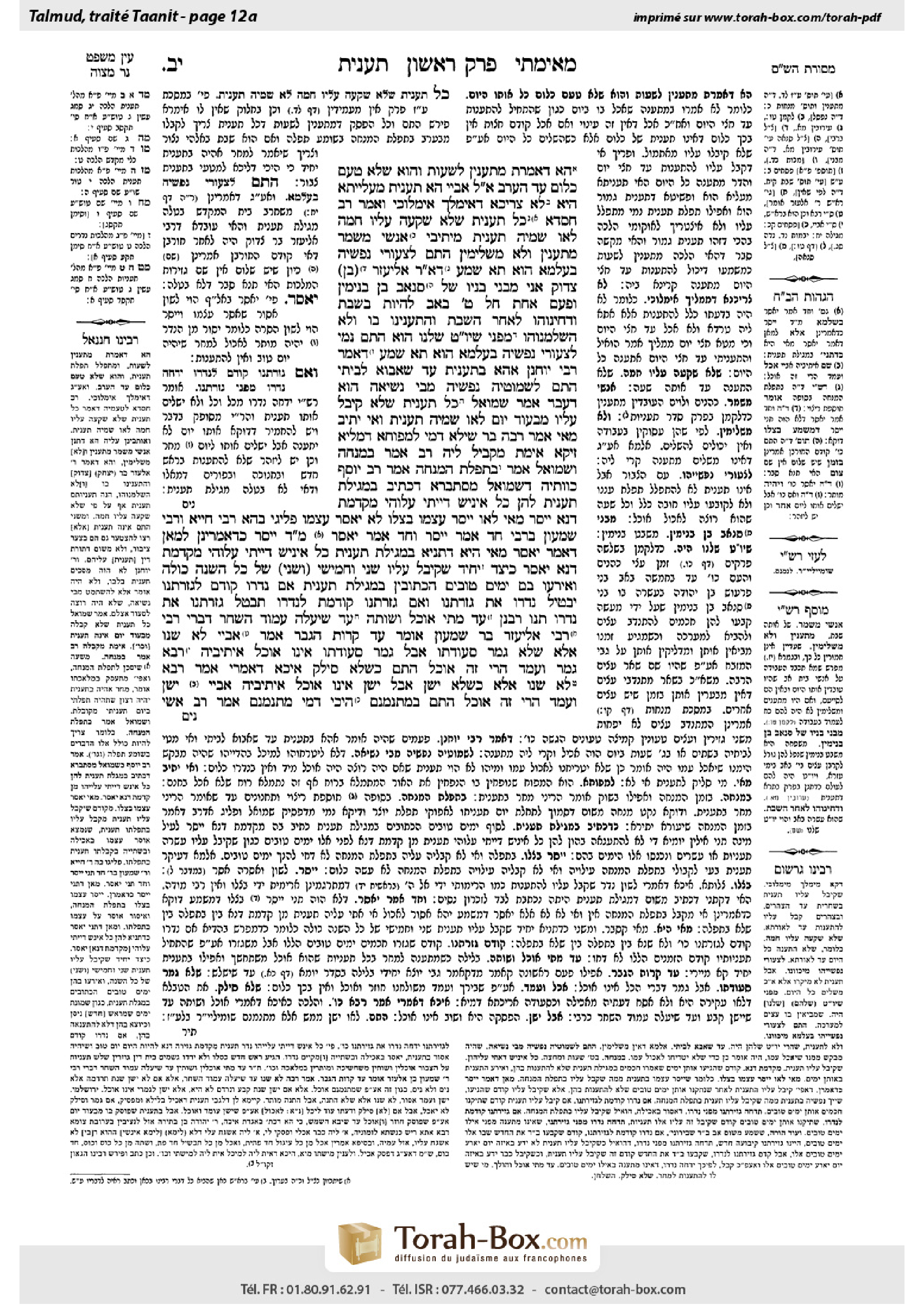
This page of Taanit includes the Aramaic text, an English translation and an AI-generated French translation, alongside the scan above.
תענית י״ב א · Aramaic and Hebrew text
הָא דְּאָמְרַתְּ מִתְעַנִּין לְשָׁעוֹת — וְהוּא שֶׁלֹּא טָעַם כְּלוּם עַד הָעֶרֶב. אָמַר לֵיהּ אַבָּיֵי: הָא תַּעֲנִית מְעַלַּיְיתָא הִיא! לָא צְרִיכָא — דְּאִימְּלַךְ אִימְּלוֹכֵי.
וְאָמַר רַב חִסְדָּא: כׇּל תַּעֲנִית שֶׁלֹּא שָׁקְעָה עָלָיו חַמָּה — לָא שְׁמֵיהּ תַּעֲנִית. מֵיתִיבִי: אַנְשֵׁי מִשְׁמָר מִתְעַנִּין וְלֹא מַשְׁלִימִין! הָתָם, לְצַעוֹרֵי נַפְשֵׁיהּ בְּעָלְמָא הוּא.
תָּא שְׁמַע, דְּאָמַר רַבִּי אֶלְעָזָר בְּרַבִּי צָדוֹק: אֲנִי מִבְּנֵי בָנָיו שֶׁל סְנָאָה בֶּן בִּנְיָמִין, וּפַעַם אַחַת חָל תִּשְׁעָה בְּאָב לִהְיוֹת בְּשַׁבָּת, וּדְחִינוּהוּ לְאַחַר הַשַּׁבָּת, וְהִתְעַנִּינוּ בּוֹ וְלֹא הִשְׁלַמְנוּהוּ — מִפְּנֵי שֶׁיּוֹם טוֹב שֶׁלָּנוּ הוּא. הָתָם נָמֵי, לְצַעוֹרֵי נַפְשֵׁיהּ בְּעָלְמָא הוּא.
תָּא שְׁמַע, דְּאָמַר רַבִּי יוֹחָנָן: אֱהֵא בְּתַעֲנִית עַד שֶׁאָבוֹא לְבֵיתִי. הָתָם, לְשַׁמּוֹטֵי נַפְשֵׁיהּ מִבֵּי נְשִׂיאָה הוּא דַּעֲבַד.
אָמַר שְׁמוּאֵל: כׇּל תַּעֲנִית שֶׁלֹּא קִיבֵּל עָלָיו מִבְּעוֹד יוֹם — לָאו שְׁמֵיהּ תַּעֲנִית. וְאִי יָתֵיב, מַאי? אָמַר רַבָּה בַּר שֵׁילָא: דָּמֵי לְמַפּוּחָא דְּמַלְיָא זִיקָא.
אֵימַת מְקַבֵּיל לֵיהּ? רַב אָמַר: בְּמִנְחָה, וּשְׁמוּאֵל אָמַר: בִּתְפִלַּת הַמִּנְחָה. אָמַר רַב יוֹסֵף: כְּווֹתֵיהּ דִּשְׁמוּאֵל מִסְתַּבְּרָא, דִּכְתִיב בִּמְגִילַּת תַּעֲנִית: לָהֵן, כֹּל אִינִישׁ דְּיֵיתֵי עֲלוֹהִי מִקַּדְמַת דְּנָא — יֵיסַר.
מַאי לָאו — יֵיסַר עַצְמוֹ בִּצְלוֹ? לָא — יֵאסַר עַצְמוֹ.
פְּלִיגִי בַּהּ רַבִּי חִיָּיא וְרַבִּי שִׁמְעוֹן בְּרַבִּי. חַד אָמַר: יֵיסַר, וְחַד אָמַר: יֵאָסֵר. מַאן דְּאָמַר יֵיסַר — כִּדְאָמְרִינַן. לְמַאן דְּאָמַר יֵאָסֵר — מַאי הִיא?
דְּתַנְיָא בִּמְגִילַּת תַּעֲנִית: כׇּל אִינִישׁ דְּיֵיתֵי עֲלוֹהִי מִקַּדְמַת דְּנָא יֵאָסֵר. כֵּיצַד? יָחִיד שֶׁקִּיבֵּל עָלָיו שֵׁנִי וַחֲמִישִׁי וְשֵׁנִי שֶׁל כׇּל הַשָּׁנָה כּוּלָּהּ, וְאֵירְעוּ בָּם יָמִים טוֹבִים הַכְּתוּבִין בִּמְגִילַּת תַּעֲנִית, אִם נִדְרוֹ קוֹדֶם לִגְזֵרָתֵנוּ — יְבַטֵּיל נִדְרוֹ אֶת גְּזֵרָתֵנוּ, וְאִם גְּזֵרָתֵנוּ קוֹדֶמֶת לְנִדְרוֹ — תְּבַטֵּל גְּזֵרָתֵנוּ אֶת נִדְרוֹ.
תָּנוּ רַבָּנַן: עַד מָתַי אוֹכֵל וְשׁוֹתֶה — עַד שֶׁיַּעֲלֶה עַמּוּד הַשַּׁחַר, דִּבְרֵי רַבִּי. רַבִּי אֶלְעָזָר בְּרַבִּי שִׁמְעוֹן אוֹמֵר: עַד קְרוֹת הַגֶּבֶר. אָמַר אַבָּיֵי: לֹא שָׁנוּ אֶלָּא שֶׁלֹּא גָּמַר סְעוּדָתוֹ, אֲבָל גָּמַר סְעוּדָתוֹ — אֵינוֹ אוֹכֵל.
אֵיתִיבֵיהּ רָבָא: גָּמַר וְעָמַד — הֲרֵי זֶה אוֹכֵל! הָתָם כְּשֶׁלֹּא סִילֵּק. אִיכָּא דְּאָמְרִי, אָמַר רָבָא: לֹא שָׁנוּ אֶלָּא כְּשֶׁלֹּא יָשַׁן, אֲבָל יָשַׁן — אֵינוֹ אוֹכֵל. אֵיתִיבֵיהּ אַבָּיֵי: יָשַׁן וְעָמַד — הֲרֵי זֶה אוֹכֵל! הָתָם בְּמִתְנַמְנֵם.
הֵיכִי דָּמֵי מִתְנַמְנֵם? אָמַר רַב אָשֵׁי:
Taanit 12a · English translation
The halakha is that which you said, that one may fast for a few hours, provided that one took a fast of a few hours upon himself, and that he fasted and did not taste anything until the evening. Abaye said to Rav Ḥisda: This ruling is obvious, since it is a full-fledged fast, as one ultimately fasts the entire day. Rav Ḥisda answered: No, it is necessary to say this halakha in a case where he changed his mind, i.e., he began the day without intending to fast, but for various reasons he did not eat, and halfway through the day he decided to continue fasting for another few hours until nightfall. Rav Ḥisda maintains that this kind of fasting for hours is considered a fast.
And Rav Ḥisda said: Any fast upon which the sun does not set, i.e., when one eats in the middle of the day, it is not called a fast at all. The Gemara raises an objection: The members of the priestly watch, the priests and Levites who are serving in the Temple that week, fast on a communal fast, like the members of the non-priestly watch who are attached to specific groups of priests, but they do not complete the fast with the rest of the community. This indicates that even a fast lasting only a few hours is called a fast. The Gemara explains: There they abstained from food merely to cause themselves distress, as an act of solidarity with the rest of the community, but this was not considered a full-fledged fast.
The Gemara cites another proof: Come and hear, as Rabbi Elazar, son of Rabbi Tzadok, said: I am a descendant of Senaah, son of the tribe of Benjamin, and once the Ninth of Av occurred on Shabbat, and we postponed the fast until after Shabbat, as Shabbat supersedes the fast of the Ninth of Av. And we fasted on that day, but we did not complete the fast, due to the fact that the tenth of Av is a holiday of ours, a private holiday for our family (26a), and one does not fast on holidays. This proves that a fast of only a few hours is nevertheless called a fast. The Gemara rejects this claim: There too, they did so merely to cause themselves distress.
The Gemara again attempts to disprove the opinion of Rav Ḥisda, this time by citing a custom of Rabbi Yoḥanan: Come and hear, as Rabbi Yoḥanan occasionally said: I shall be in observance of a fast until I come to my house. This indicates that one can take a fast upon himself even for just a few hours. The Gemara rejects this proof as well: There he did this to excuse himself from the household of the Nasi. At times, Rabbi Yoḥanan received an invitation to dine at the house of the Nasi, but wanted to decline. To avoid insulting the Nasi, he would say that he had taken a fast upon himself, and afterward he would eat at home. Since this was not a real fast, it is not proof of the legitimacy of a partial-day fast.
Shmuel said: Any fast that one did not take upon himself while it was still day is not called a fast. The Gemara asks: And if one happened to sit in observance of a fast that day, what is that considered? Rabba bar Sheila said: He is likened to a bellows that is full of air. His behavior does not constitute a fast, as he is merely a container full of air, without food.
§ The Gemara asks: When does one take a fast upon himself? Rav said: One takes a fast upon himself in the afternoon of the day preceding the fast, from midday onward. And Shmuel said: One must take a fast upon himself for the following day at the end of the afternoon prayer. Rav Yosef said: It stands to reason that the halakha should be in accordance with the opinion of Shmuel, as it is written in Megillat Ta’anit, after a list of all of the Festivals established by the Sages in commemoration of various events throughout Jewish history: Therefore, whoever has bound himself beforehand with an obligation to fast on one of these commemorative days, he will be bound.
The Gemara explains the apparent proof from the text of Megillat Ta’anit. What, is it not the case that this means that he binds himself to the obligation at the time of prayer, and if he did not do so at that point in time his fast does not go into effect? The Gemara rejects this explanation: No; the text should be amended by one letter so that it does not read yeisar, he shall bind himself, but yei’aser, he shall render himself prohibited from transgressing these instructions. In other words, the text is explaining that despite a prior vow to fast, it is prohibited for one to do so on the commemorative days enumerated in Megillat Ta’anit.
The Gemara comments: Rabbi Ḥiyya and Rabbi Shimon, son of Rabbi Yehuda HaNasi, disagree with regard to this dispute. One of them said that the text of Megillat Ta’anit reads: He will be bound, and the other one said that it reads: He will be prohibited. The one who said: He will be bound, this is as we just say. However, according to the one who said: He will be prohibited, what does it mean?
The Gemara explains: This is as it is taught in Megillat Ta’anit: Whoever has taken upon himself beforehand to fast on one of these Festival days, he will be prohibited to eat and drink. How so? With regard to an individual who took upon himself to fast on each Monday, Thursday, and Monday series of the entire year, and the commemorative holidays written in Megillat Ta’anit occurred on these days, if his vow preceded our decree, i.e., the decree of the Sages establishing these commemorative days, his vow annuls our decree and he must fast, but if our decree preceded his vow, our decree annuls his vow and he may not fast on those days.
The Sages taught in a baraita: Until when may one eat and drink on communal fasts, when one fasts during the day but not the preceding evening? Until dawn. This is the statement of Rabbi Yehuda HaNasi. Rabbi Elazar, son of Rabbi Shimon, says: Until the call of the rooster, which is before dawn. Abaye said: They taught this ruling, that one may eat all night, only if he has not finished his evening meal, as he may continue eating the same meal all night. However, if he has finished his meal, he may not eat any more.
Rava raised an objection to Abaye from a baraita: If one finished his meal and stood up, nevertheless, he may eat more. This shows that one may in fact eat throughout the night, even if he has finished his meal. Abaye answered: There the baraita is referring to a situation where he has not yet removed or cleared the table, and therefore it is as though he has not yet finished his meal. Some say a slightly different version of this discussion. Rava said: They taught this ruling only if he did not sleep after eating, but if he slept he may not eat anything else that night. Abaye raised an objection to Rava from a baraita: If one slept and arose from his sleep during the night, he may eat. Rava explained: There the baraita is referring to one who was merely dozing, and was not fully asleep.
The Gemara asks: What are the circumstances of dozing? Rav Ashi said:
Taanit 12a · Traduction française (IA)
La halakha est celle que tu as énoncée : on peut jeûner quelques heures, à condition d’avoir pris sur soi un jeûne de quelques heures et de n’avoir rien goûté jusqu’au soir. Abaye dit à Rav Ḥisda : Cette décision est évidente, puisque c’est un véritable jeûne, car, en définitive, on jeûne toute la journée. Rav Ḥisda répondit : Non, cette halakha est nécessaire dans le cas où l’on a changé d’avis, c’est-à-dire que l’on a commencé la journée sans avoir l’intention de jeûner, mais que, pour diverses raisons, on n’a pas mangé et qu’au milieu de la journée, on a décidé de continuer à jeûner quelques heures de plus, jusqu’à la tombée de la nuit. Rav Ḥisda estime que ce type de jeûne de quelques heures est considéré comme un jeûne.
Et Rav Ḥisda dit : Tout jeûne qui ne va pas jusqu’au coucher du soleil, c’est-à-dire lorsque l’on mange au milieu de la journée, n’est pas du tout appelé un jeûne. La Guemara objecte : Les membres de la garde sacerdotale, les prêtres et les Lévites qui servent au Temple cette semaine-là, jeûnent lors d’un jeûne communautaire, comme les membres des gardes non sacerdotales, rattachés à des groupes précis de prêtres, mais ils ne jeûnent pas jusqu’au bout avec le reste de la communauté. Cela indique que même un jeûne de quelques heures est appelé un jeûne. La Guemara explique : Dans ce cas, ils s’abstenaient de nourriture uniquement pour s’affliger, en solidarité avec le reste de la communauté, mais cela n’était pas considéré comme un véritable jeûne.
La Guemara apporte une autre preuve : Viens et entends, car Rabbi Elazar, fils de Rabbi Tzadok, a dit : « Je descends de Senaah, de la tribu de Benjamin. » Une fois, le Neuf Av tomba un Chabbat ; nous avons reporté le jeûne après Chabbat, car Chabbat l’emporte sur le jeûne du Neuf Av. Nous avons jeûné ce jour-là, mais nous n’avons pas mené le jeûne à son terme, parce que le Dix Av est une fête pour nous, une fête privée de notre famille (26a), et l’on ne jeûne pas les jours de fête. Cela prouve qu’un jeûne de quelques heures seulement est néanmoins appelé un jeûne. La Guemara rejette cette preuve : Là aussi, ils l’ont fait uniquement pour s’affliger.
La Guemara tente de nouveau de réfuter l’opinion de Rav Ḥisda, cette fois en citant une pratique de Rabbi Yoḥanan : Viens et entends, car Rabbi Yoḥanan disait parfois : « Je jeûnerai jusqu’à ce que je rentre chez moi. » Cela indique qu’on peut prendre sur soi un jeûne pour quelques heures seulement. La Guemara rejette également cette preuve : Il agissait ainsi pour se dispenser de manger chez le Nassi. Parfois, Rabbi Yoḥanan était invité à dîner chez le Nassi, mais souhaitait décliner l’invitation. Pour ne pas offenser le Nassi, il disait qu’il avait pris sur lui un jeûne, puis il mangeait chez lui. Puisqu’il ne s’agissait pas d’un véritable jeûne, cela ne prouve pas qu’un jeûne limité à une partie de la journée soit valide.
Chmouel a dit : Tout jeûne que l’on n’a pas pris sur soi alors qu’il faisait encore jour n’est pas appelé un jeûne. La Guemara demande : Et si quelqu’un s’est mis à observer un jeûne ce jour-là, qu’est-ce que cela signifie ? Rabba bar Sheila a dit : Il ressemble à un soufflet plein d’air. Son comportement ne constitue pas un jeûne : il n’est qu’un récipient plein d’air, sans nourriture.
§ La Guemara demande : Quand prend-on un jeûne sur soi ? Rav a dit : On prend un jeûne sur soi l’après-midi du jour qui précède le jeûne, à partir de midi. Chmouel a dit : On doit prendre sur soi un jeûne pour le lendemain à la fin de la prière de l’après-midi. Rav Yossef a dit : Il est logique que la halakha suive l’opinion de Chmouel, car il est écrit dans la Méguilat Ta’anit, après la liste de toutes les fêtes instituées par les Sages en souvenir de divers événements de l’histoire juive : « Par conséquent, quiconque s’est lié à l’avance par l’obligation de jeûner l’un de ces jours commémoratifs sera lié. »
La Guemara explique la preuve apparente tirée du texte de la Méguilat Ta’anit. N’est-ce pas que cela signifie qu’il se lie à cette obligation au moment de la prière et que, s’il ne l’a pas fait à ce moment-là, son jeûne ne prend pas effet ? La Guemara rejette cette explication : Non ; il faut modifier une lettre du texte, de sorte qu’il ne lise pas yeisar, « il se liera », mais ye’aser, « il se rendra interdit » de transgresser ces instructions. Autrement dit, le texte explique que, malgré un vœu antérieur de jeûner, il est interdit de jeûner les jours commémoratifs énumérés dans la Méguilat Ta’anit.
La Guemara remarque : Rabbi Ḥiyya et Rabbi Shimon, fils de Rabbi Yehuda HaNasi, sont en désaccord au sujet de cette controverse. L’un d’eux a dit que le texte de la Méguilat Ta’anit porte : « Il sera lié », et l’autre a dit qu’il porte : « Il sera interdit ». Celui qui a dit : « Il sera lié » suit l’explication que nous venons de donner. Cependant, selon celui qui a dit : « Il sera interdit », que signifie le texte ?
La Guemara explique : C’est ce qui est enseigné dans la Méguilat Ta’anit : « Quiconque a pris sur lui à l’avance de jeûner l’un de ces jours de fête se verra interdire de manger et de boire. » Dans quelles circonstances ? Si un particulier a pris sur lui de jeûner chaque série de lundi, jeudi et lundi pendant toute l’année, et que les jours de fête commémoratifs mentionnés dans la Méguilat Ta’anit tombent ces jours-là, alors, si son vœu a précédé notre décret, c’est-à-dire le décret des Sages instituant ces jours commémoratifs, son vœu annule notre décret et il doit jeûner ; mais si notre décret a précédé son vœu, notre décret annule son vœu et il ne peut pas jeûner ces jours-là.
Les Sages ont enseigné dans une baraïta : Jusqu’à quand peut-on manger et boire les jours de jeûne communautaire, où l’on jeûne pendant la journée mais pas la veille au soir ? Jusqu’à l’aube. Telle est l’opinion de Rabbi Yehuda HaNasi. Rabbi Elazar, fils de Rabbi Shimon, dit : Jusqu’au chant du coq, qui précède l’aube. Abaye a dit : Ils ont enseigné cette règle, selon laquelle on peut manger toute la nuit, uniquement si l’on n’a pas terminé son repas du soir, car on peut continuer le même repas toute la nuit. En revanche, si l’on a terminé son repas, on ne peut plus rien manger.
Rava objecta à Abaye en citant une baraïta : Si quelqu’un a terminé son repas et s’est levé, il peut néanmoins manger davantage. Cela montre qu’en réalité, on peut manger toute la nuit, même si l’on a terminé son repas. Abaye répondit : Dans ce cas, la baraïta parle d’une situation où l’on n’a pas encore débarrassé la table ; c’est donc comme si l’on n’avait pas encore terminé son repas. Certains rapportent une version légèrement différente de cet échange. Rava dit : Ils ont enseigné cette règle uniquement si l’on n’a pas dormi après avoir mangé ; mais si l’on a dormi, on ne peut plus rien manger cette nuit-là. Abaye objecta à Rava en citant une baraïta : Si quelqu’un s’est endormi puis s’est réveillé au cours de la nuit, il peut manger. Rava expliqua : Dans ce cas, la baraïta parle de quelqu’un qui somnolait seulement et ne dormait pas profondément.
La Guemara demande : Dans quelles circonstances parle-t-on de somnoler ? Rav Ashi a dit :
Traduction française générée par IA à partir de l’édition anglaise de Sefaria. Vérifie toujours un passage avec le texte source.
Text from Sefaria: William Davidson Edition - Vocalized Aramaic (CC BY NC); William Davidson Edition - English (CC BY NC).