Taanit 12b: Talmud study for Daf Yomi
Daf Yomi is the daily study of one Talmud folio. Explore 37 tractates with scans, Hebrew text, Sefaria English and AI-generated French translations where annotated.
Passage selection and English or AI-generated French translation are available where the scan has annotations. Daf Study is independent of Torah-Box and Sefaria.
Browse Taanit · תענית · All tractatesTaanit 12b text and translations
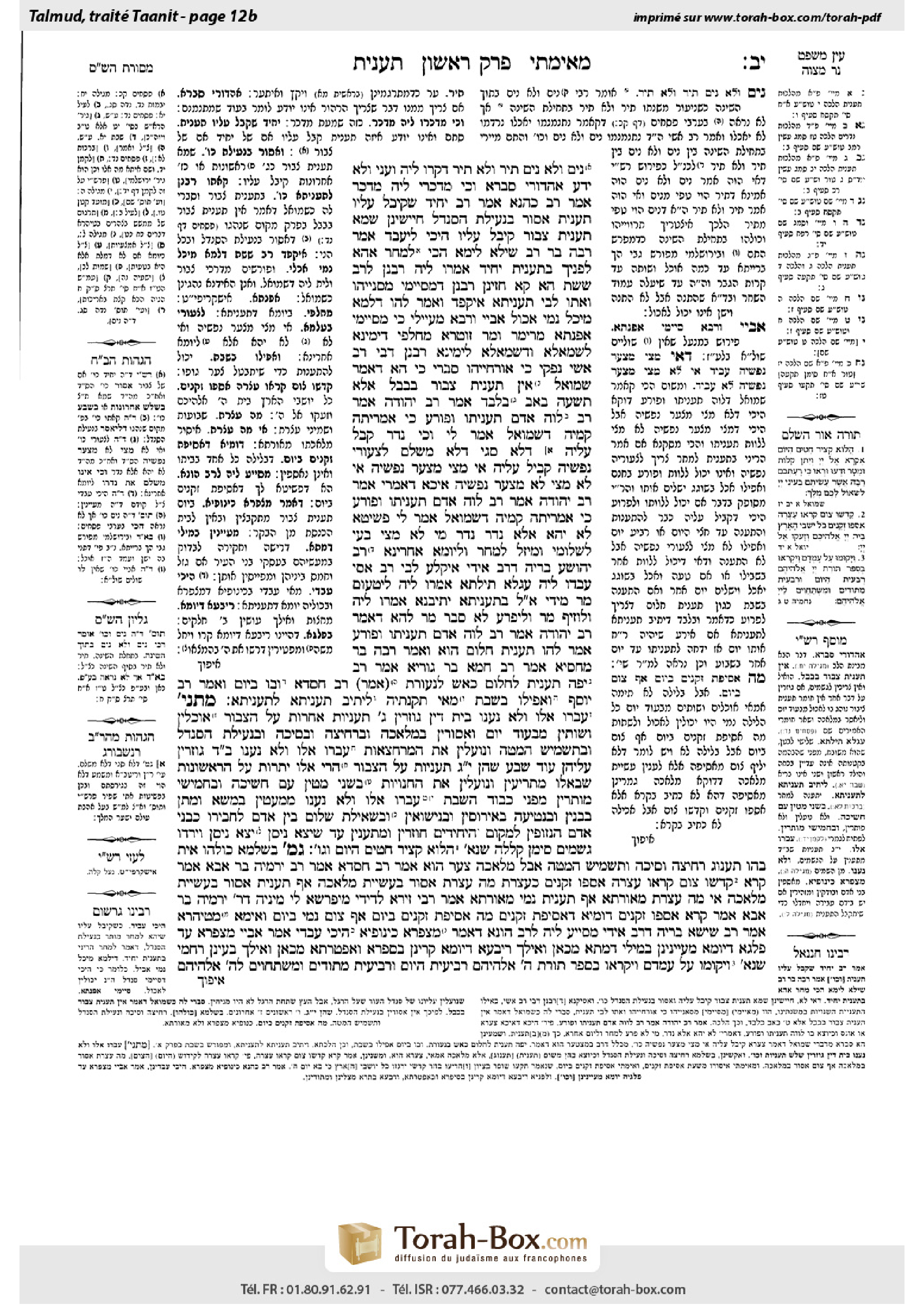
This page of Taanit includes the Aramaic text, an English translation and an AI-generated French translation, alongside the scan above.
תענית י״ב ב · Aramaic and Hebrew text
נִים וְלָא נִים, תִּיר וְלָא תִּיר. דְּקָרוּ לֵיהּ וְעָנֵי, וְלָא יָדַע אַהְדּוֹרֵי סְבָרָא, וְכִי מַדְכְּרִי לֵיהּ מִדְּכַר.
אָמַר רַב כָּהֲנָא אָמַר רַב: יָחִיד שֶׁקִּיבֵּל עָלָיו תַּעֲנִית — אָסוּר בִּנְעִילַת הַסַּנְדָּל. חָיְישִׁינַן שֶׁמָּא תַּעֲנִית צִבּוּר קִיבֵּל עָלָיו. הֵיכִי לֶיעְבַּד? אָמַר רַבָּה בַּר רַב שֵׁילָא, לֵימָא הָכִי: לְמָחָר אֱהֵא לְפָנֶיךָ בְּתַעֲנִית יָחִיד.
אֲמַרוּ לֵיהּ רַבָּנַן לְרַב שֵׁשֶׁת: הָא קָא חָזֵינַן רַבָּנַן דִּמְסַיְּימִי מְסָנַיְיהוּ וְאָתוּ לְבֵי תַעֲנִיתָא! אִיקְּפַד וַאֲמַר לְהוּ: דִּלְמָא מֵיכַל נָמֵי אֲכוּל.
אַבָּיֵי וְרָבָא (מְעַיְּילִי כִּי מְ)סָיְימִי אֲפַנְתָּא. מָרִימָר וּמַר זוּטְרָא מְחַלְּפִי דְּיַמִּינָא לִשְׂמָאלָא וְדִשְׂמָאלָא לְיַמִּינָא. רַבָּנַן דְּבֵי רַב אָשֵׁי נָפְקִי כִּי אוֹרְחַיְיהוּ, סָבְרִי כִּי הָא דְּאָמַר שְׁמוּאֵל: אֵין תַּעֲנִית צִבּוּר בְּבָבֶל אֶלָּא תִּשְׁעָה בְּאָב בִּלְבַד.
אָמַר רַב יְהוּדָה אָמַר רַב: לֹוֶה אָדָם תַּעֲנִיתוֹ וּפוֹרֵעַ. כִּי אַמְרִיתַהּ קַמֵּיהּ דִּשְׁמוּאֵל, אָמַר לִי: וְכִי נֶדֶר קַבֵּל עֲלֵיהּ, דְּלָא סַגִּי דְּלָא מְשַׁלֵּם? לְצַעוֹרֵי נַפְשֵׁיהּ קַבֵּיל עֲלֵיהּ. אִי מָצֵי — מְצַעַר נַפְשֵׁיהּ, אִי לָא מָצֵי — לָא מְצַעַר נַפְשֵׁיהּ.
אִיכָּא דְּאָמְרִי, אָמַר רַב יְהוּדָה אָמַר רַב: לֹוֶה אָדָם תַּעֲנִיתוֹ וּפוֹרֵעַ. כִּי אַמְרִיתַהּ קַמֵּיהּ דִּשְׁמוּאֵל, אָמַר לִי: פְּשִׁיטָא! לֹא יְהֵא אֶלָּא נֶדֶר. נֶדֶר — מִי לָא מָצֵי בָּעֵי לְשַׁלּוֹמֵי וּמֵיזַל לִמְחַר וּלְיוֹמָא אַחֲרִינָא.
רַב יְהוֹשֻׁעַ בְּרֵיהּ דְּרַב אִידֵּי אִיקְּלַע לְבֵי רַב אַסִּי. עֲבַדוּ לֵיהּ עִגְלָא תִּילְתָּא, אֲמַרוּ לֵיהּ: לִיטְעוֹם מָר מִידֵּי. אֲמַר לְהוּ: בְּתַעֲנִיתָא יָתֵיבְנָא. אֲמַרוּ לֵיהּ: וְלוֹזֵיף מָר וְלִיפְרַע, לָא סָבַר מָר לְהָא דְּאָמַר רַב יְהוּדָה אָמַר רַב: לֹוֶה אָדָם תַּעֲנִיתוֹ וּפוֹרֵעַ? אֲמַר לְהוּ: תַּעֲנִית חֲלוֹם הוּא.
וְאָמַר רַבָּה בַּר מַחְסֵיָא אָמַר רַב חָמָא בַּר גּוּרְיָא אָמַר רַב: יָפָה תַּעֲנִית לַחֲלוֹם כְּאֵשׁ לִנְעוֹרֶת. אָמַר רַב חִסְדָּא: וּבוֹ בַּיּוֹם. וְאָמַר רַב יוֹסֵף: וַאֲפִילּוּ בְּשַׁבָּת. מַאי תַּקַּנְתֵּיהּ? לִיתֵּיב תַּעֲנִיתָא לְתַעֲנִיתָא.
מַתְנִי׳ עָבְרוּ אֵלּוּ וְלֹא נַעֲנוּ — בֵּית דִּין גּוֹזְרִין שָׁלֹשׁ תַּעֲנִיּוֹת אֲחֵרוֹת עַל הַצִּבּוּר. אוֹכְלִין וְשׁוֹתִין מִבְּעוֹד יוֹם, וַאֲסוּרִין בִּמְלָאכָה וּבִרְחִיצָה וּבְסִיכָה וּבִנְעִילַת הַסַּנְדָּל וּבְתַשְׁמִישׁ הַמִּטָּה, וְנוֹעֲלִין אֶת הַמֶּרְחֲצָאוֹת.
עָבְרוּ אֵלּוּ וְלֹא נַעֲנוּ, בֵּית דִּין גּוֹזְרִין עֲלֵיהֶן עוֹד שֶׁבַע שֶׁהֵן שְׁלוֹשׁ עֶשְׂרֵה תַּעֲנִיּוֹת עַל הַצִּבּוּר. הֲרֵי אֵלּוּ יְתֵרוֹת עַל הָרִאשׁוֹנוֹת, שֶׁבְּאֵלּוּ מַתְרִיעִין, וְנוֹעֲלִין אֶת הַחֲנוּיוֹת. בַּשֵּׁנִי מַטִּין עִם חֲשֵׁיכָה, וּבַחֲמִישִׁי מוּתָּרִין מִפְּנֵי כְּבוֹד הַשַּׁבָּת.
עָבְרוּ אֵלּוּ וְלֹא נַעֲנוּ, מְמַעֲטִין בְּמַשָּׂא וּמַתָּן, בְּבִנְיָן וּבִנְטִיעָה, בְּאֵירוּסִין וּבְנִישּׂוּאִין, וּבִשְׁאֵילַת שָׁלוֹם בֵּין אָדָם לַחֲבֵירוֹ — כִּבְנֵי אָדָם הַנְּזוּפִין לַמָּקוֹם. הַיְּחִידִים חוֹזְרִין וּמִתְעַנִּין עַד שֶׁיֵּצֵא נִיסָן. יָצָא נִיסָן וְיָרְדוּ גְּשָׁמִים — סִימַן קְלָלָה, שֶׁנֶּאֱמַר: ״הֲלוֹא קְצִיר חִטִּים הַיּוֹם וְגוֹ׳״.
גְּמָ׳ בִּשְׁלָמָא כּוּלְּהוּ, אִית בְּהוּ תַּעֲנוּג: רְחִיצָה וְסִיכָה וְתַשְׁמִישׁ הַמִּטָּה, אֲבָל מְלָאכָה — צַעַר הוּא! אָמַר רַב חִסְדָּא אָמַר רַב יִרְמְיָה בַּר אַבָּא, אָמַר קְרָא: ״קַדְּשׁוּ צוֹם קִרְאוּ עֲצָרָה אִסְפוּ זְקֵנִים״, כַּעֲצֶרֶת, מָה עֲצֶרֶת אָסוּר בַּעֲשִׂיַּית מְלָאכָה — אַף תַּעֲנִית אָסוּר בַּעֲשִׂיַּית מְלָאכָה.
אִי, מָה עֲצֶרֶת מֵאוּרְתָּא — אַף תַּעֲנִית נָמֵי מֵאוּרְתָּא! אָמַר רַבִּי זֵירָא: לְדִידִי מִיפָּרְשָׁא לִי מִינֵּיהּ דְּרַבִּי יִרְמְיָה בַּר אַבָּא. אָמַר קְרָא: ״אִסְפוּ זְקֵנִים״, דּוּמְיָא דַּאֲסִיפַת זְקֵנִים, מָה אֲסִיפַת זְקֵנִים בַּיּוֹם — אַף צוֹם נָמֵי בַּיּוֹם. וְאֵימָא מִטִּיהֲרָא? אָמַר רַב שִׁישָׁא בְּרֵיהּ דְּרַב אִידִי: מְסַיַּיע לֵיהּ לְרַב הוּנָא, דְּאָמַר: מִצַּפְרָא כִּינּוּפְיָא.
הֵיכִי עָבְדִי? אָמַר אַבָּיֵי: מִצַּפְרָא עַד פַּלְגָא דְיוֹמָא מְעַיְּינִינַן בְּמִילֵּי דְמָתָא. מִכָּאן וְאֵילָךְ, רִבְעָא דְיוֹמָא קָרֵינַן בְּסִפְרָא וְאַפְטַרְתָּא, מִכָּאן וְאֵילָךְ בָּעֵינַן רַחֲמֵי, שֶׁנֶּאֱמַר: ״וַיָּקוּמוּ עַל עׇמְדָם וַיִּקְרְאוּ בְּסֵפֶר תּוֹרַת ה׳ אֱלֹהֵיהֶם רְבִעִית הַיּוֹם וּרְבִעִית מִתְוַדִּים וּמִשְׁתַּחֲוִים לַה׳ אֱלֹהֵיהֶם״.
Taanit 12b · English translation
One is asleep but not fully asleep, awake but not fully awake. This means that if they call him he will answer, but he cannot give a coherent reason. And when we remind him of something that just happened he remembers it.
Rav Kahana said that Rav said: An individual who took a fast upon himself is prohibited to engage in the wearing of shoes on the day of his fast. The reason is that we are concerned that perhaps he took a communal fast upon himself, and wearing shoes is prohibited on communal fast days. The Gemara asks: How should one act, to avoid this problem? Rabba bar Rav Sheila said: Let him recite this formula: Tomorrow I shall be before You in the observance of an individual fast.
The Gemara relates: The Sages said to Rav Sheshet, who was blind: We see Sages who wear their shoes and go to the study house on a communal fast day. This shows that there is no need to be concerned about this prohibition. Rav Sheshet became angry and said to them: Perhaps they even ate, if you saw them treating the fast lightly.
The Gemara further relates: Abaye and Rava would enter the synagogue while wearing sandals on the leather [apanta] of their shoes, i.e., they would wear their shoes upside down. Mareimar and Mar Zutra would switch the right shoe for the left and the left for the right. By contrast, the Sages of the school of Rav Ashi would go out wearing shoes in their usual manner. They hold in accordance with that which Shmuel said: The only completely stringent communal fast in Babylonia is the Ninth of Av alone. Therefore, in Babylonia there is no need to be concerned that one might have taken a communal fast upon himself.
The Gemara discusses another topic related to fasts. Rav Yehuda said that Rav said: A person may borrow his fast and repay, i.e., if one is unable to fast on the specific day he intended to fast, he may annul his fast for that day and fast on another day instead. Rav Yehuda related: When I said this halakha before Shmuel, he said to me: And did he take a vow upon himself, which would mean that it is not possible for him not to repay it? He took upon himself to cause himself discomfort on that day. If he is able, he must cause himself discomfort; if he is unable, he does not need to cause himself discomfort, in which case he need not repay the fast.
Some say a different version of this discussion. Rav Yehuda said that Rav said: One may borrow his fast and repay. When I said this halakha before Shmuel, he said to me: This is obvious. Let it be considered only a vow; even so, is he not required to repay a vow on the next day or on another day? Since a commitment to fast is a type of vow, he is obligated to repay it at some point in time.
The Gemara relates: Rav Yehoshua, son of Rav Idi, happened to visit the house of Rav Asi. They prepared a third-born calf, whose meat is high quality, for him. They said to him: Let the Master taste something. He said to them: I am sitting in the observance of a fast and may not eat. They said to him: And let the Master borrow and repay the fast. Doesn’t the Master hold in accordance with this halakha that Rav Yehuda said that Rav said: A person may borrow his fast and repay? Rav Yehoshua, son of Rav Idi, said to them: It is a fast for a dream. He was fasting to rectify the negative effects of a bad dream he had experienced the night before.
The Gemara explains the relevance of this last comment. And Rabba bar Meḥasseya said that Rav Ḥama bar Gurya said that Rav said: A fast is effective to neutralize a bad dream like fire is effective for burning chaff. Rav Ḥisda said: The fast is effective specifically on that day that one dreamed. And Rav Yosef said: And one suffering from a bad dream is permitted to fast even on Shabbat. The Gemara asks: What is the remedy for one who has denigrated Shabbat by fasting? Let him sit in observance of another fast, on another day, to atone for his fast on Shabbat.
MISHNA: If these three regular fasts have passed and they have not been answered with rain, the court decrees three other fasts upon the community. These are severe fasts, in which one may eat and drink only while it is still day, before the beginning of the night of the fast, and on the day of the fast itself they are prohibited to engage in the performance of work, in bathing, in smearing with oil, in wearing shoes, and in marital relations; and they lock the bathhouses so that no one should come to bathe on that day.
If these three fasts have passed and they still have not been answered, the court decrees on them another seven fasts, which are a total of thirteen fasts, upon the community, not including the first three fasts observed by individuals. These seven fast days are more severe than the first ones, as on these days, in addition to all the earlier stringencies, they sound the alarm, as will be explained in the Gemara, and they lock the stores. Although shops must remained closed most of the time on these days, on Monday they open them a little at nightfall to allow people to purchase food for breaking their fast, and on Thursday they are permitted to open the stores all day in deference to Shabbat, so that people may purchase food for the sacred day.
If these fasts have passed and they have not been answered the court does not decree additional fasts, but the entire community observes the customs of mourning. They decrease their engagement in business transactions, in building and planting, in betrothals and marriages, and in greetings between each person and his fellow, like people who have been rebuked by God. The individuals, i.e., Torah scholars, resume fasting every Monday and Thursday until the month of Nisan ends. After this date they no longer pray for rain, since if Nisan has ended and rains subsequently fall, they are a sign of a curse, as it is stated: “Is not the wheat harvest today? I will call to the Lord that He may send thunder and rain, and you will know and see that your wickedness is great” (I Samuel 12:17). The wheat harvest is around the time of Shavuot, well after Nisan.
GEMARA: The Gemara discusses the activities that are prohibited on a communal fast day: Granted, all of the other actions are prohibited, as they provide pleasure, namely, bathing, smearing, and marital relations. However, working is a cause of suffering. Why was it decreed that one must refrain from working? Rav Ḥisda said that Rav Yirmeya bar Abba said as that the verse states: “Sanctify a fast, call a solemn assembly, gather the elders” (Joel 1:14), this indicates that a fast day is like a day of assembly. Just as on a day of assembly, i.e., a Festival, it is prohibited to engage in working, so too, on a fast it is prohibited to engage in working.
The Gemara asks: If so, one could say: Just as on a day of assembly it is prohibited to work from the previous evening, so too, on a fast it should be prohibited to work from the evening. Rabbi Zeira said: This was explained to me by Rabbi Yirmeya bar Abba himself: The verse states: “Sanctify a fast, call a solemn assembly, gather the elders,” indicating that a fast is similar to a gathering of elders: Just as the gathering of elders is performed by day, so too, the time for a fast is also by day. The Gemara asks: But if so, one can say that the fast should begin from noon. Rav Sheisha, son of Rav Idi, said: This supports the opinion of Rav Huna, who said: The public gathering on fast days occurs in the hours of the morning.
The Gemara asks: How do they act on a fast day? Abaye said: From the morning until the middle of the day they examine the affairs of the town by checking if there are any deficiencies or corruptions in the city, moral or otherwise, and attempt to fix them, as these problems may have been the cause of the Divine punishment. From this point forward, for a quarter of the day they read a portion from the Torah and a portion from the Prophets [haftara]. From this point forward, they pray and petition for mercy, as it is stated: “And they stood up in their place and they read in the book of the Torah of the Lord their God a fourth part of the day; and another fourth part they confessed, and prostrated themselves before the Lord their God” (Nehemiah 9:3).
Taanit 12b · Traduction française (IA)
On est endormi, mais pas complètement, et éveillé, mais pas complètement. Cela signifie que si on l’appelle, il répondra, mais qu’il ne peut pas donner une explication cohérente. Et lorsqu’on lui rappelle quelque chose qui vient de se produire, il s’en souvient.
Rav Kahana dit au nom de Rav : Un particulier qui s’est imposé un jeûne n’a pas le droit de porter des chaussures le jour de son jeûne. En effet, on craint qu’il ne se soit imposé un jeûne communautaire, or le port de chaussures est interdit les jours de jeûne communautaire. La Guemara demande : Que doit-on faire pour éviter ce problème ? Rabba bar Rav Sheila dit : Qu’il récite cette formule : Demain, je me présenterai devant Toi en observant un jeûne individuel.
La Guemara rapporte : Les Sages dirent à Rav Sheshet, qui était aveugle : Nous voyons des Sages porter leurs chaussures et se rendre à la maison d’étude un jour de jeûne communautaire. Cela montre qu’il n’est pas nécessaire de craindre cette interdiction. Rav Sheshet se mit en colère et leur dit : Peut-être ont-ils même mangé, si vous les avez vus prendre le jeûne à la légère.
La Guemara rapporte encore : Abaye et Rava entraient dans la synagogue en portant leurs chaussures sur le cuir [apanta] de celles-ci, c’est-à-dire qu’ils les portaient à l’envers. Mareimar et Mar Zutra intervertissaient leurs chaussures droite et gauche. En revanche, les Sages de l’école de Rav Ashi sortaient en portant leurs chaussures comme à l’accoutumée. Ils suivent l’avis de Shmuel, qui a dit : En Babylonie, le seul jeûne communautaire observé avec toute la rigueur est celui du Neuf Av. Par conséquent, en Babylonie, il n’est pas nécessaire de craindre qu’une personne se soit imposé un jeûne communautaire.
La Guemara aborde un autre sujet lié aux jeûnes. Rav Yehuda dit au nom de Rav : Une personne peut reporter son jeûne et le rattraper ; autrement dit, si elle ne peut pas jeûner le jour précis où elle avait prévu de jeûner, elle peut annuler son jeûne ce jour-là et jeûner un autre jour à la place. Rav Yehuda rapporta : Lorsque j’exposai cette halakha devant Shmuel, il me dit : A-t-il donc pris un vœu sur lui, de sorte qu’il serait tenu de le rattraper ? Il s’est engagé à s’imposer une privation ce jour-là. S’il en est capable, il doit s’imposer cette privation ; s’il en est incapable, il n’a pas à le faire et n’a donc pas à rattraper le jeûne.
Certains rapportent une version différente de cette discussion. Rav Yehuda dit au nom de Rav : On peut reporter son jeûne et le rattraper. Lorsque j’exposai cette halakha devant Shmuel, il me dit : C’est évident. Même si l’on considère qu’il s’agit d’un vœu, n’est-il pas tenu de le rattraper le lendemain ou un autre jour ? Puisqu’un engagement à jeûner est une sorte de vœu, il est tenu de le rattraper à un moment donné.
La Guemara rapporte : Rav Yehoshua, fils de Rav Idi, vint par hasard chez Rav Asi. On lui prépara un veau de troisième génération, dont la viande est de grande qualité. On lui dit : Que le Maître goûte quelque chose. Il leur répondit : J’observe un jeûne et je ne peux pas manger. Ils lui dirent : Que le Maître reporte donc son jeûne et le rattrape. Le Maître ne suit-il pas cette halakha que Rav Yehuda rapporte au nom de Rav : Une personne peut reporter son jeûne et le rattraper ? Rav Yehoshua, fils de Rav Idi, leur dit : C’est un jeûne pour un rêve. Il jeûnait pour remédier aux effets négatifs d’un mauvais rêve qu’il avait fait la nuit précédente.
La Guemara explique la pertinence de cette dernière remarque. Rabba bar Meḥasseya dit au nom de Rav Ḥama bar Gurya, qui le tenait de Rav : Un jeûne est aussi efficace pour neutraliser un mauvais rêve que le feu pour brûler la paille. Rav Ḥisda dit : Le jeûne est efficace précisément le jour où l’on a fait le rêve. Rav Yosef dit : Celui qui souffre à cause d’un mauvais rêve a le droit de jeûner même le Chabbat. La Guemara demande : Quel est le remède pour celui qui a déshonoré le Chabbat en jeûnant ? Qu’il observe un autre jeûne, un autre jour, afin d’expier son jeûne du Chabbat.
MICHNA : Si ces trois jeûnes réguliers sont passés sans qu’ils aient obtenu de réponse sous forme de pluie, le tribunal décrète trois autres jeûnes pour la communauté. Ce sont des jeûnes rigoureux, durant lesquels on ne peut manger et boire que tant qu’il fait encore jour, avant le début de la nuit du jeûne. Le jour du jeûne lui-même, il leur est interdit de travailler, de se baigner, de s’enduire d’huile, de porter des chaussures et d’avoir des relations conjugales. On ferme les bains publics afin que personne ne vienne s’y baigner ce jour-là.
Si ces trois jeûnes sont passés sans qu’ils aient encore obtenu de réponse, le tribunal décrète sept autres jeûnes pour eux, soit un total de treize jeûnes pour la communauté, sans compter les trois premiers jeûnes observés par des particuliers. Ces sept jours de jeûne sont plus rigoureux que les premiers : outre toutes les rigueurs précédentes, on sonne l’alarme, comme la Guemara l’expliquera, et on ferme les magasins. Bien que les magasins doivent rester fermés la majeure partie du temps ces jours-là, le lundi, on les ouvre brièvement à la tombée de la nuit afin que les gens puissent acheter de quoi rompre leur jeûne ; le jeudi, on leur permet de rester ouverts toute la journée par égard pour le Chabbat, afin que les gens puissent acheter de quoi se préparer pour le jour saint.
Si ces jeûnes sont passés sans qu’ils aient obtenu de réponse, le tribunal ne décrète pas de jeûnes supplémentaires ; toute la communauté observe plutôt les usages du deuil. Les gens réduisent leurs activités commerciales, la construction et les plantations, les fiançailles et les mariages, ainsi que les salutations échangées entre chacun et son prochain, comme des personnes réprimandées par Dieu. Les particuliers, c’est-à-dire les érudits de la Torah, reprennent le jeûne chaque lundi et jeudi jusqu’à la fin du mois de Nissan. Après cette date, ils ne prient plus pour la pluie, car si le mois de Nissan est passé et que des pluies tombent ensuite, elles sont un signe de malédiction, comme il est dit : « N’est-ce pas aujourd’hui la moisson du blé ? Je vais invoquer le Seigneur afin qu’Il envoie le tonnerre et la pluie, et vous saurez et verrez que votre méchanceté est grande » (I Samuel 12:17). La moisson du blé a lieu aux alentours de Chavouot, bien après Nissan.
GUEMARA : La Guemara examine les activités interdites un jour de jeûne communautaire. Il est compréhensible que toutes les autres activités soient interdites, puisqu’elles procurent du plaisir : se baigner, s’enduire d’huile et avoir des relations conjugales. Mais le travail est une cause de souffrance. Pourquoi a-t-on décrété qu’il fallait s’abstenir de travailler ? Rav Ḥisda dit au nom de Rav Yirmeya bar Abba : Le verset dit : « Sanctifiez un jeûne, convoquez une assemblée solennelle, rassemblez les anciens » (Joël 1:14), ce qui indique qu’un jour de jeûne est comparable à un jour d’assemblée. De même qu’il est interdit de travailler un jour d’assemblée, c’est-à-dire une fête, de même est-il interdit de travailler un jour de jeûne.
La Guemara demande : Dans ce cas, pourrait-on dire que, de même qu’il est interdit de travailler dès la veille d’un jour d’assemblée, il devrait aussi être interdit de travailler dès la veille d’un jeûne ? Rabbi Zeira dit : Rabbi Yirmeya bar Abba lui-même m’a expliqué cela : le verset dit « Sanctifiez un jeûne, convoquez une assemblée solennelle, rassemblez les anciens », ce qui indique qu’un jeûne est comparable à un rassemblement d’anciens. De même que le rassemblement des anciens a lieu le jour, de même le jeûne doit-il avoir lieu le jour. La Guemara demande : Mais dans ce cas, on pourrait dire que le jeûne devrait commencer à midi. Rav Sheisha, fils de Rav Idi, dit : Cela appuie l’avis de Rav Huna, qui a dit : Le rassemblement public les jours de jeûne a lieu le matin.
La Guemara demande : Comment procède-t-on un jour de jeûne ? Abaye dit : Du matin jusqu’au milieu de la journée, on examine les affaires de la ville, en vérifiant si elle présente des lacunes ou des actes de corruption, d’ordre moral ou autre, et on s’efforce d’y remédier, car ces problèmes peuvent être à l’origine de la punition divine. Ensuite, pendant un quart de la journée, on lit un passage de la Torah et un passage des Prophètes [haftara]. Puis on prie et on implore la miséricorde, comme il est dit : « Ils se levèrent à leur place et lurent dans le livre de la Torah du Seigneur leur Dieu pendant un quart de la journée ; et pendant un autre quart, ils confessèrent leurs fautes et se prosternèrent devant le Seigneur leur Dieu » (Néhémie 9:3).
Traduction française générée par IA à partir de l’édition anglaise de Sefaria. Vérifie toujours un passage avec le texte source.
Text from Sefaria: William Davidson Edition - Vocalized Aramaic (CC BY NC); William Davidson Edition - English (CC BY NC).