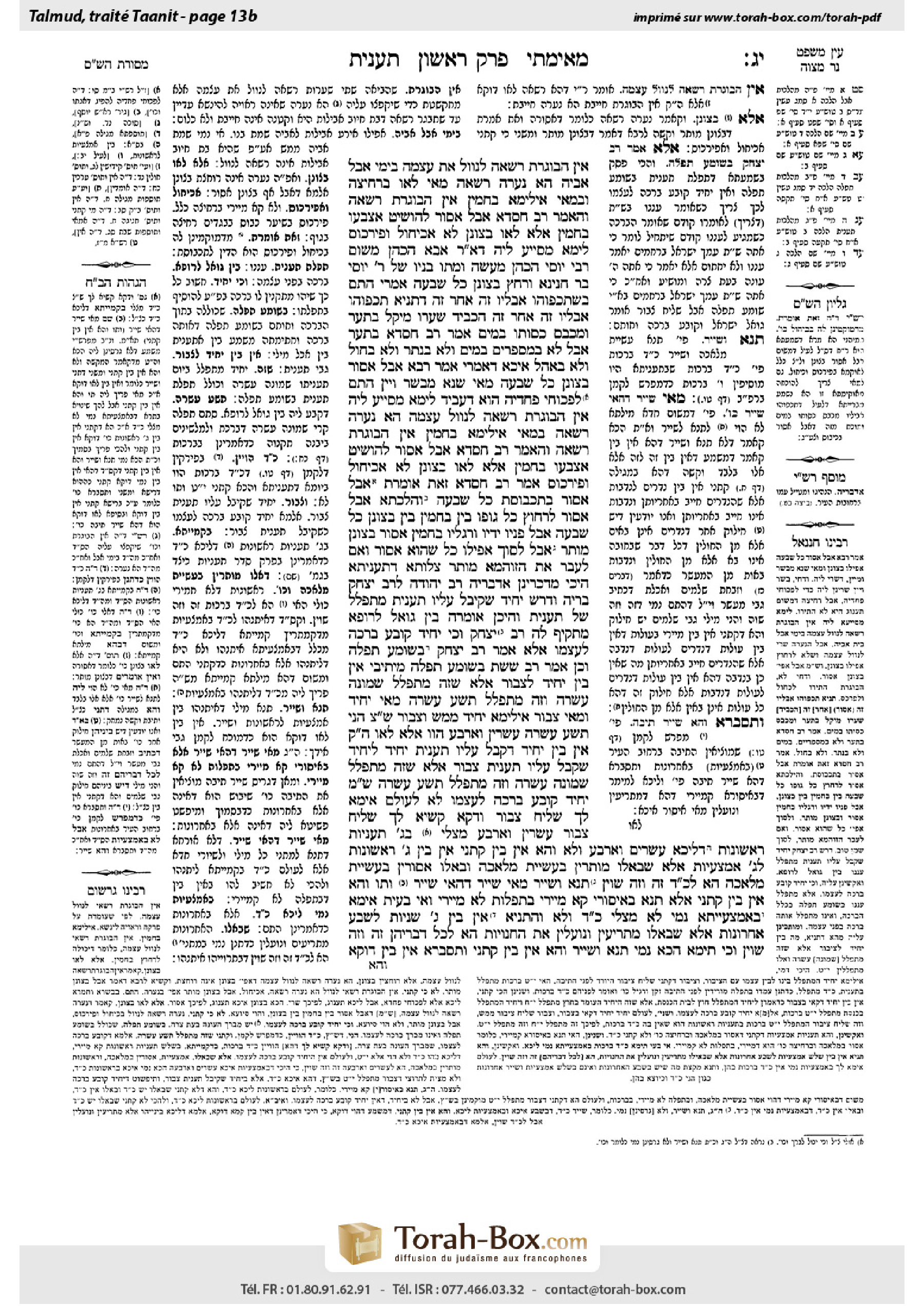
Taanit 13b: Talmud study for Daf Yomi
Daf Yomi is the daily study of one Talmud folio. Explore 37 tractates with scans, Hebrew text, Sefaria English and AI-generated French translations where annotated.
Passage selection and English or AI-generated French translation are available where the scan has annotations. Daf Study is independent of Torah-Box and Sefaria.
Browse Taanit · תענית · All tractatesTaanit 13b text and translations
This page of Taanit includes the Aramaic text, an English translation and an AI-generated French translation, alongside the scan above.
תענית י״ג ב · Aramaic and Hebrew text
אֵין הַבּוֹגֶרֶת רַשָּׁאָה לְנַוֵּול אֶת עַצְמָהּ בִּימֵי אֵבֶל אָבִיהָ. הָא נַעֲרָה — רַשָּׁאָה.
מַאי לָאו בִּרְחִיצָה, וּבְמַאי? אִילֵימָא בְּחַמִּין, אֵין הַבּוֹגֶרֶת רַשָּׁאָה?! וְהָאָמַר רַב חִסְדָּא: אָבֵל אָסוּר לְהוֹשִׁיט אֶצְבָּעוֹ בְּחַמִּין! אֶלָּא לָאו, בְּצוֹנֵן. לָא, אַכִּיחוּל וּפִירְכּוּס.
לֵימָא מְסַיַּיע לֵיהּ, דְּאָמַר רַבִּי אַבָּא הַכֹּהֵן מִשּׁוּם רַבִּי יוֹסֵי הַכֹּהֵן: מַעֲשֶׂה וּמֵתוּ בָּנָיו שֶׁל רַבִּי יוֹסֵי בַּר חֲנִינָא, וְרָחַץ בְּצוֹנֵן כׇּל שִׁבְעָה!
אָמְרִי: הָתָם בְּשֶׁתְּכָפוּהוּ אֲבָלָיו זֶה אַחַר זֶה. דְּתַנְיָא: תְּכָפוּהוּ אֲבָלָיו זֶה אַחַר זֶה, הִכְבִּיד שְׂעָרוֹ — מֵיקֵל בְּתַעַר, וּמְכַבֵּס כְּסוּתוֹ בְּמַיִם. אָמַר רַב חִסְדָּא: בְּתַעַר — אֲבָל לֹא בְּמִסְפָּרַיִם, בְּמַיִם — וְלֹא בְּנֶתֶר וְלֹא בְּחוֹל וְלֹא בְּאָהָל.
אִיכָּא דְּאָמְרִי, אָמַר רָבָא: אָבֵל אָסוּר בְּצוֹנֵן כׇּל שִׁבְעָה. מַאי שְׁנָא מִבָּשָׂר וְיַיִן? הָתָם לְפַכּוֹחֵי פַּחְדֵּיהּ הוּא דְּעָבֵיד.
לֵימָא מְסַיַּיע לֵיהּ: אֵין הַבּוֹגֶרֶת רַשָּׁאָה לְנַוֵּול עַצְמָהּ. הָא נַעֲרָה — רַשָּׁאָה! בְּמַאי, אִילֵימָא בְּחַמִּין: אֵין הַבּוֹגֶרֶת רַשָּׁאָה?! וְהָאָמַר רַב חִסְדָּא: אָבֵל אָסוּר לְהוֹשִׁיט אֶצְבָּעוֹ בְּחַמִּין! אֶלָּא לָאו, בְּצוֹנֵן. לָא, אַכִּיחוּל וּפִירְכּוּס.
אָמַר רַב חִסְדָּא: זֹאת אוֹמֶרֶת, אָבֵל אָסוּר בְּתִכְבּוֹסֶת כׇּל שִׁבְעָה. וְהִלְכְתָא: אָבֵל אָסוּר לִרְחוֹץ כׇּל גּוּפוֹ בֵּין בְּחַמִּין וּבֵין בְּצוֹנֵן כׇּל שִׁבְעָה. אֲבָל פָּנָיו יָדָיו וְרַגְלָיו, בְּחַמִּין — אָסוּר, בְּצוֹנֵן — מוּתָּר. אֲבָל לָסוּךְ, אֲפִילּוּ כָּל שֶׁהוּא אָסוּר. וְאִם לְעַבֵּר אֶת הַזּוּהֲמָא — מוּתָּר.
צְלוֹתָא דְתַעֲנִיתָא הֵיכִי מַדְכְּרִינַן? אַדְבְּרֵיהּ רַב יְהוּדָה לְרַב יִצְחָק בְּרֵיהּ, וּדְרַשׁ: יָחִיד שֶׁקִּיבֵּל עָלָיו תַּעֲנִית — מִתְפַּלֵּל שֶׁל תַּעֲנִית, וְהֵיכָן אוֹמְרָהּ — בֵּין ״גּוֹאֵל״ לְ״רוֹפֵא״.
מַתְקֵיף לַהּ רַב יִצְחָק: וְכִי יָחִיד קוֹבֵעַ בְּרָכָה לְעַצְמוֹ? אֶלָּא אָמַר רַב יִצְחָק: בְּ״שׁוֹמֵעַ תְּפִלָּה״. וְכֵן אָמַר רַב שֵׁשֶׁת: בְּ״שׁוֹמֵעַ תְּפִלָּה״.
מֵיתִיבִי: אֵין בֵּין יָחִיד לְצִבּוּר, אֶלָּא שֶׁזֶּה מִתְפַּלֵּל שְׁמוֹנֶה עֶשְׂרֵה, וְזֶה מִתְפַּלֵּל תְּשַׁע עֶשְׂרֵה. מַאי ״יָחִיד״ וּמַאי ״צִבּוּר״? אִילֵּימָא יָחִיד — מַמָּשׁ, וְצִבּוּר — שְׁלִיחַ צִבּוּר, הָנֵי תְּשַׁע עֶשְׂרֵה? עֶשְׂרִין וְאַרְבַּע הָווּ!
אֶלָּא לָאו, הָכִי קָאָמַר: אֵין בֵּין יָחִיד דְּקִבֵּל עָלָיו תַּעֲנִית יָחִיד לְיָחִיד שֶׁקִּבֵּל עָלָיו תַּעֲנִית צִבּוּר, אֶלָּא שֶׁזֶּה מִתְפַּלֵּל שְׁמוֹנֶה עֶשְׂרֵה, וְזֶה מִתְפַּלֵּל תְּשַׁע עֶשְׂרֵה. שְׁמַע מִינַּהּ: יָחִיד קוֹבֵעַ בְּרָכָה לְעַצְמוֹ!
לָא, לְעוֹלָם אֵימָא לָךְ שְׁלִיחַ צִבּוּר, וּדְקָא קַשְׁיָא לָךְ: שְׁלִיחַ צִבּוּר עֶשְׂרִין וְאַרְבַּע מְצַלֵּי — בְּשָׁלֹשׁ תַּעֲנִיּוֹת רִאשׁוֹנוֹת, דְּלֵיכָּא עֶשְׂרִים וְאַרְבַּע.
וְלָא? וְהָא ״אֵין בֵּין״ קָתָנֵי: אֵין בֵּין שָׁלֹשׁ רִאשׁוֹנוֹת לְשָׁלֹשׁ אֶמְצָעִיּוֹת, אֶלָּא שֶׁבְּאֵלּוּ מוּתָּרִין בַּעֲשִׂיַּית מְלָאכָה, וּבְאֵלּוּ אֲסוּרִין בַּעֲשִׂיַּית מְלָאכָה. הָא לְעֶשְׂרִים וְאַרְבַּע — זֶה וָזֶה שָׁוִין!
תְּנָא וְשַׁיַּיר. מַאי שַׁיַּיר דְּהַאי שַׁיַּיר? וְתוּ: וְהָא ״אֵין בֵּין״ קָתָנֵי! אֶלָּא, תַּנָּא בְּאִיסּוּרֵי קָא מַיְירֵי, בִּתְפִלּוֹת לָא מַיְירֵי. וְאִי בָּעֵית אֵימָא: בְּאֶמְצָעֲיָיתָא נָמֵי לָא מְצַלֵּי עֶשְׂרִים וְאַרְבַּע.
וְלָא?! וְהָתַנְיָא: אֵין בֵּין שָׁלֹשׁ שְׁנִיּוֹת לְשֶׁבַע אַחֲרוֹנוֹת, אֶלָּא שֶׁבְּאִלּוּ מַתְרִיעִין וְנוֹעֲלִין אֶת הַחֲנוּיוֹת. הָא לְכׇל דִּבְרֵיהֶן — זֶה וָזֶה שָׁוִין! וְכִי תֵּימָא הָכָא נָמֵי תְּנָא וְשַׁיַּיר — וְהָא ״אֵין בֵּין״ קָתָנֵי!
וְתִסְבְּרָא ״אֵין בֵּין״ דַּוְקָא?
Taanit 13b · English translation
A grown woman, i.e., a girl over twelve and a half, who is old enough to be married, is not permitted to render herself unattractive during the days of mourning for her father, as this would adversely affect her chances of marriage. The Gemara infers that this halakha applies only to a grown woman, whereas a young woman, a girl between the ages of twelve and twelve and a half, who is not yet old enough to be married, is permitted to render herself unattractive.
The Gemara analyzes this halakha: What, is it not referring to the prohibition against bathing? And in what kind of water may a grown woman bathe? If we say that the baraita is referring to hot water, is a grown woman not permitted to render herself unattractive by refraining from washing in hot water? But didn’t Rav Ḥisda say: It is prohibited for a mourner to insert even his finger into hot water for the purpose of washing. Rather, is it not the case that it is permitted for a grown woman to bathe in cold water, from which it may be inferred that it is not permitted for a young woman to bathe even in cold water. The Gemara answers: No, the baraita is not speaking of bathing at all. Rather it is referring to painting the eyes and dyeing [pirkus] one’s hair, which it is permitted for a grown woman to do during mourning.
The Gemara proposes: Let us say that the aforementioned baraita supports Rava’s ruling. As Rabbi Abba the priest said in the name of Rabbi Yosei the priest: An incident occurred in which the sons of Rabbi Yosei, son of Rabbi Ḥanina, died, and he bathed in cold water all seven days of mourning. This ruling apparently indicates that a mourner is permitted to bathe in cold water.
The Gemara responds: This is not a proof, as they say: There it is referring to a case where his mourning periods came immediately one after the other, as it is taught in a baraita: If one’s mourning periods came immediately one after the other and his hair grew heavy, he may lighten it with a razor, and he may wash his garment in water. And Rav Ḥisda said: He may trim his hair with a razor, but not with scissors. Likewise, he may wash his garment in water, but not with natron, nor with sand, and nor with iceplant.
The foregoing is one version of Rava’s opinion and the ensuing discussion. Some say a different version of this debate. Rava said: It is prohibited for a mourner to bathe in cold water all seven days of mourning. The Gemara asks: In what way is this case different from eating meat and drinking wine, which a mourner is permitted to do? The Gemara responds: There, he acts to relieve his anxieties. Since a mourner is typically distressed over the death of a close relative, the Sages permitted him to fortify himself with strong food and drink.
The Gemara proposes: Let us say that the following baraita supports Rava’s ruling. A grown woman is not permitted to render herself unattractive during the days of mourning for her father. As above, the Gemara infers that this halakha applies only to a grown woman, but a young woman is permitted to render herself unattractive. In what kind of water may a grown woman bathe? If we say that this is referring to hot water, is a grown woman not permitted to refrain from washing in hot water? But didn’t Rav Ḥisda say: It is prohibited for a mourner to insert his finger into hot water for the purpose of washing. Rather, is it not the case that the baraita is referring to bathing in cold water? The Gemara answers: No; the baraita is speaking of painting the eyes and dyeing the hair.
Rav Ḥisda said: That is to say, i.e., as the baraita states that it is permitted for a grown woman who observes successive periods of mourning to paint and dye her hair, the same halakha evidently applies to laundry, from which it may be inferred that in an unexceptional case it is prohibited for a mourner to wash laundry all seven days of mourning. The Gemara concludes: And the practical halakha is: It is prohibited for a mourner to bathe his entire body both in hot water and in cold water all seven days of mourning. However, with regard to his face, his hands, and his feet, although it is prohibited to bathe them in hot water, in cold water it is permitted. However, with regard to smearing with oil, even any minimal amount of smearing is prohibited. But if one does so to remove the dirt, it is permitted.
§ The Gemara returns to the discussion of the Aneinu prayer, recited on fast days. The prayer of a fast, how does one mention it? Rav Yehuda granted his son Rav Yitzḥak general permission to expound publicly, while instructing him in the substance of what he should say, and Rav Yitzḥak taught: An individual who took a fast upon himself prays the prayer of a fast. And where in the Amida does he recite this additional prayer? Between the seventh blessing of the Amida: Who redeems, and the eighth blessing: Who heals.
Rav Yitzḥak strongly objects to this: But may an individual establish a blessing for himself, in addition to the fixed blessings of the Amida? Rather, Rav Yitzḥak said: One mentions his fast in the blessing: Who listens to prayer, in accordance with the general principle that an individual may insert private requests into this general plea for the acceptance of prayers, including matters outside the scope of the established blessings. And similarly, Rav Sheshet said: One recites the prayer for a fast day in the blessing: Who listens to prayer.
The Gemara raises an objection from a baraita: The only halakhic difference between an individual and a community is that this one, an individual, prays eighteen blessings in his Amida, and that one, a community, prays nineteen blessings. The Gemara analyzes this statement: What is an individual and what is a community in this context? If we say that an individual means an actual individual, and community is referring to the communal prayer leader, are there really only nineteen blessings in the communal Amida of a fast? There are twenty-four blessings. As will be explained, six additional blessings are added on communal fast days.
Rather, is it not the case that this is what the baraita is saying: The only halakhic difference between an individual who took an individual fast upon himself and an individual who took a communal fast upon himself, is only that this one prays eighteen blessings, as he mentions his fast in the blessing: Who listens to prayer, and that one prays nineteen blessings. Learn from this statement that an individual may establish an individual blessing for himself.
The Gemara rejects this contention: No, actually I could say to you that this mention of a community is referring to the prayer leader. And with regard to what poses a difficulty for you, that the prayer leader prays twenty-four blessings, the baraita is referring to the first three fasts, in which there are not twenty-four blessings, but only the usual eighteen blessings, plus one additional blessing for fast days.
The Gemara questions this resolution: And are the six additional blessings not recited on the first series of communal fasts? But with regard to this issue, a baraita taught the instructive phrase: The only difference between them, as follows: The difference between the first three fasts and the middle three fasts is only that on these first fasts it is permitted to perform work, and on these middle fasts it is prohibited to perform work. This indicates that with regard to reciting all twenty-four blessings, both this and that are identical.
The Gemara rejects this argument: The tanna taught some of the differences between the fasts, and omitted some of them. The Gemara asks: What else did the tanna omit that you can justifiably claim that he omitted this case? In other words, it is possible for the tanna to have omitted a few examples, but he would not have omitted a single case. And furthermore, the baraita does not merely offer a list of differences, as it teaches: The difference between them is only. This phrase indicates that this is the only difference. Rather, the tanna is speaking of the various prohibitions of fast days, but he is not speaking of other differences, such as those that involve the details of prayers. And if you wish, say instead that on the middle three fasts too, the prayer leader does not pray twenty-four blessings, as the six additional blessings are recited only during the last series of fasts.
The Gemara expresses surprise at this: And does the prayer leader not recite all twenty-four blessings during the middle three fasts? But isn’t it taught in a baraita: The difference between the second set of three fasts and the last seven fasts is only that in these they sound the alarm and lock the stores. This indicates that with regard to all their other matters, both this and that are identical. And if you say that here, too, he taught and omitted, but it teaches: The difference between them is only indicating that there is no other difference.
The Gemara asks: And how can you understand it that way? Does the phrase: The difference between them is only, specifically mean that there is only a single difference between the cases?
Taanit 13b · Traduction française (IA)
Une femme majeure, c’est-à-dire une fille de plus de douze ans et demi, en âge de se marier, n’a pas le droit de se rendre disgracieuse pendant les jours de deuil pour son père, car cela nuirait à ses chances de mariage. La Guemara déduit que cette halakha ne s’applique qu’à une femme majeure, tandis qu’une jeune fille, âgée de douze à douze ans et demi et qui n’est pas encore en âge de se marier, a le droit de se rendre disgracieuse.
La Guemara examine cette halakha : ne concerne-t-elle pas l’interdiction de se baigner ? Et dans quelle sorte d’eau une femme majeure peut-elle se baigner ? Si l’on dit que la baraïta parle d’eau chaude, une femme majeure n’a-t-elle pas le droit de se rendre disgracieuse en s’abstenant de se laver à l’eau chaude ? Mais Rav Ḥisda n’a-t-il pas dit qu’il est interdit à une personne en deuil de plonger ne serait-ce que le doigt dans l’eau chaude pour se laver ? Il faut donc conclure qu’une femme majeure a le droit de se baigner dans l’eau froide, d’où l’on déduit qu’une jeune fille n’a pas le droit de se baigner, même dans l’eau froide. La Guemara répond : non, la baraïta ne parle pas du tout de bain. Elle concerne plutôt le maquillage des yeux et la teinture [pirkus] des cheveux, qu’une femme majeure a le droit de pratiquer pendant le deuil.
La Guemara propose : disons que la baraïta mentionnée plus haut appuie la décision de Rava. En effet, Rabbi Abba le prêtre a dit au nom de Rabbi Yosei le prêtre : un événement s’est produit où les fils de Rabbi Yosei, fils de Rabbi Ḥanina, sont morts, et celui-ci s’est baigné à l’eau froide pendant les sept jours de deuil. Cette décision semble indiquer qu’une personne en deuil a le droit de se baigner à l’eau froide.
La Guemara répond : ce n’est pas une preuve, car on dit que ce cas concerne une situation où les périodes de deuil se sont succédé immédiatement. En effet, une baraïta enseigne : si les périodes de deuil se sont succédé immédiatement et que ses cheveux sont devenus épais, il peut les alléger au rasoir et laver son vêtement à l’eau. Rav Ḥisda a dit : il peut se couper les cheveux au rasoir, mais pas aux ciseaux. De même, il peut laver son vêtement à l’eau, mais pas au natron, au sable ni à la plante de soude.
Ce qui précède est une version de l’opinion de Rava et de la discussion qui s’ensuit. Selon certains, ce débat est rapporté sous une autre forme. Rava a dit : il est interdit à une personne en deuil de se baigner à l’eau froide pendant les sept jours de deuil. La Guemara demande : en quoi ce cas diffère-t-il de la consommation de viande et de vin, que la personne en deuil a le droit de consommer ? La Guemara répond : dans ce cas, elle agit pour apaiser ses angoisses. Puisqu’une personne en deuil est généralement affligée par la mort d’un proche, les Sages lui ont permis de se fortifier avec des aliments et des boissons nourrissants.
La Guemara propose : disons que la baraïta suivante appuie la décision de Rava. Une femme majeure n’a pas le droit de se rendre disgracieuse pendant les jours de deuil pour son père. Comme précédemment, la Guemara déduit que cette halakha ne s’applique qu’à une femme majeure, tandis qu’une jeune fille a le droit de se rendre disgracieuse. Dans quelle sorte d’eau une femme majeure peut-elle se baigner ? Si l’on dit que la baraïta parle d’eau chaude, une femme majeure n’a-t-elle pas le droit de s’abstenir de se laver à l’eau chaude ? Mais Rav Ḥisda n’a-t-il pas dit qu’il est interdit à une personne en deuil de plonger le doigt dans l’eau chaude pour se laver ? Il faut donc conclure que la baraïta parle d’un bain à l’eau froide. La Guemara répond : non, la baraïta parle du maquillage des yeux et de la teinture des cheveux.
Rav Ḥisda a dit : on peut en déduire que, puisque la baraïta affirme qu’une femme majeure dont les périodes de deuil se succèdent a le droit de se maquiller et de se teindre les cheveux, la même halakha s’applique manifestement à la lessive. On peut donc déduire que, dans un cas ordinaire, il est interdit à une personne en deuil de faire la lessive pendant les sept jours de deuil. La Guemara conclut : en pratique, il est interdit à une personne en deuil de se baigner tout le corps, à l’eau chaude comme à l’eau froide, pendant les sept jours de deuil. Toutefois, pour le visage, les mains et les pieds, bien qu’il soit interdit de les laver à l’eau chaude, il est permis de le faire à l’eau froide. En revanche, il est interdit de s’enduire d’huile, même en quantité minime. Mais si l’on en applique pour enlever la saleté, cela est permis.
§ La Guemara revient à la discussion de la prière Aneinou, récitée les jours de jeûne. Comment mentionne-t-on le jeûne dans la prière ? Rav Yehuda a donné à son fils Rav Yitzḥak l’autorisation générale d’enseigner en public, tout en lui indiquant ce qu’il devait dire. Rav Yitzḥak enseigna : un particulier qui s’est imposé un jeûne récite la prière du jeûne. Et où récite-t-il cette prière supplémentaire dans la Amida ? Entre la septième bénédiction de la Amida, « Celui qui rachète », et la huitième bénédiction, « Celui qui guérit ».
Rav Yitzḥak s’y oppose vivement : un particulier peut-il instituer une bénédiction pour lui-même, en plus des bénédictions fixes de la Amida ? Rav Yitzḥak dit plutôt : il mentionne son jeûne dans la bénédiction « Celui qui écoute la prière », conformément au principe général selon lequel un particulier peut insérer des demandes personnelles dans cette requête générale pour que les prières soient agréées, y compris des sujets qui ne relèvent pas des bénédictions établies. De même, Rav Sheshet a dit : on récite la prière des jours de jeûne dans la bénédiction « Celui qui écoute la prière ».
La Guemara soulève une objection à partir d’une baraïta : la seule différence halakhique entre un particulier et une communauté est que celui-ci, le particulier, récite dix-huit bénédictions dans sa Amida, tandis que celle-là, la communauté, en récite dix-neuf. La Guemara analyse cette affirmation : que désignent ici un particulier et une communauté ? Si l’on dit que le particulier désigne un individu et que la communauté désigne l’officiant de la prière communautaire, l’Amida communautaire d’un jour de jeûne ne compte-t-elle réellement que dix-neuf bénédictions ? Elle en compte vingt-quatre. Comme on l’expliquera, six bénédictions supplémentaires sont ajoutées les jours de jeûne communautaire.
Il faut plutôt comprendre que la baraïta dit ceci : la seule différence halakhique entre un particulier qui s’est imposé un jeûne individuel et un particulier qui s’est imposé un jeûne communautaire est que celui-ci récite dix-huit bénédictions, puisqu’il mentionne son jeûne dans la bénédiction « Celui qui écoute la prière », tandis que celui-là en récite dix-neuf. Déduis de cette affirmation qu’un particulier peut instituer une bénédiction individuelle pour lui-même.
La Guemara rejette cette déduction : non, en réalité, je pourrais te dire que la mention d’une communauté désigne l’officiant de la prière. Quant à la difficulté que tu soulèves, à savoir que l’officiant récite vingt-quatre bénédictions, la baraïta parle des trois premiers jeûnes, qui ne comptent pas vingt-quatre bénédictions, mais seulement les dix-huit bénédictions habituelles, auxquelles s’ajoute une bénédiction pour les jours de jeûne.
La Guemara remet en question cette résolution : les six bénédictions supplémentaires ne sont-elles pas récitées lors de la première série de jeûnes communautaires ? Or, à ce sujet, une baraïta enseigne cette formulation instructive : « La seule différence entre eux est la suivante » : la différence entre les trois premiers jeûnes et les trois jeûnes intermédiaires est uniquement que, lors des premiers jeûnes, il est permis de travailler, tandis que lors des jeûnes intermédiaires, il est interdit de travailler. Cela indique que, pour la récitation des vingt-quatre bénédictions, les uns et les autres sont identiques.
La Guemara rejette cet argument : le tanna a enseigné certaines différences entre les jeûnes et en a omis d’autres. La Guemara demande : qu’a omis d’autre le tanna pour que l’on puisse légitimement prétendre qu’il a omis ce cas ? Autrement dit, il est possible que le tanna ait omis quelques exemples, mais il n’aurait pas omis un seul cas. En outre, la baraïta ne se contente pas de dresser une liste de différences, puisqu’elle enseigne : « La différence entre eux est uniquement… » Cette formulation indique qu’il s’agit de la seule différence. Il faut plutôt dire que le tanna parle des diverses interdictions applicables les jours de jeûne, mais pas d’autres différences, telles que celles qui concernent les détails des prières. Ou, si tu le souhaites, dis plutôt que, lors des trois jeûnes intermédiaires également, l’officiant ne récite pas vingt-quatre bénédictions, car les six bénédictions supplémentaires ne sont récitées que pendant la dernière série de jeûnes.
La Guemara exprime son étonnement : l’officiant ne récite-t-il donc pas les vingt-quatre bénédictions lors des trois jeûnes intermédiaires ? Mais n’est-il pas enseigné dans une baraïta : « La seule différence entre la deuxième série de trois jeûnes et les sept derniers jeûnes est que, lors de ceux-ci, on sonne l’alarme et l’on ferme les magasins » ? Cela indique que, pour toutes les autres questions, les uns et les autres sont identiques. Et si tu dis qu’ici aussi, le tanna a enseigné certaines choses et en a omis d’autres, la baraïta enseigne pourtant : « La différence entre eux est uniquement… », ce qui indique qu’il n’y a pas d’autre différence.
La Guemara demande : et comment peux-tu comprendre cela ainsi ? L’expression « La différence entre eux est uniquement… » signifie-t-elle précisément qu’il n’existe qu’une seule différence entre les cas ?
Traduction française générée par IA à partir de l’édition anglaise de Sefaria. Vérifie toujours un passage avec le texte source.
Text from Sefaria: William Davidson Edition - Vocalized Aramaic (CC BY NC); William Davidson Edition - English (CC BY NC).