Taanit 14a: Talmud study for Daf Yomi
Daf Yomi is the daily study of one Talmud folio. Explore 37 tractates with scans, Hebrew text, Sefaria English and AI-generated French translations where annotated.
Passage selection and English or AI-generated French translation are available where the scan has annotations. Daf Study is independent of Torah-Box and Sefaria.
Browse Taanit · תענית · All tractatesTaanit 14a text and translations
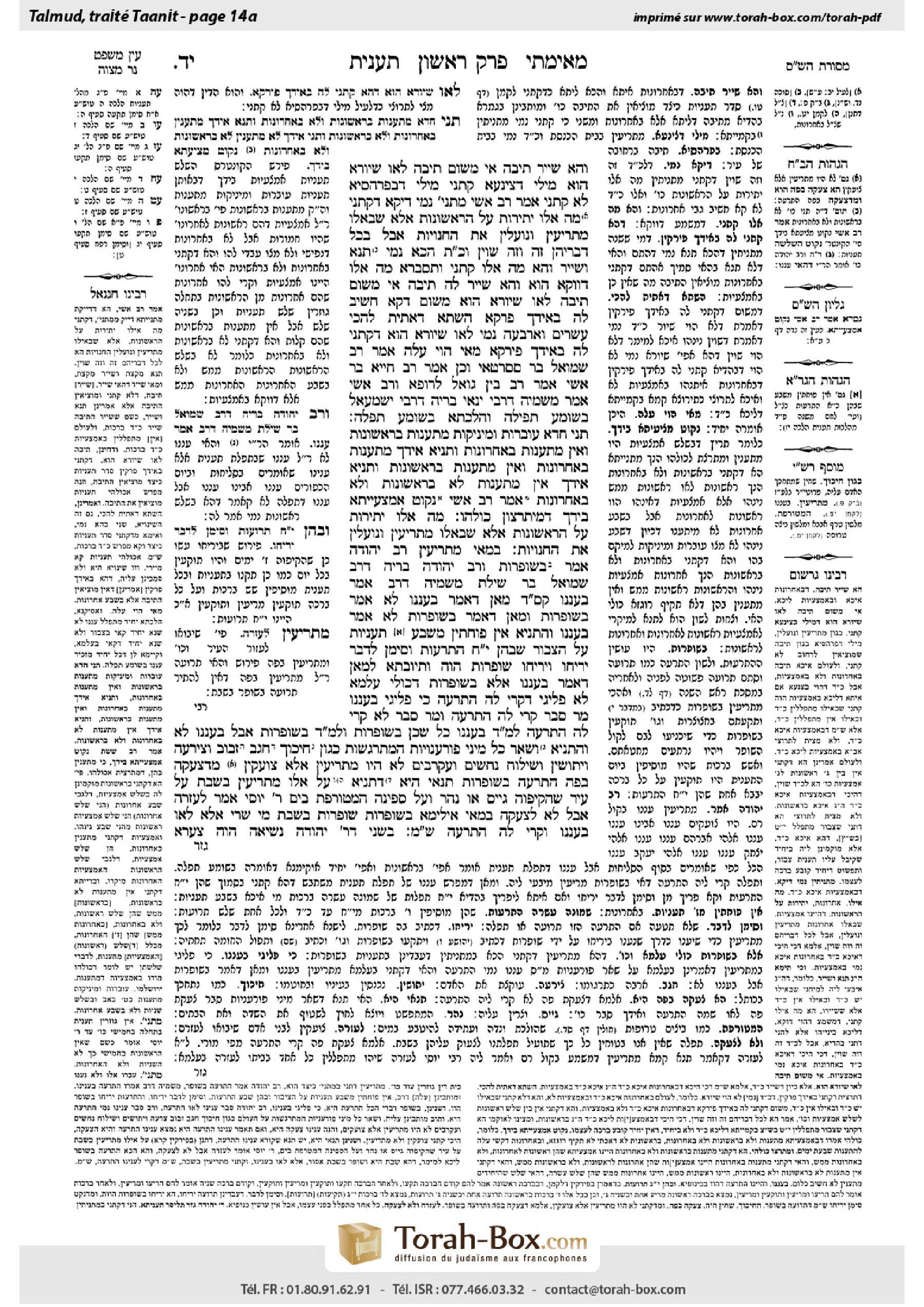
This page of Taanit includes the Aramaic text, an English translation and an AI-generated French translation, alongside the scan above.
תענית י״ד א · Aramaic and Hebrew text
וְהָא שַׁיַּיר תֵּיבָה! אִי מִשּׁוּם תֵּיבָה — לָאו שִׁיּוּרָא הוּא. מִילֵּי דְצִינְעָא — קָתָנֵי, מִילֵּי דִבְפַרְהֶסְיָא — לָא קָתָנֵי.
אָמַר רַב אָשֵׁי: מַתְנִיתִין נָמֵי דַּיְקָא, דְּקָתָנֵי: מָה אֵלּוּ יְתֵירוֹת עַל הָרִאשׁוֹנוֹת, אֶלָּא שֶׁבְּאֵלּוּ מַתְרִיעִין וְנוֹעֲלִין אֶת הַחֲנוּיוֹת. אֲבָל בְּכׇל דִּבְרֵיהֶן — זֶה וָזֶה שָׁוִין. וְכִי תֵּימָא הָכָא נָמֵי תְּנָא וְשַׁיַּיר, וְהָא ״מָה אֵלּוּ״ קָתָנֵי.
וְתִסְבְּרָא ״מָה אֵלּוּ״ דַּוְוקָא הוּא? וְהָא שַׁיַּיר לַהּ תֵּיבָה! אִי מִשּׁוּם תֵּיבָה — לָאו שִׁיּוּרָא הוּא, מִשּׁוּם דְּקָא חָשֵׁיב לַהּ בְּאִידַּךְ פִּרְקָא. הַשְׁתָּא דְּאָתֵית לְהָכִי: עֶשְׂרִים וְאַרְבָּעָה נָמֵי לָאו שִׁיּוּרָא הוּא, דְּקָתָנֵי לַהּ בְּאִידַּךְ פִּירְקָא.
מַאי הָוֵי עֲלַהּ? אָמַר רַבִּי שְׁמוּאֵל בַּר סִסְרָטַאי, וְכֵן אָמַר רַב חִיָּיא בַּר אָשֵׁי אָמַר רַב: בֵּין ״גּוֹאֵל״ לְ״רוֹפֵא״. וְרַב אָשֵׁי אָמַר מִשְּׁמֵיהּ דְּרַבִּי יַנַּאי בְּרֵיהּ דְּרַבִּי יִשְׁמָעֵאל: בְּ״שׁוֹמֵעַ תְּפִילָּה״. וְהִלְכְתָא, בְּ״שׁוֹמֵעַ תְּפִילָּה״.
תָּנֵי חֲדָא: עוּבָּרוֹת וּמֵינִיקוֹת מִתְעַנּוֹת בָּרִאשׁוֹנוֹת, וְאֵין מִתְעַנּוֹת בָּאַחֲרוֹנוֹת. וְתַנְיָא אִידַּךְ: מִתְעַנּוֹת בָּאַחֲרוֹנוֹת, וְאֵין מִתְעַנּוֹת בָּרִאשׁוֹנוֹת. וְתַנְיָא אִידַּךְ: אֵין מִתְעַנּוֹת, לֹא בָּרִאשׁוֹנוֹת וְלֹא בָּאַחֲרוֹנוֹת.
אָמַר רַב אָשֵׁי: נְקוֹט אֶמְצָעֲיָיתָא בִּידָךְ, דְּמִיתָּרְצָן כּוּלְּהוּ.
מָה אֵלּוּ יְתֵירוֹת עַל הָרִאשׁוֹנוֹת, אֶלָּא שֶׁבְּאֵלּוּ מַתְרִיעִין וְנוֹעֲלִין אֶת הַחֲנוּיוֹת. בְּמַאי מַתְרִיעִין? רַב יְהוּדָה אָמַר: בְּשׁוֹפָרוֹת, וְרַב יְהוּדָה בְּרֵיהּ דְּרַב שְׁמוּאֵל בַּר שִׁילַת מִשְּׁמֵיהּ דְּרַב אָמַר: בַּ״עֲנֵנוּ״.
קָא סָלְקָא דַּעְתָּן, מַאן דְּאָמַר בַּ״עֲנֵנוּ״ — לָא אָמַר בְּשׁוֹפָרוֹת, וּמַאן דְּאָמַר בְּשׁוֹפָרוֹת — לָא אָמַר בַּ״עֲנֵנוּ״. וְהָתַנְיָא: אֵין פּוֹחֲתִין מִשֶּׁבַע תַּעֲנִיּוֹת עַל הַצִּבּוּר, שֶׁבָּהֶן שְׁמוֹנֶה עֶשְׂרֵה הַתְרָעוֹת. וְסִימָן לַדָּבָר: יְרִיחוֹ. וִירִיחוֹ שׁוֹפָרוֹת הֲוָה, וּתְיוּבְתָּא לְמַאן דְּאָמַר בַּ״עֲנֵנוּ״!
אֶלָּא: בְּשׁוֹפָרוֹת, דְּכוּלֵּי עָלְמָא לָא פְּלִיגִי דְּקָרֵי לַהּ הַתְרָעָה. כִּי פְּלִיגִי בַּ״עֲנֵנוּ״. מָר סָבַר: קָרֵי לַהּ הַתְרָעָה, וּמָר סָבַר: לָא קָרֵי לַהּ הַתְרָעָה.
לְמַאן דְּאָמַר בַּ״עֲנֵנוּ״ — כׇּל שֶׁכֵּן בְּשׁוֹפָרוֹת. וּלְמַאן דְּאָמַר בְּשׁוֹפָרוֹת — אֲבָל בַּעֲנֵנוּ לָא!
וְהָתַנְיָא: וּשְׁאָר כׇּל מִינֵי פּוּרְעָנוּיוֹת הַמִּתְרַגְּשׁוֹת, כְּגוֹן: חִיכּוּךְ, חָגָב, זְבוּב וְצִירְעָה וְיַתּוּשִׁין, וְשִׁילּוּחַ נְחָשִׁים וְעַקְרַבִּים — לֹא הָיוּ מַתְרִיעִין אֶלָּא צוֹעֲקִין. מִדִּצְעָקָה בַּפֶּה, הַתְרָעָה בְּשׁוֹפָרוֹת!
תַּנָּאֵי הִיא, דִּתְנַן: עַל אֵלּוּ מַתְרִיעִין בְּשַׁבָּת, עַל עִיר שֶׁהִקִּיפוּהָ גַּיִיס אוֹ נָהָר, וְעַל סְפִינָה הַמְטוֹרֶפֶת בַּיָּם. רַבִּי יוֹסֵי אֹמֵר: לְעֶזְרָה, אֲבָל לֹא לִצְעָקָה.
בְּמַאי? אִילֵימָא בְּשׁוֹפָרוֹת — שׁוֹפָרוֹת בְּשַׁבָּת מִי שְׁרֵי? אֶלָּא לָאו, בַּ״עֲנֵנוּ״, וְקָרֵי לַהּ הַתְרָעָה, שְׁמַע מִינַּהּ.
בִּשְׁנֵי דְּרַבִּי יְהוּדָה נְשִׂיאָה הֲוָה צַעֲרָא,
Taanit 14a · English translation
But he omitted any mention of the ark and the halakha that during the last seven fast days the ark was brought into the streets of the city. The Gemara rejects this argument: If the omission is due to the ark, that is not a real omission. The reason is that the tanna teaches only matters that are performed in private, whereas he does not teach matters that are performed in public [parhesya].
Rav Ashi said: The wording of the mishna is also precise, according to this explanation, as it teaches: How are these seven fast days more stringent than the first ones? Rather, the difference is that on these days, in addition to all the earlier stringencies, they sound the alarm and they lock the stores. However, in regard to all their other matters, both this and that are identical. And if you say that here too he taught and omitted, but it teaches: How are these more stringent, an expression that indicates that the mishna states the only difference.
The Gemara asks: And how can you understand the phrase: How are these, specifically, as indicating that there is only one difference between the cases? But he omitted the ark. The Gemara responds: If the omission is due to the ark, that is not a real omission, because the tanna includes it in another chapter (15a). The Gemara comments: Now that you have arrived at this solution, a similar answer can be applied to the earlier difficulties. The matter of the twenty-four blessings is also not an omission, as he teaches this halakha in another chapter, also on 15a, where the mishna provides further details of the blessings. Here, however, the tanna lists only those matters that are not discussed later.
Since no decisive proof was offered in support of any of the opinions as to where an individual inserts the Aneinu prayer, the Gemara asks: What halakhic conclusion was reached about this matter? Rabbi Shmuel bar Sasretai said, and similarly Rav Ḥiyya bar Ashi said that Rav said: One inserts it between the seventh blessing of the Amida: Who redeems, and the eighth blessing: Who heals. And Rav Ashi said in the name of Rabbi Yannai, son of Rabbi Yishmael: One inserts it in the blessing: Who listens to prayer. The Gemara concludes: And the halakha is that one includes it in the blessing: Who listens to prayer.
§ It is taught in one baraita: Pregnant and nursing women fast with the community on the first fasts, but they do not fast on the last fasts. And it was taught in another baraita: Pregnant and nursing women fast on the last set of fasts but they do not fast on the first set of fasts. And it was taught in yet another baraita: They do not fast either on the first fast days or on the last fast days.
Rav Ashi said: Take the mention of the middle fasts in your hand as the decisive matter, as this resolves all three baraitot. The halakha is that pregnant and nursing women fast only on the middle fasts, as they are stricter than the first fasts but less taxing than the last seven fasts. Consequently, when the first baraita is referring to the first fasts, it in fact means the middle set, which is the first of the last two sets. Similarly, when the second baraita mentions the last fasts, it means the middle set, which is the last of the two sets. In the third baraita, the first and last fasts are literally the first three and last seven fasts, respectively. In this manner all three baraitot follow the same halakha.
§ The mishna teaches: How are these seven fast days more stringent than the first ones? Rather, the difference is that on these days, in addition to all the earlier stringencies, they sound the alarm and they lock the stores. The Gemara asks: With what do they sound the alarm? Rav Yehuda said: With shofarot. And Rav Yehuda, son of Rav Shmuel bar Sheilat, said in the name of Rav: With the Aneinu prayer.
The Gemara analyzes the dispute: It might enter our mind to say that the one who said that the community sounds the alarm by reciting Aneinu, i.e., Rav, did not say that they cry out with shofarot, and likewise the one who said that they do cry out with shofarot, Rav Yehuda, did not say that they sound the alarm by reciting Aneinu. But isn’t it taught in a baraita: The court does not decree fewer than seven fasts on the community, which include eighteen acts of sounding the alarm. And a mnemonic for this matter is Jericho. And as there were many episodes of sounding the shofarot in Jericho, this is a conclusive refutation of the one who said that according to the opinion of Rav they sound the alarm only by reciting Aneinu.
Rather, the Gemara explains that the dispute must be understood differently: With regard to shofarot, everyone, i.e., Rav and Rav Yehuda, agrees that the mishna calls this: Sounding the alarm. When they disagree, it is with regard to the Aneinu prayer. One Sage, Rav, holds that this too is called sounding the alarm, and one Sage, Rav Yehuda, holds that reciting Aneinu is not called sounding the alarm.
The Gemara comments: If so, then it follows that according to the one who said that they sound the alarm by reciting Aneinu, all the more so they can do so with shofarot, but according to the one who said that they sound the alarm with shofarot, this is the way they sound the alarm; however, they may not do so with Aneinu, i.e., the community does not sound the alarm by reciting this prayer. This indicates that the Aneinu prayer is recited only in extreme cases, as it is a greater form of petitioning to God than blowing the shofar.
The Gemara raises a difficulty against this conclusion. But isn’t it taught in a baraita: And with regard to all other types of calamities than drought that break out, for example scabs, plagues of locusts, flies, or hornets, or mosquitoes, or infestations of snakes or scorpions, they would not sound the alarm, but they would cry out. From the fact that crying out is, according to all opinions, a prayer recited with one’s mouth, it follows that sounding an alarm must be with shofarot. This baraita indicates that sounding the alarm with shofarot is the response to a serious situation, whereas the Aneinu prayer is recited on less worrisome occasions.
The Gemara answers: This is a dispute between tanna’im, as we learned in a mishna: For the following calamities they sound the alarm even on Shabbat: For a city that is surrounded by an enemy army or in danger of being flooded by a river, or for a ship tossed about at sea. Rabbi Yosei said: An alarm may be sounded on Shabbat to summon help, but it may not be sounded for crying out to God.
The Gemara clarifies this case. With what do they sound the alarm? If we say with shofarot, is the sounding of shofarot permitted on Shabbat? Even when Rosh HaShana occurs on Shabbat, one must refrain from sounding the shofar on that day. Rather, is it not the case that this is referring to the recitation of the Aneinu prayer, and yet the mishna calls this recitation: Sounding the alarm. Conclude from this that there is a tanna who maintains that sounding of the alarm is in fact performed by prayer, as claimed by Rav Yehuda, son of Rav Shmuel bar Sheilat.
§ The Gemara relates: During the years of Rabbi Yehuda Nesia there was a trouble that afflicted the community.
Taanit 14a · Traduction française (IA)
Mais il n’a mentionné ni l’arche ni la halakha selon laquelle, pendant les sept derniers jours de jeûne, on apportait l’arche dans les rues de la ville. La Guemara rejette cet argument : si l’omission concerne l’arche, il ne s’agit pas d’une véritable omission. En effet, le tanna enseigne uniquement les pratiques accomplies en privé, mais pas celles qui se déroulent en public [parhesya].
Rav Ashi dit : selon cette explication, la formulation de la Michna est également précise, puisqu’elle enseigne : « En quoi ces sept jours de jeûne sont-ils plus rigoureux que les premiers ? » La différence est que, ces jours-là, en plus de toutes les rigueurs précédentes, on sonne l’alarme et on ferme les boutiques. Pour toutes les autres règles, en revanche, les uns et les autres sont identiques. Et si tu dis qu’ici aussi, le tanna a enseigné certaines choses en en omettant d’autres, la Michna demande : « En quoi ceux-ci sont-ils plus rigoureux ? » Cette formulation indique qu’elle énonce la seule différence.
La Guemara demande : Comment peux-tu comprendre l’expression « En quoi ceux-ci », précisément, comme indiquant qu’il n’y a qu’une seule différence entre les cas ? Il a pourtant omis l’arche. La Guemara répond : si l’omission concerne l’arche, il ne s’agit pas d’une véritable omission, car le tanna l’inclut dans un autre chapitre (15a). La Guemara fait remarquer : maintenant que tu es parvenu à cette solution, une réponse similaire peut être apportée aux difficultés précédentes. La question des vingt-quatre bénédictions ne constitue pas non plus une omission, car le tanna enseigne cette halakha dans un autre chapitre, également en 15a, où la Michna donne davantage de détails sur les bénédictions. Ici, toutefois, le tanna ne répertorie que les éléments qui ne sont pas traités par la suite.
Puisqu’aucune preuve décisive n’a été apportée en faveur de l’une ou l’autre des opinions sur l’endroit où un particulier insère la prière Aneinu, la Guemara demande : Quelle conclusion halakhique a-t-on tirée à ce sujet ? Rabbi Shmuel bar Sasretai a dit, et de même Rav Ḥiyya bar Ashi a dit au nom de Rav : on l’insère entre la septième bénédiction de la Amida, « Celui qui rachète », et la huitième bénédiction, « Celui qui guérit ». Rav Ashi a dit au nom de Rabbi Yannai, fils de Rabbi Yishmael : on l’insère dans la bénédiction « Celui qui écoute la prière ». La Guemara conclut : la halakha est qu’on l’inclut dans la bénédiction « Celui qui écoute la prière ».
§ Il est enseigné dans une baraïta : les femmes enceintes et celles qui allaitent jeûnent avec la communauté lors des premiers jeûnes, mais ne jeûnent pas lors des derniers. Une autre baraïta enseigne : les femmes enceintes et celles qui allaitent jeûnent lors de la dernière série de jeûnes, mais ne jeûnent pas lors de la première série. Une troisième baraïta enseigne : elles ne jeûnent ni lors des premiers jours de jeûne ni lors des derniers.
Rav Ashi dit : considérez la mention des jeûnes intermédiaires comme l’élément décisif, car elle permet de résoudre les trois baraïtot. La halakha est que les femmes enceintes et celles qui allaitent jeûnent uniquement lors des jeûnes intermédiaires, qui sont plus rigoureux que les premiers, mais moins éprouvants que les sept derniers. Par conséquent, lorsque la première baraïta parle des premiers jeûnes, elle désigne en réalité la série intermédiaire, qui est la première des deux dernières séries. De même, lorsque la deuxième baraïta parle des derniers jeûnes, elle désigne la série intermédiaire, qui est la dernière des deux séries. Dans la troisième baraïta, les premiers et les derniers jeûnes désignent littéralement les trois premiers et les sept derniers jours de jeûne, respectivement. Ainsi, les trois baraïtot suivent la même halakha.
§ La Michna enseigne : « En quoi ces sept jours de jeûne sont-ils plus rigoureux que les premiers ? » La différence est que, ces jours-là, en plus de toutes les rigueurs précédentes, on sonne l’alarme et on ferme les boutiques. La Guemara demande : Avec quoi sonne-t-on l’alarme ? Rav Yehuda dit : avec des chofarot. Rav Yehuda, fils de Rav Shmuel bar Sheilat, dit au nom de Rav : avec la prière Aneinu.
La Guemara analyse la controverse : on pourrait penser que celui qui dit que la communauté sonne l’alarme en récitant Aneinu, à savoir Rav, ne dit pas qu’on crie avec des chofarot, et que, de même, celui qui dit qu’on crie avec des chofarot, Rav Yehuda, ne dit pas que la communauté sonne l’alarme en récitant Aneinu. Mais n’est-il pas enseigné dans une baraïta : le tribunal ne décrète pas moins de sept jeûnes pour la communauté, lesquels comportent dix-huit actes consistant à sonner l’alarme ? Un moyen mnémotechnique pour ce sujet est Jéricho. Or, comme il y eut de nombreux épisodes de sonneries de chofarot à Jéricho, cela réfute de manière concluante l’opinion selon laquelle, d’après Rav, on ne sonne l’alarme qu’en récitant Aneinu.
La Guemara explique plutôt qu’il faut comprendre la controverse autrement : pour ce qui est des chofarot, tous, c’est-à-dire Rav et Rav Yehuda, conviennent que la Michna désigne cela par l’expression « sonner l’alarme ». Leur désaccord porte sur la prière Aneinu. L’un des Sages, Rav, estime que cela aussi est appelé « sonner l’alarme », tandis que l’autre Sage, Rav Yehuda, estime que réciter Aneinu n’est pas appelé « sonner l’alarme ».
La Guemara fait remarquer : si c’est ainsi, il s’ensuit que, selon celui qui dit qu’on sonne l’alarme en récitant Aneinu, on peut à plus forte raison le faire avec des chofarot. Mais selon celui qui dit qu’on sonne l’alarme avec des chofarot, c’est de cette manière qu’on sonne l’alarme ; en revanche, on ne peut pas le faire avec Aneinu, c’est-à-dire que la communauté ne sonne pas l’alarme en récitant cette prière. Cela indique que la prière Aneinu n’est récitée que dans les cas extrêmes, car elle constitue une supplication à Dieu plus intense que la sonnerie du chofar.
La Guemara soulève une difficulté contre cette conclusion. Mais n’est-il pas enseigné dans une baraïta : en cas de toutes les autres calamités que la sécheresse qui surviennent, par exemple des dartres, des invasions de sauterelles, de mouches, de frelons ou de moustiques, ou des infestations de serpents ou de scorpions, on ne sonne pas l’alarme, mais on crie. Puisque, de l’avis de tous, crier désigne une prière prononcée oralement, il s’ensuit que sonner l’alarme doit se faire avec des chofarot. Cette baraïta indique que sonner l’alarme avec des chofarot est la réponse à une situation grave, tandis que la prière Aneinu est récitée lors d’événements moins préoccupants.
La Guemara répond : il s’agit d’une controverse entre tannaïm, comme nous l’avons appris dans une Michna : pour les calamités suivantes, on sonne l’alarme même le Chabbat : une ville encerclée par une armée ennemie ou menacée par la montée des eaux d’un fleuve, ou un navire ballotté en mer. Rabbi Yosei dit : on peut sonner l’alarme le Chabbat pour appeler à l’aide, mais pas pour crier vers Dieu.
La Guemara précise ce cas. Avec quoi sonne-t-on l’alarme ? Si nous disons avec des chofarot, la sonnerie des chofarot est-elle autorisée le Chabbat ? Même lorsque Roch Hachana tombe un Chabbat, il faut s’abstenir de sonner le chofar ce jour-là. Ne s’agit-il pas plutôt de la récitation de la prière Aneinu, alors que la Michna appelle cette récitation « sonner l’alarme » ? Déduis-en qu’il existe un tanna qui soutient que l’alarme est effectivement donnée par la prière, comme l’affirme Rav Yehuda, fils de Rav Shmuel bar Sheilat.
§ La Guemara rapporte : à l’époque de Rabbi Yehuda Nesia, une calamité frappa la communauté.
Traduction française générée par IA à partir de l’édition anglaise de Sefaria. Vérifie toujours un passage avec le texte source.
Text from Sefaria: William Davidson Edition - Vocalized Aramaic (CC BY NC); William Davidson Edition - English (CC BY NC).