Taanit 14b: Talmud study for Daf Yomi
Daf Yomi is the daily study of one Talmud folio. Explore 37 tractates with scans, Hebrew text, Sefaria English and AI-generated French translations where annotated.
Passage selection and English or AI-generated French translation are available where the scan has annotations. Daf Study is independent of Torah-Box and Sefaria.
Browse Taanit · תענית · All tractatesTaanit 14b text and translations
This page of Taanit includes the Aramaic text, an English translation and an AI-generated French translation, alongside the scan above.
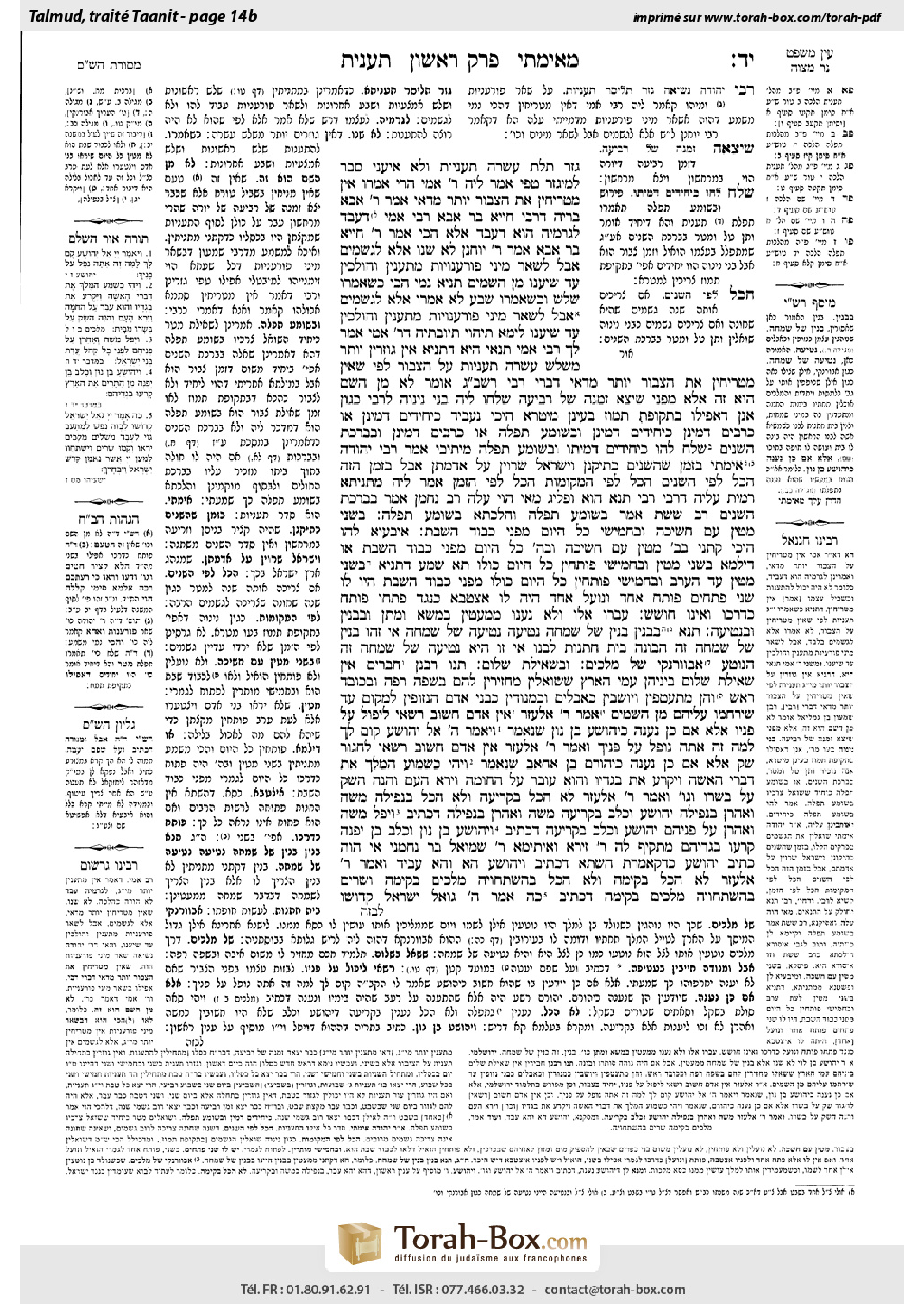
תענית י״ד ב · Aramaic and Hebrew text
גְּזַר תְּלָת עַשְׂרֵה תַּעֲנִיּוֹת וְלָא אִיעֲנִי. סְבַר לְמִיגְזַר טְפֵי. אֲמַר לֵיהּ רַבִּי אַמֵּי: הֲרֵי אָמְרוּ אֵין מַטְרִיחִין אֶת הַצִּבּוּר יוֹתֵר מִדַּאי.
אָמַר רַבִּי אַבָּא בְּרֵיהּ דְּרַבִּי חִיָּיא בַּר אַבָּא: רַבִּי אַמֵּי דַּעֲבַד — לְגַרְמֵיהּ הוּא דַּעֲבַד. אֶלָּא הָכִי אָמַר רַבִּי חִיָּיא בַּר אַבָּא אָמַר רַבִּי יוֹחָנָן: לֹא שָׁנוּ אֶלָּא לִגְשָׁמִים, אֲבָל לִשְׁאָר מִינֵי פוּרְעָנוּיוֹת — מִתְעַנִּין וְהוֹלְכִין עַד שֶׁיֵּעָנוּ מִן הַשָּׁמַיִם. תַּנְיָא נָמֵי הָכִי: כְּשֶׁאָמְרוּ שָׁלֹשׁ וּכְשֶׁאָמְרוּ שֶׁבַע — לֹא אָמְרוּ אֶלָּא לִגְשָׁמִים, אֲבָל לִשְׁאָר מִינֵי פוּרְעָנוּיוֹת — מִתְעַנִּין וְהוֹלְכִין עַד שֶׁיֵּעָנוּ.
לֵימָא תֶּיהְוֵי תְּיוּבְתֵּיהּ דְּרַבִּי אַמֵּי! אָמַר לָךְ רַבִּי אַמֵּי: תַּנָּאֵי הִיא, דְּתַנְיָא: אֵין גּוֹזְרִין יוֹתֵר מִשְּׁלֹשׁ עֶשְׂרֵה תַּעֲנִיּוֹת עַל הַצִּבּוּר, לְפִי שֶׁאֵין מַטְרִיחִין אֶת הַצִּבּוּר יוֹתֵר מִדַּאי, דִּבְרֵי רַבִּי. רַבָּן שִׁמְעוֹן בֶּן גַּמְלִיאֵל אוֹמֵר: לֹא מִן הַשֵּׁם הוּא זֶה, אֶלָּא מִפְּנֵי שֶׁיָּצָא זְמַנָּהּ שֶׁל רְבִיעָה.
שְׁלַחוּ לֵיהּ בְּנֵי נִינְוֵה לְרַבִּי: כְּגוֹן אֲנַן, דַּאֲפִילּוּ בִּתְקוּפַת תַּמּוּז בָּעֵינַן מִטְרָא, הֵיכִי נַעֲבֵיד? כִּיחִידִים דָּמֵינַן אוֹ כְּרַבִּים דָּמֵינַן? כִּיחִידִים דָּמֵינַן וּבְ״שׁוֹמֵעַ תְּפִלָּה״, אוֹ כְּרַבִּים דָּמֵינַן וּבְבִרְכַּת הַשָּׁנִים? שְׁלַח לְהוּ: כִּיחִידִים דָּמֵיתוּ וּבְ״שׁוֹמֵעַ תְּפִלָּה״.
מֵיתִיבִי, אָמַר רַבִּי יְהוּדָה: אֵימָתַי — בִּזְמַן שֶׁהַשָּׁנִים כְּתִיקְנָן וְיִשְׂרָאֵל שְׁרוּיִן עַל אַדְמָתָן. אֲבָל בִּזְמַן הַזֶּה — הַכֹּל לְפִי הַשָּׁנִים, הַכֹּל לְפִי הַמְּקוֹמוֹת, הַכֹּל לְפִי הַזְּמַן! אֲמַר לֵיהּ: מַתְנִיתָא רָמֵית עֲלֵיהּ דְּרַבִּי?! רַבִּי תַּנָּא הוּא וּפָלֵיג.
מַאי הָוֵי עֲלַהּ? רַב נַחְמָן אָמַר: בְּבִרְכַּת הַשָּׁנִים. רַב שֵׁשֶׁת אָמַר: בְּ״שׁוֹמֵעַ תְּפִלָּה״. וְהִלְכְתָא: בְּ״שׁוֹמֵעַ תְּפִלָּה״.
בַּשֵּׁנִי מַטִּין עִם חֲשֵׁיכָה וּבַחֲמִישִׁי כׇּל הַיּוֹם מִפְּנֵי כְּבוֹד הַשַּׁבָּת. אִיבַּעְיָא לְהוּ, הֵיכִי קָתָנֵי: בַּשֵּׁנִי מַטִּין עִם חֲשֵׁיכָה, וּבַחֲמִישִׁי כׇּל הַיּוֹם — מִפְּנֵי כְּבוֹד הַשַּׁבָּת, אוֹ דִילְמָא: בַּשֵּׁנִי מַטִּין, וּבַחֲמִישִׁי פּוֹתְחִין כׇּל הַיּוֹם כּוּלּוֹ?
תָּא שְׁמַע, דְּתַנְיָא: בַּשֵּׁנִי מַטִּין עַד הָעֶרֶב, וּבַחֲמִישִׁי פּוֹתְחִין כׇּל הַיּוֹם כּוּלּוֹ מִפְּנֵי כְּבוֹד הַשַּׁבָּת. הָיוּ לוֹ שְׁנֵי פְתָחִים — פּוֹתֵחַ אֶחָד וְנוֹעֵל אֶחָד. הָיָה לוֹ אִצְטְבָא כְּנֶגֶד פִּתְחוֹ — פּוֹתֵחַ כְּדַרְכּוֹ וְאֵינוֹ חוֹשֵׁשׁ.
עָבְרוּ אֵלּוּ וְלֹא נַעֲנוּ — מְמַעֲטִין בְּמַשָּׂא וּמַתָּן, בְּבִנְיָן וּבִנְטִיעָה. תָּנָא: בְּבִנְיָן — בִּנְיָן שֶׁל שִׂמְחָה. נְטִיעָה — נְטִיעָה שֶׁל שִׂמְחָה. אֵי זֶהוּ בִּנְיָן שֶׁל שִׂמְחָה — זֶה הַבּוֹנֶה בֵּית חַתְנוּת לִבְנוֹ. אִי זוֹ הִיא נְטִיעָה שֶׁל שִׂמְחָה — זֶה הַנּוֹטֵעַ אַבְּווֹרַנְקֵי שֶׁל מְלָכִים.
וּבִשְׁאֵילַת שָׁלוֹם. תָּנוּ רַבָּנַן: חֲבֵרִים, אֵין שְׁאֵילַת שָׁלוֹם בֵּינֵיהֶן. עַמֵּי הָאָרֶץ שֶׁשּׁוֹאֲלִין — מַחְזִירִין לָהֶם בְּשָׂפָה רָפָה, וּבְכוֹבֶד רֹאשׁ. וְהֵן מִתְעַטְּפִין וְיוֹשְׁבִין כַּאֲבֵלִים וְכִמְנוּדִּין, כִּבְנֵי אָדָם הַנְּזוּפִין לַמָּקוֹם, עַד שֶׁיְּרַחֲמוּ עֲלֵיהֶם מִן הַשָּׁמַיִם.
אָמַר רַבִּי אֶלְעָזָר: אֵין אָדָם חָשׁוּב רַשַּׁאי לִיפּוֹל עַל פָּנָיו, אֶלָּא אִם כֵּן נַעֲנֶה כִּיהוֹשֻׁעַ בִּן נוּן, שֶׁנֶּאֱמַר: ״וַיֹּאמֶר ה׳ אֶל יְהוֹשֻׁעַ קֻם לָךְ לָמָּה זֶּה אַתָּה נֹפֵל עַל פָּנֶיךָ״.
וְאָמַר רַבִּי אֶלְעָזָר: אֵין אָדָם חָשׁוּב רַשַּׁאי לַחֲגוֹר שַׂק אֶלָּא אִם כֵּן נַעֲנֶה כִּיהוֹרָם בֶּן אַחְאָב, שֶׁנֶּאֱמַר: ״וַיְהִי כִשְׁמֹעַ הַמֶּלֶךְ אֶת דִּבְרֵי הָאִשָּׁה וַיִּקְרַע אֶת בְּגָדָיו וְהוּא עֹבֵר עַל הַחֹמָה וַיַּרְא הָעָם וְהִנֵּה הַשַּׂק עַל בְּשָׂרוֹ וְגוֹ׳״.
וְאָמַר רַבִּי אֶלְעָזָר: לֹא הַכֹּל בִּקְרִיעָה וְלֹא הַכֹּל בִּנְפִילָה. מֹשֶׁה וְאַהֲרוֹן — בִּנְפִילָה, יְהוֹשֻׁעַ וְכָלֵב — בִּקְרִיעָה. מֹשֶׁה וְאַהֲרֹן בִּנְפִילָה, דִּכְתִיב: ״וַיִּפּוֹל מֹשֶׁה וְאַהֲרֹן עַל פְּנֵיהֶם״. יְהוֹשֻׁעַ וְכָלֵב בִּקְרִיעָה, דִּכְתִיב: ״וִיהוֹשֻׁעַ בִּן נוּן וְכָלֵב בֶּן יְפֻנֶּה קָרְעוּ בִּגְדֵיהֶם״.
מַתְקֵיף לַהּ רַבִּי זֵירָא, וְאִיתֵּימָא רַבִּי שְׁמוּאֵל בַּר נַחְמָנִי: אִי הֲוָה כְּתִיב ״יְהוֹשֻׁעַ״ — כִּדְקָאָמְרַתְּ, הַשְׁתָּא דִּכְתִיב: ״וִיהוֹשֻׁעַ״, הָא וְהָא עָבֵיד.
וְאָמַר רַבִּי אֶלְעָזָר: לֹא הַכֹּל בְּקִימָה וְלֹא הַכֹּל בְּהִשְׁתַּחֲוָיָה. מְלָכִים — בְּקִימָה, וְשָׂרִים — בְּהִשְׁתַּחֲוָיָה. מְלָכִים בְּקִימָה, דִּכְתִיב: ״כֹּה אָמַר ה׳ גֹּאֵל יִשְׂרָאֵל קְדוֹשׁוֹ
Taanit 14b · English translation
Rabbi Yehuda Nesia decreed thirteen fasts, but he was not answered. He considered decreeing more fasts until they would be answered. Rabbi Ami said to him that they said: One does not trouble the community excessively, and therefore you should not impose more than thirteen fasts.
Rabbi Abba, son of Rabbi Ḥiyya bar Abba, said: When Rabbi Ami acted and issued this ruling, he did so on his own authority, as it went against the majority opinion. Rather, Rabbi Ḥiyya bar Abba said that Rabbi Yoḥanan said as follows: They taught only that the community observes a maximum of thirteen fasts when they are praying for rain. However, with regard to other types of calamities, they continue to fast until they are answered from Heaven. The Gemara comments: This halakha is also taught in a baraita: When the Sages said three and when they said seven, they spoke only concerning fasts for rain. However, with regard to other types of calamities, they continue to fast until they are answered.
The Gemara suggests: Let us say that this baraita is a conclusive refutation of the opinion of Rabbi Ami. The Gemara answers: Rabbi Ami could have said to you that this is a dispute between tanna’im, as it is taught in a baraita: One does not decree more than thirteen fasts on the community, as one does not trouble the community excessively. This is the statement of Rabbi Yehuda HaNasi. Rabban Shimon ben Gamliel says: This halakha is not for that reason. Rather, it is due to the fact that after thirteen fasts the time of the rainfall has already passed, and there is no reason to fast for rain after the rainy season has ended.
The Gemara relates a story on a similar topic: The inhabitants of Nineveh sent a question to Rabbi Yehuda HaNasi: People such as us, who require rain even during the season of Tammuz, and who live in areas where rain falls all year round, what should we do when there is a drought during the summer? Are we likened to individuals or are we likened to a community? The Gemara explains the practical difference between these two options: Are we likened to individuals and therefore we pray for rain in the blessing: Who listens to prayer? Or are we likened to a community and we pray for rain in the ninth blessing, the blessing of the years? He sent his answer to them: You are likened to individuals and therefore you pray for rain in the blessing: Who listens to prayer.
The Gemara raises an objection from a baraita: Rabbi Yehuda said: When do the halakhot concerning the times during which the prayer for rain is recited apply? When the years, i.e., the climate, are as they ought to be and the Jewish people are living in their land. However, nowadays, when the Jewish people are dispersed around the world, and the climate is not always as it ought to be, all is in accordance with the year, i.e., the local climate, all is in accordance with the place in question, and all is in accordance with the particular time, and therefore one prays for rain in the blessing of the years, as necessary for the local climate. He said to him: You raise a contradiction from a baraita against Rabbi Yehuda HaNasi? Rabbi Yehuda HaNasi himself is a tanna, and consequently has the authority to dispute the opinion of Rabbi Yehuda.
The Gemara asks: What halakhic conclusion was reached about this matter? Rav Naḥman said: One prays for rain in the blessing of the years, in accordance with the opinion of Rabbi Yehuda. Rav Sheshet said: One prays in the blessing: Who listens to prayer, as stated by Rabbi Yehuda HaNasi. The Gemara concludes: And the halakha is that if rain is required when it is not the rainy season in Eretz Yisrael, one prays for rain in the blessing: Who listens to prayer.
§ The mishna taught: On Monday they open the stores a little at nightfall, and on Thursday they are permitted to open the stores all day, in deference to Shabbat. A dilemma was raised before the Sages: How is this taught, i.e., what is the meaning of this ruling? Does it mean that on Monday the storeowners open their doors a little at nightfall, and on Thursday they likewise open their doors just a little, but do so all day, in deference to Shabbat? Or perhaps, the mishna means that on Monday they open their doors a little, but all day, and on Thursday they open their doors wide the entire day?
The Gemara answers: Come and hear a resolution of this dilemma, as it is taught in a baraita: On Monday they open their doors a little until the evening, and on Thursday they open them the entire day, in deference to Shabbat. If one’s shop had two entrances, he opens one and locks one, thereby demonstrating that his store is not open in the normal manner. If he had a platform opposite his entrance which conceals the door to his store, he may open in his usual manner without concern, as it is prohibited to open one’s store not due to work, but only so that it not appear as though people are eating and drinking on this day.
§ The mishna taught: If these fasts have passed and they have not been answered, they decrease their engagement in business negotiations and in building and planting. It was taught in the Tosefta (Megilla 5:2): Building means joyful building, not building in general. Likewise, planting means joyful planting, not all planting. The Tosefta elaborates: What is joyful building? This is referring to one who builds a wedding chamber for his son. It was customary upon the marriage of a son to build him a small house where the marriage feast was held and where the newlywed couple would live for a certain period of time. What is joyful planting? This is referring to one who plants a splendid, royal garden that does not serve practical purposes, but is only for ornamentation.
§ And the mishna further taught that they decrease greetings between one another. The Sages taught: Ḥaverim, members of a group dedicated to the precise observance of mitzvot, do not extend greetings between each other at all. Amei ha’aretz, common, uneducated people, who extend greetings to ḥaverim, do so while unaware that this is inappropriate. The ḥaverim answer them in an undertone and in a solemn manner. And ḥaverim wrap themselves and sit as mourners and as ostracized ones, like people who have been rebuked by God, until they are shown mercy from Heaven.
Rabbi Elazar said: An important person is permitted to fall on his face and humiliate himself in front of the community only if he is certain that he will be answered like Joshua, son of Nun, as it is stated: “And the Lord said to Joshua, Get you up, why are you fallen upon your face?” (Joshua 7:10). One who is not absolutely certain that he will be answered may not fall on his face in public, as if he is unanswered he will become an object of derision.
And Rabbi Elazar said: An important person is permitted to gird himself in sackcloth as a sign of mourning and to pray for mercy only if he is certain that he will be answered like Jehoram, son of Ahab, as it is stated: “And it came to pass, when the king heard the words of the woman, that he rent his clothes, now he was passing by upon the wall, and the people looked, and, behold, he had sackcloth within upon his flesh” (II Kings 6:30). Although he was wicked, Jehoram was later answered and the suffering of the Jews was alleviated.
And Rabbi Elazar further said: Not all are worthy to petition God by rending their garments, and not all are worthy of falling on their faces in times of trouble. Moses and Aaron were worthy of petitioning God by falling on their faces, whereas their students Joshua and Caleb prayed by only rending their garments. The Gemara elaborates: Moses and Aaron petitioned God by falling on their faces, as it is written: “Then Moses and Aaron fell on their faces” (Numbers 14:5). Joshua and Caleb prayed by rending their garments, as it is written in the next verse: “And Joshua, son of Nun, and Caleb, son of Jephunneh, who were of those who spied out the land, rent their garments” (Numbers 14:6).
Rabbi Zeira strongly objects to this interpretation, and some say it was Rabbi Shmuel bar Naḥmani who objected: Had the verse written only: Joshua and Caleb, the meaning would be as you said, that Moses and Aaron fell upon their faces whereas Joshua and Caleb only rent their garments. However, now that it is written: “And Joshua,” it is possible that the connecting word “and” indicates that Moses and Aaron merely fell upon their faces, while Joshua and Caleb did both this and that, i.e., they rent their clothing in addition to falling upon their faces.
And Rabbi Elazar further said: Not all dignitaries will worship God in the messianic age by rising, and not all will do so by bowing. Rather, kings will serve God by rising, and ministers by bowing. The Gemara elaborates: Kings by rising, as it is written: “Thus says the Lord, the Redeemer of Israel, his Holy One,
Taanit 14b · Traduction française (IA)
Rabbi Yehuda Nesia décréta treize jeûnes, mais ne fut pas exaucé. Il envisagea d’en décréter d’autres jusqu’à ce qu’ils soient exaucés. Rabbi Ami lui dit qu’ils avaient enseigné : « On ne doit pas accabler excessivement la communauté » ; il ne devait donc pas lui imposer plus de treize jeûnes.
Rabbi Abba, fils de Rabbi Ḥiyya bar Abba, dit : Lorsque Rabbi Ami agit et rendit cette décision, il le fit de sa propre autorité, car elle allait à l’encontre de l’opinion majoritaire. Rabbi Ḥiyya bar Abba dit plutôt que Rabbi Yoḥanan enseigna ce qui suit : Ils n’ont enseigné cette règle que pour les cas où la communauté jeûne afin d’obtenir la pluie. En revanche, face à d’autres sortes de calamités, on continue à jeûner jusqu’à ce que l’on soit exaucé par le Ciel. La Guemara fait remarquer que cette halakha est également enseignée dans une baraïta : Lorsque les Sages ont parlé de trois jeûnes et lorsqu’ils ont parlé de sept, ils ne visaient que les jeûnes pour la pluie. En revanche, face à d’autres sortes de calamités, on continue à jeûner jusqu’à ce que l’on soit exaucé.
La Guemara suggère : « Disons que cette baraïta réfute de manière décisive l’opinion de Rabbi Ami. » La Guemara répond : Rabbi Ami aurait pu vous dire qu’il s’agit d’une controverse entre tannaïm, car il est enseigné dans une baraïta : « On ne décrète pas plus de treize jeûnes pour la communauté, car on ne doit pas l’accabler excessivement. » Telle est l’opinion de Rabbi Yehuda HaNasi. Rabban Shimon ben Gamliel dit : « Cette halakha ne s’explique pas ainsi. Elle tient plutôt au fait qu’après treize jeûnes, la saison des pluies est déjà passée ; il n’y a donc aucune raison de jeûner pour la pluie une fois la saison pluvieuse terminée. »
La Guemara rapporte un récit sur un sujet similaire : Les habitants de Ninive adressèrent une question à Rabbi Yehuda HaNasi : « Des gens comme nous, qui avons besoin de pluie même durant la saison de Tammouz et vivons dans des régions où il pleut toute l’année, que devons-nous faire en cas de sécheresse durant l’été ? Sommes-nous assimilés à des particuliers ou à une communauté ? » La Guemara précise la différence pratique entre ces deux possibilités : « Sommes-nous assimilés à des particuliers et prions-nous donc pour la pluie dans la bénédiction “Celui qui écoute la prière” ? Ou sommes-nous assimilés à une communauté et prions-nous pour la pluie dans la neuvième bénédiction, celle des années ? » Il leur fit parvenir cette réponse : « Vous êtes assimilés à des particuliers et vous priez donc pour la pluie dans la bénédiction “Celui qui écoute la prière”. »
La Guemara soulève une objection à partir d’une baraïta : Rabbi Yehuda a dit : « Quand les règles relatives aux périodes où l’on récite la prière pour la pluie s’appliquent-elles ? Lorsque les années, c’est-à-dire le climat, sont conformes à ce qu’elles devraient être et que le peuple juif vit sur sa terre. Mais de nos jours, alors que le peuple juif est dispersé dans le monde et que le climat n’est pas toujours conforme à ce qu’il devrait être, tout dépend de l’année, c’est-à-dire du climat local ; tout dépend du lieu concerné et tout dépend du moment précis. On prie donc pour la pluie dans la bénédiction des années, selon les besoins du climat local. » Il lui dit : « Tu soulèves une contradiction entre une baraïta et Rabbi Yehuda HaNasi ? Rabbi Yehuda HaNasi lui-même est un tanna et a donc autorité pour contester l’opinion de Rabbi Yehuda. »
La Guemara demande : « Quelle conclusion halakhique a-t-on tirée à ce sujet ? » Rav Naḥman dit : « On prie pour la pluie dans la bénédiction des années », conformément à l’opinion de Rabbi Yehuda. Rav Sheshet dit : « On prie dans la bénédiction “Celui qui écoute la prière” », comme l’a dit Rabbi Yehuda HaNasi. La Guemara conclut : La halakha est que, si l’on a besoin de pluie alors que ce n’est pas la saison des pluies en Eretz Israël, on prie pour la pluie dans la bénédiction « Celui qui écoute la prière ».
§ La Michna a enseigné : Le lundi, les boutiques ouvrent un peu à la tombée du jour ; le jeudi, il leur est permis de rester ouvertes toute la journée, en l’honneur du Chabbat. Une question fut posée aux Sages : Comment faut-il comprendre cette règle ? Les commerçants ouvrent-ils un peu leurs portes le lundi à la tombée du jour et les ouvrent-ils pareillement un peu le jeudi, mais toute la journée, en l’honneur du Chabbat ? Ou bien la Michna veut-elle dire que le lundi, ils ouvrent un peu leurs portes, mais toute la journée, tandis que le jeudi, ils les ouvrent en grand toute la journée ?
La Guemara répond : « Venez entendre » la résolution de cette question, car il est enseigné dans une baraïta : « Le lundi, les commerçants entrouvrent leurs portes jusqu’au soir ; le jeudi, ils les ouvrent toute la journée, en l’honneur du Chabbat. » Si sa boutique avait deux entrées, il en ouvre une et en verrouille une, montrant ainsi que sa boutique n’est pas ouverte comme à l’ordinaire. S’il avait une estrade en face de son entrée qui dissimule la porte de sa boutique, il peut l’ouvrir comme d’habitude sans s’en préoccuper, car l’interdiction d’ouvrir sa boutique n’est pas liée au travail : elle vise seulement à éviter de donner l’impression que les gens mangent et boivent ce jour-là.
§ La Michna a enseigné : Si ces jeûnes sont passés sans qu’ils aient été exaucés, ils réduisent leurs activités commerciales, ainsi que les travaux de construction et de plantation. Il a été enseigné dans la Tossefta (Meguila 5:2) : Par « construction », on entend une construction liée à la réjouissance, et non la construction en général. De même, par « plantation », on entend une plantation liée à la réjouissance, et non toute plantation. La Tossefta précise : Qu’est-ce qu’une construction liée à la réjouissance ? Cela désigne celui qui construit une chambre nuptiale pour son fils. Il était d’usage, lors du mariage d’un fils, de lui construire une petite maison où se tenait le festin de noces et où les jeunes mariés vivaient pendant un certain temps. Qu’est-ce qu’une plantation liée à la réjouissance ? Cela désigne celui qui plante un magnifique jardin royal, qui n’a aucune utilité pratique et ne sert qu’à l’ornement.
§ La Michna a également enseigné qu’ils réduisent les salutations qu’ils s’adressent les uns aux autres. Les Sages ont enseigné : Les ḥaverim, membres d’un groupe voué à l’observance scrupuleuse des mitsvot, ne se saluent pas du tout entre eux. Les amei ha’aretz, gens du commun sans instruction, saluent les ḥaverim sans savoir que cela est inapproprié. Les ḥaverim leur répondent à voix basse et d’un ton grave. Ils s’enveloppent et s’assoient comme des endeuillés et des personnes frappées d’excommunication, tels des gens réprimandés par Dieu, jusqu’à ce que la miséricorde leur soit accordée par le Ciel.
Rabbi Elazar dit : Une personnalité importante n’est autorisée à se prosterner le visage contre terre et à s’humilier devant la communauté que si elle est certaine d’être exaucée, comme Josué, fils de Noun, ainsi qu’il est dit : « Et l’Éternel dit à Josué : Lève-toi, pourquoi te prosternes-tu ainsi le visage contre terre ? » (Josué 7:10). Celui qui n’est pas absolument certain d’être exaucé ne peut pas se prosterner ainsi en public, car s’il n’est pas exaucé, il deviendra la risée de tous.
Et Rabbi Elazar dit : Une personnalité importante n’est autorisée à se ceindre d’un sac en signe de deuil et à implorer la miséricorde que si elle est certaine d’être exaucée, comme Yehoram, fils d’Achab, ainsi qu’il est dit : « Il arriva que, lorsque le roi entendit les paroles de la femme, il déchira ses vêtements ; il passait alors sur le rempart, et le peuple vit qu’il portait un sac sous ses vêtements, contre sa chair » (II Rois 6:30). Bien que Yehoram fût méchant, sa prière fut ensuite exaucée et les souffrances des Juifs furent soulagées.
Et Rabbi Elazar dit encore : Tous ne sont pas dignes d’implorer Dieu en déchirant leurs vêtements, et tous ne sont pas dignes de se prosterner le visage contre terre en période de détresse. Moïse et Aaron étaient dignes d’implorer Dieu en se prosternant le visage contre terre, tandis que leurs élèves Josué et Caleb prièrent en se contentant de déchirer leurs vêtements. La Guemara développe : Moïse et Aaron implorèrent Dieu en se prosternant le visage contre terre, ainsi qu’il est écrit : « Alors Moïse et Aaron tombèrent le visage contre terre » (Nombres 14:5). Josué et Caleb prièrent en déchirant leurs vêtements, ainsi qu’il est écrit au verset suivant : « Josué, fils de Noun, et Caleb, fils de Yefounné, qui étaient de ceux qui avaient exploré le pays, déchirèrent leurs vêtements » (Nombres 14:6).
Rabbi Zeira s’oppose fermement à cette interprétation ; certains disent que c’est Rabbi Shmuel bar Naḥmani qui s’y opposa : Si le verset avait seulement dit « Josué et Caleb », le sens aurait été celui que vous donnez : Moïse et Aaron se seraient prosternés le visage contre terre, tandis que Josué et Caleb se seraient contentés de déchirer leurs vêtements. Cependant, puisque le verset dit « Et Josué », il est possible que le mot de liaison « et » indique que Moïse et Aaron se sont seulement prosternés le visage contre terre, tandis que Josué et Caleb ont fait les deux, c’est-à-dire qu’ils ont déchiré leurs vêtements en plus de s’être prosternés le visage contre terre.
Et Rabbi Elazar dit encore : Tous les dignitaires ne serviront pas Dieu à l’époque messianique en se tenant debout, et tous ne le feront pas en s’inclinant. Les rois serviront Dieu en se tenant debout, et les ministres en s’inclinant. La Guemara développe : « Les rois, en se tenant debout », ainsi qu’il est écrit : « Ainsi parle l’Éternel, le Rédempteur d’Israël, son Saint… »
Traduction française générée par IA à partir de l’édition anglaise de Sefaria. Vérifie toujours un passage avec le texte source.
Text from Sefaria: William Davidson Edition - Vocalized Aramaic (CC BY NC); William Davidson Edition - English (CC BY NC).