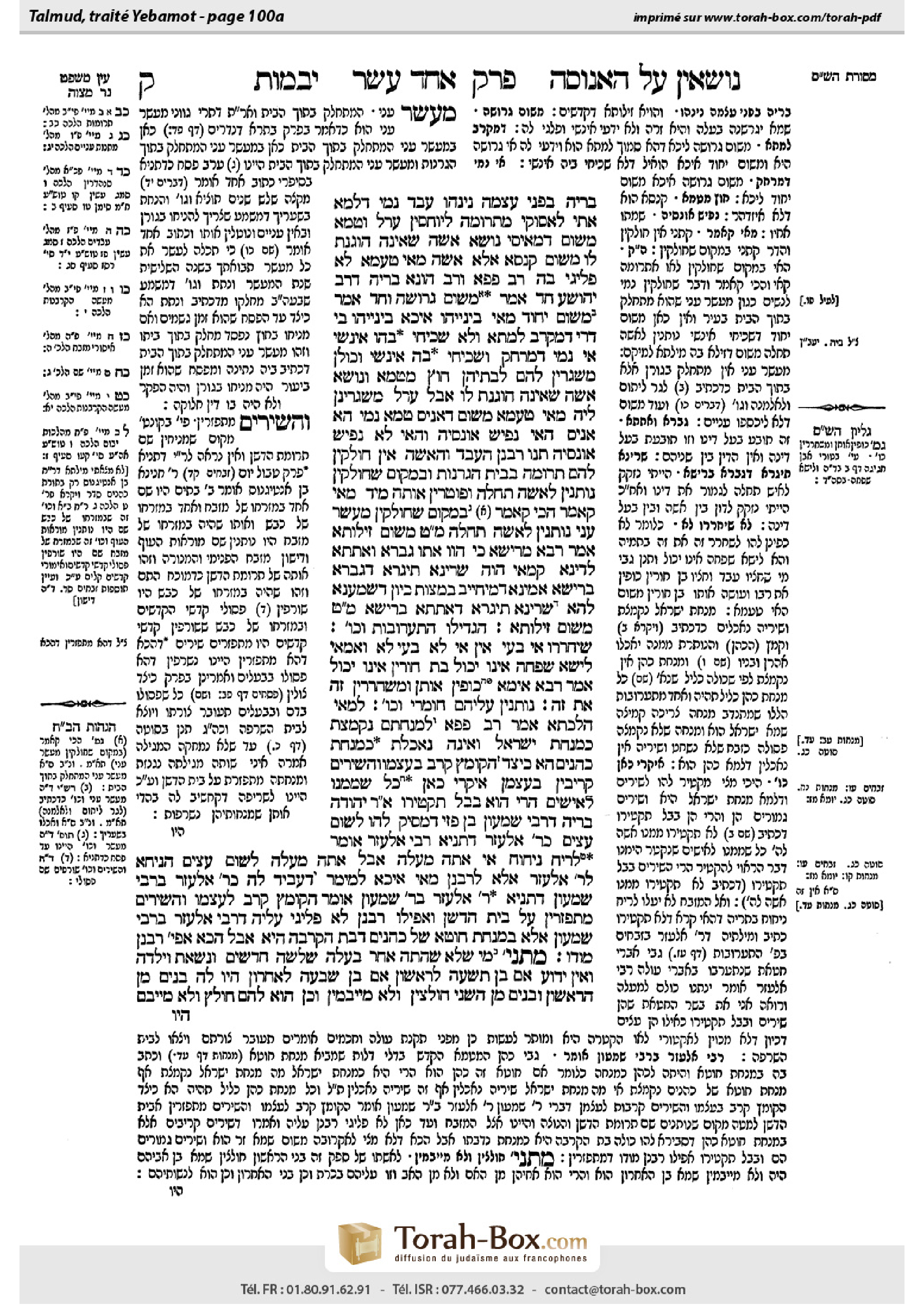
Yevamot 100a: Talmud study for Daf Yomi
Daf Yomi is the daily study of one Talmud folio. Explore 37 tractates with scans, Hebrew text, Sefaria English and AI-generated French translations where annotated.
Passage selection and English or AI-generated French translation are available where the scan has annotations. Daf Study is independent of Torah-Box and Sefaria.
Browse Yevamot · יבמות · All tractatesYevamot 100a text and translations
This page of Yevamot includes the Aramaic text, an English translation and an AI-generated French translation, alongside the scan above.
יבמות ק׳ א · Aramaic and Hebrew text
בְּרִיָּה בִּפְנֵי עַצְמָהּ נִינְהוּ. עֶבֶד נָמֵי — דִּלְמָא אָתֵי לְאַסּוֹקֵי מִתְּרוּמָה לְיוּחֲסִין. עָרֵל וְטָמֵא — מִשּׁוּם דִּמְאִיסִי. נוֹשֵׂא אִשָּׁה שֶׁאֵינָהּ הוֹגֶנֶת לוֹ — מִשּׁוּם קְנָסָא. אֶלָּא אִשָּׁה, מַאי טַעְמָא לָא?
פְּלִיגִי בַּהּ רַב פָּפָּא וְרַב הוּנָא בְּרֵיהּ דְּרַב יְהוֹשֻׁעַ. חַד אָמַר: מִשּׁוּם גְּרוּשָׁה. וְחַד אָמַר: מִשּׁוּם יִחוּד.
מַאי בֵּינַיְיהוּ? אִיכָּא בֵּינַיְיהוּ בֵּי דָרֵי דִּמְקָרַב לְמָתָא, וְלָא שְׁכִיחִי בְּהוּ אִינָשֵׁי. אִי נָמֵי: דִּמְרַחַק, וּשְׁכִיחִי בֵּהּ אִינָשֵׁי.
וְכוּלָּן מְשַׁגְּרִין לָהֶם לְבָתֵּיהֶן, חוּץ מִטָּמֵא וְנוֹשֵׂא אִשָּׁה שֶׁאֵינָהּ הוֹגֶנֶת לוֹ. אֲבָל עָרֵל מְשַׁגְּרִינַן לֵיהּ, מַאי טַעְמָא?
מִשּׁוּם דַּאֲנִיס. טָמֵא נָמֵי, הָא אֲנִיס? הַאי נְפִישׁ אוּנְסֵיהּ, וְהַאי לָא נְפִישׁ אוּנְסֵיהּ.
תָּנוּ רַבָּנַן: הָעֶבֶד וְהָאִשָּׁה, אֵין חוֹלְקִין לָהֶם תְּרוּמָה בְּבֵית הַגֳּרָנוֹת. וּבְמָקוֹם שֶׁחוֹלְקִין — נוֹתְנִין לָאִשָּׁה תְּחִלָּה וּפוֹטְרִין אוֹתָהּ מִיָּד. מַאי קָאָמַר?
הָכִי קָאָמַר: בְּמָקוֹם שֶׁחוֹלְקִין מַעְשַׂר עָנִי — נוֹתְנִין לְאִשָּׁה תְּחִלָּה. מַאי טַעְמָא — מִשּׁוּם זִילוּתָא.
אָמַר רָבָא: מֵרֵישָׁא, כִּי הֲווֹ אָתוּ גַּבְרָא וְאִתְּתָא לְדִינָא קַמַּאי, הֲוָה שָׁרֵינָא תִּיגְרָא דְגַבְרָא בְּרֵישָׁא. אָמֵינָא: דְּמִיחַיַּיב בְּמִצְוֹת. כֵּיוָן דִּשְׁמַעְנָא לְהָא, שָׁרֵינָא תִּיגְרָא דְּאִתְּתָא בְּרֵישָׁא. מַאי טַעְמָא? מִשּׁוּם זִילוּתָא.
הִגְדִּילוּ הַתַּעֲרוֹבוֹת וְכוּ׳. שִׁיחְרְרוּ, אִי בָּעֵי — אִין, אִי לָא בָּעֵי — לָא, וְאַמַּאי? לִישָּׂא שִׁפְחָה אֵינוֹ יָכוֹל, בַּת חוֹרִין אֵינוֹ יָכוֹל! אָמַר רָבָא, אֵימָא: כּוֹפִין אוֹתָן, וּמְשַׁחְרְרִין זֶה אֶת זֶה.
נוֹתְנִין עֲלֵיהֶם חוּמְרֵי וְכוּ׳. לְמַאי הִלְכְתָא? אָמַר רַב פָּפָּא: לְמִנְחָתָם נִקְמֶצֶת כְּמִנְחַת יִשְׂרָאֵל וְאֵינָהּ נֶאֱכֶלֶת כְּמִנְחַת כֹּהֲנִים. הָא כֵּיצַד? הַקּוֹמֶץ קָרֵב בְּעַצְמוֹ, וְהַשִּׁירַיִם קְרֵיבִין בְּעַצְמָן.
אִיקְּרִי כָּאן: כֹּל שֶׁמִּמֶּנּוּ לָאִישִּׁים, הֲרֵי הוּא בְּ״בַל תַּקְטִירוּ״.
אָמַר רַבִּי יְהוּדָה בְּרֵיהּ דְּרַבִּי שִׁמְעוֹן בֶּן פַּזִּי: דְּמַסֵּיק לְהוּ לְשׁוּם עֵצִים, כְּרַבִּי אֶלְעָזָר. דְּתַנְיָא, רַבִּי אֶלְעָזָר אוֹמֵר: ״לְרֵיחַ נִיחוֹחַ״ אִי אַתָּה מַעֲלֶה, אֲבָל אַתָּה מַעֲלֶה לְשׁוּם עֵצִים.
הָנִיחָא לְרַבִּי אֶלְעָזָר. אֶלָּא לְרַבָּנַן, מַאי אִיכָּא לְמֵימַר? דְּעָבֵיד לַהּ כְּרַבִּי אֶלְעָזָר בְּרַבִּי שִׁמְעוֹן. דְּתַנְיָא, רַבִּי אֶלְעָזָר בְּרַבִּי שִׁמְעוֹן אוֹמֵר: הַקּוֹמֶץ קָרֵב לְעַצְמוֹ, וְהַשִּׁירַיִם מִתְפַּזְּרִין עַל בֵּית הַדֶּשֶׁן. וַאֲפִילּוּ רַבָּנַן לָא פְּלִיגִי עֲלֵיהּ דְּרַבִּי אֶלְעָזָר בְּרַבִּי שִׁמְעוֹן אֶלָּא בְּמִנְחַת חוֹטֵא שֶׁל כֹּהֲנִים, דְּבַת הַקְרָבָה הִיא, אֲבָל הָכָא — אֲפִילּוּ רַבָּנַן מוֹדוּ.
מַתְנִי׳ מִי שֶׁלֹּא שָׁהֲתָה אַחַר בַּעֲלָהּ שְׁלֹשָׁה חֳדָשִׁים, וְנִשֵּׂאת, וְיָלְדָה, וְאֵין יָדוּעַ אִם בֶּן תִּשְׁעָה לָרִאשׁוֹן אִם בִּן שִׁבְעָה לָאַחֲרוֹן — הָיוּ לָהּ בָּנִים מִן הָרִאשׁוֹן וּבָנִים מִן הַשֵּׁנִי, חוֹלְצִין וְלֹא מְיַיבְּמִין. וְכֵן הוּא לָהֶם — חוֹלֵץ וְלֹא מְיַיבֵּם.
Yevamot 100a · English translation
as they are each an unusual creature of their own kind. With regard to a slave it is also clear, since if he is given teruma, perhaps the court will come to elevate him to the presumptive status of priestly lineage. Teruma may not be distributed to an uncircumcised man and a ritually impure man, because these situations are repulsive and it is unseemly to give them teruma in public. One may not distribute teruma to one who marries a woman unfit for him, due to a penalty that expropriates his priestly rights as long as he persists in his transgression. But for what reason is teruma not distributed to a woman?
Rav Pappa and Rav Huna, son of Rav Yehoshua, disagree on this issue. One said that it is due to the case of an Israelite woman who was married to a priest and got divorced, thereby losing her permission to partake of teruma. Teruma is not distributed to women in public at all, lest this divorcée continue to receive teruma. And the other one said that it is due to the concern that the owner and the woman might be alone together in the granary.
The Gemara asks: What is the practical difference between them? The Gemara answers: The practical difference between them is in the case of a granary that is close to town but is not frequented by people. Because it is close to town, the owner of the granary would know if she was divorced. However, since there are not many people there, the concern about their being alone together remains. Alternatively, there is a practical difference in the case of a granary that is distant but is frequented by people. There, there is concern that the owner of the granary might not know if she was divorced, but the concern that they might be alone together does not exist.
It is stated in the baraita under discussion: And with regard to all of them, one may send teruma to them, to their homes, with the exception of a ritually impure man and one who marries a woman unfit for him. The Gemara infers: However, to an uncircumcised man one may send it. What is the reason? How does he differ from an impure man?
The Gemara answers: One may send him teruma. It is because of circumstances beyond his control, i.e., the death of his brothers from their circumcision, that he was not circumcised. The Gemara asks: Isn’t an impure man also in his state due to circumstances beyond his control? Why is teruma not sent to him? The Gemara answers: This man is uncircumcised because of circumstances entirely beyond his control, as circumcision is considered life-threatening for him, whereas that impure man is not under circumstances entirely beyond his control, as one can protect himself from ritual impurity.
§ The Sages taught: One may not distribute teruma to a slave or a woman if they are in the granary. And in a place where people do distribute it to them, the woman is given first and released immediately. The Gemara asks: What is this saying? If one may not distribute teruma to them, how can there be a place where it is distributed?
The Gemara explains that this statement is not referring to teruma. This is what it is saying: In a case where the poor man’s tithe is distributed to the poor from the owner’s house, the woman is given first. What is the reason? She is given the tithe first because it is demeaning for a woman to have to wait in the company of men for a lengthy period of time.
Rava said: Initially, when a man and a woman would come for judgment before me, each for a different case, I would resolve the man’s quarrel first. I would say that since he is obligated in many positive mitzvot I should not waste his time by causing him to wait. However, since I heard this baraita, I resolve the woman’s quarrel first. What is the reason? I resolve her quarrel first because it is demeaning for her to be waiting in the company of men.
§ It is stated in the mishna: If the mixed sons matured and freed each other, they may marry women fit for the priesthood. The use of the past tense indicates that this halakha applies after the fact. If one of the sons desires to free the other, he may, but if he does not desire to do so, he is not obligated. And why not? Neither of them can marry a maidservant in case he is a priest, nor can either of them marry a free woman, as he might be a slave. They are therefore unable to fulfill the mitzva to be fruitful and multiply in their current state and should be obligated to free each other. Rava said: Say that the mishna means that we coerce them and they free each other.
It is stated in the mishna that we place upon them both the stringencies of priests and the stringencies of Israelites. The Gemara asks: With regard to what halakha is this stated, beyond those cited specifically in the mishna? Rav Pappa said: It is stated with regard to their meal-offering: The handful is taken from it like the meal-offering of an Israelite, unlike that of a priest, which is burned in its entirety. However, the offering does not get eaten, like the meal-offering of priests. How so? How is the practice performed so that both stringencies are kept? The handful is sacrificed and burned by itself, and the remainder of the offering is offered by itself.
The Gemara asks: How can it be performed in this manner? There is a principle that should apply here, that whatever is partly burned in the fire on the altar is subject to the prohibition of “you may not make…as an offering” (Leviticus 2:11). This principle states that if part of an item, e.g., the blood of an animal offering or the handful of a meal-offering, is burned on the altar, then burning any of its other parts, which are not designated for burning, is prohibited. How, then, can the remainder of the meal-offering be sacrificed?
Rabbi Yehuda, son of Rabbi Shimon ben Pazi, said that the remainder is brought up to the altar only for the purpose of wood, i.e., as fuel for the altar, not as an offering. In this manner, it is permitted. This answer is in accordance with the opinion of Rabbi Elazar, as it is taught in a baraita that Rabbi Elazar said: “But they shall not come up for a sweet savor on the altar” (Leviticus 2:12). This verse indicates that you may not bring up leaven and honey as a “sweet savor,” i.e., an offering. However, you may bring up leaven, and honey, and other materials for the purpose of wood.
The Gemara asks: This works out well according to Rabbi Elazar. However, according to the Rabbis, who disagree with Rabbi Elazar and hold that it may not be burned for the purpose of fuel, what can be said? What is to be done with the remainder? The Gemara answers that the offering is treated in accordance with the opinion of Rabbi Elazar, son of Rabbi Shimon, as it is taught in a baraita that Rabbi Elazar, son of Rabbi Shimon, says: The handful is sacrificed by itself, and the remainder is scattered over the place of the ashes. And even the Rabbis disagree with Rabbi Elazar, son of Rabbi Shimon, only with regard to a sinner’s meal-offering that belongs to priests, as it is fit to be sacrificed in its entirety. However, here, in the case of an uncertain priest, even the Rabbis agree that the remainder is scattered over the ashes, as it cannot be offered in case he is a non-priest.
MISHNA: With regard to a woman who did not wait three months after separating from her husband, and remarried and gave birth to a son, and it is not known if he was born after nine months of pregnancy to the former husband or if he was born after seven months to the latter husband, if she had sons of certain patrilineage from the first husband and sons of certain patrilineage from the second one, and the son of uncertain patrilineage married and died childless, then the brothers from both husbands must perform ḥalitza with his wife, as they might be his paternal brothers. But they may not perform levirate marriage with her, in case he is only their maternal half brother, and his wife is forbidden to them. And similarly, with regard to him and their wives, if one of them dies childless, he performs ḥalitza and not levirate marriage.
Yevamot 100a · Traduction française (IA)
car chacun d’eux est une créature inhabituelle dans son genre. Pour un esclave, la raison est également claire : si on lui donne de la terouma, le tribunal pourrait en venir à lui attribuer présomptivement une ascendance sacerdotale. On ne distribue pas de terouma à un homme incirconcis ni à un homme rituellement impur, car ces situations sont répugnantes et il ne convient pas de leur donner de la terouma en public. On ne distribue pas de terouma à celui qui épouse une femme qui ne lui est pas permise, en raison de la pénalité qui le prive de ses droits sacerdotaux tant qu’il persiste dans sa transgression. Mais pourquoi ne distribue-t-on pas de terouma à une femme ?
Rav Pappa et Rav Houna, fils de Rav Yehoshoua, sont en désaccord sur cette question. Selon l’un, c’est en raison du cas d’une femme israélite qui a épousé un prêtre puis a divorcé, perdant ainsi le droit de consommer de la terouma. On ne distribue jamais de terouma aux femmes en public, de peur que cette divorcée continue à en recevoir. Selon l’autre, c’est par crainte que le propriétaire et la femme se retrouvent seuls ensemble dans le grenier.
La Guemara demande : Quelle est la différence pratique entre eux ? La Guemara répond : la différence pratique concerne un grenier proche de la ville, mais peu fréquenté. Comme il est proche de la ville, le propriétaire du grenier saurait si elle a divorcé. Cependant, puisqu’il y a peu de monde, la crainte qu’ils se retrouvent seuls ensemble subsiste. Autre possibilité : la différence pratique concerne un grenier éloigné, mais fréquenté. Dans ce cas, on craint que le propriétaire du grenier ne sache pas si elle a divorcé, mais il n’y a pas lieu de craindre qu’ils se retrouvent seuls ensemble.
Il est dit dans la baraïta en question : « Et pour tous ceux-là, on peut leur envoyer de la terouma chez eux, à l’exception d’un homme rituellement impur et de celui qui épouse une femme qui ne lui est pas permise. » La Guemara en déduit que l’on peut toutefois envoyer de la terouma à un homme incirconcis. Pour quelle raison ? En quoi diffère-t-il d’un homme impur ?
La Guemara répond : On peut lui envoyer de la terouma, car c’est en raison de circonstances indépendantes de sa volonté — la mort de ses frères à la suite de leur circoncision — qu’il n’a pas été circoncis. La Guemara demande : L’homme impur n’est-il pas lui aussi dans cet état en raison de circonstances indépendantes de sa volonté ? Pourquoi ne lui envoie-t-on pas de terouma ? La Guemara répond : Cet homme est incirconcis en raison de circonstances totalement indépendantes de sa volonté, car la circoncision représente pour lui un danger mortel ; tandis que cet homme impur ne se trouve pas dans une situation totalement indépendante de sa volonté, car on peut se protéger de l’impureté rituelle.
§ Les Sages ont enseigné : On ne distribue pas de terouma à un esclave ni à une femme s’ils se trouvent dans le grenier. Et dans un lieu où on la leur distribue, on sert d’abord la femme, puis on la fait partir immédiatement. La Guemara demande : Que signifie cette déclaration ? Si on ne peut pas leur distribuer de terouma, comment peut-il exister un lieu où on la leur distribue ?
La Guemara explique que cette déclaration ne concerne pas la terouma. Voici ce qu’elle signifie : lorsqu’on distribue aux pauvres la dîme des pauvres depuis la maison du propriétaire, on sert d’abord la femme. Pour quelle raison ? On lui donne la dîme en premier, car il est humiliant pour une femme de devoir attendre longtemps en compagnie d’hommes.
Rava dit : Au début, lorsqu’un homme et une femme venaient chacun devant moi pour un litige différent, je réglais d’abord le litige de l’homme. Je me disais que, puisqu’il est tenu d’accomplir de nombreuses mitsvot positives, je ne devais pas lui faire perdre son temps en le faisant attendre. Cependant, depuis que j’ai entendu cette baraïta, je règle d’abord le litige de la femme. Pour quelle raison ? Je règle son litige en premier, car il est humiliant pour elle d’attendre en compagnie d’hommes.
§ Il est dit dans la Michna : « Si les fils issus du mélange ont grandi et se sont affranchis mutuellement, ils peuvent épouser des femmes aptes à entrer dans la prêtrise. » L’emploi du passé indique que cette halakha s’applique après coup. Si l’un des fils souhaite affranchir l’autre, il le peut ; mais s’il ne le souhaite pas, il n’y est pas obligé. Pourquoi ne le serait-il pas ? Aucun des deux ne peut épouser une servante, au cas où il serait prêtre, et aucun ne peut épouser une femme libre, car il pourrait être esclave. Dans leur état actuel, ils ne peuvent donc accomplir la mitsva de procréer et devraient être obligés de s’affranchir mutuellement. Rava dit : Il faut comprendre que la Michna signifie qu’on les contraint à s’affranchir mutuellement.
Il est dit dans la Michna qu’on leur impose à la fois les rigueurs applicables aux prêtres et celles applicables aux Israélites. La Guemara demande : À quelle halakha cela se rapporte-t-il, en dehors de celles qui sont mentionnées explicitement dans la Michna ? Rav Pappa dit : Cela concerne leur offrande de farine : on en prélève une poignée, comme pour l’offrande de farine d’un Israélite, contrairement à celle d’un prêtre, qui est brûlée entièrement. Cependant, l’offrande n’est pas consommée, comme celle des prêtres. Comment procède-t-on afin de respecter les deux rigueurs ? La poignée est offerte et brûlée à part, et le reste de l’offrande est présenté à part.
La Guemara demande : Comment peut-on procéder de cette manière ? Un principe devrait s’appliquer ici : tout ce dont une partie est brûlée sur le feu de l’autel est soumis à l’interdiction « vous ne devrez pas en faire une offrande » (Lévitique 2:11). Selon ce principe, si une partie d’un élément, par exemple le sang d’un sacrifice animal ou la poignée d’une offrande de farine, est brûlée sur l’autel, il est interdit de brûler l’une de ses autres parties, qui ne sont pas destinées à être brûlées. Comment peut-on donc offrir le reste de l’offrande de farine ?
Rabbi Yehouda, fils de Rabbi Shimon ben Pazi, dit que le reste est porté sur l’autel uniquement pour servir de bois, c’est-à-dire de combustible pour l’autel, et non comme offrande. De cette manière, cela est permis. Cette réponse est conforme à l’opinion de Rabbi Elazar, comme il est enseigné dans une baraïta : Rabbi Elazar dit : « Mais ils ne monteront pas sur l’autel pour produire une odeur agréable » (Lévitique 2:12). Ce verset indique qu’on ne peut pas apporter du levain et du miel comme « odeur agréable », c’est-à-dire comme offrande. Toutefois, on peut apporter du levain, du miel et d’autres matières pour servir de bois.
La Guemara demande : Cela convient selon Rabbi Elazar. Mais que peut-on répondre selon les Rabbins, qui sont en désaccord avec Rabbi Elazar et soutiennent qu’on ne peut pas les brûler comme combustible ? Que fait-on du reste ? La Guemara répond que l’offrande est traitée conformément à l’opinion de Rabbi Elazar, fils de Rabbi Shimon, comme il est enseigné dans une baraïta : Rabbi Elazar, fils de Rabbi Shimon, dit : « La poignée est offerte à part, et le reste est dispersé à l’emplacement des cendres. » Les Rabbins ne sont en désaccord avec Rabbi Elazar, fils de Rabbi Shimon, que concernant l’offrande de farine d’un pécheur appartenant aux prêtres, car elle peut être offerte entièrement. Cependant, ici, dans le cas d’un prêtre de statut incertain, même les Rabbins conviennent que le reste est dispersé sur les cendres, car on ne peut pas l’offrir au cas où il ne serait pas prêtre.
MICHNA : Une femme n’a pas attendu trois mois après s’être séparée de son mari, s’est remariée et a donné naissance à un fils, sans que l’on sache s’il est né après neuf mois de grossesse de son premier mari ou après sept mois de grossesse de son second mari. Si elle a des fils dont la filiation paternelle par rapport au premier mari est certaine et des fils dont la filiation paternelle par rapport au second mari est certaine, et que le fils à la filiation paternelle incertaine s’est marié puis est mort sans enfant, les frères issus des deux maris doivent accomplir la halitsa avec sa femme, car ils pourraient être ses frères paternels. Mais ils ne peuvent pas contracter avec elle un mariage léviratique, au cas où il ne serait que leur demi-frère maternel, auquel cas sa femme leur est interdite. De même, concernant cet homme et leurs femmes, si l’un d’eux meurt sans enfant, il accomplit la halitsa et non le mariage léviratique.
Traduction française générée par IA à partir de l’édition anglaise de Sefaria. Vérifie toujours un passage avec le texte source.
Text from Sefaria: William Davidson Edition - Vocalized Aramaic (CC BY NC); William Davidson Edition - English (CC BY NC).