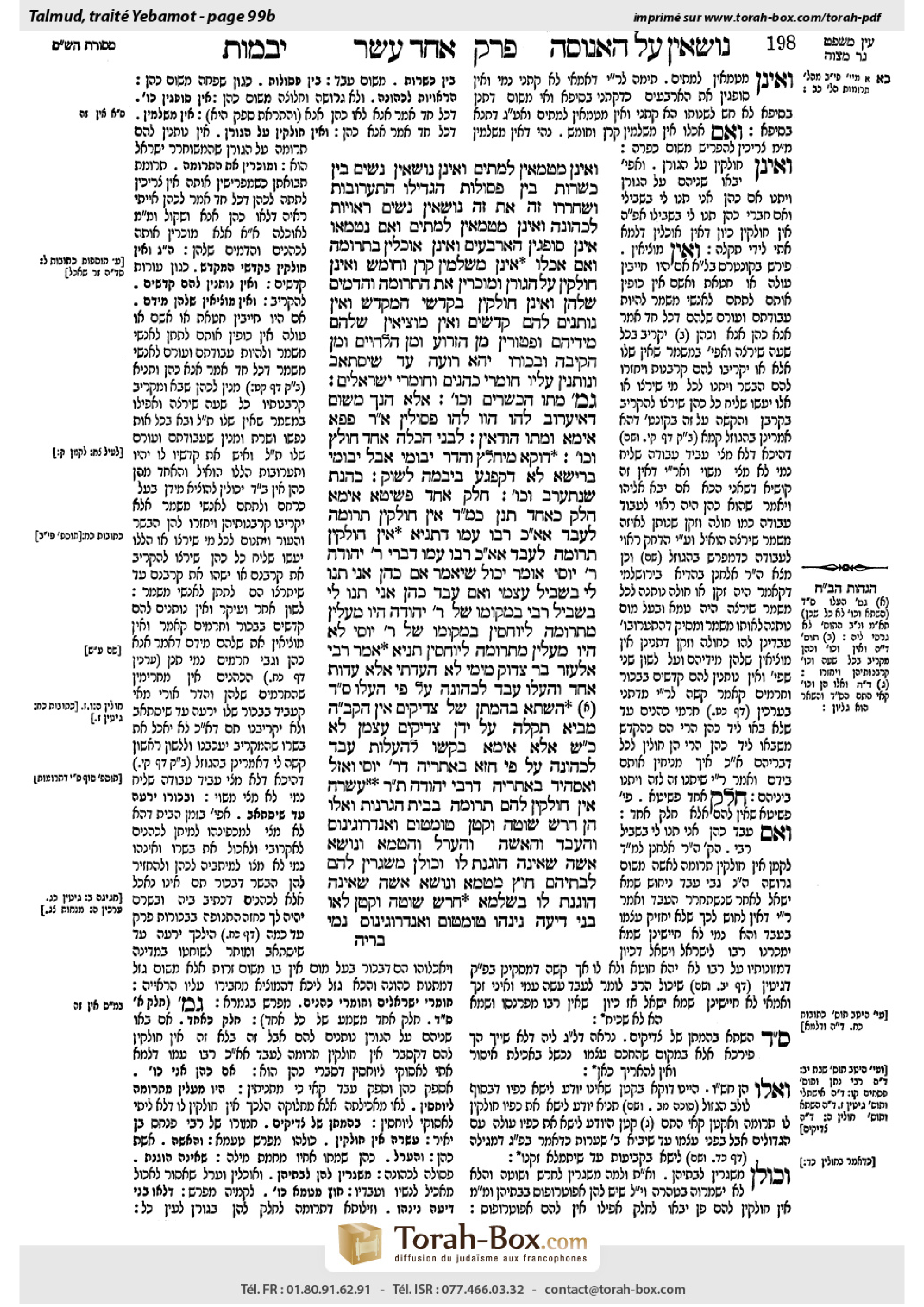
Yevamot 99b: Talmud study for Daf Yomi
Daf Yomi is the daily study of one Talmud folio. Explore 37 tractates with scans, Hebrew text, Sefaria English and AI-generated French translations where annotated.
Passage selection and English or AI-generated French translation are available where the scan has annotations. Daf Study is independent of Torah-Box and Sefaria.
Browse Yevamot · יבמות · All tractatesYevamot 99b text and translations
This page of Yevamot includes the Aramaic text, an English translation and an AI-generated French translation, alongside the scan above.
יבמות צ״ט ב · Aramaic and Hebrew text
וְאֵינָן מִטַּמְּאִין לְמֵתִים. וְאֵינָן נוֹשְׂאִין נָשִׁים, בֵּין כְּשֵׁרוֹת בֵּין פְּסוּלוֹת. הִגְדִּילוּ הַתַּעֲרוֹבוֹת וְשִׁחְרְרוּ זֶה אֶת זֶה — נוֹשְׂאִין נָשִׁים רְאוּיוֹת לַכְּהוּנָּה.
וְאֵינָן מְטַמְּאִין לְמֵתִים, וְאִם נִטְמְאוּ — אֵינָן סוֹפְגִין הָאַרְבָּעִים. וְאֵינָן אוֹכְלִין בִּתְרוּמָה, וְאִם אָכְלוּ — אֵינָן מְשַׁלְּמִין קֶרֶן וָחוֹמֶשׁ. וְאֵינָן חוֹלְקִין עַל הַגּוֹרֶן. וּמוֹכְרִין אֶת הַתְּרוּמָה, וְהַדָּמִים שֶׁלָּהֶן.
וְאֵינָן חוֹלְקִין בְּקׇדְשֵׁי הַמִּקְדָּשׁ, וְאֵין נוֹתְנִים לָהֶם קָדָשִׁים. וְאֵין מוֹצִיאִין שֶׁלָּהֶם מִידֵיהֶם.
וּפְטוּרִין מִן הַזְּרוֹעַ וּמִן הַלְּחָיַיִם וּמִן הַקֵּיבָה, וּבְכוֹרוֹ יְהֵא רוֹעֶה עַד שֶׁיִּסְתָּאֵב. וְנוֹתְנִין עָלָיו חוּמְרֵי כֹהֲנִים וְחוּמְרֵי יִשְׂרְאֵלִים.
גְּמָ׳ מֵתוּ הַכְּשֵׁרִים וְכוּ׳. אֶלָּא הָנָךְ, מִשּׁוּם דְּאִיעָרוּב לְהוּ הָווּ לְהוּ פְּסוּלִין? אָמַר רַב פָּפָּא, אֵימָא: וּמֵתוּ הַוַּדָּאִין.
לִבְנֵי הַכַּלָּה אֶחָד חוֹלֵץ וְכוּ׳. דַּוְקָא מִיחְלָץ וַהֲדַר יַבּוֹמֵי, אֲבָל יַבּוֹמֵי בְּרֵישָׁא — לָא, דְּקָפָגַע בִּיבָמָה לַשּׁוּק.
כֹּהֶנֶת שֶׁנִּתְעָרֵב וְכוּ׳. חֵלֶק אֶחָד פְּשִׁיטָא! אֵימָא חֵלֶק כְּאֶחָד.
תְּנַן כְּמַאן דְּאָמַר אֵין חוֹלְקִין תְּרוּמָה לְעֶבֶד אֶלָּא אִם כֵּן רַבּוֹ עִמּוֹ. דְּתַנְיָא: אֵין חוֹלְקִין תְּרוּמָה לְעֶבֶד אֶלָּא אִם כֵּן רַבּוֹ עִמּוֹ, דִּבְרֵי רַבִּי יְהוּדָה. רַבִּי יוֹסֵי אוֹמֵר: יָכוֹל שֶׁיֹּאמַר, אִם כֹּהֵן אֲנִי — תְּנוּ לִי בִּשְׁבִיל עַצְמִי, וְאִם עֶבֶד כֹּהֵן אֲנִי — תְּנוּ לִי בִּשְׁבִיל רַבִּי.
בִּמְקוֹמוֹ שֶׁל רַבִּי יְהוּדָה הָיוּ מַעֲלִין מִתְּרוּמָה לְיוּחֲסִין. בִּמְקוֹמוֹ שֶׁל רַבִּי יוֹסֵי לֹא הָיוּ מַעֲלִין מִתְּרוּמָה לְיוּחֲסִין.
תַּנְיָא, אָמַר רַבִּי אֶלְעָזָר בַּר צָדוֹק: מִיָּמַי לֹא הֵעַדְתִּי אֶלָּא עֵדוּת אֶחָד, וְהֶעֱלוּ עֶבֶד לַכְּהוּנָּה עַל פִּי.
הֶעֱלוּ סָלְקָא דַּעְתָּךְ?! הַשְׁתָּא בְּהֶמְתָּן שֶׁל צַדִּיקִים אֵין הַקָּדוֹשׁ בָּרוּךְ הוּא מֵבִיא תַּקָּלָה עַל יָדָן, צַדִּיקִים עַצְמָן לֹא כׇּל שֶׁכֵּן!
אֶלָּא אֵימָא: בִּקְּשׁוּ לְהַעֲלוֹת עֶבֶד לַכְּהוּנָּה עַל פִּי. חֲזָא בְּאַתְרֵיהּ דְּרַבִּי יוֹסֵי — וַאֲזַל וְאַסְהֵיד בְּאַתְרֵיהּ דְּרַבִּי יְהוּדָה.
תָּנוּ רַבָּנַן: עֲשָׂרָה אֵין חוֹלְקִין לָהֶם תְּרוּמָה בְּבֵית הַגֳּרָנוֹת, וְאֵלּוּ הֵן: חֵרֵשׁ, שׁוֹטֶה, וְקָטָן, טוּמְטוּם, וְאַנְדְּרוֹגִינוֹס, וְהָעֶבֶד, וְהָאִשָּׁה, וְהֶעָרֵל, וְהַטָּמֵא, וְנוֹשֵׂא אִשָּׁה שֶׁאֵינָהּ הוֹגֶנֶת לוֹ. וְכוּלָּן מְשַׁגְּרִין לָהֶם לְבָתֵּיהֶם, חוּץ מִטָּמֵא וְנוֹשֵׂא אִשָּׁה שֶׁאֵינָהּ הוֹגֶנֶת לוֹ.
בִּשְׁלָמָא חֵרֵשׁ שׁוֹטֶה וְקָטָן — לָאו בְּנֵי דֵּיעָה נִינְהוּ. טוּמְטוּם וְאַנְדְּרוֹגִינוֹס נָמֵי —
Yevamot 99b · English translation
And they may not become ritually impure with impurity imparted by a corpse, as each of them might be a priest. And they may not marry women, whether unflawed women, who may not marry a slave, or women unfit to marry into the priesthood, as with regard to each of them it is uncertain whether he is a priest or a slave. If the mixed sons matured and freed each other, they may marry women fit to marry into the priesthood, as a freed slave may marry such women. However, neither may marry a woman unfit for the priesthood, in case he is a priest.
And they may not become ritually impure with impurity imparted by a corpse, since they are uncertain priests. However, if they became impure, they do not receive the forty lashes, as each of them might not be priest. And they may not partake of teruma, as one of them is not a priest. However, if they ate teruma unwittingly they do not pay the principal and the additional fifth, as each of them might be a priest. And they do not receive a share of teruma in the granary, as neither can prove that he is a priest. However, they may sell the teruma that they remove from their own produce, and although they may not eat it, the money is theirs. Since it cannot be proven with regard to either of them that he is not a priest, teruma cannot be appropriated from them.
And they do not receive a share of the consecrated offerings of the Temple, as each of them might not be a priest. And one may not give them consecrated offerings to sacrifice for the same reason. However, the hides of their own offerings may not be appropriated from their possession, as it cannot be proven with regard to either of them that he is not a priest.
And they are exempt from giving a priest the foreleg, and from giving him the jaw, and from giving him the maw of their non-consecrated kosher animals. And with regard to either of them, the firstling of his kosher animal should graze until it becomes unfit to be sacrificed, i.e., until it gets a blemish. It is against his interest to sacrifice the animal before it gets a blemish, thereby letting it be eaten by the priests. Once it gets a blemish, it cannot be appropriated from him. Since he is possibly a priest, he may claim that the animal is the property of a priest. The animal then becomes his private property, and he may eat it if he wishes. And in general, we place upon him both the stringencies of priests and the stringencies of Israelites.
GEMARA: It is stated in the mishna that if the sons of certain, unflawed lineage were the ones who died, the mixed sons perform ḥalitza with the widows of the elder woman’s sons, but not levirate marriage. The Gemara asks: Does this indicate that because these sons were mixed up they are rendered unfit? The fact that their lineage is unclear should not render them unfit. Rava Pappa said: Say that the correct wording is: And if the certain sons were the ones who died.
It is stated in the mishna that with the widows of the certain sons of the daughter-in-law, one of the mixed sons performs ḥalitza and the other one performs levirate marriage. The Gemara comments that ḥalitza is specifically performed first, and afterward levirate marriage. However, levirate marriage is not performed first, because if she is not his own yevama but rather his brother’s daughter-in-law, doing so breaches the prohibition against a yevama engaging in intercourse with a member of the public.
§ It is stated in the mishna that in the case of a priestess whose offspring was mixed with her maidservant’s offspring, they receive one share of teruma in the granary. The Gemara asks: Isn’t it obvious that they receive one share and no more? Rather, say that they receive a share as one, i.e., they receive a share at the granary only if they come together.
The Gemara comments: According to this modification, we have learned in the mishna a ruling that is in accordance with the one who said that one may distribute teruma to a slave only if his master is with him, as it is taught in a baraita: One may distribute teruma to the slave of a priest who is possibly a priest himself only if his master is with him; this is the statement of Rabbi Yehuda. Rabbi Yosei says that teruma is distributed to him alone, even without the accompaniment of his master, as he can say: If I am a priest, give me teruma due to my own priesthood, and if I am the slave of a priest, give me due to my master.
The Gemara explains the background behind this dispute: In Rabbi Yehuda’s place, they would elevate a person to the presumptive status of priesthood for the purpose of lineage on the basis of his having received teruma. If they saw a person receive teruma, they would assume that he is a priest and testify to that effect. Therefore, teruma was not distributed to someone who might be a slave, unless he was accompanied by his master, lest the slave be assumed to be a priest himself. Conversely, in Rabbi Yosei’s place they would not elevate a person to the presumptive status of priestly lineage on the basis of his having received teruma. Therefore, he was allowed to receive teruma independently.
It is taught in a baraita that Rabbi Elazar bar Tzadok said: In all my days I never had the opportunity to testify in court, besides one testimony, and they promoted a slave to the presumptive status of priesthood on the basis of my word. Although they presumably examined the matter carefully, an error occurred.
The Gemara asks: Can it enter your mind that they actually promoted him? Now consider: If, even through the animals of the righteous, the Holy One, Blessed be He, does not bring about a stumbling block, then through the righteous themselves, all the more so is it not so that He does not bring about stumbling blocks?
Rather, say that this is what Rabbi Elazar bar Tzadok meant: They sought to promote a slave to the presumptive status of priesthood on the basis of my word. How did this happen? Rabbi Elazar bar Tzadok saw a man receiving teruma in Rabbi Yosei’s locale and went and testified in Rabbi Yehuda’s locale about what he saw, not realizing that this testimony would be sufficient grounds to assume that the man is a priest. Since teruma is distributed there only to priests, the slave was almost promoted to the presumptive status of priesthood erroneously.
§ The Sages taught: There are ten types of priests to whom one may not distribute teruma in the granary, and they are: A deaf-mute, an imbecile, and a minor, a person whose sexual organs are concealed [tumtum], and a hermaphrodite, and a slave, and a woman, and an uncircumcised man, and a ritually impure man, and one who marries a woman who is unfit for him, i.e., who is unfit to marry a priest. And with regard to all of them, one may send teruma to them, to their homes, with the exception of a ritually impure man and one who marries a woman who is unfit for him.
The Gemara asks: Granted, teruma may not be distributed to a deaf-mute, an imbecile, and a minor, as they are not competent, and it is unbecoming to give them teruma in public. It is also inappropriate to distribute teruma to a tumtum and a hermaphrodite,
Yevamot 99b · Traduction française (IA)
Et ils ne peuvent pas se rendre rituellement impurs par contact avec un cadavre, car chacun d’eux pourrait être prêtre. Ils ne peuvent pas non plus épouser de femmes, qu’il s’agisse de femmes de statut irréprochable, qui ne peuvent épouser un esclave, ou de femmes interdites aux prêtres, puisque, pour chacun d’eux, on ne sait pas s’il est prêtre ou esclave. Si les fils issus du mélange ont grandi et se sont affranchis l’un l’autre, ils peuvent épouser des femmes aptes à épouser un prêtre, car un esclave affranchi peut épouser de telles femmes. Cependant, aucun des deux ne peut épouser une femme interdite aux prêtres, au cas où il serait lui-même prêtre.
Ils ne peuvent pas se rendre rituellement impurs par contact avec un cadavre, puisqu’ils pourraient être prêtres. Toutefois, s’ils se sont rendus impurs, ils ne reçoivent pas les quarante coups de fouet, car chacun d’eux pourrait ne pas être prêtre. Ils ne peuvent pas non plus consommer de terouma, puisque l’un d’eux n’est pas prêtre. Toutefois, s’ils ont consommé de la terouma par inadvertance, ils ne remboursent ni le principal ni le cinquième supplémentaire, car chacun d’eux pourrait être prêtre. Ils ne reçoivent pas non plus de part de terouma à l’aire de battage, car aucun ne peut prouver qu’il est prêtre. Toutefois, ils peuvent vendre la terouma qu’ils prélèvent sur leurs propres produits et, bien qu’ils ne puissent pas la consommer, l’argent leur appartient. Puisqu’on ne peut prouver, pour aucun des deux, qu’il n’est pas prêtre, on ne peut leur reprendre la terouma.
Ils ne reçoivent pas de part des offrandes consacrées du Temple, car chacun d’eux pourrait ne pas être prêtre. Pour la même raison, on ne peut leur confier des offrandes consacrées à sacrifier. Toutefois, on ne peut leur reprendre les peaux de leurs propres offrandes, puisqu’on ne peut prouver, pour aucun des deux, qu’il n’est pas prêtre.
Ils sont dispensés de donner à un prêtre la patte antérieure, la mâchoire et la caillette de leurs animaux cachères non consacrés. Quant au premier-né de l’animal cachère de chacun d’eux, il doit paître jusqu’à ce qu’il ne puisse plus être offert, c’est-à-dire jusqu’à ce qu’il ait un défaut. Il n’a pas intérêt à sacrifier l’animal avant qu’il ait un défaut, ce qui permettrait alors aux prêtres de le consommer. Une fois que l’animal a un défaut, on ne peut le lui reprendre. Comme il est peut-être prêtre, il peut prétendre que l’animal appartient à un prêtre. L’animal devient alors sa propriété privée, et il peut le consommer s’il le souhaite. De façon générale, on lui applique à la fois les rigueurs qui s’appliquent aux prêtres et celles qui s’appliquent aux Israélites.
GUEMARA : La Michna enseigne que si ce sont les fils de filiation certaine et de statut irréprochable qui sont morts, les fils issus du mélange accomplissent la ḥalitsa avec les veuves des fils de la femme aînée, mais ne contractent pas avec elles de mariage léviratique. La Guemara demande : Cela indique-t-il que ces fils sont considérés comme inaptes du fait qu’ils sont issus du mélange ? L’incertitude quant à leur filiation ne devrait pas les rendre inaptes. Rava Pappa dit : Il faut dire que la formulation correcte est : « Et si ce sont les fils de statut certain qui sont morts. »
La Michna enseigne qu’avec les veuves des fils de filiation certaine de la belle-fille, l’un des fils issus du mélange accomplit la ḥalitsa et l’autre contracte avec elle un mariage léviratique. La Guemara précise que la ḥalitsa a lieu en premier, puis le mariage léviratique. En revanche, on ne contracte pas d’abord le mariage léviratique, car si elle n’est pas sa propre yevama, mais la belle-fille de son frère, agir ainsi violerait l’interdiction faite à une yevama d’avoir des relations avec un homme quelconque.
§ La Michna enseigne que, dans le cas d’une femme de prêtre dont la progéniture a été mêlée à celle de son esclave, ils reçoivent une seule part de terouma à l’aire de battage. La Guemara demande : N’est-il pas évident qu’ils ne reçoivent qu’une seule part ? Il faut plutôt dire qu’ils reçoivent une part en tant qu’un seul groupe, c’est-à-dire qu’ils ne reçoivent une part à l’aire de battage que s’ils se présentent ensemble.
La Guemara commente : Avec cette correction, nous avons appris dans la Michna une décision conforme à l’avis selon lequel on ne peut distribuer de terouma à un esclave qu’en présence de son maître. En effet, il est enseigné dans une baraïta : On ne peut distribuer de terouma à l’esclave d’un prêtre qui pourrait être prêtre lui-même qu’en présence de son maître ; telle est la déclaration de Rabbi Yehuda. Rabbi Yosei dit qu’on lui distribue de la terouma à lui seul, même sans la présence de son maître, car il peut dire : « Si je suis prêtre, donnez-moi de la terouma en raison de ma propre prêtrise ; et si je suis l’esclave d’un prêtre, donnez-m’en en raison de mon maître. »
La Guemara explique le contexte de cette controverse : dans la région de Rabbi Yehuda, on établissait la présomption de filiation sacerdotale d’une personne sur la base du fait qu’elle avait reçu de la terouma. Si l’on voyait quelqu’un recevoir de la terouma, on supposait qu’il était prêtre et l’on témoignait en ce sens. C’est pourquoi on ne distribuait pas de terouma à quelqu’un qui pouvait être esclave, à moins qu’il ne soit accompagné de son maître, de peur que l’esclave ne soit pris lui-même pour un prêtre. À l’inverse, dans la région de Rabbi Yosei, on n’établissait pas la présomption de filiation sacerdotale d’une personne sur la base du fait qu’elle avait reçu de la terouma. On lui permettait donc d’en recevoir sans accompagnement.
Il est enseigné dans une baraïta que Rabbi Elazar bar Tzadok a dit : « De toute ma vie, je n’ai jamais eu l’occasion de témoigner devant un tribunal, hormis une fois ; et, sur la foi de mon témoignage, on a élevé un esclave au statut présumé de prêtre. » Bien qu’on ait vraisemblablement examiné la question avec soin, une erreur s’est produite.
La Guemara demande : Peut-on concevoir qu’on l’ait effectivement élevé à ce statut ? Considérons ceci : si le Saint, béni soit-Il, ne fait pas trébucher même les animaux des justes, à plus forte raison ne fait-Il pas trébucher les justes eux-mêmes.
Il faut plutôt dire que voici ce que Rabbi Elazar bar Tzadok voulait dire : « On a cherché à élever un esclave au statut présumé de prêtre sur la foi de mon témoignage. » Comment cela s’est-il produit ? Rabbi Elazar bar Tzadok avait vu un homme recevoir de la terouma dans la région de Rabbi Yosei, puis il était allé témoigner dans la région de Rabbi Yehuda de ce qu’il avait vu, sans se rendre compte que ce témoignage suffirait à faire supposer que l’homme était prêtre. Puisqu’on n’y distribuait de la terouma qu’aux prêtres, on a failli élever l’esclave par erreur au statut présumé de prêtre.
§ Les Sages ont enseigné : Il existe dix catégories de prêtres auxquels on ne distribue pas de terouma à l’aire de battage. Ce sont : un sourd-muet, un déficient mental et un mineur ; une personne dont les organes sexuels sont dissimulés [tumtum] et un androgyne ; un esclave, une femme, un homme incirconcis, un homme rituellement impur et celui qui épouse une femme qui ne lui convient pas, c’est-à-dire une femme qu’un prêtre n’a pas le droit d’épouser. Pour tous ceux-là, on peut leur envoyer de la terouma à domicile, à l’exception de l’homme rituellement impur et de celui qui épouse une femme qui ne lui convient pas.
La Guemara demande : Il est compréhensible qu’on ne distribue pas de terouma à un sourd-muet, à un déficient mental et à un mineur, puisqu’ils ne sont pas aptes à agir de façon autonome et qu’il est inconvenant de leur donner de la terouma en public. Il est également inapproprié de distribuer de la terouma à un tumtum et à un androgyne,
Traduction française générée par IA à partir de l’édition anglaise de Sefaria. Vérifie toujours un passage avec le texte source.
Text from Sefaria: William Davidson Edition - Vocalized Aramaic (CC BY NC); William Davidson Edition - English (CC BY NC).