Yevamot 99a: Talmud study for Daf Yomi
Daf Yomi is the daily study of one Talmud folio. Explore 37 tractates with scans, Hebrew text, Sefaria English and AI-generated French translations where annotated.
Passage selection and English or AI-generated French translation are available where the scan has annotations. Daf Study is independent of Torah-Box and Sefaria.
Browse Yevamot · יבמות · All tractatesYevamot 99a text and translations
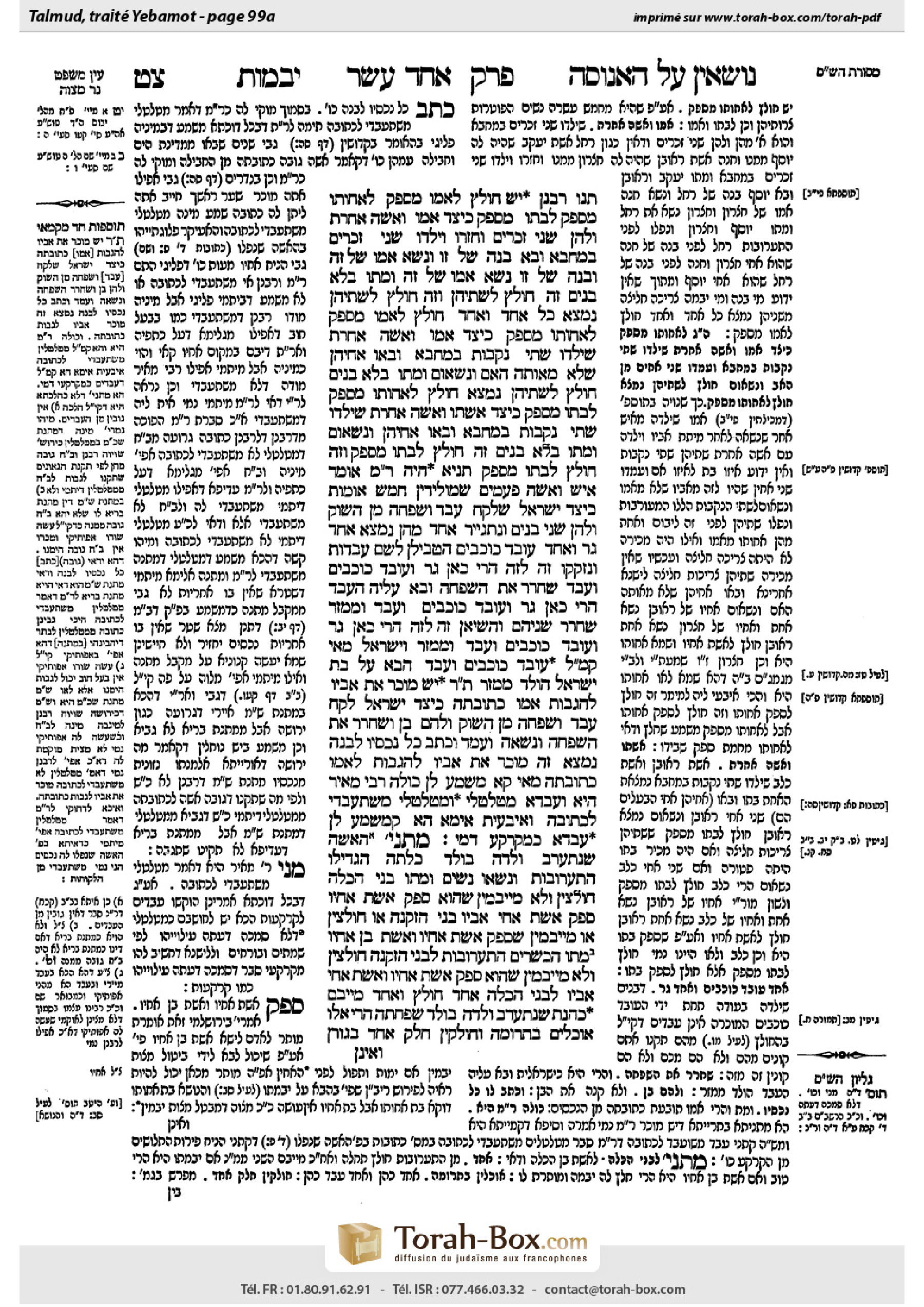
This page of Yevamot includes the Aramaic text, an English translation and an AI-generated French translation, alongside the scan above.
יבמות צ״ט א · Aramaic and Hebrew text
תָּנוּ רַבָּנַן: יֵשׁ חוֹלֵץ לְאִמּוֹ מִסָּפֵק, לַאֲחוֹתוֹ מִסָּפֵק, לְבִתּוֹ מִסָּפֵק.
כֵּיצַד? אִמּוֹ וְאִשָּׁה אַחֶרֶת, וְלָהֶן שְׁנֵי זְכָרִים, וְחָזְרוּ וְיָלְדוּ שְׁנֵי זְכָרִים בְּמַחֲבֵא, וּבָא בְּנָהּ שֶׁל זוֹ וְנָשָׂא אִמּוֹ שֶׁל זֶה, וּבְנָהּ שֶׁל זוֹ נָשָׂא אִמּוֹ שֶׁל זֶה, וּמֵתוּ בְּלֹא בָּנִים — זֶה חוֹלֵץ לִשְׁתֵּיהֶן, וְזֶה חוֹלֵץ לִשְׁתֵּיהֶן. נִמְצָא כׇּל אֶחָד וְאֶחָד חוֹלֵץ לְאִמּוֹ מִסָּפֵק.
לַאֲחוֹתוֹ מִסָּפֵק כֵּיצַד? אִמּוֹ וְאִשָּׁה אַחֶרֶת שֶׁיָּלְדוּ שְׁתֵּי נְקֵבוֹת בְּמַחֲבֵא, וּבָאוּ אֲחֵיהֶן שֶׁלֹּא מֵאוֹתָהּ הָאֵם וּנְשָׂאוּם, וּמֵתוּ בְּלֹא בָּנִים — חוֹלֵץ לִשְׁתֵּיהֶן, נִמְצָא חוֹלֵץ לַאֲחוֹתוֹ מִסָּפֵק.
לְבִתּוֹ מִסָּפֵק כֵּיצַד? אִשְׁתּוֹ וְאִשָּׁה אַחֶרֶת שֶׁיָּלְדוּ שְׁתֵּי נְקֵבוֹת בְּמַחֲבֵא, וּבָאוּ אֲחֵיהֶן וּנְשָׂאוּם, וּמֵתוּ בְּלֹא בָּנִים — זֶה חוֹלֵץ לְבִתּוֹ מִסָּפֵק, וְזֶה חוֹלֵץ לְבִתּוֹ מִסָּפֵק.
תַּנְיָא, הָיָה רַבִּי מֵאִיר אוֹמֵר: אִישׁ וְאִשָּׁה פְּעָמִים שֶׁמּוֹלִידִין חָמֵשׁ אוּמּוֹת.
כֵּיצַד? יִשְׂרָאֵל שֶׁלָּקַח עֶבֶד וְשִׁפְחָה מִן הַשּׁוּק, וְלָהֶן שְׁנֵי בָנִים, וְנִתְגַּיֵּיר אֶחָד מֵהֶן — נִמְצָא אֶחָד גֵּר וְאֶחָד גּוֹי. הִטְבִּילָן לְשֵׁם עַבְדוּת וְנִזְקְקוּ זֶה לָזֶה, הֲרֵי כָּאן גֵּר וְגוֹי וְעֶבֶד. שִׁחְרֵר אֶת הַשִּׁפְחָה וּבָא עָלֶיהָ הָעֶבֶד, הֲרֵי כָּאן גֵּר וְגוֹי וְעֶבֶד וּמַמְזֵר. שִׁחְרֵר שְׁנֵיהֶם, וְהִשִּׂיאָן זֶה לָזֶה — הֲרֵי כָּאן גֵּר וְגוֹי וְעֶבֶד וּמַמְזֵר וְיִשְׂרָאֵל.
מַאי קָא מַשְׁמַע לַן — גּוֹי וְעֶבֶד הַבָּא עַל בַּת יִשְׂרָאֵל הַוָּלָד מַמְזֵר.
תָּנוּ רַבָּנַן: יֵשׁ מוֹכֵר אֶת אָבִיו לְהַגְבּוֹת אִמּוֹ כְּתוּבָּתָהּ. כֵּיצַד? יִשְׂרָאֵל לָקַח עֶבֶד וְשִׁפְחָה מִן הַשּׁוּק וְלָהֶם בֵּן. וְשִׁחְרֵר אֶת הַשִּׁפְחָה וּנְשָׂאָהּ, וְעָמַד וְכָתַב כׇּל נְכָסָיו לִבְנָהּ, נִמְצָא זֶה מוֹכֵר אֶת אָבִיו לְהַגְבּוֹת לְאִמּוֹ כְּתוּבָּתָהּ.
מַאי קָא מַשְׁמַע לַן? כּוּלַּהּ רַבִּי מֵאִיר הִיא, וְעַבְדָּא מִטַּלְטְלֵי, וּמִטַּלְטְלֵי מִשְׁתַּעְבְּדִי לִכְתוּבָה. וְאִיבָּעֵית אֵימָא: הָא קָמַשְׁמַע לַן עַבְדָּא כִּמְקַרְקַע דָּמֵי.
מַתְנִי׳ הָאִשָּׁה שֶׁנִּתְעָרֵב וְלָדָהּ בִּוְלַד כַּלָּתָהּ, הִגְדִּילוּ הַתַּעֲרוֹבוֹת וְנָשְׂאוּ נָשִׁים, וּמֵתוּ — בְּנֵי הַכַּלָּה חוֹלְצִין וְלֹא מְיַיבְּמִין, שֶׁהוּא סָפֵק אֵשֶׁת אָחִיו, סָפֵק אֵשֶׁת אֲחִי אָבִיו.
בְּנֵי הַזְּקֵנָה אוֹ חוֹלְצִין אוֹ מְיַיבְּמִין, שֶׁ[הוּא] סָפֵק אֵשֶׁת אָחִיו וְאֵשֶׁת בֶּן אָחִיו.
מֵתוּ הַכְּשֵׁרִים, הַתַּעֲרוֹבוֹת לִבְנֵי הַזְּקֵנָה חוֹלְצִין וְלֹא מְיַיבְּמִין, שֶׁהוּא סָפֵק אֵשֶׁת אָחִיו וְאֵשֶׁת אֲחִי אָבִיו. לִבְנֵי הַכַּלָּה — אֶחָד חוֹלֵץ, וְאֶחָד מְיַיבֵּם.
כֹּהֶנֶת שֶׁנִּתְעָרֵב וְלָדָהּ בִּוְלַד שִׁפְחָתָהּ — הֲרֵי אֵלּוּ אוֹכְלִים בִּתְרוּמָה — וְחוֹלְקִין חֵלֶק אֶחָד בַּגּוֹרֶן,
Yevamot 99a · English translation
§ The Sages taught: There is a case in which one performs ḥalitza with his mother due to uncertainty, or with his sister due to uncertainty, or with his daughter due to uncertainty. This is the halakha despite the fact that a levirate bond cannot be created between these relatives.
How so? If his mother and another woman had two sons, one each, and they then gave birth to two other sons in hiding, whose identities were confused, such that their lineage was consequently indeterminate, and the known son of this woman came and married the mother of that other known son, and the known son of that woman married this son’s mother, and they died without children, the halakha is that this one of the mixed sons performs ḥalitza with both women, as it is unknown which is his mother and which his yevama, and that one likewise performs ḥalitza with both women. It is therefore found that each one of them performs ḥalitza with his mother, due to the uncertainty.
There is a case where a man performs ḥalitza with his sister due to uncertainty. How so? If his mother and another woman gave birth to two females in hiding, and they were mixed, and the paternal, but not maternal, half brothers of this man and of the son of the other woman came and married them, and those half brothers died without children, the halakha is that the living half brothers perform ḥalitza with both wives, each with his half sister-in-law. It is therefore found that one performs ḥalitza with his half sister due to uncertainty.
There is a case where one performs ḥalitza with his daughter due to uncertainty. How so? If his wife and another woman gave birth to two females in hiding, and they were mixed, and his brothers and the brothers of the other woman’s husband came and married them, and they died without children, then this one performs ḥalitza with his daughter due to uncertainty, and that one also performs ḥalitza with his daughter due to uncertainty.
§ Following the previous baraita, the Gemara cites two additional baraitot that discuss unusual family situations. It is taught in a baraita that Rabbi Meir would say: A man and a woman can sometimes bear children of five nations, i.e., of five separate categories of lineage.
How so? If a Jew bought a slave and a maidservant from the market, and the slave and maidservant had two children at the time, and one of these children converted, it is found that one child is a convert and the other one is a gentile. If the master immersed the slave and maidservant for the sake of giving them the status of slaves, and they engaged in intercourse with each other and had a child, here there are three children in the family who are a convert, and a gentile, and a slave. If he freed the maidservant, which renders her a Jewess, and her husband the slave engaged in intercourse with her, and they had another child, here there are a convert, a gentile, a slave, and a mamzer. The offspring of a slave and a Jewess, according to Rabbi Meir, have the same status as a son born from an incestuous or adulterous relationship. If the master subsequently freed both the maidservant and the slave and married them to each other and they had another child, here there are a convert, a gentile, a slave, a mamzer, and a regular Jew.
The Gemara asks: What is the baraita teaching us? The Gemara answers: It is teaching us that if a gentile or a slave engaged in intercourse with a Jewish woman, their offspring is a mamzer.
The Sages taught: There is a case in which a man sells his father in order to collect his mother’s marriage contract for her. How so? A Jew bought a slave and a maidservant from the market, and they had a son, and the master freed the maidservant and married her, and he arose and wrote that all his property should go to her son, including her son’s father, the slave. It is found that this son, after receiving the master’s property, might sell his father to collect for his mother her marriage contract.
The Gemara asks: What is the baraita teaching us? The Gemara answers: The entire baraita is the statement of Rabbi Meir, and it is teaching us that although the legal status of a slave is like that of movable property, and there are those who hold that movable property cannot be mortgaged, Rabbi Meir holds that movable property is mortgaged for a marriage contract. This is also Rabbi Meir’s ruling elsewhere. Therefore, one might be obligated to sell his slave to pay a marriage contract. And if you wish, say that it is teaching us this: The legal status of a slave is like that of real estate, and therefore, according to all opinions one is obligated to sell his slave to pay a marriage contract.
MISHNA: With regard to a woman whose offspring was mixed with the offspring of her daughter-in-law, and their lineage was consequently indeterminate, and the mixed sons matured and married women, and subsequently they died, the certain sons of the daughter-in-law perform ḥalitza with the wives, but not levirate marriage, as with regard to each wife it is uncertain whether she is his brother’s wife, and therefore his yevama, and uncertain whether she is his father’s brother’s wife, who is forbidden to him.
However, the certain sons of the elder woman, i.e., the mother-in-law, perform either ḥalitza or levirate marriage, as with regard to each wife it is uncertain whether she is his brother’s wife, in which case levirate marriage is valid, or his brother’s son’s wife, in which case she is permitted to him, after having performed ḥalitza with a son of the daughter-in-law.
If the sons of certain, unflawed lineage were the ones who died, then the mixed sons perform ḥalitza with the widows of the elder woman’s sons but not levirate marriage, as it is uncertain whether she is his brother’s wife or his father’s brother’s wife. With the widows of the certain sons of the daughter-in-law, one of the mixed sons performs ḥalitza, in case she is his brother’s wife. And the other one performs levirate marriage, as even if she is his brother’s son’s wife, she is permitted to him.
In the case of a priestess whose offspring was mixed with her maidservant’s offspring, they may partake of teruma, as both a priest and the slave of a priest partake of teruma. And they receive one share of teruma in the granary.
Yevamot 99a · Traduction française (IA)
§ Les Sages ont enseigné : Il arrive qu’un homme accomplisse la ḥalitsa avec sa mère en raison d’un doute, ou avec sa sœur en raison d’un doute, ou avec sa fille en raison d’un doute. Telle est la halakha, bien qu’un lien de lévirat ne puisse être établi entre ces parentes.
Comment cela ? Si sa mère et une autre femme ont chacune donné naissance à un fils, puis ont chacune donné naissance en secret à un autre fils, dont les identités ont été confondues, de sorte que leur filiation est devenue incertaine ; si le fils connu de cette femme est venu épouser la mère de cet autre fils connu, et que le fils connu de l’autre femme a épousé la mère de ce fils, puis qu’ils sont morts sans enfants, la halakha est que l’un des fils dont l’identité a été confondue accomplit la ḥalitsa avec les deux femmes, puisqu’on ignore laquelle est sa mère et laquelle est sa yevama ; l’autre accomplit lui aussi la ḥalitsa avec les deux femmes. Il s’avère donc que chacun d’eux accomplit la ḥalitsa avec sa mère, en raison du doute.
Il arrive qu’un homme accomplisse la ḥalitsa avec sa sœur en raison d’un doute. Comment cela ? Si sa mère et une autre femme ont donné naissance en secret à deux filles, dont les identités ont été confondues, puis que les demi-frères paternels, mais non maternels, de cet homme et du fils de l’autre femme sont venus les épouser, et que ces demi-frères sont morts sans enfants, la halakha est que les demi-frères survivants accomplissent la ḥalitsa avec les deux épouses, chacun avec sa belle-sœur. Il s’avère donc que l’un d’eux accomplit la ḥalitsa avec sa demi-sœur en raison du doute.
Il arrive qu’un homme accomplisse la ḥalitsa avec sa fille en raison d’un doute. Comment cela ? Si sa femme et une autre femme ont donné naissance en secret à deux filles, dont les identités ont été confondues, puis que ses frères et les frères du mari de l’autre femme sont venus les épouser et sont morts sans enfants, cet homme accomplit alors la ḥalitsa avec sa fille en raison du doute, et l’autre homme accomplit lui aussi la ḥalitsa avec sa fille en raison du doute.
§ À la suite de la baraïta précédente, la Guemara cite deux autres baraïtot qui traitent de situations familiales inhabituelles. Une baraïta enseigne que Rabbi Meïr disait : Un homme et une femme peuvent parfois avoir des enfants appartenant à cinq nations, c’est-à-dire à cinq catégories distinctes de filiation.
Comment cela ? Si un Juif achète au marché un esclave et une servante, qui ont déjà deux enfants, et que l’un de ces enfants se convertit, il s’avère que l’un est converti et l’autre non-Juif. Si le maître immerge l’esclave et la servante afin de leur conférer le statut d’esclaves, qu’ils ont des relations l’un avec l’autre et qu’ils ont un enfant, la famille compte alors trois enfants : un converti, un non-Juif et un esclave. Si le maître affranchit la servante, ce qui lui confère le statut de Juive, et que son mari, l’esclave, a des relations avec elle et qu’ils ont un autre enfant, il y a alors un converti, un non-Juif, un esclave et un mamzer. Selon Rabbi Meïr, les enfants d’un esclave et d’une Juive ont le même statut qu’un enfant né d’une relation incestueuse ou adultérine. Si, par la suite, le maître affranchit la servante et l’esclave, les marie l’un à l’autre et qu’ils ont un autre enfant, il y a alors un converti, un non-Juif, un esclave, un mamzer et un Juif de statut ordinaire.
La Guemara demande : Que nous enseigne cette baraïta ? La Guemara répond : Elle nous enseigne que si un non-Juif ou un esclave a des relations avec une femme juive, leur enfant est un mamzer.
Les Sages ont enseigné : Il arrive qu’un homme vende son père afin de percevoir pour sa mère la somme prévue par son contrat de mariage. Comment cela ? Un Juif achète au marché un esclave et une servante, qui ont un fils ; le maître affranchit la servante et l’épouse, puis rédige un acte par lequel il lègue tous ses biens au fils de celle-ci, y compris le père de ce fils, l’esclave. Il s’avère que ce fils, après avoir reçu les biens du maître, pourrait vendre son père afin de percevoir pour sa mère la somme prévue par son contrat de mariage.
La Guemara demande : Que nous enseigne cette baraïta ? La Guemara répond : Toute la baraïta est une déclaration de Rabbi Meïr, et elle nous enseigne que, bien que le statut juridique d’un esclave soit celui d’un bien meuble et que certains soutiennent que les biens meubles ne peuvent être grevés d’une garantie, Rabbi Meïr considère que les biens meubles garantissent le paiement d’un contrat de mariage. Rabbi Meïr statue de même ailleurs. On pourrait donc être tenu de vendre son esclave pour payer une somme prévue par un contrat de mariage. Et si tu préfères, dis que la baraïta nous enseigne ceci : le statut juridique d’un esclave est celui d’un bien immobilier ; par conséquent, selon toutes les opinions, on est tenu de vendre son esclave pour payer une somme prévue par un contrat de mariage.
MICHNA : Dans le cas d’une femme dont la descendance a été confondue avec celle de sa belle-fille, de sorte que leur filiation est devenue incertaine, et dont les fils aux identités confondues ont grandi, se sont mariés puis sont morts, les fils à la filiation certaine de la belle-fille accomplissent la ḥalitsa avec les épouses, mais ne contractent pas de mariage léviratique. En effet, pour chacune de ces épouses, on ignore si elle est la femme de son frère et donc sa yevama, ou la femme du frère de son père, qui lui est interdite.
Cependant, les fils à la filiation certaine de la femme âgée, c’est-à-dire de la belle-mère, accomplissent soit la ḥalitsa, soit le mariage léviratique. En effet, pour chacune de ces épouses, on ignore si elle est la femme de son frère, auquel cas le mariage léviratique est valide, ou la femme du fils de son frère, auquel cas elle lui est permise après avoir accompli la ḥalitsa avec un fils de la belle-fille.
Si ce sont les fils à la filiation certaine et sans défaut qui sont morts, les fils aux identités confondues accomplissent la ḥalitsa avec les veuves des fils de la femme âgée, mais ne contractent pas de mariage léviratique, car on ignore si chacune est la femme de son frère ou celle du frère de son père. Avec les veuves des fils à la filiation certaine de la belle-fille, l’un des fils aux identités confondues accomplit la ḥalitsa, au cas où elle serait la femme de son frère. L’autre contracte un mariage léviratique, car même si elle est la femme du fils de son frère, elle lui est permise.
Dans le cas d’une femme de prêtre dont la descendance a été confondue avec celle de sa servante, ils peuvent consommer la terouma, car aussi bien le prêtre que l’esclave d’un prêtre peuvent consommer la terouma. Ils reçoivent une seule part de terouma dans le grenier.
Traduction française générée par IA à partir de l’édition anglaise de Sefaria. Vérifie toujours un passage avec le texte source.
Text from Sefaria: William Davidson Edition - Vocalized Aramaic (CC BY NC); William Davidson Edition - English (CC BY NC).