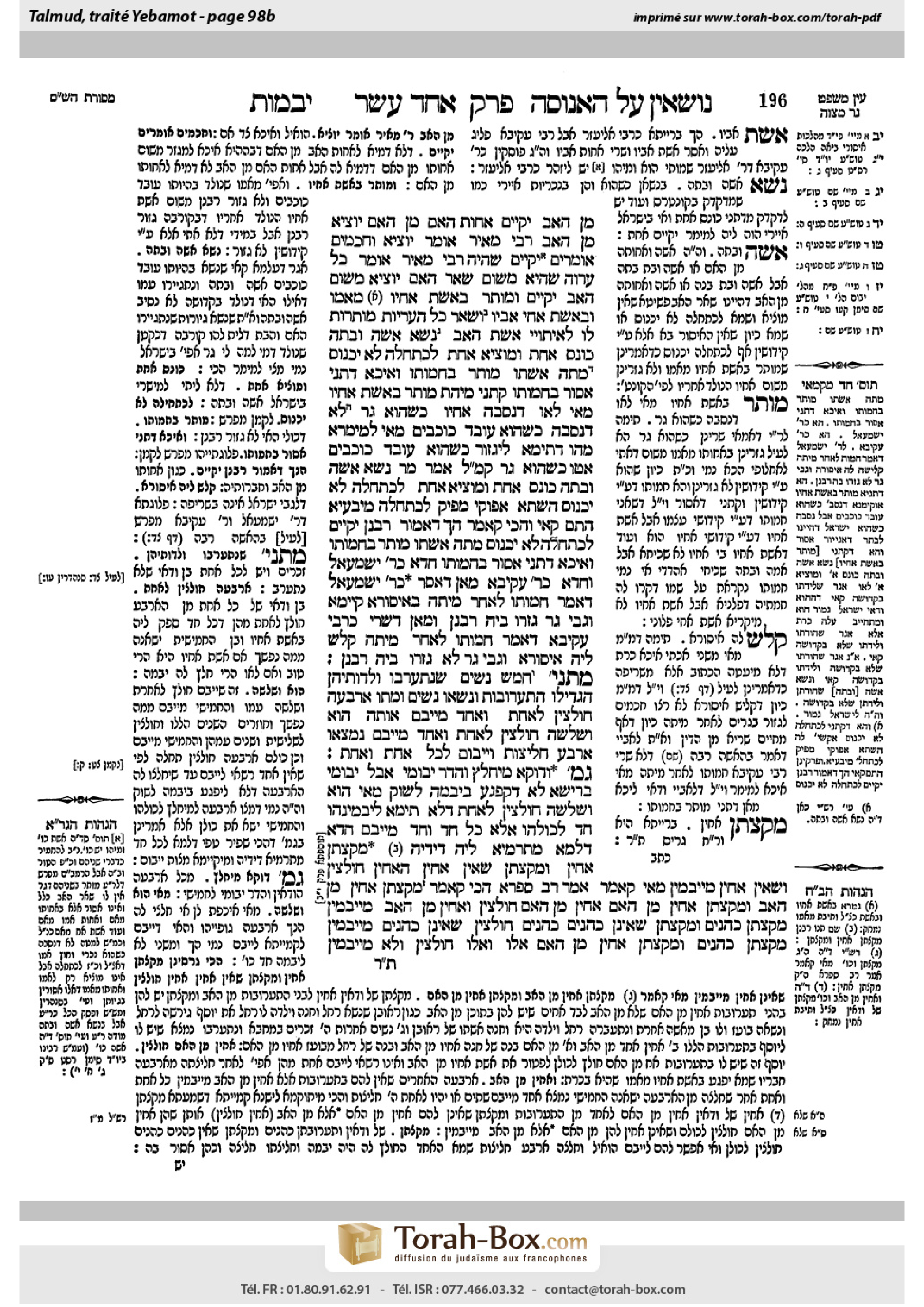
Yevamot 98b: Talmud study for Daf Yomi
Daf Yomi is the daily study of one Talmud folio. Explore 37 tractates with scans, Hebrew text, Sefaria English and AI-generated French translations where annotated.
Passage selection and English or AI-generated French translation are available where the scan has annotations. Daf Study is independent of Torah-Box and Sefaria.
Browse Yevamot · יבמות · All tractatesYevamot 98b text and translations
This page of Yevamot includes the Aramaic text, an English translation and an AI-generated French translation, alongside the scan above.
יבמות צ״ח ב · Aramaic and Hebrew text
מִן הָאָב — יְקַיֵּים. אָחוֹת הָאֵם מִן הָאֵם — יוֹצִיא, מִן הָאָב — רַבִּי מֵאִיר אוֹמֵר: יוֹצִיא, וַחֲכָמִים אוֹמְרִים: יְקַיֵּים. שֶׁהָיָה רַבִּי מֵאִיר אוֹמֵר: כׇּל עֶרְוָה שֶׁהִיא מִשּׁוּם שְׁאֵר הָאֵם — יוֹצִיא, מִשּׁוּם הָאָב — יְקַיֵּים.
וּמוּתָּר בְּאֵשֶׁת אָחִיו מֵאִמּוֹ, וּבְאֵשֶׁת אֲחִי אָבִיו. וּשְׁאָר כׇּל הָעֲרָיוֹת מוּתָּרוֹת לוֹ. לְאֵיתוֹיֵי אֵשֶׁת הָאָב.
נָשָׂא אִשָּׁה וּבִתָּהּ — כּוֹנֵס אַחַת וּמוֹצִיא אַחַת. לְכַתְּחִלָּה לֹא יִכְנוֹס. מֵתָה אִשְׁתּוֹ — מוּתָּר בַּחֲמוֹתוֹ. וְאִיכָּא דְּתָנֵי: אָסוּר בַּחֲמוֹתוֹ.
קָתָנֵי מִיהַת: מוּתָּר בְּאֵשֶׁת אָחִיו, מַאי לָאו, דְּנַסְבַהּ אָחִיו כְּשֶׁהוּא גֵּר? לָא, דְּנַסְבַהּ כְּשֶׁהוּא גּוֹי. מַאי לְמֵימְרָא? מַהוּ דְּתֵימָא: לִיגְזוֹר כְּשֶׁהוּא גּוֹי אַטּוּ כְּשֶׁהוּא גֵּר, קָא מַשְׁמַע לַן.
אָמַר מָר: נָשָׂא אִשָּׁה וּבִתָּהּ — כּוֹנֵס אַחַת וּמוֹצִיא אַחַת. לְכַתְּחִלָּה לֹא יִכְנוֹס. הַשְׁתָּא אַפּוֹקֵי מַפֵּיק — לְכַתְּחִלָּה מִיבַּעְיָא?! הָתָם קָאֵי, וְהָכִי קָאָמַר: הָךְ דַּאֲמוּר רַבָּנַן יְקַיֵּים, לְכַתְּחִלָּה לֹא יִכְנוֹס.
מֵתָה אִשְׁתּוֹ — מוּתָּר בַּחֲמוֹתוֹ. וְאִיכָּא דְּתָנֵי: אָסוּר בַּחֲמוֹתוֹ. חֲדָא כְּרַבִּי יִשְׁמָעֵאל, וַחֲדָא כְּרַבִּי עֲקִיבָא.
מַאן דְּאָסַר, כְּרַבִּי יִשְׁמָעֵאל, דְּאָמַר: חֲמוֹתוֹ לְאַחַר מִיתָה — בְּאִיסּוּרָא קָיְימָא, וְגַבֵּי גֵר גְּזַרוּ בֵּיהּ רַבָּנַן. וּמַאן דְּשָׁרֵי, כְּרַבִּי עֲקִיבָא, דְּאָמַר: חֲמוֹתוֹ לְאַחַר מִיתָה — קְלַשׁ לֵיהּ אִיסּוּרָא, וְגַבֵּי גֵר לָא גְּזַרוּ בֵּיהּ רַבָּנַן.
מַתְנִי׳ חָמֵשׁ נָשִׁים שֶׁנִּתְעָרְבוּ וַלְדוֹתֵיהֶן, הִגְדִּילוּ הַתַּעֲרוֹבוֹת וְנָשְׂאוּ נָשִׁים, וּמֵתוּ — אַרְבָּעָה חוֹלְצִין לְאַחַת, וְאֶחָד מְיַיבֵּם אוֹתָהּ.
הוּא וּשְׁלֹשָׁה חוֹלְצִין לְאַחַת, וְאֶחָד מְיַיבֵּם. נִמְצְאוּ אַרְבַּע חֲלִיצוֹת וְיִיבּוּם לְכׇל אַחַת וְאַחַת.
גְּמָ׳ וְדַוְקָא מִיחְלָץ וַהֲדַר יַבּוֹמֵי, אֲבָל יַבּוֹמֵי בְּרֵישָׁא — לָא, דְּקָפָגַע בִּיבָמָה לַשּׁוּק.
מַאי הוּא וּשְׁלֹשָׁה חוֹלְצִין לְאַחַת? דְּלָא תֵּימָא לְיַבְּמִינְהוּ חַד לְכוּלְּהוּ, אֶלָּא כֹּל חַד וְחַד מְיַיבֵּם חֲדָא, דִּלְמָא מִתְרַמְיָא לֵיהּ דִּידֵיהּ.
מִקְצָתָן אַחִין וּמִקְצָתָן שֶׁאֵין אַחִין — הָאַחִין חוֹלְצִין, וְשֶׁאֵין אַחִין מְיַיבְּמִין. מַאי קָאָמַר? אָמַר רַב סָפְרָא, הָכִי קָאָמַר: מִקְצָתָן אַחִין מִן הָאָב וּמִקְצָתָן אַחִין מִן הָאֵם. אַחִין מִן הָאֵם — חוֹלְצִין, וְאַחִין מִן הָאָב — מְיַיבְּמִין.
מִקְצָתָן כֹּהֲנִים וּמִקְצָתָן שֶׁאֵינָן כֹּהֲנִים — כֹּהֲנִים חוֹלְצִין, שֶׁאֵינָן כֹּהֲנִים — מְיַיבְּמִין. מִקְצָתָן כֹּהֲנִים וּמִקְצָתָן אַחִין מִן הָאֵם — אֵלּוּ וָאֵלּוּ חוֹלְצִין וְלֹא מְיַיבְּמִין.
Yevamot 98b · English translation
If she is his father’s paternal half sister, he may maintain her as his wife. If she is his mother’s maternal half sister, he must divorce her. If she is his mother’s paternal half sister, Rabbi Meir says he must divorce her, and the Rabbis say he may maintain her. This is as Rabbi Meir would say: Any relative forbidden due to kinship with the mother, whether the woman is his paternal relative, e.g., his father’s maternal half sister, or his maternal relative, he must divorce her. However, if she is forbidden due to the father, he may maintain her.
And he is permitted to marry his maternal brother’s wife and his father’s brother’s wife, and all other forbidden relatives are also permitted to him. The expression: And all other relatives are also permitted to him, is added to include the father’s wife.
With regard to one who married a woman and her daughter and they converted, he may remarry one but must divorce the other one. He should not marry her ab initio. If his wife, the daughter, died, he is permitted to maintain his mother-in-law as his wife. And some teach that he is prohibited from maintaining his mother-in-law.
In any event, this baraita teaches that he is permitted to marry his brother’s wife. The Gemara asks: What, is it not referring to a case where his brother married her when he was already a convert? The Gemara answers: No, it is referring to a case where he married her while he was a gentile. The Gemara asks: If so, what is the purpose of stating this obvious halakha? The Gemara answers: Lest you say that the Sages should decree that the marriage is prohibited if the brother married her while he was a gentile, due to the prohibition against their marriage if the brother married her when he was already a convert. The baraita therefore teaches us that there is no such decree.
The Master said: If one married a woman and her daughter and they converted, he may remarry one but must divorce the other one. He should not marry her ab initio. The Gemara asks: Now that he must divorce her, is it necessary to state that he should not marry her ab initio? The Gemara answers: That statement is standing there, i.e., it is referring to the previous sentence, and this is what it is saying: Those wives that the Sages said that he may maintain, e.g., his paternal half sister, he should not marry them ab initio.
The baraita taught: If his wife, the daughter, died, he is permitted to maintain his mother-in-law as his wife. And some teach that he is prohibited to maintain his mother-in-law. The Gemara comments: One of the teachings is in accordance with the opinion of Rabbi Yishmael, and the other one is in accordance with the opinion of Rabbi Akiva.
The one who prohibits the convert from maintaining his mother-in-law is in accordance with the opinion of Rabbi Yishmael, who said that one’s mother-in-law after his wife’s death remains forbidden to him to the same degree as during her lifetime. And therefore, with regard to a convert, the Sages decreed that she is forbidden to him, lest one marry his mother-in-law who is a Jew from birth after his wife’s death. And the one who permits him to maintain her is in accordance with the opinion of Rabbi Akiva, who said that the prohibition against engaging in intercourse with one’s mother-in-law is weakened after his wife’s death, as they are not liable to receive the death penalty. And therefore, with regard to a convert, the Sages did not decree that she is forbidden to him.
MISHNA: With regard to five women whose offspring were mixed, i.e., their lineage became indeterminate, and they had other sons as well who were not mixed, and the mixed sons matured and married women and subsequently died, then four sons who were not mixed, each one from a different mother, must perform ḥalitza with one of the widows, as she might be the sister-in-law of any of them. And one son of the mother whose sons did not perform ḥalitza may perform levirate marriage with her instead of ḥalitza; even if she is not his sister-in-law, once she has received ḥalitza from the others she may marry any man.
Subsequently, he and three of the four other sons must perform ḥalitza with one of the remaining widows, and the other one may perform levirate marriage. When this process has been completed for all the widows, four ḥalitzot and a levirate marriage are found altogether for each and every widow.
GEMARA: The Gemara infers from the mishna that ḥalitza specifically is performed first, and afterward levirate marriage. However, levirate marriage may not be performed first, as that would breach the prohibition against a yevama engaging in intercourse with a member of the public, if she is not his sister-in-law.
The Gemara asks: What is the reason for the mishna’s ruling that the son who performed levirate marriage and three of the four others must perform ḥalitza with one of the remaining widows, and the remaining son may perform levirate marriage? Why can’t the same son who performed levirate marriage with the first widow be the one to perform levirate marriage with the other widows, too, after the other four sons perform ḥalitza? The Gemara answers: Do not say that one of the brothers may perform levirate marriage with all of them. Rather, each one of them should perform levirate marriage with one, as perhaps one will happen upon his own sister-in-law, whereas if one performs levirate marriage with all of them, the others will not have a chance to perform the mitzva.
§ A continuation of a case in the mishna is stated in a baraita: If some of them are brothers, and some of them are not brothers, the brothers perform ḥalitza and those who are not brothers perform levirate marriage. The Gemara asks: What is the baraita saying? Rav Safra said that this is what it is saying: If some of the sons who were not mixed are only paternal brothers of the mixed sons, and some of them, in addition to being paternal half brothers, are also maternal half brothers of other members of the mixed group, then the maternal half brothers must perform ḥalitza with all of the women, since each of them might be his maternal sister-in-law, who is forbidden to him, as levirate marriage applies only to a paternal sister-in-law. And those who are only paternal brothers perform levirate marriage.
The baraita continues: If some of them are priests and some of them are not priests, the priests perform ḥalitza, and those who are not priests perform levirate marriage, as it is prohibited for a priest to marry a woman who underwent ḥalitza. If some of them are priests and some of them are maternal half brothers, both these and those perform ḥalitza and not levirate marriage.
Yevamot 98b · Traduction française (IA)
Si elle est la demi-sœur paternelle de son père, il peut la garder pour épouse. Si elle est la demi-sœur maternelle de sa mère, il doit divorcer d’elle. Si elle est la demi-sœur paternelle de sa mère, Rabbi Meïr dit qu’il doit divorcer d’elle, tandis que les Sages disent qu’il peut la garder. C’est ce que soutiendrait Rabbi Meïr : toute parente interdite en raison de sa parenté avec sa mère, qu’elle soit une parente du côté paternel — par exemple, la demi-sœur maternelle de son père — ou une parente du côté maternel, doit être renvoyée. En revanche, si elle lui est interdite en raison de sa parenté avec son père, il peut la garder.
Il lui est permis d’épouser la femme de son frère maternel et celle du frère de son père ; toutes les autres parentes interdites lui sont également permises. L’expression « toutes les autres parentes lui sont également permises » est ajoutée pour inclure la femme de son père.
Celui qui a épousé une femme et sa fille, puis qui s’est converti avec elles, peut en reprendre une pour épouse, mais doit divorcer de l’autre. Il ne doit pas épouser l’une d’elles a priori. Si son épouse, la fille, est morte, il lui est permis de garder sa belle-mère pour épouse. Certains enseignent qu’il lui est interdit de garder sa belle-mère.
Quoi qu’il en soit, cette baraïta enseigne qu’il lui est permis d’épouser la femme de son frère. La Guemara demande : n’est-il pas question d’un cas où son frère l’a épousée alors qu’il était déjà converti ? La Guemara répond : non, il s’agit d’un cas où il l’a épousée alors qu’il était encore non-Juif. La Guemara demande : dans ce cas, pourquoi énoncer cette halakha évidente ? La Guemara répond : de crainte que tu ne dises que les Sages auraient dû décréter que le mariage était interdit lorsque le frère l’avait épousée alors qu’il était non-Juif, en raison de l’interdiction de ce mariage si le frère l’avait épousée alors qu’il était déjà converti. La baraïta nous enseigne donc qu’un tel décret n’a pas été institué.
Le Maître a dit : « Celui qui a épousé une femme et sa fille, puis qui s’est converti avec elles, peut en reprendre une pour épouse, mais doit divorcer de l’autre. Il ne doit pas l’épouser a priori. » La Guemara demande : puisqu’il doit divorcer d’elle, était-il nécessaire de préciser qu’il ne doit pas l’épouser a priori ? La Guemara répond : cette phrase se rapporte à ce qui précède, c’est-à-dire à la phrase précédente, et voici ce qu’elle signifie : les femmes que les Sages ont déclaré pouvoir être gardées, par exemple sa demi-sœur paternelle, ne doivent pas être épousées a priori.
La baraïta enseigne : « Si son épouse, la fille, est morte, il lui est permis de garder sa belle-mère pour épouse. » Certains enseignent qu’il lui est interdit de garder sa belle-mère. La Guemara fait remarquer : l’un de ces enseignements suit l’opinion de Rabbi Yishmaël, et l’autre celle de Rabbi Akiva.
Celui qui interdit au converti de garder sa belle-mère suit l’opinion de Rabbi Yishmaël, qui a dit que la belle-mère reste interdite à un homme au même degré après la mort de son épouse que de son vivant. Par conséquent, concernant un converti, les Sages ont décrété qu’elle lui est interdite, de peur qu’on n’épouse sa belle-mère, qui est juive de naissance, après la mort de son épouse. Celui qui lui permet de la garder suit l’opinion de Rabbi Akiva, qui a dit que l’interdiction d’avoir des relations avec sa belle-mère s’atténue après la mort de son épouse, puisqu’ils ne sont alors pas passibles de la peine capitale. Par conséquent, concernant un converti, les Sages n’ont pas décrété qu’elle lui était interdite.
MICHNA : Dans le cas de cinq femmes dont les enfants ont été mêlés, si bien que leur filiation est devenue incertaine, et qui ont également eu d’autres fils, dont la filiation n’est pas incertaine, les fils mêlés ont grandi, se sont mariés et sont ensuite morts. Quatre des fils non mêlés, chacun issu d’une mère différente, doivent accomplir la ḥalitsa avec l’une des veuves, car elle pourrait être la belle-sœur de chacun d’eux. Un fils de la mère dont les fils n’ont pas accompli la ḥalitsa peut contracter avec elle un mariage léviratique plutôt que d’accomplir la ḥalitsa ; même si elle n’est pas sa belle-sœur, une fois qu’elle a reçu la ḥalitsa des autres, elle peut épouser n’importe quel homme.
Ensuite, lui et trois des quatre autres fils doivent accomplir la ḥalitsa avec l’une des veuves restantes, et le dernier peut contracter avec elle un mariage léviratique. Une fois cette procédure achevée pour toutes les veuves, chacune d’elles aura reçu au total quatre ḥalitsot et un mariage léviratique.
GUEMARA : La Guemara déduit de la Michna que c’est précisément la ḥalitsa qui doit être accomplie en premier, puis le mariage léviratique. En revanche, le mariage léviratique ne peut pas avoir lieu en premier, car cela enfreindrait l’interdiction faite à une yevama d’avoir des relations avec un homme quelconque, si celui-ci n’est pas son beau-frère.
La Guemara demande : pourquoi la Michna statue-t-elle que le fils qui a contracté un mariage léviratique et trois des quatre autres doivent accomplir la ḥalitsa avec l’une des veuves restantes, tandis que le fils restant peut contracter un mariage léviratique ? Pourquoi le même fils qui a contracté un mariage léviratique avec la première veuve ne pourrait-il pas aussi en contracter un avec les autres veuves, après que les quatre autres fils ont accompli la ḥalitsa ? La Guemara répond : ne dis pas qu’un seul des frères peut contracter un mariage léviratique avec toutes les femmes. Au contraire, chacun d’eux doit contracter un mariage léviratique avec l’une d’elles, car il se peut que l’un d’eux tombe sur sa propre belle-sœur ; tandis que si un seul contracte un mariage léviratique avec toutes, les autres n’auront pas l’occasion d’accomplir la mitsva.
§ La suite d’un cas de la Michna est enseignée dans une baraïta : si certains d’entre eux sont frères et d’autres ne le sont pas, les frères accomplissent la ḥalitsa et ceux qui ne sont pas frères contractent un mariage léviratique. La Guemara demande : que dit la baraïta ? Rav Safra explique qu’elle signifie ceci : si certains des fils non mêlés ne sont que des frères paternels des fils mêlés, tandis que d’autres, en plus d’être des demi-frères paternels, sont également des demi-frères maternels d’autres membres du groupe des fils mêlés, alors les demi-frères maternels doivent accomplir la ḥalitsa avec toutes les femmes, car chacune pourrait être leur belle-sœur maternelle, avec laquelle le mariage léviratique est interdit, puisque celui-ci ne s’applique qu’à une belle-sœur paternelle. Quant à ceux qui ne sont que des frères paternels, ils contractent un mariage léviratique.
La baraïta poursuit : si certains d’entre eux sont prêtres et d’autres ne le sont pas, les prêtres accomplissent la ḥalitsa et ceux qui ne sont pas prêtres contractent un mariage léviratique, car il est interdit à un prêtre d’épouser une femme qui a subi la ḥalitsa. Si certains d’entre eux sont prêtres et d’autres sont des demi-frères maternels, les uns comme les autres accomplissent la ḥalitsa et ne contractent pas de mariage léviratique.
Traduction française générée par IA à partir de l’édition anglaise de Sefaria. Vérifie toujours un passage avec le texte source.
Text from Sefaria: William Davidson Edition - Vocalized Aramaic (CC BY NC); William Davidson Edition - English (CC BY NC).