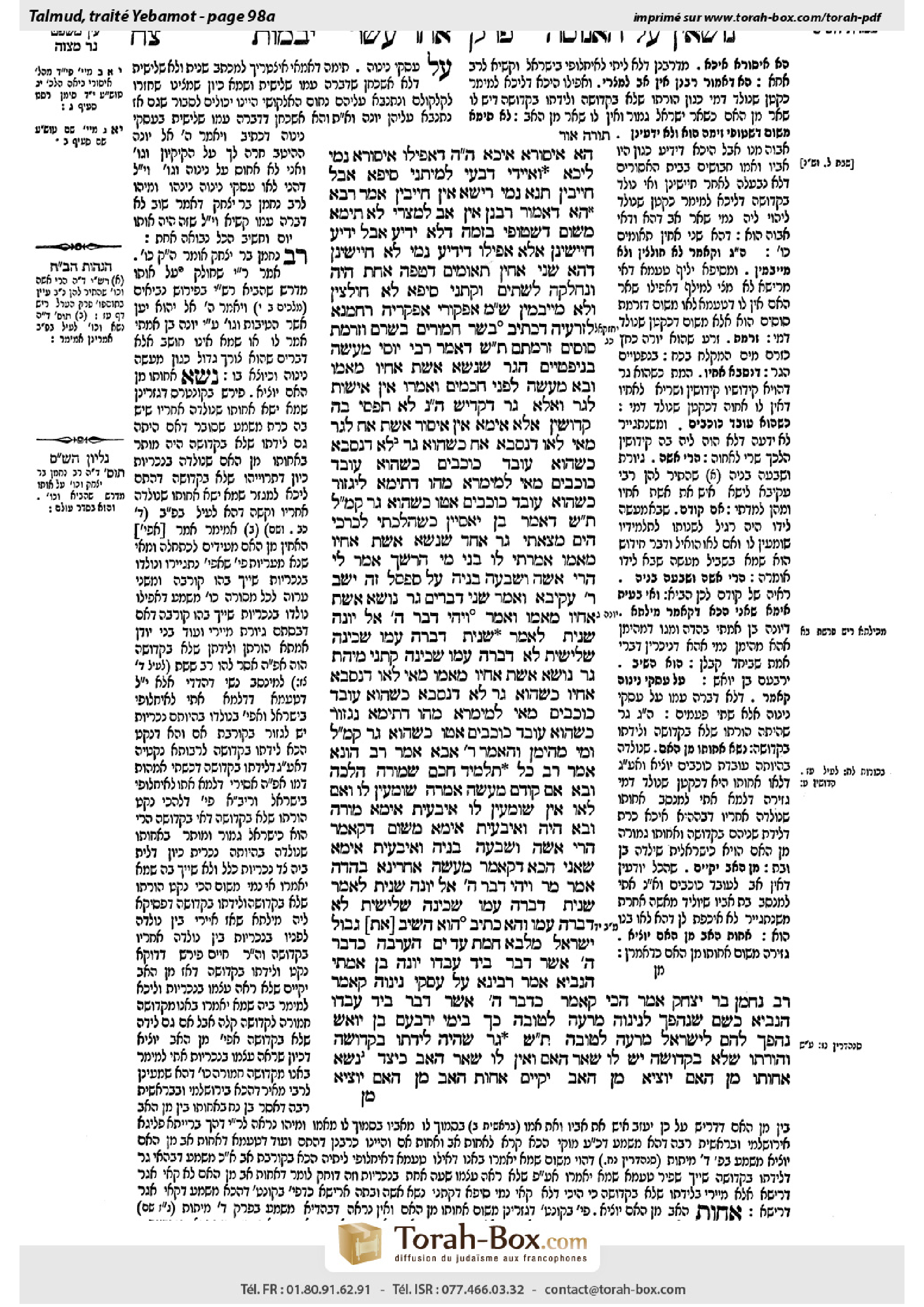
Yevamot 98a: Talmud study for Daf Yomi
Daf Yomi is the daily study of one Talmud folio. Explore 37 tractates with scans, Hebrew text, Sefaria English and AI-generated French translations where annotated.
Passage selection and English or AI-generated French translation are available where the scan has annotations. Daf Study is independent of Torah-Box and Sefaria.
Browse Yevamot · יבמות · All tractatesYevamot 98a text and translations
This page of Yevamot includes the Aramaic text, an English translation and an AI-generated French translation, alongside the scan above.
יבמות צ״ח א · Aramaic and Hebrew text
הָא אִיסּוּרָא אִיכָּא! הוּא הַדִּין דַּאֲפִילּוּ אִיסּוּרָא נָמֵי לֵיכָּא, וְאַיְּידֵי דְּבָעֵי לְמִיתְנֵי סֵיפָא ״אֲבָל חַיָּיבִין״, תַּנָּא נָמֵי רֵישָׁא ״אֵין חַיָּיבִין״.
אָמַר רָבָא, הָא דַּאֲמוּר רַבָּנַן: אֵין אָב לְגוֹי, לָא תֵּימָא מִשּׁוּם דִּשְׁטִופִי בְּזִמָּה, דְּלָא יְדִיעַ, אֲבָל יְדִיעַ — חָיְישִׁינַן, אֶלָּא אֲפִילּוּ דִּידִיעַ — נָמֵי לָא חָיְישִׁינַן.
דְּהָא שְׁנֵי אַחִין תְּאוֹמִים, דְּטִפָּה אַחַת הִיא וְנֶחְלְקָה לִשְׁתַּיִם, וְקָתָנֵי סֵיפָא: לֹא חוֹלְצִין וְלֹא מְיַיבְּמִין, שְׁמַע מִינַּהּ: אַפְקוֹרֵי אַפְקְרֵיהּ רַחֲמָנָא לְזַרְעֵיהּ, דִּכְתִיב: ״בְּשַׂר חֲמוֹרִים בְּשָׂרָם וְזִרְמַת סוּסִים זִרְמָתָם״.
תָּא שְׁמַע, דְּאָמַר רַבִּי יוֹסֵי: מַעֲשֶׂה בְּנִיפְטַיִים הַגֵּר שֶׁנָּשָׂא אֵשֶׁת אָחִיו מֵאִמּוֹ, וּבָא מַעֲשֶׂה לִפְנֵי חֲכָמִים, וְאָמְרוּ: אֵין אִישׁוּת לַגֵּר. וְאֶלָּא גֵּר דְּקַדֵּישׁ הָכִי נָמֵי לָא תָּפְסִי בַּהּ קִידּוּשִׁין?! אֶלָּא אֵימָא: אֵין אִסּוּר אֵשֶׁת אָח לַגֵּר. מַאי לָאו דְּנַסְבַהּ אַח כְּשֶׁהוּא גֵּר!
לָא, דְּנַסְבַהּ כְּשֶׁהוּא גּוֹי. כְּשֶׁהוּא גּוֹי, מַאי לְמֵימְרָא? מַהוּ דְּתֵימָא: לִיגְזוֹר כְּשֶׁהוּא גּוֹי אַטּוּ כְּשֶׁהוּא גֵּר, קָא מַשְׁמַע לַן.
תָּא שְׁמַע, דְּאָמַר בֶּן יָאסְיָין: כְּשֶׁהָלַכְתִּי לִכְרַכֵּי הַיָּם מָצָאתִי גֵּר אֶחָד שֶׁנָּשָׂא אֵשֶׁת אָחִיו מֵאִמּוֹ. אָמַרְתִּי לוֹ: בְּנִי, מִי הִרְשְׁךָ? אָמַר לִי: הֲרֵי אִשָּׁה וְשִׁבְעָה בָּנֶיהָ, עַל סַפְסָל זֶה יָשַׁב רַבִּי עֲקִיבָא וְאָמַר שְׁנֵי דְבָרִים: גֵּר נוֹשֵׂא אֵשֶׁת אָחִיו מֵאִמּוֹ, וְאָמַר: ״וַיְהִי דְבַר ה׳ אֶל יוֹנָה שֵׁנִית לֵאמֹר״ — שֵׁנִית דִּבְּרָה עִמּוֹ שְׁכִינָה, שְׁלִישִׁית לֹא דִּבְּרָה עִמּוֹ שְׁכִינָה. קָתָנֵי מִיהַת גֵּר נוֹשֵׂא אֵשֶׁת אָחִיו מֵאִמּוֹ. מַאי לָאו, דְּנַסְבַהּ אָחִיו כְּשֶׁהוּא גֵּר?
לָא, דְּנַסְבַהּ כְּשֶׁהוּא גּוֹי. מַאי לְמֵימְרָא? מַהוּ דְּתֵימָא: נִגְזוֹר כְּשֶׁהוּא גּוֹי אַטּוּ כְּשֶׁהוּא גֵּר, קָא מַשְׁמַע לַן.
וּמִי מְהֵימַן, וְהָאָמַר רַבִּי אַבָּא אָמַר רַב הוּנָא אָמַר רַב: כׇּל תַּלְמִיד חָכָם שֶׁמּוֹרֶה הֲלָכָה וּבָא, אִם קוֹדֶם מַעֲשֶׂה אֲמָרָהּ — שׁוֹמְעִין לוֹ, וְאִם לָאו — אֵין שׁוֹמְעִין לוֹ!
אִיבָּעֵית אֵימָא: מוֹרֶה וּבָא הָיָה. וְאִיבָּעֵית אֵימָא: מִשּׁוּם דְּקָאָמַר הֲרֵי אִשָּׁה וְשִׁבְעָה בָּנֶיהָ. וְאִיבָּעֵית אֵימָא: שָׁאנֵי הָכָא, דְּקָאָמַר מַעֲשֶׂה אַחֲרִינָא בַּהֲדֵהּ.
אָמַר מָר: ״וַיְהִי דְבַר ה׳ אֶל יוֹנָה שֵׁנִית לֵאמֹר״, שֵׁנִית דִּבְּרָה עִמּוֹ שְׁכִינָה, שְׁלִישִׁית לֹא דִּבְּרָה עִמּוֹ. וְהָא כְּתִיב: ״הוּא הֵשִׁיב [אֶת] גְּבוּל יִשְׂרָאֵל מִלְּבוֹא חֲמָת עַד יָם הָעֲרָבָה כִּדְבַר ה׳ אֲשֶׁר דִּבֶּר בְּיַד עַבְדּוֹ יוֹנָה בֶן אֲמִתַּי הַנָּבִיא״!
אָמַר רָבִינָא: עַל עִסְקֵי נִינְוֵה קָאָמַר. רַב נַחְמָן בַּר יִצְחָק אָמַר, הָכִי קָאָמַר: ״כִּדְבַר ה׳ אֲשֶׁר דִּבֶּר בְּיַד עַבְדּוֹ הַנָּבִיא״ — כְּשֵׁם שֶׁנֶּהְפַּךְ לְנִינְוֵה מֵרָעָה לְטוֹבָה, כָּךְ בִּימֵי יָרׇבְעָם בֶּן יוֹאָשׁ נֶהֱפַךְ לָהֶם לְיִשְׂרָאֵל מֵרָעָה לְטוֹבָה.
תָּא שְׁמַע: גֵּר שֶׁהָיָה לֵידָתוֹ בִּקְדוּשָּׁה וְהוֹרָתוֹ שֶׁלֹּא בִּקְדוּשָּׁה — יֵשׁ לוֹ שְׁאֵר הָאֵם, וְאֵין לוֹ שְׁאֵר הָאָב. כֵּיצַד? נָשָׂא אֲחוֹתוֹ מִן הָאֵם — יוֹצִיא. מִן הָאָב — יְקַיֵּים. אֲחוֹת הָאָב מִן הָאֵם — יוֹצִיא,
Yevamot 98a · English translation
there is a rabbinic prohibition, contrary to Rav Aḥa’s opinion. The Gemara answers: The same is true that there is no prohibition, either. And since the baraita wanted to teach in the latter clause that if they were born in sanctity they are liable, it also taught in the first clause that they are not liable. For this reason, the baraita mentions only the absence of liability.
Rava said: With regard to that which the Sages said, that a gentile has no patrilineage, do not say that it is because they are so steeped in licentiousness that they do not know the identity of their fathers with certainty, but if that identity is known, we are concerned that the paternity is recognized, with regard to the prohibition of intercourse with forbidden paternal relatives and other halakhic issues. Rather, even when it is known, we are still not concerned.
The proof is from the case of two identical twin brothers, who were one drop that was divided into two and obviously have the same father, and yet it is taught in the latter clause of the baraita: They do not perform ḥalitza and they do not perform levirate marriage, although they certainly have the same father. Learn from this that the Merciful One dispossesses the male gentile of his offspring, as it is written with regard to Egyptians: “Whose flesh is the flesh of donkeys, and whose semen is the semen of horses” (Ezekiel 23:20), i.e., the offspring of a male gentile is considered no more related to him than the offspring of donkeys and horses.
The Gemara resumes its discussion of the dispute between Rav Aḥa bar Ya’akov and Rav Sheshet. Come and hear another proof, as Rabbi Yosei said: An incident took place involving Niftayim the convert, who married the wife of his maternal half brother, and the incident came before the Sages, and they said that there is no valid marriage for a convert. The Gemara asks: Is this possible? And if a convert betroths a woman who is not related to him, is his betrothal to her indeed ineffective? Rather, modify the baraita and say that with regard to a convert there is no prohibition proscribing a brother’s wife. The Gemara concludes: What, is the baraita not referring to a case where the brother, her first husband, married her when he was already a convert, thereby proving that a convert is permitted to marry the wife of his deceased brother who was also a convert, even if they were maternal brothers?
The Gemara answers: No, the baraita is referring to a case where the brother married her while he was still a gentile, and since he converted they are no longer married. The Gemara asks: If he married her while he was a gentile, what is the purpose of stating this obvious halakha? The Gemara answers: Lest you say the Sages should decree that the marriage is prohibited even in a case where the first husband married her while he was a gentile, due to the prohibition against their marriage if the brother married her when he was already a convert. The baraita therefore teaches us that there is no such decree.
Come and hear another proof, as ben Yasiyan said: When I went to cities overseas, I found one convert who married the wife of his maternal half brother. I said to him: My son, who permitted this to you? He said to me: There is a local woman and her seven sons to whom this was permitted. On this very bench [safsal], Rabbi Akiva sat and said two statements: He said that a convert may marry the former wife of his maternal half brother, and he said that the verse “And the word of the Lord came to Jonah a second time, saying” (Jonah 3:1) implies that the Divine Presence spoke with him only a second time. However, a third time the Divine Presence did not speak with him, i.e., Jonah did not receive any more prophecies. In any event, this baraita teaches that a convert may marry the wife of his maternal brother. What, is it not referring to a case where the convert’s brother married her when he himself was already a convert?
The Gemara answers: No, the baraita is referring to a case where the brother married her while he was still a gentile. The Gemara asks: If so, what is the purpose of stating this obvious halakha? The Gemara answers: Lest you say we should decree that marriage between a convert and the former wife of his brother is prohibited even if the brother married her while he was still a gentile, due to the prohibition against their marrying if the brother married her when he was already a convert. The baraita therefore teaches us that there is no such decree.
And is that convert who cited Rabbi Akiva a reliable witness, despite the fact that the ruling affects him personally? Didn’t Rabbi Abba say that Rav Huna said that Rav said: With regard to any Torah scholar who teaches a ruling of halakha in a certain case and it comes to be, if he said it before the incident, one listens to him. And if not, if the ruling followed the incident, one does not listen to him.
The Gemara answers: If you wish, say that the convert taught the ruling, and only afterward it came to be that he himself married his sister-in-law. And if you wish, say that he is reliable because he supported his ruling by stating that there was a practical case involving a woman and her seven sons, in which Rabbi Akiva ruled that this kind of marriage is permitted. And if you wish, say that here it is different, as the convert stated a different incident with it. Since he cited an unrelated teaching of Rabbi Akiva in the same testimony, this teaching is also considered reliable.
The Master said that Rabbi Akiva inferred from the verse “And the word of the Lord came to Jonah a second time, saying” that the Divine Presence spoke with him only a second time. However, a third time the Divine Presence did not speak with him. The Gemara asks: Isn’t it written with regard to King Jeroboam ben Joash: “He restored the border of Israel from the entrance of Hamath to the Sea of the Arabah, according to the word of the Lord, the God of Israel, which He spoke by the hand of His servant Jonah the son of Amittai, the prophet” (II Kings 14:25)? Evidently, Jonah prophesied at least once more.
Ravina said: Rabbi Akiva was saying that Jonah did not prophesize a third time about the issue of Nineveh. Rav Naḥman bar Yitzḥak said that this is the meaning of the phrase “According to the word of the Lord, the God of Israel, which He spoke by the hand of His servant Jonah the son of Amittai, the prophet”: It is not that Jonah had prophesized about the conquests of Jeroboam ben Joash, but rather that just as the fortune of Nineveh turned from bad to good, so too, in the days of Jeroboam ben Joash, Israel’s fortune turned from bad to good.
The Gemara resumes discussion of the dispute between Rav Aḥa bar Ya’akov and Rav Sheshet. Come and hear another proof: A convert whose birth was in sanctity but whose conception was not in sanctity has maternal kinship, i.e., his relationship to his mother’s relatives is recognized. However, he does not have paternal kinship. How so? If he married his maternal half sister, who was born before him and converted, he must divorce her. Although by Torah law they are considered unrelated, the Sages rendered it prohibited for them to marry, lest he marry a maternal half sister who was born after him and is forbidden to him. If she is his paternal half sister, he may maintain her as his wife. If he married his father’s maternal half sister, he must divorce her.
Yevamot 98a · Traduction française (IA)
Il existe une interdiction rabbinique, contrairement à l’avis de Rav Aḥa. La Guemara répond : Il est également vrai qu’il n’y a aucune interdiction. Puisque la baraïta voulait enseigner, dans sa dernière partie, que s’ils étaient nés dans la sainteté, ils sont passibles, elle a également enseigné, dans sa première partie, qu’ils ne sont pas passibles. C’est pourquoi la baraïta ne mentionne que l’absence de responsabilité.
Rava dit : À propos de ce que les Sages ont dit, à savoir qu’un non-Juif n’a pas de filiation paternelle, ne dites pas que c’est parce qu’ils sont si plongés dans la débauche qu’ils ne connaissent pas avec certitude l’identité de leurs pères, mais que, si cette identité est connue, nous tenons compte de cette paternité pour ce qui est de l’interdiction des relations avec des proches paternels interdits et d’autres questions halakhiques. Au contraire, même lorsqu’elle est connue, nous n’en tenons pas compte.
La preuve vient du cas de deux frères jumeaux identiques, issus d’une seule goutte divisée en deux et qui ont manifestement le même père. Pourtant, la dernière partie de la baraïta enseigne : Ils ne procèdent ni à la ḥalitsa ni au mariage léviratique, bien qu’ils aient certainement le même père. Apprends-en que le Miséricordieux dépouille le mâle non juif de sa descendance, comme il est écrit au sujet des Égyptiens : « Leur chair est la chair des ânes, et leur semence, la semence des chevaux » (Ézéchiel 23:20), c’est-à-dire que la descendance d’un mâle non juif n’est pas considérée comme plus apparentée à lui que la descendance des ânes et des chevaux.
La Guemara reprend la discussion du désaccord entre Rav Aḥa bar Ya’akov et Rav Sheshet. Viens et entends une autre preuve, car Rabbi Yosei a dit : Un incident eut lieu concernant Niftayim le converti, qui épousa la femme de son demi-frère maternel. L’incident fut soumis aux Sages, qui dirent qu’un converti ne peut contracter de mariage valide. La Guemara demande : Est-ce possible ? Si un converti fait les kiddouchin d’une femme qui n’est pas sa parente, ses kiddouchin seraient-ils réellement sans effet ? Il faut plutôt corriger la baraïta et dire qu’un converti n’est pas soumis à l’interdiction d’épouser la femme de son frère. La Guemara conclut : La baraïta ne parle-t-elle pas d’un cas où le frère, son premier mari, l’avait épousée alors qu’il était déjà converti, ce qui prouverait qu’un converti a le droit d’épouser la femme de son frère défunt, lui aussi converti, même s’ils étaient frères par leur mère ?
La Guemara répond : Non, la baraïta parle d’un cas où le frère l’avait épousée alors qu’il était encore non-Juif ; après sa conversion, ils ne sont plus mariés. La Guemara demande : S’il l’a épousée alors qu’il était non-Juif, à quoi bon énoncer cette halakha évidente ? La Guemara répond : De peur que tu ne dises que les Sages auraient dû décréter que le mariage est interdit même dans le cas où le premier mari l’avait épousée alors qu’il était non-Juif, en raison de l’interdiction de leur mariage si le frère l’avait épousée alors qu’il était déjà converti. La baraïta nous enseigne donc qu’il n’existe pas de décret de ce genre.
Viens et entends une autre preuve, car ben Yasiyan a dit : Lorsque je me rendis dans des villes d’outre-mer, je trouvai un converti qui avait épousé la femme de son demi-frère maternel. Je lui dis : Mon fils, qui t’a permis cela ? Il me répondit : Il y a ici une femme et ses sept fils à qui cela a été permis. Sur ce banc [safsal], Rabbi Akiva s’assit et énonça deux enseignements : il dit qu’un converti peut épouser l’ancienne femme de son demi-frère maternel, et il dit que le verset « La parole de l’Éternel fut adressée à Jonas une seconde fois, en ces termes » (Jonas 3:1) implique que la Présence divine ne lui parla qu’une seconde fois. Cependant, elle ne lui parla pas une troisième fois, c’est-à-dire que Jonas ne reçut plus aucune prophétie. Quoi qu’il en soit, cette baraïta enseigne qu’un converti peut épouser la femme de son frère maternel. Ne s’agit-il pas d’un cas où le frère du converti l’avait épousée alors qu’il était lui-même déjà converti ?
La Guemara répond : Non, la baraïta parle d’un cas où le frère l’avait épousée alors qu’il était encore non-Juif. La Guemara demande : Si c’est ainsi, à quoi bon énoncer cette halakha évidente ? La Guemara répond : De peur que tu ne dises qu’il faut décréter que le mariage entre un converti et l’ancienne femme de son frère est interdit même si le frère l’avait épousée alors qu’il était encore non-Juif, en raison de l’interdiction de leur mariage si le frère l’avait épousée alors qu’il était déjà converti. La baraïta nous enseigne donc qu’il n’existe pas de décret de ce genre.
Et ce converti qui cite Rabbi Akiva est-il un témoin fiable, alors que la décision le concerne personnellement ? Rabbi Abba n’a-t-il pas dit que Rav Huna a dit au nom de Rav : Tout érudit de Torah qui enseigne une décision de halakha dans un cas donné, et que ce cas se présente ensuite, est écouté s’il a énoncé sa décision avant l’incident. Sinon, si la décision n’a été énoncée qu’après l’incident, on ne l’écoute pas.
La Guemara répond : Si tu le souhaites, dis que le converti a enseigné cette décision, et que ce n’est qu’ensuite qu’il a lui-même épousé sa belle-sœur. Et si tu le souhaites, dis qu’il est fiable parce qu’il a étayé sa décision en mentionnant un cas concret concernant une femme et ses sept fils, dans lequel Rabbi Akiva a statué que ce type de mariage est permis. Et si tu le souhaites, dis qu’ici, la situation est différente, car le converti a rapporté un autre incident en même temps. Puisqu’il a cité, dans le même témoignage, un enseignement de Rabbi Akiva sans rapport avec la question, cet enseignement aussi est considéré comme fiable.
Le Maître a dit que Rabbi Akiva a déduit du verset « La parole de l’Éternel fut adressée à Jonas une seconde fois, en ces termes » que la Présence divine ne lui parla qu’une seconde fois. Cependant, elle ne lui parla pas une troisième fois. La Guemara demande : N’est-il pas écrit au sujet du roi Jéroboam ben Joas : « Il rétablit la frontière d’Israël depuis l’entrée de Hamath jusqu’à la mer de la Arava, conformément à la parole de l’Éternel, le Dieu d’Israël, qu’il avait prononcée par l’intermédiaire de son serviteur Jonas, fils d’Amittaï, le prophète » (II Rois 14:25) ? Il apparaît donc que Jonas prophétisa au moins une fois de plus.
Ravina dit : Rabbi Akiva voulait dire que Jonas n’avait pas prophétisé une troisième fois au sujet de Ninive. Rav Naḥman bar Yitzḥak dit que telle est la signification de l’expression « Conformément à la parole de l’Éternel, le Dieu d’Israël, qu’il avait prononcée par l’intermédiaire de son serviteur Jonas, fils d’Amittaï, le prophète » : cela ne signifie pas que Jonas avait prophétisé au sujet des conquêtes de Jéroboam ben Joas ; plutôt, de même que le sort de Ninive passa du mal au bien, ainsi, du temps de Jéroboam ben Joas, le sort d’Israël passa du mal au bien.
La Guemara reprend la discussion du désaccord entre Rav Aḥa bar Ya’akov et Rav Sheshet. Viens et entends une autre preuve : un converti né dans la sainteté, mais conçu hors de la sainteté, a une parenté maternelle, c’est-à-dire que son lien avec les parents de sa mère est reconnu. Cependant, il n’a pas de parenté paternelle. Qu’est-ce que cela signifie ? S’il a épousé sa demi-sœur maternelle, née avant lui et convertie, il doit divorcer d’elle. Bien qu’aux termes de la Torah écrite ils soient considérés comme n’ayant aucun lien de parenté, les Sages leur ont interdit de se marier, de peur qu’il n’épouse une demi-sœur maternelle née après lui, avec laquelle le mariage lui est interdit. Si elle est sa demi-sœur paternelle, il peut la garder pour épouse. S’il a épousé la demi-sœur maternelle de son père, il doit divorcer d’elle.
Traduction française générée par IA à partir de l’édition anglaise de Sefaria. Vérifie toujours un passage avec le texte source.
Text from Sefaria: William Davidson Edition - Vocalized Aramaic (CC BY NC); William Davidson Edition - English (CC BY NC).