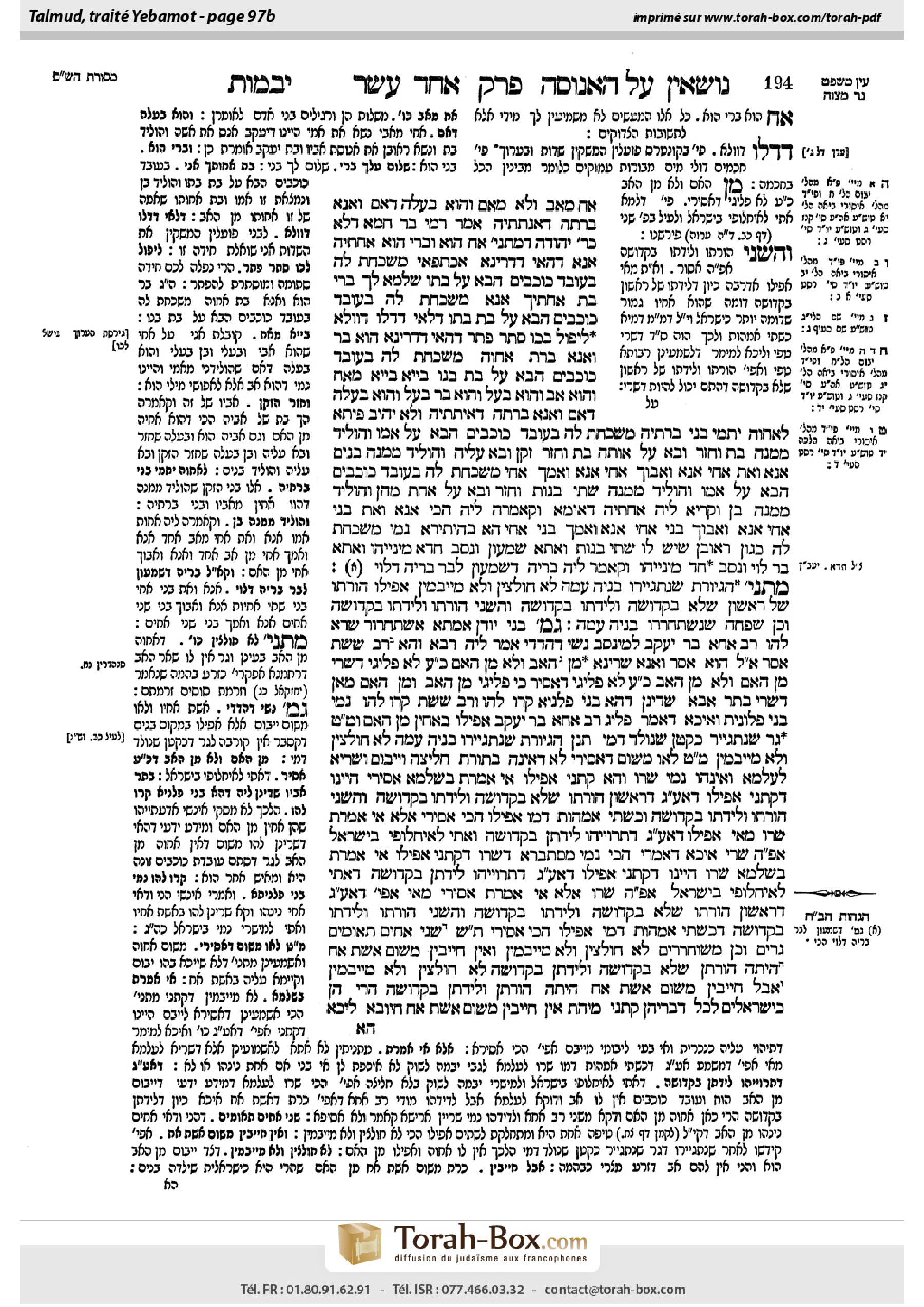
Yevamot 97b: Talmud study for Daf Yomi
Daf Yomi is the daily study of one Talmud folio. Explore 37 tractates with scans, Hebrew text, Sefaria English and AI-generated French translations where annotated.
Passage selection and English or AI-generated French translation are available where the scan has annotations. Daf Study is independent of Torah-Box and Sefaria.
Browse Yevamot · יבמות · All tractatesYevamot 97b text and translations
This page of Yevamot includes the Aramaic text, an English translation and an AI-generated French translation, alongside the scan above.
יבמות צ״ז ב · Aramaic and Hebrew text
״אַח מֵאַב וְלֹא מֵאֵם, וְהוּא בַּעֲלַהּ דְּאֵם, וַאֲנָא בְּרַתַּהּ דְּאִנְתְּתֵיהּ״. אָמַר רָמֵי בַּר חָמָא: דְּלָא כְּרַבִּי יְהוּדָה דְּמַתְנִיתִין.
״אָח הוּא, וּבְרִי הוּא, אֲחָתֵיהּ אֲנָא דְּהַאי דְּדָרֵינָא אַכַּתְפַּאי״ — מַשְׁכַּחַתְּ לַהּ בְּגוֹי הַבָּא עַל בִּתּוֹ.
״שְׁלָמָא לָךְ בְּרִי, בַּת אֲחָתִיךְ אֲנָא״ — מַשְׁכַּחַתְּ לַהּ בְּגוֹי הַבָּא עַל בַּת בִּתּוֹ.
״דַּלָּאֵי דְּדָלוּ דַּוְולָא, לִיפּוֹל בְּכוּ סְתַר פְּתַר: דְּהַאי דְּדָרֵינָא הוּא בַּר, וַאֲנָא בְּרַת אֲחוּהּ״ — מַשְׁכַּחַתְּ לַהּ בְּגוֹי הַבָּא עַל בַּת בְּנוֹ.
״בִּיָּיא בִּיָּיא מֵאַח, וְהוּא אַב, וְהוּא בְּעֵל, וְהוּא בַּר בְּעֵל, וְהוּא בַּעְלַהּ דְּאֵם, וַאֲנָא בְּרַתַּהּ דְּאִיתְּתֵיהּ, וְלָא יָהֵיב פִּיתָּא לַאֲחוּהּ יַתְמֵי בְּנֵי בְרַתֵּיה״ — מַשְׁכַּחַתְּ לַהּ בְּגוֹי הַבָּא עַל אִמּוֹ וְהוֹלִיד מִמֶּנָּה בַּת, וְחָזַר וּבָא עַל אוֹתָהּ בַּת, וְחָזַר זָקֵן וּבָא עָלֶיהָ וְהוֹלִיד מִמֶּנָּה בָּנִים.
״אֲנָא וְאַתְּ — אַחֵי, אֲנָא וַאֲבוּךְ — אַחֵי, אֲנָא וְאִמָּךְ — אַחֵי״ — מַשְׁכַּחַתְּ לַהּ בְּגוֹי הַבָּא עַל אִמּוֹ וְהוֹלִיד מִמֶּנָּה שְׁתֵּי בָנוֹת, וְחָזַר וּבָא עַל אַחַת מֵהֶן, וְהוֹלִיד מִמֶּנָּה בֵּן, וְקָרְיָא לֵיהּ אֲחָתֵיהּ דְּאִימָּא וְקָאָמְרָה לֵיהּ הָכִי.
״אֲנָא וְאַתְּ — בְּנֵי אַחֵי, אֲנָא וַאֲבוּךְ — בְּנֵי אַחֵי, אֲנָא וְאִמָּךְ — בְּנֵי אַחֵי״. הָא בְּהֶיתֵּירָא נָמֵי מַשְׁכַּחַתְּ לַהּ — כְּגוֹן רְאוּבֵן שֶׁיֵּשׁ לוֹ שְׁתֵּי בָנוֹת, וַאֲתָא שִׁמְעוֹן וּנְסַב חֲדָא מִינַּיְיהוּ, וַאֲתָא בַּר לֵוִי וּנְסַב חַד מִינַּיְיהוּ, וְקָאָמַר לֵיהּ בְּרֵיהּ דְּשִׁמְעוֹן לְבַר בְּרֵיהּ דְּלֵוִי.
מַתְנִי׳ הַגִּיּוֹרֶת שֶׁנִּתְגַּיְּירוּ בָּנֶיהָ עִמָּהּ לֹא — חוֹלְצִין וְלֹא מְיַיבְּמִין, אֲפִלּוּ הוֹרָתוֹ שֶׁל רִאשׁוֹן שֶׁלֹּא בִּקְדוּשָּׁה וְלֵידָתוֹ בִּקְדוּשָּׁה, וְהַשֵּׁנִי הוֹרָתוֹ וְלֵידָתוֹ בִּקְדוּשָּׁה. וְכֵן שִׁפְחָה שֶׁנִּשְׁתַּחְרְרוּ בָּנֶיהָ עִמָּהּ.
גְּמָ׳ בְּנֵי יוּדָן אַמְתָּא אִשְׁתַּחְרוּר, שְׁרָא לְהוּ רַב אַחָא בַּר יַעֲקֹב לְמִינְסַב נְשֵׁי דַּהֲדָדֵי. אֲמַר לֵיהּ רָבָא: וְהָא רַב שֵׁשֶׁת אָסַר! אֲמַר לֵיהּ: הוּא אָסַר וַאֲנָא שָׁרֵינָא.
מִן הָאָב וְלֹא מִן הָאֵם — כּוּלֵּי עָלְמָא לָא פְּלִיגִי דִּשְׁרֵי. מִן הָאֵם וְלֹא מִן הָאָב — כּוּלֵּי עָלְמָא לָא פְּלִיגִי דַּאֲסִיר.
כִּי פְּלִיגִי, מִן הָאָב וּמִן הָאֵם. מַאן דְּשָׁרֵי: בָּתַר אַבָּא שָׁדֵינַן, דְּהָא ״בְּנֵי פְלָנְיָא״ קָרוּ לְהוּ. וְרַב שֵׁשֶׁת: קָרוּ לְהוּ נָמֵי ״בְּנֵי פְלוֹנִית״.
וְאִיכָּא דְּאָמַר: פְּלִיג רַב אַחָא בַּר יַעֲקֹב אֲפִילּוּ בְּאַחִין מִן הָאֵם, וּמַאי טַעְמָא? גֵּר שֶׁנִּתְגַּיֵּיר כְּקָטָן שֶׁנּוֹלַד דָּמֵי.
תְּנַן: הַגִּיּוֹרֶת שֶׁנִּתְגַּיְּירוּ בָּנֶיהָ עִמָּהּ — לֹא חוֹלְצִין וְלֹא מְיַיבְּמִין. מַאי טַעְמָא, לָאו מִשּׁוּם דַּאֲסִירִי! לָא, דְּאֵינָהּ בְּתוֹרַת חֲלִיצָה וְיִיבּוּם, וְשַׁרְיָא לְעָלְמָא. וְאִינְהוּ נָמֵי שְׁרוּ.
וְהָא קָתָנֵי ״אֲפִילּוּ״, אִי אָמְרַתְּ בִּשְׁלָמָא אֲסִירִי, הַיְינוּ דְּקָתָנֵי ״אֲפִילּוּ״ — דְּאַף עַל גַּב דְּרִאשׁוֹן הוֹרָתוֹ שֶׁלֹּא בִּקְדוּשָּׁה וְלֵידָתוֹ בִּקְדוּשָּׁה, וְהַשֵּׁנִי הוֹרָתוֹ וְלֵידָתוֹ בִּקְדוּשָּׁה, וְכִשְׁתֵּי אִמָּהוֹת דָּמוּ, אֲפִילּוּ הָכִי — אֲסִירִי. אֶלָּא אִי אָמְרַתְּ שָׁרוּ, מַאי ״אֲפִילּוּ״?
דְּאַף עַל גַּב דְּתַרְוַיְיהוּ לֵידָתָן בִּקְדוּשָּׁה, וְאָתֵי לְאִיחַלּוֹפֵי בְּיִשְׂרָאֵל, אֲפִילּוּ הָכִי — שְׁרֵי.
אִיכָּא דְּאָמְרִי: הָכִי נָמֵי מִסְתַּבְּרָא דִּשְׁרוּ, דְּקָתָנֵי ״אֲפִילּוּ״. אִי אָמְרַתְּ בִּשְׁלָמָא שְׁרוּ — הַיְינוּ דְּקָתָנֵי ״אֲפִילּוּ״, דְּאַף עַל גַּב דְּתַרְוַיְיהוּ לֵידָתָן בִּקְדוּשָּׁה, דְּאָתֵי לְאִיחַלּוֹפֵי בְּיִשְׂרָאֵל — אֲפִילּוּ הָכִי שְׁרוּ. אֶלָּא אִי אָמְרַתְּ אֲסִירִי, מַאי ״אֲפִילּוּ״?
דְּאַף עַל גַּב דְּרִאשׁוֹן הוֹרָתוֹ שֶׁלֹּא בִּקְדוּשָּׁה וְלֵידָתוֹ בִּקְדוּשָּׁה, וְהַשֵּׁנִי הוֹרָתוֹ וְלֵידָתוֹ בִּקְדוּשָּׁה, דְּכִשְׁתֵּי אִמָּהוֹת דָּמֵי — אֲפִילּוּ הָכִי אֲסִירִי.
תָּא שְׁמַע: שְׁנֵי אַחִים תְּאוֹמִים גֵּרִים, וְכֵן מְשׁוּחְרָרִים — לֹא חוֹלְצִין וְלֹא מְיַיבְּמִין, וְאֵין חַיָּיבִין מִשּׁוּם אֵשֶׁת אָח. הָיְתָה הוֹרָתָן שֶׁלֹּא בִּקְדוּשָּׁה וְלֵידָתָן בִּקְדוּשָּׁה — לֹא חוֹלְצִין וְלֹא מְיַיבְּמִין, אֲבָל חַיָּיבִין מִשּׁוּם אֵשֶׁת אָח. הָיְתָה הוֹרָתָן וְלֵידָתָן בִּקְדוּשָּׁה — הֲרֵי הֵן כְּיִשְׂרְאֵלִים לְכׇל דִּבְרֵיהֶן. קָתָנֵי מִיהַת: אֵין חַיָּיבִין מִשּׁוּם אֵשֶׁת אָח, חִיּוּבָא לֵיכָּא —
Yevamot 97b · English translation
§ The opinion that a man may marry a woman raped or seduced by his father can lead to the existence of an unusual family relationship. A woman says: I have a half brother from my father and not from my mother, and my half brother is the husband of my mother, and I am the daughter of his wife. Rami bar Ḥama said: This state of affairs is not legitimate according to the opinion of Rabbi Yehuda in the mishna, who holds that a man may not marry a woman with whom his father engaged in intercourse, even if they were not married. However, according to the Rabbis, a woman whose father was not married to her mother can legitimately have a paternal half brother who is married to her mother.
The Gemara cites another riddle about a bizarre family relationship. A woman says: He is my brother and he is my son; I am the sister of this one, whom I carry on my shoulders. What is the solution? You find it in the case of a gentile who engaged in intercourse with his daughter, and she bore him a son, who is therefore both her brother and her son. The Gemara is referring to a gentile because it does not wish to entertain the idea that a Jew would act in such a manner.
The Gemara cites another riddle: Peace upon you, my son; I am the daughter of your sister. You find the solution in the case of a gentile who engaged in intercourse with the daughter of his daughter, who bore him a son. This son’s mother is related to him from her mother’s side as well, as she is his sister’s daughter.
The Gemara cites another riddle: Water drawers, who draw water in buckets to irrigate fields, let this cryptic riddle fall among you: This boy whom I carry is my son, and I am the daughter of his brother. You find the solution in the case of a gentile who engaged in intercourse with the daughter of his son, as their son is also her uncle.
The Gemara cites another riddle: Woe, woe [baya, baya] for my brother, who is my father, and who is my husband, and who is the son of my husband, and who is the husband of my mother, and I am the daughter of his wife; and he does not provide bread for his brothers, who are orphans, the sons of me, his daughter. You find the solution in the case of a gentile who engaged in intercourse with his mother, and she bore him a daughter. This daughter is both his sister and his daughter. And he engaged in intercourse with that daughter. And then the old man, his father, engaged in intercourse with her, and she bore him sons. This woman is therefore the wife of her father-brother, and he is also the son of her husband, the old man. Her father’s brothers, i.e., the sons she had with the old man, are his daughter’s sons.
The Gemara cites another riddle: You and I are siblings; your father and I are siblings; your mother and I are siblings. You find the solution in the case of a gentile who engaged in intercourse with his mother, and she bore him two daughters, and he then engaged in intercourse with one of them, and she bore him a son. And the sister of the son’s mother calls him and says this statement to him, as she is his sister from his father’s side and his father’s sister from their mother’s side, and she is his mother’s sister from both sides.
The Gemara cites another riddle: You and I are cousins; your father and I are cousins; your mother and I are cousins. You find the solution to this riddle in a permitted manner as well. For example, Reuven, who has two daughters, and his brother Shimon came and married one of them, and the son of Levi, the third brother, came and married the other one of them. And the son of Shimon says this statement to the grandson of Levi. They are cousins from their mothers’ sides, Shimon’s son and Levi’s son are cousins from their fathers’ sides, and Shimon’s son and the mother of Levi’s grandson are cousins from their fathers’ sides.
MISHNA: With regard to a female convert whose sons converted with her, they do not perform ḥalitza for each other’s wives, and they do not perform levirate marriage with them, as their conversions are considered rebirth, and they are considered unrelated. This is so even if the conception of the first son was not in the sanctity of Israel, i.e., the mother had not yet converted when she conceived of him, but his birth was in the sanctity of Israel, as his mother had converted by the time she gave birth to him, whereas the second son was both conceived and born in sanctity. The first son is considered a convert, who is unrelated to his brother. And this halakha similarly applies to a maidservant whose sons were freed with her, as they too are not considered relatives.
GEMARA: The sons of Yudan the maidservant were freed. Rav Aḥa bar Ya’akov allowed them to marry each other’s wives after divorce. Rava said to him: Didn’t Rav Sheshet prohibit marriage in that case? Rav Aḥa bar Ya’akov said to him: He prohibited it and I permit it. I disagree with his ruling.
The Gemara explains: If the two freed slaves or converts are half brothers from their father’s side and not from their mother’s side, everyone agrees that the marriage is permitted, as even a gentile and certainly a convert are considered unrelated to their father’s family. If they are half brothers from their mother and not from their father, everyone agrees that it is prohibited.
When they disagree, it is a case where they are brothers both from their father and from their mother. The one who permits the marriage claims that we trace them after their father. Their paternal lineage is followed, since they are called the sons of so-and-so, their father. Since they are recognized by their paternal lineage, it is well known that they are considered unrelated, and there is no concern that people will infer that a man may marry his sister-in-law. And Rav Sheshet maintains that they are also called the sons of so-and-so, their mother. Therefore, this concern does exist, as it is not common knowledge that a convert is considered reborn and unrelated to his mother’s family.
And some say a different version of this dispute: Rav Aḥa bar Ya’akov disagrees with Rav Sheshet, even with regard to maternal half brothers. And what is the reasoning behind this opinion? The legal status of a convert who just converted is like that of a child just born, and all his previous family relationships are disregarded, whether from his father’s side or from his mother’s side.
We learned in the mishna: With regard to a female convert whose sons converted with her, they do not perform ḥalitza with each other’s wives, and they do not perform levirate marriage with them. What is the reason that they may not perform levirate marriage? Is it not because they are prohibited from marrying them, contrary to Rav Aḥa bar Ya’akov’s opinion? The Gemara answers: No, the mishna means that these wives are not included in the law of ḥalitza and levirate marriage, as they are considered unrelated, and each wife is therefore permitted to marry anyone. And they, too, are permitted to marry her.
The Gemara asks: But doesn’t the mishna teach that this is so even if the mother converted while pregnant with the first son, and the second converted independently? Granted, if you say that they are prohibited from marrying each other’s wives, this explanation is consistent with that which is taught: Even so they are prohibited from marriage. Although the first son was not conceived in sanctity and only his birth was in sanctity, whereas the second was both conceived and born in sanctity, and therefore they are like the sons of two different mothers, even so they are prohibited from performing levirate marriage with their sisters-in-law. But if you say they are permitted to marry each other’s wives, what is the meaning of the word even?
The Gemara answers: The mishna means that although both of them were born in sanctity, and people might come to confuse them with Jews from birth, who may not marry their sisters-in-law, nevertheless they are permitted to marry each other’s wives.
There are those who say a different version of this inference: So too, it is reasonable that they are permitted to marry their sisters-in-law, as the mishna teaches: Even if the mother converted while pregnant. Granted, if you say that they are permitted, this explanation is consistent with that which is taught: Even so they are permitted. Although both of them were born in sanctity, and people might come to confuse them with Jews from birth, nevertheless, they are permitted. But if you say that they are prohibited, what is the meaning of the word even?
The Gemara answers: The mishna means that although the first son was not conceived in sanctity and only his birth was in sanctity, whereas the second was both conceived and born in sanctity, so that they are like the sons of two mothers, nevertheless, they are prohibited from marrying each other’s wives.
The Gemara cites another proof. Come and hear: Two twin brothers who are converts, and similarly twin brothers who are freed slaves, do not perform ḥalitza for each other’s wives, and they do not perform levirate marriage with them, and if they engage in intercourse with them they are not liable to receive karet for engaging in intercourse with a brother’s wife. If they were not conceived in sanctity and only their birth was in sanctity, they do not perform ḥalitza or levirate marriage, but they are liable for engaging in intercourse with a brother’s wife. If they were conceived and born in sanctity, they are like Jews from birth in all of their matters. In any event, the baraita is teaching that regular converts are not liable for engaging in intercourse with a brother’s wife. It can be inferred that while there is no liability by Torah law,
Yevamot 97b · Traduction française (IA)
§ L'opinion selon laquelle un homme peut épouser une femme violée ou séduite par son père peut conduire à l'existence d'une relation familiale inhabituelle. Une femme dit : J'ai un demi-frère de père et non de mère, et mon demi-frère est l'époux de ma mère, et je suis la fille de son épouse. Rami bar Ḥama a dit : Cet état de choses n'est pas légitime selon l'opinion de Rabbi Yehuda dans la Michna, qui soutient qu'un homme ne peut pas épouser une femme avec laquelle son père a eu des rapports, même s'ils n'étaient pas mariés. Cependant, selon les Sages, une femme dont le père n'était pas marié à sa mère peut légitimement avoir un demi-frère paternel qui est marié à sa mère.
La Guemara cite une autre énigme sur une relation familiale bizarre. Une femme dit : Il est mon frère et il est mon fils ; je suis la sœur de celui que je porte sur mes épaules. Quelle est la solution ? On la trouve dans le cas d'un non-Juif qui a eu des rapports avec sa fille, et elle lui a donné un fils, qui est donc à la fois son frère et son fils. La Guemara fait référence à un non-Juif parce qu'elle ne souhaite pas envisager l'idée qu'un Juif agirait de cette manière.
La Guemara cite une autre énigme : La paix sur toi, mon fils ; je suis la fille de ta sœur. On trouve la solution dans le cas d'un non-Juif qui a eu des rapports avec la fille de sa fille, et elle lui a donné un fils. La mère de ce fils est apparentée à lui par le côté maternel également, car elle est la fille de sa sœur.
La Guemara cite une autre énigme : « Vous, puisers d'eau qui puisez l'eau dans des seaux pour irriguer les champs, que cette énigme cryptique tombe parmi vous : Ce garçon que je porte est mon fils, et je suis la fille de son frère. » On trouve la solution dans le cas d'un non-Juif qui a eu des rapports avec la fille de son fils, car leur fils est aussi son oncle.
La Guemara cite une autre énigme : « Malheur, malheur [baya, baya] à mon frère, qui est mon père, et qui est mon époux, et qui est le fils de mon époux, et qui est l'époux de ma mère, et je suis la fille de son épouse ; et il ne fournit pas de pain à ses frères, qui sont orphelins, les fils de moi, sa fille. » On trouve la solution dans le cas d'un non-Juif qui a eu des rapports avec sa mère, et elle lui a donné une fille. Cette fille est à la fois sa sœur et sa fille. Et il a eu des rapports avec cette fille. Et puis le vieil homme, son père, a eu des rapports avec elle, et elle lui a donné des fils. Cette femme est donc l'épouse de son père-frère, et il est aussi le fils de son époux, le vieil homme. Les frères de son père, c'est-à-dire les fils qu'elle a eus avec le vieil homme, sont les fils de sa fille.
La Guemara cite une autre énigme : « Toi et moi sommes des frères et sœurs ; ton père et moi sommes des frères et sœurs ; ta mère et moi sommes des frères et sœurs. » On trouve la solution dans le cas d'un non-Juif qui a eu des rapports avec sa mère, et elle lui a donné deux filles, et il a ensuite eu des rapports avec l'une d'entre elles, et elle lui a donné un fils. Et la sœur de la mère du fils l'appelle et lui fait cette déclaration, car elle est sa sœur par le côté paternel et la sœur de son père par le côté maternel, et elle est la sœur de sa mère des deux côtés.
La Guemara cite une autre énigme : Toi et moi sommes cousins ; ton père et moi sommes cousins ; ta mère et moi sommes cousins. On trouve la solution à cette énigme d'une manière permise également. Par exemple, Reuven, qui a deux filles, et son frère Shimon est venu et a épousé l'une d'entre elles, et le fils de Levi, le troisième frère, est venu et a épousé l'autre. Et le fils de Shimon fait cette déclaration au petit-fils de Levi. Ils sont cousins par le côté maternel, le fils de Shimon et le fils de Levi sont cousins par le côté paternel, et le fils de Shimon et la mère du petit-fils de Levi sont cousins par le côté paternel.
MICHNA : En ce qui concerne une convertie dont les fils se sont convertis avec elle, ils ne pratiquent pas la ḥalitza pour les épouses de l'autre, et ils ne pratiquent pas le mariage lévirat avec elles, car leurs conversions sont considérées comme une renaissance, et ils sont considérés comme non apparentés. C'est ainsi même si la conception du premier fils n'a pas eu lieu dans la sainteté d'Israël, c'est-à-dire que la mère ne s'était pas encore convertie lorsqu'elle l'a conçu, mais sa naissance a eu lieu dans la sainteté d'Israël, car sa mère s'était convertie au moment où elle l'a mis au monde, tandis que le second fils a été conçu et né dans la sainteté. Le premier fils est considéré comme un converti, qui n'est pas apparenté à son frère. Et cette halakha s'applique de la même manière à une servante dont les fils ont été affranchis avec elle, car eux aussi ne sont pas considérés comme des parents.
GUEMARA : Les fils de Yudan la servante ont été affranchis. Rav Aḥa bar Ya’akov leur a permis d'épouser les épouses de l'autre après le divorce. Rava lui a dit : Rav Sheshet n'a-t-il pas interdit le mariage dans ce cas ? Rav Aḥa bar Ya’akov lui a dit : Il l'a interdit et je le permets. Je ne suis pas d'accord avec sa décision.
La Guemara explique : Si les deux esclaves affranchis ou convertis sont des demi-frères par le père et non par la mère, tout le monde est d'accord que le mariage est permis, car même un non-Juif, et à fortiori un converti, est considéré comme non apparenté à la famille de son père. S'ils sont des demi-frères par la mère et non par le père, tout le monde est d'accord que c'est interdit.
Lorsqu'ils sont en désaccord, il s'agit d'un cas où ils sont frères à la fois par le père et par la mère. Celui qui permet le mariage soutient que nous les rattachons à leur père. Leur lignée paternelle est suivie, car ils sont appelés les fils de tel, leur père. Puisqu'ils sont reconnus par leur lignée paternelle, il est bien connu qu'ils sont considérés comme non apparentés, et il n'y a pas de crainte que les gens en déduisent qu'un homme peut épouser sa belle-sœur. Et Rav Sheshet soutient qu'ils sont aussi appelés les fils de telle, leur mère. Par conséquent, cette crainte existe, car il n'est pas de notoriété publique qu'un converti est considéré comme né à nouveau et non apparenté à la famille de sa mère.
Et certains rapportent une autre version de ce débat : Rav Aḥa bar Ya’akov est en désaccord avec Rav Sheshet, même en ce qui concerne les demi-frères maternels. Et quel est le raisonnement à la base de cet avis ? Le statut juridique d’un converti qui vient de se convertir est comparable à celui d’un enfant qui vient de naître, et toutes ses relations familiales antérieures sont ignorées, qu’elles soient du côté du père ou du côté de la mère.
Nous avons appris dans la Michna : En ce qui concerne une femme convertie dont les fils se sont convertis avec elle, ils ne pratiquent pas la ḥalitza avec les épouses de l'autre, et ils ne contractent pas de mariage lévirat avec elles. Quelle est la raison pour laquelle ils ne peuvent pas contracter de mariage lévirat ? N'est-ce pas parce qu'ils sont interdits de se marier avec elles, contrairement à l'avis de Rav Aḥa bar Ya'akov ? La Guemara répond : Non, la Michna signifie que ces épouses ne sont pas incluses dans la loi de la ḥalitza et du mariage lévirat, car elles sont considérées comme sans lien de parenté, et chaque épouse est donc autorisée à se marier avec quiconque. Et eux aussi sont autorisés à se marier avec elle.
La Guemara demande : Mais la Michna n'enseigne-t-elle pas que c'est ainsi même si la mère s'est convertie alors qu'elle était enceinte du premier fils, et que le second s'est converti indépendamment ? Certes, si l'on dit qu'ils sont interdits de se marier avec les épouses de l'autre, cette explication est cohérente avec ce qui est enseigné : Même ainsi, ils sont interdits de mariage. Bien que le premier fils n'ait pas été conçu dans la sainteté et que seule sa naissance ait eu lieu dans la sainteté, tandis que le second a été conçu et né dans la sainteté, et qu'ils soient donc comme les fils de deux mères différentes, même ainsi, ils sont interdits de contracter un mariage lévirat avec leurs belles-sœurs. Mais si l'on dit qu'ils sont autorisés à se marier avec les épouses de l'autre, quel est le sens du mot « même » ?
La Guemara répond : La Michna signifie que bien que tous deux soient nés dans la sainteté, et que l'on puisse venir à les confondre avec des Juifs de naissance, qui ne peuvent pas se marier avec leurs belles-sœurs, néanmoins, ils sont autorisés à se marier avec les épouses de l'autre.
Certains rapportent une autre version de cette déduction : De même, il est raisonnable qu'ils soient autorisés à épouser leurs belles-sœurs, car la Michna enseigne : Même si la mère s'est convertie alors qu'elle était enceinte. Certes, si l'on dit qu'ils sont autorisés, cette explication est cohérente avec ce qui est enseigné : Même ainsi, ils sont autorisés. Bien que tous deux soient nés dans la sainteté, et que l'on puisse venir à les confondre avec des Juifs de naissance, néanmoins, ils sont autorisés. Mais si l'on dit qu'ils sont interdits, quel est le sens du mot « même » ?
La Guemara répond : La Michna signifie que bien que le premier fils n'ait pas été conçu dans la sainteté et que seule sa naissance ait eu lieu dans la sainteté, tandis que le second a été conçu et né dans la sainteté, de sorte qu'ils sont comme les fils de deux mères, néanmoins, ils sont interdits de se marier avec les épouses de l'autre.
La Guemara cite une autre preuve. Écoutez : Deux frères jumeaux qui sont des convertis, et de même des frères jumeaux qui sont des esclaves affranchis, ne pratiquent pas la ḥalitza pour les épouses de l'autre, et ils ne contractent pas de mariage lévirat avec elles, et s'ils ont des rapports avec elles, ils ne sont pas passibles de la peine de karet pour avoir eu des rapports avec l'épouse d'un frère. S'ils n'ont pas été conçus dans la sainteté et que seule leur naissance a eu lieu dans la sainteté, ils ne pratiquent ni la ḥalitza ni le mariage lévirat, mais ils sont passibles de la peine pour avoir eu des rapports avec l'épouse d'un frère. S'ils ont été conçus et nés dans la sainteté, ils sont comme des Juifs de naissance en toutes leurs affaires. En tout état de cause, la baraïta enseigne que les convertis ordinaires ne sont pas passibles de la peine pour avoir eu des rapports avec l'épouse d'un frère. On peut en déduire que s'il n'y a pas de responsabilité selon la loi de la Torah,
Traduction française générée par IA à partir de l’édition anglaise de Sefaria. Vérifie toujours un passage avec le texte source.
Text from Sefaria: William Davidson Edition - Vocalized Aramaic (CC BY NC); William Davidson Edition - English (CC BY NC).