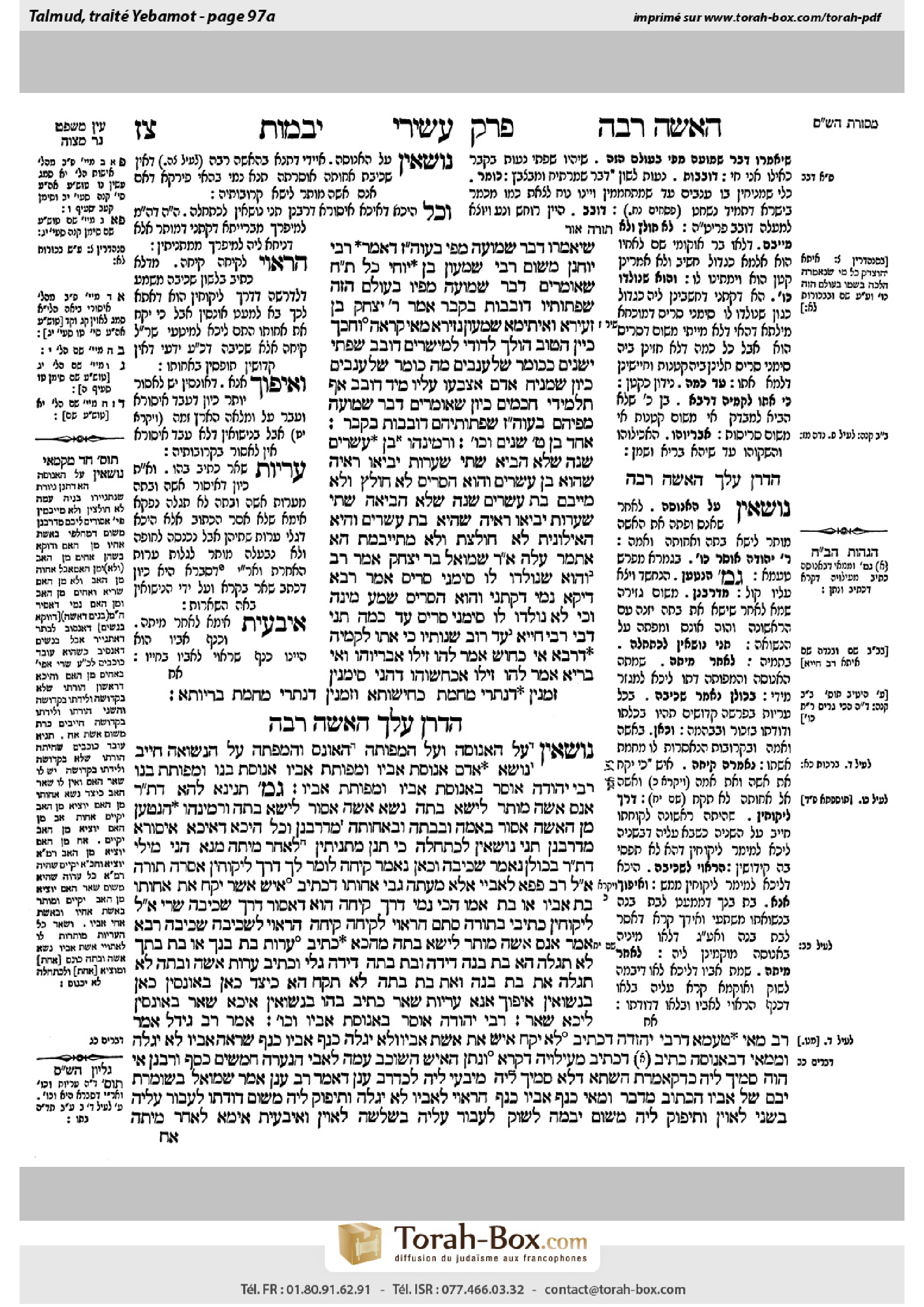
Yevamot 97a: Talmud study for Daf Yomi
Daf Yomi is the daily study of one Talmud folio. Explore 37 tractates with scans, Hebrew text, Sefaria English and AI-generated French translations where annotated.
Passage selection and English or AI-generated French translation are available where the scan has annotations. Daf Study is independent of Torah-Box and Sefaria.
Browse Yevamot · יבמות · All tractatesYevamot 97a text and translations
This page of Yevamot includes the Aramaic text, an English translation and an AI-generated French translation, alongside the scan above.
יבמות צ״ז א · Aramaic and Hebrew text
שֶׁיֹּאמְרוּ דְּבַר שְׁמוּעָה מִפִּי בָּעוֹלָם הַזֶּה. דְּאָמַר רַבִּי יוֹחָנָן מִשּׁוּם רַבִּי שִׁמְעוֹן בֶּן יוֹחַי: כׇּל תַּלְמִיד חָכָם שֶׁאוֹמְרִים דְּבַר שְׁמוּעָה מִפִּיו בָּעוֹלָם הַזֶּה, שִׂפְתוֹתָיו דּוֹבְבוֹת בַּקֶּבֶר. אָמַר רַבִּי יִצְחָק בֶּן זְעֵירָא, וְאִיתֵּימָא שִׁמְעוֹן נְזִירָא: מַאי קְרָאָה — ״וְחִכֵּךְ כְּיֵין הַטּוֹב הוֹלֵךְ לְדוֹדִי לְמֵישָׁרִים דּוֹבֵב שִׂפְתֵי יְשֵׁנִים״.
כְּכוֹמֶר שֶׁל עֲנָבִים: מָה כּוֹמֶר שֶׁל עֲנָבִים, כֵּיוָן שֶׁמַּנִּיחַ אָדָם אֶצְבָּעוֹ עָלָיו — מִיָּד דּוֹבֵב; אַף תַּלְמִידֵי חֲכָמִים, כֵּיוָן שֶׁאוֹמְרִים דְּבַר שְׁמוּעָה מִפִּיהֶם בָּעוֹלָם הַזֶּה — שִׂפְתוֹתֵיהֶם דּוֹבְבוֹת בַּקֶּבֶר.
אֶחָד בֶּן תֵּשַׁע שָׁנִים וְכוּ׳. וּרְמִינְהוּ: בֶּן עֶשְׂרִים שָׁנָה שֶׁלֹּא הֵבִיא שְׁתֵּי שְׂעָרוֹת — יָבִיאוּ רְאָיָה שֶׁהוּא בֶּן עֶשְׂרִים, וְהוּא הַסָּרִיס — לֹא חוֹלֵץ וְלֹא מְיַיבֵּם.
בַּת עֶשְׂרִים שָׁנָה שֶׁלֹּא הֵבִיאָה שְׁתֵּי שְׂעָרוֹת — יָבִיאוּ רְאָיָה שֶׁהִיא בַּת עֶשְׂרִים, וְהִיא הָאַיְלוֹנִית — לֹא חוֹלֶצֶת וְלֹא מִתְיַיבֶּמֶת.
הָא אִתְּמַר עֲלַהּ, אָמַר רַב שְׁמוּאֵל בַּר יִצְחָק אָמַר רַב: וְהוּא שֶׁנּוֹלְדוּ לוֹ סִימָנֵי סָרִיס. אָמַר רָבָא: דַּיְקָא נָמֵי, דְּקָתָנֵי: וְהוּא הַסָּרִיס. שְׁמַע מִינַּהּ.
וְכִי לֹא נוֹלְדוּ לוֹ סִימָנֵי סָרִיס, עַד כַּמָּה? תָּנֵי דְּבֵי רַבִּי חִיָּיא: עַד רוֹב שְׁנוֹתָיו.
כִּי אֲתוֹ לְקַמֵּיהּ דְּרָבָא, אִי כָּחוּשׁ אֲמַר לְהוּ: זִילוּ אַבְרְיוּהּ. וְאִי בָּרִיא אֲמַר לְהוּ: זִילוּ אַכְחֲשׁוּהּ. דְּהָנֵי סִימָנִין, זִמְנִין דְּנָתְרִי מֵחֲמַת כְּחִישׁוּתָא, וְזִמְנִין דְּנָתְרִי מֵחֲמַת בְּרִיּוּתָא.
הֲדַרַן עֲלָךְ הָאִשָּׁה רַבָּה
נוֹשְׂאִין עַל הָאֲנוּסָה וְעַל הַמְפוּתָּה, הָאוֹנֵס וְהַמְפַתֶּה עַל הַנְּשׂוּאָה — חַיָּיב. נוֹשֵׂא אָדָם אֲנוּסַת אָבִיו וּמְפוּתַּת אָבִיו, אֲנוּסַת בְּנוֹ וּמְפוּתַּת בְּנוֹ. רַבִּי יְהוּדָה אוֹסֵר בַּאֲנוּסַת אָבִיו וּמְפוּתַּת אָבִיו.
גְּמָ׳ תְּנֵינָא לְהָא דְּתָנוּ רַבָּנַן: אָנַס אִשָּׁה — מוּתָּר לִישָּׂא בִּתָּהּ, נָשָׂא אִשָּׁה — אָסוּר לִישָּׂא בִּתָּהּ. וּרְמִינְהוּ: הַנִּטְעָן מִן הָאִשָּׁה — אָסוּר בְּאִמָּהּ וּבְבִתָּהּ וּבַאֲחוֹתָהּ! מִדְּרַבָּנַן.
וְכֹל הֵיכָא דְּאִיכָּא אִיסּוּרָא מִדְּרַבָּנַן תָּנֵי נוֹשְׂאִין לְכַתְּחִלָּה?! כִּי תְּנַן מַתְנִיתִין — לְאַחַר מִיתָה.
מְנָא הָנֵי מִילֵּי? דְּתָנוּ רַבָּנַן: בְּכוּלָּן נֶאֱמַר שְׁכִיבָה, וְכָאן נֶאֱמַר קִיחָה, לוֹמַר לְךָ: דֶּרֶךְ לִיקּוּחִין אָסְרָה תּוֹרָה.
אֲמַר לֵיהּ רַב פָּפָּא לְאַבָּיֵי: אֶלָּא מֵעַתָּה, גַּבֵּי אֲחוֹתוֹ דִּכְתִיב: ״אִישׁ אֲשֶׁר יִקַּח אֶת אֲחוֹתוֹ בַּת אָבִיו אוֹ בַת אִמּוֹ״, הָכִי נָמֵי דֶּרֶךְ קִיחָה הוּא דַּאֲסִיר, דֶּרֶךְ שְׁכִיבָה שְׁרֵי?!
אֲמַר לֵיהּ: לִיקּוּחִין כְּתִיבִי בַּתּוֹרָה סְתָם. הָרָאוּי לְקִיחָה — קִיחָה, הָרָאוּי לִשְׁכִיבָה — שְׁכִיבָה.
רָבָא אָמַר: אָנַס אִשָּׁה — מוּתָּר לִישָּׂא בִּתָּהּ מֵהָכָא, כְּתִיב: ״עֶרְוַת בַּת בִּנְךָ אוֹ בַת בִּתְּךָ לֹא תְגַלֶּה״, הָא בַּת בְּנָהּ דִּידַהּ, וּבַת בִּתָּהּ דִּידַהּ — גַּלִּי,
וּכְתִיב: ״עֶרְוַת אִשָּׁה וּבִתָּהּ לֹא תְגַלֵּה אֶת בַּת בְּנָהּ וְאֶת בַּת בִּתָּהּ לֹא תִקַּח״, הָא כֵּיצַד? כָּאן בָּאוֹנָסִין, כָּאן בְּנִשּׂוּאִין.
אֵיפוֹךְ אֲנָא? עֲרָיוֹת ״שְׁאֵר״ כְּתִיב בְּהוּ. בְּנִשּׂוּאִין אִיכָּא שְׁאֵר, בָּאוֹנָסִין לֵיכָּא שְׁאֵר.
רַבִּי יְהוּדָה אוֹסֵר בַּאֲנוּסַת אָבִיו וְכוּ׳. אָמַר רַב גִּידֵּל אָמַר רַב: מַאי טַעְמָא דְּרַבִּי יְהוּדָה, דִּכְתִיב: ״לֹא יִקַּח אִישׁ אֶת אֵשֶׁת אָבִיו וְלֹא יְגַלֶּה כְּנַף אָבִיו״, כָּנָף שֶׁרָאָה אָבִיו לֹא יְגַלֶּה.
וּמִמַּאי דְּבַאֲנוּסָה כְּתִיב — דִּכְתִיב מֵעִילָּוֵיהּ דִּקְרָא: ״וְנָתַן הָאִישׁ הַשּׁוֹכֵב עִמָּהּ לַאֲבִי הַנַּעֲרָה חֲמִשִּׁים כָּסֶף״.
וְרַבָּנַן: אִי הֲוָה סְמִיךְ לֵיהּ — כִּדְקָאָמְרַתְּ. הַשְׁתָּא דְּלָא סְמִיךְ לֵיהּ, מִיבְּעֵי לֵיהּ לְכִדְרַב עָנָן. דְּאָמַר רַב עָנָן אָמַר שְׁמוּאֵל: בְּשׁוֹמֶרֶת יָבָם שֶׁל אָבִיו הַכָּתוּב מְדַבֵּר. וּמַאי ״כְּנַף אָבִיו״ — כָּנָף הָרָאוּי לְאָבִיו לֹא יְגַלֶּה.
וְתִיפּוֹק לֵיהּ מִשּׁוּם דּוֹדָתוֹ! לַעֲבוֹר עָלֶיהָ בִּשְׁנֵי לָאוִין.
וְתִיפּוֹק לֵיהּ מִשּׁוּם יְבָמָה לַשּׁוּק! לַעֲבוֹר עָלֶיהָ בִּשְׁלֹשָׁה לָאוִין. וְאִיבָּעֵית אֵימָא: לְאַחַר מִיתָה.
Yevamot 97a · English translation
that they will say a matter of halakha in my name in this world when I have passed on to another world. As Rabbi Yoḥanan said in the name of Rabbi Shimon ben Yoḥai: With regard to any Torah scholar in whose name a matter of halakha is said in this world, his lips mouth the words in the grave, as though he is talking. Rabbi Yitzḥak ben Ze’eira said, and some say this was stated by Shimon the Nazirite: What is the verse from which it is derived? “And the roof of your mouth is like the best wine that glides down smoothly for my beloved, moving gently the lips of those who are asleep” (Song of Songs 7:10).
He explains: This is like a pile [komer] of grapes left to warm before they are pressed: Just as in the case of a pile of grapes, when a person places his finger on it, immediately it moves, as the wine bursts through and the whole pile shakes, so too with Torah scholars: When a teaching is said in their name in this world their lips mouth the words in the grave. For this reason Rabbi Yoḥanan wanted his Torah statements to be attributed to him, so that he would earn eternal life.
§ The Gemara addresses the statement of the mishna that this is the halakha both for a boy who is nine years and one day old as well as a twenty-year old who has not developed two pubic hairs. In both cases, their sexual relations are not considered proper intercourse with regard to levirate marriage. And the Gemara raises a contradiction against this from the following source: With regard to a man twenty years old who has not developed two pubic hairs, they must bring proof that he is twenty years old, and he is established as a eunuch, who may neither perform ḥalitza nor perform levirate marriage.
Likewise, in the case of a woman who is twenty years old and has not developed two pubic hairs, they must bring proof that she is twenty years old, and that she is a sexually underdeveloped woman, who may neither perform ḥalitza nor enter into levirate marriage. This shows that the status of a nine-year-old male and a twenty-year old man without pubic hairs are not the same, as the intercourse of a nine-year-old is considered of some significance, whereas that of a eunuch is entirely disregarded, as he may not even perform ḥalitza.
The Gemara answers: Wasn’t it stated with regard to this baraita that Rav Shmuel bar Yitzḥak said that Rav said: And this halakha applies only if he developed other signs of a eunuch by the age of twenty. The mishna, by contrast, is referring to one who merely showed the signs of maturity at a late age. Rava said: The language of the baraita is also precise, as it teaches: And he is the eunuch. One can learn from here that this is referring to one who is definitely a eunuch.
The Gemara asks a question with regard to the halakha itself: And in a case where he does not develop the signs of a eunuch, until what age is he considered a minor? The school of Rabbi Ḥiyya taught: Until most of his years have passed, i.e., until he reaches the age of thirty-five, i.e., halfway to seventy, the standard length of a man’s life.
On the same issue, the Gemara relates: When they would come before Rava to inquire about someone who had reached the age of maturity but had not yet developed the physical signs, if the person in question was thin, he would say to them: Go and fatten him up before we decide on his status. And if he was fat, he would say to them: Go and make him thin. As these signs, the pubic hairs of maturity, sometimes they fall off due to thinness and sometimes they fall off due to fatness. It is therefore possible that after his bodily shape is adjusted he will develop the signs of maturity and will not have the status of a eunuch.
MISHNA: One may marry a relative, e.g., the sister or the mother, of the woman he raped and of the woman he seduced. However, one who rapes and one who seduces a relative of the woman who is married to him is liable to receive capital punishment or karet for engaging in prohibited sexual intercourse, depending on the particular family relationship. A man may marry a woman raped by his father, or a woman seduced by his father, or a woman raped by his son, or a woman seduced by his son. Rabbi Yehuda prohibits marriage in the case of a woman raped by his father or a woman seduced by his father.
GEMARA: We learned in the mishna that which the Sages teach in a baraita: If a man raped a woman, he is permitted to marry her daughter. If he married a woman, it is prohibited for him to marry her daughter. However, the Gemara raises a contradiction from another baraita: One who is alleged to have engaged in intercourse with a particular woman is prohibited from marriage with her mother, and with her daughter, and with her sister. Apparently, as a consequence of non-marital intercourse, there is a prohibition against the man marrying the woman’s relatives. The Gemara answers: This is merely prohibited by rabbinic decree, lest the man continue to engage in intercourse with this particular woman after marrying one of her relatives, thereby transgressing a Torah prohibition.
The Gemara asks: And anywhere that there is a rabbinic prohibition, does the mishna teach that one may marry the woman ab initio? Since the marriage is prohibited by rabbinic decree, the mishna should have taught that if he marries her, he is exempt from punishment. The Gemara answers: When we learned in the mishna that he may marry her ab initio, it was dealing with their marriage after the death of the woman that he raped or seduced. The rabbinic prohibition does not relate to this case, as concern with regard to forbidden relatives is not relevant there.
The Gemara asks: With regard to the mishna’s ruling, from where are these matters derived? It is as the Sages taught: With regard to all other prohibited sexual relations, lying is stated, whereas here, with regard to a man’s intercourse with his wife’s relatives, taking is stated. This is to tell you that the Torah prohibited intercourse with these relatives only through taking, i.e., the man’s acquisition of his wife through marriage. It did not prohibit intercourse with the relative of a woman with whom he engaged in nonmarital relations.
Rav Pappa said to Abaye: However, if that interpretation is so, then with regard to intercourse with one’s sister, concerning whom it is written: “And if a man takes his sister, his father’s daughter, or his mother’s daughter” (Leviticus 20:17), you must also say that is it is only intercourse through taking, i.e., marriage, that is prohibited. But intercourse through lying, i.e., without marriage, is permitted. How can this be?
Abaye said to Rav Pappa: When the term taking is stated in the Torah without specification, it is interpreted in accordance with the context. With regard to the context of a relationship that has potential for taking through marriage, this verb is interpreted as taking through marriage. In the context of a relationship that has potential only for lying, as their marriage would be invalid, taking the woman is understood to mean lying with her.
Rava said: The halakha that if a man raped a woman it is permitted for him to marry her daughter is derived from here. It is stated: “The nakedness of your son’s daughter, or of your daughter’s daughter, even their nakedness…you may not uncover” (Leviticus 18:10). It may be inferred from here that the daughter of the woman’s own son from a different relationship, and the daughter of her own daughter, may be uncovered, i.e., intercourse with them is not prohibited.
And it is also written: “You may not uncover the nakedness of a woman and her daughter; you may not take her son’s daughter, or her daughter’s daughter, to uncover her nakedness; they are near kinswomen, it is lewdness” (Leviticus 18:17). How so? How can the two verses be reconciled? Evidently, the former verse is stated with regard to rape. A man may marry the daughter or granddaughter of the woman he raped, provided they are not his own offspring. The latter verse is stated with regard to marriage. Marrying the relatives of one’s wife is prohibited.
The Gemara asks: Perhaps I should reverse the resolution of the contradiction between the verses and state that the daughter or granddaughter of his rape victim is forbidden, whereas the relatives of his wife are permitted. The Gemara answers: With regard to those with whom intercourse is forbidden, the concept of kinship is stated (see Leviticus 18:13, 17). In marriage there is kinship, whereas in the case of rape there is no kinship. Therefore, the prohibition against intercourse with a woman and her daughter or granddaughter is clearly referring to the daughter and granddaughter of one’s wife and not of the woman he raped.
§ It is taught in the mishna that Rabbi Yehuda prohibits marrying a woman raped by his father or a woman seduced by his father. Rav Giddel said that Rav said: What is the reasoning for the ruling of Rabbi Yehuda? It is as it is written: “A man may not take his father’s wife, and may not uncover his father’s skirt” (Deuteronomy 23:1), meaning that one may not uncover the skirt that his father has seen.
And from where is it apparent that this verse is written with regard to a woman raped by his father and not with regard to his father’s wife? It is as it is written just before that verse, with regard to rape: “And the man who lay with her shall give the young woman’s father fifty shekels of silver” (Deuteronomy 22:29).
And how do the Rabbis, who disagree with Rabbi Yehuda, respond to this proof? If the prohibition stated had been juxtaposed with the verse dealing with rape, it would be as you said. However, now that it is not juxtaposed with it, as there is another prohibition in between, namely “a man may not take his father’s wife” (Deuteronomy 23:1), the prohibition of “he may not uncover his father’s skirt” is necessary to teach that which Rav Anan taught, as Rav Anan said that Shmuel said: The verse is speaking of a widow waiting for her brother-in-law, who is this man’s father, to perform levirate marriage. And what is the meaning of the phrase “his father’s skirt”? The skirt that is potentially his father’s, he may not uncover.
The Gemara questions this interpretation: Why does the Torah need to explicitly prohibit intercourse with the yevama of one’s father? Derive that intercourse is prohibited due to the fact that she is his aunt, as she is his father’s brother’s widow. The Gemara answers: The Torah purposely rendered this act a more serious offense. By specifying that it is prohibited for one to engage in sexual relations with his father’s yevama, one who engaged in intercourse with her has violated two prohibitions. The Torah specifically prohibited his father’s yevama in order to have one who engages in relations with her violate two prohibitions, the prohibition proscribing relations with his aunt and the prohibition proscribing relations with his father’s yevama, thereby rendering it a more serious offense.
The Gemara asks: But why not derive that one violates two prohibitions because there is also a prohibition against a yevama engaging in intercourse with a member of the public, i.e., someone other than her yavam. The Gemara answers: The Torah prohibited one’s father’s yevama so that one who engaged in intercourse with her will have violated three prohibitions: Intercourse with one’s aunt, with one’s yevama, and with one’s father’s yevama. And if you wish, say instead that the verse that prohibits his father’s yevama is referring to the period after the death of his father, who has no additional brothers, so there is no prohibition against the yevama engaging in intercourse with a member of the public.
Yevamot 97a · Traduction française (IA)
afin qu'ils ne disent pas une question de halakha en mon nom dans ce monde alors que je suis passé dans l'autre monde. Comme Rabbi Yoḥanan a dit au nom de Rabbi Shimon ben Yoḥai : Concernant tout érudit de la Torah en dont le nom une question de halakha est énoncée dans ce monde, ses lèvres articulent les mots dans la tombe, comme s'il parlait. Rabbi Yitzḥak ben Ze'eira a dit, et certains disent que cela a été énoncé par Shimon le Nazarite : De quel verset cela est-il dérivé ? « Et le toit de ta bouche est comme le meilleur vin qui glisse doucement pour mon bien-aimé, faisant mouvoir doucement les lèvres de ceux qui dorment » (Cantique des Cantiques 7:10).
Il explique : C'est comme un tas [komer] de raisins laissé à réchauffer avant d'être pressé : Tout comme dans le cas d'un tas de raisins, lorsqu'une personne y pose son doigt, il se met immédiatement en mouvement, car le vin perce et tout le tas tremble, de même pour les érudits de la Torah : Lorsqu'un enseignement est énoncé en leur nom dans ce monde, leurs lèvres articulent les mots dans la tombe. C'est pour cette raison que Rabbi Yoḥanan voulait que ses déclarations de la Torah lui soient attribuées, afin qu'il gagne la vie éternelle.
§ La Guemara aborde l'énoncé de la Michna selon lequel c'est la halakha tant pour un garçon de neuf ans et un jour que pour un homme de vingt ans qui n'a pas développé deux poils pubiens. Dans les deux cas, leurs relations sexuelles ne sont pas considérées comme un rapport légitime au regard du levirat mariage. Et la Guemara soulève une contradiction à ce sujet à partir de la source suivante : Concernant un homme de vingt ans qui n'a pas développé deux poils pubiens, ils doivent apporter la preuve qu'il a vingt ans, et il est établi comme un eunuque, qui ne peut ni effectuer la ḥalitza ni contracter un levirat mariage.
De même, dans le cas d'une femme de vingt ans qui n'a pas développé deux poils pubiens, ils doivent apporter la preuve qu'elle a vingt ans et qu'elle est une femme sexuellement sous-développée, qui ne peut ni effectuer la ḥalitza ni entrer dans le mariage lévirat. Cela montre que le statut d'un garçon de neuf ans et celui d'un homme de vingt ans sans poils pubiens ne sont pas les mêmes, car le rapport d'un enfant de neuf ans est considéré comme ayant une certaine signification, tandis que celui d'un eunuque est entièrement négligé, car il ne peut même pas effectuer la ḥalitza.
La Guemara répond : N'a-t-il pas été dit à propos de cette baraïta que Rav Shmuel bar Yitzḥak a dit que Rav a dit : Et cette halakha n'est applicable que s'il a développé d'autres signes d'eunuque à l'âge de vingt ans. La Michna, en revanche, fait référence à celui qui a simplement montré les signes de maturité à un âge tardif. Rava a dit : Le langage de la baraïta est également précis, car elle enseigne : Et il est l'eunuque. On peut en déduire ici que cela fait référence à celui qui est définitivement un eunuque.
La Guemara pose une question concernant la halakha elle-même : Et dans un cas où il ne développe pas les signes d'eunuque, jusqu'à quel âge est-il considéré comme mineur ? L'école de Rabbi Ḥiyya a enseigné : Jusqu'à ce que la majorité de ses années soit passée, c'est-à-dire jusqu'à ce qu'il atteigne l'âge de trente-cinq ans, c'est-à-dire la moitié de soixante-dix, la durée standard de la vie d'un homme.
Sur la même question, la Guemara rapporte : Lorsqu'ils venaient consulter Rava au sujet d'une personne qui avait atteint l'âge de la maturité mais n'avait pas encore développé les signes physiques, si la personne en question était maigre, il leur disait : Allez, engraissez-le avant que nous ne statutions sur son cas. Et s'il était gras, il leur disait : Allez, faites-le maigrir. Car ces signes, les poils pubiens de la maturité, tombent parfois à cause de la maigreur et parfois à cause de l'obésité. Il est donc possible qu'après que sa constitution corporelle se soit normalisée, il développe les signes de la maturité et n'ait pas le statut d'eunuque.
MICHNA : On peut épouser une parente, par exemple la sœur ou la mère, de la femme qu'on a violée et de la femme qu'on a séduite. Cependant, celui qui viole ou séduit une parente de la femme avec laquelle il est marié est passible de la peine de mort ou de la karet pour avoir eu des relations sexuelles interdites, selon la parenté particulière. Un homme peut épouser une femme violée par son père, ou une femme séduite par son père, ou une femme violée par son fils, ou une femme séduite par son fils. Rabbi Yehuda interdit le mariage dans le cas d'une femme violée par son père ou d'une femme séduite par son père.
GUEMARA : Nous avons appris dans la Michna ce que les Sages enseignent dans une baraïta : Si un homme a violé une femme, il lui est permis d'épouser sa fille. S'il a épousé une femme, il lui est interdit d'épouser sa fille. Cependant, la Guemara soulève une contradiction à partir d'une autre baraïta : Celui qui est présumé avoir eu des rapports avec une femme particulière est interdit de mariage avec sa mère, avec sa fille et avec sa sœur. Apparemment, en conséquence de rapports non matrimoniaux, il y a une interdiction pour l'homme d'épouser les parentes de la femme. La Guemara répond : C'est simplement interdit par décret rabbinique, de peur que l'homme ne continue d'entretenir des rapports avec cette femme particulière après avoir épousé l'une de ses parentes, transgressant ainsi une interdiction de la Torah.
La Guemara demande : Et partout où il y a une interdiction rabbinique, la Michna enseigne-t-elle qu'on peut épouser la femme ab initio ? Puisque le mariage est interdit par décret rabbinique, la Michna aurait dû enseigner que s'il l'épouse, il est exempt de punition. La Guemara répond : Lorsque nous avons appris dans la Michna qu'il peut l'épouser ab initio, il s'agissait de leur mariage après la mort de la femme qu'il a violée ou séduite. L'interdiction rabbinique ne se rapporte pas à ce cas, car la préoccupation concernant les parentes interdites n'est pas pertinente là.
La Guemara demande : Concernant le jugement de la Michna, d'où ces règles sont-elles dérivées ? C'est comme l'ont enseigné les Sages : Concernant toutes les autres relations sexuelles interdites, le terme « coucher » est utilisé, alors qu'ici, concernant les relations d'un homme avec les parentes de sa femme, le terme « prendre » est utilisé. Cela vous indique que la Torah a interdit les relations avec ces parentes uniquement par le biais de la « prise », c'est-à-dire l'acquisition de la femme par l'homme par le mariage. Elle n'a pas interdit les relations avec la parente d'une femme avec laquelle il a eu des relations extraconjugales.
Rav Pappa dit à Abaye : Cependant, si cette interprétation est correcte, alors en ce qui concerne les relations avec sa sœur, au sujet de laquelle il est écrit : « Et si un homme prend sa sœur, fille de son père ou de sa mère » (Lévitique 20:17), vous devez également dire que seules les relations par « prise », c'est-à-dire par le mariage, sont interdites. Mais les relations par « coucher », c'est-à-dire sans mariage, sont permises. Comment cela est-il possible ?
Abaye dit à Rav Pappa : Lorsque le terme « prendre » est énoncé dans la Torah sans spécification, il est interprété conformément au contexte. Dans le contexte d'une relation qui a le potentiel d'une « prise » par le mariage, ce verbe est interprété comme une « prise » par le mariage. Dans le contexte d'une relation qui n'a le potentiel que de « coucher », car leur mariage serait invalide, « prendre » la femme est compris comme signifier « coucher » avec elle.
Rava a dit : La halakha selon laquelle si un homme a violé une femme, il lui est permis d'épouser sa fille est dérivée d'ici. Il est écrit : « La nudité de la fille de ton fils, ou de la fille de ta fille, même leur nudité… tu ne la révéleras pas » (Lévitique 18:10). On peut en déduire d'ici que la fille du propre fils de la femme issu d'une autre relation, et la fille de sa propre fille, peuvent être révélées, c'est-à-dire que les relations avec elles ne sont pas interdites.
Il est également écrit : « Tu ne révéleras pas la nudité d'une femme et de sa fille ; tu ne prendras pas la fille de son fils, ou la fille de sa fille, pour révéler sa nudité ; ce sont des parentes proches, c'est une impureté » (Lévitique 18:17). Comment cela ? Comment les deux versets peuvent-ils être réconciliés ? Évidemment, le premier verset est énoncé concernant le viol. Un homme peut épouser la fille ou la petite-fille de la femme qu'il a violée, à condition qu'elles ne soient pas sa propre descendance. Le second verset est énoncé concernant le mariage. Épouser les parentes de sa femme est interdit.
La Guemara demande : Peut-être devrais-je inverser la résolution de la contradiction entre les versets et dire que la fille ou la petite-fille de sa victime de viol est interdite, tandis que les parentes de sa femme sont permises. La Guemara répond : Concernant celles avec qui les relations sont interdites, le concept de parenté est énoncé (voir Lévitique 18:13, 17). Dans le mariage, il y a parenté, tandis que dans le cas du viol, il n'y a pas de parenté. Par conséquent, l'interdiction des relations avec une femme et sa fille ou sa petite-fille fait clairement référence à la fille et à la petite-fille de sa femme et non à la femme qu'il a violée.
§ Il est enseigné dans la Michna que Rabbi Yehouda interdit d'épouser une femme violée par son père ou une femme séduite par son père. Rav Giddel a dit que Rav a dit : Quel est le raisonnement du jugement de Rabbi Yehouda ? C'est comme il est écrit : « Un homme ne prendra pas la femme de son père, et ne révélera pas la jupe de son père » (Deutéronome 23:1), ce qui signifie qu'on ne peut pas révéler la jupe que son père a vue.
Et d'où est-il apparent que ce verset est écrit au sujet d'une femme violée par son père et non au sujet de la femme de son père ? C'est comme il est écrit juste avant ce verset, au sujet du viol : « Et l'homme qui a couché avec elle donnera au père de la jeune femme cinquante shekels d'argent » (Deutéronome 22:29).
Et comment les Rabbanim, qui ne sont pas d'accord avec Rabbi Yehouda, répondent-ils à cette preuve ? Si l'interdiction énoncée avait été juxtaposée au verset traitant du viol, ce serait comme vous l'avez dit. Cependant, maintenant qu'elle n'est pas juxtaposée à celui-ci, car il y a une autre interdiction entre les deux, à savoir « un homme ne prendra pas la femme de son père » (Deutéronome 23:1), l'interdiction de « ne pas révéler la jupe de son père » est nécessaire pour enseigner ce que Rav Anan a enseigné, car Rav Anan a dit que Chmouel a dit : Le verset parle d'une veuve attendant que son beau-frère, qui est le père de cet homme, accomplisse le mariage de levirat. Et quelle est la signification de la phrase « la jupe de son père » ? La jupe qui est potentiellement celle de son père, il ne peut pas la révéler.
La Guemara met en question cette interprétation : Pourquoi la Torah a-t-elle besoin d'interdire explicitement les relations avec la yevama de son père ? Déduisez que les relations sont interdites en raison du fait qu'elle est sa tante, car elle est la veuve du frère de son père. La Guemara répond : La Torah a délibérément rendu cet acte une offense plus grave. En spécifiant qu'il est interdit d'avoir des relations sexuelles avec la yevama de son père, celui qui a eu des relations avec elle a violé deux interdictions. La Torah a spécifiquement interdit la yevama de son père afin que celui qui a des relations avec elle viole deux interdictions, l'interdiction des relations avec sa tante et l'interdiction des relations avec la yevama de son père, rendant ainsi l'acte une offense plus grave.
La Guemara demande : Mais pourquoi ne pas déduire qu'on viole deux interdictions, puisqu'il existe également une interdiction pour une yevama d'avoir des relations avec un membre du public, c'est-à-dire quelqu'un d'autre que son yavam ? La Guemara répond : La Torah a interdit la yevama de son père afin que celui qui a eu des relations avec elle viole trois interdictions : les relations avec sa tante, avec sa yevama, et avec la yevama de son père. Et si vous le souhaitez, dites plutôt que le verset qui interdit la yevama de son père fait référence à la période après la mort de son père, qui n'a pas de frères supplémentaires, de sorte qu'il n'y a pas d'interdiction pour la yevama d'avoir des relations avec un membre du public.
Traduction française générée par IA à partir de l’édition anglaise de Sefaria. Vérifie toujours un passage avec le texte source.
Text from Sefaria: William Davidson Edition - Vocalized Aramaic (CC BY NC); William Davidson Edition - English (CC BY NC).