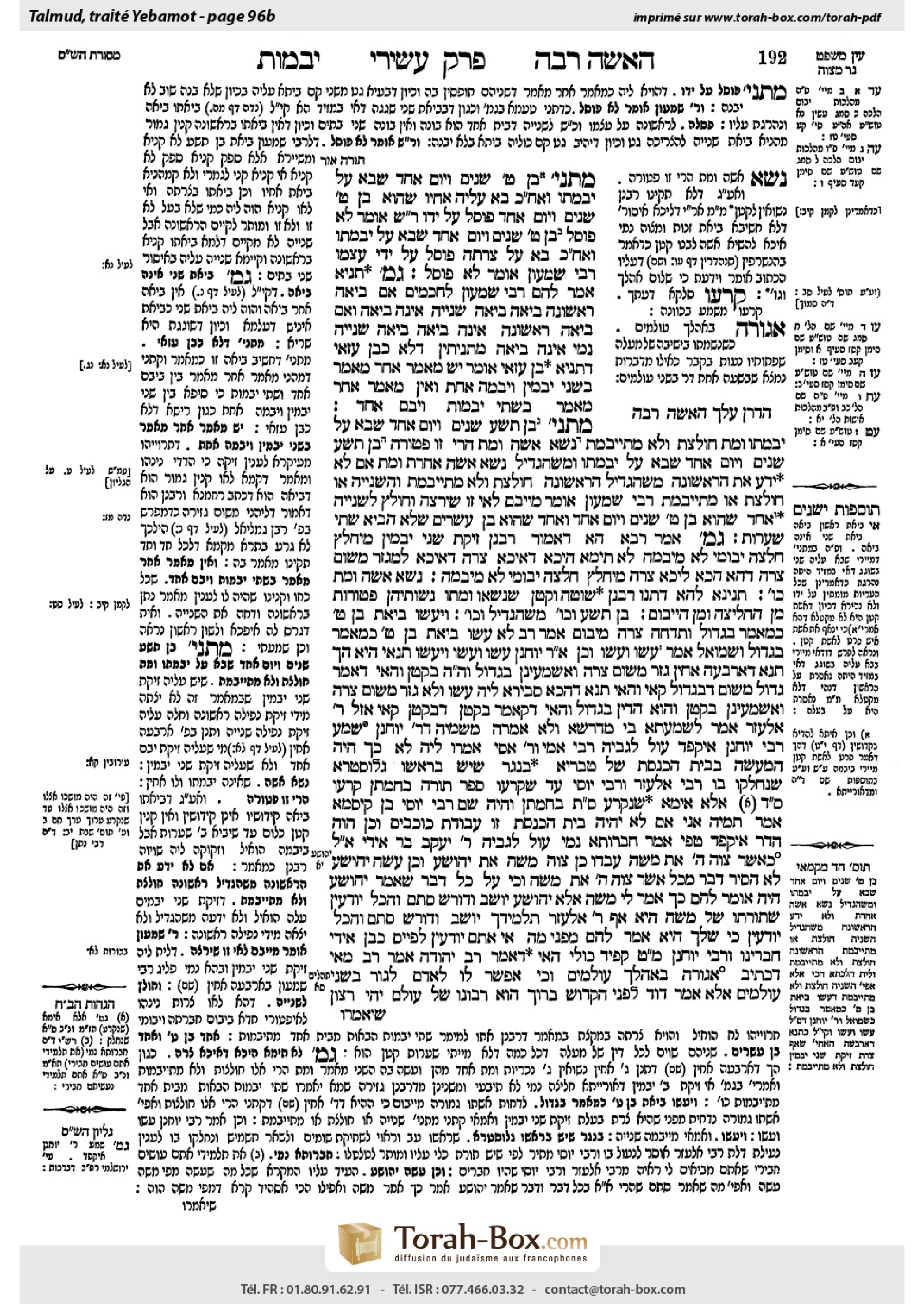
Yevamot 96b: Talmud study for Daf Yomi
Daf Yomi is the daily study of one Talmud folio. Explore 37 tractates with scans, Hebrew text, Sefaria English and AI-generated French translations where annotated.
Passage selection and English or AI-generated French translation are available where the scan has annotations. Daf Study is independent of Torah-Box and Sefaria.
Browse Yevamot · יבמות · All tractatesYevamot 96b text and translations
This page of Yevamot includes the Aramaic text, an English translation and an AI-generated French translation, alongside the scan above.
יבמות צ״ו ב · Aramaic and Hebrew text
מַתְנִי׳ בֶּן תֵּשַׁע שָׁנִים וְיוֹם אֶחָד שֶׁבָּא עַל יְבִמְתּוֹ, וְאַחַר כָּךְ בָּא עָלֶיהָ אָחִיו שֶׁהוּא בֶּן תֵּשַׁע שָׁנִים וְיוֹם אֶחָד — פּוֹסַל עַל יָדוֹ. רַבִּי שִׁמְעוֹן אוֹמֵר: לֹא פָּסַל. בֶּן תֵּשַׁע שָׁנִים וְיוֹם אֶחָד שֶׁבָּא עַל יְבִמְתּוֹ, וְאַחַר כָּךְ בָּא עַל צָרָתָהּ — פָּסַל עַל יְדֵי עַצְמוֹ. רַבִּי שִׁמְעוֹן אוֹמֵר: לֹא פָּסַל.
גְּמָ׳ תַּנְיָא, אָמַר לָהֶם רַבִּי שִׁמְעוֹן לַחֲכָמִים: אִם בִּיאָה רִאשׁוֹנָה בִּיאָה — בִּיאָה שְׁנִיָּיה אֵינָהּ בִּיאָה. וְאִם בִּיאָה רִאשׁוֹנָה אֵינָהּ בִּיאָה — בִּיאָה שְׁנִיָּיה נָמֵי אֵינָהּ בִּיאָה.
מַתְנִיתִין דְּלָא כְּבֶן עַזַּאי. דְּתַנְיָא, בֶּן עַזַּאי אוֹמֵר: יֵשׁ מַאֲמָר אַחַר מַאֲמָר בִּשְׁנֵי יְבָמִין וִיבָמָה אַחַת.
וְאֵין מַאֲמָר אַחַר מַאֲמָר בִּשְׁתֵּי יְבָמוֹת וְיָבָם אֶחָד.
מַתְנִי׳ בֶּן תֵּשַׁע שָׁנִים וְיוֹם אֶחָד שֶׁבָּא עַל יְבִמְתּוֹ וּמֵת — חוֹלֶצֶת וְלֹא מִתְיַיבֶּמֶת. נָשָׂא אִשָּׁה וָמֵת — הֲרֵי זוֹ פְּטוּרָה. בֶּן תֵּשַׁע שָׁנִים וְיוֹם אֶחָד שֶׁבָּא עַל יְבִמְתּוֹ, וּמִשֶּׁהִגְדִּיל נָשָׂא אִשָּׁה אַחֶרֶת, וָמֵת, אִם לֹא יָדַע אֶת הָרִאשׁוֹנָה מִשֶּׁהִגְדִּיל — הָרִאשׁוֹנָה חוֹלֶצֶת וְלֹא מִתְיַיבֶּמֶת, וְהַשְּׁנִיָּיה אוֹ חוֹלֶצֶת אוֹ מִתְיַיבֶּמֶת.
רַבִּי שִׁמְעוֹן אוֹמֵר: מְיַיבֵּם לְאֵי זוֹ שֶׁיִּרְצֶה, וְחוֹלֵץ לַשְּׁנִיָּיה. אֶחָד שֶׁהוּא בֶּן תֵּשַׁע שָׁנִים וְיוֹם אֶחָד, וְאֶחָד שֶׁהוּא בֶּן עֶשְׂרִים שֶׁלֹּא הֵבִיא שְׁתֵּי שְׂעָרוֹת.
גְּמָ׳ אָמַר רָבָא: הָא דַּאֲמוּר רַבָּנַן זִיקַּת שְׁנֵי יְבָמִין, מִיחְלָץ חָלְצָה יַבּוֹמֵי לָא מִיַּבְּמָה, לָא תֵּימָא הֵיכָא דְּאִיכָּא צָרָה, דְּאִיכָּא לְמִגְזַר מִשּׁוּם צָרָה.
דְּהָא הָכָא לֵיכָּא צָרָה, מִיחְלָץ חָלְצָה, יַבּוֹמֵי לָא מִיַּבְּמָה.
נָשָׂא אִשָּׁה וּמֵת כּוּ׳. תְּנֵינָא לְהָא דְּתָנוּ רַבָּנַן: שׁוֹטֶה וְקָטָן שֶׁנָּשְׂאוּ וּמֵתוּ — נְשׁוֹתֵיהֶן פְּטוּרוֹת מִן הַחֲלִיצָה וּמִן הַיִּיבּוּם.
בֶּן תֵּשַׁע וְכוּ׳ מִשֶּׁהִגְדִּיל וְכוּ׳. וְיַעֲשׂוּ בִּיאַת בֶּן תֵּשַׁע כְּמַאֲמָר בַּגָּדוֹל, וְתִדָּחֶה צָרָה מִיִּבּוּם! אָמַר רַב: לֹא עָשׂוּ בִּיאַת בֶּן תֵּשַׁע כְּמַאֲמָר בַּגָּדוֹל. וּשְׁמוּאֵל אָמַר: עָשׂוּ וְעָשׂוּ. וְכֵן אָמַר רַבִּי יוֹחָנָן: עָשׂוּ וְעָשׂוּ.
וְיַעֲשׂוּ? תַּנָּאֵי הִיא. הָךְ תַּנָּא דְּאַרְבָּעָה אַחִין גָּזַר מִשּׁוּם צָרָה.
וְאַשְׁמְעִינַן בְּגָדוֹל, וְהוּא הַדִּין בְּקָטָן. וְהַאי דְּאָמַר גָּדוֹל — מִשּׁוּם דִּבְגָדוֹל קָאֵי.
וְהַאי תַּנָּא דְּהָכָא סְבִירָא לֵיהּ עָשׂוּ, וְלָא גָּזַר מִשּׁוּם צָרָה. וְאַשְׁמְעִינַן בְּקָטָן, וְהוּא הַדִּין בְּגָדוֹל. וְהַאי דְּקָאָמַר בְּקָטָן — דִּבְקָטָן קָאֵי.
אֲזַל רַבִּי אֶלְעָזָר אֲמַר לִשְׁמַעְתָּא בֵּי מִדְרְשָׁא, וְלָא אַמְרַהּ מִשְּׁמֵיהּ דְּרַבִּי יוֹחָנָן. שְׁמַע רַבִּי יוֹחָנָן אִיקְּפַד. עוּל לְגַבֵּיהּ רַבִּי אַמֵּי וְרַבִּי אַסִּי. אֲמַרוּ לֵיהּ: לֹא כָּךְ הָיָה הַמַּעֲשֶׂה בְּבֵית הַכְּנֶסֶת שֶׁל טְבֶרְיָא בְּנֶגֶר שֶׁיֵּשׁ בְּרֹאשׁוֹ גְּלוֹסְטְרָא,
שֶׁנֶּחְלְקוּ בּוֹ רַבִּי אֶלְעָזָר וְרַבִּי יוֹסֵי, עַד שֶׁקָּרְעוּ סֵפֶר תּוֹרָה בַּחֲמָתָן. קָרְעוּ סָלְקָא דַּעְתָּךְ?! אֶלָּא אֵימָא שֶׁנִּקְרַע סֵפֶר תּוֹרָה בַּחֲמָתָן. וְהָיָה שָׁם רַבִּי יוֹסֵי בֶּן קִיסְמָא, אָמַר: תָּמֵיהַּ אֲנִי אִם לֹא יִהְיֶה בֵּית הַכְּנֶסֶת זוֹ עֲבוֹדָה זָרָה. וְכֵן הֲוָה.
הֲדַר אִיקְּפַד טְפֵי, אֲמַר: חַבְרוּתָא נָמֵי?!
עוּל לְגַבֵּיהּ רַבִּי יַעֲקֹב בַּר אִידִי. אֲמַר לֵיהּ: ״כַּאֲשֶׁר צִוָּה ה׳ אֶת מֹשֶׁה עַבְדּוֹ כֵּן צִוָּה מֹשֶׁה אֶת יְהוֹשֻׁעַ וְכֵן עָשָׂה יְהוֹשֻׁעַ לֹא הֵסִיר דָּבָר מִכׇּל אֲשֶׁר צִוָּה ה׳ אֶת מֹשֶׁה״, וְכִי עַל כׇּל דָּבָר שֶׁאָמַר יְהוֹשֻׁעַ הָיָה אוֹמֵר לָהֶם: כָּךְ אָמַר לִי מֹשֶׁה? אֶלָּא יְהוֹשֻׁעַ יוֹשֵׁב וְדוֹרֵשׁ סְתָם, וְהַכֹּל יוֹדְעִין שֶׁתּוֹרָתוֹ שֶׁל מֹשֶׁה הִיא. אַף רַבִּי אֶלְעָזָר תַּלְמִידְךָ יוֹשֵׁב וְדוֹרֵשׁ סְתָם, וְהַכֹּל יוֹדְעִין כִּי שֶׁלְּךָ הִיא.
אָמַר לָהֶם: מִפְּנֵי מָה אִי אַתֶּם יוֹדְעִין לְפַיֵּיס כְּבֶן אִידִי חֲבֵרֵינוּ. וְרַבִּי יוֹחָנָן מַאי טַעְמָא קָפֵיד כּוּלֵּי הַאי? דְּאָמַר רַב יְהוּדָה אָמַר רַב: מַאי דִּכְתִיב: ״אָגוּרָה בְּאׇהׇלְךָ עוֹלָמִים״, וְכִי אֶפְשָׁר לוֹ לְאָדָם לָגוּר בִּשְׁנֵי עוֹלָמִים? אֶלָּא אָמַר דָּוִד לִפְנֵי הַקָּדוֹשׁ בָּרוּךְ הוּא: רִבּוֹנוֹ שֶׁל עוֹלָם, יְהִי רָצוֹן
Yevamot 96b · English translation
MISHNA: If a boy aged nine years and one day had sexual relations with his yevama, and afterward his brother, who is also nine years and one day old, had relations with her, the second brother disqualifies her to the first one. Rabbi Shimon says he does not disqualify her. If a minor aged nine years and one day had relations with his yevama, and afterward that same boy had relations with her rival wife, he thereby disqualifies her to himself, and both women are now forbidden to him. Rabbi Shimon says he does not disqualify her.
GEMARA: It is taught in a baraita that Rabbi Shimon said to the Rabbis: If the first sexual act of a nine-year-old is considered a proper act of sexual relations, then the second act is not an act of consequence, just as the intercourse of one adult yavam after that of another adult yavam is of no effect. And if you say that the first sexual act is not considered a sexual act, the second act of himself or his brother is also not a sexual act. However, the Rabbis maintain that as the intercourse of a nine-year-old is like a levirate betrothal, one sexual act can take effect after another.
The Gemara comments that according to this explanation, the mishna is not in accordance with the opinion of ben Azzai. As it is taught in a baraita that ben Azzai says: There is levirate betrothal after levirate betrothal in a case of two yevamin and one yevama. In other words, if they both performed levirate betrothal with her, their actions are effective and she is forbidden to them both. The reason is that she has ties to each of the two men, which means that each levirate betrothal is effective in forbidding the other man.
But there is no levirate betrothal after a levirate betrothal in a case of two yevamot and one yavam, as the yavam did not have a full-fledged levirate bond with both of them. Therefore, if he performs a levirate betrothal with one of them, he has completed the bond. In contrast, the conclusion of the mishna is that the sexual relations of a nine-year-old with two yevamot is effective, and as the intercourse of a boy of this age is considered like a levirate betrothal the tanna of the mishna evidently maintains that there is levirate betrothal after levirate betrothal even in a case of one yavam.
MISHNA: If a boy aged nine years and one day had relations with his yevama and died, that yevama performs ḥalitza and may not enter into levirate marriage. If the minor married a woman in a regular manner and died, she is exempt from levirate marriage and ḥalitza, as by Torah law a minor cannot marry. If a boy aged nine years and one day had relations with his yevama, and after he matured he married a different woman and then died childless, if he did not carnally know the first woman after he matured, but only when he was a minor, the first one performs ḥalitza and may not enter into levirate marriage, as she is in essence a yevama who had relations with a minor, and the second woman either performs ḥalitza or enters into levirate marriage, as she is his full-fledged wife.
Rabbi Shimon says: The brother consummates levirate marriage with whichever woman he chooses, and performs ḥalitza with the second one. The mishna comments: This is the halakha both for a boy who is nine years and one day old, and also for one who is twenty years old who has not developed two pubic hairs. He has the status of a nine-year-old boy in this regard, as his intercourse is not considered a proper act of intercourse.
GEMARA: If a brother performed levirate betrothal with a yevama and died, she has a levirate bond in relation to the remaining brothers from two deceased brothers. Rava said: With regard to that which the Rabbis said, that when the bond of two yevamin exists, she performs ḥalitza and she does not enter into levirate marriage, you should not say that this applies only when there is a rival wife, as there is reason to decree due to a rival wife. The suggestion is that as the rival wife can enter into levirate marriage by Torah law, if the woman who performed levirate betrothal with the second brother was also permitted to enter into levirate marriage, people might mistakenly permit levirate marriage to two rival wives from the same family.
The proof that this is not the case is that here, in the first clause of the mishna, there is no rival wife, as it is referring to one woman, which means that this yevama who had relations with the nine-year-old is tied by the bonds of both her first husband and the underage yavam, whose intercourse is like levirate betrothal, and even so she performs ḥalitza but she does not enter into levirate marriage.
§ The mishna teaches that if a nine-year-old boy married a woman and died, she is exempt from levirate marriage and ḥalitza. The Gemara comments: We already learned this, as the Sages taught in a baraita: With regard to an imbecile and a minor who married women and died, their wives are exempt from ḥalitza and from levirate marriage, as the marriage of a minor or an imbecile is of no account.
§ The mishna further teaches the case of a nine-year-old boy who had relations with his yevama and after he matured married another woman. The Gemara asks: And let the Sages at least establish the sexual relations of a nine-year-old to be like the levirate betrothal of an adult, and it would therefore override the requirement of the rival wife to enter into levirate marriage, in accordance with the halakha of the rival wife of a woman who has the bond of two yevamin. Rav said: They did not establish the intercourse of a nine-year-old to be like the levirate betrothal of an adult in all regards, and Shmuel said: They certainly did. And similarly, Rabbi Yoḥanan said: They certainly did.
If so, the question remains: And let them establish the sexual relations of a nine-year-old to be considered like levirate betrothal. Why is he able to perform levirate marriage with her rival wife? The Gemara answers: This is a dispute between tanna’im. This tanna who discusses the case of four brothers, one of whom died, followed by the brother who performed levirate betrothal with the yevama (31b), he maintains that the yevama and her rival wife may not perform levirate marriage with one of the surviving brothers. The reason is that he maintains that the Sages decreed that a woman who has the bond of two deceased brothers may not perform levirate marriage due to a rival wife. They must both perform ḥalitza so that people will not say that two yevamot from one family can perform levirate marriage.
And that tanna taught us this halakha with regard to an adult brother who performed levirate marriage, and the same is true of a minor who had relations with her. And the reason that he stated the case of an adult in particular is because he was referring to an adult.
And conversely, this tanna, of the mishna here, holds that they established the sexual relations of a minor entirely like the levirate betrothal of an adult, and he maintains that the Sages did not decree that a woman who has the bond of two deceased brothers may not perform levirate marriage due to the case of a rival wife. And he taught us this halakha with regard to a minor, and the same is true of an adult. And the reason that he stated the case of a minor in particular is because he was referring to a minor.
§ Rabbi Elazar went and said this halakha in the study hall, but he did not state it in the name of Rabbi Yoḥanan. Instead, he issued the halakha without attribution. Rabbi Yoḥanan heard that Rabbi Elazar omitted mention of his name and became angry with him. Rabbi Ami and Rabbi Asi visited Rabbi Yoḥanan, to placate him so that he would not be annoyed with his beloved disciple. They said to him: Wasn’t there an incident in the synagogue of Tiberias involving a bolt that secures a door in place and that has a thick knob [gelustera] at its end? The question was whether it may be moved on Shabbat as a vessel, or whether it is considered muktze as raw material.
And it was stated that Rabbi Elazar and Rabbi Yosei argued over this case until they became so upset with each other that they tore a Torah scroll in their anger. The Gemara interrupts this account to clarify exactly what happened: Tore? Can it enter your mind that such great Sages would intentionally tear a Torah scroll? Rather, you must say that a Torah scroll was torn through their anger. In the heat of their debate they pulled the scroll from one side to another until it tore. And Rabbi Yosei ben Kisma, who was there at the time, said: I would be surprised if this synagogue does not become a place of idolatrous worship. This unfortunate event is a sign that this place is unsuitable for a synagogue. And indeed this eventually occurred.
Rabbi Ami and Rabbi Asi cited this baraita to hint to Rabbi Yoḥanan how careful one must be to avoid anger. However, Rabbi Yoḥanan grew even angrier, saying: You are even making us colleagues now? Those two Sages were peers, whereas Rabbi Elazar is merely my student.
Rabbi Ya’akov bar Idi visited Rabbi Yoḥanan and said to him: The verse states: “As God commanded His servant Moses, so did Moses command Joshua, and so did Joshua, he left nothing undone of all that the Lord commanded Moses” (Joshua 11:15). Now did Joshua, with regard to every matter that he said, say to the Jews: Thus Moses said to me? Rather, Joshua would sit and teach Torah without attributing his statements, and everyone would know that it was from the Torah of Moses. So too, your disciple Rabbi Elazar sits and teaches without attribution, and everyone knows that his teaching is from your instruction. Hearing this, Rabbi Yoḥanan was appeased.
Later, after calming down, he said to Rabbi Ami and Rabbi Asi: Why don’t you know how to appease me like our colleague ben Idi? The Gemara asks: And Rabbi Yoḥanan, what is the reason that he was so angry about this matter? The Gemara answers that this is as Rav Yehuda said that Rav said: What is the meaning of that which is written: “I will dwell in Your tent in worlds” (Psalms 61:5), literally, forever? And is it possible for a person to live in two worlds simultaneously? Rather, David said before the Holy One, Blessed be He: Master of the Universe, let it be Your will
Yevamot 96b · Traduction française (IA)
MICHNA : Si un garçon âgé de neuf ans et un jour a eu des relations sexuelles avec sa yevama, puis que son frère, qui est également âgé de neuf ans et un jour, a eu des relations avec elle, le second frère la rend interdite au premier. Rabbi Shimon dit qu'il ne la rend pas interdite. Si un mineur âgé de neuf ans et un jour a eu des relations avec sa yevama, puis que ce même garçon a eu des relations avec la femme rivale, il la rend par là même interdite à lui-même, et les deux femmes sont désormais interdites à lui. Rabbi Shimon dit qu'il ne la rend pas interdite.
GUEMARA : Il est enseigné dans une baraïta que Rabbi Shimon a dit aux Sages : Si le premier acte sexuel d'un enfant de neuf ans est considéré comme un acte sexuel valide, alors le second acte n'est pas un acte ayant des conséquences, de même que les relations d'un yavam adulte après celles d'un autre yavam adulte n'ont aucun effet. Et si vous dites que le premier acte sexuel n'est pas considéré comme un acte sexuel, le second acte, qu'il soit le sien ou celui de son frère, n'est pas non plus un acte sexuel. Cependant, les Sages soutiennent que, comme les relations d'un enfant de neuf ans sont comparables à une yibboum (betrothal leviratique), un acte sexuel peut prendre effet après un autre.
La Guemara commente que, selon cette explication, la Michna ne suit pas l'opinion de ben Azzai. Car il est enseigné dans une baraïta que ben Azzai dit : Il y a yibboum après yibboum dans le cas de deux yevamin et d'une seule yevama. Autrement dit, s'ils ont tous deux accompli une yibboum avec elle, leurs actes sont effectifs et elle leur est interdite à tous deux. La raison en est qu'elle a des liens avec chacun des deux hommes, ce qui signifie que chaque yibboum est effectif pour interdire l'autre homme.
Mais il n'y a pas de yibboum après un yibboum dans le cas de deux yevamot et d'un seul yavam, car le yavam n'avait pas un lien leviratique complet avec toutes les deux. Par conséquent, s'il accomplit un yibboum avec l'une d'entre elles, il a complété le lien. En revanche, la conclusion de la Michna est que les relations sexuelles d'un enfant de neuf ans avec deux yevamot sont effectives, et comme les relations d'un garçon de cet âge sont considérées comme un yibboum, le tanna de la Michna soutient manifestement qu'il y a yibboum après yibboum même dans le cas d'un seul yavam.
MICHNA : Si un garçon âgé de neuf ans et un jour a eu des relations avec sa yevama et est mort, cette yevama accomplit la ḥalitza et ne peut pas entrer dans le mariage leviratique. Si le mineur a épousé une femme de manière régulière et est mort, elle est exempte du mariage leviratique et de la ḥalitza, car selon la Torah écrite, un mineur ne peut pas se marier. Si un garçon âgé de neuf ans et un jour a eu des relations avec sa yevama, puis qu'après sa maturité il a épousé une autre femme et est mort sans enfant, s'il n'a pas connu charnellement la première femme après sa maturité, mais seulement lorsqu'il était mineur, la première accomplit la ḥalitza et ne peut pas entrer dans le mariage leviratique, car elle est en substance une yevama qui a eu des relations avec un mineur, et la seconde femme accomplit soit la ḥalitza, soit entre dans le mariage leviratique, car elle est sa femme à part entière.
Rabbi Shimon dit : Le frère consomme le mariage leviratique avec la femme de son choix, et accomplit la ḥalitza avec la seconde. La Michna commente : C'est la halakha tant pour un garçon âgé de neuf ans et un jour, que pour un homme de vingt ans qui n'a pas développé deux poils pubiens. Il a le statut d'un garçon de neuf ans à cet égard, car ses relations ne sont pas considérées comme un acte sexuel valide.
Guemara : Si un frère a accompli une yibboum avec une yevama et est mort, elle est liée par un lien leviratique envers les frères restants issus de deux frères décédés. Rava a dit : Concernant ce que les Sages ont dit, à savoir que lorsque le lien de deux yevamin existe, elle accomplit la ḥalitza et n'entre pas dans le mariage leviratique, vous ne devriez pas dire que cela ne s'applique que lorsqu'il y a une femme rivale, car il y a une raison de décréter en raison d'une femme rivale. La suggestion est que, comme la femme rivale peut entrer dans le mariage leviratique selon la Torah, si la femme qui a accompli la yibboum avec le second frère était également autorisée à entrer dans le mariage leviratique, les gens pourraient par erreur autoriser le mariage leviratique avec deux femmes rivales de la même famille.
La preuve que ce n'est pas le cas est que, ici, dans la première clause de la Michna, il n'y a pas de femme rivale, car il s'agit d'une seule femme, ce qui signifie que cette yevama qui a eu des relations avec le garçon de neuf ans est liée par les liens de son premier mari et du yavam mineur, dont les relations sont comparables à une yibboum, et pourtant elle accomplit la ḥalitza mais n'entre pas dans le mariage leviratique.
§ La Michna enseigne que si un garçon de neuf ans a épousé une femme et est mort, elle est exempte du mariage leviratique et de la ḥalitza. La Guemara commente : Nous avons déjà appris cela, car les Sages ont enseigné dans une baraïta : Concernant un imbécile et un mineur qui ont épousé des femmes et sont morts, leurs femmes sont exemptes de la ḥalitza et du mariage leviratique, car le mariage d'un mineur ou d'un imbécile n'a aucune valeur.
§ La Michna enseigne également le cas d'un garçon de neuf ans qui a eu des relations avec sa yevama et qui, après sa maturité, a épousé une autre femme. La Guemara demande : Et que les Sages établissent au moins que les relations sexuelles d'un enfant de neuf ans sont comparables à la yibboum d'un adulte, et qu'elles annuleraient donc l'obligation de la femme rivale d'entrer dans le mariage leviratique, conformément à la halakha de la femme rivale d'une femme ayant le lien de deux yevamin. Rav a dit : Ils n'ont pas établi que les relations d'un enfant de neuf ans sont comparables à la yibboum d'un adulte sous tous les aspects, et Shmuel a dit : Ils l'ont certainement fait. Et de même, Rabbi Yoḥanan a dit : Ils l'ont certainement fait.
S'il en est ainsi, la question demeure : Et qu'ils établissent que les relations sexuelles d'un enfant de neuf ans soient considérées comme une yibboum de fiançailles. Pourquoi est-il capable de contracter un mariage de yibboum avec sa femme rivale ? La Guemara répond : Il s'agit d'un différend entre des tannaïm. Ce tanna qui traite du cas de quatre frères, dont l'un est mort, suivi par le frère qui a contracté une yibboum de fiançailles avec la yevama (31b), soutient que la yevama et sa femme rivale ne peuvent pas contracter de mariage de yibboum avec l'un des frères survivants. La raison en est qu'il soutient que les Sages ont décrété qu'une femme qui a le lien de deux frères décédés ne peut pas contracter de mariage de yibboum en raison d'une femme rivale. Elles doivent toutes deux effectuer la ḥalitza afin que l'on ne dise pas que deux yevamot d'une même famille peuvent contracter un mariage de yibboum.
Et ce tanna nous a enseigné cette halakha concernant un frère adulte qui a contracté un mariage de yibboum, et il en va de même pour un mineur qui a eu des relations avec elle. Et la raison pour laquelle il a spécifiquement mentionné le cas d'un adulte est qu'il faisait référence à un adulte.
Et inversement, ce tanna de la Michna ici soutient qu'ils ont établi que les relations sexuelles d'un mineur sont entièrement assimilées au yébamout de fiançailles d'un adulte, et il maintient que les Sages n'ont pas décrété qu'une femme liée par le lien de deux frères décédés ne peut pas contracter le yébamout en raison du cas d'une femme rivale. Et il nous a enseigné cette halakha concernant un mineur, et il en va de même pour un adulte. Et la raison pour laquelle il a spécifiquement mentionné le cas d'un mineur est qu'il faisait référence à un mineur.
§ Rabbi Elazar est allé énoncer cette halakha dans la salle d'étude, mais il ne l'a pas énoncée au nom de Rabbi Yoḥanan. Au contraire, il a émis la halakha sans attribution. Rabbi Yoḥanan a entendu que Rabbi Elazar avait omis de mentionner son nom et s'est fâché contre lui. Rabbi Ami et Rabbi Asi ont visité Rabbi Yoḥanan pour l'apaiser, afin qu'il ne soit pas contrarié envers son disciple bien-aimé. Ils lui ont dit : N'y a-t-il pas eu un incident dans la synagogue de Tibériade concernant un loquet qui maintient une porte en place et qui a une grosse poignée [gelustera] à son extrémité ? La question était de savoir s'il peut être déplacé le Chabbat en tant que récipient, ou s'il est considéré comme muktze en tant que matière première.
Il est dit que Rabbi Elazar et Rabbi Yosei ont débattu sur ce cas jusqu'à ce que leur colère les emporte au point de déchirer un rouleau de la Torah dans leur fureur. La Guemara interrompt ce récit pour clarifier exactement ce qui s'est passé : A-t-il déchiré ? Est-il possible que de tels grands Sages aient intentionnellement déchiré un rouleau de la Torah ? Il faut plutôt dire qu'un rouleau de la Torah a été déchiré par leur colère. Dans l'ardeur de leur débat, ils ont tiré le rouleau d'un côté à l'autre jusqu'à ce qu'il se déchire. Et Rabbi Yosei ben Kisma, qui était présent à ce moment-là, a dit : Je serais surpris si cette synagogue ne devenait pas un lieu de culte idolâtre. Cet événement malheureux est un signe que cet endroit n'est pas approprié pour une synagogue. Et en effet, cela s'est produit à la fin.
Rabbi Ami et Rabbi Asi ont cité cette baraïta pour faire comprendre à Rabbi Yoḥanan à quel point il faut être prudent pour éviter la colère. Cependant, Rabbi Yoḥanan est devenu encore plus en colère, disant : Vous faites même de nous des collègues maintenant ? Ces deux Sages étaient des pairs, alors que Rabbi Elazar n'est que mon disciple.
Rabbi Ya’akov bar Idi visita Rabbi Yoḥanan et lui dit : Le verset dit : « Comme Dieu a commandé à Son serviteur Moïse, ainsi Moïse a commandé à Josué, et ainsi Josué n'a rien négligé de tout ce que l'Éternel avait commandé à Moïse » (Josué 11:15). Est-ce que Josué, pour chaque affaire qu'il a traitée, a dit aux Juifs : Ainsi Moïse m'a dit ? Plutôt, Josué s'asseyait et enseignait la Torah sans attribuer ses propos, et tout le monde savait que cela venait de la Torah de Moïse. De même, votre disciple Rabbi Elazar s'assied et enseigne sans attribution, et tout le monde sait que son enseignement vient de vos instructions. En entendant cela, Rabbi Yoḥanan fut apaisé.
Plus tard, après s'être calmé, il dit à Rabbi Ami et à Rabbi Asi : Pourquoi ne savez-vous pas m'apaiser comme notre collègue ben Idi ? La Guemara demande : Et Rabbi Yoḥanan, quelle est la raison pour laquelle il était si en colère à ce sujet ? La Guemara répond que c'est comme Rav Yehuda a dit que Rav a dit : Quelle est la signification de ce qui est écrit : « Je résiderai dans votre tente dans les mondes » (Psaumes 61:5), littéralement, pour toujours ? Et est-il possible pour une personne de vivre dans deux mondes simultanément ? Plutôt, David a dit devant le Saint, béni soit-Il : Maître de l'Univers, que ce soit Ta volonté
Traduction française générée par IA à partir de l’édition anglaise de Sefaria. Vérifie toujours un passage avec le texte source.
Text from Sefaria: William Davidson Edition - Vocalized Aramaic (CC BY NC); William Davidson Edition - English (CC BY NC).