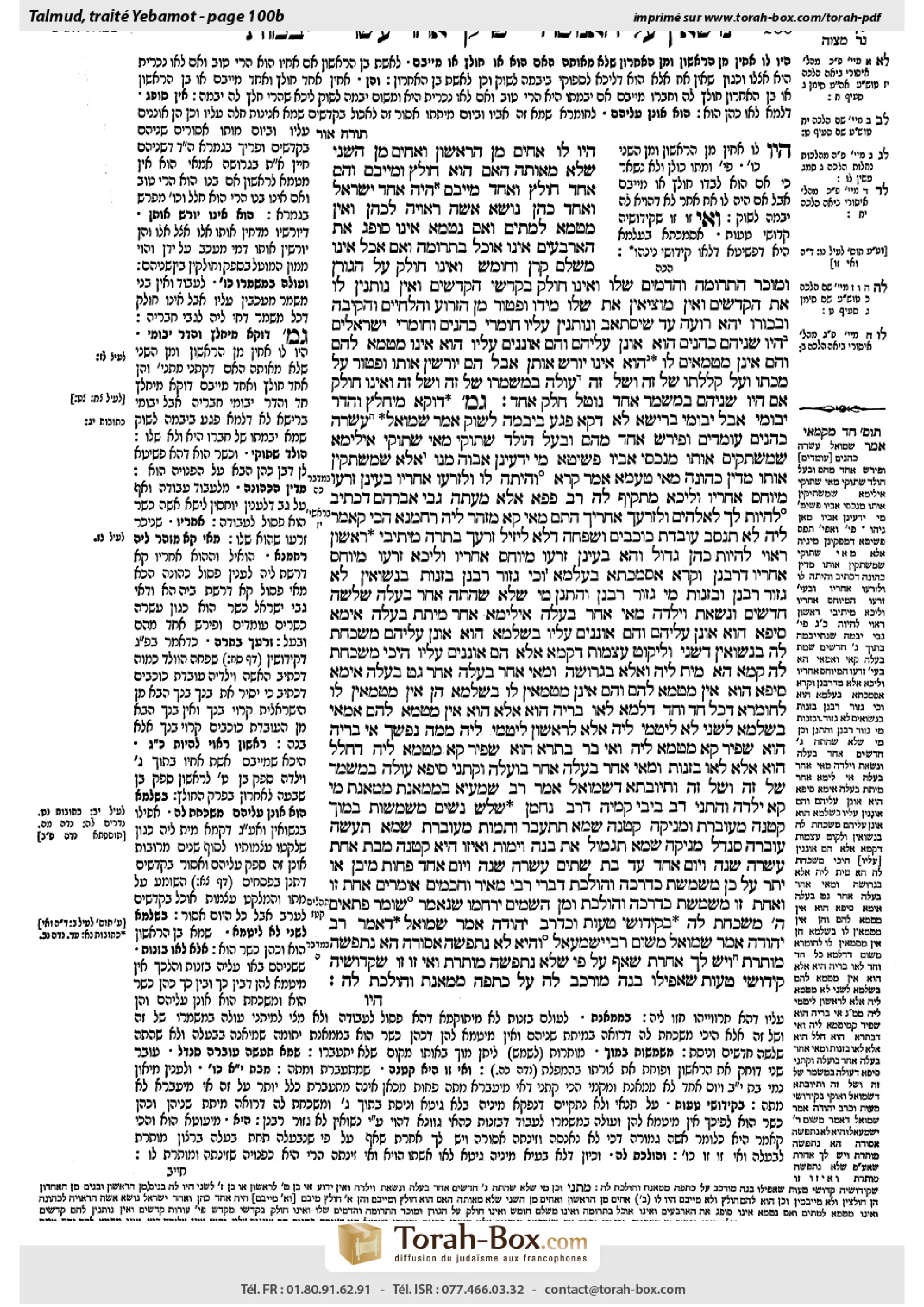
Yevamot 100b: Talmud study for Daf Yomi
Daf Yomi is the daily study of one Talmud folio. Explore 37 tractates with scans, Hebrew text, Sefaria English and AI-generated French translations where annotated.
Passage selection and English or AI-generated French translation are available where the scan has annotations. Daf Study is independent of Torah-Box and Sefaria.
Browse Yevamot · יבמות · All tractatesYevamot 100b text and translations
This page of Yevamot includes the Aramaic text, an English translation and an AI-generated French translation, alongside the scan above.
יבמות ק׳ ב · Aramaic and Hebrew text
הָיוּ לוֹ אַחִים מִן הָרִאשׁוֹן וְאַחִים מִן הַשֵּׁנִי, שֶׁלֹּא מֵאוֹתָהּ הָאֵם — הוּא חוֹלֵץ וּמְיַיבֵּם, וְהֵם — אֶחָד חוֹלֵץ וְאֶחָד מְיַיבֵּם.
הָיָה אֶחָד יִשְׂרָאֵל וְאֶחָד כֹּהֵן — נוֹשֵׂא אִשָּׁה רְאוּיָה לְכֹהֵן, וְאֵין מִטַּמֵּא לְמֵתִים. וְאִם נִטְמָא — אֵינוֹ סוֹפֵג אֶת הָאַרְבָּעִים. אֵינוֹ אוֹכֵל בִּתְרוּמָה, וְאִם אָכַל — אֵינוֹ מְשַׁלֵּם קֶרֶן וָחוֹמֶשׁ. וְאֵינוֹ חוֹלֵק עַל הַגּוֹרֶן. וּמוֹכֵר הַתְּרוּמָה, וְהַדָּמִים שֶׁלּוֹ.
וְאֵינוֹ חוֹלֵק בְּקׇדְשֵׁי הַקֳּדָשִׁים. וְאֵין נוֹתְנִין לוֹ אֶת הַקֳּדָשִׁים, וְאֵין מוֹצִיאִין אֶת שֶׁלּוֹ מִיָּדוֹ. וּפָטוּר מִן הַזְּרוֹעַ וְהַלְּחָיַיִם וְהַקֵּיבָה. וּבְכוֹרוֹ יְהֵא רוֹעֶה עַד שֶׁיִּסְתָּאֵב. וְנוֹתְנִין עָלָיו חוּמְרֵי כֹּהֲנִים וְחוּמְרֵי יִשְׂרְאֵלִים.
הָיוּ שְׁנֵיהֶם כֹּהֲנִים — הוּא אוֹנֵן עֲלֵיהֶם, וְהֵם אוֹנְנִים עָלָיו. הוּא אֵינוֹ מִטַּמֵּא לָהֶם, וְהֵם אֵינָן מְטַמְּאִים לוֹ. הוּא אֵינוֹ יוֹרֵשׁ אוֹתָן, אֲבָל הֵם יוֹרְשִׁין אוֹתוֹ.
וּפָטוּר עַל מַכָּתוֹ וְעַל קִלְלָתוֹ שֶׁל זֶה וְשֶׁל זֶה. עוֹלֶה בְּמִשְׁמָרוֹ שֶׁל זֶה וְשֶׁל זֶה, וְאֵינוֹ חוֹלֵק. אִם הָיוּ שְׁנֵיהֶם בְּמִשְׁמָר אֶחָד — נוֹטֵל חֵלֶק אֶחָד.
גְּמָ׳ דַּוְקָא מִיחְלָץ וַהֲדַר יַבּוֹמֵי, אֲבָל יַבּוֹמֵי בְּרֵישָׁא — לָא, דְּקָא פָגַע בִּיבָמָה לַשּׁוּק.
אָמַר שְׁמוּאֵל: עֲשָׂרָה כֹּהֲנִים עוֹמְדִים, וּפֵירַשׁ אֶחָד מֵהֶם, וּבָעַל — הַוָּלָד שְׁתוּקִי. מַאי ״שְׁתוּקִי״? אִילֵימָא שֶׁמְּשַׁתְּקִין אוֹתוֹ מִנִּכְסֵי אָבִיו — פְּשִׁיטָא! מִי יָדְעִינַן אֲבוּהּ מַנּוּ? אֶלָּא שֶׁמְּשַׁתְּקִין אוֹתוֹ מִדִּין כְּהוּנָּה.
מַאי טַעְמָא? אָמַר קְרָא: ״וְהָיְתָה לּוֹ וּלְזַרְעוֹ אַחֲרָיו״, בָּעֵינַן זַרְעוֹ מְיוּחָס אַחֲרָיו, וְלֵיכָּא.
מַתְקֵיף לַהּ רַב פָּפָּא: אֶלָּא מֵעַתָּה גַּבֵּי אַבְרָהָם, דִּכְתִיב: ״לִהְיוֹת לְךָ לֵאלֹהִים וּלְזַרְעֲךָ אַחֲרֶיךָ״, הָתָם מַאי קָא מַזְהַר לֵיהּ רַחֲמָנָא? הָכִי קָאָמַר לֵיהּ: לָא תִּנְסַב גּוֹיָה וְשִׁפְחָה, דְּלָא לֵיזִיל זַרְעָךְ בָּתְרַהּ.
מֵיתִיבִי: רִאשׁוֹן רָאוּי לִהְיוֹת כֹּהֵן גָּדוֹל. וְהָא בָּעֵינַן זַרְעוֹ מְיוּחָס אַחֲרָיו, וְלֵיכָּא! זַרְעוֹ מְיוּחָס אַחֲרָיו — דְּרַבָּנַן, וּקְרָא אַסְמַכְתָּא בְּעָלְמָא. וְכִי גְּזוּר רַבָּנַן — בִּזְנוּת, בְּנִשּׂוּאִין לָא גְּזוּר רַבָּנַן.
וּבִזְנוּת מִי גְּזוּר רַבָּנַן? וְהָתְנַן: מִי שֶׁלֹּא שָׁהֲתָה אַחַר בַּעְלָהּ שְׁלֹשָׁה חֳדָשִׁים וְנִשֵּׂאת וְיָלְדָה.
מַאי ״אַחַר בַּעְלָהּ״? אִילֵימָא אַחַר מִיתַת בַּעְלָהּ, אֵימָא סֵיפָא: הוּא אוֹנֵן עֲלֵיהֶם, וְהֵם אוֹנְנִים עָלָיו. בִּשְׁלָמָא הוּא אוֹנֵן עֲלֵיהֶם — מַשְׁכַּחַתְּ לַהּ בְּנִשּׂוּאִין דְּשֵׁנִי וְלִיקּוּט עֲצָמוֹת דְּקַמָּא. אֶלָּא: הֵם אוֹנְנִים עָלָיו, הֵיכִי מַשְׁכַּחַתְּ לַהּ? קַמָּא הָא מִית לֵיהּ!
וְאֶלָּא בִּגְרוּשָׁה, וּמַאי ״אַחַר בַּעְלָהּ״ — אַחַר גֵּט בַּעְלָהּ. אֵימָא סֵיפָא: הוּא אֵין מִטַּמֵּא לָהֶם וְהֵם אֵינָן מִטַּמְּאִין לוֹ. בִּשְׁלָמָא הֵן אֵין מִטַּמְּאִין לוֹ — לְחוּמְרָא, דְּכֹל חַד וְחַד דִּלְמָא לָאו בְּרֵיהּ הוּא. אֶלָּא הוּא אֵין מִטַּמֵּא לָהֶם, אַמַּאי?
בִּשְׁלָמָא לְשֵׁנִי לָא לִיטַּמֵּי לֵיהּ, אֶלָּא לְרִאשׁוֹן לִיטַּמֵּי לֵיהּ מִמָּה נַפְשָׁךְ? אִי בְּרֵיהּ הוּא — שַׁפִּיר קָא מִטַּמֵּא לֵיהּ, וְאִי בַּר בָּתְרָא הוּא — שַׁפִּיר קָא מִטַּמֵּא לֵיהּ, דְּחָלָל הוּא.
אֶלָּא לָאו, בִּזְנוּת. וּמַאי ״אַחַר בַּעְלָהּ״ — אַחַר בּוֹעֲלָהּ. וְקָתָנֵי סֵיפָא: עוֹלֶה בְּמִשְׁמָר שֶׁל זֶה וְשֶׁל זֶה. וּתְיוּבְתָּא דִּשְׁמוּאֵל!
אָמַר רַב שְׁמַעְיָא: בִּמְמָאֶנֶת.
מְמָאֶנֶת מִי קָא יָלְדָה? וְהָתָנֵי רַב בִּיבִי קַמֵּיהּ דְּרַב נַחְמָן: שָׁלֹשׁ נָשִׁים מְשַׁמְּשׁוֹת בְּמוֹךְ: קְטַנָּה, מְעוּבֶּרֶת, וּמְנִיקָה. קְטַנָּה — שֶׁמָּא תִּתְעַבֵּר וְתָמוּת, מְעוּבֶּרֶת — שֶׁמָּא תַּעֲשֶׂה עוּבָּרָהּ סַנְדָּל, מְנִיקָה — שֶׁמָּא תִּגְמוֹל אֶת בְּנָהּ וְיָמוּת. וְאֵיזוֹ הִיא קְטַנָּה — מִבַּת אַחַת עֶשְׂרֵה שָׁנָה וְיוֹם אֶחָד עַד בַּת שְׁתֵּים עֶשְׂרֵה שָׁנָה וְיוֹם אֶחָד. פָּחוֹת מִיכֵּן אוֹ יָתֵר עַל כֵּן — מְשַׁמֶּשֶׁת כְּדַרְכָּהּ וְהוֹלֶכֶת, דִּבְרֵי רַבִּי מֵאִיר.
וַחֲכָמִים אוֹמְרִים: אַחַת זוֹ וְאַחַת זוֹ מְשַׁמֶּשֶׁת כְּדַרְכָּהּ וְהוֹלֶכֶת, וּמִן הַשָּׁמַיִם יְרַחֲמוּ. שֶׁנֶּאֱמַר: ״שׁוֹמֵר פְּתָאִים ה׳״!
מַשְׁכַּחַתְּ לַהּ בְּקִידּוּשֵׁי טָעוּת, וְכִדְרַב יְהוּדָה אָמַר שְׁמוּאֵל. דְּאָמַר רַב יְהוּדָה אָמַר שְׁמוּאֵל מִשּׁוּם רַבִּי יִשְׁמָעֵאל: ״וְהִיא לֹא נִתְפָּשָׂה״ — אֲסוּרָה, הָא נִתְפָּשָׂה — מוּתֶּרֶת.
וְיֵשׁ לְךָ אַחֶרֶת, שֶׁאַף עַל פִּי שֶׁלֹּא נִתְפָּשָׂה, מוּתֶּרֶת. וְאֵי זוֹ — זוֹ שֶׁקִּדּוּשֶׁיהָ קִידּוּשֵׁי טָעוּת, שֶׁאֲפִילּוּ בְּנָהּ מוּרְכָּב לָהּ עַל כְּתֵפָהּ — מְמָאֶנֶת וְהוֹלֶכֶת לָהּ.
Yevamot 100b · English translation
If he had half brothers from the first husband and half brothers from the second, not from the same mother but from the same father, he performs ḥalitza or levirate marriage with their widows. If he is indeed their paternal half brother, then the widows are his yevamot; if not, he may marry them like any other man. And similarly, with regard to them and his wife, one half brother from one father performs ḥalitza and one from the other father performs levirate marriage.
If one of his two uncertain fathers was an Israelite and one was a priest, he may marry only a woman fit to marry a priest, due to the possibility that he is a priest. And he may not become ritually impure with impurity imparted by a corpse because he might be a priest. But if he became impure, he does not receive the forty lashes, as he might be a non-priest. Likewise, he does not partake of teruma, in case he is a non-priest. However, if he ate teruma he does not pay the principal and the additional fifth, as he might be a priest. And he does not receive teruma at the granary. However, he may sell the teruma of his own produce and the money is his. It cannot be taken away from him due to the uncertainty with regard to his status.
And he does not receive a share of the sacred of the consecrated offerings, and one may not give him the consecrated offerings to sacrifice. However, the hides of his own offerings may not be appropriated from his possession. And he is exempt from giving a priest the foreleg, and the jaw, and the maw of his non-consecrated animals. And the firstling of his animal should graze until it becomes unfit to be sacrificed because it gets a blemish. And in general, we place upon him the stringencies of priests and the stringencies of Israelites.
If both uncertain fathers were priests, then if they die he is in a state of acute mourning over each of them, in case the deceased is his father. And if he dies, they are both in a state of acute mourning over him, as one of them is his father. He may not become ritually impure to bury them, as each one may not be his relative, and they may not become ritually impure to bury him for the same reason. He does not inherit from them, as the heirs of both husbands can reject his claims. However, they inherit from him if he has no sons and split his inheritance equally.
And he is exempt from capital punishment for striking and for cursing both this father and that one. Although one who strikes or curses his father or mother is liable to receive the death penalty, he cannot be held liable, as it is unknown which of the men is his father. He must ascend to the Temple service with the priestly watch of this father and of that one, as he belongs to one of these watches and is obligated to serve with them. However, he does not receive a share of the portion of the offerings that gets eaten, as the members of each watch can claim that he is a member of the other watch. If both uncertain fathers were in one priestly watch, he receives one share, as he certainly belongs to that watch.
GEMARA: The mishna stated that if the son has paternal half brothers from each of his two uncertain fathers and he dies childless, a half brother from one father performs ḥalitza and the other performs levirate marriage. The Gemara comments that ḥalitza is specifically performed first and only afterward levirate marriage. However, levirate marriage is not performed first, as that would breach the prohibition against a yevama engaging in intercourse with a member of the public in the event that she is not his yevama but rather the yevama of the other half brother.
Shmuel said that if ten priests were standing in one place, and one of them, who is unidentified, left the group and engaged in intercourse with a woman, and she gave birth, the child is a silenced one, i.e., a child whose father’s identity is not known. The Gemara asks: What is the meaning of the phrase silenced one [shetuki] in this regard? If we say that he is silenced from any claim to his father’s property, this is obvious; do we know who his father is? Rather, it means that he is silenced from the status of priesthood, as well. Although his father certainly is a priest, he is not given this status.
The Gemara asks: What is the reason for this? The Gemara answers that the verse states: “And it shall be to him and to his seed after him, the covenant of an everlasting priesthood” (Numbers 25:13). It is derived from “and to his seed after him” that we require a priest’s descendants to be attributed to his lineage, and here that is not the case, as there is no certain father.
Rav Pappa strongly objects to this: However, if that is so, since the same phrase is written with regard to Abraham: “To be a God to you and to your seed after you” (Genesis 17:7), what is the Merciful One warning him there? Can it possibly mean that one who cannot identify his parents is not obligated to serve God as a Jew? The Gemara answers that this is what He said to him: You may not marry a gentile woman or a maidservant, so that the status of your offspring will not follow her status, as the child of a Jewish man and a gentile woman or maidservant receives the status of his mother.
The Gemara raises an objection: A baraita (37a) teaches that if a priest performed levirate marriage with his brother’s wife within three months of his brother’s death, and she gave birth to a son who is either her deceased husband’s son or her brother-in-law’s son, this first son born after the levirate marriage is fit even to be a High Priest. But don’t we require his descendants to be attributed to his lineage, and that is not so in this case, as the father’s identity is unknown? The Gemara answers: The requirement that his descendants be attributed to his lineage is rabbinic law, and the verse is a mere support, not the actual source. And when the Sages decreed that one whose father’s identity is unknown is not a priest, they did so only with regard to a case of licentious intercourse. With regard to a case of marriage, as is the case in the baraita, the Sages did not apply the decree.
The Gemara asks: And with regard to a case of licentious intercourse, did the Sages in fact issue a decree? Didn’t we learn in the mishna about a woman who did not wait three months after separating from her husband and remarried and gave birth to a son?
What is the meaning of the phrase: After separating from her husband? If we say it means after her husband’s death, say the latter clause of the mishna: If they die, he is in a state of acute mourning over each of them, and if he dies, they are both in a state of acute mourning over him. Granted, if they die, he is in a state of acute mourning over them. You find this case with regard to his uncertain father from his mother’s marriage to the second man. If the second husband dies, the child must mourn for him, and he is also in a state of acute mourning following the gathering of the bones of the first husband, who died before he was born. When the bones of a person who was buried are dug up for proper burial in his ancestor’s plot, his relatives mourn for him a second time. But with regard to the statement that if he dies they are in a state of acute mourning for him, how can you find these circumstances? The first husband is already dead.
And assume the mishna’s statement is rather with regard to a divorcée. And accordingly what is the meaning of the phrase: After separating from her husband? It means: After she received a bill of divorce from her husband. If so, say the latter clause of the mishna: He may not become impure to bury them, and they may not become impure to bury him. Granted, they may not become impure to bury him, as the ruling is stringent, as with regard to each one of them perhaps he is not his son. However, why may he not become impure to bury them?
Granted, for the second one he should not become impure, as he might not be his son. However, for the first he should be allowed to become impure whichever way you view it: If he is his son, it is appropriate for him to become impure to bury him, as even a priest must become ritually impure to bury his father. And if he is the son of the latter one, it is appropriate for him to become impure to bury him, as he, the son, is a ḥalal. If his mother is a divorcée, his father, the latter husband, is prohibited as a priest to marry her, and a child born from this relationship is a ḥalal, who is unfit for the priesthood. There would then be no prohibition against his becoming ritually impure.
Rather, is the mishna’s statement not with regard to the licentious intercourse of an unmarried woman? And what is the meaning of the phrase: After she separated from her husband [ba’ala]? Is it not: After separating from the man with whom she engaged in intercourse [bo’ala], meaning that she engaged in intercourse with a man less than three months before marrying another man, and therefore she does not know the identity of the father? And it is taught in the latter clause of the mishna that the son ascends to the Temple service with the priestly watch of this one and of that one, which implies that he is considered a priest, although the identity of his father is uncertain due to the licentious intercourse of his mother. And this appears to be a conclusive refutation of the opinion of Shmuel.
Rav Shemaya said: The mishna’s statement pertains to a girl who refused her husband. A minor girl who was orphaned from her father may be married off by her brothers. However, she may subsequently refuse her husband before reaching majority. This nullifies the marriage entirely, so she is not considered a divorcée, for whom it is prohibited to marry a priest. In the case of the mishna, she did not wait three months after her refusal before marrying again, so she does not know who the father of her child is.
The Gemara asks: Can a girl who refuses her husband give birth? Didn’t Rav Beivai teach before Rav Naḥman that women in three situations may engage in intercourse with a contraceptive resorbent, despite the fact that this practice is generally prohibited: A minor girl, a pregnant woman, and a nursing woman? A minor girl may do so lest she become pregnant and die, as the fetus might endanger her life. A pregnant woman may do so lest she get pregnant a second time and her previous fetus becomes a sandal, i.e., it is squashed by the pressure of the second fetus. A nursing woman may do so lest she wean her child prematurely, as pregnancy will cause her milk to dry up, and he will die of hunger. And who is considered a minor girl in this context? A girl from the age of eleven years and one day until the age of twelve years and one day. If she is younger than this or older than this, she should go ahead and engage in intercourse in her usual manner. This is the statement of Rabbi Meir.
And the Rabbis say: Both this one and that one, i.e., women in any cases, should go ahead and engage in intercourse in their usual manner, and Heaven will have mercy and prevent them from getting pregnant, as it is stated: “The Lord preserves the simple” (Psalms 116:6). Evidently, a girl who is a minor and therefore young enough to refuse her husband cannot become pregnant without endangering her health.
The Gemara answers: You find a solution in the case of a mistaken betrothal. For example, if the first husband betrothed her conditionally and the condition was unfulfilled, the marriage is nullified. This woman may marry a priest. If she did so within three months, the identity of her child’s father is uncertain, which fits the statement in the mishna. And this is in accordance with that which Rav Yehuda said that Shmuel said, as Rav Yehuda said that Shmuel said in the name of Rabbi Yishmael: The verse states with regard to a sota: “Neither was she [hi] coerced in the act” (Numbers 5:13). It may be inferred that she is forbidden to her husband only if she was not coerced by the adulterer; if she was coerced she is permitted to him.
And the superfluous word “she” indicates that you have another woman who, although she engaged in intercourse willingly and was not coerced, is nevertheless permitted to her husband, as the intercourse is not considered adultery. And who is this? This is referring to a woman whose betrothal was a mistaken betrothal, as even if her child is riding on her shoulders, she may refuse her husband and go off on her way. She is considered an unmarried woman, and she is therefore permitted to return to her husband, even if she engaged in intercourse with another man. The mishna may therefore be explained in a way that does not contradict Shmuel.
Yevamot 100b · Traduction française (IA)
S’il avait des demi-frères issus du premier mari et des demi-frères issus du second, tous de même père mais de mères différentes, il accomplit la ḥalitsa avec leurs veuves ou contracte avec elles un mariage léviratique. S’il est effectivement leur demi-frère paternel, ces veuves sont ses yevamot ; sinon, il peut les épouser comme n’importe quel autre homme. De même, en ce qui concerne ces frères et son épouse, un demi-frère issu de l’un des pères accomplit la ḥalitsa, tandis qu’un demi-frère issu de l’autre père contracte avec elle un mariage léviratique.
Si l’un de ses deux pères possibles était un Israélite et l’autre un prêtre, il ne peut épouser qu’une femme apte à épouser un prêtre, car il se peut qu’il soit lui-même prêtre. Il ne peut pas non plus se rendre impur au contact d’un mort, puisqu’il pourrait être prêtre. Mais s’il est devenu impur, il ne reçoit pas les quarante coups de fouet, car il pourrait ne pas être prêtre. De même, il ne consomme pas de terouma, au cas où il ne serait pas prêtre. Toutefois, s’il a consommé de la terouma, il ne rembourse ni le principal ni le cinquième supplémentaire, car il pourrait être prêtre. Il ne reçoit pas non plus de terouma à l’aire de battage. Il peut cependant vendre la terouma provenant de ses propres récoltes et garder l’argent. On ne peut pas le lui reprendre en raison de l’incertitude quant à son statut.
Il ne reçoit pas non plus de part des portions sacrées des offrandes consacrées, et on ne peut pas lui confier les offrandes consacrées pour qu’il les sacrifie. Toutefois, on ne peut pas lui retirer les peaux de ses propres sacrifices. Il est dispensé de remettre à un prêtre la cuisse, la mâchoire et la caillette de ses animaux non consacrés. Quant au premier-né de son animal, il doit paître jusqu’à ce qu’un défaut le rende impropre au sacrifice. En général, on lui applique les rigueurs propres aux prêtres comme celles propres aux Israélites.
Si ses deux pères possibles étaient prêtres, à la mort de chacun d’eux, il est en deuil aigu, au cas où le défunt serait son père. Et s’il meurt, ils sont tous deux en deuil aigu pour lui, puisque l’un d’eux est son père. Il ne peut pas se rendre impur pour les enterrer, car chacun d’eux pourrait ne pas être son parent ; eux non plus ne peuvent pas se rendre impurs pour l’enterrer, pour la même raison. Il n’hérite pas d’eux, car les héritiers de chacun des deux maris peuvent contester ses prétentions. Cependant, s’il n’a pas de fils, ils héritent de lui et se partagent sa succession à parts égales.
Il est exempt de la peine capitale pour avoir frappé ou maudit l’un comme l’autre de ces pères. Bien que celui qui frappe ou maudit son père ou sa mère soit passible de la peine de mort, il ne peut être tenu pour responsable, puisqu’on ignore lequel de ces hommes est son père. Il doit se rendre au Temple pour le service avec la garde sacerdotale de l’un comme de l’autre, car il appartient à l’une de ces gardes et est tenu d’y servir. Toutefois, il ne reçoit pas de part des portions des offrandes destinées à être consommées, car les membres de chaque garde peuvent prétendre qu’il appartient à l’autre garde. Si ses deux pères possibles appartenaient à la même garde sacerdotale, il reçoit une part, puisqu’il appartient certainement à cette garde.
GUEMARA : La Michna enseigne que si le fils a des demi-frères paternels issus de chacun de ses deux pères possibles et qu’il meurt sans enfant, un demi-frère issu de l’un des pères accomplit la ḥalitsa, puis l’autre contracte avec la veuve un mariage léviratique. La Guemara précise que la ḥalitsa doit être accomplie en premier, et le mariage léviratique seulement ensuite. En effet, on ne peut pas contracter d’abord le mariage léviratique, car cela enfreindrait l’interdiction faite à une yevama d’avoir des relations avec un homme qui ne serait pas son yavam, au cas où elle serait la yevama de l’autre demi-frère.
Chemouel a dit que si dix prêtres se tiennent en un même lieu, que l’un d’eux, dont on ignore lequel, quitte le groupe et a des relations avec une femme, puis que celle-ci donne naissance à un enfant, cet enfant est un shetuki, c’est-à-dire un enfant dont l’identité du père est inconnue. La Guemara demande : Que signifie ici le terme shetuki [shetuki] ? Si l’on dit qu’il est privé de tout droit de réclamer les biens de son père, cela va de soi : sait-on qui est son père ? Il faut plutôt comprendre qu’il est également privé du statut de prêtre. Bien que son père soit certainement prêtre, ce statut ne lui est pas accordé.
La Guemara demande : Pour quelle raison ? Elle répond que le verset dit : « Et elle sera pour lui et pour sa descendance après lui l’alliance d’un sacerdoce éternel » (Nombres 25,13). On déduit des mots « et pour sa descendance après lui » que les descendants d’un prêtre doivent être rattachés à sa lignée ; or, ce n’est pas le cas ici, puisqu’on ne sait pas avec certitude qui est le père.
Rav Pappa objecte avec force : Mais si tel est le cas, puisque la même expression figure à propos d’Abraham : « Pour être un Dieu pour toi et pour ta descendance après toi » (Genèse 17,7), contre quoi le Miséricordieux le met-il alors en garde ? Peut-on vraiment comprendre que celui qui ne peut identifier ses parents n’est pas tenu de servir Dieu en tant que Juif ? La Guemara répond que voici ce qu’Il lui a dit : Tu ne dois épouser ni une non-Juive ni une servante, afin que le statut de ta descendance ne dépende pas du sien, car l’enfant d’un Juif et d’une non-Juive ou d’une servante reçoit le statut de sa mère.
La Guemara soulève une objection : une baraïta (37a) enseigne que si un prêtre contracte un mariage léviratique avec la femme de son frère dans les trois mois suivant la mort de celui-ci, et qu’elle donne naissance à un fils qui est soit le fils de son mari défunt, soit celui de son beau-frère, ce premier fils né après le mariage léviratique est apte même à devenir grand prêtre. Mais n’exige-t-on pas que ses descendants soient rattachés à sa lignée ? Ce n’est pas le cas ici, puisque l’identité du père est inconnue. La Guemara répond : L’exigence selon laquelle ses descendants doivent être rattachés à sa lignée relève de la loi rabbinique, et le verset n’en est qu’un appui, non la source véritable. Lorsque les Sages ont décrété qu’un homme dont l’identité du père est inconnue n’a pas le statut de prêtre, ils ne l’ont fait que dans le cas de relations illicites. Dans le cas d’un mariage, comme dans la baraïta, les Sages n’ont pas appliqué ce décret.
La Guemara demande : Les Sages ont-ils vraiment édicté un décret dans le cas de relations illicites ? N’avons-nous pas appris dans la Michna le cas d’une femme qui n’a pas attendu trois mois après s’être séparée de son mari, s’est remariée et a donné naissance à un fils ?
Que signifie l’expression « après s’être séparée de son mari » ? Si l’on dit qu’elle signifie après la mort de son mari, examinons la suite de la Michna : s’ils meurent, il est en deuil aigu pour chacun d’eux, et s’il meurt, ils sont tous deux en deuil aigu pour lui. Il est compréhensible que, s’ils meurent, il soit en deuil aigu pour eux. On peut trouver ce cas concernant celui dont le père est incertain, issu du mariage de sa mère avec le second homme. Si le second mari meurt, l’enfant doit porter son deuil ; il est aussi en deuil aigu lors du rassemblement des os du premier mari, mort avant sa naissance. Lorsque les os d’une personne enterrée sont déterrés pour être inhumés comme il convient dans le tombeau de ses ancêtres, ses proches sont de nouveau en deuil. Mais comment comprendre l’affirmation selon laquelle, s’il meurt, ils sont en deuil aigu pour lui ? Le premier mari est déjà mort.
Supposons plutôt que la Michna parle d’une femme divorcée. Que signifie alors l’expression « après s’être séparée de son mari » ? Elle signifie : après avoir reçu de son mari un acte de divorce. Dans ce cas, examinons la suite de la Michna : il ne peut pas se rendre rituellement impur pour les enterrer, et ils ne peuvent pas se rendre rituellement impurs pour l’enterrer. Il est compréhensible qu’ils ne puissent pas se rendre rituellement impurs pour l’enterrer, car la règle est stricte : pour chacun d’eux, il est possible qu’il ne soit pas son fils. Mais pourquoi ne peut-il pas se rendre rituellement impur pour les enterrer ?
Il est compréhensible qu’il ne doive pas se rendre rituellement impur pour le second, puisqu’il pourrait ne pas être son fils. Mais il devrait être autorisé à se rendre rituellement impur pour le premier, quelle que soit l’hypothèse : s’il est son fils, il convient qu’il se rende rituellement impur pour l’enterrer, car même un prêtre doit se rendre rituellement impur pour enterrer son père. Et s’il est le fils du second mari, il convient qu’il se rende rituellement impur pour enterrer le premier, car lui, le fils, est un ḥalal. Si sa mère est divorcée, son père, le second mari, n’a pas le droit, en tant que prêtre, de l’épouser ; l’enfant issu de cette union est donc un ḥalal, inapte à la prêtrise. Il n’y aurait alors aucune interdiction à ce qu’il se rende rituellement impur.
La Michna ne parle-t-elle pas plutôt des relations illicites d’une femme non mariée ? Et que signifie l’expression « après s’être séparée de son mari » [ba’ala] ? Ne faut-il pas comprendre : après s’être séparée de l’homme avec lequel elle a eu des relations [bo’ala], c’est-à-dire qu’elle a eu des relations avec un homme moins de trois mois avant d’en épouser un autre, de sorte qu’elle ignore l’identité du père ? La suite de la Michna enseigne que le fils monte au Temple pour le service avec la garde sacerdotale de l’un et de l’autre, ce qui implique qu’on le considère comme prêtre, bien que l’identité de son père soit incertaine en raison des relations illicites de sa mère. Cela semble donc réfuter de manière concluante l’opinion de Chemouel.
Rav Shemaya a dit : La Michna parle d’une jeune fille qui a refusé son mari. Une mineure devenue orpheline de père peut être mariée par ses frères. Toutefois, elle peut ensuite refuser son mari avant d’atteindre la majorité. Ce refus annule entièrement le mariage ; elle n’est donc pas considérée comme une femme divorcée, qui ne peut pas épouser un prêtre. Dans le cas de la Michna, elle n’a pas attendu trois mois après son refus avant de se remarier ; elle ignore donc qui est le père de son enfant.
La Guemara demande : Une jeune fille qui a refusé son mari peut-elle donner naissance ? Rav Beivai n’a-t-il pas enseigné devant Rav Naḥman que, dans trois situations, les femmes peuvent avoir des relations en utilisant une éponge contraceptive, bien que cette pratique soit généralement interdite : une jeune fille mineure, une femme enceinte et une femme qui allaite ? Une jeune fille mineure peut le faire de peur de tomber enceinte et d’en mourir, car le fœtus pourrait mettre sa vie en danger. Une femme enceinte peut le faire de peur de tomber enceinte une seconde fois et que le fœtus qu’elle porte devienne un sandal, c’est-à-dire qu’il soit écrasé par la pression du second fœtus. Une femme qui allaite peut le faire de peur de sevrer son enfant prématurément, car une grossesse tarirait son lait et l’enfant mourrait de faim. Et qui est considérée ici comme une jeune fille mineure ? Une fille âgée de onze ans et un jour à douze ans et un jour. Si elle est plus jeune ou plus âgée, elle peut avoir des relations comme d’habitude. Telle est l’opinion de Rabbi Meïr.
Et les Sages disent : dans les deux cas, c’est-à-dire pour les femmes dans toutes ces situations, elles peuvent avoir des relations comme d’habitude, et le Ciel aura pitié d’elles et les empêchera de tomber enceintes, comme il est dit : « Le Seigneur protège les simples » (Psaumes 116,6). Il apparaît donc qu’une jeune fille mineure, assez jeune pour pouvoir refuser son mari, ne peut pas tomber enceinte sans mettre sa santé en danger.
La Guemara répond : On trouve une solution dans le cas d’un kiddouchin erroné. Par exemple, si le premier mari l’a épousée sous condition et que la condition n’a pas été remplie, le mariage est annulé. Cette femme peut épouser un prêtre. Si elle s’est remariée dans les trois mois, l’identité du père de son enfant est incertaine, ce qui correspond à ce que dit la Michna. Cela s’accorde avec ce que Rav Yehouda a rapporté au nom de Chemouel, car Rav Yehouda a rapporté au nom de Chemouel, au nom de Rabbi Yishmaël : le verset dit, à propos d’une sota : « Elle [hi] n’a pas non plus été contrainte dans l’acte » (Nombres 5,13). On peut en déduire qu’elle n’est interdite à son mari que si l’adultère ne l’a pas contrainte ; si elle a été contrainte, elle lui reste permise.
Le mot superflu « elle » indique qu’il existe une autre femme qui, bien qu’elle ait eu des relations de plein gré et n’ait pas été contrainte, reste permise à son mari, car ces relations ne sont pas considérées comme un adultère. De qui s’agit-il ? D’une femme dont les kiddouchin étaient erronés : même si son enfant est porté sur ses épaules, elle peut refuser son mari et partir. Elle est considérée comme une femme non mariée et peut donc retourner auprès de son mari, même si elle a eu des relations avec un autre homme. La Michna peut ainsi être expliquée d’une manière qui ne contredit pas Chemouel.
Traduction française générée par IA à partir de l’édition anglaise de Sefaria. Vérifie toujours un passage avec le texte source.
Text from Sefaria: William Davidson Edition - Vocalized Aramaic (CC BY NC); William Davidson Edition - English (CC BY NC).