Yevamot 101a: Talmud study for Daf Yomi
Daf Yomi is the daily study of one Talmud folio. Explore 37 tractates with scans, Hebrew text, Sefaria English and AI-generated French translations where annotated.
Passage selection and English or AI-generated French translation are available where the scan has annotations. Daf Study is independent of Torah-Box and Sefaria.
Browse Yevamot · יבמות · All tractatesYevamot 101a text and translations
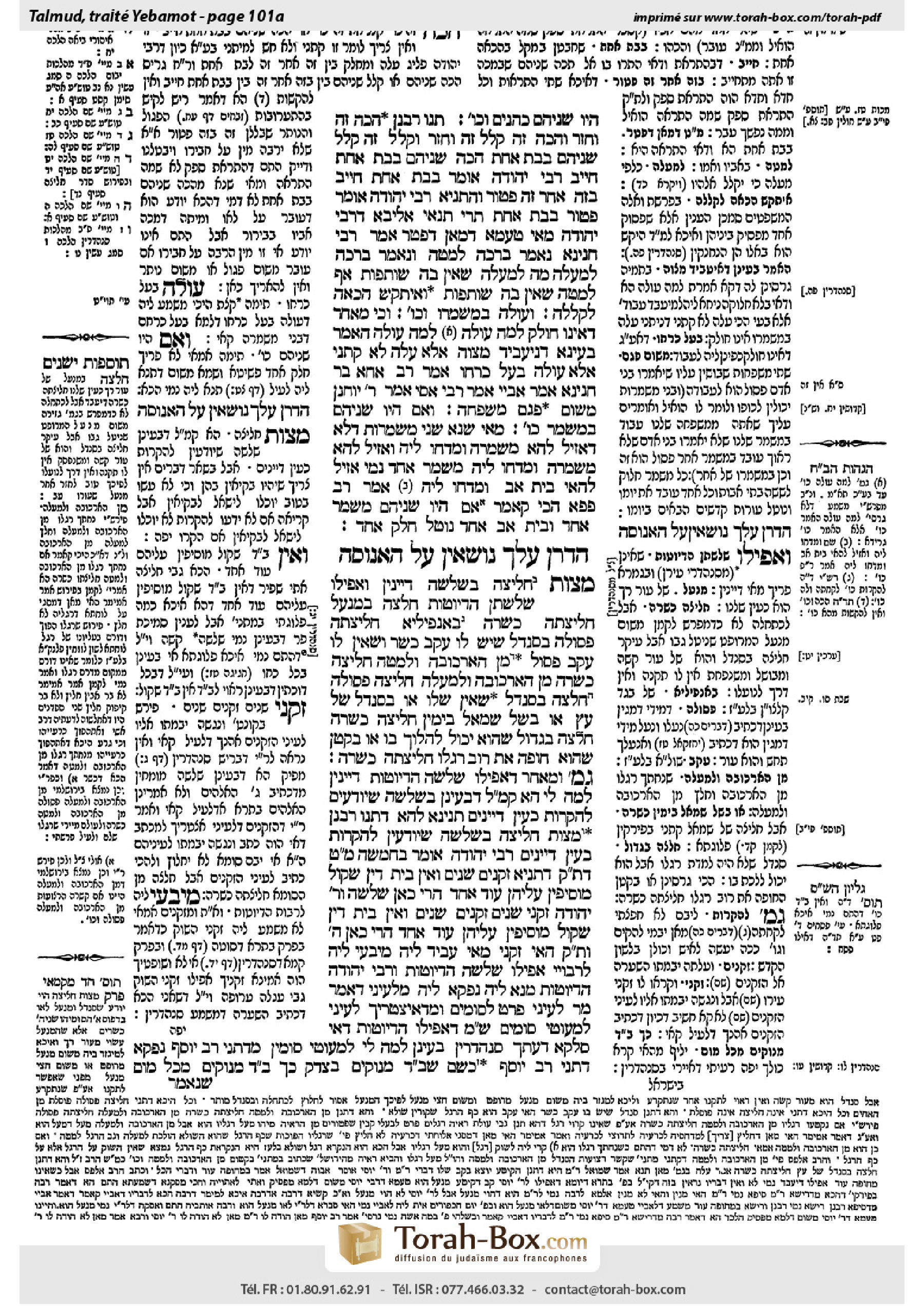
This page of Yevamot includes the Aramaic text, an English translation and an AI-generated French translation, alongside the scan above.
יבמות ק״א א · Aramaic and Hebrew text
הָיוּ שְׁנֵיהֶם כֹּהֲנִים וְכוּ׳. תָּנוּ רַבָּנַן: הִכָּה זֶה וְחָזַר וְהִכָּה זֶה, קִלֵּל זֶה וְחָזַר וְקִלֵּל זֶה, קִלֵּל שְׁנֵיהֶם בְּבַת אַחַת, הִכָּה שְׁנֵיהֶם בְּבַת אַחַת — חַיָּיב. רַבִּי יְהוּדָה אוֹמֵר: בְּבַת אַחַת — חַיָּיב, בָּזֶה אַחַר זֶה — פָּטוּר.
וְהָתַנְיָא, רַבִּי יְהוּדָה אוֹמֵר: פָּטוּר בְּבַת אַחַת! תְּרֵי תַּנָּאֵי אַלִּיבָּא דְּרַבִּי יְהוּדָה.
מַאי טַעְמָא דְּמַאן דְּפָטַר? אָמַר רַבִּי חֲנִינָא: נֶאֶמְרָה בְּרָכָה לְמַטָּה, וְנֶאֶמְרָה בְּרָכָה לְמַעְלָה. מָה לְמַעְלָה שֶׁאֵין בָּהּ שׁוּתָּפוּת — אַף לְמַטָּה שֶׁאֵין בָּהּ שׁוּתָּפוּת. וְאִיתַּקַּשׁ הַכָּאָה לִקְלָלָה.
וְעוֹלֶה בְּמִשְׁמָרוֹ וְכוּ׳. וְכִי מֵאַחַר דְּאֵינוֹ חוֹלֵק, לָמָּה עוֹלֶה? לָמָּה עוֹלֶה?! הָאָמַר: בָּעֵינָא דְּנֶיעְבֵּיד מִצְוָה! אֶלָּא: ״עָלָה״ לָא קָתָנֵי, אֶלָּא ״עוֹלֶה״ — בְּעַל כׇּרְחוֹ.
אָמַר רַב אַחָא בַּר חֲנִינָא אָמַר אַבָּיֵי אָמַר רַבִּי אַסִּי אָמַר רַבִּי יוֹחָנָן: מִשּׁוּם פְּגַם מִשְׁפָּחָה.
וְאִם הָיוּ שְׁנֵיהֶם בְּמִשְׁמָר כּוּ׳. מַאי שְׁנָא שְׁנֵי מִשְׁמָרוֹת דְּלָא — דְּאָזֵיל לְהָא מִשְׁמָרָה וּמְדַחוּ לֵיהּ, וְאָזֵיל לְהָא מִשְׁמָרָה וּמְדַחוּ לֵיהּ. מִשְׁמָר אֶחָד נָמֵי: אָזֵיל לְהַאי בֵּית אָב וּמְדַחוּ לֵיהּ!
אָמַר רַב פָּפָּא, הָכִי קָאָמַר: אִם הָיוּ שְׁנֵיהֶם מִשְׁמָר אֶחָד וּבֵית אָב אֶחָד — נוֹטֵל חֵלֶק אֶחָד.
הֲדַרַן עֲלָךְ נוֹשְׂאִין עַל הָאֲנוּסָה
מִצְוַת חֲלִיצָה בִּשְׁלֹשָׁה דַּיָּינִין, וַאֲפִילּוּ שְׁלָשְׁתָּן הֶדְיוֹטוֹת. חָלְצָה בְּמִנְעָל — חֲלִיצָתָהּ כְּשֵׁרָה, בְּאַנְפִּילְיָא — חֲלִיצָתָהּ פְּסוּלָה. בְּסַנְדָּל שֶׁיֵּשׁ לוֹ עָקֵב — כָּשֵׁר, וְשֶׁאֵין לוֹ עָקֵב — פְּסוּל.
מִן הָאַרְכּוּבָּה וּלְמַטָּה — חֲלִיצָה כְּשֵׁרָה. מִן הָאַרְכּוּבָּה וּלְמַעְלָה — חֲלִיצָה פְּסוּלָה. חָלְצָה בְּסַנְדָּל שֶׁאֵין שֶׁלּוֹ, אוֹ בְּסַנְדָּל שֶׁל עֵץ, אוֹ בְּשֶׁל שְׂמֹאל בְּיָמִין — חֲלִיצָה כְּשֵׁרָה. חָלְצָה בְּגָדוֹל שֶׁהוּא יָכוֹל לַהֲלוֹךְ בּוֹ, אוֹ בְּקָטָן שֶׁהוּא חוֹפֶה אֶת רוֹב רַגְלוֹ — חֲלִיצָתָהּ כְּשֵׁרָה.
גְּמָ׳ וּמֵאַחַר דַּאֲפִילּוּ שְׁלֹשָׁה הֶדְיוֹטוֹת, דַּיָּינִין לְמָה לִי? הָא קָא מַשְׁמַע לַן דְּבָעֵינַן בִּשְׁלֹשָׁה שֶׁיּוֹדְעִים לְהַקְרוֹת כְּעֵין דַּיָּינִים. תְּנֵינָא לְהָא דְּתָנוּ רַבָּנַן: מִצְוַת חֲלִיצָה בִּשְׁלֹשָׁה שֶׁיּוֹדְעִין לְהַקְרוֹת כְּעֵין דַּיָּינִים. רַבִּי יְהוּדָה אוֹמֵר: בַּחֲמִשָּׁה.
מַאי טַעְמָא דְּתַנָּא קַמָּא, דְּתַנְיָא: ״זְקֵנִים״ — שְׁנַיִם, וְאֵין בֵּית דִּין שָׁקוּל, מוֹסִיפִין עֲלֵיהֶן עוֹד אֶחָד — הֲרֵי כָּאן שְׁלֹשָׁה. וְרַבִּי יְהוּדָה: ״זִקְנֵי״ — שְׁנַיִם, ״זְקֵנִים״ — שְׁנַיִם, וְאֵין בֵּית דִּין שָׁקוּל, מוֹסִיפִין עֲלֵיהֶן עוֹד אֶחָד — הֲרֵי כָּאן חֲמִשָּׁה.
וְתַנָּא קַמָּא, הַאי ״זִקְנֵי״ מַאי עָבֵיד לֵיהּ? מִיבְּעֵי לֵיהּ לְרַבּוֹיֵי אֲפִילּוּ שְׁלֹשָׁה הֶדְיוֹטוֹת.
וְרַבִּי יְהוּדָה, הֶדְיוֹטוֹת מְנָא לֵיהּ? נָפְקָא לֵיהּ מִ״לְּעֵינֵי״, דְּאָמַר מָר: ״לְעֵינֵי״ — פְּרָט לְסוֹמִים,
וּמִדְּאִיצְטְרִיךְ ״לְעֵינֵי״ לְמַעוֹטֵי סוֹמִים, שְׁמַע מִינַּהּ דַּאֲפִילּוּ הֶדְיוֹטוֹת. דְּאִי סָלְקָא דַעְתָּךְ סַנְהֶדְרִין בָּעֵינַן, לְמָה לִי לְמַעוֹטֵי סוֹמִין? מִדְּתָנֵי רַב יוֹסֵף נָפְקָא, דְּתָנֵי רַב יוֹסֵף: כְּשֵׁם שֶׁבֵּית דִּין מְנוּקִּים בְּצֶדֶק, כָּךְ בֵּית דִּין מְנוּקִּים מִכׇּל מוּם,
Yevamot 101a · English translation
§ It is stated in the mishna that if both uncertain fathers were priests, the son is exempt from punishment for striking and for cursing them. The Sages taught: If he struck this uncertain father, and then struck that one, or if he cursed this one and then cursed that one, or if he cursed both of them simultaneously or struck both of them simultaneously, in all these cases he is liable to receive capital punishment, as one of them is certainly his father. Rabbi Yehuda says: Although if he struck or cursed both of them simultaneously he is liable, if he struck or cursed them one after the other, he is exempt.
The Gemara asks: But isn’t it taught in a baraita that Rabbi Yehuda says: He is exempt even if he struck or cursed them simultaneously? The Gemara answers: These are the opinions of two tanna’im, and they each expressed their opinion in accordance with that of Rabbi Yehuda.
The Gemara asks: What is the reasoning of the one who exempts the son from punishment? Rabbi Ḥanina said: Blessing is stated below (Leviticus 20:9), with regard to cursing parents, and blessing is stated above (Exodus 22:27), with regard to cursing God. The Sages used the word blessing as a euphemism for cursing, as it was their custom to avoid uncouth language. Just as the statement above, in Exodus, is referring to a curse that does not involve partnership, as God is One, so too the statement below, in Leviticus, is referring exclusively to a curse of a parent that does not involve partnership, i.e., when there is no doubt with regard to his identity. And striking is juxtaposed with cursing. Just as one is not liable for cursing when it is unclear who his father is, the same applies to striking.
§ It is stated in the mishna: And he ascends to the Temple service with the priestly watch of both uncertain fathers. However, he does not receive a share of the offerings of either watch. The Gemara asks: Since he does not receive a share, why does he ascend? The Gemara is puzzled by this question: Why does he ascend? Doesn’t he naturally say: I wish to perform a mitzva by serving as a priest? The Gemara explains: However, note that the mishna does not state: If he ascended, but rather: He ascends, in the present tense. Apparently he is obligated to ascend, even against his will.
Why is he under obligation to serve in the Temple? Rav Aḥa bar Ḥanina said that Abaye said that Rabbi Yoḥanan said: He is obligated due to the potential family flaw, i.e., harm to the family name. If he does not serve with these watches, people will infer that both families are unfit for the priesthood, which is not the case.
It is stated in the mishna: And if both uncertain fathers were in one priestly watch, he receives one share. The Gemara asks: What is different about the case in which the uncertain fathers belonged to two priestly watches, with regard to which the mishna states that the son does not receive a share, and the case in which they belonged to the same watch? Just as in the case where they belonged to two watches, he goes to this watch to receive a share and they reject him, claiming that he belongs to the other watch, and he goes to that watch and they reject him in the same manner, so too, where they belonged to one watch, he goes to this patrilineal family to receive a share on their day, and they reject him, and the other patrilineal family rejects him too, as his true patrilineal family is unknown.
Rav Pappa said that this is what the mishna is saying: If they were both in one priestly watch and one patrilineal family, he receives one share, as he cannot be rejected.
MISHNA: The mitzva of ḥalitza, the ritual through which the yavam frees the yevama of her levirate bonds, must be performed before three judges, and the ritual does not require the judges to be experts fit to adjudicate other matters, as even if all three are laymen, it is acceptable. If she performed ḥalitza while he was wearing a shoe made of soft leather that covers the whole foot, her ḥalitza is valid, but if she performed ḥalitza while he was wearing a soft shoe [anpileya] made of cloth, her ḥalitza is invalid, as it is not considered a real shoe. If ḥalitza was performed while he was wearing a sandal, i.e., footwear made of hard leather, that has a heel, it is valid; but if performed with a sandal without a heel, it is invalid ḥalitza.
If the leg of the yavam was amputated anywhere from the knee down and she performed ḥalitza as he wore a shoe on the stump of his leg, it is valid ḥalitza. If, however, the leg was amputated anywhere from the knee and above, and she performed ḥalitza as he wore a shoe on the stump of his leg, it is invalid ḥalitza. If she performed ḥalitza while the man was wearing a sandal that did not belong to him, or a sandal made of wood, or on the left shoe, which was being worn on his right foot, it is valid ḥalitza. If she performed ḥalitza as the man was wearing a shoe that was too large for him but which he can still walk in, or a shoe that was too small but that covered most of his foot, her ḥalitza is valid.
GEMARA: The Gemara asks: Now that the mishna says that even three laymen are qualified for ḥalitza, why do I need it to mention judges? It would be sufficient to say that the mitzva requires three people. The Gemara answers: This teaches us that we require three people who can at least dictate the verses read during the ḥalitza ritual to the participants like judges, as they are not complete laymen in that they are literate. The Gemara comments: We already learned this halakha in a baraita, as the Sages taught: The mitzva of ḥalitza is performed before three individuals who know how to dictate the verses like judges. Rabbi Yehuda says: Ḥalitza must be performed before five individuals acting as judges.
The Gemara discusses the dispute as to how many individuals must conduct the ḥalitza: What is the reason of the first tanna, who requires three? As it is taught in a baraita concerning ḥalitza: “His yevama shall ascend to the gate to the Elders” (Deuteronomy 25:7). Since the minimum number of the plural term “Elders” is two, and since, in order to prevent a paralyzing disagreement between an even number of judges, a court may not be composed of an even number of judges, one more is added to them. Therefore, there are three judges. And Rabbi Yehuda interprets the verse otherwise, for one verse states: “And the Elders of his city shall call him” (Deuteronomy 25:8), indicating a minimum of two judges, and it says in the following verse “Elders” another time, indicating an additional two people, and since a court may not be composed of an even number of judges, one more is added to them. Therefore, there are five judges.
The Gemara asks: And what does the first tanna do with this second appearance of the word “Elders”? The Gemara explains: He requires it for allowing the inclusion of even three laymen as presiding judges for ḥalitza. The word “Elders” would seem to limit ḥalitza to recognized judges, but since it is mentioned twice, it becomes an instance of the hermeneutic principle that one restrictive expression appearing after another restrictive expression comes to include some additional halakha. Therefore, repeating the restrictive term “Elders” twice actually comes to include laymen rather than exclude them.
The Gemara asks: From where does Rabbi Yehuda derive the halakha that ḥalitza can be done in the presence of laymen? The Gemara answers: He derives it from what is written: “Before the eyes of the Elders” (Deuteronomy 25:9), for the Master said: “Before the eyes of” excludes blind individuals from being the judges conducting the ḥalitza.
And since it was necessary to say “before the eyes of” to exclude blind individuals from being judges for ḥalitza, learn from here that even laymen are qualified to be judges for ḥalitza. For if it enters your mind to say that we require expert judges who are fit to sit on the high court of the Sanhedrin, then why do I need to exclude blind individuals? For that matter can be derived from a baraita that Rav Yosef taught, as Rav Yosef taught: Just as a court must be clean in righteousness, as they are careful to judge others justly, and are free of guilt and suspicion, likewise a court must be clean of any physical blemish, with judges who are physically complete.
Yevamot 101a · Traduction française (IA)
§ La Michna enseigne que si les deux pères possibles étaient prêtres, le fils est exempt de peine pour les avoir frappés ou maudits. Les Sages ont enseigné : S’il a frappé ce père possible, puis l’autre, ou s’il a maudit celui-ci, puis l’autre, ou encore s’il les a maudits tous deux simultanément ou les a frappés tous deux simultanément, dans tous ces cas il est passible de la peine capitale, car l’un d’eux est certainement son père. Rabbi Yehouda dit : Bien que, s’il les a frappés ou maudits tous deux simultanément, il soit passible de la peine capitale, s’il les a frappés ou maudits l’un après l’autre, il est exempt.
La Guemara demande : Mais n’est-il pas enseigné dans une baraïta que Rabbi Yehouda dit : Il est exempt même s’il les a frappés ou maudits simultanément ? La Guemara répond : Ce sont les opinions de deux tannaïm, qui ont chacun exprimé leur opinion conformément à celle de Rabbi Yehouda.
La Guemara demande : Quel est le raisonnement de celui qui exempte le fils de peine ? Rabbi Ḥanina dit : Le terme « bénir » est employé plus loin (Lévitique 20:9), à propos de la malédiction des parents, et plus haut (Exode 22:27), à propos de la malédiction de Dieu. Les Sages employaient le mot « bénir » comme euphémisme pour « maudire », selon leur habitude d’éviter les expressions grossières. De même que le passage de l’Exode parle d’une malédiction qui ne concerne pas plusieurs personnes, puisque Dieu est Un, de même le passage du Lévitique parle exclusivement de la malédiction d’un parent qui ne concerne pas plusieurs personnes, c’est-à-dire lorsque son identité ne fait aucun doute. En outre, le fait de frapper est mis en parallèle avec celui de maudire. De même qu’on n’est pas passible de peine pour avoir maudit son père lorsque l’identité de celui-ci n’est pas certaine, il en va de même pour le fait de le frapper.
§ La Michna enseigne : Il rejoint le service du Temple avec la garde sacerdotale de chacun des deux pères possibles. Cependant, il ne reçoit de part dans les offrandes d’aucune des deux gardes. La Guemara demande : Puisqu’il ne reçoit pas de part, pourquoi y monte-t-il ? La Guemara s’étonne de cette question : Pourquoi y monte-t-il ? Ne peut-il pas simplement dire : « Je souhaite accomplir une mitsva en servant comme prêtre » ? La Guemara explique : Toutefois, remarquons que la Michna ne dit pas : « S’il y est monté », mais plutôt : « Il y monte », au présent. Il semble donc qu’il soit tenu d’y monter, même contre sa volonté.
Pourquoi est-il tenu de servir dans le Temple ? Rav Aḥa bar Ḥanina dit au nom d’Abaye, qui le dit au nom de Rabbi Yoḥanan : Il en a l’obligation afin d’éviter de porter atteinte au nom de la famille. S’il ne sert pas avec ces gardes, les gens en déduiront que les deux familles ne sont pas aptes à la prêtrise, ce qui n’est pas le cas.
La Michna enseigne : Si les deux pères possibles appartenaient à une même garde sacerdotale, il reçoit une part. La Guemara demande : En quoi le cas où les pères possibles appartenaient à deux gardes sacerdotales diffère-t-il du cas où ils appartenaient à la même garde, alors que la Michna dit qu’il ne reçoit pas de part dans le premier cas ? De même que, dans le cas où ils appartenaient à deux gardes, il se rend auprès de l’une pour recevoir une part, mais qu’on le renvoie en affirmant qu’il relève de l’autre, puis qu’il se rend auprès de l’autre garde et qu’on le renvoie de la même manière, de même, lorsqu’ils appartenaient à une seule garde, il se rend auprès de l’une des familles patrilinéaires pour recevoir une part le jour où elle officie, mais on le renvoie, et l’autre famille patrilinéaire le renvoie elle aussi, puisque sa véritable famille patrilinéaire est inconnue.
Rav Pappa dit que voici ce que signifie la Michna : S’ils appartenaient tous deux à la même garde sacerdotale et à la même famille patrilinéaire, il reçoit une part, car on ne peut pas le renvoyer.
MICHNA : La mitsva de ḥalitsa, le rituel par lequel le yavam libère la yevama des liens du lévirat, doit être accomplie devant trois juges. Ceux-ci n’ont pas besoin d’être des experts aptes à juger d’autres affaires : même si tous trois sont des profanes, cela suffit. Si elle a accompli la ḥalitsa alors qu’il portait une chaussure en cuir souple couvrant tout le pied, sa ḥalitsa est valide ; mais s’il portait une chaussure souple en tissu [anpileya], sa ḥalitsa est invalide, car elle n’est pas considérée comme une véritable chaussure. Si la ḥalitsa a été accomplie alors qu’il portait une sandale, c’est-à-dire une chaussure en cuir rigide munie d’un talon, elle est valide ; mais si elle a été accomplie avec une sandale sans talon, elle est invalide.
Si la jambe du yavam a été amputée en dessous du genou, à quelque hauteur que ce soit, et qu’elle a accompli la ḥalitsa alors qu’il portait une chaussure sur le moignon, la ḥalitsa est valide. En revanche, si sa jambe a été amputée au niveau du genou ou au-dessus, et qu’elle a accompli la ḥalitsa alors qu’il portait une chaussure sur le moignon, la ḥalitsa est invalide. Si elle a accompli la ḥalitsa alors que l’homme portait une sandale qui ne lui appartenait pas, une sandale en bois, ou la chaussure gauche au pied droit, la ḥalitsa est valide. Si elle a accompli la ḥalitsa alors que l’homme portait une chaussure trop grande pour lui, mais avec laquelle il pouvait néanmoins marcher, ou une chaussure trop petite, mais couvrant la majeure partie de son pied, sa ḥalitsa est valide.
GUEMARA : La Guemara demande : Puisque la Michna dit que même trois profanes sont qualifiés pour la ḥalitsa, pourquoi précise-t-elle qu’il faut des juges ? Il suffirait de dire que la mitsva requiert trois personnes. La Guemara répond : Cela nous enseigne qu’il faut trois personnes capables au moins de dicter aux participants, comme le feraient des juges, les versets récités pendant le rituel de ḥalitsa ; ce ne sont pas des profanes complets, puisqu’ils savent lire. La Guemara fait remarquer : Nous avons déjà appris cette halakha dans une baraïta, car les Sages ont enseigné : La mitsva de ḥalitsa s’accomplit devant trois personnes qui savent dicter les versets comme des juges. Rabbi Yehouda dit : La ḥalitsa doit être accomplie devant cinq personnes faisant office de juges.
La Guemara examine le désaccord sur le nombre de personnes qui doivent présider à la ḥalitsa : Quel est le raisonnement du premier tanna, qui en exige trois ? Il est enseigné dans une baraïta au sujet de la ḥalitsa : « Sa yevama montera à la porte, auprès des Anciens » (Deutéronome 25:7). Puisque le pluriel « Anciens » désigne au minimum deux personnes, et que, pour éviter qu’un désaccord entre juges en nombre pair ne paralyse le tribunal, celui-ci ne peut être composé d’un nombre pair de juges, on en ajoute un. Il y a donc trois juges. Rabbi Yehouda interprète le verset autrement : un verset dit : « Les Anciens de sa ville le convoqueront » (Deutéronome 25:8), ce qui indique un minimum de deux juges ; puis le verset suivant emploie de nouveau le terme « Anciens », indiquant deux personnes supplémentaires. Et puisque le tribunal ne peut être composé d’un nombre pair de juges, on en ajoute un. Il y a donc cinq juges.
La Guemara demande : Et que fait le premier tanna de cette seconde occurrence du mot « Anciens » ? La Guemara explique : Il s’en sert pour permettre que même trois profanes président à la ḥalitsa en qualité de juges. Le mot « Anciens » semblerait réserver la ḥalitsa à des juges reconnus ; toutefois, puisqu’il est mentionné deux fois, s’applique le principe herméneutique selon lequel une expression restrictive qui apparaît après une autre expression restrictive vient inclure une halakha supplémentaire. Ainsi, la répétition du terme restrictif « Anciens » vient en réalité inclure les profanes, et non les exclure.
La Guemara demande : D’où Rabbi Yehouda déduit-il la halakha selon laquelle la ḥalitsa peut être accomplie en présence de profanes ? La Guemara répond : Il la déduit de ce qui est écrit : « Sous les yeux des Anciens » (Deutéronome 25:9), car le Maître a dit : L’expression « sous les yeux de » exclut les aveugles du nombre des juges chargés de présider à la ḥalitsa.
Et puisqu’il fallait dire « sous les yeux de » afin d’exclure les aveugles du nombre des juges de la ḥalitsa, déduis-en que même des profanes sont qualifiés pour être juges lors de la ḥalitsa. En effet, si l’on pouvait penser qu’il faut des juges experts aptes à siéger au grand tribunal du Sanhédrin, pourquoi serait-il nécessaire d’exclure les aveugles ? Cette question peut être résolue à partir d’une baraïta enseignée par Rav Yossef, car Rav Yossef enseignait : De même qu’un tribunal doit être irréprochable en matière de justice, ses membres veillant à juger les autres équitablement et étant exempts de faute et de tout soupçon, de même un tribunal doit être exempt de toute infirmité physique, et ses juges doivent être physiquement intègres.
Traduction française générée par IA à partir de l’édition anglaise de Sefaria. Vérifie toujours un passage avec le texte source.
Text from Sefaria: William Davidson Edition - Vocalized Aramaic (CC BY NC); William Davidson Edition - English (CC BY NC).