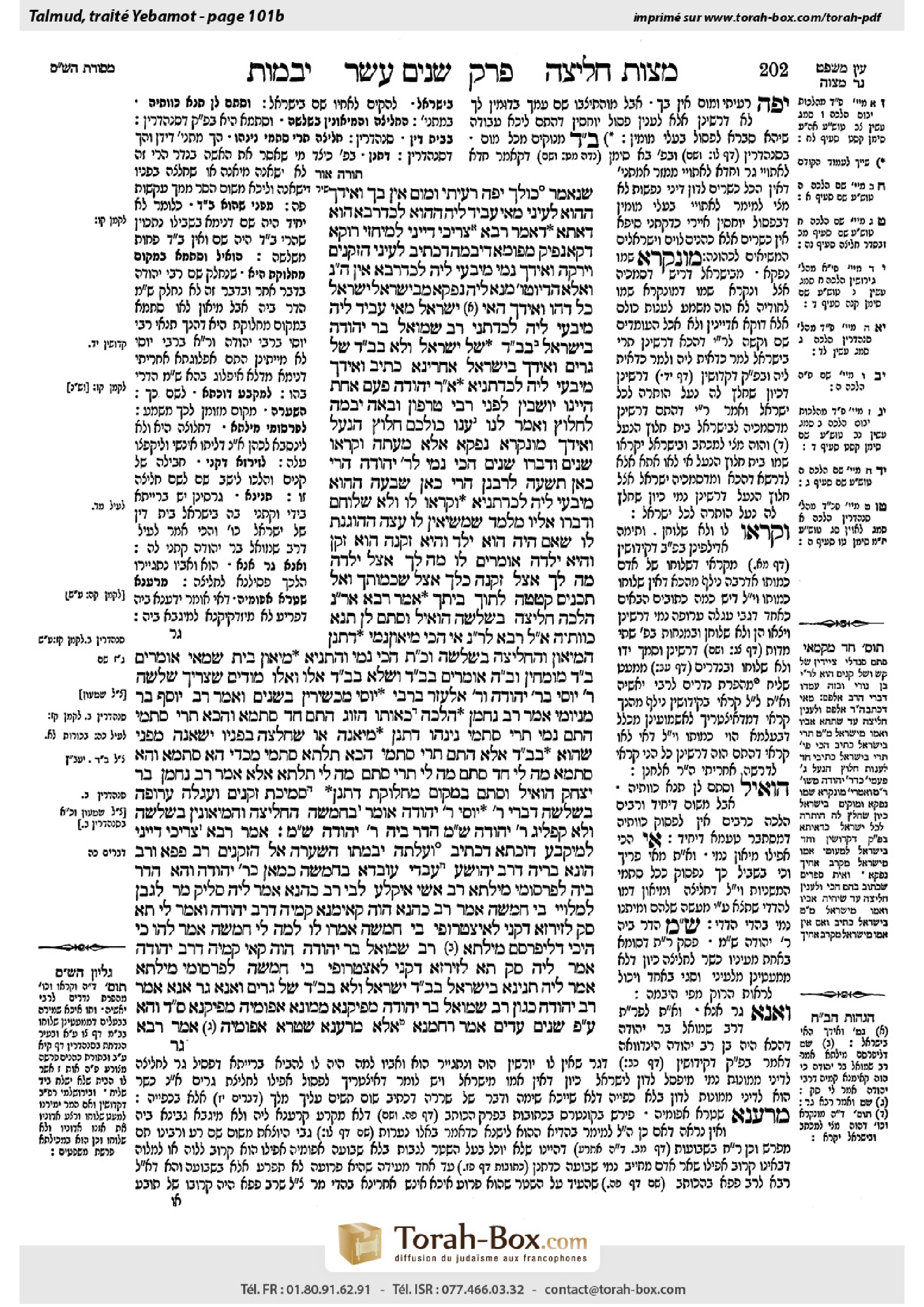
Yevamot 101b: Talmud study for Daf Yomi
Daf Yomi is the daily study of one Talmud folio. Explore 37 tractates with scans, Hebrew text, Sefaria English and AI-generated French translations where annotated.
Passage selection and English or AI-generated French translation are available where the scan has annotations. Daf Study is independent of Torah-Box and Sefaria.
Browse Yevamot · יבמות · All tractatesYevamot 101b text and translations
This page of Yevamot includes the Aramaic text, an English translation and an AI-generated French translation, alongside the scan above.
יבמות ק״א ב · Aramaic and Hebrew text
שֶׁנֶּאֱמַר: ״כֻּלָּךְ יָפָה רַעְיָתִי וּמוּם אֵין בָּךְ״. וְאִידַּךְ: הַהוּא ״לְעֵינֵי״ מַאי עָבֵיד לֵיהּ? הַהוּא לְכִדְרָבָא הוּא דַּאֲתָא. דְּאָמַר רָבָא: צְרִיכִי דַּיָּינֵי לְמִיחְזֵי רוּקָּא דְּקָא נָפֵיק מִפּוּמָּא דִיבָמָה, דִּכְתִיב: ״לְעֵינֵי הַזְּקֵנִים ... וְיָרְקָה״.
וְאִידַּךְ נָמֵי, מִיבְּעֵי לֵיהּ לְכִדְרָבָא! אִין הָכִי נָמֵי, וְאֶלָּא הֶדְיוֹטוֹת מְנָא לֵיהּ? נָפְקָא מִ״בְּיִשְׂרָאֵל״ — יִשְׂרָאֵל כֹּל דְּהוּ.
וְאִידַּךְ, הַאי ״יִשְׂרָאֵל״ מַאי עָבֵיד לֵיהּ? מִיבְּעֵי לֵיהּ לְכִדְתָנֵי רַב שְׁמוּאֵל בַּר יְהוּדָה: ״בְּיִשְׂרָאֵל״ — בְּבֵית דִּין שֶׁל יִשְׂרָאֵל, וְלֹא בְּבֵית דִּין שֶׁל גֵּרִים.
וְאִידַּךְ? ״בְּיִשְׂרָאֵל״ אַחֲרִינָא כְּתִיב. וְאִידַּךְ? מִיבְּעֵי לֵיהּ לְכִדְתַנְיָא, אָמַר רַבִּי יְהוּדָה: פַּעַם אַחַת הָיִינוּ יוֹשְׁבִין לִפְנֵי רַבִּי טַרְפוֹן, וּבָאָה יְבָמָה לַחְלוֹץ, וְאָמַר לָנוּ, עֲנוּ כּוּלְּכֶם: ״חֲלוּץ הַנָּעַל״.
וְאִידַּךְ? מִ״וְּנִקְרָא״ נָפְקָא.
אֶלָּא מֵעַתָּה, ״וְקָרְאוּ״ — שְׁנַיִם, ״וְדִבְּרוּ״ שְׁנַיִם! הָכִי נָמֵי, לְרַבִּי יְהוּדָה הֲרֵי כָּאן תִּשְׁעָה, לְרַבָּנַן הֲרֵי כָּאן שִׁבְעָה!
הָהוּא מִיבְּעֵי לֵיהּ לְכִדְתַנְיָא: ״וְקָרְאוּ לוֹ״ — וְלֹא שְׁלוּחָם, ״וְדִבְּרוּ אֵלָיו״ — מְלַמֵּד שֶׁמַּשִּׂיאִין לוֹ עֵצָה הַהוֹגֶנֶת לוֹ. שֶׁאִם הָיָה הוּא יֶלֶד וְהִיא זְקֵנָה, הוּא זָקֵן וְהִיא יַלְדָּה, אוֹמְרִים לוֹ: מָה לְךָ אֵצֶל יַלְדָּה, מָה לְךָ אֵצֶל זְקֵנָה? כְּלָךְ אֵצֶל שֶׁכְּמוֹתְךָ, וְאַל תַּכְנִיס קְטָטָה לְתוֹךְ בֵּיתְךָ.
אָמַר רָבָא אָמַר רַב נַחְמָן: הֲלָכָה, חֲלִיצָה בִּשְׁלֹשָׁה, הוֹאִיל וּסְתַם לַן תְּנָא כְּווֹתֵיהּ. אֲמַר לֵיהּ רָבָא לְרַב נַחְמָן: אִי הָכִי, מֵיאוּן נָמֵי, דִּתְנַן: הַמֵּיאוּן וְהַחֲלִיצָה בִּשְׁלֹשָׁה.
וְכִי תֵּימָא: הָכִי נָמֵי, וְהָתַנְיָא: מֵיאוּן, בֵּית שַׁמַּאי אוֹמְרִים בֵּית דִּין מוּמְחִין, וּבֵית הִלֵּל אוֹמְרִים: בְּבֵית דִּין וְשֶׁלֹּא בְּבֵית דִּין. אֵלּוּ וְאֵלּוּ מוֹדִים שֶׁצָּרִיךְ שְׁלֹשָׁה. רַבִּי יוֹסֵי בְּרַבִּי יְהוּדָה וְרַבִּי אֶלְעָזָר בְּרַבִּי יוֹסֵי מַכְשִׁירִין בִּשְׁנַיִם. וְאָמַר רַב יוֹסֵף בַּר מִנְיוֹמֵי אָמַר רַב נַחְמָן: הֲלָכָה כְּאוֹתוֹ הַזּוּג.
הָתָם חַד סְתָמָא, וְהָכָא תְּרֵי סְתָמֵי. הָתָם נָמֵי תְּרֵי סְתָמֵי נִינְהוּ, דִּתְנַן: מֵיאֲנָה אוֹ שֶׁחָלְצָה בְּפָנָיו — יִשָּׂאֶנָּה, מִפְּנֵי שֶׁהוּא בְּבֵית דִּין.
אֶלָּא, הָתָם תְּרֵי סְתָמֵי הָכָא תְּלָתָא סְתָמֵי.
מִכְּדֵי הָא סְתָמָא וְהָא סְתָמָא, מָה לִי חַד סְתָם, מָה לִי תְּרֵי סְתָם, מָה לִי תְּלָתָא? אֶלָּא, אָמַר רַב נַחְמָן בַּר יִצְחָק: הוֹאִיל וּסְתָם בִּמְקוֹם מַחְלוֹקֶת,
דִּתְנַן: סְמִיכַת זְקֵנִים וְעֶגְלָה עֲרוּפָה בִּשְׁלֹשָׁה, דִּבְרֵי רַבִּי יוֹסֵי. רַבִּי יְהוּדָה אוֹמֵר: בַּחֲמִשָּׁה. הַחֲלִיצָה וְהַמֵּיאוּנִין בִּשְׁלֹשָׁה, וְלָא קָפָלֵיג רַבִּי יְהוּדָה — שְׁמַע מִינַּהּ הֲדַר בֵּיהּ רַבִּי יְהוּדָה. שְׁמַע מִינַּהּ.
אָמַר רָבָא: צְרִיכִי דַּיָּינֵי לְמִיקְבַּע דּוּכְתָּא, דִּכְתִיב: ״וְעָלְתָה יְבִמְתּוֹ הַשַּׁעְרָה אֶל הַזְּקֵנִים״. רַב פָּפָּא וְרַב הוּנָא בְּרֵיהּ דְּרַב יְהוֹשֻׁעַ עָבְדִי עוֹבָדָא בְּחַמְשָׁה. כְּמַאן — כְּרַבִּי יְהוּדָה, וְהָא הֲדַר בֵּיהּ! לְפִרְסוֹמֵי מִילְּתָא.
רַב אָשֵׁי אִיקְּלַע לְבֵי רַב כָּהֲנָא, אֲמַר לֵיהּ: סְלֵיק מָר לְגַבַּן לְמַלּוֹיֵי בֵּי חַמְשָׁה. אָמַר רַב כָּהֲנָא: הֲוָה קָאֵימְנָא קַמֵּיהּ דְּרַב יְהוּדָה, וַאֲמַר לִי: תָּא סַק לְזִירְזָא דִּקְנֵי, לְאִיצְטְרוֹפֵי בֵּי חַמְשָׁה. אָמְרוּ לוֹ: לְמָה לִי חַמְשָׁה? אֲמַר לְהוּ: כִּי הֵיכִי דְּלִיפַּרְסַם מִילְּתָא.
רַב שְׁמוּאֵל בַּר יְהוּדָה הֲוָה קָאֵי קַמֵּיהּ דְּרַב יְהוּדָה, אֲמַר לֵיהּ: סַק תָּא לְזִירְזָא דִּקְנֵי לְאִצְטְרוֹפֵי בֵּי חַמְשָׁה, לְפַרְסוֹמֵי מִילְּתָא. אֲמַר לֵיהּ, תְּנֵינָא: ״בְּיִשְׂרָאֵל״ — בְּבֵית דִּין יִשְׂרָאֵל וְלֹא בְּבֵית דִּין שֶׁל גֵּרִים, וַאֲנָא גֵּר אֲנָא.
אָמַר רַב יְהוּדָה: כְּגוֹן רַב שְׁמוּאֵל בַּר יְהוּדָה, מַפֵּיקְנָא מָמוֹנָא אַפּוּמֵּיהּ. מַפֵּיקְנָא סָלְקָא דַּעְתָּךְ? וְהָא ״עַל פִּי שְׁנַיִם עֵדִים״ אָמַר רַחֲמָנָא! אֶלָּא: מַרַעְנָא שְׁטָרָא אַפּוּמֵּיהּ.
אָמַר רָבָא:
Yevamot 101b · English translation
This is as it is stated: “You are entirely beautiful, my love, and there is no blemish in you” (Song of Songs 4:7). If the Elders conducting ḥalitza needed to be expert judges, there would be no reason to explicitly exclude the blind, as they are unfit to be judges in a regular court. Evidently it is permitted for laymen to be judges for ḥalitza, and only blind individuals are excluded. The Gemara asks: And the other Sage, the first tanna, what does he do with the verse “before the eyes of”? The Gemara answers: That verse comes for that which Rava taught, as Rava said: The judges must see the spittle that exits from the mouth of the yevama as part of the ceremony of ḥalitza, as it is written: “His yevama shall approach him, before the eyes of the Elders, and remove his shoe from on his foot and spit before him and respond and say: So shall it be done to the man who does not build his brother’s house” (Deuteronomy 25:9).
The Gemara asks: If so, the other Sage, Rabbi Yehuda, should also require “before the eyes” to teach Rava’s statement. The Gemara answers: Yes, this is so, as Rabbi Yehuda understands “before the eyes” as requiring the judges to see the spittle. But then from where does he derive the eligibility of laymen? He derives it from the phrase: “In Israel,” in the verse “And his name shall be called in Israel” (Deuteronomy 25:10), which indicates that any Israelite, even one who is not an expert judge, may preside over ḥalitza.
The Gemara asks: And with regard to the other Sage, the first tanna, what does he do with this phrase: “In Israel”? The Gemara answers: He requires it for that which was taught by Rav Shmuel bar Yehuda: “In Israel” means in a court of Israelites from birth, and not in a court of converts. The mitzva of ḥalitza must be conducted by judges who can trace their lineage to other Jews from birth, and not converts.
The Gemara asks: And with regard to the other Sage, Rabbi Yehuda, from where does he derive this halakha? The Gemara answers: “In Israel” is written another time as well (Deuteronomy 25:7, 10), and that is the source of this principle. And the other, the first tanna, what does he do with this additional “In Israel”? The Gemara explains: He requires it for that which is taught in a baraita, that Rabbi Yehuda said: Once we were sitting in study before Rabbi Tarfon, and a yevama came to perform ḥalitza, and he said to us: After the ḥalitza is completed, you should all respond: “He who had his shoe removed.” He understands the verse “His name shall be called in Israel” (Deuteronomy 25:10) to mean that all those who witness the ḥalitza must respond: “He who had his shoe removed” (Deuteronomy 25:10).
The Gemara asks: And the other, Rabbi Yehuda, from where did he derive this halakha? The Gemara answers: He derives it from the phrase “Shall be called,” that those who attend the ḥalitza must respond aloud.
The Gemara returns to the dispute concerning the number of judges: However, if that is so, that the plural term “Elders” indicates the need for additional judges, there are other plural terms written in the verse that should also indicate the need for additional judges. As the verse states: “And they shall call”; this is referring to two people. “And they shall speak” indicates two more. Therefore, according to Rabbi Yehuda’s interpretation there should be nine judges here, and according to the Rabbis there should be seven here.
The Gemara answers: That verse is necessary for him to derive the halakha that is taught in a baraita: “They shall call him” means the judges themselves and not their agents. “They shall speak to him” teaches that they give him counsel appropriate for him concerning whether he should perform levirate marriage or ḥalitza. For example, if he was a young boy and she was elderly, or if he was elderly and she was a young girl, they would tell him not to enter into levirate marriage because: What are you doing with a young girl if you are an old man? What are you doing with an elderly woman if you are a young boy? Go be with someone like yourself, closer to your own age, and do not bring a quarrel into your household, as the age difference will be a cause for disputes and strife later.
Rava said that Rav Naḥman said: The halakha is that ḥalitza takes place before three men, since the tanna taught us this opinion as an unattributed mishna in the beginning of the chapter, in accordance with this opinion, indicating that this is the halakha. After he heard him say this, Rava said to Rav Naḥman: If that is so, then declarations of refusal, written on behalf of a girl who as a minor was married to a man by her brother or mother after the death of her father, and is given the right to refuse the marriage upon reaching majority, also should be performed before three men. As we learned in a mishna (25b): Declarations of refusal and ḥalitza are performed before three judges.
And if you would say that indeed three men are required, but isn’t it taught in a baraita: With regard to refusal, Beit Shammai say that a declaration of refusal may be performed only by a court of experts, and Beit Hillel say: It may be performed in a court of experts, or not in a court of experts. Both concede that whether the judges are experts or not, three men are required. On the other hand, Rabbi Yosei, son of Rabbi Yehuda, and Rabbi Elazar, son of Rabbi Yosei, validate declarations of refusal even before two men. And Rav Yosef bar Minyumi said that Rav Naḥman said: The halakha follows that pair. Evidently, Rav Naḥman is willing to rule differently from the unattributed mishna that rules that three judges are necessary for ḥalitza.
The Gemara answers: There, with respect to declarations of refusal, there is only one unattributed mishna (Sanhedrin 2a) that states that refusals are performed before three judges, and here, there are two unattributed mishnayot that state that ḥalitza is performed before three judges, both here and also in that same mishna in tractate Sanhedrin. The Gemara challenges the previous claim: There too, with regard to refusals, there are two unattributed mishnayot, as we learned in a mishna (25b): If she made a declaration of refusal or performed ḥalitza before a judge, this judge may marry her if he wishes to, as there is no suspicion of ulterior motives, because he is a member of a court. This mishna implies that declarations of refusal may take place only before a court.
The Gemara concedes: Rather, there, with regard to refusals, there are only two unattributed statements found in the mishna, and here, with regard to ḥalitza, there are three unattributed statements found in the mishna. That convinces us to rule in accordance with those three sources requiring three for ḥalitza.
The Gemara asks: Since this is supported by an unattributed mishna and that is supported by an unattributed mishna, what difference does it make to me if there is one unattributed mishna? What difference does it make to me if there are two unattributed mishnayot? What difference does it make to me if there are three unattributed mishnayot? Rather, Rav Naḥman bar Yitzḥak said: This ruling was made because the unattributed mishna, which states that ḥalitza requires three men, is recorded unequivocally in a place where it is adjacent to a different dispute involving Rabbi Yehuda.
As we learned in a mishna (Sanhedrin 2a): Ordination of Elders and the ceremony of the heifer whose neck is broken are performed before three judges; this is the statement of Rabbi Yosei. Rabbi Yehuda says: Before five. Ḥalitza and declarations of refusal are performed before three. The Gemara explains the rationale to rule on the basis of this mishna that ḥalitza should in fact be performed before three: And since Rabbi Yehuda did not dispute this second statement concerning ḥalitza even though he disputed the first halakha in the mishna, learn from here: Rabbi Yehuda retracted his opinion concerning ḥalitza and no longer required that it be performed before five men. The Gemara concludes: Indeed, learn from here that he retracted his opinion, and three judges are sufficient for conducting ḥalitza.
§ The Gemara begins a discussion concerning the halakhic details of ḥalitza. Rava said: The judges need to establish a location ahead of time where the ḥalitza will be performed, as it is written: “His yevama shall ascend to the gate to the Elders” (Deuteronomy 25:7), indicating that there is an established place, “the gate,” for the court to convene for ḥalitza. The Gemara relates: Rav Pappa and Rav Huna, son of Rav Yehoshua, conducted a case of ḥalitza before five judges. The Gemara asks: In accordance with whose opinion were they ruling? If you say they ruled in accordance with the opinion of Rabbi Yehuda, but it was proven above that Rabbi Yehuda retracted his initial opinion and requires only three judges. The Gemara answers: They did this only to publicize the matter and not because this number of judges is required.
It is told further: Rav Ashi once happened to come to Rav Kahana’s house. Rav Kahana said to Rav Ashi: Will the master come up with us to complete the quorum of five men in order to perform ḥalitza? Rav Kahana said further: When I stood before Rav Yehuda, he said to me: Go up to the bundle [zirza] of reeds to join the five men who will oversee the performance of ḥalitza, as a bundle of reeds had been set aside to be the established location where the court will convene to conduct cases of ḥalitza. Those in attendance said to Rav Yehuda: Why do I need five if three are sufficient? He said to them: In order to publicize the matter, and not because it is a halakhic obligation.
It is told: Rav Shmuel bar Yehuda was standing before Rav Yehuda. Rav Yehuda said to him: Go up to the bundle of reeds to complete the quorum of five in order to publicize the matter of this ḥalitza. Rav Shmuel bar Yehuda said to him: We learned that the phrase “In Israel” in the verse: “And his name shall be called in Israel” (Deuteronomy 25:10) indicates that ḥalitza must be performed before a court of Israelites from birth, and not before a court composed of converts, but I am a convert, as Rav Shmuel bar Yehuda had converted along with his father.
Rav Yehuda said to him: I would exact payment based on the word of someone such as Rav Shmuel bar Yehuda, as he has shown that he is upright and honest by revealing this unknown fact about himself. The Gemara questions: Does it enter your mind that one can actually exact payment based on the word of one man, no matter how honest he seems to be? Doesn’t the Merciful One state in the Torah: “By the mouth of two witnesses or by the mouth of three witnesses, shall a matter be established” (Deuteronomy 19:15), indicating that one can exact payment based only on the evidence of at least two witnesses? Rather, the Gemara explains that Rav Yehuda’s intention was to say: I would declare a bill of indebtedness invalid based on his word, accepting his claim that the debt had been collected.
Parenthetical to mentioning the status of a convert with regard to a court of ḥalitza, the Gemara relates: Rava said:
Yevamot 101b · Traduction française (IA)
C’est ce qu’indique le verset : « Tu es toute belle, mon aimée, et il n’y a pas de défaut en toi » (Cantique des Cantiques 4:7). Si les Anciens qui procèdent à la ḥalitsa devaient être des juges experts, il n’y aurait aucune raison d’exclure explicitement les aveugles, puisqu’ils sont inaptes à siéger comme juges dans un tribunal ordinaire. Il apparaît donc que des hommes ordinaires peuvent juger lors d’une ḥalitsa et que seuls les aveugles en sont exclus. La Guemara demande : Et l’autre Sage, le premier tanna, que fait-il de l’expression « devant les yeux de » ? La Guemara répond : Cette expression est nécessaire pour enseigner ce que Rava a enseigné. Rava a dit que les juges doivent voir le crachat qui sort de la bouche de la yevama pendant la cérémonie de ḥalitsa, comme il est écrit : « Sa yevama s’approchera de lui, devant les yeux des Anciens, lui retirera sa chaussure du pied, crachera devant lui et répondra en disant : Ainsi sera fait à l’homme qui ne bâtit pas la maison de son frère » (Deutéronome 25:9).
La Guemara demande : Si tel est le cas, l’autre Sage, Rabbi Yehuda, devrait lui aussi avoir besoin de l’expression « devant les yeux de » pour enseigner ce que Rava a dit. La Guemara répond : C’est bien le cas : Rabbi Yehuda comprend que cette expression exige que les juges voient le crachat. Mais d’où déduit-il alors que des hommes ordinaires sont aptes ? Il le déduit de l’expression « en Israël », dans le verset « Son nom sera appelé en Israël » (Deutéronome 25:10), qui indique que tout Israélite, même s’il n’est pas un juge expert, peut présider à la ḥalitsa.
La Guemara demande : Et l’autre Sage, le premier tanna, que fait-il de cette expression : « en Israël » ? La Guemara répond : Il en a besoin pour enseigner ce que Rav Shmuel bar Yehuda a enseigné : « En Israël » signifie dans un tribunal composé d’Israélites de naissance, et non dans un tribunal composé de convertis. La mitsva de ḥalitsa doit être accomplie par des juges dont l’ascendance remonte à des Juifs de naissance, et non par des convertis.
La Guemara demande : Et l’autre Sage, Rabbi Yehuda, d’où déduit-il cette halakha ? La Guemara répond : L’expression « en Israël » apparaît également une autre fois (Deutéronome 25:7, 10), et c’est la source de ce principe. Et l’autre Sage, le premier tanna, que fait-il de cette occurrence supplémentaire de « en Israël » ? La Guemara explique : Il en a besoin pour la baraïta suivante. Rabbi Yehuda a dit : Un jour, nous étions assis à étudier devant Rabbi Tarfon lorsqu’une yevama est venue accomplir la ḥalitsa. Rabbi Tarfon nous a dit : Après la ḥalitsa, vous répondrez tous : « Celui dont la chaussure a été retirée. » Il comprend le verset « Son nom sera appelé en Israël » (Deutéronome 25:10) comme signifiant que tous ceux qui assistent à la ḥalitsa doivent répondre : « Celui dont la chaussure a été retirée » (Deutéronome 25:10).
La Guemara demande : Et l’autre Sage, Rabbi Yehuda, d’où déduit-il cette halakha ? La Guemara répond : Il la déduit de l’expression « sera appelé », qui indique que ceux qui assistent à la ḥalitsa doivent répondre à haute voix.
La Guemara revient au débat sur le nombre de juges : Toutefois, si tel est le cas, si le pluriel « Anciens » indique qu’il faut des juges supplémentaires, d’autres termes au pluriel figurant dans le verset devraient également indiquer qu’il en faut davantage. En effet, le verset dit : « Et ils l’appelleront », ce qui désigne deux personnes. « Et ils lui parleront » en indique deux autres. Par conséquent, selon l’interprétation de Rabbi Yehuda, il faudrait ici neuf juges, et selon les Rabbins, sept.
La Guemara répond : Cette expression est nécessaire pour enseigner la halakha transmise dans une baraïta : « Ils l’appelleront » signifie que les juges eux-mêmes doivent l’appeler, et non leurs mandataires. « Ils lui parleront » enseigne qu’ils lui donnent un conseil adapté à sa situation pour l’aider à décider s’il doit contracter un mariage léviratique ou accomplir la ḥalitsa. Par exemple, s’il est un jeune garçon et qu’elle est âgée, ou s’il est âgé et qu’elle est une jeune fille, ils lui diraient de ne pas contracter de mariage léviratique : « Que ferais-tu d’une jeune fille, toi qui es un vieil homme ? Que ferais-tu d’une femme âgée, toi qui es un jeune garçon ? Va avec quelqu’un comme toi, plus proche de ton âge, et n’introduis pas de querelle dans ton foyer », car leur différence d’âge serait plus tard une source de disputes et de conflits.
Rava a dit au nom de Rav Naḥman : La halakha est que la ḥalitsa a lieu devant trois hommes, puisque le tanna nous a enseigné cette opinion sous la forme d’une Michna anonyme, au début du chapitre, ce qui indique que telle est la halakha. Après l’avoir entendu dire cela, Rava dit à Rav Naḥman : Si tel est le cas, les déclarations de refus — faites pour une fille mineure que son frère ou sa mère a mariée à un homme après la mort de son père, et qui obtient le droit de refuser ce mariage lorsqu’elle atteint la majorité — devraient elles aussi avoir lieu devant trois hommes. En effet, nous avons appris dans une Michna (25b) : Les déclarations de refus et la ḥalitsa ont lieu devant trois juges.
Et si tu dis qu’en effet, trois hommes sont requis, n’est-il pas enseigné dans une baraïta : En ce qui concerne le refus, Beit Shammaï disent qu’une déclaration de refus ne peut être faite que devant un tribunal de juges experts, tandis que Beit Hillel disent qu’elle peut être faite devant un tribunal de juges experts ou devant un tribunal qui ne l’est pas. Tous deux reconnaissent que, experts ou non, les juges doivent être au nombre de trois. En revanche, Rabbi Yosei, fils de Rabbi Yehuda, et Rabbi Elazar, fils de Rabbi Yosei, valident les déclarations de refus même si elles sont faites devant deux hommes. Et Rav Yossef bar Minyumi a dit au nom de Rav Naḥman : La halakha suit cette paire. Il apparaît donc que Rav Naḥman accepte de statuer différemment de la Michna anonyme qui exige trois juges pour la ḥalitsa.
La Guemara répond : Là-bas, concernant les déclarations de refus, il n’y a qu’une seule Michna anonyme (Sanhédrin 2a) qui affirme que les refus ont lieu devant trois juges, tandis qu’ici, il y a deux Michnayot anonymes qui affirment que la ḥalitsa a lieu devant trois juges : celle-ci et la même Michna du traité Sanhédrin. La Guemara conteste l’argument précédent : Là-bas aussi, à propos des refus, il y a deux Michnayot anonymes, car nous avons appris dans une Michna (25b) : Si elle a fait une déclaration de refus ou accompli la ḥalitsa devant un juge, celui-ci peut l’épouser s’il le souhaite, car il n’y a pas lieu de soupçonner une motivation intéressée, puisqu’il est membre d’un tribunal. Cette Michna implique que les déclarations de refus ne peuvent avoir lieu que devant un tribunal.
La Guemara reconnaît : En réalité, là-bas, à propos des refus, il n’y a que deux enseignements anonymes dans la Michna, tandis qu’ici, à propos de la ḥalitsa, il y en a trois. Cela nous convainc de statuer conformément à ces trois sources, qui exigent trois juges pour la ḥalitsa.
La Guemara demande : Puisque chaque position est appuyée par une Michna anonyme, quelle différence cela fait-il qu’il y ait une Michna anonyme ? Quelle différence cela fait-il qu’il y ait deux Michnayot anonymes ? Quelle différence cela fait-il qu’il y en ait trois ? Rav Naḥman bar Yitsḥak a plutôt dit : Cette décision a été prise parce que la Michna anonyme qui affirme que la ḥalitsa exige trois hommes est formulée sans équivoque à un endroit où elle côtoie un autre désaccord impliquant Rabbi Yehuda.
En effet, nous avons appris dans une Michna (Sanhédrin 2a) : L’ordination des Anciens et la cérémonie de la génisse dont on brise la nuque ont lieu devant trois juges ; telle est la déclaration de Rabbi Yosei. Rabbi Yehuda dit : Devant cinq. La ḥalitsa et les déclarations de refus ont lieu devant trois. La Guemara explique pourquoi cette Michna permet de statuer que la ḥalitsa doit en fait avoir lieu devant trois : puisque Rabbi Yehuda ne conteste pas cette seconde affirmation, concernant la ḥalitsa, bien qu’il conteste la première halakha de la Michna, déduis-en qu’il est revenu sur son opinion concernant la ḥalitsa et n’exige plus qu’elle ait lieu devant cinq hommes. La Guemara conclut : En effet, déduis-en qu’il est revenu sur son opinion et que trois juges suffisent pour accomplir la ḥalitsa.
§ La Guemara commence à examiner les détails halakhiques de la ḥalitsa. Rava a dit : Les juges doivent fixer à l’avance un lieu où la ḥalitsa sera accomplie, comme il est écrit : « Sa yevama montera à la porte, vers les Anciens » (Deutéronome 25:7), ce qui indique qu’il existe un lieu établi, « la porte », où le tribunal se réunit pour la ḥalitsa. La Guemara rapporte : Rav Pappa et Rav Huna, fils de Rav Yehoshua, ont instruit une affaire de ḥalitsa devant cinq juges. La Guemara demande : Selon l’opinion de qui statuaient-ils ? Si tu dis qu’ils statuaient conformément à l’opinion de Rabbi Yehuda, il a pourtant été établi plus haut que Rabbi Yehuda est revenu sur son opinion initiale et n’exige plus que trois juges. La Guemara répond : Ils ont fait cela uniquement pour rendre l’affaire publique, et non parce que ce nombre de juges est requis.
On raconte aussi : Rav Ashi se trouvait un jour chez Rav Kahana. Rav Kahana dit à Rav Ashi : « Le maître viendra-t-il avec nous pour compléter le quorum de cinq hommes en vue d’accomplir la ḥalitsa ? » Rav Kahana ajouta : « Lorsque je me tenais devant Rav Yehuda, celui-ci me dit : “Monte jusqu’au faisceau [zirza] de roseaux pour rejoindre les cinq hommes qui assisteront à la ḥalitsa”, car un faisceau de roseaux avait été réservé comme lieu fixe où le tribunal se réunirait pour traiter les affaires de ḥalitsa. » Les personnes présentes demandèrent à Rav Yehuda : « Pourquoi en faut-il cinq si trois suffisent ? » Il leur répondit : « C’est pour rendre l’affaire publique, et non parce que c’est une obligation halakhique. »
On raconte : Rav Shmuel bar Yehuda se tenait devant Rav Yehuda. Rav Yehuda lui dit : « Monte jusqu’au faisceau de roseaux pour compléter le quorum de cinq et rendre publique cette ḥalitsa. » Rav Shmuel bar Yehuda lui répondit : « Nous avons appris que l’expression “en Israël”, dans le verset “Son nom sera appelé en Israël” (Deutéronome 25:10), indique que la ḥalitsa doit être accomplie devant un tribunal composé d’Israélites de naissance, et non devant un tribunal composé de convertis. Or, je suis un converti », car Rav Shmuel bar Yehuda s’était converti avec son père.
Rav Yehuda lui dit : « Je recouvrerais une créance en me fondant sur la parole d’une personne comme Rav Shmuel bar Yehuda, puisqu’en révélant spontanément ce fait jusque-là inconnu, il a montré qu’il est droit et honnête. » La Guemara s’interroge : Peut-on vraiment envisager de recouvrer une créance sur la parole d’un seul homme, aussi honnête qu’il paraisse ? Le Miséricordieux ne dit-il pas dans la Torah : « C’est sur la déposition de deux témoins, ou sur celle de trois témoins, qu’une affaire sera établie » (Deutéronome 19:15), ce qui indique qu’on ne peut recouvrer une créance que sur la preuve d’au moins deux témoins ? La Guemara explique plutôt que Rav Yehuda voulait dire : « J’invaliderais un acte de reconnaissance de dette sur la foi de sa parole », acceptant ainsi son affirmation selon laquelle la dette avait été remboursée.
À propos du statut d’un converti au sein d’un tribunal de ḥalitsa, la Guemara rapporte incidemment : Rava a dit :
Traduction française générée par IA à partir de l’édition anglaise de Sefaria. Vérifie toujours un passage avec le texte source.
Text from Sefaria: William Davidson Edition - Vocalized Aramaic (CC BY NC); William Davidson Edition - English (CC BY NC).