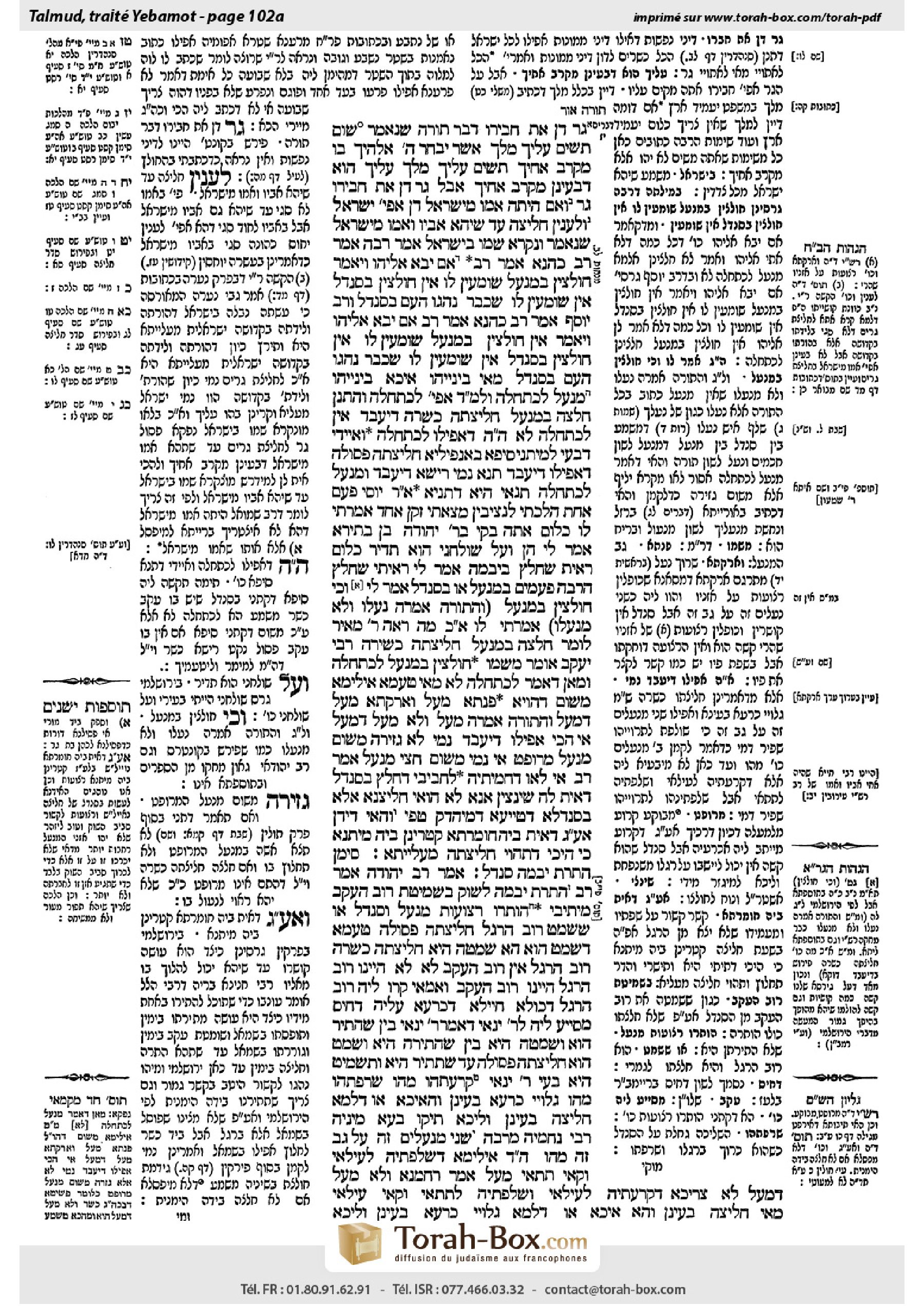
Yevamot 102a: Talmud study for Daf Yomi
Daf Yomi is the daily study of one Talmud folio. Explore 37 tractates with scans, Hebrew text, Sefaria English and AI-generated French translations where annotated.
Passage selection and English or AI-generated French translation are available where the scan has annotations. Daf Study is independent of Torah-Box and Sefaria.
Browse Yevamot · יבמות · All tractatesYevamot 102a text and translations
This page of Yevamot includes the Aramaic text, an English translation and an AI-generated French translation, alongside the scan above.
יבמות ק״ב א · Aramaic and Hebrew text
גֵּר דָּן אֶת חֲבֵירוֹ דְּבַר תּוֹרָה, שֶׁנֶּאֱמַר: ״שׂוֹם תָּשִׂים עָלֶיךָ מֶלֶךְ אֲשֶׁר יִבְחַר ה׳ אֱלֹהֶיךָ בּוֹ מִקֶּרֶב אַחֶיךָ תָּשִׂים עָלֶיךָ מֶלֶךְ״. ״עָלֶיךָ״ הוּא דְּבָעֵינַן ״מִקֶּרֶב אַחֶיךָ״, אֲבָל גֵּר דָּן אֶת חֲבֵירוֹ גֵּר.
וְאִם הָיְתָה אִמּוֹ מִיִּשְׂרָאֵל — דָּן אֲפִילּוּ יִשְׂרָאֵל. וּלְעִנְיַן חֲלִיצָה עַד שֶׁיְּהֵא אָבִיו וְאִמּוֹ מִיִּשְׂרָאֵל, שֶׁנֶּאֱמַר: ״וְנִקְרָא שְׁמוֹ בְּיִשְׂרָאֵל״.
אָמַר רַבָּה אָמַר רַב כָּהֲנָא אָמַר רַב: אִם יָבֹא אֵלִיָּהוּ וְיֹאמַר: ״חוֹלְצִין בְּמִנְעָל״ — שׁוֹמְעִין לוֹ. ״אֵין חוֹלְצִין בְּסַנְדָּל״ — אֵין שׁוֹמְעִין לוֹ, שֶׁכְּבָר נָהֲגוּ הָעָם בְּסַנְדָּל.
וְרַב יוֹסֵף אָמַר רַב כָּהֲנָא אָמַר רַב: אִם יָבֹא אֵלִיָּהוּ וְיֹאמַר: ״אֵין חוֹלְצִין בְּמִנְעָל״ — שׁוֹמְעִין לוֹ. ״אֵין חוֹלְצִין בְּסַנְדָּל״ — אֵין שׁוֹמְעִין לוֹ, שֶׁכְּבָר נָהֲגוּ הָעָם בְּסַנְדָּל.
מַאי בֵּינַיְיהוּ? אִיכָּא בֵּינַיְיהוּ מִנְעָל לְכַתְּחִלָּה.
וּלְמַאן דְּאָמַר אֲפִילּוּ לְכַתְּחִלָּה, וְהָתְנַן: חָלְצָה בְּמִנְעָל — חֲלִיצָתָהּ כְּשֵׁרָה. דִּיעֲבַד אִין, לְכַתְּחִלָּה לָא!
הוּא הַדִּין דַּאֲפִילּוּ לְכַתְּחִלָּה. וְאַיְּידֵי דְבָעֵי לְמִיתְנֵי סֵיפָא בְּאַנְפִּילְיָא חֲלִיצָתָהּ פְּסוּלָה, דַּאֲפִילּוּ דִּיעֲבַד, תְּנָא נָמֵי רֵישָׁא דִּיעֲבַד.
וּמִנְעָל לְכַתְּחִלָּה תַּנָּאֵי הִיא. דְּתַנְיָא, אָמַר רַבִּי יוֹסֵי: פַּעַם אַחַת הָלַכְתִּי לִנְצִיבִין, מָצָאתִי זָקֵן אֶחָד. אָמַרְתִּי לוֹ: כְּלוּם אַתָּה בָּקִי בְּרַבִּי יְהוּדָה בֶּן בְּתֵירָא? אָמַר לִי: הֵן, וְעַל שׁוּלְחָנִי הוּא תָּדִיר. כְּלוּם רָאִיתָ שֶׁחָלַץ בִּיבָמָה?
אָמַר לִי: רָאִיתִי שֶׁחָלַץ הַרְבֵּה פְּעָמִים. בְּמִנְעָל אוֹ בְּסַנְדָּל? אָמַר לִי: וְכִי חוֹלְצִין בְּמִנְעָל?! (וְהַתּוֹרָה אָמְרָה ״נַעֲלוֹ״, וְלֹא מִנְעָלוֹ), אָמַרְתִּי לוֹ: אִם כֵּן, מָה רָאָה רַבִּי מֵאִיר לוֹמַר חָלְצָה בְּמִנְעָל חֲלִיצָתָהּ כְּשֵׁירָה?!
רַבִּי יַעֲקֹב אוֹמֵר מִשְּׁמוֹ: חוֹלְצִין בְּמִנְעָל לְכַתְּחִלָּה. וּמַאן דְּאָמַר לְכַתְּחִלָּה לָא, מַאי טַעְמָא?
אִילֵּימָא מִשּׁוּם דְּהָוְיָא פַּנְתָּא מֵעַל וְאַרְקְתָא מֵעַל דְּמֵעַל, וְהַתּוֹרָה אָמְרָה ״מֵעַל״, וְלֹא מֵעַל דְּמֵעַל — אִי הָכִי, אֲפִילּוּ דִּיעֲבַד נָמֵי לָא!
גְּזֵירָה מִשּׁוּם מִנְעָל מְרוּפָּט.
אִי נָמֵי מִשּׁוּם חֲצִי מִנְעָל.
אָמַר רַב: אִי לָאו דַּחֲמֵיתֵיהּ לְחַבִּיבִי דַּחֲלַץ בְּסַנְדָּל דְּאִית לֵהּ שִׁינְצִין, אֲנָא לָא הֲוַאי חָלֵיצְנָא אֶלָּא בְּסַנְדָּלָא דְטַיָּיעָא דְּמִיהַדַּק טְפֵי. וְהַאי דִּידַן, אַף עַל גַּב דְּאִית בֵּיהּ חוּמַרְתָּא, קָטְרִינַן בֵּיהּ מִיתְנָא, כִּי הֵיכִי דְּתֶהְוֵי חֲלִיצָתָהּ מְעַלַּיְיתָא.
סִימַן: הַתָּרַת יְבָמָה סַנְדָּל. אָמַר רַב יְהוּדָה אָמַר רַב: הַתָּרַת יְבָמָה לַשּׁוּק — בִּשְׁמִיטַת רוֹב הֶעָקֵב.
מֵיתִיבִי: הוּתְּרוּ רְצוּעוֹת מִנְעָל וְסַנְדָּל, אוֹ שֶׁשָּׁמַט רוֹב הָרֶגֶל — חֲלִיצָתָהּ פְּסוּלָה.
טַעְמָא דְּשָׁמַט הוּא, הָא שָׁמְטָה הִיא — חֲלִיצָתָהּ כְּשֵׁרָה. רוֹב הָרֶגֶל אִין, רוֹב הֶעָקֵב לָא!
לֹא: הַיְינוּ רוֹב הָרֶגֶל, הַיְינוּ רוֹב הֶעָקֵב. וְאַמַּאי קָרוּ לֵיהּ רוֹב הָרֶגֶל — דְּכוּלָּא חֵיילָא דְכַרְעָא עֲלֵיהּ דְּחִיס.
מְסַיַּיע לֵיהּ לְרַבִּי יַנַּאי: דְּאָמַר רַבִּי יַנַּאי בֵּין שֶׁהִתִּיר הוּא וְשָׁמְטָה הִיא, בֵּין שֶׁהִתִּירָה הִיא וְשָׁמַט הוּא — חֲלִיצָתָהּ פְּסוּלָה, עַד שֶׁתַּתִּיר הִיא וְתַשְׁמִיט הִיא. בָּעֵי רַבִּי יַנַּאי: קְרָעַתְהוּ, מַהוּ? שְׂרָפַתְהוּ, מַהוּ? גַּלּוֹיֵי כַּרְעָא בָּעֵינַן, וְהָאִיכָּא? אוֹ דִלְמָא חֲלִיצָה בָּעֵינַן, וְלֵיכָּא? תֵּיקוּ.
בְּעָא מִינֵּיהּ רַבִּי נְחֶמְיָה מֵרַבָּה: שְׁנֵי מִנְעָלִים זֶה עַל גַּב זֶה, מַהוּ? הֵיכִי דָמֵי: אִילֵּימָא דִּשְׁלַפְתֵּיהּ לְעִילַּאי וְקָאֵי תַּתַּאי — ״מֵעַל״ אָמַר רַחֲמָנָא, וְלֹא מֵעַל דְּמֵעַל. לָא צְרִיכָא: דִּקְרַעְתֵּיהּ לְעִילַּאי וּשְׁלַפְתֵּיהּ לְתַתַּאי, וְקָאֵי עִילַּאי, מַאי? חֲלִיצָה בָּעֵינַן, וְהָא אִיכָּא? אוֹ דִלְמָא גַּלּוֹיֵי כַּרְעָא בָּעֵינַן, וְלֵיכָּא?
Yevamot 102a · English translation
By Torah law a convert may judge his fellow convert, as it is stated: “You shall set a king over you, whom the Lord your God shall choose; one from among your brothers you shall set king over you” (Deuteronomy 17:15). The Gemara deduces from the terminology of the phrase “over you,” i.e., when presiding over Jews by birth either as a king, a judge, or any other official, that from here it is where we require that the official must be: “From among your brothers,” meaning a Jew by birth. However, a convert may judge his fellow convert, as the requirement of “one from among your brothers” doesn’t apply when presiding over fellow converts.
And if the convert’s mother was from Israel, he may even preside as a judge in a court to adjudicate legal matters involving a native-born Jew. But with regard to ḥalitza, he may not act as a judge unless both his father and his mother were from Israel from birth, as it is stated with regard to ḥalitza: “And his name shall be called in Israel: The house of he who had his shoe removed” (Deuteronomy 25:10), implying that he must be born as a member of the Jewish people from both of his parents.
§ Rabba said that Rav Kahana said that Rav said: If Elijah the Prophet should come and say: One may perform ḥalitza using a soft leather shoe, the Rabbis would listen to him. But if he says: One may not perform ḥalitza using a hard leather sandal, they would not listen to him, for the people already have established the practice of performing ḥalitza using a sandal.
And Rav Yosef said that Rav Kahana said that Rav said: If Elijah the Prophet should come and say: One may not perform ḥalitza using a soft leather shoe, they would listen to him. But if he says: One may not perform ḥalitza using a hard leather sandal, they would not listen to him, for the people already have established the practice of performing ḥalitza using a sandal.
The Gemara asks: What is the practical difference between these two opinions? Seemingly, they both say the same thing. The Gemara answers: The practical difference between them is with respect to performing ḥalitza with a soft leather shoe ab initio. According to Rabba’s opinion, one may not perform ḥalitza this way ab initio, as Rabba said that only if Elijah comes and permits it would he be heeded, implying that until Elijah does so one may not perform ḥalitza this way. According to Rav Yosef’s opinion, one may perform ḥalitza with a soft leather shoe until Elijah comes and teaches us otherwise.
The Gemara asks: And according to the one who says that one may even perform ḥalitza with a soft leather shoe ab initio, didn’t we learn in the mishna (101a): If she performed ḥalitza with a soft leather shoe, her ḥalitza is valid, and the past tense wording indicates after the fact, yes, but it is not valid ab initio?
The Gemara answers: The same is true that one may perform ḥalitza with a soft leather shoe even ab initio, but since the tanna wished to teach in the latter clause of that mishna: If an anpileya, a soft shoe made of cloth, was used for ḥalitza, her ḥalitza is disqualified even after the fact, he also taught the first clause of the mishna using wording that indicates validity after the fact, even though it is in fact permitted even ab initio.
The Gemara comments: And performing ḥalitza with a soft leather shoe ab initio is a dispute between tanna’im, as it is taught in a baraita, Rabbi Yosei said: One time I went to the city of Netzivin in Babylonia, and I found there a certain Elder. I said to him: Do you know Rabbi Yehuda ben Beteira, who was from Netzivin? He said to me: Yes, and he is a frequent visitor at my table. I asked the Elder: Have you ever seen if he conducted the ḥalitza of a yevama?
He said to me: I saw that he conducted ḥalitza many times. I asked him: Using a soft leather shoe or a hard leather sandal? He said to me: Does anyone allow performing ḥalitza with a soft leather shoe? But the Torah said: “His shoe [na’alo]” (Deuteronomy 25:9) and not: His shoe [minalo]. I said to him: If so, what did Rabbi Meir see that made him say that if a woman performed ḥalitza using a soft leather shoe her ḥalitza is valid?
Rabbi Ya’akov says in the name of Rabbi Meir: One may perform ḥalitza using a soft leather shoe ab initio. The Gemara explains: And for the one who said one may not perform ḥalitza with a soft leather shoe ab initio, what is the reason for this?
If we say that a soft leather shoe is disqualified because the upper side of the soft leather shoe [panta] is on his foot directly, and the straps [arketa] tied around the upper portion of the shoe are like a second shoe on top of the shoe that is directly on top of his foot, and the Torah says: “Remove the shoe from on his foot,” indicating that the entire shoe must be “on his foot” but not from on something else that is on his foot, if so, then even after the fact as well, it should not be fit for use. If a soft leather shoe is unfit for ḥalitza by Torah law, it should be prohibited under all circumstances.
Rather, it is a rabbinic decree due to the concern that one might use a torn soft leather shoe, which may nevertheless be worn if torn due to its softness but is prohibited as it does not cover his foot. No similar concern exists with regard to a torn sandal, as due to its hard exterior it would never be worn if torn, and therefore there is no concern that it will be used for ḥalitza.
Alternatively, it is a rabbinic decree due to concern that one might perform ḥalitza with a half shoe, as the ḥalitza shoe must cover most of the foot, yet there are some who wear soft leather shoes that cover only half of the foot. Therefore, there is a prohibition against using a soft leather shoe for ḥalitza ab initio for fear that a half shoe might also accidentally be used. No similar fear exists with a hard leather sandal as a half sandal is never worn.
Rav said: If I had not seen my beloved uncle, Rabbi Ḥiyya, conduct a ḥalitza using a sandal with laces, I would not have conducted ḥalitza with anything other than a sandal of Arabs, which is more tight fitting and snug. The Gemara explains: And with regard to this sandal of ours, i.e., the customary sandal of that day, although it does have a ring [ḥumrata] on top to ensure that it will not fall off the foot easily, we tie a strap to it during ḥalitza in order to make it tighter, so that her ḥalitza will be of the highest standard. The strap is tied on so that the sandal will not come off by itself, to ensure that the yevama will have to untie the strap in order to remove the sandal.
§ The Gemara presents a mnemonic device for the following three halakhot that Rav Yehuda taught in the name of Rav: Hatarat, meaning release of; yevama; sandal. This mnemonic serves as a reminder that the release of a yevama is done through removing a sandal. Rav Yehuda said that Rav said: The release of a yevama to enable her marriage to a member of the public occurs when most of the heel is removed from the shoe. Even though the shoe has not been entirely removed, or even removed from most of the yavam’s foot; it is still permitted for her to remarry.
The Gemara raises an objection from the following baraita: If the straps of a soft leather shoe or a hard leather sandal were untied, but not through the actions of the yevama, or if the yavam removed most of his foot from the shoe himself before the yevama completed the removal, her ḥalitza is disqualified.
The Gemara infers: The reason her ḥalitza is disqualified is specifically that he removed most of his foot and she only completed the removal, but had she removed most of the foot from the shoe, then her ḥalitza would be valid. The Gemara continues: If so, yes, only when the yevama removes most of the foot is the ḥalitza valid, but if she removed only most of the heel, it would not be sufficient.
The Gemara rejects this question: No, most of the foot is the same as most of the heel, and therefore the inference should be that even if she removed most of the heel from the shoe the ḥalitza is valid. And why do they call it: Most of the foot? Because the whole weight of the leg puts pressure on the heel.
The Gemara comments: This baraita supports Rabbi Yannai, as Rabbi Yannai said: Whether he unties the shoe and she removes it, or whether she unties it and he removes it, her ḥalitza is disqualified unless she both unties it and takes it off. And on the same topic, Rabbi Yannai asked: If she did not remove the sandal, but instead ripped it off him, what is the halakha? If she burned it using coals, what is the halakha? The Gemara presents the real issue in question: Is exposure of the foot the essential act of ḥalitza that we require, through any act of removing that which covers the foot, which exists here? Or perhaps it is removal of the shoe from over the foot that we require, which is lacking here? No answer was found to this question, so the Gemara concludes: The question shall stand unresolved.
Rabbi Neḥemya asked Rabba the following question: If the man was wearing two shoes, one on top of the other, what is the halakha? The Gemara asks: What are the circumstances of the case? If we say that she removed the outer shoe and the inner shoe remains in place, but the Merciful One states in the Torah: “From on his foot” and not: From on that which is on his foot. The Gemara answers: No, this question wasn’t asked in a case where the inner shoe remained on his foot. Rather, it is necessary in a case where she tore the outer shoe and took off the inner shoe, and the outer one still remains on his foot although it is torn. The question centers around the previous one with regard to the nature of ḥalitza: What is the halakha for valid ḥalitza? Is it removal of the shoe that we require, which we have brought about in this example? Or perhaps it is exposing the foot that we require, which is lacking here, as the foot is still covered by the torn outer shoe.
Yevamot 102a · Traduction française (IA)
Selon la Torah, un converti peut juger un autre converti, comme il est dit : « Tu établiras sur toi un roi que choisira l’Éternel, ton Dieu ; c’est un homme issu de tes frères que tu établiras sur toi comme roi » (Deutéronome 17:15). La Guemara déduit de l’expression « sur toi » que c’est lorsqu’il exerce une autorité sur des Juifs de naissance, en tant que roi, juge ou autre responsable, que celui-ci doit être « issu de tes frères », c’est-à-dire Juif de naissance. En revanche, un converti peut juger un autre converti, car l’exigence d’être « issu de tes frères » ne s’applique pas lorsqu’il exerce son autorité sur d’autres convertis.
Et si la mère du converti est issue d’Israël, il peut même siéger comme juge dans un tribunal chargé de statuer sur des affaires concernant un Juif de naissance. Mais, pour la ḥalitsa, il ne peut pas siéger comme juge à moins que son père et sa mère soient tous deux nés en Israël, comme il est dit à propos de la ḥalitsa : « Son nom sera appelé en Israël : la maison de celui dont on a retiré la chaussure » (Deutéronome 25:10), ce qui implique qu’il doit être né au sein du peuple juif de ses deux parents.
§ Rabba a dit au nom de Rav Kahana, qui a dit au nom de Rav : Si le prophète Élie venait et disait qu’on peut accomplir la ḥalitsa avec une chaussure en cuir souple, les Sages l’écouteraient. Mais s’il disait qu’on ne peut pas accomplir la ḥalitsa avec une sandale en cuir rigide, ils ne l’écouteraient pas, car le peuple a déjà établi la pratique d’accomplir la ḥalitsa avec une sandale.
Et Rav Yossef a dit au nom de Rav Kahana, qui a dit au nom de Rav : Si le prophète Élie venait et disait qu’on ne peut pas accomplir la ḥalitsa avec une chaussure en cuir souple, les Sages l’écouteraient. Mais s’il disait qu’on ne peut pas accomplir la ḥalitsa avec une sandale en cuir rigide, ils ne l’écouteraient pas, car le peuple a déjà établi la pratique d’accomplir la ḥalitsa avec une sandale.
La Guemara demande : Quelle est la différence pratique entre ces deux opinions ? Apparemment, elles disent toutes deux la même chose. La Guemara répond : La différence pratique porte sur la possibilité d’accomplir a priori la ḥalitsa avec une chaussure en cuir souple. Selon l’opinion de Rabba, on ne peut pas procéder ainsi a priori, car Rabba a dit que si Élie venait et l’autorisait, on l’écouterait, ce qui implique que tant qu’Élie ne l’a pas fait, on ne peut pas procéder ainsi. Selon l’opinion de Rav Yossef, on peut accomplir la ḥalitsa avec une chaussure en cuir souple jusqu’à ce qu’Élie vienne nous enseigner le contraire.
La Guemara demande : Et selon celui qui dit qu’on peut même a priori accomplir la ḥalitsa avec une chaussure en cuir souple, n’avons-nous pas appris dans la Michna (101a) : « Si elle a accompli la ḥalitsa avec une chaussure en cuir souple, sa ḥalitsa est valide » ? La formulation au passé indique qu’elle est valide après coup, oui, mais non a priori.
La Guemara répond : En réalité, on peut même a priori accomplir la ḥalitsa avec une chaussure en cuir souple. Mais, puisque le tanna voulait enseigner dans la dernière partie de cette Michna que si une anpileya, une chaussure souple en tissu, a été utilisée pour la ḥalitsa, celle-ci est invalide même après coup, il a également formulé la première partie de la Michna d’une manière qui indique une validité après coup, bien qu’en réalité cela soit permis même a priori.
La Guemara fait remarquer que la possibilité d’accomplir a priori la ḥalitsa avec une chaussure en cuir souple fait l’objet d’un désaccord entre des tannaïm, comme l’enseigne une baraïta : Rabbi Yossei a dit : « Un jour, je suis allé dans la ville de Netzivin, en Babylonie, et j’y ai trouvé un certain Ancien. Je lui ai dit : “Connais-tu Rabbi Yehouda ben Beteira, qui était de Netzivin ?” Il m’a répondu : “Oui, et il vient souvent s’asseoir à ma table.” Je lui ai demandé : “L’as-tu déjà vu accomplir la ḥalitsa d’une yevama ?” »
Il m’a répondu : « Je l’ai vu accomplir la ḥalitsa de nombreuses fois. » Je lui ai demandé : « Avec une chaussure en cuir souple ou une sandale en cuir rigide ? » Il m’a répondu : « Qui permettrait d’accomplir la ḥalitsa avec une chaussure en cuir souple ? Or la Torah dit : “Sa chaussure [na’alo]” (Deutéronome 25:9), et non : “Sa chaussure [minalo]”. » Je lui ai dit : « Dans ce cas, qu’a vu Rabbi Meïr pour dire que si une femme accomplissait la ḥalitsa avec une chaussure en cuir souple, sa ḥalitsa était valide ? »
Rabbi Ya’akov dit au nom de Rabbi Meïr : On peut accomplir a priori la ḥalitsa avec une chaussure en cuir souple. La Guemara explique : Et pour celui qui dit qu’on ne peut pas accomplir a priori la ḥalitsa avec une chaussure en cuir souple, quelle en est la raison ?
Si nous disons que la chaussure en cuir souple est invalide parce que sa partie supérieure [panta] est directement sur son pied, tandis que les lanières [arketa], nouées autour de la partie supérieure de la chaussure, sont comme une seconde chaussure posée sur celle qui se trouve directement sur son pied, et que la Torah dit : « Retire la chaussure de son pied », indiquant que toute la chaussure doit être « sur son pied », et non sur quelque chose d’autre qui se trouve sur son pied, alors elle devrait également être impropre après coup. Si la chaussure en cuir souple est impropre à la ḥalitsa selon la Torah, elle devrait être interdite en toute circonstance.
Il s’agit plutôt d’un décret rabbinique, dû à la crainte qu’on n’utilise une chaussure en cuir souple déchirée, qu’on peut malgré tout porter en raison de sa souplesse, bien qu’elle ne couvre pas le pied. Il n’existe pas de crainte semblable pour une sandale déchirée, car, du fait de sa rigidité, on ne la porterait jamais si elle était déchirée ; on ne craint donc pas qu’elle soit utilisée pour la ḥalitsa.
Autre possibilité : il s’agit d’un décret rabbinique dû à la crainte qu’on n’accomplisse la ḥalitsa avec une demi-chaussure, car la chaussure de ḥalitsa doit couvrir la majeure partie du pied, alors que certaines personnes portent des chaussures en cuir souple qui n’en couvrent que la moitié. C’est pourquoi il est interdit d’utiliser a priori une chaussure en cuir souple pour la ḥalitsa, de peur qu’on n’utilise par inadvertance une demi-chaussure. Il n’existe pas de crainte semblable pour une sandale en cuir rigide, car personne ne porte une demi-sandale.
Rav a dit : « Si je n’avais pas vu mon cher oncle, Rabbi Ḥiyya, accomplir la ḥalitsa avec une sandale à lacets, je n’aurais accompli la ḥalitsa qu’avec une sandale des Arabes, qui épouse le pied de plus près et le serre davantage. » La Guemara explique : Quant à notre sandale, c’est-à-dire la sandale d’usage à cette époque, bien qu’elle comporte un anneau [ḥumrata] sur le dessus pour l’empêcher de tomber facilement du pied, nous y attachons une lanière pendant la ḥalitsa afin de la serrer davantage, pour que la ḥalitsa soit accomplie de la meilleure façon possible. La lanière est attachée de sorte que la sandale ne puisse pas se détacher d’elle-même, afin que la yevama doive la dénouer pour retirer la sandale.
§ La Guemara présente un moyen mnémotechnique pour les trois halakhot suivantes enseignées par Rav Yehouda au nom de Rav : Hatarat, c’est-à-dire la libération de ; yevama ; sandale. Ce moyen mnémotechnique rappelle que la libération d’une yevama s’effectue en retirant une sandale. Rav Yehouda a dit au nom de Rav : Une yevama est libérée pour pouvoir épouser un homme du public lorsque la majeure partie du talon a été retirée de la chaussure. Bien que la chaussure n’ait pas été entièrement retirée, ni même retirée de la majeure partie du pied du yavam, elle est néanmoins autorisée à se remarier.
La Guemara soulève une objection à partir de la baraïta suivante : Si les lacets d’une chaussure en cuir souple ou d’une sandale en cuir rigide ont été dénoués, mais pas par la yevama, ou si le yavam a lui-même retiré la majeure partie de son pied de la chaussure avant que la yevama n’ait achevé de la retirer, sa ḥalitsa est invalide.
La Guemara en déduit que la raison pour laquelle sa ḥalitsa est invalide est précisément qu’il a retiré la majeure partie de son pied et qu’elle n’a fait qu’achever le retrait ; mais si elle avait retiré de la chaussure la majeure partie du pied, sa ḥalitsa aurait été valide. La Guemara poursuit : Dans ce cas, oui, la ḥalitsa n’est valide que si la yevama retire la majeure partie du pied ; mais si elle n’a retiré que la majeure partie du talon, cela ne suffirait pas.
La Guemara écarte cette question : Non, la majeure partie du pied équivaut à la majeure partie du talon ; il faut donc en déduire que même si elle a retiré de la chaussure la majeure partie du talon, la ḥalitsa est valide. Et pourquoi parle-t-on de la majeure partie du pied ? Parce que tout le poids de la jambe s’exerce sur le talon.
La Guemara fait remarquer que cette baraïta confirme l’opinion de Rabbi Yannai, car Rabbi Yannai a dit : « Qu’il dénoue la chaussure et qu’elle la retire, ou qu’elle la dénoue et qu’il la retire, sa ḥalitsa est invalide à moins qu’elle ne la dénoue et ne la retire elle-même. » Sur le même sujet, Rabbi Yannai a demandé : « Si elle n’a pas retiré la sandale, mais l’a déchirée en la lui arrachant, quelle est la halakha ? Et si elle l’a brûlée avec des braises, quelle est la halakha ? » La Guemara expose la véritable question : L’acte essentiel de la ḥalitsa est-il le dévoilement du pied, que l’on doit obtenir par un geste qui retire ce qui le recouvre, ce qui est le cas ici ? Ou bien faut-il que la chaussure soit retirée du pied, ce qui n’a pas eu lieu ici ? Aucune réponse n’a été trouvée à cette question ; la Guemara conclut donc : La question reste sans réponse.
Rabbi Neḥemya a posé à Rabba la question suivante : Quelle est la halakha si l’homme portait deux chaussures l’une sur l’autre ? La Guemara demande : Dans quelles circonstances ? Si elle a retiré la chaussure extérieure et que la chaussure intérieure est restée en place, la Torah dit pourtant : « De son pied », et non : « De ce qui se trouve sur son pied ». La Guemara répond : Non, la question ne concerne pas un cas où la chaussure intérieure est restée à son pied. Elle est plutôt nécessaire dans un cas où elle a déchiré la chaussure extérieure et retiré la chaussure intérieure, tandis que la chaussure extérieure reste à son pied, bien qu’elle soit déchirée. La question porte sur celle qui précède, concernant la nature de la ḥalitsa : que faut-il pour que la ḥalitsa soit valide ? Faut-il que la chaussure soit retirée, ce qui a été accompli dans cet exemple ? Ou bien faut-il que le pied soit dévoilé, ce qui n’a pas été accompli ici, puisque le pied est encore couvert par la chaussure extérieure déchirée ?
Traduction française générée par IA à partir de l’édition anglaise de Sefaria. Vérifie toujours un passage avec le texte source.
Text from Sefaria: William Davidson Edition - Vocalized Aramaic (CC BY NC); William Davidson Edition - English (CC BY NC).